

Google has expanded its Gemini lineup with three new models aimed squarely at the operational realities of AI agents: Gemini 3.6 Flash, Gemini 3.5 Flash-Lite, and Gemini 3.5 Flash Cyber. The releases bring lower prices, faster inference, improved coding performance, and more specialized security tooling—but they also arrive without the long-anticipated Gemini 3.5 Pro flagship model. At the same time, Google has confirmed that Gemini 4 training is underway, making this a consequential but transitional moment for the company’s AI strategy.
For Windows developers, IT administrators, enterprise teams, and enthusiasts experimenting with AI-assisted automation, the announcement is more significant than a routine model refresh. Google is signaling that the next major AI competition may not be won solely by the largest general-purpose model. It may instead be won by models that can reliably perform work across thousands or millions of repeated tasks at an acceptable cost.
That focus is visible in every part of this release. Gemini 3.6 Flash is positioned as the new all-purpose production model for coding, research, multimodal analysis, and multi-step agents. Gemini 3.5 Flash-Lite targets document processing, structured extraction, and high-throughput subagent work. Gemini 3.5 Flash Cyber narrows the scope further, pairing a cyber-focused model with Google’s CodeMender security agent for vulnerability detection and patching.
The catch is difficult to ignore: the model many developers expected to see, Gemini 3.5 Pro, is still not broadly available.
Google’s new Gemini AI models have a shared theme: efficiency at scale. Rather than presenting each launch as a giant leap toward abstract artificial general intelligence, the company is emphasizing practical metrics that matter when an AI system is handling production work:
Google’s latest releases target that gap between impressive demos and deployable automation.
The distinction between these offerings matters. Gemini 3.6 Flash and Flash-Lite are products Windows developers can begin evaluating now through supported Gemini development and enterprise channels. Gemini 3.5 Flash Cyber is more restricted, while Gemini 3.5 Pro remains a promise rather than a shipping product.
The “Flash” branding can sound like it refers only to speed, but Google is making a larger claim here. Gemini 3.6 Flash is meant to handle reasoning-heavy coding tasks, document analysis, chart interpretation, visual understanding, and tool-driven workflows without demanding the operating budget normally associated with a premium frontier model.
Google also reports that Gemini 3.6 Flash uses 17% fewer output tokens than Gemini 3.5 Flash in an external AI evaluation index. The company further says the model needs fewer reasoning steps, conversational turns, and tool calls in multi-step workflows.
That could be more valuable than a raw benchmark increase.
A Windows automation workflow that needs six agent turns, two browser actions, a PowerShell script, and a verification pass can become unpredictable if the model falls into repeated loops. A model that completes the same workflow with fewer turns is not merely cheaper—it can be easier to govern, monitor, and trust.
For Windows developers, that has immediate relevance in scenarios such as:
That approach can improve accuracy for complicated engineering work. However, it may make Gemini 3.6 Flash feel more deliberate—or even slightly heavier—when used for simple front-end tasks where the desired answer is obvious.
For enterprise Windows environments, multimodal support is increasingly relevant. Many organizations do not store their operational knowledge in clean text databases. Their information lives in:
For example, an IT operations agent could examine a PDF incident report, compare its findings with a chart exported from a monitoring platform, review a screenshot of a Windows Event Viewer error, and prepare a structured remediation summary. The quality of that workflow will still depend on the underlying prompts, tools, permissions, and validation process, but the model’s multimodal scope makes such designs more plausible.
This is Google’s fastest and cheapest model in the Gemini 3.5 family. Its pricing starts at:
Its strongest use cases include:
A business might use Gemini 3.6 Flash as a master agent that handles planning and final quality control, while Flash-Lite performs repetitive retrieval, extraction, conversion, and routing tasks in parallel. This division of labor can be substantially more economical than sending every step to a more capable model.
That is a useful design choice. Not every task deserves the same amount of compute.
A Windows management workflow could use minimal thinking for parsing device inventory entries, medium thinking for identifying inconsistent registry settings, and a higher setting for analyzing a multi-system deployment failure. The ability to tune that tradeoff helps teams avoid paying premium inference costs for simple operations.
Google reports notable performance improvements over Gemini 3.1 Flash-Lite, including:
That inconsistency deserves attention from developers planning UI automation. It may reflect differences between API surfaces, staged availability, or an incomplete documentation update. Until the feature matrix is clarified, teams should verify computer-use support in their precise development environment rather than assuming that a listed capability applies universally.
This is a small but revealing example of a larger challenge in the AI platform market: model releases are moving rapidly, while documentation, regional access, product integrations, and policy restrictions do not always update at exactly the same pace.
Google is pairing it with CodeMender, an AI security agent system designed to find, validate, and patch code vulnerabilities. Rather than functioning as a standalone general-purpose model for every developer, Flash Cyber is intended to work within an orchestrated security workflow.
That is why the CodeMender model is noteworthy. The system reportedly uses multiple Flash Cyber agents together to produce a combined report. The objective is not only to identify flaws but to move toward a complete remediation process.
For Windows-centric organizations, this model could eventually have implications across:
That is a prudent decision.
Cybersecurity models are inherently dual use. A system capable of helping defenders discover and repair weaknesses may also be useful to attackers seeking to identify or exploit flaws. Even a model that is intended for defensive use can create risks if its access controls, tool permissions, logging, or output handling are weak.
The restricted rollout does not eliminate those risks, but it recognizes them. It also means that claims of broad availability should be treated cautiously. For most organizations, Flash Cyber is not yet a model they can deploy directly into their development workflows.
Google has confirmed that Gemini 3.5 Pro is currently being tested with selected partners and will be made broadly available when it is ready. No public release date has been announced.
That is a careful message, but it is also an admission that the company’s flagship-tier offering is not where Google wants it to be yet.
A rushed flagship release could create greater problems than a delayed one, particularly if it makes inconsistent changes to code, follows instructions unreliably, or introduces new safety weaknesses.
At the same time, delays matter in a market where competitors are iterating quickly. Developers choosing long-term AI platforms want confidence that the model roadmap is stable. If the highest-tier model is delayed while competitors launch new premium systems, some customers may hesitate to commit their most strategic workloads to one ecosystem.
Google’s decision to launch improved Flash models now may be an attempt to soften that concern. The message is effectively: the flagship is not ready, but the practical models are getting better today.
That does not mean Gemini 4 has launched. Reports suggesting that Gemini 4 is already available are inaccurate. The company has announced that training is in progress, not that a finished Gemini 4 model has been released to developers or consumers.
Still, the confirmation has strategic weight. It suggests Google is developing Gemini 3.5 Pro and Gemini 4 in overlapping phases, rather than waiting for every part of the current generation to be completed before investing in the next.
For customers, that creates both excitement and uncertainty:
However, Windows users are likely to encounter their effects indirectly through faster AI-enabled tools, improved web applications, smarter enterprise search, more capable support systems, and AI agents integrated into everyday workflows.
It is especially relevant for:
A responsible deployment model should include:
The most notable strengths are clear:
Google has not solved every question around its Gemini roadmap. But with these releases, it has made a strong case that efficient, agent-ready AI models are becoming just as strategically important as the headline-grabbing flagships.
For Windows developers, IT administrators, enterprise teams, and enthusiasts experimenting with AI-assisted automation, the announcement is more significant than a routine model refresh. Google is signaling that the next major AI competition may not be won solely by the largest general-purpose model. It may instead be won by models that can reliably perform work across thousands or millions of repeated tasks at an acceptable cost.
That focus is visible in every part of this release. Gemini 3.6 Flash is positioned as the new all-purpose production model for coding, research, multimodal analysis, and multi-step agents. Gemini 3.5 Flash-Lite targets document processing, structured extraction, and high-throughput subagent work. Gemini 3.5 Flash Cyber narrows the scope further, pairing a cyber-focused model with Google’s CodeMender security agent for vulnerability detection and patching.
The catch is difficult to ignore: the model many developers expected to see, Gemini 3.5 Pro, is still not broadly available.
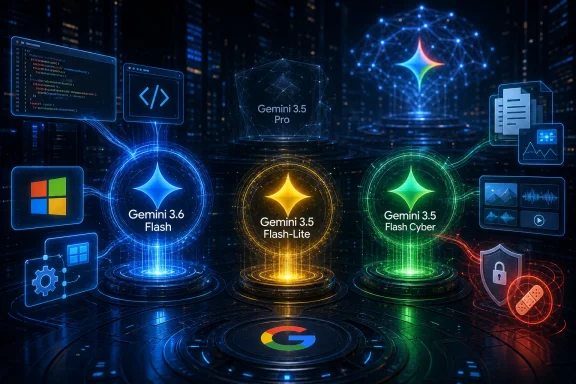 Overview: Three Gemini Models, One Clear Strategic Theme
Google’s new Gemini AI models have a shared theme: efficiency at scale. Rather than presenting each launch as a giant leap toward abstract artificial general intelligence, the company is emphasizing practical metrics that matter when an AI system is handling production work:- Token consumption
- Latency
- Tool-call reliability
- Coding precision
- Multimodal document understanding
- Cost per task
- Agent orchestration performance
Google’s latest releases target that gap between impressive demos and deployable automation.
The new lineup at a glance
| Model | Primary role | General availability |
|---|---|---|
| Gemini 3.6 Flash | Coding, knowledge work, multimodal reasoning, complex AI agents | Generally available |
| Gemini 3.5 Flash-Lite | Fast, low-cost extraction, classification, document processing, subagents | Generally available |
| Gemini 3.5 Flash Cyber | Vulnerability discovery, validation, and patching through CodeMender | Limited-access pilot |
| Gemini 3.5 Pro | Expected flagship general-purpose model | Still testing with partners |
| Gemini 4 | Next-generation model family | Training in progress |
Gemini 3.6 Flash Becomes Google’s New Workhorse Model
Gemini 3.6 Flash is the centerpiece of the announcement. It replaces Gemini 3.5 Flash as Google’s primary balance-of-speed-and-capability model for production AI workloads.The “Flash” branding can sound like it refers only to speed, but Google is making a larger claim here. Gemini 3.6 Flash is meant to handle reasoning-heavy coding tasks, document analysis, chart interpretation, visual understanding, and tool-driven workflows without demanding the operating budget normally associated with a premium frontier model.
Lower output costs and reduced token use
Gemini 3.6 Flash is priced at:- $1.50 per million input tokens
- $7.50 per million output tokens
Google also reports that Gemini 3.6 Flash uses 17% fewer output tokens than Gemini 3.5 Flash in an external AI evaluation index. The company further says the model needs fewer reasoning steps, conversational turns, and tool calls in multi-step workflows.
That could be more valuable than a raw benchmark increase.
A Windows automation workflow that needs six agent turns, two browser actions, a PowerShell script, and a verification pass can become unpredictable if the model falls into repeated loops. A model that completes the same workflow with fewer turns is not merely cheaper—it can be easier to govern, monitor, and trust.
Coding gains are the most practical upgrade
Google highlights several claimed improvements for Gemini 3.6 Flash:- DeepSWE: 49% versus 37% for Gemini 3.5 Flash
- MLE Bench: 63.9% versus 49.7%
- OSWorld-Verified: 83.0% versus 78.4%
- GDPval-AA v2: 1,421 versus 1,349
For Windows developers, that has immediate relevance in scenarios such as:
- Updating a .NET application from an older framework version
- Refactoring PowerShell automation scripts
- Generating C# code for Windows desktop utilities
- Reviewing application logs and crash reports
- Creating scripts for Microsoft Intune, Active Directory, or Azure administration
- Building web dashboards that work alongside Windows-based enterprise tools
- Converting internal documentation into structured deployment guidance
That approach can improve accuracy for complicated engineering work. However, it may make Gemini 3.6 Flash feel more deliberate—or even slightly heavier—when used for simple front-end tasks where the desired answer is obvious.
Multimodal work is central, not secondary
Gemini 3.6 Flash supports a broad range of input types, including text, images, video, audio, and PDF documents. It also supports a substantial 1 million-token context window and a maximum output size of 64,000 tokens.For enterprise Windows environments, multimodal support is increasingly relevant. Many organizations do not store their operational knowledge in clean text databases. Their information lives in:
- PDF reports
- Excel exports
- Scanned forms
- Screenshots
- Product manuals
- PowerPoint decks
- Network diagrams
- Recorded meetings
- Service desk attachments
- Legacy application interfaces
For example, an IT operations agent could examine a PDF incident report, compare its findings with a chart exported from a monitoring platform, review a screenshot of a Windows Event Viewer error, and prepare a structured remediation summary. The quality of that workflow will still depend on the underlying prompts, tools, permissions, and validation process, but the model’s multimodal scope makes such designs more plausible.
Gemini 3.5 Flash-Lite Is Built for Volume
Where Gemini 3.6 Flash aims to be the primary “workhorse,” Gemini 3.5 Flash-Lite is optimized for tasks that must happen continuously and at scale.This is Google’s fastest and cheapest model in the Gemini 3.5 family. Its pricing starts at:
- $0.30 per million input tokens
- $2.50 per million output tokens
What Flash-Lite is actually for
Gemini 3.5 Flash-Lite is not meant to be a low-quality chatbot. It is designed to act as a rapid executor in broader AI systems.Its strongest use cases include:
- High-volume document parsing
- Data extraction from PDFs and forms
- Classification and routing
- Structured JSON generation
- Search-oriented agent tasks
- Customer-service triage
- Metadata tagging
- Summarizing repetitive content
- Processing receipts, invoices, and product listings
- Running low-cost subagents within larger multi-agent workflows
A business might use Gemini 3.6 Flash as a master agent that handles planning and final quality control, while Flash-Lite performs repetitive retrieval, extraction, conversion, and routing tasks in parallel. This division of labor can be substantially more economical than sending every step to a more capable model.
Higher thinking levels add flexibility
Gemini 3.5 Flash-Lite uses a minimal thinking level by default to maximize responsiveness and cost efficiency. But developers can increase the thinking level for more complex subagent work.That is a useful design choice. Not every task deserves the same amount of compute.
A Windows management workflow could use minimal thinking for parsing device inventory entries, medium thinking for identifying inconsistent registry settings, and a higher setting for analyzing a multi-system deployment failure. The ability to tune that tradeoff helps teams avoid paying premium inference costs for simple operations.
Google reports notable performance improvements over Gemini 3.1 Flash-Lite, including:
- Terminal-Bench 2.1: 54% versus 31%
- GDM-MRCR v2 long-context testing: 72.2% versus 60.1%
- GDPval-AA v2: 1,140 versus 642
- SWE-Bench Pro: 54.2% versus 49.6% for Gemini 3 Flash
- OSWorld-Verified: 74.0% versus 65.1% for Gemini 3 Flash
A documentation detail worth watching
Google’s broader Gemini documentation describes the new Flash models as supporting a full suite of built-in tools, including computer-use features. However, the dedicated Gemini 3.5 Flash-Lite model page currently identifies computer use as unsupported.That inconsistency deserves attention from developers planning UI automation. It may reflect differences between API surfaces, staged availability, or an incomplete documentation update. Until the feature matrix is clarified, teams should verify computer-use support in their precise development environment rather than assuming that a listed capability applies universally.
This is a small but revealing example of a larger challenge in the AI platform market: model releases are moving rapidly, while documentation, regional access, product integrations, and policy restrictions do not always update at exactly the same pace.
Gemini 3.5 Flash Cyber Brings Security Agents Into Focus
The most specialized release is Gemini 3.5 Flash Cyber, a cyber-focused model built on Gemini 3.5 Flash and tuned for software vulnerability work.Google is pairing it with CodeMender, an AI security agent system designed to find, validate, and patch code vulnerabilities. Rather than functioning as a standalone general-purpose model for every developer, Flash Cyber is intended to work within an orchestrated security workflow.
Detection is easy compared with safe remediation
AI security tools face a difficult problem. Finding suspicious code patterns is useful, but it is not enough. A security system must also establish whether an issue is exploitable, understand the affected code paths, recommend a remediation that does not introduce regressions, and verify that the patch actually works.That is why the CodeMender model is noteworthy. The system reportedly uses multiple Flash Cyber agents together to produce a combined report. The objective is not only to identify flaws but to move toward a complete remediation process.
For Windows-centric organizations, this model could eventually have implications across:
- Internal line-of-business applications
- .NET services
- PowerShell-based administration tooling
- Windows endpoint agents
- CI/CD build pipelines
- Configuration management repositories
- Infrastructure-as-code projects
- Open-source dependencies used in enterprise deployments
Restricted access is the correct initial posture
Google is not making Gemini 3.5 Flash Cyber widely available. Instead, it is being introduced through a limited-access pilot for governments and trusted partners.That is a prudent decision.
Cybersecurity models are inherently dual use. A system capable of helping defenders discover and repair weaknesses may also be useful to attackers seeking to identify or exploit flaws. Even a model that is intended for defensive use can create risks if its access controls, tool permissions, logging, or output handling are weak.
The restricted rollout does not eliminate those risks, but it recognizes them. It also means that claims of broad availability should be treated cautiously. For most organizations, Flash Cyber is not yet a model they can deploy directly into their development workflows.
The Missing Gemini 3.5 Pro Is the Real Story
The release of three new models is substantial, but the absence of Gemini 3.5 Pro remains the most revealing part of the announcement.Google has confirmed that Gemini 3.5 Pro is currently being tested with selected partners and will be made broadly available when it is ready. No public release date has been announced.
That is a careful message, but it is also an admission that the company’s flagship-tier offering is not where Google wants it to be yet.
A delay can be a strength—or a warning sign
Delaying a flagship model is not automatically a failure. AI models intended for broad deployment must satisfy demanding requirements that go beyond producing impressive benchmark charts. They need to demonstrate reliability in coding, reasoning, tool use, safety, latency, cost control, and enterprise integration.A rushed flagship release could create greater problems than a delayed one, particularly if it makes inconsistent changes to code, follows instructions unreliably, or introduces new safety weaknesses.
At the same time, delays matter in a market where competitors are iterating quickly. Developers choosing long-term AI platforms want confidence that the model roadmap is stable. If the highest-tier model is delayed while competitors launch new premium systems, some customers may hesitate to commit their most strategic workloads to one ecosystem.
Google’s decision to launch improved Flash models now may be an attempt to soften that concern. The message is effectively: the flagship is not ready, but the practical models are getting better today.
Gemini 4 training changes the narrative
Google has also said that it has begun its most ambitious pre-training effort yet for Gemini 4.That does not mean Gemini 4 has launched. Reports suggesting that Gemini 4 is already available are inaccurate. The company has announced that training is in progress, not that a finished Gemini 4 model has been released to developers or consumers.
Still, the confirmation has strategic weight. It suggests Google is developing Gemini 3.5 Pro and Gemini 4 in overlapping phases, rather than waiting for every part of the current generation to be completed before investing in the next.
For customers, that creates both excitement and uncertainty:
- Excitement, because the company is clearly pushing ahead with a more ambitious next-generation model.
- Uncertainty, because it raises questions about how long Gemini 3.5 Pro will remain the premium target once it finally reaches broad availability.
What the Gemini Releases Mean for Windows Users and Developers
The direct impact on everyday Windows users may initially feel limited. Gemini 3.6 Flash and Flash-Lite are primarily developer and enterprise models, even though they are also rolling out through the Gemini app and related Google experiences.However, Windows users are likely to encounter their effects indirectly through faster AI-enabled tools, improved web applications, smarter enterprise search, more capable support systems, and AI agents integrated into everyday workflows.
For Windows developers
Developers building on Windows should see Gemini 3.6 Flash as the default model to evaluate for complex work that blends code, documents, visual assets, and tool use.It is especially relevant for:
- Visual Studio and Android Studio extension concepts
- C# and TypeScript development
- Application modernization
- Internal business automation
- Azure-connected services
- Desktop-to-web migration projects
- AI-assisted QA and test generation
- Knowledge-base analysis
- Multimodal line-of-business applications
For IT professionals
IT teams should be cautious about treating agentic AI as a direct replacement for scripted administration. In Windows environments, an AI agent may eventually help interpret logs, prepare PowerShell actions, identify configuration drift, and summarize incidents. But it should not receive broad administrative privileges without controls.A responsible deployment model should include:
- Least-privilege access for all AI-connected tools.
- Human approval gates for high-impact actions.
- Auditable logs of prompts, tool calls, outputs, and changes.
- Sandboxed testing before changes reach production endpoints.
- Clear rollback procedures for generated scripts or configuration updates.
- Data governance rules for documents, credentials, source code, and customer information.
- Independent validation of critical security or compliance conclusions.
Strengths, Risks, and the Bottom Line
Google’s Gemini 3.6 Flash and Gemini 3.5 Flash-Lite releases are meaningful because they address the economics and reliability of real AI deployment. Faster inference, lower token costs, stronger coding, better document understanding, and more capable agent workflows are not glamorous on their own, but they are the ingredients needed to make AI useful beyond isolated demos.The most notable strengths are clear:
- Gemini 3.6 Flash appears to offer a stronger quality-cost balance for coding and multimodal agent tasks.
- Gemini 3.5 Flash-Lite provides a credible high-volume alternative for extraction, routing, and subagent workloads.
- Flash Cyber and CodeMender show that Google is taking specialized AI security workflows seriously.
- Broad support for long context, structured outputs, code execution, function calling, and multimodal inputs can simplify the design of more capable applications.
- Gemini 3.5 Pro remains delayed, leaving a gap in Google’s flagship story.
- Benchmark gains do not ensure dependable performance on a company’s unique data, tools, or codebase.
- Documentation differences around feature support can complicate planning.
- Security agents introduce powerful dual-use capabilities that demand strict governance.
- Rapid model cycles can create compatibility, cost, and product-roadmap uncertainty.
Google has not solved every question around its Gemini roadmap. But with these releases, it has made a strong case that efficient, agent-ready AI models are becoming just as strategically important as the headline-grabbing flagships.
References
- Primary source: Northeast Times
Published: 2026-07-22T21:00:00+00:00
Google ships three new Gemini AI models, but its flagship is missing - Northeast Times
Google released three new Gemini AI models focused on speed and cost, but the delayed flagship Gemini 3.5 Pro is still nowhere in sight.northeasttimes.com - Independent coverage: cxotoday.com
Published: 2026-07-22T05:30:37+00:00
Google Releases Three New Gemini Models, Said to be Working on New AI Chip
Google DeepMind released three new Gemini models – 3.6 Flash, 3.5 Flash-Lite and 3.5 Flash Cyber – that promises improved capabilities in coding, knowledge work, multimodal performance while also reducing token usage by up to 17%. In parallel, there were also reports of Google working on a new...cxotoday.com - Independent coverage: dev.ua
Published: Wed, 22 Jul 2026 07:35:00 GMT
To create large-scale AI agents: Google introduced three new Gemini models | dev.ua
On Tuesday, Google DeepMind released Gemini 3.6 Flash, 3.5 Flash-Lite, and 3.5 Flash Cyber. Gemini 3.6 Flash is Google’s main workhorse, promising improved capabilities in coding, intelligence, and multimodal productivity, while reducing token usage by up to 17%, making it cheaper than itsdev.ua - Independent coverage: 36 Kr
Published: Wed, 22 Jul 2026 07:33:10 GMT
Move Over All New AI Models: Google Gemini 4 Is Here — The Company’s Largest-Ever Large Language Model Training Project Officially Launches
Gemini 3.5 Pro, the next-generation high-performance large language model developed by Google, remains in the active pre-release testing phase as of the latest public updates. This cutting-edge AI model, positioned as an upgraded iteration of Google’s Gemini series, is currently undergoing...eu.36kr.com - Independent coverage: Axios
Published: 2026-07-21T16:37:02.108710+00:00
Google releases series of new cheaper Gemini models
The AI deployment race has shifted from benchmark bragging rights to who can provide the best model at the lowest price.www.axios.com
- Independent coverage: News9live
Published: 2026-07-22T06:55:42+00:00
Gemini 3.6 Flash launched with lower costs, better coding and rank 12 debut | Artificial Intelligence News - News9live
Google DeepMind has launched three new Gemini AI models focused on coding, AI agents, speed and cybersecurity. Gemini 3.6 Flash entered Arena AI at rank 12, but the much-awaited Gemini 3.5 Pro model remains under testing.www.news9live.com
