Google has expanded its fast-moving Gemini portfolio with Gemini 3.6 Flash, Gemini 3.5 Flash-Lite, and the security-focused Gemini 3.5 Flash Cyber, putting a sharper emphasis on the practical economics of AI agents rather than simply chasing a larger headline model. The launch, announced on July 21, 2026, gives developers a new production-ready coding and multimodal model, an aggressively priced high-throughput option, and a restricted cybersecurity system designed to help identify and repair software vulnerabilities.
For Windows developers, enterprise IT teams, and anyone building AI-assisted tools into desktop workflows, the release is notable for a simple reason: Google is targeting the operational friction that makes agentic AI difficult to deploy at scale. Lower token use, reduced tool-call churn, improved computer-use support, and stronger document handling all matter more in a real Windows environment than an isolated benchmark score.
The important caveat is that Google’s impressive performance and efficiency claims are largely based on model-provider testing and selected external evaluations. They are useful indicators, but they should not substitute for validation against an organization’s own codebases, documents, security policies, and Windows automation workflows.
Google’s new Gemini lineup separates its AI strategy into clear deployment tiers.
That availability is significant. Google is not positioning these models as experimental research previews. Gemini 3.6 Flash and Gemini 3.5 Flash-Lite are intended for production deployments, meaning organizations can begin evaluating them immediately for agent-driven development, document workflows, internal knowledge tools, support automation, and data analysis.
The timing also reveals where the AI market is headed. The most consequential competition is no longer limited to “which model writes the cleverest answer.” Increasingly, the contest is over which platform can make agents complete useful tasks with fewer tokens, less latency, fewer failed tool calls, and more predictable costs.
Its core pitch is not merely higher intelligence. Google argues that the model can solve complex tasks with fewer output tokens, fewer reasoning steps, fewer conversational turns, and fewer tool calls. This matters because AI agent costs are rarely determined by one prompt and one response. They accumulate through planning, code generation, debugging, file inspection, browser activity, API calls, retries, and verbose intermediate explanations.
Google also says Gemini 3.6 Flash uses 17% fewer output tokens than its predecessor on an external efficiency index. On certain coding tasks, it reports reductions of up to 65%. Those figures should be interpreted carefully: a token reduction on a particular benchmark does not guarantee the same result for every application. Still, the direction is encouraging.
For organizations paying for AI-assisted coding at scale, the potential value is straightforward. A model that produces a correct patch in one attempt rather than generating several unnecessary revisions can reduce both billable usage and developer review time.
For Windows-centric development shops, this could be meaningful in several common scenarios:
That massive context capacity is particularly useful for enterprise work that does not fit neatly into a single code file or chat window. A Windows administrator or developer may need an AI system to correlate:
For Windows users, the concept is easy to understand. Instead of merely describing how to complete a task, an AI agent can potentially navigate interfaces, inspect screens, click controls, enter data, and carry out a workflow. That could eventually make AI valuable for browser-based administration portals, testing internal web applications, repetitive support operations, and workflow validation.
But computer-use automation introduces clear risks:
Google says Flash-Lite can produce 350 output tokens per second, a figure attributed to an external measurement service. Its published pricing is:
A well-designed AI platform should route work according to complexity. Flash-Lite can handle narrow and repeatable tasks, while Gemini 3.6 Flash takes on tasks that require deeper code inspection, broader context, multimodal analysis, or more sophisticated planning.
That architecture may become especially attractive to larger Windows organizations. Imagine a central agent reviewing an application modernization project while a fleet of low-cost subagents handles file inventories, extracts configuration values, parses exception logs, summarizes documentation, and produces structured reports. The cost advantage becomes meaningful when the same workflow runs across thousands of devices, documents, or repositories.
A common deployment mistake is treating a model setting as a quality guarantee. Raising a thinking level can improve planning on some tasks, but it can also increase latency, token usage, and the chance that an agent produces a confident yet incorrect chain of actions.
Organizations should define task classes instead of relying on vague prompt instructions:
Google is deploying the model inside CodeMender, a security platform in which multiple specialized AI agents collaborate to produce a combined vulnerability report. The company says the system can achieve competitive performance on the CyberGym benchmark while offering lower per-token costs than larger systems.
This is not a consumer-facing Gemini feature. Access is intended for governments and trusted partners through a limited pilot program.
Google’s limited release recognizes that tension. The company is attempting to give professional defenders a head start without broadly distributing a highly specialized cyber capability.
That approach has clear strengths:
It may:
This is a difficult balance. Developers and security professionals need models that can discuss defensive security, vulnerability classes, and incident response without reflexively refusing harmless work. At the same time, the model should not become a convenient assistant for harmful activity.
The key phrase is more resistant, not immune. Jailbreak resistance is not a permanent property. It is an ongoing adversarial contest, especially as users discover new ways to manipulate context, tools, documents, and multi-agent workflows.
For enterprise deployments, safety should be layered rather than delegated entirely to the foundation model:
The newer models no longer support some older sampling parameters, including:
This makes a structured migration plan essential.
That absence matters because Flash models are designed to balance quality, latency, and cost. They are not necessarily intended to be Google’s definitive answer for the most demanding reasoning, coding, and research workloads. Google has also said it has begun pre-training work on Gemini 4, signaling that the company is looking beyond the current generation even as it fills practical gaps in the Flash lineup.
For developers, the message is mixed but rational. Google is delivering models that can be deployed now, particularly for scalable AI agents, while reserving its next high-capability flagship release until it is ready.
That strategy may frustrate users waiting for a direct flagship competitor in the most demanding model category. But it also reflects a reality of enterprise AI: a model that is cheaper, faster, tool-capable, and stable enough to use in production can be more valuable than a more capable system that remains unavailable or difficult to operationalize.
Gemini 3.6 Flash is the stronger option for complex coding, large-context reasoning, multimodal tasks, and supervised agent workflows. Gemini 3.5 Flash-Lite is the value option for organizations that need to process large volumes of documents, logs, structured data, and routine requests with low latency. Gemini 3.5 Flash Cyber points toward a future where AI can assist security teams in vulnerability discovery and repair, although its limited availability and dual-use implications justify a cautious rollout.
The headline claims around lower token use and higher benchmark scores are promising, but the real test will occur inside production environments: Windows endpoints, legacy line-of-business software, .NET codebases, PowerShell automation, enterprise documents, and tightly controlled security operations. The organizations that benefit most will not be those that simply adopt the newest model first. They will be the ones that pair these faster, cheaper AI systems with strong evaluation, clear task routing, human oversight, and the governance required to turn agentic AI into reliable IT capability.
For Windows developers, enterprise IT teams, and anyone building AI-assisted tools into desktop workflows, the release is notable for a simple reason: Google is targeting the operational friction that makes agentic AI difficult to deploy at scale. Lower token use, reduced tool-call churn, improved computer-use support, and stronger document handling all matter more in a real Windows environment than an isolated benchmark score.
The important caveat is that Google’s impressive performance and efficiency claims are largely based on model-provider testing and selected external evaluations. They are useful indicators, but they should not substitute for validation against an organization’s own codebases, documents, security policies, and Windows automation workflows.
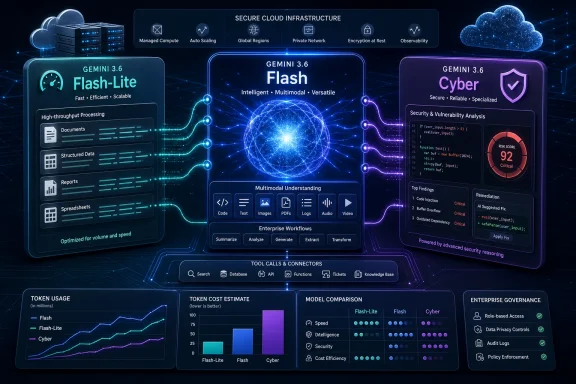 Overview: Three Gemini Models, Three Different Jobs
Google’s new Gemini lineup separates its AI strategy into clear deployment tiers.- Gemini 3.6 Flash is the main “workhorse” model for coding, knowledge work, multimodal reasoning, and multi-step AI agents.
- Gemini 3.5 Flash-Lite is optimized for speed, cost, high-volume parsing, structured extraction, and subordinate agent tasks.
- Gemini 3.5 Flash Cyber is a specialized cybersecurity model paired with Google’s CodeMender platform and initially limited to governments and selected trusted partners.
That availability is significant. Google is not positioning these models as experimental research previews. Gemini 3.6 Flash and Gemini 3.5 Flash-Lite are intended for production deployments, meaning organizations can begin evaluating them immediately for agent-driven development, document workflows, internal knowledge tools, support automation, and data analysis.
The timing also reveals where the AI market is headed. The most consequential competition is no longer limited to “which model writes the cleverest answer.” Increasingly, the contest is over which platform can make agents complete useful tasks with fewer tokens, less latency, fewer failed tool calls, and more predictable costs.
Gemini 3.6 Flash: A More Practical Model for Agentic Work
Gemini 3.6 Flash replaces Gemini 3.5 Flash as Google’s preferred general-purpose model for organizations that need capable AI without moving to a more expensive flagship tier.Its core pitch is not merely higher intelligence. Google argues that the model can solve complex tasks with fewer output tokens, fewer reasoning steps, fewer conversational turns, and fewer tool calls. This matters because AI agent costs are rarely determined by one prompt and one response. They accumulate through planning, code generation, debugging, file inspection, browser activity, API calls, retries, and verbose intermediate explanations.
Lower output-token pricing changes the cost equation
Gemini 3.6 Flash is priced at:- $1.50 per million input tokens
- $7.50 per million output tokens
Google also says Gemini 3.6 Flash uses 17% fewer output tokens than its predecessor on an external efficiency index. On certain coding tasks, it reports reductions of up to 65%. Those figures should be interpreted carefully: a token reduction on a particular benchmark does not guarantee the same result for every application. Still, the direction is encouraging.
For organizations paying for AI-assisted coding at scale, the potential value is straightforward. A model that produces a correct patch in one attempt rather than generating several unnecessary revisions can reduce both billable usage and developer review time.
Better coding performance is more than a benchmark story
Google reports substantial gains in programming and engineering-focused evaluations. Gemini 3.6 Flash reportedly reached:- 49% on DeepSWE, compared with 37% for Gemini 3.5 Flash
- 63.9% on MLE Bench, compared with 49.7%
- 83% on OSWorld-Verified, compared with 78.4%
- 1421 on GDPval-AA v2, compared with 1349
For Windows-centric development shops, this could be meaningful in several common scenarios:
- Updating a legacy
.NETapplication while preserving existing architecture. - Diagnosing build failures in a large Visual Studio solution.
- Generating PowerShell automation with predictable output formatting.
- Parsing error logs from Windows Event Viewer exports.
- Analyzing Excel-derived data, PDFs, screenshots, and internal documentation together.
- Drafting migration plans for Windows Server, Microsoft 365, Azure, or endpoint-management projects.
Multimodal Context and Computer Use Are Major Parts of the Story
Gemini 3.6 Flash supports text, images, video, audio, and PDF inputs, with text output. It also supports a one-million-token context window and output sizes up to 65,536 tokens.That massive context capacity is particularly useful for enterprise work that does not fit neatly into a single code file or chat window. A Windows administrator or developer may need an AI system to correlate:
- A lengthy incident report.
- A collection of event logs.
- Configuration files.
- A network diagram screenshot.
- A PowerShell module.
- A security policy document.
- A spreadsheet containing device inventory data.
Computer use is useful, but preview status deserves caution
One of the most important platform features is Computer Use, which is supported as a native tool for agentic UI automation. Google describes it as a client-side capability available through its API and enterprise offerings.For Windows users, the concept is easy to understand. Instead of merely describing how to complete a task, an AI agent can potentially navigate interfaces, inspect screens, click controls, enter data, and carry out a workflow. That could eventually make AI valuable for browser-based administration portals, testing internal web applications, repetitive support operations, and workflow validation.
But computer-use automation introduces clear risks:
- A model can misunderstand a page state or UI label.
- A click or form submission may be irreversible.
- An agent with broad access can expose data or make unauthorized changes.
- Web interfaces often change without warning, breaking automated routines.
- A successful benchmark task may not reflect the complexity of an enterprise environment.
Gemini 3.5 Flash-Lite: The Case for Fast, Cheap AI at Scale
While Gemini 3.6 Flash is designed to handle difficult, multi-step work, Gemini 3.5 Flash-Lite targets volume. It is Google’s fastest and lowest-cost model in the 3.5 generation, built for workloads where a small improvement in latency or unit cost can have an outsized impact.Google says Flash-Lite can produce 350 output tokens per second, a figure attributed to an external measurement service. Its published pricing is:
- $0.30 per million input tokens
- $2.50 per million output tokens
The best use cases are repetitive but important
Flash-Lite is a practical candidate for applications such as:- Large-scale document classification.
- Invoice, receipt, and form processing.
- OCR cleanup and structured data extraction.
- JSON transformation and schema-driven outputs.
- Search-query analysis.
- Customer support routing.
- Ticket summarization.
- Log triage.
- High-volume internal knowledge retrieval.
- Subagent tasks within a larger multi-agent workflow.
A well-designed AI platform should route work according to complexity. Flash-Lite can handle narrow and repeatable tasks, while Gemini 3.6 Flash takes on tasks that require deeper code inspection, broader context, multimodal analysis, or more sophisticated planning.
Flash-Lite’s gains go beyond raw speed
Google reports strong improvements over earlier Flash-Lite generations, including:- 54% on Terminal-Bench 2.1, up from 31%
- 72.2% on GDM-MRCR v2, up from 60.1%
- 1140 on GDPval-AA v2, up from 642
- 54.2% on SWE-Bench Pro
- 74% on OSWorld-Verified
That architecture may become especially attractive to larger Windows organizations. Imagine a central agent reviewing an application modernization project while a fleet of low-cost subagents handles file inventories, extracts configuration values, parses exception logs, summarizes documentation, and produces structured reports. The cost advantage becomes meaningful when the same workflow runs across thousands of devices, documents, or repositories.
Thinking levels create flexibility—and a governance challenge
Flash-Lite can be configured to prioritize minimal latency and cost, or to use higher thinking levels for more complex agent activity. This flexibility is useful, but it also means teams need clear standards.A common deployment mistake is treating a model setting as a quality guarantee. Raising a thinking level can improve planning on some tasks, but it can also increase latency, token usage, and the chance that an agent produces a confident yet incorrect chain of actions.
Organizations should define task classes instead of relying on vague prompt instructions:
- Minimal thinking for classification, routing, extraction, and normalized formatting.
- Medium thinking for document synthesis, tool selection, and constrained troubleshooting.
- Higher thinking for supervised code analysis, multi-step automation, and research workflows.
- Human approval for production changes, access-control modifications, security remediation, and external communication.
Gemini 3.5 Flash Cyber and CodeMender: Security AI With Guardrails
The third model, Gemini 3.5 Flash Cyber, is the most strategically interesting release and the least accessible one. Built on Gemini 3.5 Flash and fine-tuned for cybersecurity tasks, it is designed to find, validate, and help repair software vulnerabilities.Google is deploying the model inside CodeMender, a security platform in which multiple specialized AI agents collaborate to produce a combined vulnerability report. The company says the system can achieve competitive performance on the CyberGym benchmark while offering lower per-token costs than larger systems.
This is not a consumer-facing Gemini feature. Access is intended for governments and trusted partners through a limited pilot program.
Why restricted access is the responsible decision
Cybersecurity models are inherently dual-use. A system capable of discovering software flaws, reasoning about exploitability, and proposing patches can help defenders move faster. It may also lower barriers for offensive research if deployed without sufficient controls.Google’s limited release recognizes that tension. The company is attempting to give professional defenders a head start without broadly distributing a highly specialized cyber capability.
That approach has clear strengths:
- It reduces immediate misuse exposure.
- It allows controlled feedback from security professionals.
- It provides time to assess how the model behaves in real environments.
- It supports auditing of potentially dangerous workflows.
- It acknowledges that vulnerability remediation requires more than a chatbot answer.
AI-generated patches need human security review
The idea of automatically fixing vulnerabilities is compelling, especially as software teams face enormous patch backlogs. Yet a patch that makes a scanner happy is not necessarily a secure fix.It may:
- Break compatibility with a legacy Windows environment.
- Disable a legitimate feature rather than solve the underlying weakness.
- Create a new authorization flaw.
- Introduce performance regressions.
- Miss a related issue elsewhere in the codebase.
- Depend on assumptions that do not hold in production.
Safety Improvements Are Welcome, but Not a Complete Answer
Gemini 3.6 Flash includes enhanced safety protections related to chemical, biological, radiological, nuclear, and cyber-offense misuse. Google says the model is more resistant to jailbreak attempts while aiming to reduce unnecessary refusals for legitimate uses.This is a difficult balance. Developers and security professionals need models that can discuss defensive security, vulnerability classes, and incident response without reflexively refusing harmless work. At the same time, the model should not become a convenient assistant for harmful activity.
The key phrase is more resistant, not immune. Jailbreak resistance is not a permanent property. It is an ongoing adversarial contest, especially as users discover new ways to manipulate context, tools, documents, and multi-agent workflows.
For enterprise deployments, safety should be layered rather than delegated entirely to the foundation model:
- Limit which tools the model can call.
- Restrict access to sensitive files and systems.
- Log prompts, actions, and tool outputs.
- Scan generated code and scripts.
- Apply data-loss prevention policies.
- Separate test, staging, and production environments.
- Require approvals for high-impact actions.
- Continuously red-team workflows after deployment.
Migration Considerations for Existing Gemini Developers
Developers moving from older Gemini models should not assume that changing the model identifier is the only required step. Google’s documentation identifies several API changes that can affect existing applications.The newer models no longer support some older sampling parameters, including:
temperaturetop_ptop_k
This makes a structured migration plan essential.
A sensible Windows development migration path
- Inventory existing model calls. Identify every application, script, service, and prototype that references Gemini 3.5 Flash, Gemini 3 Flash previews, or earlier Flash-Lite versions.
- Update SDKs and API assumptions. Ensure development teams are using supported APIs and remove deprecated generation parameters before changing production traffic.
- Create a benchmark corpus from real work. Include Visual Studio projects, PowerShell scripts, Windows logs, common support tickets, business documents, and structured data files.
- Measure task completion, not just response quality. Track correct results, cost, latency, tool-call success rate, unwanted file edits, and the number of retries.
- Split work between Flash and Flash-Lite. Use Gemini 3.6 Flash for deeper reasoning and Gemini 3.5 Flash-Lite for high-throughput extraction, routing, and structured tasks.
- Pilot computer use in a sandbox. Start with read-only navigation or disposable test systems before permitting actions in a production environment.
- Set explicit human review gates. Require approval for code merges, system changes, security patches, user-account actions, and outbound communications.
The Missing Gemini 3.5 Pro Still Matters
The launch of three Gemini models does not answer every question surrounding Google’s roadmap. Gemini 3.5 Pro remains in partner testing and is not yet broadly available.That absence matters because Flash models are designed to balance quality, latency, and cost. They are not necessarily intended to be Google’s definitive answer for the most demanding reasoning, coding, and research workloads. Google has also said it has begun pre-training work on Gemini 4, signaling that the company is looking beyond the current generation even as it fills practical gaps in the Flash lineup.
For developers, the message is mixed but rational. Google is delivering models that can be deployed now, particularly for scalable AI agents, while reserving its next high-capability flagship release until it is ready.
That strategy may frustrate users waiting for a direct flagship competitor in the most demanding model category. But it also reflects a reality of enterprise AI: a model that is cheaper, faster, tool-capable, and stable enough to use in production can be more valuable than a more capable system that remains unavailable or difficult to operationalize.
The Bottom Line for Windows Users and IT Teams
Google’s Gemini 3.6 Flash and Gemini 3.5 Flash-Lite releases are less about spectacle than infrastructure. They are designed to make AI agents economically viable across coding, document processing, multimodal analysis, automation, and high-volume data work.Gemini 3.6 Flash is the stronger option for complex coding, large-context reasoning, multimodal tasks, and supervised agent workflows. Gemini 3.5 Flash-Lite is the value option for organizations that need to process large volumes of documents, logs, structured data, and routine requests with low latency. Gemini 3.5 Flash Cyber points toward a future where AI can assist security teams in vulnerability discovery and repair, although its limited availability and dual-use implications justify a cautious rollout.
The headline claims around lower token use and higher benchmark scores are promising, but the real test will occur inside production environments: Windows endpoints, legacy line-of-business software, .NET codebases, PowerShell automation, enterprise documents, and tightly controlled security operations. The organizations that benefit most will not be those that simply adopt the newest model first. They will be the ones that pair these faster, cheaper AI systems with strong evaluation, clear task routing, human oversight, and the governance required to turn agentic AI into reliable IT capability.
Update: Additional details (July 23, 2026)
MakeUseOf notes that Gemini 3.1 Pro remains Google’s publicly available high-end model while Gemini 3.5 Pro continues partner testing. Google has not provided a release timetable for the newer Pro model.Update: Additional details (July 23, 2026)
The new report specifies Gemini 3.6 Flash’s context limit as 1,048,576 input tokens, rather than the rounded one-million figure. It also lists support for structured outputs, code execution, file search, search grounding, URL context, context caching, and managed, batch, flex, and priority inference options.References
- Primary source: Technetbook
Published: 2026-07-22T23:15:00+00:00
Google Releases Gemini 3.6 Flash and 3.5 Flash Lite Models | Technetbook
Google Expands Gemini Family with Three Efficient AI Modelswww.technetbooks.com
- Independent coverage: Pulse 2.0
Published: 2026-07-22T18:51:52+00:00
Google Launches Gemini 3.6 Flash And 3.5 Flash-Lite For Scalable AI Agents
Google has introduced Gemini 3.6 Flash and Gemini 3.5 Flash-Lite, two models designed to improve the speed, cost and reliability of production AI agents. The company also unveiled Gemini 3.5 Flash Cyber, a specialized cybersecurity model that will operate through Google’s CodeMender security agent. pulse2.com
- Independent coverage: innovation-village.com
Published: 2026-07-22T15:18:02+00:00
Google Launches Three Gemini AI Models - Innovation Village | Technology, Product Reviews, Business
Google has launched Gemini 3.6 Flash, 3.5 Flash-Lite and Flash Cyber while delaying the release of its flagship Gemini 3.5 Pro model.innovation-village.com - Independent coverage: NewsBricks
Published: 2026-07-22T12:45:00+00:00
Google Unveils Gemini 3.6 Flash, 3.5 Flash Lite&Cyber Models - NewsBricks
Google has launched Gemini 3.6 Flash, Gemini 3.5 Flash Lite, and Gemini 3.5 Flash Cyber, introducing faster performance, improved coding, enhanced AI agent www.newsbricks.com
- Independent coverage: International Business Times, Singapore Edition
Published: 2026-07-22T12:35:00+00:00
Google Unleashes Gemini 3.6 Flash and Cyber AI Models as AI Ra...
Google DeepMind launches Gemini 3.6 Flash, 3.5 Flash-Lite and Cyber AI models, bringing faster, cheaper AI agents, improved coding and cybersecurity...www.ibtimes.sg - Independent coverage: ETV Bharat
Published: 2026-07-22T12:19:16+00:00
Google Launches Gemini 3.6 Flash, 3.5 Flash-Lite And 3.5 Flash Cyber AI Models
Google has released Gemini 3.6 Flash, 3.5 Flash-Lite and a specialised cyber model, offering faster, cheaper and more efficient tools for building AI agents.www.etvbharat.com
Last edited: