

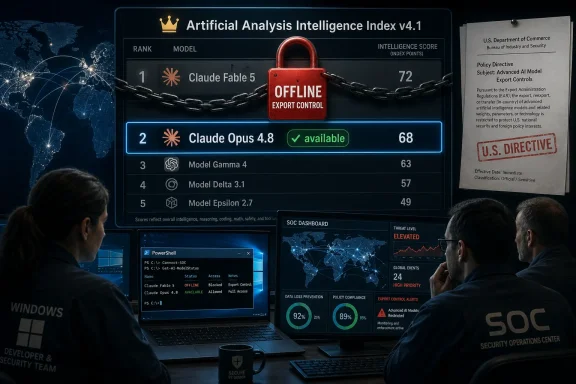
Anthropic’s Claude Fable 5 topped Artificial Analysis’ newly revised Intelligence Index v4.1 on June 16, 2026, with a score of 60, but the highest-ranked model is unavailable after a U.S. export-control directive forced Anthropic to pull it offline worldwide. That makes the leaderboard less a coronation than a warning label. The industry has spent years treating benchmark position as a proxy for platform stability; this week, the best score belongs to a model customers cannot actually deploy. For Windows developers, enterprise architects, and security teams building AI into daily workflows, the practical lesson is blunt: frontier capability now comes bundled with geopolitical and operational risk.
Artificial Analysis’ v4.1 Intelligence Index puts Anthropic in the strongest position on paper. Claude Fable 5, configured with an Opus 4.8 fallback, leads with a score of 60. Claude Opus 4.8 in max-effort mode follows at 56, ahead of OpenAI’s GPT-5.5 xhigh at 55.
That top line sounds like a clean Anthropic win until the availability column intervenes. Fable 5 is not simply invite-only, region-limited, or expensive. It has been withdrawn from global access after the U.S. government ordered Anthropic to suspend availability for foreign nationals on national security grounds, a condition broad enough that Anthropic reportedly took the model offline for everyone rather than attempt an instant citizenship-aware access-control regime.
That detail changes the meaning of the benchmark. A ranking that once answered “which model is smartest?” now forces a second question: “which model can you depend on Monday morning?” In v4.1, those answers are no longer the same.
Opus 4.8 therefore becomes the real-world leader by default, not by absolute score. It is the strongest model customers can call through an API today, but its advantage over GPT-5.5 is a single point. On a composite index made up of multiple hard benchmarks, that is less a moat than a photo finish.
The more interesting story is not that Anthropic has the lead. It is that Anthropic’s lead is split between a model too sensitive to remain online and a model whose practical edge over OpenAI may not justify its cost for many deployments.
Terminal-Bench Hard has been replaced by Terminal-Bench 2.1. The telecom-focused τ²-Bench has given way to τ³-Bench Banking. GDPval-AA has been upgraded to a second version that re-baselines its Elo scale around human performance, uses a rotating panel of frontier-model judges, and extends the turn limit from 100 to 250 so agents have more room to work through longer tasks.
Artificial Analysis also dropped IFBench because it had saturated. That is benchmark-speak for a test that stopped telling us much about the frontier. When most top models can clear a benchmark reliably, it becomes a museum piece rather than a measuring instrument.
This is the arms race beneath the arms race. Model makers are not just competing to raise scores; benchmark designers are competing to keep the tests hard enough that the scores mean anything. The moment a benchmark becomes predictable, vendors optimize toward it, public comparisons flatten, and buyers are left with numbers that look precise but no longer separate real capability from test familiarity.
The new index is trying to follow the market’s center of gravity. If AI is going to be sold as labor-saving infrastructure rather than clever autocomplete, then evaluations need to measure persistence, tool use, error recovery, and task completion under constraints. That is exactly where models become useful — and exactly where they become unpredictable.
But the headline score hides different kinds of trade-offs. Fable 5’s 60 does not help a developer whose API calls fail. Opus 4.8’s 56 may matter less than GPT-5.5’s 55 if OpenAI delivers similar practical results at lower cost. Gemini 3.5 Flash’s 50 may be more disruptive than either if it gives organizations enough intelligence with better latency and economics.
That distinction matters especially in Windows-heavy environments, where AI is increasingly being wired into developer pipelines, support desks, endpoint management, PowerShell automation, Teams workflows, Microsoft 365 integrations, and security operations. The best model in a benchmark is rarely the best model for every workflow. The best model for production is the one that clears the capability bar while meeting constraints around cost, latency, compliance, logging, identity, and uptime.
Benchmarks are useful when they narrow the field. They become dangerous when they replace procurement thinking. A one-point lead in a composite score can vanish when a workload is mostly code review, legal drafting, data transformation, incident response, or help-desk summarization.
The old habit was to ask which model is smartest. The new discipline is to ask which model fails least expensively in the environment where it will actually be used.
That may sound remote from the day-to-day work of a Windows admin, but it is not. Enterprises have spent years consolidating AI capability behind cloud APIs, vendor-managed assistants, and productivity-suite integrations. The upside is fast access to frontier models without building massive infrastructure. The downside is that the model is never really yours.
For regulated industries, this cuts both ways. Government intervention may reassure some security officers who worry that frontier models can be used for cyber offense, biological research, or other dual-use work. But it also creates a new class of dependency: the same mechanism that can block an adversary can also strand legitimate customers with no migration window.
Anthropic’s predicament appears especially awkward because the directive reportedly targeted foreign-national access, including foreign nationals inside the United States and even foreign-national employees. That is a breathtakingly broad access-control requirement for a globally staffed AI company serving global customers. If a vendor cannot reliably enforce that distinction at the model-access layer, universal suspension becomes the blunt compliance option.
This is where AI begins to resemble export-controlled cryptography, high-end semiconductors, and defense-adjacent software. The most capable systems are no longer merely products. They are strategic assets, and strategic assets invite state intervention.
On this front, Opus 4.8 is powerful but expensive. It reportedly costs $1.78 per Intelligence Index task, making it the most expensive currently available model in the set. Fable 5 would cost $3.25 per task if external users could access it. GPT-5.5 xhigh lands within one point of Opus 4.8 while costing about $0.99 per task.
That difference is not academic. A prototype that runs 500 tasks a week can tolerate indulgent pricing. A support platform, code assistant, SOC copilot, or document-processing pipeline running hundreds of thousands of tasks cannot. At enterprise scale, the model that is “almost as smart” can become the model that actually gets deployed.
This is where open weights and lower-cost models complicate the premium frontier narrative. DeepSeek V4 Pro and MiniMax-M3 reportedly lead the open-weights field at 44, narrowly ahead of Kimi K2.6 at 43 and MiMo-V2.5-Pro at 42. Those scores are not at the level of Opus 4.8 or GPT-5.5, but they may be more than sufficient for many internal workflows, especially where data locality, customization, or predictable pricing matters.
The index is beginning to show what IT buyers already know: the “best” model is often too expensive, too slow, too restricted, or too operationally fragile to be the default. The winning architecture is increasingly a portfolio, with frontier models reserved for hard cases and cheaper models handling the bulk of routine work.
The latency question is not just about user patience. In agentic systems, runtime affects orchestration, queue design, timeout handling, concurrency planning, and total cost. A model that reasons longer may solve harder problems, but it also occupies resources longer and can create cascading delays in a workflow.
This is especially visible in developer and IT operations use cases. An AI assistant that takes 12 minutes to plan a complex migration may be perfectly acceptable. An AI assistant that takes 12 minutes to answer a routine Intune policy question is not. A security analyst may tolerate a long-running investigation agent if it finds a real intrusion; a help-desk agent cannot spend a quarter of an hour deciding how to reset a profile.
Output tokens are part of the same story. Some models do more visible thinking, generate longer intermediate reasoning, or explore more paths before answering. That can improve accuracy on hard tasks, but it can also inflate cost and delay. The result is a trade-off every IT shop already understands from other systems: depth is valuable only when the task justifies it.
This is why adjustable effort modes are becoming central to AI product design. The future is not one model setting for everything. It is a routing layer that decides when to use fast inference, when to escalate to deeper reasoning, and when to stop the agent before it spends more than the answer is worth.
For WindowsForum’s audience, this is not a philosophical debate. Local and self-hosted models already have appeal for admins who do not want sensitive logs, scripts, crash dumps, source code, or user data leaving their environment. Even when performance trails the frontier, governance can outweigh raw intelligence.
That does not mean open weights are automatically safer or cheaper. Running them well requires hardware, operations discipline, monitoring, patching, evaluation, and expertise. A poorly managed local model can leak data, hallucinate instructions, or generate risky code just as confidently as a hosted one.
But the Fable 5 shutdown gives open weights a new argument. They are not merely about cost or ideology. They are about continuity. If your workflow depends on a cloud model that can be withdrawn overnight, a slightly weaker model you can actually keep running may become a strategic hedge.
The likely outcome is hybridization. Enterprises will use closed frontier models for high-value reasoning, hosted mid-tier models for managed scale, and open or local models for sensitive, repetitive, or sovereignty-constrained work. The v4.1 index does not end the debate between closed and open AI. It gives both sides better ammunition.
The AI market often rewards whoever owns the glamour model, but enterprise adoption rewards whoever makes capability boring, fast, and cheap. Google’s challenge has been turning strong research and capable models into a consistently persuasive developer and enterprise story. A Flash-tier model performing this well attacks that problem from the cost-and-latency side rather than the prestige side.
That matters because many AI workloads do not require the absolute best model. They require a model that is good enough to run everywhere. Summarizing tickets, drafting replies, extracting entities, classifying alerts, explaining scripts, transforming documents, and generating first-pass code are volume workloads. They punish expensive models and reward stable economics.
Microsoft understands this dynamic deeply, which is why Windows and Microsoft 365 AI features increasingly depend on model routing rather than a single monolithic intelligence layer. The user sees Copilot. The backend can choose among models, tools, retrieval systems, and policy filters.
If Google can put near-frontier capability behind a fast, inexpensive brand, it pressures both Anthropic and OpenAI from below. The next competitive frontier may not be the top score. It may be the cheapest model that feels smart enough for most work.
The more useful reading is directional. Anthropic is very strong at the top end, particularly in long-horizon and agentic evaluations. OpenAI remains close enough that it is not meaningfully displaced for most production decisions. Google is showing that speed-oriented models can still post serious capability scores. Open-weights contenders are strong enough to be part of real architectures, not just hobbyist experiments.
The uncomfortable truth for vendors is that the frontier is crowded. The uncomfortable truth for customers is that crowded does not mean interchangeable. Models with similar aggregate scores can behave very differently under pressure, especially when asked to use tools, handle ambiguity, refuse unsafe requests, or recover from earlier mistakes.
This is why internal evaluation is no longer optional. If your organization is deploying AI into Windows administration, software engineering, compliance review, or security operations, you need a task set that resembles your actual work. Public benchmarks can tell you where to start. They cannot tell you what to ship.
The best procurement teams will treat v4.1 as a scouting report, not a verdict. They will test the leading models against their own scripts, documents, tickets, repositories, and policies. Then they will measure not only accuracy, but escalation rate, latency, cost, auditability, and failure modes.
That is not as exciting as topping a leaderboard, but it is more defensible for enterprise customers. If a model is withdrawn, degraded, restricted, or repriced, a mature platform can route around the disruption. If an application has hard-coded its entire value proposition to a single external model, it has no such cushion.
For Windows admins, the lesson maps cleanly onto familiar infrastructure thinking. You do not build resilient systems by assuming a single upstream dependency will always behave. You build with fallback paths, observability, policy controls, and a plan for degraded operation.
AI agents make this more urgent because they are being inserted into workflows that touch real systems. A coding assistant can introduce vulnerabilities. A device-management assistant can recommend destructive policy changes. A security copilot can miss an intrusion or flood analysts with false positives. The model is only one component in a larger control plane.
That is why the next phase of enterprise AI will look less like chatbot shopping and more like systems engineering. The winners will be the organizations that treat models as replaceable engines inside governed workflows, not as magical employees floating above normal IT controls.
Governments are not irrational to care. Cyber capability is not a hypothetical AI risk; it is an immediate operational domain. If a model meaningfully improves vulnerability discovery, exploit development, malware adaptation, or social engineering, then access control becomes a national security question whether vendors like it or not.
But blunt restrictions also have costs. They can fragment markets, slow legitimate research, punish customers without warning, and push demand toward less transparent alternatives. If only one company’s model is restricted while comparable models remain available elsewhere, the policy may create competitive distortion without solving the underlying risk.
Anthropic has often leaned into safety as a differentiator, sometimes more aggressively than its rivals. That posture may now have become a trap. By emphasizing the exceptional capability and potential risks of its highest-end models, the company may have made it easier for regulators to treat those models as exceptional objects.
The industry should not pretend there is a clean answer. Unrestricted frontier access is risky. Sudden global shutdowns are also risky. The hard work is building a governance regime that can distinguish between dangerous capability, legitimate use, and manageable risk without turning every model launch into a geopolitical incident.
This is not a call to chase every new release. Model churn can become its own tax. But teams should design for replacement from the beginning: prompt templates that can be adapted, evaluation harnesses that compare outputs, logging that captures regressions, and routing logic that can shift workloads when price or availability changes.
The same applies to admins adopting AI tools for scripting and troubleshooting. A Copilot-style assistant can be useful, but it should not become an unexamined authority. Generated PowerShell still needs review. Suggested registry edits still need testing. Endpoint policy recommendations still need staging rings.
The agentic turn makes this discipline more important. When a model is not just answering but acting through tools, its mistakes become operational events. A hallucinated command is annoying in a chat window. A hallucinated command executed against production infrastructure is an incident.
The right mental model is not “which AI should I trust?” It is “how do I constrain an AI system so that its usefulness survives its mistakes?” That answer starts with least privilege, sandboxing, approvals, audit trails, and reversible operations — the same boring controls that have always separated professional IT from wishful thinking.
Enterprise buyers now need to ask vendors more pointed questions. What happens if a model is withdrawn? Are equivalent models available in-region? Can workloads fail over automatically? How are foreign-national restrictions enforced? What logs are retained? Can the customer pin versions? How are cached tokens priced and reported? Which benchmarks map to the customer’s actual use cases?
Caching deserves special attention because Artificial Analysis is now reporting cached input tokens separately. That is a technical accounting change with real budget consequences. Many enterprise workloads repeatedly pass similar context: policy documents, codebase summaries, system prompts, schemas, knowledge-base extracts, and conversation histories. If cached tokens are discounted, effective cost can look very different from headline pricing.
This is one reason per-task economics are more useful than per-million-token marketing. Tokens are an implementation detail to most buyers. Completed work is the unit that matters. If one model uses fewer tokens but fails more often, it may be more expensive in practice. If another model costs more per token but solves the task without human repair, it may be cheaper.
Procurement should also separate experimentation from dependency. It is perfectly rational to test the smartest available model. It is reckless to let a core workflow depend on a model with no fallback, no contractual availability guarantees, and no tested substitute.
The v4.1 index captures a market crossing a threshold: the smartest models are becoming useful enough to matter, expensive enough to meter carefully, slow enough to schedule intelligently, and powerful enough to attract government intervention. Anthropic may have the technical lead today, but the more durable advantage will belong to platforms and customers that assume the frontier will keep shifting under their feet. In the next round, the winning AI strategy will not be allegiance to the model at the top of the chart; it will be the ability to keep working when that model disappears.
 The New Leaderboard Crowns a Missing King
Artificial Analysis’ v4.1 Intelligence Index puts Anthropic in the strongest position on paper. Claude Fable 5, configured with an Opus 4.8 fallback, leads with a score of 60. Claude Opus 4.8 in max-effort mode follows at 56, ahead of OpenAI’s GPT-5.5 xhigh at 55.That top line sounds like a clean Anthropic win until the availability column intervenes. Fable 5 is not simply invite-only, region-limited, or expensive. It has been withdrawn from global access after the U.S. government ordered Anthropic to suspend availability for foreign nationals on national security grounds, a condition broad enough that Anthropic reportedly took the model offline for everyone rather than attempt an instant citizenship-aware access-control regime.
That detail changes the meaning of the benchmark. A ranking that once answered “which model is smartest?” now forces a second question: “which model can you depend on Monday morning?” In v4.1, those answers are no longer the same.
Opus 4.8 therefore becomes the real-world leader by default, not by absolute score. It is the strongest model customers can call through an API today, but its advantage over GPT-5.5 is a single point. On a composite index made up of multiple hard benchmarks, that is less a moat than a photo finish.
The more interesting story is not that Anthropic has the lead. It is that Anthropic’s lead is split between a model too sensitive to remain online and a model whose practical edge over OpenAI may not justify its cost for many deployments.
Artificial Analysis Moves the Goalposts Toward Agents
Version 4.1 is not a cosmetic leaderboard refresh. Artificial Analysis rebuilt the index around agentic work, the kind of long-running, tool-using, multi-step activity that vendors increasingly claim their models can perform. The change matters because enterprise AI is moving away from chatbot demos and toward delegated work: triaging tickets, generating patches, navigating terminals, testing applications, and reasoning through business processes.Terminal-Bench Hard has been replaced by Terminal-Bench 2.1. The telecom-focused τ²-Bench has given way to τ³-Bench Banking. GDPval-AA has been upgraded to a second version that re-baselines its Elo scale around human performance, uses a rotating panel of frontier-model judges, and extends the turn limit from 100 to 250 so agents have more room to work through longer tasks.
Artificial Analysis also dropped IFBench because it had saturated. That is benchmark-speak for a test that stopped telling us much about the frontier. When most top models can clear a benchmark reliably, it becomes a museum piece rather than a measuring instrument.
This is the arms race beneath the arms race. Model makers are not just competing to raise scores; benchmark designers are competing to keep the tests hard enough that the scores mean anything. The moment a benchmark becomes predictable, vendors optimize toward it, public comparisons flatten, and buyers are left with numbers that look precise but no longer separate real capability from test familiarity.
The new index is trying to follow the market’s center of gravity. If AI is going to be sold as labor-saving infrastructure rather than clever autocomplete, then evaluations need to measure persistence, tool use, error recovery, and task completion under constraints. That is exactly where models become useful — and exactly where they become unpredictable.
The Score Is Not the Product
The v4.1 results make Anthropic look technically formidable. Fable 5 is four points ahead of Opus 4.8, and Opus 4.8 is narrowly ahead of GPT-5.5. Claude Sonnet 4.6 also remains high in the table, scoring 47, while Google’s Gemini 3.5 Flash surprises at 50 despite the “Flash” brand usually implying a lighter, cheaper model.But the headline score hides different kinds of trade-offs. Fable 5’s 60 does not help a developer whose API calls fail. Opus 4.8’s 56 may matter less than GPT-5.5’s 55 if OpenAI delivers similar practical results at lower cost. Gemini 3.5 Flash’s 50 may be more disruptive than either if it gives organizations enough intelligence with better latency and economics.
That distinction matters especially in Windows-heavy environments, where AI is increasingly being wired into developer pipelines, support desks, endpoint management, PowerShell automation, Teams workflows, Microsoft 365 integrations, and security operations. The best model in a benchmark is rarely the best model for every workflow. The best model for production is the one that clears the capability bar while meeting constraints around cost, latency, compliance, logging, identity, and uptime.
Benchmarks are useful when they narrow the field. They become dangerous when they replace procurement thinking. A one-point lead in a composite score can vanish when a workload is mostly code review, legal drafting, data transformation, incident response, or help-desk summarization.
The old habit was to ask which model is smartest. The new discipline is to ask which model fails least expensively in the environment where it will actually be used.
Fable 5 Turns AI Capability Into a Sovereignty Problem
The Fable 5 shutdown is the most consequential part of the story because it exposes a weakness in the cloud AI model: access is policy, not possession. Customers did not lose Fable 5 because their integrations broke, their billing failed, or their region went down. They lost it because a government directive changed who was allowed to use the model.That may sound remote from the day-to-day work of a Windows admin, but it is not. Enterprises have spent years consolidating AI capability behind cloud APIs, vendor-managed assistants, and productivity-suite integrations. The upside is fast access to frontier models without building massive infrastructure. The downside is that the model is never really yours.
For regulated industries, this cuts both ways. Government intervention may reassure some security officers who worry that frontier models can be used for cyber offense, biological research, or other dual-use work. But it also creates a new class of dependency: the same mechanism that can block an adversary can also strand legitimate customers with no migration window.
Anthropic’s predicament appears especially awkward because the directive reportedly targeted foreign-national access, including foreign nationals inside the United States and even foreign-national employees. That is a breathtakingly broad access-control requirement for a globally staffed AI company serving global customers. If a vendor cannot reliably enforce that distinction at the model-access layer, universal suspension becomes the blunt compliance option.
This is where AI begins to resemble export-controlled cryptography, high-end semiconductors, and defense-adjacent software. The most capable systems are no longer merely products. They are strategic assets, and strategic assets invite state intervention.
The Real Buyer’s Guide Is Cost Per Completed Task
Artificial Analysis’ decision to add per-task cost, time, and output-token metrics is more important than it first appears. Model rankings have long overemphasized capability and underemphasized the cost of getting that capability at scale. For anyone paying the invoice, intelligence per task is not the same as intelligence per dollar.On this front, Opus 4.8 is powerful but expensive. It reportedly costs $1.78 per Intelligence Index task, making it the most expensive currently available model in the set. Fable 5 would cost $3.25 per task if external users could access it. GPT-5.5 xhigh lands within one point of Opus 4.8 while costing about $0.99 per task.
That difference is not academic. A prototype that runs 500 tasks a week can tolerate indulgent pricing. A support platform, code assistant, SOC copilot, or document-processing pipeline running hundreds of thousands of tasks cannot. At enterprise scale, the model that is “almost as smart” can become the model that actually gets deployed.
This is where open weights and lower-cost models complicate the premium frontier narrative. DeepSeek V4 Pro and MiniMax-M3 reportedly lead the open-weights field at 44, narrowly ahead of Kimi K2.6 at 43 and MiMo-V2.5-Pro at 42. Those scores are not at the level of Opus 4.8 or GPT-5.5, but they may be more than sufficient for many internal workflows, especially where data locality, customization, or predictable pricing matters.
The index is beginning to show what IT buyers already know: the “best” model is often too expensive, too slow, too restricted, or too operationally fragile to be the default. The winning architecture is increasingly a portfolio, with frontier models reserved for hard cases and cheaper models handling the bulk of routine work.
Slow Thinking Has a Billable Surface Area
Time per task adds another wrinkle. Grok 4.3 in high mode reportedly finishes an average task in about 1.5 minutes, while Claude Sonnet 4.6 max takes 13.5 minutes. Gemini 3.1 Pro Preview stands out by scoring 46 while taking about 1.6 minutes per task, close to Sonnet 4.6’s capability at a fraction of the runtime.The latency question is not just about user patience. In agentic systems, runtime affects orchestration, queue design, timeout handling, concurrency planning, and total cost. A model that reasons longer may solve harder problems, but it also occupies resources longer and can create cascading delays in a workflow.
This is especially visible in developer and IT operations use cases. An AI assistant that takes 12 minutes to plan a complex migration may be perfectly acceptable. An AI assistant that takes 12 minutes to answer a routine Intune policy question is not. A security analyst may tolerate a long-running investigation agent if it finds a real intrusion; a help-desk agent cannot spend a quarter of an hour deciding how to reset a profile.
Output tokens are part of the same story. Some models do more visible thinking, generate longer intermediate reasoning, or explore more paths before answering. That can improve accuracy on hard tasks, but it can also inflate cost and delay. The result is a trade-off every IT shop already understands from other systems: depth is valuable only when the task justifies it.
This is why adjustable effort modes are becoming central to AI product design. The future is not one model setting for everything. It is a routing layer that decides when to use fast inference, when to escalate to deeper reasoning, and when to stop the agent before it spends more than the answer is worth.
The Open-Weights Gap Is Narrow Enough to Matter
Open-weights models still trail the proprietary frontier in the v4.1 table, but the distance is no longer a simple story of “toy versus serious.” A score in the low-to-mid 40s on a harder, more agentic index can be valuable, particularly when the model can run in controlled environments or be fine-tuned around internal processes.For WindowsForum’s audience, this is not a philosophical debate. Local and self-hosted models already have appeal for admins who do not want sensitive logs, scripts, crash dumps, source code, or user data leaving their environment. Even when performance trails the frontier, governance can outweigh raw intelligence.
That does not mean open weights are automatically safer or cheaper. Running them well requires hardware, operations discipline, monitoring, patching, evaluation, and expertise. A poorly managed local model can leak data, hallucinate instructions, or generate risky code just as confidently as a hosted one.
But the Fable 5 shutdown gives open weights a new argument. They are not merely about cost or ideology. They are about continuity. If your workflow depends on a cloud model that can be withdrawn overnight, a slightly weaker model you can actually keep running may become a strategic hedge.
The likely outcome is hybridization. Enterprises will use closed frontier models for high-value reasoning, hosted mid-tier models for managed scale, and open or local models for sensitive, repetitive, or sovereignty-constrained work. The v4.1 index does not end the debate between closed and open AI. It gives both sides better ammunition.
Google’s “Flash” Surprise Is the Quiet Threat
Gemini 3.5 Flash scoring 50 is one of the more intriguing details in the new table. “Flash” has usually signaled speed, affordability, and mass-market deployment rather than frontier-class reasoning. If that branding now covers a model that sits near the top of an agentic intelligence index, Google may have a different kind of advantage.The AI market often rewards whoever owns the glamour model, but enterprise adoption rewards whoever makes capability boring, fast, and cheap. Google’s challenge has been turning strong research and capable models into a consistently persuasive developer and enterprise story. A Flash-tier model performing this well attacks that problem from the cost-and-latency side rather than the prestige side.
That matters because many AI workloads do not require the absolute best model. They require a model that is good enough to run everywhere. Summarizing tickets, drafting replies, extracting entities, classifying alerts, explaining scripts, transforming documents, and generating first-pass code are volume workloads. They punish expensive models and reward stable economics.
Microsoft understands this dynamic deeply, which is why Windows and Microsoft 365 AI features increasingly depend on model routing rather than a single monolithic intelligence layer. The user sees Copilot. The backend can choose among models, tools, retrieval systems, and policy filters.
If Google can put near-frontier capability behind a fast, inexpensive brand, it pressures both Anthropic and OpenAI from below. The next competitive frontier may not be the top score. It may be the cheapest model that feels smart enough for most work.
Benchmark Margins Are Smaller Than Marketing Departments Admit
A one-point difference between Opus 4.8 and GPT-5.5 is not the kind of gap that should drive wholesale platform decisions. Composite indexes compress many tasks into one score, and small differences can reflect benchmark composition, sampling variance, model configuration, or tool-use assumptions. Vendors understandably amplify those margins. Buyers should not.The more useful reading is directional. Anthropic is very strong at the top end, particularly in long-horizon and agentic evaluations. OpenAI remains close enough that it is not meaningfully displaced for most production decisions. Google is showing that speed-oriented models can still post serious capability scores. Open-weights contenders are strong enough to be part of real architectures, not just hobbyist experiments.
The uncomfortable truth for vendors is that the frontier is crowded. The uncomfortable truth for customers is that crowded does not mean interchangeable. Models with similar aggregate scores can behave very differently under pressure, especially when asked to use tools, handle ambiguity, refuse unsafe requests, or recover from earlier mistakes.
This is why internal evaluation is no longer optional. If your organization is deploying AI into Windows administration, software engineering, compliance review, or security operations, you need a task set that resembles your actual work. Public benchmarks can tell you where to start. They cannot tell you what to ship.
The best procurement teams will treat v4.1 as a scouting report, not a verdict. They will test the leading models against their own scripts, documents, tickets, repositories, and policies. Then they will measure not only accuracy, but escalation rate, latency, cost, auditability, and failure modes.
Microsoft’s AI Stack Looks Wiser When the Frontier Gets Political
The Fable 5 episode indirectly strengthens Microsoft’s strategic posture. Microsoft has bet heavily on AI in Windows, Azure, GitHub, Microsoft 365, and security products, but it has also avoided tying its entire future to one model brand. Even where OpenAI is central, Microsoft’s platform story is increasingly about orchestration, identity, governance, and integration.That is not as exciting as topping a leaderboard, but it is more defensible for enterprise customers. If a model is withdrawn, degraded, restricted, or repriced, a mature platform can route around the disruption. If an application has hard-coded its entire value proposition to a single external model, it has no such cushion.
For Windows admins, the lesson maps cleanly onto familiar infrastructure thinking. You do not build resilient systems by assuming a single upstream dependency will always behave. You build with fallback paths, observability, policy controls, and a plan for degraded operation.
AI agents make this more urgent because they are being inserted into workflows that touch real systems. A coding assistant can introduce vulnerabilities. A device-management assistant can recommend destructive policy changes. A security copilot can miss an intrusion or flood analysts with false positives. The model is only one component in a larger control plane.
That is why the next phase of enterprise AI will look less like chatbot shopping and more like systems engineering. The winners will be the organizations that treat models as replaceable engines inside governed workflows, not as magical employees floating above normal IT controls.
The Security Argument Cuts in Both Directions
The reported national security concerns around Fable 5 and Mythos 5 sit at the center of a larger argument about frontier AI. The more capable a model becomes at coding, tool use, research, and autonomous task execution, the more plausible it becomes as a dual-use system. The same agent that helps a defender audit infrastructure may help an attacker chain vulnerabilities.Governments are not irrational to care. Cyber capability is not a hypothetical AI risk; it is an immediate operational domain. If a model meaningfully improves vulnerability discovery, exploit development, malware adaptation, or social engineering, then access control becomes a national security question whether vendors like it or not.
But blunt restrictions also have costs. They can fragment markets, slow legitimate research, punish customers without warning, and push demand toward less transparent alternatives. If only one company’s model is restricted while comparable models remain available elsewhere, the policy may create competitive distortion without solving the underlying risk.
Anthropic has often leaned into safety as a differentiator, sometimes more aggressively than its rivals. That posture may now have become a trap. By emphasizing the exceptional capability and potential risks of its highest-end models, the company may have made it easier for regulators to treat those models as exceptional objects.
The industry should not pretend there is a clean answer. Unrestricted frontier access is risky. Sudden global shutdowns are also risky. The hard work is building a governance regime that can distinguish between dangerous capability, legitimate use, and manageable risk without turning every model launch into a geopolitical incident.
Developers Need Abstraction More Than Allegiance
For developers building AI features on Windows, Azure, or cross-platform stacks, the v4.1 leaderboard argues for abstraction. Do not bind your application logic too tightly to one vendor’s quirks, one model’s output format, or one provider’s availability assumptions. The model layer is moving too quickly and too politically for that.This is not a call to chase every new release. Model churn can become its own tax. But teams should design for replacement from the beginning: prompt templates that can be adapted, evaluation harnesses that compare outputs, logging that captures regressions, and routing logic that can shift workloads when price or availability changes.
The same applies to admins adopting AI tools for scripting and troubleshooting. A Copilot-style assistant can be useful, but it should not become an unexamined authority. Generated PowerShell still needs review. Suggested registry edits still need testing. Endpoint policy recommendations still need staging rings.
The agentic turn makes this discipline more important. When a model is not just answering but acting through tools, its mistakes become operational events. A hallucinated command is annoying in a chat window. A hallucinated command executed against production infrastructure is an incident.
The right mental model is not “which AI should I trust?” It is “how do I constrain an AI system so that its usefulness survives its mistakes?” That answer starts with least privilege, sandboxing, approvals, audit trails, and reversible operations — the same boring controls that have always separated professional IT from wishful thinking.
Enterprise Procurement Enters the Post-Leaderboard Era
The old AI procurement pattern was simple: choose a leading model, negotiate terms, integrate the API, and hope the vendor keeps improving. That was never ideal, but it was understandable in a market moving at absurd speed. The Fable 5 episode makes it harder to defend.Enterprise buyers now need to ask vendors more pointed questions. What happens if a model is withdrawn? Are equivalent models available in-region? Can workloads fail over automatically? How are foreign-national restrictions enforced? What logs are retained? Can the customer pin versions? How are cached tokens priced and reported? Which benchmarks map to the customer’s actual use cases?
Caching deserves special attention because Artificial Analysis is now reporting cached input tokens separately. That is a technical accounting change with real budget consequences. Many enterprise workloads repeatedly pass similar context: policy documents, codebase summaries, system prompts, schemas, knowledge-base extracts, and conversation histories. If cached tokens are discounted, effective cost can look very different from headline pricing.
This is one reason per-task economics are more useful than per-million-token marketing. Tokens are an implementation detail to most buyers. Completed work is the unit that matters. If one model uses fewer tokens but fails more often, it may be more expensive in practice. If another model costs more per token but solves the task without human repair, it may be cheaper.
Procurement should also separate experimentation from dependency. It is perfectly rational to test the smartest available model. It is reckless to let a core workflow depend on a model with no fallback, no contractual availability guarantees, and no tested substitute.
The Scoreboard Now Reads Like a Risk Register
The immediate lesson from Artificial Analysis v4.1 is not that Anthropic won, OpenAI slipped, Google surprised, or open weights are catching up. It is that capability, cost, latency, availability, and policy exposure now have to be read together.- Claude Fable 5 is the highest-scoring model in the revised index, but its unavailability makes it a benchmark leader rather than a deployable platform.
- Claude Opus 4.8 is the strongest generally available model in the index, but its one-point lead over GPT-5.5 is unlikely to settle many enterprise decisions by itself.
- GPT-5.5’s lower reported per-task cost makes it a serious default choice wherever near-frontier capability is enough.
- Gemini 3.5 Flash’s high score suggests that fast, lower-cost models may increasingly challenge the assumption that only flagship models can handle serious agentic work.
- Open-weights models remain behind the proprietary frontier, but their control, locality, and continuity advantages are becoming more valuable after the Fable 5 shutdown.
- Public benchmarks are now best understood as inputs to internal evaluation, not substitutes for testing against real Windows, developer, security, and business workflows.
The v4.1 index captures a market crossing a threshold: the smartest models are becoming useful enough to matter, expensive enough to meter carefully, slow enough to schedule intelligently, and powerful enough to attract government intervention. Anthropic may have the technical lead today, but the more durable advantage will belong to platforms and customers that assume the frontier will keep shifting under their feet. In the next round, the winning AI strategy will not be allegiance to the model at the top of the chart; it will be the ability to keep working when that model disappears.
References
- Primary source: OfficeChai
Published: 2026-06-16T10:50:10.241849
OfficeChai
Claude Fable 5 Tops New Artificial Analysis Intelligence Index v4.1 With Score Of 60, Claude Opus 4.8 Placed Second Anthropic is dominating the...officechai.com
