

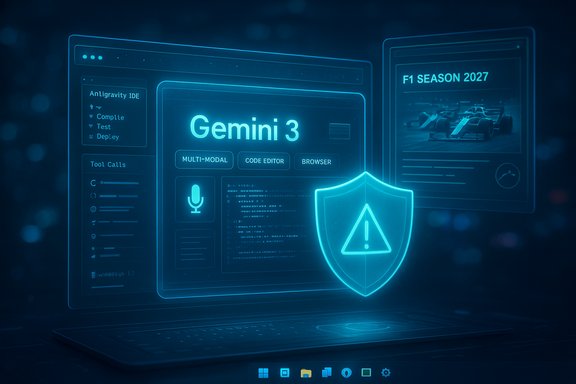
Google's Gemini 3 arriving in preview, EA retooling its F1 release cadence, and Microsoft’s stark warning about agentic AI in Windows 11 together mark a seismic week for consumers, gamers and IT teams — each story exposes a different face of the same trend: AI and long-term platform strategy now govern product roadmaps, security posture, and what users will actually experience on their PCs.
Background / Overview
The headlines fold into three interlocking shifts. First, Google has launched Gemini 3, a multimodal, agentic-focused model that the company positions as its flagship for advanced reasoning, long-context workflows and “agentic coding” — and it’s being baked into Search, the Gemini app, enterprise tools and a new agentic IDE. Second, Electronic Arts (via Codemasters) has announced a strategic pause in the annual sports‑game treadmill: there will be no full new F1 title in 2026; instead, F1 25 will be extended with a paid 2026 season expansion, while a fully reworked F1 experience is slated for 2027. That restructure signals how publishers are rethinking yearly release economics and how big regulation shifts in real‑world sports (the 2026 F1 technical reset) can force major development choices. Third, Microsoft’s Windows 11 agentic preview documentation openly flags the security risks of granting AI agents the ability to act — including a blunt admission that agents could be manipulated to perform malicious actions, such as installing malware via cross‑prompt injection (XPIA). Microsoft’s guidance also describes runtime isolation, audit logs and admin gating as mitigations. That combination — powerful automation plus acknowledged attack surfaces — is the central security story of the week.Gemini 3: what changed and why it matters
What Google announced and where it ships
Google released Gemini 3 Pro in preview and announced a deeper reasoning variant called Gemini 3 Deep Think (the latter is being staged for safety testing and phased availability). Gemini 3 Pro is immediately available in the Gemini app, in AI Mode in Google Search for paying tiers, in Google AI Studio / Vertex for developers and enterprises, and in a newly revealed agentic development environment called Google Antigravity. The model is positioned as the company’s flagship for multimodal tasks, long‑context reasoning and agentic automation. Key product outlets where Gemini 3 appears at launch:- The Gemini app (consumer and paid tiers)
- Google Search’s AI Mode (Pro/Ultra tiers)
- Vertex AI / Gemini Enterprise for business
- Google AI Studio and Gemini API for developers
- Antigravity IDE for agentic workflows and “vibe coding.”
Notable technical claims (and cautions)
Google’s headline claims are substantial:- 1,000,000 token input context and large (64k) output windows for certain variants.
- Substantial benchmark gains on multimodal and reasoning suites (Gemini 3 Pro is presented as scoring ~81% on MMMU‑Pro and topping LMArena).
What “agentic” means here
Gemini 3 is explicitly built to be an agentic model — it’s optimized to plan multi‑step workflows, call tools, operate developer environments (Antigravity exposes editors, terminals and browser control), and orchestrate chained actions. This is a different commercial vector than single‑turn chat: the product push is toward agents that can do things, not just answer questions. That’s powerful for automation and developer productivity, but it also increases the attack surface of any system that lets the model act.Practical implications for Windows users and admins
For end users the practical upside is faster, more contextual help, content creation and multimodal workflows — picture image/video-aware assistants that can summarize long transcripts, generate interactive visualizations, or prototype code with integrated testing. For IT and security teams, the considerations are immediate:- Latency and cost: more capable models often mean higher per‑inference cost and different latency characteristics; expect tiered pricing and quotas.
- Data governance: enterprises should validate retention settings, non‑training guarantees, and connector behavior before sending regulated data to external models.
- Agent governance: agent orchestration requires auditable logs, credential scoping, and manual approval gates to avoid runaway actions.
EA’s F1 realignment: a realistic pivot for annual sports franchises
The announcement in plain terms
EA and Codemasters will not ship a full new F1 title in 2026. Instead, F1 25 will receive a paid expansion that updates the game for the 2026 FIA season and its sweeping technical regulation changes. The studio says the choice frees development time to build a more ambitious and “reimagined” F1 title for 2027 — currently described as deeper, more authentic, and built with a multi‑year investment in the series.Why the change is logical (and necessary)
Formula 1 is entering a major technical reset that affects car design, hybrid powertrain performance and aerodynamics — translating such shifts faithfully into a simulator requires substantive development work. Several forces make EA’s decision defensible:- Annual sports releases are increasingly brittle: minor incremental updates strain player goodwill and studio resources.
- The 2026 F1 technical changes are not just cosmetic; they affect physics, car handling, and race strategy systems that sit at the heart of gameplay realism.
- A paid expansion keeps the player base on the same service while giving the studio runway to rebuild core systems for the 2027 release.
What players should expect
- A premium 2026 season upgrade for F1 25 that adds new teams, cars, and driver lineups aligned with the real‑world calendar (timing to match the season start — expect details in early 2026).
- No standalone F1 26 disc/box release next year; rather, a live‑service expansion model.
- A promise of a fully re‑engineered F1 27 in 2027, with broader gameplay ambitions and more development time dedicated to core simulation fidelity.
Broader implications for the games industry
EA’s move is part editorial and part economic. It signals that:- Publishers with premium sports IP may shift from strict annualization to “live‑platform + episodic expansion” when the sport’s evolution demands deeper engineering.
- Players should expect more frequent seasonal content but less frequent ground‑up releases — a tradeoff that can benefit quality if handled transparently.
- Studios need to balance retention (you still monetize annually) with goodwill (don’t overcharge for incremental content). Success depends on execution, pricing fairness and communication.
Microsoft’s agentic AI warning: frank language, real risks
What Microsoft actually says
Microsoft’s public support documentation for experimental agentic features (Agent Workspace and Copilot Actions) is explicit: the feature is off by default, requires admin enablement, and is gated to Insiders in preview. The documentation lists a security threat that’s rarely stated so plainly: agentic applications introduce novel security risks such as cross‑prompt injection (XPIA), where malicious content embedded in UI elements or documents can override agent instructions and cause unintended actions — including data exfiltration or malware installation. The doc also sets out mitigation principles: scoped authorization, least‑privilege permissions, tamper‑evident audit logs, and human approval gates for potentially sensitive actions. Agent workspaces run with separate accounts and session isolation to reduce risk, and experimental toggles exist so organizations can delay exposure while controls mature.Why this is a milestone moment for endpoint security
Microsoft’s guidance is notable because it does three things that enterprises value — and that also create friction:- Honest threat modeling: Microsoft publicly acknowledges that agentic automation can be weaponized; that frankness helps defenders prioritize mitigations rather than pretend there isn’t an attack surface.
- Operational complexity: the model introduces new admin decisions — when to enable agentic features, how to scope folder and connector access, how to log and revoke agent credentials, and how to integrate these agents into existing SIEM/EDR workflows.
- Novel attack vectors: XPIA and related prompt‑injection variants require defenders to treat UI content and documents as active attack vectors, not just passive artifacts. This changes threat hunting, detection rules, and incident response.
Practical guidance for admins and security teams
- Keep the experimental agentic features off on production devices until you can validate logs, revocation mechanics and MDM controls in a test fleet. Microsoft’s toggle is admin‑only and global per device.
- Require explicit approval gates for agents that access sensitive folders or call external tools; never grant blanket admin rights to agents.
- Ensure auditable, tamper‑evident logging is enabled and that logs export to your existing SIEM so agent actions are visible and correlated with other telemetry.
- Model revocation and incident playbooks: test how quickly a compromised agent can be revoked and whether that revocation propagates across your fleet. Microsoft’s architecture includes signing and trust mechanics, but real‑world revocation speed matters.
Why the warning stings in public discourse
Microsoft is both the vendor shipping the agent features and the party warning customers about them — a rare juxtaposition. That candor should be welcomed because it frames risk management as a first‑class design problem rather than an afterthought. That said, the presence of the warning also means IT teams must treat agentic features as a material security change and plan accordingly, rather than relying on vendor defaults.Cross-cutting analysis: convergence, opportunity and risk
Three big, intersecting trends
- Agentic AI is now product strategy — from Google’s Antigravity and Gemini 3 to Microsoft’s Agent Workspace and EA’s decision to stretch a live platform, vendors are building product roadmaps around models that can act, not just respond. That changes timeframes, monetization and development priorities.
- The attack surface grows with capability — as AI systems are granted more privileges (file access, tool calling, OS control), the potential for automated misuse grows correspondingly. The security model must evolve to treat agent behavior as a first‑class risk vector. Microsoft’s documentation is a direct nod to that reality.
- Service models are morphing — EA’s pivot to DLC/live‑platforms and cloud‑centric distribution of models (Pro/Ultra, enterprise tiers) show that product delivery and monetization are being remade to reflect continuous service, not one‑time releases. This affects consumer expectations and enterprise procurement alike.
Opportunity: genuine productivity and creative gains
When agents are properly governed, the upside is tangible:- Faster software development via agentic coding (Antigravity + Gemini 3).
- More powerful content creation and multimodal workflows for creators.
- Lower friction automation for routine IT tasks (ticket triage, report generation) when audit and approval gates are in place.
Risk: a new class of automated abuse
The primary danger is not that models hallucinate — it’s that models with privileged access can turn hallucinations or adversarial prompts into actionable damage. Examples:- A malicious prompt embedded in a document instructs an agent to download and run an arbitrary binary.
- A compromised agent exfiltrates files by staging disguised API calls.
- Chain-of-trust failures where agent credentials are reused improperly or revocation is delayed.
Action checklist — what Windows users, gamers, and IT teams should do now
- For individual Windows users:
- Leave experimental agentic features disabled unless you fully understand the risk/benefit and control who can enable them.
- If you try agentic features, use a non‑admin account and don’t store highly sensitive files in accessible known folders.
- For gamers and F1 players:
- Treat F1 25 as the live platform for 2026; budget for the paid expansion if you want up‑to‑date rosters and cars. Watch pricing and release timing when EA announces details early Q1 2026.
- Expect a deeper reboot in 2027; consider whether you want to wait for that reimagined release before major purchases.
- For IT and security teams:
- Block experimental agentic channels in production images until you validate telemetry, revocation and audit features in a pilot. Microsoft’s preview is intentionally staged for this reason.
- Require explicit human approvals for any agent action that touches sensitive data or external tooling, and ensure audit logs are exported to your central monitoring stack.
- Update incident response playbooks to include agent compromise scenarios: test agent revocation, credential rotation and quick isolation procedures.
Final assessment: balance ambition with governance
This week’s developments demonstrate the technology axis shifting from models-as-features to models-as‑platforms. Google’s Gemini 3 is a major technical step and an explicit push into agentic automation; EA’s F1 cadence shift shows how even game release economies adapt to real‑world complexity; and Microsoft’s public security notice is a pragmatic recognition that handing action capabilities to models requires new defenses.- The upside is real: more powerful, multimodal assistants, more productive developer tooling, and a richer ecosystem of agentic services.
- The risk is also real: automation that can act becomes a meaningful attack vector if governance is immature.
Gemini 3 and the agentic era are here — but they are not turnkey miracles. They are powerful new tools that need operators who understand the levers: cost, context, control and containment. The next 12–24 months will show whether the industry can get those levers right at scale — and whether consumers and enterprises reap the efficiency gains without paying the price in security and trust.
Source: Hindustan Times Gemini 3 is here, EA’s F1 realignment, and Windows 11’s agentic AI warning
