

Google’s Gemini and Microsoft’s Copilot now represent two very different AI strategies rather than a clean head-to-head product fight. Alphabet said on its February 4, 2026 earnings call that the Gemini app had surpassed 750 million monthly active users. Microsoft, meanwhile, said in its April 29 fiscal Q3 earnings call that Microsoft 365 Copilot had passed 20 million paid seats.
Those figures are not directly comparable, but they explain the market. Gemini is a mass-market assistant distributed through Google’s consumer services; Copilot is a paid work product layered onto Microsoft 365.
Gemini has the broader destination-app footprint. Google attributes its growth to integrations across Search, Android and its own app, while Gemini 3 arrived in November 2025 as the company’s latest model family for reasoning, multimodal tasks and agentic workflows.
Copilot’s centre of gravity is different. Microsoft 365 Copilot is designed to use business context from Word, Excel, PowerPoint, Outlook, Teams and connected Microsoft 365 data. Microsoft says seat growth accelerated during the latest quarter, and named Accenture’s deployment of more than 740,000 seats as its largest Copilot win to date.
For Windows users, this means the free Copilot app and the paid Microsoft 365 Copilot service should not be treated as the same buying decision. The consumer assistant is broadly available on Windows, the web and mobile. The business product is a Microsoft 365 add-on intended to work against corporate documents, meetings, mail and tenant controls.
That difference is real, but it is rarely the deciding factor for an organisation. A Microsoft 365 tenant with SharePoint libraries, Teams meetings and Exchange mail has a stronger practical case for Copilot because its most useful features are embedded where users already work. A Google Workspace shop will generally get the same advantage from Gemini’s access to Gmail, Drive, Docs, Sheets and Chat.
Neither assistant offers a native bridge into the other vendor’s productivity suite. Users can open either service in a browser, but the valuable context-aware features remain tied to the home platform.
Admins should focus less on generic benchmark claims and more on data boundaries, permissions hygiene, licensing and whether staff actually live in Microsoft 365 or Google Workspace. Copilot’s value rises with well-managed Microsoft 365 data; poor SharePoint permissions and stale content can become AI-visible problems faster.
For Windows-first organisations already standardised on Microsoft 365, Copilot remains the more relevant choice because its paid features are built directly into the Office workflows they already administer.
Those figures are not directly comparable, but they explain the market. Gemini is a mass-market assistant distributed through Google’s consumer services; Copilot is a paid work product layered onto Microsoft 365.
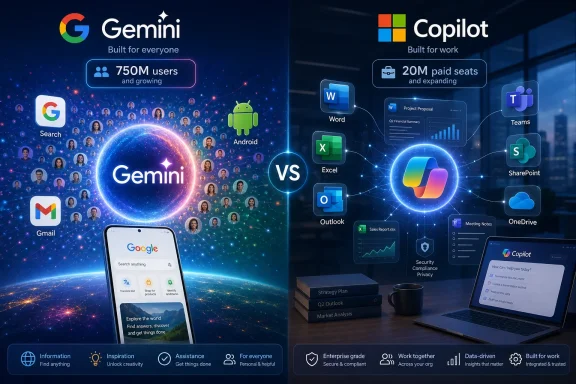 Consumer AI versus work AI
Gemini has the broader destination-app footprint. Google attributes its growth to integrations across Search, Android and its own app, while Gemini 3 arrived in November 2025 as the company’s latest model family for reasoning, multimodal tasks and agentic workflows.Copilot’s centre of gravity is different. Microsoft 365 Copilot is designed to use business context from Word, Excel, PowerPoint, Outlook, Teams and connected Microsoft 365 data. Microsoft says seat growth accelerated during the latest quarter, and named Accenture’s deployment of more than 740,000 seats as its largest Copilot win to date.
For Windows users, this means the free Copilot app and the paid Microsoft 365 Copilot service should not be treated as the same buying decision. The consumer assistant is broadly available on Windows, the web and mobile. The business product is a Microsoft 365 add-on intended to work against corporate documents, meetings, mail and tenant controls.
Models matter less than the surface
Google’s Gemini 3 family is built in-house by Google DeepMind. Microsoft’s Copilot uses a routed model approach: Microsoft introduced GPT-5-based Smart mode in August 2025, selecting a faster model for routine prompts and deeper reasoning for harder work. Microsoft’s own current Copilot guidance still describes Smart mode as GPT-5-powered, although the company has continued updating its model stack.That difference is real, but it is rarely the deciding factor for an organisation. A Microsoft 365 tenant with SharePoint libraries, Teams meetings and Exchange mail has a stronger practical case for Copilot because its most useful features are embedded where users already work. A Google Workspace shop will generally get the same advantage from Gemini’s access to Gmail, Drive, Docs, Sheets and Chat.
Neither assistant offers a native bridge into the other vendor’s productivity suite. Users can open either service in a browser, but the valuable context-aware features remain tied to the home platform.
Cost and admin implications
Gemini is easier for an individual to buy as a standalone premium service. Microsoft’s enterprise Copilot generally requires an eligible Microsoft 365 licence beneath the per-user Copilot charge, making it a larger commitment but also bringing Microsoft’s existing identity, compliance and management controls into the deployment.Admins should focus less on generic benchmark claims and more on data boundaries, permissions hygiene, licensing and whether staff actually live in Microsoft 365 or Google Workspace. Copilot’s value rises with well-managed Microsoft 365 data; poor SharePoint permissions and stale content can become AI-visible problems faster.
For Windows-first organisations already standardised on Microsoft 365, Copilot remains the more relevant choice because its paid features are built directly into the Office workflows they already administer.
References
- Primary source: SQ Magazine
Published: 2026-07-20T02:33:08+00:00
Gemini vs Copilot 2026: Google and Microsoft • SQ Magazine
Gemini vs Copilot compared on models, pricing and integration. Gemini's 750 million-user app against Copilot's 20 million paid seats in 2026.sqmagazine.co.uk - Related coverage: blog.google
Gemini 3: News and announcements
Gemini 3, our most intelligent model, combines all of Gemini’s capabilities together so you can bring any idea to life.blog.google - Official source: microsoft.com
Release notes: August 7, 2025 | Microsoft Copilot Blog
For an optimal mobile viewing experience, use landscape mode. Welcome to Microsoft’s Copilot Release Notes. Here we’ll provide regular updates on what’s happening with Copilot, from new features to firmware updates and more. GPT-5 now live in Microsoft Copilot We’re excited...www.microsoft.com - Official source: support.microsoft.com
Conversation modes in Microsoft Copilot | Microsoft Support
Microsoft Copilot offers multiple conversation modes. Each mode is designed to help users get better responses to complex questions using different AI models.support.microsoft.com - Official source: techcommunity.microsoft.com
- Official source: cdn-dynmedia-1.microsoft.com
