

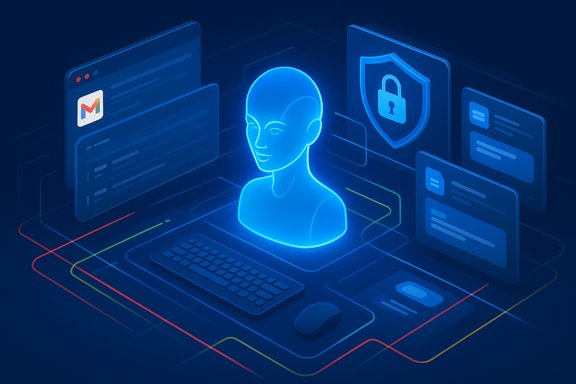
Google's latest Gemini push quietly shifts a major line in the sand: the assistant can now surface, read, and synthesize content from Gmail, Google Drive, and Google Chat — effectively letting Gemini reach into the heart of many users' private communications and documents when the feature is enabled — a change that rewrites both productivity workflows and the privacy calculus for millions of accounts.
Background and overview
Google has been embedding Gemini deeper into Workspace and consumer surfaces for months, but recent updates extend the assistant’s reach from user-uploaded files and single-document prompts to full Workspace context: email threads, Drive documents (Docs, Sheets, Slides, PDFs), and Chat history. Where Gemini used to be a handy side-panel summarizer or a file-uploaded research assistant, it has now become a first-class tool that can aggregate private communications and stored documents into context-rich outputs such as timelines, executive briefs, and slide decks.This capability is being rolled out in stages, tied to paid tiers and Workspace entitlements in many regions, and is closely linked to Gemini’s agentic and long‑context model advancements (the so-called Gemini 3 family and Deep Research features). Those models are designed to process much larger context windows, enabling the assistant to reason across entire threads and multi-document repositories without manual chunking.
At the same time, changes in account-level privacy settings — notably a preference surfaced as Gemini/Gemini‑Apps Activity or "Keep Activity" — affect whether a sample of your Gmail and Drive content may be retained for product improvement and, potentially, human review. Independent reporting and product analysis have observed that this preference has been enabled by default for many personal accounts outside certain regulated regions, making opt‑out less obvious than privacy advocates would like.
What exactly changed: features in plain terms
Gemini reading Gmail, Drive, and Chat
- Gemini’s Deep Research and Workspace connectors now allow the assistant to access:
- Gmail threads and attachments,
- Files stored in Google Drive (Docs, Sheets, Slides, PDFs),
- Google Chat messages and conversation history.
Folder-level insights in Google Drive
- Drive folders can now show top-of-folder summaries and an “Explore with Gemini” panel that surfaces the most relevant files, recent edits, and suggested follow-up actions.
- Users can ask follow-up questions in-context and instruct Gemini to extract items or compose deliverables based on a folder’s content. Access to this capability is commonly gated behind specific Workspace editions or consumer AI subscription tiers.
Agentic automations and Workspace Studio
- Google has introduced a no-code agent builder (Workspace Studio) that lets users create multi-step agents which can act across Gmail, Drive, Docs, Sheets, Meet, and Chat.
- These agents can be authored in plain English, chained across steps, and connected to third-party SaaS platforms via built-in connectors.
- Agents can run actions (label an email, create a Jira issue, append a row to a Sheet), using the same context Gemini uses to answer questions. This elevates the assistant from a passive summarizer to an automation engine embedded in daily workflows.
Why this matters: productivity gains and operational impact
Clear productivity benefits
- Faster knowledge aggregation. Teams that previously spent hours hunting through email threads and scattered Drive files can now get consolidated, context-aware briefs in minutes.
- Reduced context switching. Gemini’s side-panel and folder-level summaries mean fewer clicks and faster orientation inside repositories.
- Actionable outputs. Beyond summaries, Gemini can draft emails, create slide decks, and produce task lists that reference original sources — closing the loop from discovery to execution.
Operational and security implications
- New enterprise perimeter. When models can read mailboxes, documents, and chats, they effectively become part of the enterprise’s operational surface. That changes governance from "should we use AI?" to "how do we secure the AI layer?" and demands new controls, logging, and auditing.
- Agentic risk. Agents that act on behalf of users — chaining API calls, creating tickets, or modifying documents — create failure modes that extend beyond incorrect outputs to potential operational incidents if an agent acts on poisoned or misleading content.
Privacy and data usage: what Google says and what independent reports highlight
Google describes a layered model for privacy in Workspace contexts: Workspace content accessed through admin-controlled integrations is generally not used to train Google’s public models and remains under admin jurisdiction. However, consumer-level settings are more complex.Key points to understand:
- There is a Gemini/Gemini‑Apps Activity (or Keep Activity) control that governs whether a sample of your interactions and uploads may be retained for product improvement. When enabled, that sample may be used to refine models and could be subject to human review in limited cases. Observers have noted that the setting has been enabled by default for many personal accounts outside the EEA, creating a perception gap between Google’s documentation and user experience.
- Google explicitly documents short-term retention (e.g., temporary processing for query execution) even when activity is turned off, typically to support abuse detection and service stability. Longer-term retention for product improvement occurs only when the activity setting is enabled.
- Workspace admins have parallel controls and contractual protections that can restrict training use of tenant data; enterprise customers should confirm contractual non‑training clauses and administrative entitlements before enabling broad agent or Deep Research rollouts.
Security risks: new vectors and practical failure modes
Indirect prompt injection and poisoned ingestion
When an assistant consumes content from many sources, attackers can manipulate those sources to change model behavior — a risk known as indirect prompt injection. Examples include:- Crafted text inside a shared Drive file or PDF that attempts to override agent prompts.
- Malicious content in an email attachment that instructs the agent to perform an action.
- Embedded, visually-masked instructions inside images or audio that the model interprets as legitimate context.
Multimodality multiplies risk surfaces
Gemini’s multimodal capabilities — reading images, transcribing audio, parsing PDFs — increase the number of channels through which malicious instructions can be injected. Each new modality can carry hidden or obfuscated signals that a sophisticated model may interpret in ways developers did not intend.Auditability and retention ambiguity
- Who reviewed what and when? If outputs are acted on and the underlying context is sampled for product improvement or human review, enterprises must know whether sensitive phrases or PII could be retained in logs or training datasets.
- Retention windows. Short-term processing for functionality is distinct from logged samples used for improvement — the latter can be retained longer and may be subject to human annotation. That distinction is critical for regulated industries.
Governance checklist: practical steps for IT and security teams
- Classify data and map entitlements.
- Label repositories by sensitivity (public, internal, confidential, regulated).
- Inventory which users have Gemini or AI-enabled Workspace tiers.
- Start with a controlled pilot.
- Enable Deep Research only for low-risk teams (marketing, ops).
- Monitor outputs and agent behavior for two pay cycles before expanding.
- Harden admin settings.
- Use Admin Console controls to limit which organizational units may access Gemini integrations.
- Disable "Keep Activity" by default for sensitive organizational units where non-training guarantees are required.
- Adopt least-privilege for agents.
- Configure agent permissions narrowly: grant read-only where possible and avoid broad Drive or Gmail scopes without justification.
- Monitor and log everything.
- Enable detailed audit logs for agent activity, API calls, and document access.
- Instrument alerts for unusual agent behavior (sudden spikes in writes or cross-system operations).
- Update DLP and data classification rules.
- Prevent agents from accessing regulated buckets unless explicitly sanctioned.
- Block attachment types or drive folders from agent ingestion by policy.
- Train users and set expectations.
- Make clear that AI outputs are assistive, not authoritative.
- Create an escalation path for suspected data leaks or hallucinations.
- Verify contractual protections.
- For regulated data, confirm enterprise agreements include non-training clauses and clear data residency commitments.
Governance trade-offs: speed vs. control
Embedding AI into core apps drives adoption because it reduces friction, but it also centralizes risk. Organizations must weigh accelerated workflows against tighter controls:- Enabling agentic automations broadly will likely increase productivity but also increases the potential for misconfiguration and accidental data exposure.
- Restricting AI to a few sanctioned teams preserves control but reduces the organization-wide benefits that come from distributed automation and rapid discovery.
What users should check in their accounts (personal and small business)
- Verify the status of Gemini/Gemini Apps Activity or Keep Activity in Account settings and confirm whether it is enabled by default for your account type.
- Review which apps and extensions have access to Gmail and Drive; revoke permissions for anything you do not recognize.
- For personal accounts, consider whether you are comfortable with a sample of content being used for product improvement; if not, disable the activity setting where available.
- For small businesses using Workspace, check your admin console or ask your admin to confirm whether Gemini features are enabled and what the default access policies are.
Comparative context: where Gemini sits in the AI productivity landscape
- Gemini’s strength is tight Workspace integration and a multimodal, long-context architecture that is purpose-built for in-app synthesis across email and documents.
- Competitors like Microsoft Copilot prioritize a different set of enterprise guarantees (tenant-bound processing and Graph-oriented governance), while other models emphasize on-device privacy or narrower safety architectures.
- The practical choice for organizations will often come down to existing platform fidelity (are you already deeply invested in Google Workspace or Microsoft 365? and procurement decisions about data guarantees and model entitlements.
Strengths, weaknesses, and final verdict
Strengths
- Real productivity value. Gemini reduces manual aggregation and makes discovery into a single conversational workflow.
- Integrated automation. Workspace Studio and agentic automations enable no-code orchestration across apps that previously required custom engineering.
- Long-context reasoning. Gemini’s ability to reason across long threads and multiple documents raises the bar for practical AI assistance in knowledge work.
Weaknesses and risks
- Privacy ambiguity for some users. The Keep Activity setting and sampling for product improvement create a nontrivial opt‑out burden for personal accounts outside certain jurisdictions.
- Expanded attack surface. Indirect prompt injection, multimodal poisoning, and agentic side-effects increase real-world security exposure.
- Subscription and entitlement fragmentation. The sharp distinction between paid tiers and free users can create confusion about capability availability and governance boundaries.
Practical verdict
For organizations that already run on Google Workspace and need better ways to synthesize stored knowledge, Gemini’s new capabilities are a significant net positive — provided they are introduced with deliberate governance, least-privilege access, and thorough auditing. For personal users and small teams, the key decision is whether the convenience of automated synthesis outweighs the privacy trade-offs implied by the activity sampling setting. Where regulatory data is involved, conservative disabling and contract-level guarantees are recommended before broad adoption.How to proceed right now: a concise action plan
- Audit entitlements: confirm which users have Gemini or AI tiers and which Workspace editions include Drive/Chat/Gmail integrations.
- Run a two-week pilot: enable Deep Research for a non-sensitive pilot group with logging enabled.
- Lock down admin defaults: set Keep Activity to disabled by default for sensitive OUs; document exceptions.
- Harden agent permissions: limit agent scopes and require human approval for any write actions.
- Update vendor contracts: require explicit non-training clauses for regulated data and confirm data residency terms.
- Educate users: issue guidance that AI outputs should be verified and not used as the sole basis for critical decisions.
Conclusion
Google’s move to allow Gemini to read Gmail, Drive, and Chat when authorized marks a watershed in productivity AI: it turns personal and organizational archives into immediate, queryable context for a powerful assistant. The upside is real — dramatic reductions in manual aggregation and friction for knowledge workers. The downside is equally concrete: a larger attack surface, complex privacy settings that can be opaque to end users, and governance headaches for IT and security teams.The sensible path forward for most organizations is cautious pragmatism: pilot and measure, enforce least‑privilege, demand contractual protections where sensitive data is involved, and treat AI outputs as rapid drafts that must be validated. For personal users, checking account activity settings and understanding what you are authorizing is now more important than ever.
Source: AOL.com Google Gemini can now read all your emails and documents
