

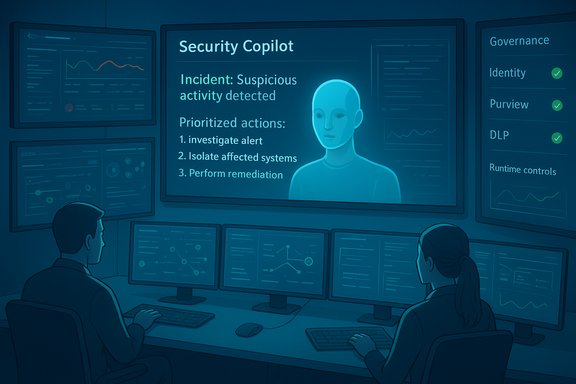
Microsoft’s new e‑book and the surrounding product messaging make a clear, consequential claim: generative AI can shift Security Operations Centers (SOCs) from overwhelmed triage centers into proactive, high‑impact defense teams — reducing wasted analyst time, accelerating investigations, and improving remediation outcomes. That promise is both realistic and measurable in early deployments, but it also carries new operational, governance, and adversarial risks that security leaders must treat as first‑order problems before they scale automation across production SOCs.
Background
Security operations teams have been under pressure for years: tool fragmentation, massive alert volumes, chronic false positives, and a persistent global skills shortage combine to create fatigue and slow response. Independent workforce research shows the scale of the problem — the global cybersecurity workforce gap remains in the millions and organizations consistently report skills shortages that impair defensive capacity. These structural constraints are a key part of the backdrop that makes generative AI attractive to SecOps leaders. At the same time, vendors and early adopters report tangible productivity gains after embedding generative AI into analyst workflows. Microsoft’s messaging — and the company’s recent e‑book aimed at SOC practitioners — highlights scenarios where a generative AI assistant (Microsoft Security Copilot) consolidates related alerts, generates incident summaries, suggests prioritized responses, and can automate routine containment actions via playbooks. Those capabilities address familiar pain points: noisy queues, slow investigations, inconsistent reporting, and a lack of contextual correlation across siloed telemetry.What Microsoft and Early Adopters Are Saying
The capability set: where generative AI plugs into SecOps
Microsoft’s materials and customer stories outline four practical ways generative AI is being applied inside modern SOCs:- Alert triage: correlate disparate alerts, surface related activity that didn't trigger classic rules, and prioritize incidents for human review.
- Investigation acceleration: produce rapid, evidence‑backed incident summaries and step‑by‑step investigative guidance.
- Automated response: generate and execute playbooks for routine containment and remediation tasks.
- Proactive hunting & reporting: suggest queries to uncover lateral movement or privilege escalation, and create polished, audience‑ready incident summaries for stakeholders.
Reported outcomes: what early evidence shows
Two measurable claims are repeated in vendor and customer materials:- A roughly 30% reduction in mean time to resolution (MTTR) associated with generative AI adoption in SOC workflows. An independent working paper using observational data from live operations found an association consistent with this magnitude — a 30.13% reduction in MTTR after adopting generative AI tools. That result is notable because it’s grounded in field data rather than lab demos. Still, the authors caution about confounders and the difficulty of proving causality from observational data.
- Customer testimonials report dramatic analyst speedups. For example, TÜV SÜD reports analyzing results “about 60% to 70% faster” after embedding Security Copilot into their workflows. Customer stories like this are valuable real‑world signals, though they come from vendor channels and reflect a single organization’s environment, telemetry, and tuning.
How generative AI actually helps analysts (practical examples)
Rapid, context‑rich triage
Generative AI can consume diverse contextual inputs — recent alerts, threat‑intel feeds, endpoint telemetry, identity logs — then produce a concise incident narrative and a prioritized action list. For a high‑priority account takeover, Copilot‑style assistants can consolidate multi‑geographic login alerts, show correlated process artifacts, and recommend immediate containment steps in plain language that junior analysts can execute under supervision. That reduces cognitive load and helps standardize investigative outputs across teams.Decoding complex artifacts
Automated decoding of obfuscated or malicious scripts is another practical win. A generative model can annotate malicious PowerShell or encoded payloads, map referenced IOCs to threat‑intel sources, and propose containment or remediation playbooks that integrate with your SOAR tools. This speeds forensic work and makes analysis outcomes easier to reproduce and audit.Guided threat hunting
AI assistants can suggest hunting queries derived from observed patterns (e.g., lateral movement signatures, suspicious use of built‑in tools). They can also propose pivot paths — “if you see X, check Y and Z” — which helps teams uncover long‑dwell intrusions that escaped initial detection. When hunting becomes systematic and repeatable, defenders shift from reactive to proactive postures.Audience‑ready reporting
Security leaders repeatedly cite the time spent translating technical findings into business‑level summaries. Generative AI can generate incident artifacts and executive summaries tailored to specific audiences, reducing friction between technical teams and business stakeholders and ensuring consistent messaging after incidents.Independent evidence and verification
Any vendor claim that materially changes how organizations operate should be verified against independent sources. On that front:- The academic working paper “Generative AI and Security Operations Center Productivity: Evidence from Live Operations” analyzed observational data and found a ~30% reduction in MTTR associated with GAI adoption. The authors note robustness to modeling choices but correctly warn that observational studies cannot rule out all confounders. This gives credible, non‑vendor evidence for large, practical productivity gains but not causal proof.
- Industry research into SOC behavior and workload (for example, IBM’s commissioned SOC survey) documents the pre‑existing problem: analysts spend large fractions of time on false positives and repetitive tasks. That prior baseline explains why automation and AI have outsized potential when implemented thoughtfully. The IBM‑commissioned study (Morning Consult for IBM) found that SOC teams often spend roughly one‑third of their time investigating alerts that turn out not to be real threats — a problem AI is well‑positioned to reduce if implemented correctly.
- Vendor customer stories (TÜV SÜD and others) document large, practical gains (60–70% faster analyses in that case). Those are real operational outcomes but should be treated as case studies rather than universal guarantees — ROI depends on baseline maturity and the depth of integration.
Strengths: where generative AI delivers the most value
- Noise reduction and prioritization. AI correlates signals across silos and surfaces what matters, reducing time wasted on false positives.
- Speed and standardization. Rapid incident summaries and templated playbooks reduce MTTR and produce repeatable outputs across analysts.
- Analyst uplift. Junior analysts level up faster because AI provides context, suggested queries, and remediation steps that accelerate learning curves.
- Proactive hunting. Generative tools help identify hidden attack paths and suggest investigative pivots that humans might miss.
- Human‑centric interfaces. Natural‑language queries lower the barrier to complex security analytics, enabling faster hypotheses and response cycles.
Risks and gaps: what to plan for before adoption
Generative AI also introduces new risks that must be managed deliberately.1) Prompt injection and data exfiltration
A class of attacks known as prompt injection can trick LLM‑based assistants into revealing sensitive data or performing unauthorized actions. Real incidents and proofs‑of‑concept have shown that maliciously crafted documents or inputs can coerce AI assistants to leak secrets or produce executable instructions that help attackers. This is not theoretical: researchers and incident reports have documented prompt‑injection vectors and vendor mitigations. Treat any integration that gives an AI access to internal data as a potential exfiltration channel until proven safe.2) Over‑automation and blast radius
Automating remediation tasks without adequate human‑in‑the‑loop controls can magnify errors. An over‑eager agent that quarantines the wrong set of endpoints or revokes critical credentials can cause business outages. Design systems so that high‑impact actions require approvals and support immediate rollback. Operational runbooks must include human approval gates, robust rollback procedures, and conservative defaults.3) Data handling, retention, and compliance
AI assistants often require context to be useful. That context can include logs, documents, and identity information that touch regulated data. Clarify what telemetry is sent to model runtime vs. what remains tenant‑side, define retention policies, and map agent flows to compliance obligations (GDPR, HIPAA, sector rules). Purview, DLP, and tenant‑hosted monitoring should be part of any production rollout.4) Vendor claims vs. tenant reality
Vendor ROI claims (percent improvements, signal volumes, or “first in industry” marketing) are useful hypotheses but should be validated in your environment. Pilot projects with clear KPIs — MTTR, false positive rate, hours saved — are essential. Marketing figures like “78 trillion signals a day” describe vendor telemetry scale but do not directly translate into your environment’s detection performance. Verify expected gains through instrumented measurements.5) Model explainability and auditability
LLMs can produce plausible‑sounding justifications that mask uncertain or wrong reasoning. For security use, outputs need provenance (which signals were used, which rules fired, and what evidence supports a recommendation). Require model versioning, decision provenance, and full audit trails for any agentic action.Practical rollout checklist for SOC leaders
- Start with focused, low‑risk pilots (phishing triage, alert summarization, or ticket enrichment). Measure p50/p95 latencies, false positive/negative rates, and analyst satisfaction.
- Keep agents in observe mode initially; do not enable blocking or auto‑remediation until you’ve validated behavior under peak loads and adversarial tests.
- Instrument governance controls: tenant‑hosted Model Context Protocol (MCP) servers, least‑privilege Entra identity for agents, and a strict approval pipeline for any agent that can act.
- Perform adversarial testing (prompt injection, RAG poisoning, connector abuse) as part of the pilot acceptance criteria. Record false positive/negative rates and tune models accordingly.
- Maintain cost governance: long‑range hunting and graph traversals can produce heavy query loads. Set quotas, cost alerts, and schedule heavy jobs in non‑peak windows.
- Require full provenance and audit logs: every recommendation and action must include model version, input snapshot, and the evidence used to produce the output. This is essential for compliance and post‑incident reviews.
Red flags that should stop a rollout in its tracks
- Agents are given broad, unscoped privileges without time‑bound approvals.
- The pilot lacks tenant‑hosted telemetry controls or Purview/DLP integration for PII/regulated data.
- There is no adversarial testing plan for prompt injection and RAG poisoning.
- The team cannot produce measurable KPIs or lacks the ability to roll back automated actions quickly.
The governance stack — what must be in place
- Identity: Entra‑backed agent identities, role‑based access control (RBAC), and time‑bound approvals.
- Data controls: Purview classification, DLP, and telemetry minimization to limit what the model can access.
- Runtime monitoring: tenant‑hosted MCPs or runtime monitors that can block or escalate agent actions.
- CI/CD for agents: versioned agent definitions, an approval pipeline, and retirement policies.
- Observability: cost meters, latency SLOs, and audit trails for every decision.
Final assessment: how to balance opportunity and risk
Generative AI is not magic, but it is a force multiplier for security operations when deployed with discipline. Independent operational evidence indicates meaningful productivity gains (a substantiated ~30% reduction in MTTR in observational studies), and customer case studies show even larger improvements in specific environments when integration and telemetry quality are high. However, those gains come with systemic risks — prompt injection, expanded attack surfaces through agents, compliance challenges, and the danger of over‑automation.The prudent path is deliberate pilots that treat agentic automation as an operational program rather than a point product. Instrument everything: measure MTTR, analyst time saved, false positive/negative rates, and cost metrics. Pair pilots with adversarial testing and strict governance: tenant‑hosted controls, least‑privilege agent identities, retention policies, and human‑in‑the‑loop approvals for high‑impact actions. If those controls are implemented, generative AI can deliver faster, smarter, and more resilient security operations — but unchecked adoption will create new risks that are potentially larger than the problems the technology was meant to solve.
Bottom line for WindowsForum readers and SOC decision‑makers
- Generative AI is already changing SecOps workflows and producing measurable results in the field. Confirmed evidence and customer outcomes show real potential to shorten detection and remediation timelines and to reduce analyst toil.
- Don’t adopt blindly: validate vendor claims in your environment with instrumented pilots, adversarial tests, and clear KPIs. Vendor metrics and customer stories are valuable signals but require tenant‑level verification.
- Treat governance, identity, and data controls as non‑negotiable prerequisites for any production rollout. The adversary can and will target AI workflows; design as if they already know your agent endpoints and approval processes.
Source: Microsoft Learn what generative AI can do for your security operations center | Microsoft Security Blog
