

Generative AI has stopped being a boardroom curiosity and quietly become a day‑to‑day tool for large organizations — nearly half of surveyed business leaders now use Gen AI daily, roughly four out of five use it weekly, and about three in four firms tracking outcomes report a positive return on investment.
Generative AI adoption has moved through a familiar technology lifecycle: rapid consumer‑facing experimentation followed by enterprise embedding into mission‑critical workflows. What began as point solutions for writing, summarization, and code assistance has expanded into wide productivity rollouts and the emergence of multi‑functional, agentic systems that orchestrate entire business processes from recruiting to onboarding. Independent surveys and enterprise reporting now show high frequency of use and growing budget allocations to support that transition. This shift is not merely cosmetic. Organizations are reallocating budget and operational responsibility to treat AI as a platform: expenditure and procurement now resemble other major enterprise investments rather than a series of one‑off pilot projects. Yet beneath the headlines lies a more complex reality: gains in productivity are real, but they depend on disciplined data practices, careful integration, and human oversight.
A growing number of organizations now treat data management as a first‑class concern: they assign owners to policies, version their corpora, and instrument systems to detect stale or contradictory documents. Without these measures, the ROI numbers quoted by surveys are much less likely to be repeatable across teams.
This immaturity creates real risks:
Enterprises and HR leaders should plan for:
AI will continue to reshape tasks and roles, but the path forward is not inevitability toward mass job loss; it is a practical, human‑centered redesign of work where superworkers — employees who pair deep domain expertise with AI fluency — become the durable source of competitive advantage. The business decision is no longer whether to adopt generative AI; it is how to adopt it thoughtfully, govern it rigorously, and scale it responsibly.
Source: Azat TV Gen AI Goes Mainstream: How Businesses Are Adapting and What’s Next
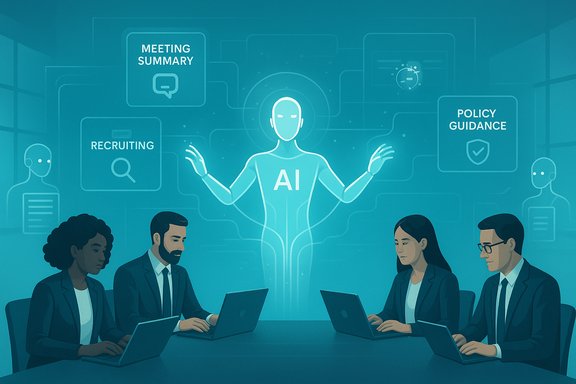 Background / Overview
Generative AI adoption has moved through a familiar technology lifecycle: rapid consumer‑facing experimentation followed by enterprise embedding into mission‑critical workflows. What began as point solutions for writing, summarization, and code assistance has expanded into wide productivity rollouts and the emergence of multi‑functional, agentic systems that orchestrate entire business processes from recruiting to onboarding. Independent surveys and enterprise reporting now show high frequency of use and growing budget allocations to support that transition. This shift is not merely cosmetic. Organizations are reallocating budget and operational responsibility to treat AI as a platform: expenditure and procurement now resemble other major enterprise investments rather than a series of one‑off pilot projects. Yet beneath the headlines lies a more complex reality: gains in productivity are real, but they depend on disciplined data practices, careful integration, and human oversight.Productivity Revolution: The First Wave
From assistants to everyday tools
The first visible phase of Gen AI adoption has been a productivity revolution at the individual level. Tools embedded in office suites and communication platforms — notably copilots in productivity apps — are being used for:- Summarizing meetings and emails
- Drafting documents, job descriptions, and proposals
- Preliminary data analysis and visualization
- Rapid prototyping and ideation
HR as a surprising front line
Human Resources has emerged as one of the most active business functions for Gen AI, ranking immediately behind IT and Finance in many organizational rollouts. HR teams are using AI for candidate screening, job‑ad creation, drafting communications, policy guidance, manager coaching, and routine case handling — work that amplifies the capacity of HR departments and shortens operational cycles. Vendor case studies and HR‑platform integrations show rapid evolution from simple assistants to more capable HR agents.Multi‑Functional Agents: The Next Big Leap
What multi‑functional agents are
Multi‑functional agents are autonomous or semi‑autonomous AI components that perform multi‑step tasks across a business process. Unlike single‑function chatbots, these agents can:- Orchestrate workflows (recruit → interview → offer → onboarding)
- Integrate with multiple enterprise systems (HRIS, ATS, payroll)
- Maintain state and recall past interactions for personalization
- Execute actions (schedule interviews, populate forms, route approvals)
HR example: Galileo and platform integration
Galileo — an HR agent product developed by The Josh Bersin Company — illustrates how an HR‑centric agent becomes a single point of contact for employees and managers. Galileo is being embedded into larger HR platforms and marketplaces (including ServiceNow, HiBob, and other HCM vendors), allowing a single AI interface to service pay queries, training requests, and policy guidance. Recent product integrations show how a third‑party HR agent can be made available inside major HR surfaces, creating a consolidated user experience.Data Management: The Hidden Backbone
Clean data is non‑negotiable
Generative models operate on probabilities derived from data. That mathematical reality means dirty or poorly labeled data produces noisy, unreliable outcomes — and in enterprise contexts, noisy outputs quickly translate into operational risk. Corporations reporting scaled AI deployments emphasize governance, stewardship, and owner‑assigned responsibility for datasets and policies to keep content current and auditable.A growing number of organizations now treat data management as a first‑class concern: they assign owners to policies, version their corpora, and instrument systems to detect stale or contradictory documents. Without these measures, the ROI numbers quoted by surveys are much less likely to be repeatable across teams.
Error rates and the reality of hallucinations
Independent investigations have repeatedly shown that AI assistants can produce incorrect summaries or asserted facts with surprising frequency. A high‑profile review of AI summaries of news stories revealed that a substantial share of outputs contained inaccuracies or omitted critical details. The precise error numbers vary by study and methodology (some media analyses flagged near‑half error rates), but the takeaway is consistent: AI outputs require human validation for consequential decisions. This makes robust data governance and human‑in‑the‑loop workflows mandatory for production deployments. Treat headline error percentages as an alarm bell, not a death sentence.Agent‑to‑Agent Communication and Integration Challenges
The integration problem
Multi‑agent systems succeed only when agents can communicate, share context, and agree on action semantics. Standards and protocols for agent communication are still immature — enterprises are experimenting with patterns like Model Context Protocols and other emerging agent orchestration frameworks, but there is no universal stack yet.This immaturity creates real risks:
- Fragmentation: multiple agents that cannot interoperate produce silos, increasing maintenance costs.
- Vendor lock‑in: bespoke integrations may be expensive to rewrite.
- Governance gaps: tracing decisions across agent boundaries is challenging without cross‑agent observability.
Practical integration trends
- Declarative agent definitions and lifecycle tooling (from SDKs and agent frameworks) are lowering the barrier to production‑grade orchestration.
- Observability and OpenTelemetry become critical: agents require traceable events, checkpointing, and human‑in‑the‑loop breakpoints.
- Hybrid routing patterns reduce cost: cheap models handle routine queries while premium models are reserved for high‑risk decisions.
Vendor Landscape, M&A Activity, and Market Risks
Established platforms vs. specialist players
The vendor ecosystem is bifurcating:- Large enterprise platform vendors (SAP, Workday, Microsoft) are embedding agent capabilities into broad HCM and ERP suites, selling integration and governance as selling points.
- Specialized vendors (Galileo, Paradox, Sana, Galileo‑like HR agents) focus on verticalized agent experiences and often integrate into the big platform stacks.
Recent and notable acquisitions
M&A continues to reshape the recruiting and HR technology stack:- Workday announced its intent to acquire HiredScore and has been integrating HiredScore’s talent orchestration capabilities into Workday’s recruiting suite, accelerating agent‑driven recruiting and internal mobility features. This move underscores Workday’s strategy to deliver an AI‑first talent platform.
- SAP’s acquisition of SmartRecruiters (announced publicly) folds a modern recruiting platform into SAP’s broader HCM strategy, positioning SAP SuccessFactors to deliver a more seamless recruiting‑to‑onboard experience. The acquisition highlights how enterprise incumbents are buying specialized recruiting capabilities rather than building them from scratch.
Market risks and scenario planning
- Consolidation risk: macroeconomic shocks could accelerate vendor consolidation, forcing customers to migrate or renegotiate.
- Reliability and continuity: reliance on a single cloud model or provider introduces systemic risk if the provider changes policy or pricing.
- Over‑proliferation: buying many narrow agents without an integration strategy increases operational overhead.
Addressing Fears: Jobs, Skills, and Organizational Design
Job loss vs. job transformation
Anxiety about displacement is real and understandable — every productivity wave creates winners and losers at first glance. History shows that technology reassigns labor rather than simply erases it: routine tasks are automated and new roles emerge that require different skills.Enterprises and HR leaders should plan for:
- Retraining and reskilling programs targeted at AI‑augmented workflows.
- Rewriting role descriptions to emphasize decision quality, domain expertise, and AI orchestration skills.
- Creating pathways for internal mobility as agents change the skills needed for roles.
The rise of the “Superworker”
Workers who can combine domain expertise with AI fluency — prompt design, model selection, and interpretation — will be disproportionately valuable. Organizations that invest in internal learning, AI upskilling, and change management will capture more of the productivity gains and retain institutional knowledge during transitions.Governance, Compliance, and Ethical Considerations
Practical governance building blocks
- Data lineage: track where training and retrieval data originate and who owns it.
- Human‑in‑the‑loop policies: define clear escalation and review points for high‑risk decisions.
- Audit trails and explainability: log agent actions and rationale where feasible to satisfy compliance teams.
- Bias and fairness testing: routinely assess outcomes for disparate impact and correct model behavior.
- Cost controls: monitor agent usage via model routing and caching to prevent runaway spend.
Environmental and infrastructure costs
As agents grow in scale and multi‑modal capabilities (text + audio + video), infrastructure costs — including energy and water footprints — are becoming non‑trivial considerations for sustainability programs. Large organizations should measure and report compute consumption for material AI programs and explore efficiency optimizations such as model distillation and hybrid routing.Operational Playbook: How to Adopt AI Thoughtfully
- Define the problem, not the tool. Align AI pilots to measurable business outcomes (time‑saved, cost avoided, candidate throughput).
- Start small with strong instrumentation. Deploy pilot agents in contained processes with full telemetry and rollback plans.
- Invest in data governance up front. Assign owners, version corpora, and create a policy backlog to eliminate ambiguous guidance.
- Prioritize integration and observability. Choose vendors and architectures that support cross‑agent tracing and open telemetry.
- Treat people as the competitive advantage. Run simultaneous reskilling programs and adjust role frameworks to reward AI fluency.
What’s Next? The Road Ahead
- Agent orchestration will become table stakes: agents that can hand off and collaborate will outcompete isolated bots. Standards and frameworks for agent communication will converge, but vendors that support open integration and observability will have an edge.
- Verticalized, high‑trust agent offerings (healthcare, finance, regulated HR) will require tighter controls and domain‑specific validation; some use cases will remain human‑centric due to safety considerations.
- The vendor landscape will continue to consolidate, but there will also be ongoing opportunities for specialist startups that solve concrete, auditable, and ROI‑clear problems in narrow domains. Recent acquisitions in recruiting illustrate both trends.
- Political and sustainability scrutiny will increase: expect disclosure and reporting requirements around model accuracy, data provenance, and environmental footprint to emerge or intensify in key markets.
Strengths, Risks, and a Balanced Assessment
Notable strengths
- Measurable productivity gains are already being realized; enterprise leaders report daily use and positive ROI on many programs. Embedding AI inside existing productivity tools reduces adoption friction and accelerates impact.
- Multi‑functional agents enable end‑to‑end process automation, reducing handoffs and improving employee experience when implemented with strong governance. Galileo’s integrations illustrate how a domain agent can simplify HR operations across disparate systems.
Key risks
- Data quality and model error rates remain primary operational hazards; independent reviews show error rates that are materially non‑zero and require human validation for consequential outputs. Headlines vary by study, so use caution when extrapolating a single percentage as a universal truth.
- Integration fragmentation and vendor lock‑in can create technical debt. Buying many niche agents without an integration and observability strategy raises long‑term costs.
- Overconfidence in ROI measurement can be misleading: many reported ROI figures are survey‑based and self‑reported, not audited financial outcomes. Use instrumented measurement inside your systems to validate vendor claims.
Unverifiable or variable claims (flagged)
Some specific budget and usage percentages (for example, precise shares of organizations spending particular dollar thresholds annually on AI) are reported in trade coverage and individual vendor or survey writeups. These figures often depend on sample frames, firm size definitions, and questionnaire wording; they should be used as directional indicators rather than precise benchmarks for budgeting decisions. Where possible, verify those numbers directly with primary survey reports or your vendor contracts.Final Takeaway
Generative AI has crossed the threshold from hype to routine. The organizations that will thrive are those that treat AI as an operating system challenge — not a feature sprint. That means investing in data stewardship, integration and observability, and people‑centric change management while adopting a cautious yet decisive procurement posture.AI will continue to reshape tasks and roles, but the path forward is not inevitability toward mass job loss; it is a practical, human‑centered redesign of work where superworkers — employees who pair deep domain expertise with AI fluency — become the durable source of competitive advantage. The business decision is no longer whether to adopt generative AI; it is how to adopt it thoughtfully, govern it rigorously, and scale it responsibly.
Source: Azat TV Gen AI Goes Mainstream: How Businesses Are Adapting and What’s Next
