

Microsoft Is Turning Office Into the Runtime for Work
The most important phrase in Genspark’s announcement is not “AI agents.” It is “without leaving the applications they use every day.” That is the whole bet. Microsoft does not need every knowledge worker to adopt a new AI app if it can make Word, Excel, PowerPoint, Teams, Copilot, and the Microsoft 365 admin center the place where every serious AI app must eventually appear.
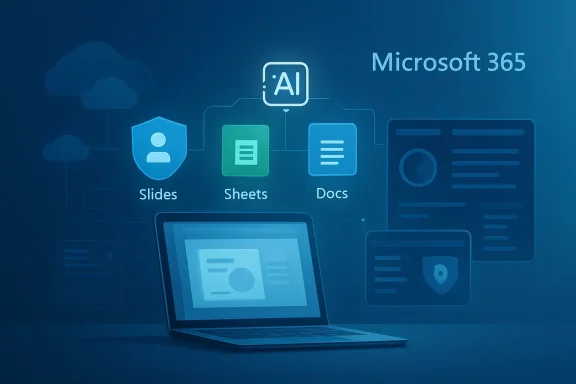
That is why this partnership matters more than a typical marketplace listing. Genspark says its Slides, Sheets, and Docs Agents are becoming native plugins inside Microsoft 365, letting users generate presentations, analyze data, and draft documents from within PowerPoint, Excel, and Word. In practical terms, the pitch is familiar: less context-switching, fewer browser tabs, and fewer half-finished exports from one tool into another.
But the strategic implication is sharper. Microsoft is telling the market that agentic AI will not mature as a collection of clever chat windows. It will mature as a managed layer inside enterprise workflows, with identity, permissions, compliance, telemetry, and procurement wrapped around it. The Office ribbon was once the user interface for productivity; now Microsoft wants the agent surface to become the new one.
For Genspark, the upside is obvious. Microsoft 365 is where enterprise attention already lives. Getting embedded there shortens the adoption path from “convince employees to try a new AI suite” to “approve an add-in and let users invoke it where the work already sits.”
Genspark Is Selling the Agent as a Coworker, Not a Feature
Genspark’s language is deliberately ambitious. CEO Eric Jing described the company’s vision as AI operating “as a true employee,” able to work across systems, files, and applications without being told where to go or how to begin. That phrasing will excite some executives and alarm plenty of administrators, which is exactly why Microsoft’s role in the partnership is so central.
An AI assistant that summarizes a document is a feature. An AI agent that can inspect files, create a presentation, query a spreadsheet, infer intent, and produce a deliverable starts to look like a workflow participant. Once software behaves less like a tool and more like a delegate, IT’s old comfort zones break down quickly.
That is the promise Genspark is bringing to Microsoft 365. In PowerPoint, it says users can create professional slides from prompts, use their own templates, draw from existing slide decks, and rely on built-in research, outlines, and AI editing. In Excel, it promises natural-language questions over data, along with analysis, charts, and insights without writing formulas. In Word, it offers context-aware drafting and editing for polished documents.
None of these claims is individually shocking in 2026. Copilot, Google Workspace AI, Notion, Salesforce, Adobe, and a long list of startups have been converging on the same idea for years. What makes this announcement more interesting is the distribution channel: Genspark is not merely competing against Microsoft’s apps. It is trying to live inside them.
Agent 365 Is the Governance Story Microsoft Needed
Microsoft introduced Agent 365 at Ignite 2025 as a management and governance layer for AI agents, not just as another Copilot feature. The pitch was straightforward: enterprises are about to have many agents, from Microsoft, third parties, open-source frameworks, and internal teams, and someone has to inventory, secure, monitor, and govern them. That someone, naturally, is Microsoft.
This is where the Genspark partnership moves from product news to platform news. Genspark says it plans to deepen integration with Agent 365, while Microsoft has positioned Agent 365 as a control plane that brings together tools such as Entra, Defender, Purview, and the Microsoft 365 admin center. The message to CIOs is that AI agents should be treated less like rogue SaaS subscriptions and more like identities with permissions.
That framing is important because agents are a different security animal from ordinary productivity add-ins. A classic add-in may read a document or call an API when the user clicks a button. An agent may reason across a corpus, invoke tools, chain actions, and produce outputs that look authoritative even when the underlying reasoning is flawed. The blast radius is larger because the software is explicitly designed to take initiative.
Microsoft’s advantage is that it already owns much of the enterprise trust fabric. Entra handles identity. Purview handles data governance and compliance. Defender handles security posture and threat detection. The Microsoft 365 admin center is already where admins expect to manage users, licenses, policies, and app access. If Agent 365 can bring agents into that same operational model, Microsoft has a credible answer to the most obvious enterprise objection: who is watching the bots?
Azure Is the Boring Part That Makes the Deal Work
Genspark also emphasizes that its agentic AI is built and deployed on Microsoft Azure. That detail may sound like routine cloud-partner boilerplate, but it is commercially important. Enterprise buyers are less interested in a demo than in whether a vendor can satisfy the ordinary, grinding requirements of scale, security, uptime, data residency, compliance, and procurement.
Azure gives Genspark a shortcut into that conversation. It does not magically settle every question about data handling or model behavior, but it lets the startup align itself with Microsoft’s enterprise cloud posture. That matters when the target customer is not an individual creator but a regulated company trying to decide whether AI-generated board materials, financial models, and client documents can safely move through a third-party system.
There is also a product-development angle. Genspark says Azure’s infrastructure is central to its ability to ship new capabilities quickly. That is the part of the announcement startup founders like to emphasize, because it signals velocity. But for enterprises, velocity is a double-edged word. Fast iteration is attractive only if IT can understand what changed, who can use it, what data it touches, and how to roll it back.
This is the tension Microsoft is trying to resolve. The company wants the pace of AI startups without the governance chaos of AI startups. Azure supplies the infrastructure story; Agent 365 supplies the administrative story; Microsoft 365 supplies the workflow story. Genspark supplies the agent layer Microsoft can showcase as evidence that the ecosystem is not merely theoretical.
The Marketplace Is Where Microsoft Converts Hype Into Procurement
Genspark’s planned expansion through the Microsoft Marketplace may be the least glamorous part of the announcement, but it could be the most consequential. Enterprises do not adopt software only because users like it. They adopt software because procurement can buy it, legal can review it, security can approve it, finance can track it, and admins can deploy it.
The Microsoft Marketplace is increasingly the route by which Microsoft turns partner ecosystems into enterprise sales motion. For a startup like Genspark, appearing there means access to customers that have already standardized large parts of their technology stack around Microsoft contracts and cloud commitments. For Microsoft, it means third-party agent adoption can reinforce Azure consumption and Microsoft 365 stickiness rather than siphon attention away.
That is the classic platform bargain. Microsoft gives the partner distribution and credibility. The partner gives Microsoft more reasons for customers to remain inside the Microsoft environment. If the agent economy becomes real, the winners will not only be the companies with the smartest models. They will be the companies that can make adoption feel administratively boring.
That may sound cynical, but it is how enterprise technology usually wins. The best product does not always beat the product that fits the procurement path, the compliance model, the user workflow, and the admin console. Microsoft knows this better than almost anyone.
The Office Apps Are Becoming Agent Habitats
PowerPoint, Excel, and Word are not just legacy productivity apps. They are the formats in which organizations think, persuade, measure, and remember. A company’s strategy is often a deck before it is a plan. Its operating reality is often a spreadsheet before it is a system of record. Its institutional memory is often a document before it is a database.
That gives agent vendors a powerful incentive to embed directly into Office. If an AI system wants to produce useful work, it needs to understand not just language but business artifacts. A slide deck has hierarchy, audience, brand constraints, prior versions, speaker intent, and political baggage. A spreadsheet contains formulas, assumptions, messy inputs, hidden tabs, and tacit rules that may never appear in documentation.
The challenge is that Office documents are deceptively complex. Generating a plausible slide is easy; generating a slide that respects a company’s template, tone, data lineage, and approval process is much harder. Producing a chart from a spreadsheet is easy; knowing whether the spreadsheet is trustworthy is not. Drafting a polished memo is easy; understanding whether it contradicts policy or exposes confidential information is the hard part.
This is why the “native” claim matters. If Genspark’s agents can operate with richer context inside Office, they may avoid some of the clumsiness that comes from uploading files into a separate AI tool. But native integration also raises the stakes. The closer an agent gets to live enterprise work, the less tolerance there is for hallucination, sloppy permissions, or invisible data movement.
Microsoft’s Partner Strategy Is Also a Defensive Move
Microsoft already has Copilot, Copilot Studio, Azure AI Foundry, and a sprawling AI partnership with OpenAI. So why elevate partners like Genspark? Because Microsoft cannot build every specialized agent itself, and because customers will not want a single-vendor monoculture for every AI workflow.
There is also a competitive defense here. If high-value AI work migrates to standalone agent platforms outside Microsoft 365, Microsoft risks losing the surface where work begins. The documents may still be stored in SharePoint and OneDrive, but the user’s attention, prompts, workflows, and automation logic could move elsewhere. That would be dangerous for a company whose enterprise power has long depended on owning the daily work surface.
By welcoming agent builders into Microsoft 365 and Agent 365, Microsoft is trying to make the ecosystem gravitational. The company does not need to own every agent if it owns the place where agents are discovered, governed, deployed, and invoked. In that world, even third-party innovation strengthens the Microsoft platform.
For Genspark, the Microsoft channel provides legitimacy in a crowded market. AI agent startups are easy to announce and hard to differentiate. A Microsoft partnership gives Genspark a clearer enterprise story: this is not a toy in a browser tab; it is an agent suite built on Azure and intended to operate inside the Microsoft estate.
The Sysadmin’s Problem Is No Longer Whether AI Arrives
For IT pros, the question is not whether users will bring AI into documents and spreadsheets. They already have. The question is whether those AI interactions happen through sanctioned, observable, policy-bound systems or through consumer tools, personal accounts, pasted data, and unmanaged browser extensions.
That is the uncomfortable truth behind the partnership. Microsoft and Genspark are selling productivity, but the admin audience will hear governance. If users can ask Excel questions in natural language and generate board-ready slides from company files, IT needs to know what data the agent can read, what it can retain, what it can send to external services, what logs exist, and how access maps to existing permissions.
Agent 365 is supposed to answer some of those questions, but the operational reality will depend on implementation details. Does an agent inherit the user’s permissions cleanly? Can administrators see which files or connectors it touched? Can sensitive information types be blocked or redacted? Can policies differ by department, geography, data class, or risk level? Can an agent be disabled instantly if something goes wrong?
Those are not edge cases. They are the conditions under which enterprises will move from pilot projects to broad deployment. AI agents that cannot be governed will be treated like security risks. AI agents that can be governed may become the next layer of enterprise workflow automation.
The Shadow IT Lesson Is Being Relearned at AI Speed
Every major enterprise platform shift has produced a shadow IT phase. Employees adopted cloud file sharing before companies standardized it. Teams bought SaaS tools before procurement caught up. Developers used open-source packages and APIs long before security teams built modern software supply-chain programs. AI is compressing that same pattern into months.
The difference is agency. A file-sharing app stored data. A SaaS tool structured a workflow. An AI agent can interpret a goal and act across multiple systems. That makes unmanaged adoption more dangerous because the system is no longer just a place where users put information; it is a participant that can transform information, infer intent, and trigger action.
Microsoft’s answer is to make sanctioned AI easier than unsanctioned AI. That is why embedding matters. If users can get powerful agents inside Word, Excel, and PowerPoint, the temptation to upload sensitive files into random web tools decreases. If admins can govern those agents through familiar Microsoft controls, the organization has a plausible path to saying yes instead of reflexively saying no.
But this only works if the user experience is good enough. Enterprise users will not choose a governed tool simply because it has better compliance posture. They will choose it if it is fast, useful, and available at the moment of need. Genspark’s challenge is therefore not only to satisfy IT, but to delight the analyst, consultant, manager, marketer, and executive who just wants the deck finished before the meeting.
The Copilot Question Hangs Over Everything
The obvious question for Microsoft watchers is how Genspark fits alongside Microsoft 365 Copilot. Microsoft has spent heavily to make Copilot the default AI layer for work. Yet this partnership suggests the company also sees room for specialized third-party agents inside the same environment.
That is not necessarily a contradiction. Copilot can be the broad interface, while partners provide domain-specific or workflow-specific agents. This mirrors the way Microsoft has long treated Office: the core apps are Microsoft’s, but add-ins, connectors, templates, and partner services extend them into vertical workflows. Agent 365 could become the administrative equivalent of that model for the AI era.
Still, the overlap will be real. If Genspark can create slides, analyze spreadsheets, and draft documents, users will compare it directly with Copilot. Microsoft may be comfortable with that if the competition happens inside its platform and on Azure. The company would rather have customers choose between Copilot and a Microsoft-integrated partner than watch them move critical workflows to an external AI workspace.
For customers, the best outcome is competition under governance. If Microsoft’s ecosystem approach works, organizations can evaluate agents on capability while retaining centralized control. If it fails, they will face a messy sprawl of overlapping assistants, inconsistent permissions, unclear data flows, and confused users.
The Language of “True Employee” Needs a Safety Manual
The idea of an AI agent as a “true employee” is powerful marketing, but enterprises should treat it carefully. Employees have training, accountability, managers, audit trails, disciplinary procedures, and legal status. Agents have models, prompts, tools, policies, logs, and failure modes. Confusing the two is a fast route to overtrust.
The better analogy may be a very capable intern with instant access to documents and no common sense unless the system supplies it. That does not make agents useless. It makes supervision essential. The highest-value deployments will likely be those where agents accelerate skilled workers rather than replace judgment outright.
This distinction matters in Office workflows because the outputs are so easy to accept. A well-formatted Word document looks credible. A polished PowerPoint deck looks executive-ready. A chart in Excel looks quantitative even if the underlying analysis is weak. AI’s danger in productivity software is not only that it may be wrong; it is that it may be wrong beautifully.
Microsoft and Genspark will need to make provenance, review, and control visible enough that users do not mistake fluency for correctness. That is harder than adding another button to the ribbon. It requires product design that nudges users toward verification without ruining the speed that made the agent attractive in the first place.
The Windows Angle Is the Return of the Managed Desktop
For WindowsForum readers, the partnership also fits a broader Microsoft direction: the managed desktop is becoming an AI execution environment. Microsoft has been talking about Windows, Microsoft 365, Copilot, and cloud PCs in increasingly agentic terms. The long-term vision is not just AI in a browser, but AI that can operate across applications under enterprise control.
That brings Windows back into the conversation in a subtle way. For years, the center of gravity seemed to move away from the OS and toward the browser. But if agents need secure access to local apps, virtual desktops, enterprise credentials, files, and policy-managed environments, Microsoft has a reason to reassert the importance of its client and cloud desktop stack.
Windows 365 for Agents, Agent 365, and Microsoft 365 integrations all point in the same direction. Microsoft wants agents to run where enterprise controls already exist, not in a consumer-style free-for-all. Genspark’s integration with Microsoft’s ecosystem gives that strategy another partner proof point.
The risk is that users experience this as more AI shoved into places they did not ask for. Microsoft has already faced skepticism from Windows users who see AI features as intrusive, cloud-dependent, or difficult to disable. The enterprise version of that concern is more sober but no less real: admins want control, licensing clarity, predictable behavior, and a clean opt-out path.
The Economics Will Decide How Fast This Becomes Normal
AI agents in Microsoft 365 will not be judged only on technical capability. They will be judged on cost. Microsoft 365 customers have already had to parse Copilot licensing, Azure consumption, premium connectors, security add-ons, and marketplace billing. Adding third-party agents may improve capability, but it may also make AI budgeting more complicated.
Genspark’s announcement does not settle that question. Availability through Microsoft Marketplace may simplify purchasing, but enterprises will still ask how pricing scales by user, usage, department, or workload. They will also ask whether agent-generated productivity is measurable enough to justify another AI line item.
This is where the hype around “one billion knowledge workers” collides with the mundane math of IT finance. A tool that saves ten minutes a week may not justify premium pricing. A tool that reliably automates hours of analysis, presentation building, and document drafting for expensive teams might. The value case will vary wildly by role.
Microsoft’s broader strategy is to make these tools feel like infrastructure. Once AI agents are managed like users, discovered through marketplace channels, embedded in productivity apps, and governed through admin consoles, they become easier to normalize as part of the enterprise stack. The commercial genius of Microsoft is that it turns new categories into renewals.
The Genspark Deal Shows Where the Agent Market Is Going
The Genspark-Microsoft partnership is not the final form of enterprise AI, but it is a useful snapshot of the direction of travel. The agent market is moving from standalone novelty toward embedded workflow, from open-ended chat toward task-specific deliverables, and from consumer-style experimentation toward enterprise governance.
That shift favors companies that can combine model orchestration with distribution and trust. Genspark says it orchestrates more than 70 AI models and can turn business objectives into deliverables such as presentations, financial models, client-ready documents, web applications, and mobile apps. Those claims are broad, but the Microsoft partnership narrows the immediate enterprise story to something more concrete: agents inside the productivity suite where workers already live.
The biggest unknown is execution. Native plugins can be transformative or forgettable. Agent marketplaces can become vibrant ecosystems or cluttered catalogs. Governance platforms can deliver clarity or become yet another dashboard. The announcement gives Microsoft and Genspark a credible narrative, but customers will decide whether the experience feels like a breakthrough or another layer of AI branding.
For now, the pattern is clear. AI agents are becoming less like destinations and more like embedded capabilities. The companies that win will not merely answer prompts; they will fit into the places where work is reviewed, approved, secured, and shipped.
The Slide Deck Is Now a Security Boundary
The concrete lesson for IT leaders is that productivity files can no longer be treated as passive artifacts. When agents can read, modify, summarize, remix, and act on them, documents become operational surfaces. That changes how organizations should think about access, classification, retention, and review.
The Genspark partnership puts that issue squarely inside Microsoft 365. If an agent can help build a financial model in Excel or a board presentation in PowerPoint, then the permissions and auditability around those files become part of the AI governance story. The familiar question “Who can open this document?” expands into “Which agent can reason over it, what can it do with the result, and who approved that behavior?”
That is why Agent 365 is more than a branding exercise. Microsoft is trying to define the administrative model before the agent sprawl becomes unmanageable. Genspark is betting that enterprises will prefer powerful agents delivered through that model instead of isolated tools with unclear governance.
This is the right direction, but it is not a guarantee. Admins should demand transparent controls, clear data-handling terms, meaningful logs, and the ability to segment access. Users should demand accuracy, speed, and outputs that can be inspected rather than blindly trusted. Vendors should assume that “agentic” is not a magic word that suspends enterprise due diligence.
The Microsoft 365 Agent Era Arrives One Add-In at a Time
The most useful way to read this announcement is not as a revolution, but as a normalization step. Genspark is not asking enterprises to abandon Microsoft 365 for an AI workspace. It is asking them to let agents enter the Microsoft 365 workflow under Microsoft’s cloud and governance umbrella.
That makes the news both more modest and more important. Most enterprise technology changes do not arrive as a single dramatic cutover. They arrive as add-ins, admin previews, marketplace listings, security integrations, pilot programs, and procurement approvals. Then, one day, the new layer is simply part of how work gets done.
For WindowsForum’s audience, the near-term checklist is practical:
- Organizations should treat Microsoft 365 AI agents as governed enterprise applications, not as harmless document helpers.
- Admins should evaluate Genspark and similar agents based on permissions, logging, data handling, tenant controls, and rollback options as much as output quality.
- Users should expect the best agent experiences to appear inside familiar apps rather than in separate AI destinations.
- Microsoft’s Agent 365 strategy is designed to make third-party agents manageable through the same trust fabric that already governs users, devices, data, and apps.
- The real competitive battle is not simply Copilot versus other agents, but unmanaged AI workflows versus governed AI inside the Microsoft ecosystem.
The Genspark-Microsoft partnership is a reminder that the next phase of AI at work will be won in the least glamorous places: admin centers, procurement catalogs, compliance policies, Office add-ins, and the everyday files where companies make decisions. If Microsoft can make agents feel native without making them feel uncontrolled, it will have turned the chaos of AI experimentation into another enterprise platform. If it cannot, the future of work may still be agentic — but it will also be messy, expensive, and much harder for IT to trust.