

Getac announced on June 3, 2026, that its ZX80 family of 8-inch rugged tablets will expand in July with the Windows 11-based ZX80W, a fanless ARM device using Qualcomm’s QCS6490 platform for field computing. That sounds like a niche product announcement, and in unit volume it probably is. But the ZX80W is more interesting as a signal: Windows on Arm is no longer being pitched only as a premium-laptop battery-life story. It is being pushed into the places where Windows has historically been both indispensable and awkward — the back of a utility truck, the logistics yard, the defense workflow, and the industrial site where Android is nimble but Windows remains the system of record.
The rugged tablet market has never cared much for consumer-computing fashion. A device either survives the shift or it does not. It either runs the required line-of-business software, reads in sunlight, tolerates gloves and rain, and keeps working away from a charger — or it becomes another expensive procurement lesson.
That is why the ZX80W matters. Getac is not selling Windows on Arm as a thin-and-light laptop convenience. It is selling it as an answer to a practical field problem: organizations want the manageability, security model, and software base of Windows, but they do not always want the weight, heat, fan noise, and battery penalties associated with traditional x86 rugged tablets.
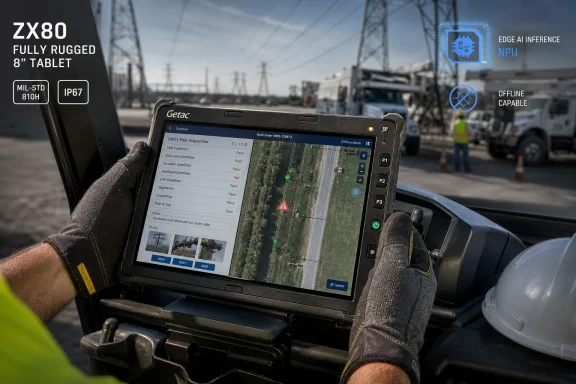
The company’s pitch is straightforward. The ZX80W uses Qualcomm’s QCS6490 platform, includes 12GB of LPDDR5 memory and 256GB of UFS storage, and runs Windows 11 IoT Enterprise LTSC in a compact 8-inch chassis. It is fanless, weighs about 1.3 pounds, and is built for environments where dropping a device six feet is not a warranty nightmare but an operational assumption.
The larger story is not that Getac found a way to put Windows into a smaller rugged tablet. The larger story is that Microsoft’s long, uneven Windows-on-Arm campaign is now mature enough for vendors to build highly specific industrial products around it.
For years, that tension pushed buyers into uncomfortable choices. A larger x86 Windows tablet could run legacy apps and management tools, but it often carried the thermal and power baggage of a PC. An Android rugged tablet could be lighter and more battery-efficient, but it might require app rewrites, workflow compromises, or parallel device-management practices.
The ZX80W is Getac’s attempt to collapse that split. It brings Windows 11 IoT Enterprise LTSC into a form factor that behaves more like the Android side of the aisle: small, light, sealed, power-conscious, and designed around always-outside use. That does not make it a universal replacement for every rugged Windows machine, but it does make the trade-off less binary.
Windows 11 IoT Enterprise LTSC is an important part of the positioning. This is not a consumer Windows tablet chasing the latest feature wave. LTSC exists for fixed-purpose and specialized devices where stability, long support windows, and predictable servicing matter more than constant interface churn.
That makes the ZX80W less of a gadget and more of a managed endpoint. In the environments Getac is targeting — utilities, transportation and logistics, and defense — that distinction matters.
A fanless design is more than an aesthetic choice in field hardware. Fans pull in dust, add failure points, complicate sealing, and struggle in punishing environments. Removing the fan helps the device meet the physical expectations of a rugged tablet, but it also raises the bar for the silicon underneath.
This is where ARM’s advantage becomes operational. Lower heat and lower power draw let Getac design around endurance and portability without giving up the Windows environment its customers still need. The result is a Windows device that is less burdened by the usual Windows-device assumptions.
The ZX80W’s quoted operating range, from -20°F to 145°F, is also a reminder that rugged computers are engineered for conditions consumer devices merely disclaim. The sunlight-readable display, IP67 rating, MIL-STD-810H certification, vibration resistance, and six-foot drop resistance are not decoration. They are the reason such products exist.
The interesting question is whether ARM allows more Windows devices to move into physical categories where Android has had the ergonomic advantage. Getac clearly believes the answer is yes.
But in Getac’s case, the AI angle is less silly than it may sound. Field environments are precisely where local inference can be useful, because connectivity is not guaranteed and latency can be more than an inconvenience. If a tablet is being used for inspection, asset management, drone support, logging, or situational awareness, the ability to process information at the edge can matter.
Getac points to scenarios such as UAV flight control in utility environments, predictive asset management, and electronic logging devices in transportation and logistics. These are not consumer AI use cases. They are workflows where the device may need to recognize, classify, alert, or assist without waiting on a stable cloud link.
That distinction is crucial. The ZX80W is not compelling because it might run a chatbot in a hard hat. It is compelling because the same NPU marketing that feels ornamental in a consumer laptop can be practical in a disconnected or bandwidth-constrained environment.
Still, buyers should be careful. “AI-ready” does not mean a field organization automatically has useful AI workflows, trained models, compliant data pipelines, or validated automation. Hardware makes local inference possible; it does not make the business case by itself.
For ordinary productivity software, Windows on Arm is increasingly credible. For specialized operational environments, credibility is earned one dependency at a time. An app that runs is not necessarily an app that runs acceptably under field conditions, with the right peripherals, inside the right management stack, under the right security policy.
This is where the ZX80W’s use of Windows 11 IoT Enterprise LTSC cuts both ways. On one hand, LTSC is attractive to enterprise and industrial buyers because it prioritizes stability and long-term servicing. On the other hand, specialized images and locked-down deployments make pre-purchase validation even more important.
The selling point is that organizations can keep Windows as the application and management target while moving to a more mobile hardware profile. The caveat is that Windows compatibility is not magic when the underlying architecture changes. Native Arm64 support, emulated app behavior, driver availability, and vendor certification all matter.
That is not a reason to dismiss the ZX80W. It is a reason to treat it like infrastructure, not like a tablet purchase.
In the field, an 8-inch tablet is not trying to replace a laptop for spreadsheet marathons. It is trying to show maps, forms, checklists, diagnostics, dispatch details, asset records, video feeds, or workflow prompts. It needs to be held in one hand, mounted in a vehicle, clipped to gear, passed between workers, and used while standing.
That is why the ZX80W’s size is important. It suggests Windows is being adapted to a task-specific mobility role rather than shoved into a consumer tablet dream that never quite worked. The device is Windows because the organization needs Windows, not because the user wants a miniature desktop.
Getac’s pitch that the ZX80W combines Windows security and app compatibility with Android-like mobility is, unsurprisingly, vendor language. But it captures a real procurement desire. Many organizations would prefer not to maintain one stack for rugged Android endpoints and another for rugged Windows endpoints if a single Windows device can meet the mobility requirement.
The device’s 12GB of memory and 256GB of storage also point to a practical baseline. This is not a stripped-down terminal pretending to be a PC. It is meant to multitask, store data locally, and keep operating when the network becomes unreliable.
That matters because field devices are not just computers. They are inventory assets, security risks, compliance surfaces, update targets, and support tickets waiting to happen. A rugged Android tablet may be perfectly capable for a given job, but it can introduce another management lane if the rest of the organization is standardized around Windows.
A Windows 11 IoT Enterprise LTSC device gives IT departments a familiar policy and servicing model, provided the vendor image and management tooling fit the organization’s existing practices. It may simplify application delivery, authentication, endpoint protection, and lifecycle planning. It may also reduce the number of custom mobile workflows needed to bridge Windows back-office systems and field operations.
But the word “may” is doing work. Rugged devices are often purchased into vertical-specific environments with specialized software vendors and long hardware refresh cycles. The practical win depends on whether those vendors support Windows on Arm cleanly and whether the organization’s security tooling behaves as expected.
That is why the ZX80W should not be read as a mass-market Windows-on-Arm victory lap. It is something more targeted and perhaps more meaningful: a sign that Windows on Arm is becoming boring enough to deploy in serious niches.
Hazardous-location computing has strict design constraints. Devices used around flammable gases, vapors, dust, or industrial hazards must be engineered in ways that go far beyond ordinary ruggedness. A platform that can deliver Windows functionality with lower heat and sealed operation is naturally attractive in that category.
This is another reason ARM is a structural choice rather than a marketing choice. Less heat and fewer moving parts are not merely nice-to-have attributes when the device is destined for harsh or regulated environments. They can influence what kinds of certifications and deployments are feasible.
The EX variant also underlines the split between consumer and industrial innovation. Consumer technology often treats thinness and battery life as comfort features. Industrial technology turns the same attributes into risk reduction, uptime, and compliance.
That is where the Windows-on-Arm story becomes more persuasive. It is not trying to convince a gamer to accept a compatibility footnote. It is trying to help a utility, logistics operator, or defense customer carry Windows into places where conventional Windows hardware was heavier, hotter, or less convenient.
Products like the ZX80W suggest a different path to relevance. Windows on Arm does not need to replace x86 across the enterprise to matter. It needs to win where ARM’s strengths map cleanly to the job: battery life, thermals, sealed designs, standby behavior, integrated connectivity, and local AI acceleration.
That is especially true in edge computing. The endpoint is no longer just a screen attached to a database. It may be a sensor hub, an inference device, a communications node, a workflow terminal, and a security boundary. In those scenarios, a low-power Windows device that can run local workloads and remain manageable by IT has obvious appeal.
The irony is that rugged deployments may be less emotionally attached to x86 than some desktop users are. If the certified application stack works, the device survives, and the support model is sound, the processor architecture may be invisible to the worker holding it. That invisibility is what Windows on Arm has always needed.
The ZX80W therefore represents a more mature kind of Arm adoption. It is not asking users to admire the architecture. It is asking IT departments to approve the outcome.
The most concrete takeaways are practical rather than glamorous:
 Getac Puts Windows on Arm Where Battery Life Is Not a Lifestyle Feature
The rugged tablet market has never cared much for consumer-computing fashion. A device either survives the shift or it does not. It either runs the required line-of-business software, reads in sunlight, tolerates gloves and rain, and keeps working away from a charger — or it becomes another expensive procurement lesson.That is why the ZX80W matters. Getac is not selling Windows on Arm as a thin-and-light laptop convenience. It is selling it as an answer to a practical field problem: organizations want the manageability, security model, and software base of Windows, but they do not always want the weight, heat, fan noise, and battery penalties associated with traditional x86 rugged tablets.
The company’s pitch is straightforward. The ZX80W uses Qualcomm’s QCS6490 platform, includes 12GB of LPDDR5 memory and 256GB of UFS storage, and runs Windows 11 IoT Enterprise LTSC in a compact 8-inch chassis. It is fanless, weighs about 1.3 pounds, and is built for environments where dropping a device six feet is not a warranty nightmare but an operational assumption.
The larger story is not that Getac found a way to put Windows into a smaller rugged tablet. The larger story is that Microsoft’s long, uneven Windows-on-Arm campaign is now mature enough for vendors to build highly specific industrial products around it.
The Rugged Tablet Has Always Been a Compromise Machine
Rugged computing is full of compromises that consumer buyers rarely see. A warehouse supervisor, field engineer, utility inspector, or defense contractor may need Windows because the enterprise stack demands it, but the physical job may be better suited to a handheld Android tablet. The form factor wants mobility; the software estate wants Windows.For years, that tension pushed buyers into uncomfortable choices. A larger x86 Windows tablet could run legacy apps and management tools, but it often carried the thermal and power baggage of a PC. An Android rugged tablet could be lighter and more battery-efficient, but it might require app rewrites, workflow compromises, or parallel device-management practices.
The ZX80W is Getac’s attempt to collapse that split. It brings Windows 11 IoT Enterprise LTSC into a form factor that behaves more like the Android side of the aisle: small, light, sealed, power-conscious, and designed around always-outside use. That does not make it a universal replacement for every rugged Windows machine, but it does make the trade-off less binary.
Windows 11 IoT Enterprise LTSC is an important part of the positioning. This is not a consumer Windows tablet chasing the latest feature wave. LTSC exists for fixed-purpose and specialized devices where stability, long support windows, and predictable servicing matter more than constant interface churn.
That makes the ZX80W less of a gadget and more of a managed endpoint. In the environments Getac is targeting — utilities, transportation and logistics, and defense — that distinction matters.
ARM Is the Thermal Strategy, Not Just the Processor Choice
The Qualcomm QCS6490 is not the same conversation as a Snapdragon X Elite laptop chip chasing MacBook comparisons. It is an IoT and edge-focused platform, and Getac is leaning on its performance-per-watt rather than raw benchmark theater. In a rugged tablet, power efficiency is not a spec-sheet flourish; it determines whether the device can remain sealed, fanless, cool enough to hold, and useful through a long shift.A fanless design is more than an aesthetic choice in field hardware. Fans pull in dust, add failure points, complicate sealing, and struggle in punishing environments. Removing the fan helps the device meet the physical expectations of a rugged tablet, but it also raises the bar for the silicon underneath.
This is where ARM’s advantage becomes operational. Lower heat and lower power draw let Getac design around endurance and portability without giving up the Windows environment its customers still need. The result is a Windows device that is less burdened by the usual Windows-device assumptions.
The ZX80W’s quoted operating range, from -20°F to 145°F, is also a reminder that rugged computers are engineered for conditions consumer devices merely disclaim. The sunlight-readable display, IP67 rating, MIL-STD-810H certification, vibration resistance, and six-foot drop resistance are not decoration. They are the reason such products exist.
The interesting question is whether ARM allows more Windows devices to move into physical categories where Android has had the ergonomic advantage. Getac clearly believes the answer is yes.
The AI Story Is Really an Offline Story
The ZX80W is being marketed as AI-ready, with Qualcomm’s sixth-generation AI Engine and Hexagon NPU handling neural workloads. In 2026, almost every hardware announcement needs an AI paragraph, and rugged computing is no exception. The risk is that “AI-ready” becomes the new “cloud-enabled” — technically true, commercially vague, and often several steps ahead of actual deployment.But in Getac’s case, the AI angle is less silly than it may sound. Field environments are precisely where local inference can be useful, because connectivity is not guaranteed and latency can be more than an inconvenience. If a tablet is being used for inspection, asset management, drone support, logging, or situational awareness, the ability to process information at the edge can matter.
Getac points to scenarios such as UAV flight control in utility environments, predictive asset management, and electronic logging devices in transportation and logistics. These are not consumer AI use cases. They are workflows where the device may need to recognize, classify, alert, or assist without waiting on a stable cloud link.
That distinction is crucial. The ZX80W is not compelling because it might run a chatbot in a hard hat. It is compelling because the same NPU marketing that feels ornamental in a consumer laptop can be practical in a disconnected or bandwidth-constrained environment.
Still, buyers should be careful. “AI-ready” does not mean a field organization automatically has useful AI workflows, trained models, compliant data pipelines, or validated automation. Hardware makes local inference possible; it does not make the business case by itself.
Windows Compatibility Is Better, but Drivers Still Decide the Deployment
The most important sentence in any Windows-on-Arm procurement discussion is still the least glamorous: test your applications and drivers. Windows 11 on Arm has come a long way, and emulation has improved substantially, but rugged deployments often depend on peripherals, custom drivers, device agents, security tools, VPN clients, smart-card readers, scanners, radios, and legacy installers. Those are exactly the places where architecture transitions can expose hidden assumptions.For ordinary productivity software, Windows on Arm is increasingly credible. For specialized operational environments, credibility is earned one dependency at a time. An app that runs is not necessarily an app that runs acceptably under field conditions, with the right peripherals, inside the right management stack, under the right security policy.
This is where the ZX80W’s use of Windows 11 IoT Enterprise LTSC cuts both ways. On one hand, LTSC is attractive to enterprise and industrial buyers because it prioritizes stability and long-term servicing. On the other hand, specialized images and locked-down deployments make pre-purchase validation even more important.
The selling point is that organizations can keep Windows as the application and management target while moving to a more mobile hardware profile. The caveat is that Windows compatibility is not magic when the underlying architecture changes. Native Arm64 support, emulated app behavior, driver availability, and vendor certification all matter.
That is not a reason to dismiss the ZX80W. It is a reason to treat it like infrastructure, not like a tablet purchase.
The Eight-Inch Form Factor Changes the Windows Conversation
There is something almost countercultural about an 8-inch Windows device in 2026. The consumer market largely abandoned tiny Windows tablets years ago, and for good reason: desktop UI conventions, touch ergonomics, and cramped productivity apps made them awkward for general use. But rugged computing has different assumptions.In the field, an 8-inch tablet is not trying to replace a laptop for spreadsheet marathons. It is trying to show maps, forms, checklists, diagnostics, dispatch details, asset records, video feeds, or workflow prompts. It needs to be held in one hand, mounted in a vehicle, clipped to gear, passed between workers, and used while standing.
That is why the ZX80W’s size is important. It suggests Windows is being adapted to a task-specific mobility role rather than shoved into a consumer tablet dream that never quite worked. The device is Windows because the organization needs Windows, not because the user wants a miniature desktop.
Getac’s pitch that the ZX80W combines Windows security and app compatibility with Android-like mobility is, unsurprisingly, vendor language. But it captures a real procurement desire. Many organizations would prefer not to maintain one stack for rugged Android endpoints and another for rugged Windows endpoints if a single Windows device can meet the mobility requirement.
The device’s 12GB of memory and 256GB of storage also point to a practical baseline. This is not a stripped-down terminal pretending to be a PC. It is meant to multitask, store data locally, and keep operating when the network becomes unreliable.
The Enterprise Value Is in Manageability, Not Novelty
For WindowsForum readers, the most interesting question may be how a device like this fits into the broader Windows endpoint estate. The answer is not “AI tablet.” The answer is “managed Windows endpoint in a place where a managed Windows endpoint used to be physically inconvenient.”That matters because field devices are not just computers. They are inventory assets, security risks, compliance surfaces, update targets, and support tickets waiting to happen. A rugged Android tablet may be perfectly capable for a given job, but it can introduce another management lane if the rest of the organization is standardized around Windows.
A Windows 11 IoT Enterprise LTSC device gives IT departments a familiar policy and servicing model, provided the vendor image and management tooling fit the organization’s existing practices. It may simplify application delivery, authentication, endpoint protection, and lifecycle planning. It may also reduce the number of custom mobile workflows needed to bridge Windows back-office systems and field operations.
But the word “may” is doing work. Rugged devices are often purchased into vertical-specific environments with specialized software vendors and long hardware refresh cycles. The practical win depends on whether those vendors support Windows on Arm cleanly and whether the organization’s security tooling behaves as expected.
That is why the ZX80W should not be read as a mass-market Windows-on-Arm victory lap. It is something more targeted and perhaps more meaningful: a sign that Windows on Arm is becoming boring enough to deploy in serious niches.
The Hazardous-Location Variant Shows Where This Platform Wants to Go
Getac is also introducing the ZX80W-EX in some markets, a variant aimed at hazardous or potentially explosive environments with ATEX and IECEx Zone 2/22 certification. Even if the standard ZX80W is the product most readers will encounter first, the existence of the EX model helps explain the strategy. This platform is not about casual field mobility; it is about specialized deployment.Hazardous-location computing has strict design constraints. Devices used around flammable gases, vapors, dust, or industrial hazards must be engineered in ways that go far beyond ordinary ruggedness. A platform that can deliver Windows functionality with lower heat and sealed operation is naturally attractive in that category.
This is another reason ARM is a structural choice rather than a marketing choice. Less heat and fewer moving parts are not merely nice-to-have attributes when the device is destined for harsh or regulated environments. They can influence what kinds of certifications and deployments are feasible.
The EX variant also underlines the split between consumer and industrial innovation. Consumer technology often treats thinness and battery life as comfort features. Industrial technology turns the same attributes into risk reduction, uptime, and compliance.
That is where the Windows-on-Arm story becomes more persuasive. It is not trying to convince a gamer to accept a compatibility footnote. It is trying to help a utility, logistics operator, or defense customer carry Windows into places where conventional Windows hardware was heavier, hotter, or less convenient.
Microsoft’s Arm Bet Looks Different Outside the Laptop Aisle
Microsoft’s Windows-on-Arm history has been messy enough to make skepticism healthy. There were years of underpowered devices, confusing app compatibility, and promises that sounded better in keynote form than in daily use. The Snapdragon X-era consumer push improved the narrative, but laptops are only one part of the Windows ecosystem.Products like the ZX80W suggest a different path to relevance. Windows on Arm does not need to replace x86 across the enterprise to matter. It needs to win where ARM’s strengths map cleanly to the job: battery life, thermals, sealed designs, standby behavior, integrated connectivity, and local AI acceleration.
That is especially true in edge computing. The endpoint is no longer just a screen attached to a database. It may be a sensor hub, an inference device, a communications node, a workflow terminal, and a security boundary. In those scenarios, a low-power Windows device that can run local workloads and remain manageable by IT has obvious appeal.
The irony is that rugged deployments may be less emotionally attached to x86 than some desktop users are. If the certified application stack works, the device survives, and the support model is sound, the processor architecture may be invisible to the worker holding it. That invisibility is what Windows on Arm has always needed.
The ZX80W therefore represents a more mature kind of Arm adoption. It is not asking users to admire the architecture. It is asking IT departments to approve the outcome.
The Procurement Lesson Hidden Inside Getac’s July Launch
The ZX80W is scheduled for July availability, which means interested organizations should treat the launch window as the beginning of evaluation, not the end of decision-making. Rugged devices tend to live long, expensive lives. A mistake made during pilot testing can echo through years of accessories, mounts, spares, training, and support contracts.The most concrete takeaways are practical rather than glamorous:
- The ZX80W brings Windows 11 IoT Enterprise LTSC to an 8-inch fully rugged tablet powered by Qualcomm’s ARM-based QCS6490 platform.
- The device’s main argument is endurance and mobility, not raw PC performance, with a fanless design aimed at field environments where charging and cooling are real constraints.
- Its AI hardware is most relevant for offline or edge workflows such as inspection, asset monitoring, logistics, and field automation.
- Windows-on-Arm compatibility should be validated against line-of-business applications, drivers, security agents, VPNs, peripherals, and deployment tools before any broad rollout.
- The product is best understood as a managed industrial endpoint, not as a consumer-style Windows tablet revival.
Rugged Windows Finally Gets a Smaller Envelope
The ZX80W will not make Windows on Arm mainstream by itself, and it is not supposed to. Its importance lies in showing that Arm-based Windows devices are moving beyond the familiar laptop argument and into specialized machines where the architecture’s advantages are easier to justify. If Getac and its software partners can make the compatibility story boring, the next phase of Windows on Arm may be defined less by benchmark charts and more by devices that quietly survive a full shift in places ordinary PCs were never meant to go.References
- Primary source: Equipment World
Published: Fri, 26 Jun 2026 16:15:52 GMT
Getac ZX80W Rugged Windows 11 Tablet Adds AI, ARM Power | Equipment World
Getac's new ZX80W rugged tablet combines Windows 11, AI edge computing, ARM efficiency and a 1.3-pound design for demanding field applications. www.equipmentworld.com
- Related coverage: getac.com
Getac’s new 8-inch ZX80W and ZX80W-EX tablets blend Windows 11 functionality with energy-efficient fanless design, for all-day productivity in the field|Getac
With the launch of the ZX80W and ZX80W-EX tablets, Getac is meeting growing customer demand for power-efficient, fanless rugged solutions running the Windows 11 operating system (OS), that can be used in a wide range of industrial environments and scenarios, such as those found in the defence...www.getac.com - Related coverage: prnewswire.com
Getac's new 8-inch ZX80W tablet blends Windows 11 functionality with energy-efficient fanless design for all-day productivity in the field
Compact and lightweight form factor meets powerful edge AI performance in Getac's versatile new offering, built on ARM architecture News in brief: Getac is... www.prnewswire.com
- Related coverage: techradar.com
Getac launches rugged Windows tablets that look like smartphones and survive explosions, drops, and extreme industrial field conditions worldwide | TechRadar
Getac’s ZX80W-EX tablet runs Win11 and can survive in explosive zoneswww.techradar.com - Related coverage: techenet.com
- Related coverage: windowsforum.com
getac zx80w | Windows Forum
Getac ZX80W is a rugged 8-inch Windows 11 on Arm tablet for field work. Learn about its Qualcomm ARM processor, fanless design, and hazardous-location ZX80W-EX.windowsforum.com
- Official source: learn.microsoft.com
Windows IoT FAQ | Microsoft Learn
Frequently asked questions (FAQ) about Windows IoT.learn.microsoft.com - Related coverage: windowscentral.com
Microsoft states that x64 emulation is only available on Windows 11 on ARM PCs | Windows Central
To utilize x64 emulation, people will need their PC to run Windows 11 on ARM. Microsoft discussed the status of x64 emulation alongside several major pieces of Windows news.www.windowscentral.com - Official source: developer.microsoft.com
Windows Apps on Arm | Microsoft Developer
Windows PCs with Arm chip processors offer stronger battery life, cellular connectivity, and new AI-focused devices.developer.microsoft.com - Official source: support.microsoft.com
Windows Arm-based PCs FAQ | Microsoft Support
Learn about using a Windows Arm-based PC and get answers to common questions about Arm-based PCs.support.microsoft.com - Related coverage: tomshardware.com
Xbox app is now available on all Arm-based Windows 11 devices — Microsoft says ‘more than 85% of Game Pass catalog is compatible with these PCs’ | Tom's Hardware
This move opens gaming to Snapdragon X-powered laptops.www.tomshardware.com - Related coverage: arrow.com
