

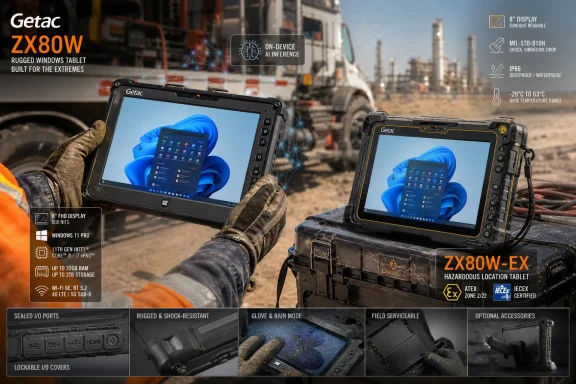
Getac announced on June 3, 2026, that its ZX80 family of eight-inch rugged tablets will expand in July with the Windows 11-powered ZX80W and hazardous-location ZX80W-EX, both built around Qualcomm’s QCS6490 Arm platform for fanless field computing. The news is not just another rugged-tablet refresh. It is a small but telling sign that Windows on Arm is moving out of the conference keynote and into the mud, heat, vibration, and certification-heavy world where hardware gets judged by uptime rather than elegance. For Windows shops, the interesting part is not that Getac made a tougher tablet; it is that Getac thinks Windows 11 on Arm is now credible enough for frontline operations.
The eight-inch rugged tablet has typically been Android’s home turf. That is not because Android is inherently more industrial, but because it scales down well: low-power chips, long battery life, integrated mobile radios, quick touch-first interfaces, and relatively simple application deployment for scanner, inspection, logistics, and field-service workflows.
Windows has often entered that same conversation with baggage. It brings a larger software universe, more familiar management, and deep enterprise integration, but also a reputation for needing more thermal headroom, more battery, more storage, and more patience from users holding a device in one hand while standing beside a vehicle, valve, aircraft, transformer, or warehouse rack.
The ZX80W series is Getac’s attempt to collapse that tradeoff. The pitch is straightforward: keep the compact, sealed, fanless hardware profile that field teams like, but give IT departments Windows 11 IoT Enterprise LTSC, enterprise security tooling, and compatibility with existing Windows workflows. If that sounds like a compromise, it is. But in rugged computing, compromise is the product.
The device is also a reminder that the Windows endpoint category is fragmenting. Not every Windows device is a laptop, not every AI-capable machine is a Copilot+ PC, and not every Arm system is trying to be a MacBook rival. Some are tools with handles, sealed ports, glove-friendly screens, barcode accessories, and certification paperwork thicker than the marketing brochure.
That matters because rugged designs punish heat. A consumer tablet can use thinness, glass, airflow, and short performance bursts to manage thermals. A field tablet may be sealed against dust and water, used in sunlight, mounted in a vehicle, dropped on concrete, wiped down, left in a hot service truck, or operated in freezing conditions with gloves.
Fans are liabilities in that world. They move air, and air carries dust, moisture, and failure points. A fanless Windows tablet is therefore not merely quieter; it is easier to seal, easier to certify, and easier to trust in places where maintenance windows are expensive.
This is the less glamorous side of Windows on Arm, but it may be the more important one. The consumer PC conversation tends to focus on benchmark charts, app translation, and whether Arm laptops can finally compete with x86 ultrabooks. Getac is asking a different question: can Arm make Windows small enough, cool enough, and efficient enough to survive in form factors where x86 has always been awkward?
LTSC matters because industrial buyers dislike surprise. A warehouse scanner, refinery inspection device, vehicle-mounted logistics terminal, or utility field tablet cannot behave like a consumer laptop chasing the next feature wave. It needs security fixes, predictable behavior, and a stable application environment over years, not a parade of UI changes arriving at inconvenient moments.
Microsoft’s IoT Enterprise LTSC model fits that reality better than standard Windows servicing. Windows 11 IoT Enterprise LTSC 2024 is aligned with the Windows 11 24H2 generation and carries a 10-year support lifecycle, which is exactly the kind of promise that rugged-device buyers understand. In this market, a device is not bought for the next eighteen months; it is often bought for a fleet, a contract, a compliance regime, or an operational refresh cycle measured in years.
That does not make LTSC magic. It can also mean fewer consumer conveniences, slower access to new Windows features, and a more deliberate app environment. But for Getac’s audience, that is not a bug. It is the whole point.
Windows 11 on Arm can run native Arm applications and can emulate many x86 and x64 applications. Microsoft has also pushed Arm64EC as a way for developers to mix native Arm code and emulated x64 code within the same process, giving software vendors a migration bridge rather than a cliff. That matters in industrial settings, where applications may be old, bespoke, poorly documented, or tied to specific peripherals.
Still, “runs Windows” and “runs your Windows deployment without friction” are not the same sentence. Drivers, VPN clients, endpoint agents, scanner middleware, serial adapters, smart-card systems, calibration tools, and line-of-business applications all need validation. An Arm Windows tablet may pass the brochure test and still fail the pilot if one critical component assumes x86.
For Getac’s likely customers, this is manageable but not ignorable. The ZX80W is not a device to buy by the pallet because the spec sheet looks modern. It is a device to test against the exact image, exact management stack, exact accessories, and exact field applications that workers already use.
In field work, local processing is not just about latency. It is about resilience. A tablet used for inspections, drone support, predictive maintenance, or industrial monitoring may spend much of its life in places with weak networks, expensive connectivity, or strict data-handling requirements. Sending every image, sensor reading, or event stream to the cloud is not always practical.
On-device inference changes the workflow. A utility crew can classify equipment conditions at the edge. A logistics operation can process visual or sensor data locally before syncing. A hazardous-site technician can receive assisted decision support without waiting for a stable uplink. None of this requires the tablet to become a science-fiction machine; it simply needs to reduce the number of times field work stops because the network disappeared.
The caution is that “AI-ready” is not the same as “AI-transformed.” Rugged customers will care less about demos and more about validated models, maintainable software, battery impact, thermal consistency, and auditability. Edge AI becomes valuable only when it is tied to a specific workflow with measurable savings in time, error rates, safety, or downtime.
This distinction matters. Ruggedness is often described in dramatic terms: drops, vibration, water, dust, and temperature extremes. Hazardous-location certification is different. It is about whether equipment can be used safely where a spark, heat source, or electrical fault could have consequences far beyond a broken screen.
Getac says the EX version includes additional physical protections such as thicker display glass, reinforced protective structures, secured port covers, and specialized sealing. Those details are not ornamental. In hazardous industries, physical design and certification are inseparable; a port cover is not just a port cover when the device may be used near dust or vapors.
The EX model also weighs more. At 780 grams, it is heavier than the standard ZX80W’s 590 grams, and its supported operating temperature range is narrower at -21°C to 55°C versus -29°C to 63°C for the non-EX model. That is the kind of tradeoff industrial buyers expect: more safety certification and protection, less absolute flexibility.
The display is eight inches, sunlight-readable, and designed for outdoor work. The chassis meets MIL-STD-810H and IP67 ratings, with drop resistance up to 1.8 meters. The standard ZX80W operates across a broad -29°C to 63°C temperature range, which matters more to a utility crew or military logistics team than a synthetic CPU score.
That is why the “small Windows tablet” angle should not be dismissed. A full-size rugged laptop is powerful but cumbersome. A 10- or 12-inch rugged tablet gives more screen space but can become tiring in continuous handheld work. An eight-inch Windows device sits in a narrow but useful gap: large enough for Windows applications and field forms, small enough to carry all day.
The danger, as always, is usability. Windows applications designed for a mouse, keyboard, and 14-inch display can be miserable on an eight-inch touch screen. Getac can solve the hardware problem, but customers and software vendors still have to solve the interface problem.
Enterprise and industrial buyers do not need Arm to win every benchmark. They need it to solve specific problems: heat, battery life, weight, sealed design, mobile connectivity, and lifecycle stability. If it does that while preserving enough Windows compatibility, the platform can succeed in niches long before it becomes universal.
This is how many enterprise shifts actually happen. They do not arrive as a sudden revolution across the whole fleet. They begin in constrained environments where the old architecture is an imperfect fit and the new one has a practical advantage. Over time, the exception becomes a supported pattern.
Getac’s move also gives Microsoft a stronger argument for Windows in frontline computing. If Android owns the handheld field device and iOS owns some premium mobile workflows, Windows has to justify itself beyond familiarity. Windows on Arm plus IoT LTSC plus rugged certification is one such argument: not glamorous, but coherent.
That pilot should be ruthless. Test the management stack. Test application compatibility. Test offline workflows. Test VPN and zero-trust agents. Test barcode scanners, docks, vehicle mounts, gloves, styluses, cameras, cellular connectivity, smart cards, and any weird peripheral that only one department remembers exists. Test battery life not in a lab, but across an actual shift.
The Arm transition makes this discipline more important, not less. A Windows rugged tablet that fails one driver dependency may become an expensive exception. A Windows rugged tablet that passes those checks may let an organization consolidate around familiar Windows tooling while moving into smaller, cooler, more mobile hardware.
Security teams should also pay attention. A field tablet is often both physically exposed and operationally privileged. It may access plant systems, customer data, maintenance records, maps, credentials, or regulated workflows. Windows 11 IoT Enterprise LTSC gives administrators a strong foundation, but only if the device is enrolled, locked down, patched, monitored, and treated as part of the enterprise attack surface rather than as a specialty gadget.
The early answer appears to be yes, with conditions. The hardware proposition makes sense: fanless Arm efficiency, rugged construction, long-lived Windows IoT servicing, and edge AI acceleration in a compact device. The deployment proposition is more complicated: compatibility validation, interface adaptation, and fleet management will decide whether the tablets are transformational or merely interesting.
For WindowsForum readers, the broader signal is that Windows is being stretched into shapes that used to belong to other platforms. The desktop operating system is becoming a handheld industrial endpoint, an AI edge node, a regulated hazardous-location device, and a long-lifecycle embedded system all at once. That is messy, but it is also where some of the most consequential Windows work is now happening.
 Getac Is Selling Windows Where Android Usually Wins
The eight-inch rugged tablet has typically been Android’s home turf. That is not because Android is inherently more industrial, but because it scales down well: low-power chips, long battery life, integrated mobile radios, quick touch-first interfaces, and relatively simple application deployment for scanner, inspection, logistics, and field-service workflows.Windows has often entered that same conversation with baggage. It brings a larger software universe, more familiar management, and deep enterprise integration, but also a reputation for needing more thermal headroom, more battery, more storage, and more patience from users holding a device in one hand while standing beside a vehicle, valve, aircraft, transformer, or warehouse rack.
The ZX80W series is Getac’s attempt to collapse that tradeoff. The pitch is straightforward: keep the compact, sealed, fanless hardware profile that field teams like, but give IT departments Windows 11 IoT Enterprise LTSC, enterprise security tooling, and compatibility with existing Windows workflows. If that sounds like a compromise, it is. But in rugged computing, compromise is the product.
The device is also a reminder that the Windows endpoint category is fragmenting. Not every Windows device is a laptop, not every AI-capable machine is a Copilot+ PC, and not every Arm system is trying to be a MacBook rival. Some are tools with handles, sealed ports, glove-friendly screens, barcode accessories, and certification paperwork thicker than the marketing brochure.
The Arm Bet Is About Heat Before It Is About Hype
Qualcomm’s QCS6490 is the hinge of the announcement. Getac lists the platform as an eight-core Arm processor running at up to 2.7GHz, paired with 12GB of LPDDR5 memory and 256GB of UFS storage. That combination is not meant to make a rugged tablet feel like a workstation; it is meant to make a small Windows device practical without a fan.That matters because rugged designs punish heat. A consumer tablet can use thinness, glass, airflow, and short performance bursts to manage thermals. A field tablet may be sealed against dust and water, used in sunlight, mounted in a vehicle, dropped on concrete, wiped down, left in a hot service truck, or operated in freezing conditions with gloves.
Fans are liabilities in that world. They move air, and air carries dust, moisture, and failure points. A fanless Windows tablet is therefore not merely quieter; it is easier to seal, easier to certify, and easier to trust in places where maintenance windows are expensive.
This is the less glamorous side of Windows on Arm, but it may be the more important one. The consumer PC conversation tends to focus on benchmark charts, app translation, and whether Arm laptops can finally compete with x86 ultrabooks. Getac is asking a different question: can Arm make Windows small enough, cool enough, and efficient enough to survive in form factors where x86 has always been awkward?
Windows 11 IoT Enterprise LTSC Is the Real Product
The operating system choice tells us who Getac is really addressing. The ZX80W series runs Windows 11 IoT Enterprise LTSC, not a normal consumer Windows build. That is a deliberate signal to device makers, integrators, and IT departments that these tablets are meant for fixed-purpose or tightly managed deployments rather than general-purpose office computing.LTSC matters because industrial buyers dislike surprise. A warehouse scanner, refinery inspection device, vehicle-mounted logistics terminal, or utility field tablet cannot behave like a consumer laptop chasing the next feature wave. It needs security fixes, predictable behavior, and a stable application environment over years, not a parade of UI changes arriving at inconvenient moments.
Microsoft’s IoT Enterprise LTSC model fits that reality better than standard Windows servicing. Windows 11 IoT Enterprise LTSC 2024 is aligned with the Windows 11 24H2 generation and carries a 10-year support lifecycle, which is exactly the kind of promise that rugged-device buyers understand. In this market, a device is not bought for the next eighteen months; it is often bought for a fleet, a contract, a compliance regime, or an operational refresh cycle measured in years.
That does not make LTSC magic. It can also mean fewer consumer conveniences, slower access to new Windows features, and a more deliberate app environment. But for Getac’s audience, that is not a bug. It is the whole point.
Compatibility Is Still the Windows-on-Arm Tax
The ZX80W’s biggest promise is also its biggest caveat: it runs Windows on Arm. That gives Getac a path to better battery life and fanless operation, but it also places buyers inside the compatibility story that has followed Windows on Arm for years.Windows 11 on Arm can run native Arm applications and can emulate many x86 and x64 applications. Microsoft has also pushed Arm64EC as a way for developers to mix native Arm code and emulated x64 code within the same process, giving software vendors a migration bridge rather than a cliff. That matters in industrial settings, where applications may be old, bespoke, poorly documented, or tied to specific peripherals.
Still, “runs Windows” and “runs your Windows deployment without friction” are not the same sentence. Drivers, VPN clients, endpoint agents, scanner middleware, serial adapters, smart-card systems, calibration tools, and line-of-business applications all need validation. An Arm Windows tablet may pass the brochure test and still fail the pilot if one critical component assumes x86.
For Getac’s likely customers, this is manageable but not ignorable. The ZX80W is not a device to buy by the pallet because the spec sheet looks modern. It is a device to test against the exact image, exact management stack, exact accessories, and exact field applications that workers already use.
Edge AI Gives the Rugged Tablet a New Job Description
Getac’s announcement leans into edge AI, and this is one place where the marketing has some operational substance. The QCS6490 platform includes Qualcomm’s sixth-generation AI Engine and Hexagon neural processing hardware, giving the ZX80W series local acceleration for machine-learning tasks that do not need, or cannot rely on, a constant cloud connection.In field work, local processing is not just about latency. It is about resilience. A tablet used for inspections, drone support, predictive maintenance, or industrial monitoring may spend much of its life in places with weak networks, expensive connectivity, or strict data-handling requirements. Sending every image, sensor reading, or event stream to the cloud is not always practical.
On-device inference changes the workflow. A utility crew can classify equipment conditions at the edge. A logistics operation can process visual or sensor data locally before syncing. A hazardous-site technician can receive assisted decision support without waiting for a stable uplink. None of this requires the tablet to become a science-fiction machine; it simply needs to reduce the number of times field work stops because the network disappeared.
The caution is that “AI-ready” is not the same as “AI-transformed.” Rugged customers will care less about demos and more about validated models, maintainable software, battery impact, thermal consistency, and auditability. Edge AI becomes valuable only when it is tied to a specific workflow with measurable savings in time, error rates, safety, or downtime.
The EX Model Is Where Rugged Turns Into Regulated
The ZX80W-EX is the more specialized and arguably more revealing version of the device. It adds ATEX and IECEx Zone 2/22 certification for hazardous environments where explosive gases, dust, or combustible materials may be present. That moves the product from the broad “rugged” category into the narrower world of regulated industrial computing.This distinction matters. Ruggedness is often described in dramatic terms: drops, vibration, water, dust, and temperature extremes. Hazardous-location certification is different. It is about whether equipment can be used safely where a spark, heat source, or electrical fault could have consequences far beyond a broken screen.
Getac says the EX version includes additional physical protections such as thicker display glass, reinforced protective structures, secured port covers, and specialized sealing. Those details are not ornamental. In hazardous industries, physical design and certification are inseparable; a port cover is not just a port cover when the device may be used near dust or vapors.
The EX model also weighs more. At 780 grams, it is heavier than the standard ZX80W’s 590 grams, and its supported operating temperature range is narrower at -21°C to 55°C versus -29°C to 63°C for the non-EX model. That is the kind of tradeoff industrial buyers expect: more safety certification and protection, less absolute flexibility.
The Spec Sheet Is Modest Because the Use Case Is Not
From a consumer-tech perspective, 12GB of memory and 256GB of storage may not sound exciting in 2026. In rugged field computing, the numbers look different. The target is not video editing, gaming, or heavy multitasking across dozens of browser tabs. It is stable performance for line-of-business applications, forms, mapping, communications, diagnostics, image capture, device control, and local inference.The display is eight inches, sunlight-readable, and designed for outdoor work. The chassis meets MIL-STD-810H and IP67 ratings, with drop resistance up to 1.8 meters. The standard ZX80W operates across a broad -29°C to 63°C temperature range, which matters more to a utility crew or military logistics team than a synthetic CPU score.
That is why the “small Windows tablet” angle should not be dismissed. A full-size rugged laptop is powerful but cumbersome. A 10- or 12-inch rugged tablet gives more screen space but can become tiring in continuous handheld work. An eight-inch Windows device sits in a narrow but useful gap: large enough for Windows applications and field forms, small enough to carry all day.
The danger, as always, is usability. Windows applications designed for a mouse, keyboard, and 14-inch display can be miserable on an eight-inch touch screen. Getac can solve the hardware problem, but customers and software vendors still have to solve the interface problem.
This Is Microsoft’s Enterprise Arm Story, Not Its Consumer One
Microsoft’s public Windows-on-Arm narrative has spent years chasing mainstream legitimacy. The company wants fast laptops, long battery life, AI features, and a developer ecosystem that treats Arm64 as normal. That story is important, but rugged devices like the ZX80W may reveal a quieter path to adoption.Enterprise and industrial buyers do not need Arm to win every benchmark. They need it to solve specific problems: heat, battery life, weight, sealed design, mobile connectivity, and lifecycle stability. If it does that while preserving enough Windows compatibility, the platform can succeed in niches long before it becomes universal.
This is how many enterprise shifts actually happen. They do not arrive as a sudden revolution across the whole fleet. They begin in constrained environments where the old architecture is an imperfect fit and the new one has a practical advantage. Over time, the exception becomes a supported pattern.
Getac’s move also gives Microsoft a stronger argument for Windows in frontline computing. If Android owns the handheld field device and iOS owns some premium mobile workflows, Windows has to justify itself beyond familiarity. Windows on Arm plus IoT LTSC plus rugged certification is one such argument: not glamorous, but coherent.
IT Departments Should Read the Announcement as a Pilot Invitation
The ZX80W series is scheduled for commercial availability beginning in July 2026, which means the near-term question for IT departments is not whether to standardize on it immediately. It is whether the device deserves a structured pilot.That pilot should be ruthless. Test the management stack. Test application compatibility. Test offline workflows. Test VPN and zero-trust agents. Test barcode scanners, docks, vehicle mounts, gloves, styluses, cameras, cellular connectivity, smart cards, and any weird peripheral that only one department remembers exists. Test battery life not in a lab, but across an actual shift.
The Arm transition makes this discipline more important, not less. A Windows rugged tablet that fails one driver dependency may become an expensive exception. A Windows rugged tablet that passes those checks may let an organization consolidate around familiar Windows tooling while moving into smaller, cooler, more mobile hardware.
Security teams should also pay attention. A field tablet is often both physically exposed and operationally privileged. It may access plant systems, customer data, maintenance records, maps, credentials, or regulated workflows. Windows 11 IoT Enterprise LTSC gives administrators a strong foundation, but only if the device is enrolled, locked down, patched, monitored, and treated as part of the enterprise attack surface rather than as a specialty gadget.
The Small Tablet Carries a Big Windows Argument
Getac’s ZX80W launch is not a mass-market PC story, and that is precisely why it is useful. It strips away much of the consumer drama around Windows on Arm and asks whether the platform can do a job that x86 Windows devices often struggle to do elegantly.The early answer appears to be yes, with conditions. The hardware proposition makes sense: fanless Arm efficiency, rugged construction, long-lived Windows IoT servicing, and edge AI acceleration in a compact device. The deployment proposition is more complicated: compatibility validation, interface adaptation, and fleet management will decide whether the tablets are transformational or merely interesting.
For WindowsForum readers, the broader signal is that Windows is being stretched into shapes that used to belong to other platforms. The desktop operating system is becoming a handheld industrial endpoint, an AI edge node, a regulated hazardous-location device, and a long-lifecycle embedded system all at once. That is messy, but it is also where some of the most consequential Windows work is now happening.
The ZX80W Story Shrinks to Five Field-Testable Claims
The best way to understand the ZX80W series is not as a gadget launch but as a set of claims Getac and Microsoft now need to prove in real deployments. The value will show up only when these tablets survive the boring, brutal details of enterprise field work.- Getac is bringing Windows 11 IoT Enterprise LTSC to an eight-inch rugged tablet form factor that has usually favored Android-style mobility.
- The Qualcomm QCS6490 Arm platform is the foundation for the ZX80W’s fanless design, power efficiency, and local AI processing claims.
- The standard ZX80W prioritizes wider temperature tolerance and lighter weight, while the ZX80W-EX trades some of that flexibility for hazardous-location certification.
- Windows on Arm compatibility remains the deployment variable that administrators must test carefully before fleet adoption.
- Edge AI is most credible here when it improves specific field workflows such as inspection, maintenance, logistics, drone support, or industrial monitoring.
- July 2026 availability makes the ZX80W series a near-term pilot candidate for organizations already invested in Windows management and ruggedized frontline devices.
References
- Primary source: wilayah.com.my
Published: 2026-06-10T09:10:07.506845
Getac Introduces ZX80W Series Rugged Tablets with Windows 11, ARM Efficiency and Edge AI Capabilities - Wilayah.com.my
TAIPEI: Rugged computing specialist Getac Technology Corporation has expanded its portfolio of field-ready devices with the introduction of the new ZX80W and ZX80W-EX, two compact eight-inch tablets designed to deliver enterprise-grade performance in demanding environments. The latest additions...wilayah.com.my - Related coverage: techradar.com
Getac launches rugged Windows tablets that look like smartphones and survive explosions, drops, and extreme industrial field conditions worldwide | TechRadar
Getac’s ZX80W-EX tablet runs Win11 and can survive in explosive zoneswww.techradar.com - Related coverage: getac.com
ZX80W|Getac
The ZX80W 8" fully rugged Windows tablet delivers AI-ready performance in a compact design, powered by Windows 11 IoT Enterprise LTSC, with extreme durability and a class-leading battery capacity for extended, reliable performance.www.getac.com - Related coverage: windowsforum.com
Getac ZX80W Rugged Windows 11 on Arm Tablets: Fanless & EX Certified (July 2026) | Windows Forum
Getac announced on June 3, 2026, that its ZX80 family of 8-inch fully rugged tablets is expanding with the Windows 11-powered ZX80W and hazardous-location...windowsforum.com - Related coverage: getac.com.cn
强固型工业平板 -ZX80W - Getac
ZX80 8吋全强固安卓平板电脑是一款专为人工智能打造的强大产品,可将实时分析、设施管理和无人机驾驶等功能置于您的掌中,在光滑轻巧的包装内具有极高的耐用性和超长的电池续航时间。www.getac.com.cn
