

GitHub published a June 25, 2026 benchmark report arguing that the GitHub Copilot agentic harness delivers task-resolution roughly on par with Claude Code and Codex CLI while often using fewer tokens across several software-engineering benchmarks. The claim is not that GitHub has built the smartest model. It is that the wrapper around the model — the tools, context, memory, orchestration, and execution loop — has become a competitive product in its own right. For developers and IT teams now deciding whether to standardize on Copilot, Claude Code, Codex, or a mix of all three, that distinction matters more than the usual leaderboard drama.
For the last two years, AI coding debates have tended to collapse into a single question: which model is best? GPT versus Claude, Opus versus Sonnet, frontier versus fast, native vendor tool versus enterprise platform. GitHub’s new report tries to move that argument one level up the stack.
The post centers on the GitHub Copilot agentic harness, a shared component in the GitHub Copilot SDK. GitHub says this harness powers Copilot CLI, the Copilot app, Copilot code review, and other experiences across GitHub and Microsoft. In plain English, it is the part of Copilot that decides how a model gets work done: what context it sees, what tools it can call, how it traverses a repository, how it spends tokens, and when it stops.
That framing is self-serving, but it is also correct. A coding agent is not just a large language model with a terminal bolted on. It is a control system wrapped around a model, and small changes in that system can determine whether the agent edits the right file, spirals into redundant searches, burns through a context window, or produces a clean patch in one pass.
This is why GitHub’s benchmark pitch is more interesting than another “our AI is faster” blog post. The company is effectively saying that the model arms race is no longer the whole story. The harness is becoming the place where developer experience, cost control, enterprise policy, and reliability converge.
The important word in GitHub’s post is not “better.” It is “on par.” Across the reported comparisons, GitHub says task-resolution rates are effectively comparable when the same model and task are held constant. The company emphasizes that differences between harnesses often sit inside the natural variance of stochastic model runs.
That is a more credible argument than pretending every benchmark point is a knockout punch. Agentic coding benchmarks are noisy. The same model can solve a task on one run, fail on the next, and take a different route through the repository each time. The fact that GitHub highlights variance, especially in its TerminalBench analysis, is a welcome sign that the company understands the fragility of the measurement.
But parity is not modest when the product strategy is taken seriously. If Copilot can run the same frontier models as vendor-native tools, solve roughly the same share of tasks, and do so with less token waste in many configurations, GitHub does not need to win every raw capability chart. It only needs to be good enough on quality and better enough on integration.
That is a classic platform move. The best integrated tool does not always need to be the best specialist tool. It needs to be reliable, available where work already happens, and cheap enough to survive procurement scrutiny.
For individual developers, inefficient token use feels like latency, rate limits, and surprise usage ceilings. For enterprises, it becomes budget forecasting, capacity planning, and policy enforcement. A coding agent that reaches the same answer by reading half the repository twice is not merely inelegant. It is operationally expensive.
This is especially true as agentic workflows move from autocomplete to multi-step task execution. Inline completion can be wasteful, but it is usually bounded. An agent with shell access, repository search, test execution, code review context, and retry loops can turn a single request into a long chain of model calls. If the harness is sloppy, the model’s intelligence becomes a cost amplifier.
GitHub is positioning Copilot’s harness as a governor on that cost. The pitch is that smarter orchestration extracts more useful work from each token. That may sound like vendor marketing, but it is the right axis for the next phase of coding-agent competition.
The uncomfortable truth for model vendors is that token efficiency can be improved outside the model itself. Better context packing, fewer redundant tool calls, better repository indexing, more disciplined stop conditions, and smarter task decomposition can all make the same model look cheaper and more capable. If GitHub can improve those mechanics once and distribute the benefit across every Copilot surface, it gains leverage that a single-model CLI cannot easily match.
GitHub says Copilot’s purple markers sit within overlapping variance ellipses against same-model competitors in nearly every case. It also says Copilot is never below a competitor on completion or to the right on cost in the configurations evaluated. That is a carefully worded claim, but it is the kind of claim that matters to teams choosing a default tool.
The ellipses are doing a lot of work here. They remind readers that an AI agent is not a deterministic compiler. It is a probabilistic system operating through tools, files, prompts, shell commands, and model-generated plans. A single score can overstate certainty; multiple runs reveal how much the agent wobbles.
For sysadmins and engineering managers, that variability is not academic. If an agent solves a migration task 60 percent of the time but consumes wildly different amounts of compute on each attempt, it is harder to automate safely. If two harnesses have similar average performance but one has tighter variance, the more predictable one may be preferable even if its headline score is slightly lower.
GitHub does not claim to have eliminated variance. Instead, it argues that Copilot is competitive despite it. That is an important distinction because agent reliability is still one of the hardest unsolved problems in AI-assisted development. Benchmarks can measure task completion, but production teams also care about repeatability, debuggability, and blast radius.
That sounds like a developer convenience feature, but in enterprise terms it is a procurement and governance strategy. A company that standardizes on a single vendor-native harness is implicitly betting that one model family will be best enough, available enough, affordable enough, and compliant enough for every software task. That is a risky bet in a market moving this quickly.
A multi-model harness lets GitHub sell Copilot as the stable layer above an unstable model market. If Claude is better for one class of repository work, GPT is cheaper for another, Gemini is preferred in a particular policy environment, and Microsoft’s own models improve for internal workloads, the customer does not have to swap tooling every quarter. In theory, the harness absorbs the churn.
There is also a political advantage. Enterprises rarely want every developer expensing separate subscriptions to every AI coding tool. They want central controls, auditability, identity integration, data-handling commitments, and predictable billing. GitHub can argue that Copilot gives teams access to the model market without turning the developer workstation into a patchwork of unsupervised agents.
The risk is that abstraction can become dilution. Developers who swear by Claude Code or Codex CLI often do so because the native harness feels tuned to that model’s strengths. If Copilot’s shared harness smooths over too many model-specific behaviors, it could deliver consistency at the expense of peak performance. GitHub’s benchmark post is an attempt to answer that criticism with data: the shared layer, it says, does not meaningfully sacrifice task completion.
Windows development is messier. It involves PowerShell, MSBuild, Visual Studio solution structures, Windows-specific paths, registry-adjacent behavior, COM-era ghosts, enterprise endpoint constraints, and containerization realities that do not always map neatly to Linux-first agent assumptions. A harness that performs well in a Linux terminal benchmark may still stumble in a Windows shop.
GitHub says Win-Hill helps validate that performance generalizes across operating systems and environments. The company does not provide enough public detail in the blog text to independently assess that benchmark, and internal benchmarks always require caution. They can be useful, but they are also controlled by the vendor making the claim.
Still, the existence of a Windows-container benchmark is strategically important. Microsoft and GitHub need Copilot to work not just for trendy TypeScript repos and Python packages, but for the enterprise codebases that keep banks, insurers, manufacturers, and government agencies alive. Those environments often include Windows-specific build chains and legacy complexity that public AI benchmarks underrepresent.
If GitHub can make its harness more reliable in Windows containers, that improvement could matter more to enterprise IT than a marginal SWE-bench gain. The future of AI coding assistance will not be decided only in open-source Python repos. It will be decided in the awkward places where real organizations actually maintain software.
That is why GitHub’s “single shared component” language matters. If the same harness powers Copilot CLI, the Copilot app, code review, and other GitHub and Microsoft experiences, then a harness improvement propagates broadly. Better token efficiency in the harness can reduce cost across multiple surfaces. Better tool orchestration can improve code review and CLI workflows at the same time. Better context handling can make the assistant feel smarter without changing the underlying model.
This is also why GitHub’s advantage is not just technical. The company owns the platform where much of the world’s code already lives. It can build agents that understand pull requests, issues, repository metadata, code ownership, checks, Actions workflows, and security alerts as native objects rather than as text scraped into a prompt.
Model vendors can build excellent CLIs, and many developers will prefer them. But GitHub can embed agentic behavior into the lifecycle of software delivery. That changes the contest from “which chatbot writes better code?” to “which system can safely participate in the software supply chain?”
That shift should make administrators both interested and nervous. The closer agents get to the delivery pipeline, the more valuable they become — and the more consequential their mistakes become.
That level of methodological detail is useful. It makes the comparison more serious than a casual vendor demo. Normalizing settings helps isolate the harness from the model and reduces the chance that one tool wins simply because it was allowed more context, more reasoning, or more tools.
But normalization also creates a gap between the benchmark and the product as developers experience it. Real users do not always run agents with identical context windows, identical reasoning effort, disabled web tools, no MCP servers, and default built-in tools. They run whatever the tool exposes, whatever the organization allows, and whatever the model vendor has tuned for its own environment.
That is the paradox of fair benchmarking. To compare harnesses cleanly, GitHub has to make the conditions artificial. To evaluate products realistically, users have to let each tool behave like itself. Both comparisons are valid, but they answer different questions.
GitHub’s benchmark answers: if you hold the model and task steady, does Copilot’s harness waste more tokens or solve fewer tasks than native vendor harnesses? GitHub says no. The buyer’s question is slightly different: in my environment, with my repos, policies, secrets, tests, flaky dependencies, and developer habits, which agent produces acceptable work at a tolerable cost?
GitHub wisely ends by encouraging users to try it themselves. That should not be read as a throwaway call to action. For agentic coding tools, local evaluation is not optional. Benchmarks can narrow the field, but your build system gets the final vote.
There is also a cultural factor. Many power users like tools that feel close to the metal. They want to see how the model thinks, adjust prompts, wire in custom workflows, and choose the exact version or endpoint. A platform harness optimized for broad enterprise use can feel constrained compared with a native CLI built for aggressive agentic experimentation.
GitHub’s counterargument is breadth. Copilot does not need to be the most opinionated harness for every model if it can be a competent harness for many models, backed by GitHub identity, repository context, code review integration, and Microsoft’s enterprise machinery. The trade-off is specialization versus consolidation.
This is a familiar pattern in developer tooling. Specialist tools often move faster and delight early adopters. Platform tools arrive later, integrate more deeply, and become the default for organizations that value manageability. The specialist tool may remain better in expert hands, while the platform tool wins the fleet.
The next year of AI coding adoption will likely be shaped by that tension. Individual developers may continue to choose the agent that feels most capable on a hard task. Enterprises will increasingly ask which agent can be governed, measured, supported, and paid for at scale.
For a hobbyist, “did it solve the problem?” may be enough. For a business, “what did it cost to solve the problem, how often did it fail, and how much review did it require?” is the real question. If an agent produces a correct patch but requires expensive model calls, multiple retries, and a senior engineer to untangle its reasoning, the economics may not work.
Cost per task also forces a more nuanced view of model choice. GitHub’s TerminalBench discussion says GPT models delivered strong value at lower cost, while Claude Opus reached the highest resolution at a premium. That is precisely the kind of trade-off engineering managers already make with human labor: not every task needs the most expensive expert, but some tasks justify one.
A multi-model harness makes that trade-off operational. Routine refactors, test updates, and simple bug fixes might go to a cheaper model. Deep architectural changes or stubborn debugging sessions might justify a premium model. If the harness can route intelligently, the developer does not need to become a pricing analyst every time they open a terminal.
The caution is that routing decisions can become opaque. If Auto model selection chooses a cheaper model and the result is poor, developers will blame Copilot. If it chooses an expensive model too often, finance will blame Copilot. Model choice is powerful, but only if teams can understand and govern it.
Cross-model critique is appealing because different models fail differently. One may be better at broad planning, another at code edits, another at spotting unsafe assumptions, and another at summarizing changes for review. A harness that can orchestrate those roles could outperform any single model acting alone.
This is also where the term “agent” begins to feel inadequate. The future may look less like one AI pair programmer and more like a managed team of specialized AI workers: planner, editor, tester, reviewer, security analyst, documentation writer. The harness becomes the manager deciding who does what, in what order, and under what constraints.
That future is attractive, but it also compounds the governance problem. If one model writes a patch and another critiques it, who is accountable for the final output? How are disagreements resolved? How much extra cost does critique add? Does a second model meaningfully reduce risk, or merely create the appearance of review?
For Windows administrators and security teams, those questions are not philosophical. Agentic systems will increasingly touch repositories that contain deployment scripts, infrastructure definitions, authentication logic, and sensitive business rules. A harness that coordinates multiple models must also coordinate permissions, audit logs, and human approval points.
None of this invalidates the results, but it shapes what they mean. A non-interactive benchmark is not the same as a developer collaborating with an agent over an afternoon. Disabling web tools may make comparisons fairer, but many real debugging tasks involve documentation lookup, package issues, and external context. Reporting best-of-five on smaller benchmarks can reduce the impact of unlucky runs, but it can also make results look cleaner than a one-shot production experience.
The larger issue is that benchmarks still struggle to measure maintainability. Passing tests is not the same as producing a patch a senior engineer would approve. Solving an issue is not the same as preserving architecture. Terminal success is not the same as a secure, minimal, comprehensible change.
GitHub knows this, which is why the post says benchmarks are only one signal alongside real-world usage metrics and online experiments. That is the right posture. The wrong posture would be to treat a chart as proof that the agent is ready to operate unsupervised across critical repositories.
For now, the practical conclusion is simpler. Copilot’s harness appears competitive enough that teams already invested in GitHub should evaluate it seriously against native vendor tools. But no benchmark should replace internal pilots on representative repositories, with human review, cost tracking, and failure analysis.
That has consequences for competitors. Anthropic can make Claude better. OpenAI can make GPT better. Google can push Gemini into more developer workflows. But GitHub can say: bring those models here, and we will make them useful inside the place where code already moves from issue to pull request to review to deployment.
This is Microsoft’s old platform instinct in a new form. The company does not have to own every best model if it owns the workbench. It can integrate, route, meter, govern, and package the models in ways that are attractive to enterprises. In that world, model providers become both partners and suppliers inside Copilot’s marketplace.
There is danger in that centralization. If Copilot becomes the default agentic layer for software development, GitHub’s choices about context, tool permissions, evaluation, model routing, and telemetry will shape how millions of developers experience AI. Defaults will matter. So will transparency.
WindowsForum readers have seen this movie before in other parts of the Microsoft ecosystem. Integration brings convenience, but it also raises lock-in concerns. The best outcome would be a competitive market where native tools push the frontier and platform tools make those gains manageable for ordinary teams.
A few concrete points should survive the benchmark fog:
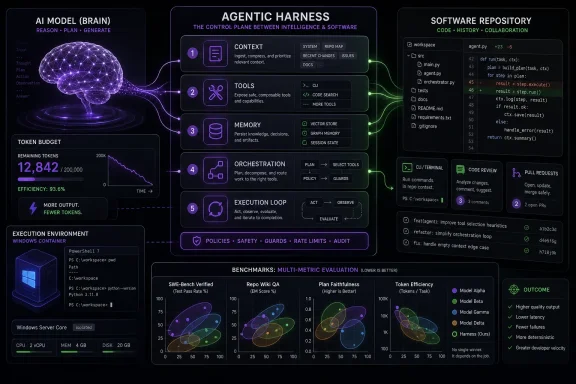 GitHub Moves the Fight From Model IQ to Agent Discipline
For the last two years, AI coding debates have tended to collapse into a single question: which model is best? GPT versus Claude, Opus versus Sonnet, frontier versus fast, native vendor tool versus enterprise platform. GitHub’s new report tries to move that argument one level up the stack.The post centers on the GitHub Copilot agentic harness, a shared component in the GitHub Copilot SDK. GitHub says this harness powers Copilot CLI, the Copilot app, Copilot code review, and other experiences across GitHub and Microsoft. In plain English, it is the part of Copilot that decides how a model gets work done: what context it sees, what tools it can call, how it traverses a repository, how it spends tokens, and when it stops.
That framing is self-serving, but it is also correct. A coding agent is not just a large language model with a terminal bolted on. It is a control system wrapped around a model, and small changes in that system can determine whether the agent edits the right file, spirals into redundant searches, burns through a context window, or produces a clean patch in one pass.
This is why GitHub’s benchmark pitch is more interesting than another “our AI is faster” blog post. The company is effectively saying that the model arms race is no longer the whole story. The harness is becoming the place where developer experience, cost control, enterprise policy, and reliability converge.
The Benchmark Story Is About Parity, Not Domination
GitHub evaluated its Copilot CLI harness against the native harnesses shipped by model vendors: Claude Code for Claude Sonnet 4.6 and Claude Opus 4.7, and Codex CLI for GPT-5.4 and GPT-5.5. The reported benchmarks include SWE-bench Verified, SWE-bench Pro, SkillsBench, TerminalBench, and an internal Windows-container benchmark called Win-Hill.The important word in GitHub’s post is not “better.” It is “on par.” Across the reported comparisons, GitHub says task-resolution rates are effectively comparable when the same model and task are held constant. The company emphasizes that differences between harnesses often sit inside the natural variance of stochastic model runs.
That is a more credible argument than pretending every benchmark point is a knockout punch. Agentic coding benchmarks are noisy. The same model can solve a task on one run, fail on the next, and take a different route through the repository each time. The fact that GitHub highlights variance, especially in its TerminalBench analysis, is a welcome sign that the company understands the fragility of the measurement.
But parity is not modest when the product strategy is taken seriously. If Copilot can run the same frontier models as vendor-native tools, solve roughly the same share of tasks, and do so with less token waste in many configurations, GitHub does not need to win every raw capability chart. It only needs to be good enough on quality and better enough on integration.
That is a classic platform move. The best integrated tool does not always need to be the best specialist tool. It needs to be reliable, available where work already happens, and cheap enough to survive procurement scrutiny.
Token Efficiency Is the New Admin Console Metric
GitHub’s strongest claim is around token efficiency. Holding model and task fixed, the company says the Copilot harness achieved comparable completion rates while consuming fewer tokens across most configurations. That matters because tokens are no longer an abstract developer metric; they are becoming the unit economics of AI-assisted software work.For individual developers, inefficient token use feels like latency, rate limits, and surprise usage ceilings. For enterprises, it becomes budget forecasting, capacity planning, and policy enforcement. A coding agent that reaches the same answer by reading half the repository twice is not merely inelegant. It is operationally expensive.
This is especially true as agentic workflows move from autocomplete to multi-step task execution. Inline completion can be wasteful, but it is usually bounded. An agent with shell access, repository search, test execution, code review context, and retry loops can turn a single request into a long chain of model calls. If the harness is sloppy, the model’s intelligence becomes a cost amplifier.
GitHub is positioning Copilot’s harness as a governor on that cost. The pitch is that smarter orchestration extracts more useful work from each token. That may sound like vendor marketing, but it is the right axis for the next phase of coding-agent competition.
The uncomfortable truth for model vendors is that token efficiency can be improved outside the model itself. Better context packing, fewer redundant tool calls, better repository indexing, more disciplined stop conditions, and smarter task decomposition can all make the same model look cheaper and more capable. If GitHub can improve those mechanics once and distribute the benefit across every Copilot surface, it gains leverage that a single-model CLI cannot easily match.
TerminalBench Shows Why Agent Results Refuse to Sit Still
The most revealing part of GitHub’s report is its discussion of TerminalBench 2.0. GitHub plotted resolution rate against dollar cost per task, with each marker representing an agent-and-model configuration and an ellipse showing one standard deviation of run-to-run spread. The ideal position is up and left: solve more tasks for less money.GitHub says Copilot’s purple markers sit within overlapping variance ellipses against same-model competitors in nearly every case. It also says Copilot is never below a competitor on completion or to the right on cost in the configurations evaluated. That is a carefully worded claim, but it is the kind of claim that matters to teams choosing a default tool.
The ellipses are doing a lot of work here. They remind readers that an AI agent is not a deterministic compiler. It is a probabilistic system operating through tools, files, prompts, shell commands, and model-generated plans. A single score can overstate certainty; multiple runs reveal how much the agent wobbles.
For sysadmins and engineering managers, that variability is not academic. If an agent solves a migration task 60 percent of the time but consumes wildly different amounts of compute on each attempt, it is harder to automate safely. If two harnesses have similar average performance but one has tighter variance, the more predictable one may be preferable even if its headline score is slightly lower.
GitHub does not claim to have eliminated variance. Instead, it argues that Copilot is competitive despite it. That is an important distinction because agent reliability is still one of the hardest unsolved problems in AI-assisted development. Benchmarks can measure task completion, but production teams also care about repeatability, debuggability, and blast radius.
The Multi-Model Bet Is Really a Procurement Bet
GitHub’s report leans heavily on model choice. The company says the Copilot agentic harness supports more than 20 frontier models across the GPT, Claude, Gemini, and MAI families, plus bring-your-own-key support for open-source and local models. It also points to automatic model selection, which can balance task intent, model health, and efficiency.That sounds like a developer convenience feature, but in enterprise terms it is a procurement and governance strategy. A company that standardizes on a single vendor-native harness is implicitly betting that one model family will be best enough, available enough, affordable enough, and compliant enough for every software task. That is a risky bet in a market moving this quickly.
A multi-model harness lets GitHub sell Copilot as the stable layer above an unstable model market. If Claude is better for one class of repository work, GPT is cheaper for another, Gemini is preferred in a particular policy environment, and Microsoft’s own models improve for internal workloads, the customer does not have to swap tooling every quarter. In theory, the harness absorbs the churn.
There is also a political advantage. Enterprises rarely want every developer expensing separate subscriptions to every AI coding tool. They want central controls, auditability, identity integration, data-handling commitments, and predictable billing. GitHub can argue that Copilot gives teams access to the model market without turning the developer workstation into a patchwork of unsupervised agents.
The risk is that abstraction can become dilution. Developers who swear by Claude Code or Codex CLI often do so because the native harness feels tuned to that model’s strengths. If Copilot’s shared harness smooths over too many model-specific behaviors, it could deliver consistency at the expense of peak performance. GitHub’s benchmark post is an attempt to answer that criticism with data: the shared layer, it says, does not meaningfully sacrifice task completion.
Windows Containers Are a Quiet but Important Signal
The inclusion of Win-Hill, GitHub’s internal benchmark for tasks running inside Windows containers, deserves attention from the WindowsForum audience. Most public coding-agent benchmarks still carry a Unix-shaped bias. They assume POSIX tooling, Linux containers, Python projects, shell workflows, and open-source repositories that resemble the environments where many benchmark creators live.Windows development is messier. It involves PowerShell, MSBuild, Visual Studio solution structures, Windows-specific paths, registry-adjacent behavior, COM-era ghosts, enterprise endpoint constraints, and containerization realities that do not always map neatly to Linux-first agent assumptions. A harness that performs well in a Linux terminal benchmark may still stumble in a Windows shop.
GitHub says Win-Hill helps validate that performance generalizes across operating systems and environments. The company does not provide enough public detail in the blog text to independently assess that benchmark, and internal benchmarks always require caution. They can be useful, but they are also controlled by the vendor making the claim.
Still, the existence of a Windows-container benchmark is strategically important. Microsoft and GitHub need Copilot to work not just for trendy TypeScript repos and Python packages, but for the enterprise codebases that keep banks, insurers, manufacturers, and government agencies alive. Those environments often include Windows-specific build chains and legacy complexity that public AI benchmarks underrepresent.
If GitHub can make its harness more reliable in Windows containers, that improvement could matter more to enterprise IT than a marginal SWE-bench gain. The future of AI coding assistance will not be decided only in open-source Python repos. It will be decided in the awkward places where real organizations actually maintain software.
The Harness Is Becoming the Developer’s Operating System for AI
The word harness can make this all sound narrower than it is. In practice, the harness is becoming a kind of operating layer for AI development work. It mediates between the model and the repository, the shell, the issue tracker, the test suite, the code review system, and increasingly the organization’s policies.That is why GitHub’s “single shared component” language matters. If the same harness powers Copilot CLI, the Copilot app, code review, and other GitHub and Microsoft experiences, then a harness improvement propagates broadly. Better token efficiency in the harness can reduce cost across multiple surfaces. Better tool orchestration can improve code review and CLI workflows at the same time. Better context handling can make the assistant feel smarter without changing the underlying model.
This is also why GitHub’s advantage is not just technical. The company owns the platform where much of the world’s code already lives. It can build agents that understand pull requests, issues, repository metadata, code ownership, checks, Actions workflows, and security alerts as native objects rather than as text scraped into a prompt.
Model vendors can build excellent CLIs, and many developers will prefer them. But GitHub can embed agentic behavior into the lifecycle of software delivery. That changes the contest from “which chatbot writes better code?” to “which system can safely participate in the software supply chain?”
That shift should make administrators both interested and nervous. The closer agents get to the delivery pipeline, the more valuable they become — and the more consequential their mistakes become.
Benchmark Normalization Helps, but It Also Hides the Real Product
GitHub says it controlled variables by using the same model, the same benchmark task, normalized context windows, reasoning effort, tool selection, and MCP servers. In the all-benchmark methodology, it reports pass@1 results and notes that for smaller benchmarks it ran five independent trials and reported the best scored run. For TerminalBench 2.0, it says each agent-model combination was run at least five times, with missing data or infrastructure failures rerun until all tasks produced results.That level of methodological detail is useful. It makes the comparison more serious than a casual vendor demo. Normalizing settings helps isolate the harness from the model and reduces the chance that one tool wins simply because it was allowed more context, more reasoning, or more tools.
But normalization also creates a gap between the benchmark and the product as developers experience it. Real users do not always run agents with identical context windows, identical reasoning effort, disabled web tools, no MCP servers, and default built-in tools. They run whatever the tool exposes, whatever the organization allows, and whatever the model vendor has tuned for its own environment.
That is the paradox of fair benchmarking. To compare harnesses cleanly, GitHub has to make the conditions artificial. To evaluate products realistically, users have to let each tool behave like itself. Both comparisons are valid, but they answer different questions.
GitHub’s benchmark answers: if you hold the model and task steady, does Copilot’s harness waste more tokens or solve fewer tasks than native vendor harnesses? GitHub says no. The buyer’s question is slightly different: in my environment, with my repos, policies, secrets, tests, flaky dependencies, and developer habits, which agent produces acceptable work at a tolerable cost?
GitHub wisely ends by encouraging users to try it themselves. That should not be read as a throwaway call to action. For agentic coding tools, local evaluation is not optional. Benchmarks can narrow the field, but your build system gets the final vote.
The Native Harnesses Still Have a Strong Case
GitHub’s report should not be read as an obituary for Claude Code or Codex CLI. Vendor-native tools retain several advantages, especially for developers who want the fastest access to a model’s newest behaviors. Model vendors can tune their harnesses around the quirks, strengths, and tool-use patterns of their own systems. They may expose capabilities before broader platforms integrate them.There is also a cultural factor. Many power users like tools that feel close to the metal. They want to see how the model thinks, adjust prompts, wire in custom workflows, and choose the exact version or endpoint. A platform harness optimized for broad enterprise use can feel constrained compared with a native CLI built for aggressive agentic experimentation.
GitHub’s counterargument is breadth. Copilot does not need to be the most opinionated harness for every model if it can be a competent harness for many models, backed by GitHub identity, repository context, code review integration, and Microsoft’s enterprise machinery. The trade-off is specialization versus consolidation.
This is a familiar pattern in developer tooling. Specialist tools often move faster and delight early adopters. Platform tools arrive later, integrate more deeply, and become the default for organizations that value manageability. The specialist tool may remain better in expert hands, while the platform tool wins the fleet.
The next year of AI coding adoption will likely be shaped by that tension. Individual developers may continue to choose the agent that feels most capable on a hard task. Enterprises will increasingly ask which agent can be governed, measured, supported, and paid for at scale.
Cost per Task Is the Metric That Will Survive the Hype
The most durable idea in GitHub’s post is not any single benchmark result. It is the pairing of resolution rate with cost per task. That framing is where AI coding tools start to look less like magic and more like infrastructure.For a hobbyist, “did it solve the problem?” may be enough. For a business, “what did it cost to solve the problem, how often did it fail, and how much review did it require?” is the real question. If an agent produces a correct patch but requires expensive model calls, multiple retries, and a senior engineer to untangle its reasoning, the economics may not work.
Cost per task also forces a more nuanced view of model choice. GitHub’s TerminalBench discussion says GPT models delivered strong value at lower cost, while Claude Opus reached the highest resolution at a premium. That is precisely the kind of trade-off engineering managers already make with human labor: not every task needs the most expensive expert, but some tasks justify one.
A multi-model harness makes that trade-off operational. Routine refactors, test updates, and simple bug fixes might go to a cheaper model. Deep architectural changes or stubborn debugging sessions might justify a premium model. If the harness can route intelligently, the developer does not need to become a pricing analyst every time they open a terminal.
The caution is that routing decisions can become opaque. If Auto model selection chooses a cheaper model and the result is poor, developers will blame Copilot. If it chooses an expensive model too often, finance will blame Copilot. Model choice is powerful, but only if teams can understand and govern it.
Rubber Duck Points to a Stranger Future
GitHub briefly mentions Rubber Duck, a cross-model-family critique capability where one model reviews another model’s work. That is a small detail with large implications. It suggests that GitHub sees the harness not merely as a way to run different models, but as a way to compose them.Cross-model critique is appealing because different models fail differently. One may be better at broad planning, another at code edits, another at spotting unsafe assumptions, and another at summarizing changes for review. A harness that can orchestrate those roles could outperform any single model acting alone.
This is also where the term “agent” begins to feel inadequate. The future may look less like one AI pair programmer and more like a managed team of specialized AI workers: planner, editor, tester, reviewer, security analyst, documentation writer. The harness becomes the manager deciding who does what, in what order, and under what constraints.
That future is attractive, but it also compounds the governance problem. If one model writes a patch and another critiques it, who is accountable for the final output? How are disagreements resolved? How much extra cost does critique add? Does a second model meaningfully reduce risk, or merely create the appearance of review?
For Windows administrators and security teams, those questions are not philosophical. Agentic systems will increasingly touch repositories that contain deployment scripts, infrastructure definitions, authentication logic, and sensitive business rules. A harness that coordinates multiple models must also coordinate permissions, audit logs, and human approval points.
Developers Should Read the Fine Print Before Declaring a Winner
GitHub’s methodology includes several caveats that should temper the excitement. Web tools were disabled. Runs were non-interactive and single-turn. Some settings were normalized in ways that differ from public benchmark submissions. Infrastructure anomalies and network-access effects were excluded. Smaller benchmarks reported the best of five runs.None of this invalidates the results, but it shapes what they mean. A non-interactive benchmark is not the same as a developer collaborating with an agent over an afternoon. Disabling web tools may make comparisons fairer, but many real debugging tasks involve documentation lookup, package issues, and external context. Reporting best-of-five on smaller benchmarks can reduce the impact of unlucky runs, but it can also make results look cleaner than a one-shot production experience.
The larger issue is that benchmarks still struggle to measure maintainability. Passing tests is not the same as producing a patch a senior engineer would approve. Solving an issue is not the same as preserving architecture. Terminal success is not the same as a secure, minimal, comprehensible change.
GitHub knows this, which is why the post says benchmarks are only one signal alongside real-world usage metrics and online experiments. That is the right posture. The wrong posture would be to treat a chart as proof that the agent is ready to operate unsupervised across critical repositories.
For now, the practical conclusion is simpler. Copilot’s harness appears competitive enough that teams already invested in GitHub should evaluate it seriously against native vendor tools. But no benchmark should replace internal pilots on representative repositories, with human review, cost tracking, and failure analysis.
The Copilot Harness Turns Microsoft’s Ecosystem Into the Product
The broader competitive picture is unmistakable. Microsoft and GitHub are building an AI development layer that spans the repository, the IDE, the terminal, code review, enterprise identity, and potentially Windows-based execution environments. The Copilot harness is the connective tissue.That has consequences for competitors. Anthropic can make Claude better. OpenAI can make GPT better. Google can push Gemini into more developer workflows. But GitHub can say: bring those models here, and we will make them useful inside the place where code already moves from issue to pull request to review to deployment.
This is Microsoft’s old platform instinct in a new form. The company does not have to own every best model if it owns the workbench. It can integrate, route, meter, govern, and package the models in ways that are attractive to enterprises. In that world, model providers become both partners and suppliers inside Copilot’s marketplace.
There is danger in that centralization. If Copilot becomes the default agentic layer for software development, GitHub’s choices about context, tool permissions, evaluation, model routing, and telemetry will shape how millions of developers experience AI. Defaults will matter. So will transparency.
WindowsForum readers have seen this movie before in other parts of the Microsoft ecosystem. Integration brings convenience, but it also raises lock-in concerns. The best outcome would be a competitive market where native tools push the frontier and platform tools make those gains manageable for ordinary teams.
The Chart Is Not the Victory Lap; It Is the Buying Guide
The safest way to read GitHub’s report is as a buying guide for the next phase of AI coding, not as a final verdict on the best agent. The company’s argument is that Copilot’s shared harness can match vendor-native task completion closely enough while improving efficiency and preserving model choice. That is a serious claim, and it maps well to what enterprise buyers actually need.A few concrete points should survive the benchmark fog:
- GitHub is arguing that the agentic harness, not just the underlying model, now determines coding-agent performance, cost, and predictability.
- The company reports that Copilot CLI achieves task-resolution broadly on par with Claude Code and Codex CLI when the same models and benchmark tasks are held constant.
- GitHub’s most practical claim is token efficiency, because fewer wasted tokens can translate into lower cost, lower latency, and more predictable scaling.
- The multi-model architecture is strategically important because it lets organizations choose among GPT, Claude, Gemini, MAI, and other models without standardizing on a separate workflow for each one.
- The Windows-container benchmark is a quiet acknowledgement that enterprise software work does not live entirely in Linux-flavored public benchmark suites.
- Teams should still run their own evaluations, because benchmark normalization cannot reproduce every repository, build chain, policy constraint, or developer workflow.
References
- Primary source: The GitHub Blog
Published: Thu, 25 Jun 2026 23:01:13 GMT
Evaluating performance and efficiency of the GitHub Copilot agentic harness across models and tasks - The GitHub Blog
Explore how the GitHub Copilot agentic harness delivers strong results across multiple benchmarks and leading token efficiency.github.blog
- Official source: docs.github.com
Hosting of models for GitHub Copilot - GitHub Docs
Learn how different AI models are hosted for GitHub Copilot. docs.github.com
- Related coverage: digitalapplied.com
Claude Opus 4.7 vs GPT-5.4: Agentic Coding Compared
Claude Opus 4.7 beats GPT-5.4 on SWE-bench Pro, tool use, and computer use. Full agentic coding benchmark comparison with migration guidance.www.digitalapplied.com - Related coverage: claudefa.st
Claude Opus 4.7 vs GPT-5.4: Coding, Tools, Vision
Claude Fast | Opus 4.7 beats GPT-5.4 on SWE-bench Pro by 6.6 points. Full comparison: coding, tools, vision, pricing, agentic reliability.claudefa.st - Official source: github.com
GitHub - benchflow-ai/ClawsBench: Repository for results and data (coming soon!) for ClawsBench · GitHub
Repository for results and data (coming soon!) for ClawsBench - benchflow-ai/ClawsBench github.com
- Related coverage: stet.sh
GPT-5.5 vs GPT-5.4 vs Opus 4.7 on 56 real coding tasks from 2 open source repos — Stet
Opus 4.7 vs GPT-5.5 vs GPT-5.4 on 56 real coding tasks across two open-source repos. Opus writes smaller patches; GPT-5.5 writes patches that more often survive review.www.stet.sh
- Related coverage: vellum.ai
Claude Opus 4.7 Benchmarks Explained
Full breakdown of Claude Opus 4.7 benchmarks and what it means for your agents and assistants. Compare against Opus 4.6, GPT-5.4, Gemini 3.1 Pro, and Mythos Preview. www.vellum.ai
- Related coverage: datacamp.com
Claude Opus 4.7: Anthropic’s New Best (Available) Model | DataCamp
Claude Opus 4.7 review: Anthropic's new flagship leads SWE-bench Pro and MCP-Atlas. See what's new vs. Opus 4.6, GPT-5.4, Gemini 3.1 Pro, and Mythos Preview. www.datacamp.com
- Related coverage: theaijournal.co
Grok 4.3 vs Claude Opus & GPT-5.5: Enterprise Agentic AI Benchmarks
Exact benchmark comparison of Grok 4.3, Claude Opus 4.6/4.7, and GPT-5.5 for enterprise agentic workflows with real scores, pricing, and which model to pick.theaijournal.co - Related coverage: itpro.com
GitHub is scrapping some Claude, OpenAI, and Gemini models in Copilot – here's what you need to know and what alternatives are available | IT Pro
A raft of AI models from OpenAI, Anthropic, and Google have been officially cut from the GitHub Copilot service.www.itpro.com - Related coverage: zeronoise.ai
