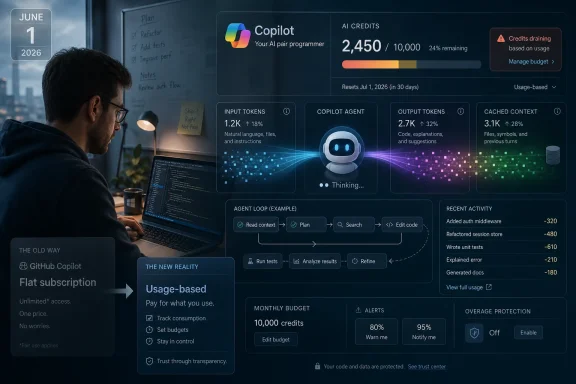
GitHub is moving Copilot to usage-based billing on June 1, 2026, replacing premium request units with GitHub AI Credits that are consumed according to token usage across input, output, and cached context for different AI models. The company says this better reflects the real cost of modern AI coding, especially agentic workflows that can run for long periods. Developers hear something else: the predictable subscription era is ending, and the bill for AI-assisted programming is being handed back to the keyboard.
The backlash is not just about price. It is about trust, workflow design, and a software industry that spent the last three years telling developers to push more work into AI assistants before admitting that the meter was always running. Copilot’s new model may be economically rational for GitHub and Microsoft, but it also forces a harder question onto every developer and IT shop: was AI coding cheap because it was efficient, or because someone else was eating the cost?
For most developers, Copilot’s appeal was not only that it could autocomplete boilerplate or explain unfamiliar code. It was that the product felt simple. You paid a monthly fee, opened your editor, and treated the assistant as part of the development environment rather than a metered cloud service.
That simplicity is now being replaced by a billing model closer to the economics of the underlying AI systems. GitHub’s new structure keeps familiar subscription tiers, but the important unit becomes the AI Credit, which is consumed based on token usage. Tokens are the small chunks of text that language models read and generate; in practice, that means prompts, code context, generated output, cached context, and the invisible chatter of multi-step agentic sessions all become part of the cost equation.
This is a profound shift because Copilot is no longer just an editor convenience. It now spans chat, code review, autonomous coding tasks, model selection, and increasingly ambitious “agent” workflows. A quick inline completion and a long-running agent session are not remotely similar from an infrastructure-cost perspective, but legacy subscription packaging often made them feel similar to the user.
GitHub’s argument is straightforward: the old model was no longer sustainable. The company has said that a brief chat request and a multi-hour autonomous coding session could previously cost the user the same amount, while GitHub absorbed much of the growing inference cost behind the scenes. That is credible, but credibility does not make the transition painless.
The problem for Microsoft is that Copilot’s brand was built around removing friction from programming. Usage billing puts friction back in the loop. It turns every large context window, every exploratory prompt, every “try again,” and every agentic detour into a budget event.
In the early phase of a product category, vendors often hide that complexity. They simplify pricing, subsidize usage, and prioritize habit formation. The goal is to make the tool feel inevitable before users have to think too hard about its marginal cost.
That is exactly what happened with AI coding assistants. Developers learned to paste stack traces, ask for refactors, generate tests, summarize pull requests, and delegate increasingly broad tasks. Product marketing celebrated those behaviors as the future of software development. Now the invoice is beginning to reflect them.
This does not make GitHub uniquely villainous. The same gravitational pull is visible across the AI industry, where API-style pricing has long been token-based and consumer-facing subscriptions have become harder to square with heavy usage. The more capable the model, the more expensive the inference. The more “agentic” the workflow, the less predictable the compute path.
But Copilot is different because it sits inside the daily workflow of millions of developers. When a chatbot subscription changes, users can cancel and move on. When the coding assistant embedded into an editor, repository, review process, and team workflow changes its economics, the blast radius is larger.
The second argument is technically plausible. Token usage can explode when a developer repeatedly feeds large files, oversized repositories, verbose prompts, and broad instructions into a model. A human who gives precise instructions, narrows context, and treats the assistant as a tool rather than an oracle will usually consume less.
But that critique is too tidy. Modern AI coding tools are not merely passive text boxes waiting for disciplined prompts. They are designed to feel conversational, iterative, and forgiving. They encourage broad requests like “fix this test suite,” “review this PR,” or “refactor this service,” and then they assemble context, call tools, generate patches, and loop over failures.
In other words, token burn is not only a user behavior. It is also a product-design outcome. If the interface hides context selection, abstracts away model behavior, and celebrates autonomous task completion, then users should not be surprised when the bill reflects a system doing far more than a traditional autocomplete ever did.
That is where the anger becomes understandable. Developers were sold convenience. Now they are being asked to become cost engineers for their own editor.
Small firms and individual developers have a different relationship with subscriptions. A $10, $19, or $39 monthly fee is easy to understand and easy to approve. A metered assistant that may be cheap in one month and surprisingly expensive in another feels like a risk, even if the average cost remains manageable.
GitHub has tried to soften that landing with included credits, budget controls, previews, and pooled usage for organizations. Those tools matter, especially for IT administrators who need to prevent runaway spend. But they also reveal the deeper product change: Copilot is now something to manage, not merely something to enable.
For a two-person startup, a freelance developer, or an open-source maintainer, the psychological shift may be larger than the actual invoice. The moment a tool becomes unpredictable, users start rationing it. They ask fewer questions. They avoid long tasks. They downgrade models. They begin wondering whether a cheaper alternative is good enough.
That matters because Copilot’s value depends on being used habitually. If developers become reluctant to invoke it, the product may save Microsoft compute costs while losing the ambient trust that made it sticky in the first place.
That future is computationally hungry. A simple code completion may involve a modest prompt and a short output. An agent that investigates a failing test, reads files, proposes a fix, runs checks, adjusts the patch, and explains its reasoning can consume orders of magnitude more tokens and tool calls.
This is the part of the AI coding boom that was always under-discussed. If an agent saves a senior engineer three hours, a $10 or $50 compute cost might be a bargain. If it wanders through a codebase, generates mediocre patches, and needs constant correction, the economics quickly look worse. Usage billing exposes that difference.
It also changes what “productivity” means. The relevant question is no longer whether Copilot can generate code. It is whether the generated work is worth the compute, the review burden, the security risk, and the developer attention required to supervise it.
That is a more mature conversation, and probably a necessary one. The problem is that it arrives after years of industry messaging that blurred experimentation, productivity, and automation into one optimistic story. The new pricing model forces everyone to separate them.
The immediate concern for Windows developers is not whether inline completions vanish. Core completions and certain suggestions remain part of the subscription experience. The bigger issue is how teams use premium models, chat, code review, and agentic sessions across daily work.
A .NET team maintaining a large legacy application may use Copilot differently from a JavaScript developer building a greenfield app. A sysadmin writing PowerShell automation may need occasional help and never approach the included credit limits. A startup leaning on AI agents to generate tests, migrate frameworks, and review pull requests could burn through credits quickly.
That variance makes policy important. Organizations that previously assigned Copilot seats as a productivity perk now need to decide which models are allowed, which workflows are appropriate, and where budget caps should sit. “Everyone gets Copilot” becomes less obvious when some users consume a few dollars of AI credits and others consume hundreds.
The Windows ecosystem has seen this pattern before with cloud services. What begins as a developer convenience eventually becomes an administrative surface. Copilot is crossing that line now.
Budget controls are especially important because AI usage does not behave like traditional seat licensing. A seat is predictable. A model session is not. One developer may spend the day accepting small completions, while another asks an agent to analyze a sprawling monorepo.
Pooled credits may help organizations avoid waste by letting light users offset heavy users. That is sensible for teams because software work is uneven. A developer on a release crunch may need more AI assistance in one month than another developer working on maintenance tasks.
Still, controls are a double-edged signal. They reassure administrators, but they also confirm that runaway usage is a real enough problem to require guardrails. No one builds budget caps for a product whose costs are inherently predictable.
The most important administrative question is whether GitHub’s tooling will be transparent enough. Developers and managers need to understand not just that credits were consumed, but why. If the answer is buried in model multipliers, cached-token accounting, tool calls, and agent loops, the billing system will feel like a black box.
For years, the industry message was clear: use AI more, integrate it earlier, trust it with broader tasks, and let it reshape the development lifecycle. Copilot was not marketed as a fragile resource to conserve. It was marketed as a companion that could sit beside developers all day.
Now the same behaviors are being sorted into efficient and inefficient usage. The developer who experiments broadly may be described as wasteful. The user who relies on agentic loops may be told that high costs are the natural result. That may be true, but it also feels like a retrospective rule change.
This is why the “just prompt better” response misses the politics of the moment. Efficient usage matters, and developers should learn it. But vendors cannot design tools for frictionless consumption, celebrate the resulting engagement, and then act surprised when users consume heavily.
A healthier transition would make costs visible at the moment of action. If a prompt will attach half a repository, use an expensive model, and likely run a multi-step loop, the developer should know before pressing Enter. The meter should be legible, not merely discoverable after the fact.
IT leaders now have to ask practical questions. Which AI coding assistant offers the best value for our workload? Which models are approved for which repositories? How do we prevent confidential code from leaking into unmanaged tools? How do we measure whether AI-generated code reduces cycle time or merely shifts work into review?
Usage-based billing sharpens all of those questions because it gives every workflow a price. A code review bot is no longer just a helpful automation; it is a recurring compute expense. An agent that opens pull requests is not just a productivity demo; it is a process that consumes credits, Actions minutes, reviewer time, and trust.
This may ultimately benefit disciplined teams. The best engineering organizations already measure build times, cloud spend, test flakiness, and deployment risk. Adding AI usage to that operational picture is not absurd. In fact, it may be necessary.
But the industry should stop pretending this is merely a pricing tweak. It is the normalization of AI coding as metered infrastructure.
The teams that adapt best will make AI usage observable. They will identify which workflows produce measurable value and which ones produce expensive churn. They will distinguish between AI assistance that accelerates senior engineers and AI dependency that creates review debt.
They will also standardize patterns. Smaller prompts, narrower context, cheaper models for simple tasks, premium models for genuinely hard reasoning, and clear limits on autonomous loops will become normal engineering hygiene. The skill is not just “prompt engineering” in the buzzword sense. It is cost-aware delegation.
Individual developers will need a similar discipline. The cheapest Copilot session is not always the best one, but neither is the most powerful model the right default for every task. Knowing when to ask for a quick explanation, when to use inline completion, and when to launch an agent will become part of professional judgment.
That is not necessarily a bad outcome. Good tools have always rewarded users who understand their constraints. The risk is that GitHub makes those constraints too opaque for ordinary developers to reason about.
The backlash is not just about price. It is about trust, workflow design, and a software industry that spent the last three years telling developers to push more work into AI assistants before admitting that the meter was always running. Copilot’s new model may be economically rational for GitHub and Microsoft, but it also forces a harder question onto every developer and IT shop: was AI coding cheap because it was efficient, or because someone else was eating the cost?
 Microsoft Turns the Copilot Meter Back Toward the User
For most developers, Copilot’s appeal was not only that it could autocomplete boilerplate or explain unfamiliar code. It was that the product felt simple. You paid a monthly fee, opened your editor, and treated the assistant as part of the development environment rather than a metered cloud service.That simplicity is now being replaced by a billing model closer to the economics of the underlying AI systems. GitHub’s new structure keeps familiar subscription tiers, but the important unit becomes the AI Credit, which is consumed based on token usage. Tokens are the small chunks of text that language models read and generate; in practice, that means prompts, code context, generated output, cached context, and the invisible chatter of multi-step agentic sessions all become part of the cost equation.
This is a profound shift because Copilot is no longer just an editor convenience. It now spans chat, code review, autonomous coding tasks, model selection, and increasingly ambitious “agent” workflows. A quick inline completion and a long-running agent session are not remotely similar from an infrastructure-cost perspective, but legacy subscription packaging often made them feel similar to the user.
GitHub’s argument is straightforward: the old model was no longer sustainable. The company has said that a brief chat request and a multi-hour autonomous coding session could previously cost the user the same amount, while GitHub absorbed much of the growing inference cost behind the scenes. That is credible, but credibility does not make the transition painless.
The problem for Microsoft is that Copilot’s brand was built around removing friction from programming. Usage billing puts friction back in the loop. It turns every large context window, every exploratory prompt, every “try again,” and every agentic detour into a budget event.
The Subscription Was a Subsidy Masquerading as a Product Category
The flat-rate Copilot era trained developers to think of AI coding assistance like an IDE feature. That was always a category mistake. Under the hood, Copilot was closer to a cloud workload whose cost depended on model choice, context length, output length, and the number of times a developer asked the system to reason through a problem.In the early phase of a product category, vendors often hide that complexity. They simplify pricing, subsidize usage, and prioritize habit formation. The goal is to make the tool feel inevitable before users have to think too hard about its marginal cost.
That is exactly what happened with AI coding assistants. Developers learned to paste stack traces, ask for refactors, generate tests, summarize pull requests, and delegate increasingly broad tasks. Product marketing celebrated those behaviors as the future of software development. Now the invoice is beginning to reflect them.
This does not make GitHub uniquely villainous. The same gravitational pull is visible across the AI industry, where API-style pricing has long been token-based and consumer-facing subscriptions have become harder to square with heavy usage. The more capable the model, the more expensive the inference. The more “agentic” the workflow, the less predictable the compute path.
But Copilot is different because it sits inside the daily workflow of millions of developers. When a chatbot subscription changes, users can cancel and move on. When the coding assistant embedded into an editor, repository, review process, and team workflow changes its economics, the blast radius is larger.
Token Billing Makes Bad Habits Expensive and Good Habits Measurable
The developer backlash has split into two camps, and both have a point. One camp argues that Microsoft encouraged heavy iterative usage, pushed agentic coding as a productivity breakthrough, and is now penalizing the very behavior it promoted. The other camp argues that extreme projected bills are evidence of sloppy prompting, bloated context, and “vibe coding” workflows that were never economically defensible.The second argument is technically plausible. Token usage can explode when a developer repeatedly feeds large files, oversized repositories, verbose prompts, and broad instructions into a model. A human who gives precise instructions, narrows context, and treats the assistant as a tool rather than an oracle will usually consume less.
But that critique is too tidy. Modern AI coding tools are not merely passive text boxes waiting for disciplined prompts. They are designed to feel conversational, iterative, and forgiving. They encourage broad requests like “fix this test suite,” “review this PR,” or “refactor this service,” and then they assemble context, call tools, generate patches, and loop over failures.
In other words, token burn is not only a user behavior. It is also a product-design outcome. If the interface hides context selection, abstracts away model behavior, and celebrates autonomous task completion, then users should not be surprised when the bill reflects a system doing far more than a traditional autocomplete ever did.
That is where the anger becomes understandable. Developers were sold convenience. Now they are being asked to become cost engineers for their own editor.
Small Teams Lose the Comfort of Predictability First
Large enterprises are better positioned for this shift because they already live in the world of cloud budgeting. They have procurement teams, admin controls, cost centers, usage dashboards, and internal policies for who can run expensive workloads. For them, Copilot’s move to usage billing is annoying but familiar.Small firms and individual developers have a different relationship with subscriptions. A $10, $19, or $39 monthly fee is easy to understand and easy to approve. A metered assistant that may be cheap in one month and surprisingly expensive in another feels like a risk, even if the average cost remains manageable.
GitHub has tried to soften that landing with included credits, budget controls, previews, and pooled usage for organizations. Those tools matter, especially for IT administrators who need to prevent runaway spend. But they also reveal the deeper product change: Copilot is now something to manage, not merely something to enable.
For a two-person startup, a freelance developer, or an open-source maintainer, the psychological shift may be larger than the actual invoice. The moment a tool becomes unpredictable, users start rationing it. They ask fewer questions. They avoid long tasks. They downgrade models. They begin wondering whether a cheaper alternative is good enough.
That matters because Copilot’s value depends on being used habitually. If developers become reluctant to invoke it, the product may save Microsoft compute costs while losing the ambient trust that made it sticky in the first place.
The Agentic Future Has a Cloud Bill Attached
The timing is not accidental. Copilot is evolving from autocomplete into something closer to an autonomous development platform. The industry’s favorite word for this is agentic, a term that usually means the model can plan, use tools, inspect results, and iterate toward a goal.That future is computationally hungry. A simple code completion may involve a modest prompt and a short output. An agent that investigates a failing test, reads files, proposes a fix, runs checks, adjusts the patch, and explains its reasoning can consume orders of magnitude more tokens and tool calls.
This is the part of the AI coding boom that was always under-discussed. If an agent saves a senior engineer three hours, a $10 or $50 compute cost might be a bargain. If it wanders through a codebase, generates mediocre patches, and needs constant correction, the economics quickly look worse. Usage billing exposes that difference.
It also changes what “productivity” means. The relevant question is no longer whether Copilot can generate code. It is whether the generated work is worth the compute, the review burden, the security risk, and the developer attention required to supervise it.
That is a more mature conversation, and probably a necessary one. The problem is that it arrives after years of industry messaging that blurred experimentation, productivity, and automation into one optimistic story. The new pricing model forces everyone to separate them.
Windows Developers Will Feel This Inside the Toolchain
For WindowsForum readers, this is not an abstract GitHub pricing story. Copilot is deeply entangled with Microsoft’s developer ecosystem: Visual Studio Code, Visual Studio, GitHub repositories, GitHub Actions, Azure workflows, and enterprise identity. A billing change in Copilot ripples through the Microsoft development stack.The immediate concern for Windows developers is not whether inline completions vanish. Core completions and certain suggestions remain part of the subscription experience. The bigger issue is how teams use premium models, chat, code review, and agentic sessions across daily work.
A .NET team maintaining a large legacy application may use Copilot differently from a JavaScript developer building a greenfield app. A sysadmin writing PowerShell automation may need occasional help and never approach the included credit limits. A startup leaning on AI agents to generate tests, migrate frameworks, and review pull requests could burn through credits quickly.
That variance makes policy important. Organizations that previously assigned Copilot seats as a productivity perk now need to decide which models are allowed, which workflows are appropriate, and where budget caps should sit. “Everyone gets Copilot” becomes less obvious when some users consume a few dollars of AI credits and others consume hundreds.
The Windows ecosystem has seen this pattern before with cloud services. What begins as a developer convenience eventually becomes an administrative surface. Copilot is crossing that line now.
GitHub’s Controls Are Necessary, but They Also Admit the Risk
GitHub is not simply throwing users into the deep end. The company has introduced budget controls, usage visibility, included credits, and organizational pooling. Those features are essential if Copilot is to remain viable in business environments.Budget controls are especially important because AI usage does not behave like traditional seat licensing. A seat is predictable. A model session is not. One developer may spend the day accepting small completions, while another asks an agent to analyze a sprawling monorepo.
Pooled credits may help organizations avoid waste by letting light users offset heavy users. That is sensible for teams because software work is uneven. A developer on a release crunch may need more AI assistance in one month than another developer working on maintenance tasks.
Still, controls are a double-edged signal. They reassure administrators, but they also confirm that runaway usage is a real enough problem to require guardrails. No one builds budget caps for a product whose costs are inherently predictable.
The most important administrative question is whether GitHub’s tooling will be transparent enough. Developers and managers need to understand not just that credits were consumed, but why. If the answer is buried in model multipliers, cached-token accounting, tool calls, and agent loops, the billing system will feel like a black box.
The Backlash Is Really About a Broken Social Contract
The anger around Copilot’s pricing change is partly financial, but the emotional charge comes from something deeper. Developers feel that Microsoft and GitHub changed the deal after shaping the behavior.For years, the industry message was clear: use AI more, integrate it earlier, trust it with broader tasks, and let it reshape the development lifecycle. Copilot was not marketed as a fragile resource to conserve. It was marketed as a companion that could sit beside developers all day.
Now the same behaviors are being sorted into efficient and inefficient usage. The developer who experiments broadly may be described as wasteful. The user who relies on agentic loops may be told that high costs are the natural result. That may be true, but it also feels like a retrospective rule change.
This is why the “just prompt better” response misses the politics of the moment. Efficient usage matters, and developers should learn it. But vendors cannot design tools for frictionless consumption, celebrate the resulting engagement, and then act surprised when users consume heavily.
A healthier transition would make costs visible at the moment of action. If a prompt will attach half a repository, use an expensive model, and likely run a multi-step loop, the developer should know before pressing Enter. The meter should be legible, not merely discoverable after the fact.
AI Coding Is Becoming Procurement, Not Just Productivity
The larger story is that AI coding tools are leaving their novelty phase. They are becoming budget lines, governance objects, and procurement decisions. That is good for maturity but bad for the fantasy that AI assistance would simply become an invisible layer of software work.IT leaders now have to ask practical questions. Which AI coding assistant offers the best value for our workload? Which models are approved for which repositories? How do we prevent confidential code from leaking into unmanaged tools? How do we measure whether AI-generated code reduces cycle time or merely shifts work into review?
Usage-based billing sharpens all of those questions because it gives every workflow a price. A code review bot is no longer just a helpful automation; it is a recurring compute expense. An agent that opens pull requests is not just a productivity demo; it is a process that consumes credits, Actions minutes, reviewer time, and trust.
This may ultimately benefit disciplined teams. The best engineering organizations already measure build times, cloud spend, test flakiness, and deployment risk. Adding AI usage to that operational picture is not absurd. In fact, it may be necessary.
But the industry should stop pretending this is merely a pricing tweak. It is the normalization of AI coding as metered infrastructure.
The Winners Will Be the Teams That Treat Tokens Like Build Minutes
There is a practical way through the disruption, but it requires a change in mindset. Developers should not treat tokens as moral judgments, nor should managers treat them as an excuse to ban experimentation. Tokens are simply a resource, like CPU time, CI minutes, storage, or bandwidth.The teams that adapt best will make AI usage observable. They will identify which workflows produce measurable value and which ones produce expensive churn. They will distinguish between AI assistance that accelerates senior engineers and AI dependency that creates review debt.
They will also standardize patterns. Smaller prompts, narrower context, cheaper models for simple tasks, premium models for genuinely hard reasoning, and clear limits on autonomous loops will become normal engineering hygiene. The skill is not just “prompt engineering” in the buzzword sense. It is cost-aware delegation.
Individual developers will need a similar discipline. The cheapest Copilot session is not always the best one, but neither is the most powerful model the right default for every task. Knowing when to ask for a quick explanation, when to use inline completion, and when to launch an agent will become part of professional judgment.
That is not necessarily a bad outcome. Good tools have always rewarded users who understand their constraints. The risk is that GitHub makes those constraints too opaque for ordinary developers to reason about.
Copilot’s New Price Tag Leaves Developers With Fewer Illusions
The Copilot billing change is not the end of AI coding, but it is the end of a comfortable illusion. The product can still be valuable, but users now have to understand the economics they were previously insulated from.- GitHub Copilot’s June 1 shift replaces premium request units with AI Credits consumed according to token usage.
- Base subscription prices may remain familiar, but heavy chat, premium-model, review, and agentic workflows can now create more visible overage costs.
- Large organizations have more tools to absorb the change through pooling, budgets, and admin controls, while individuals and small teams face the sharpest predictability problem.
- Developers will need to treat model choice, context size, and autonomous loops as cost-bearing technical decisions.
- Microsoft’s biggest challenge is not proving that usage billing is rational, but preserving trust after years of encouraging frictionless AI-assisted work.
References
- Primary source: LatestLY
Published: 2026-05-31T09:50:30.537797
GitHub Copilot Shifts to Token-Usage Billing Model Starting June 1, Sparks Developer Backlash Over Cost Increases | 📲 LatestLY
Microsoft has transitioned GitHub Copilot from a flat subscription rate to a token-usage billing system starting June 1. The change has drawn sharp criticism from developers, who warn of drastic price increases for intensive users. While Microsoft aims to standardise AI service costs, many...www.latestly.com
- Related coverage: techcrunch.com
'What a joke': GitHub Copilot's new token-based billing spurs consternation among devs | TechCrunch
The golden age of Microsoft's GitHub Copilot appears to be at an end.techcrunch.com - Related coverage: frontierbeat.com
GitHub Copilot Drops Flat-Rate Pricing June 1—Power Users Pay by the Token - Frontierbeat
GitHub replaces flat-rate Copilot plans with token-based AI Credits on June 1. Business users get a $30 credit buffer—until August, when the subsidy ends. frontierbeat.com
- Related coverage: usagebox.com

GitHub Copilot Pricing & Billing 2026: Plans, AI Credits & Overages | UsageBox
GitHub Copilot pricing for 2026, verified against GitHub's plans page: Free $0, Pro $10/mo (includes $15 credits), Pro+ $39/mo ($70), Max $100/mo ($200), plus Business and Enterprise seats. How AI Credits work (1 credit = $0.01), where to see usage in VS Code, and why some bills jumped.
usagebox.com
- Official source: docs.github.com
GitHub Copilot licenses - GitHub Docs
Learn how licenses for Copilot work, including usage measurement and managing your budget. docs.github.com
- Related coverage: therouter.ai
GitHub Copilot AI Credits, June 2026: Token Billing Explained and Fallback Removed — TheRouter.ai | TheRouter.ai
GitHub Copilot AI Credits launched June 2026, replacing Premium Request Units with token-based billing. The old model fallback that let you keep working on a cheaper model is gone—agentic sessions now stop when credits run out. Here's what changed and how to manage it.therouter.ai
- Related coverage: pondero.ai
GitHub Copilot switches to AI Credits billing on June 1 as individual sign-ups stay paused and a Max plan joins the lineup
Starting June 1, 2026, GitHub is replacing premium request units with token-based AI Credits across all Copilot plans, introducing a new $100/month Max tier and keeping base prices flat.pondero.ai
- Related coverage: byteiota.com
- Related coverage: explore.febspot.com
GitHub Copilot’s switch to token billing draws backlash from developers
GitHub is shifting Copilot from a flat subscription to a token-usage billing model starting June 1, a change that could raise costs substantially for some users. Larger enterprises may absorb the increase, but smaller companies and individual developers worry about balancing monthly budgets under thexplore.febspot.com
- Related coverage: techbullion.com
GitHub Copilot Reaches 4.7 Million Subscribers: AI-Powered Software Development in 2026 - TechBullion
Across millions of code editors around the world, a quiet revolution is unfolding line by line. Developers are writing code alongside an AI pair programmer that suggests completions, generates functions, writes tests and explains complex logic in real time. GitHub Copilot reached 4.7 million...techbullion.com - Related coverage: getpanto.ai
GitHub Copilot Statistics 2026 — Users, Revenue & Adoption
Data-driven GitHub Copilot Statistics 2026: users, paid subscribers, enterprise adoption, productivity impact, and market projections.www.getpanto.ai - Related coverage: winbuzzer.com
GitHub Moves Copilot to Usage-Based Billing June 1
GitHub Copilot will switch to usage-based billing on June 1, keeping base plan prices but adding AI credit overages that could make heavy use costlier.winbuzzer.com - Related coverage: itpro.com
Everything you need to know about the GitHub Copilot pricing changes | IT Pro
GitHub Copilot pricing changes mean users will be charged based on consumption, rather than a set number of credits.www.itpro.com - Related coverage: techradar.com
'That is unacceptable in a professional development workflow': Microsoft acts after VS Code gives Copilot credit for work a human developer did | TechRadar
VS Code Copilot author credits have been reversedwww.techradar.com - Related coverage: windowscentral.com
Microsoft denies injecting ads into GitHub pull requests — blames "programming logic issue" for 11,000 "coding agent tip" insertions | Windows Central
Over 11,000 pull requests have been spotted with the same "tips" injected into descriptions.www.windowscentral.com