GitHub Copilot PR “tips” controversy: Microsoft removes promotional UI feature

  • Thread Author
Microsoft’s explanation for the GitHub Copilot pull request ad controversy lands somewhere between a technical correction and a reputational cleanup. What looked to many developers like a new monetization layer inside pull requests is now being framed by the company as a programming logic issue that caused product tips to surface in the wrong place, at the wrong frequency, and with the wrong optics. The company says the feature has been removed from pull requests entirely, which makes this less a temporary bug fix than a hard retreat from a design choice that clearly crossed a trust boundary.

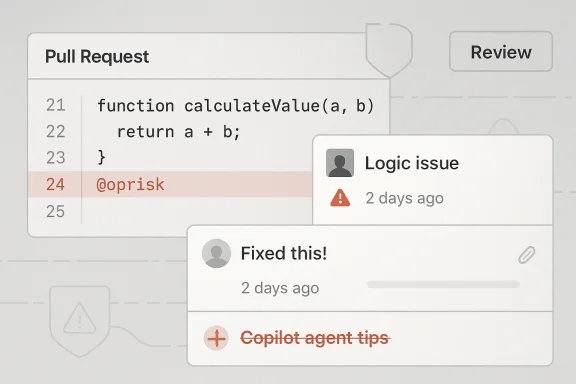
GitHub pull request screen shows a code change, “Logic issue” warning, and “Fixed this!” update.Overview​

The incident matters because pull requests are not just another surface in GitHub; they are one of the most sensitive parts of the software development workflow. A PR is where engineers review code, debate architecture, validate behavior, and decide whether changes should ship. When promotional content appears there, even if it is framed as a tip or suggestion, it can feel like a breach of the workflow’s neutrality.
That perception is especially damaging for GitHub Copilot, which has spent years trying to position itself as an assistant rather than an attention channel. Copilot’s value proposition depends on staying out of the way and helping developers move faster. Any hint that it is also being used to distribute marketing messages risks undermining the very trust that makes people willing to let it touch code, reviews, and repository context.
Microsoft’s messaging suggests the company believes the problem was not an ad sales arrangement but a product surface that expanded too aggressively after a March 24 change. According to the clarification, a third-party link was displayed in a way that could be interpreted as promotion, and the “Copilot agent tips” surfaced more frequently than intended alongside other suggestions. That distinction matters, but only up to a point; from a user’s perspective, the outcome still looked like advertising inside developer tooling.
The controversy also arrives at a moment when GitHub is pushing Copilot deeper into the platform. Recent GitHub updates have expanded Copilot’s role in pull requests, coding agent workflows, titles, code review, and issue-driven automation, making the PR experience a high-traffic place for AI-generated guidance. In that context, even a small logic bug can feel larger than it is, because it touches a workflow many teams now rely on daily.

Background​

GitHub Copilot began as an inline code completion tool, but it has steadily grown into a broader agentic assistant. GitHub’s recent product cadence shows that the company wants Copilot to handle more of the work around software delivery, not just typing assistance. That includes pull request titles, pull request comments, coding agent handoffs, and broader review workflows.
This expansion is strategically logical. If Copilot can help create a PR, name it, summarize it, and respond to review feedback, then the tool becomes embedded in the developer lifecycle rather than hovering at the edge of it. GitHub has been marketing that deeper integration as a productivity story, with the added benefit of keeping users inside its ecosystem for longer stretches of time.
But deeper integration also raises the stakes of any interface decision. Developers are highly sensitive to anything that interrupts code review or makes workflow outputs feel commercialized. That sensitivity is not irrational; teams often use PRs to coordinate production changes, security fixes, and release approvals, so they expect those surfaces to be governed by utility, not promotion.
The new controversy appears to have been triggered by a March 24 change that expanded Copilot capabilities. Microsoft’s explanation suggests that a logic path responsible for surfacing product tips also introduced a link to a third-party product partner in a way that was too visible and too repetitive. In effect, what was meant to be a contextual hint became a distribution mechanism that looked like advertising.
That distinction between intent and presentation is central to the fallout. Even if no formal ad buy existed, the audience saw something that resembled paid placement. In consumer software, that might be dismissed as sloppy UI copy. In developer infrastructure, it reads more like a trust violation because the line between tooling and messaging is supposed to be firm.
The timing also made the situation worse. GitHub has been under heightened scrutiny due to recent product changes around Copilot usage policies and platform behavior. The company is in the middle of a broader push to monetize AI features more deeply while also promising greater utility and control, which means any misstep gets interpreted through a wider lens of commercialization.

What Microsoft Says Happened​

Microsoft’s public framing is straightforward: this was not an ad initiative but a programming logic issue. In that version of events, the code responsible for showing “product tips” misfired and caused a third-party suggestion to appear in pull requests where it did not belong, and with frequency that made it look intentional. The company says it has removed the Copilot agent tips from all pull requests moving forward.

The key distinction: bug versus product strategy​

That explanation matters because it determines how users judge the company’s intent. A bug is embarrassing; a strategy to place ads in PRs would be a much bigger breach. Microsoft is clearly trying to land on the safer side of that divide by calling the issue accidental and by emphasizing that the tips are gone, not merely paused.
Still, accidental does not mean harmless. Product bugs that affect trust surfaces are often remembered more for their impact than their root cause. If developers think a company is willing to test new “tips” inside their review workflow, they may begin to assume future changes are also experiments waiting to happen.
The company also says the highlighted partner was Raycast, and that there were no formal ad arrangements. That is an important clarification, but it does not eliminate the optics problem. A third-party link inside a PR still looks promotional whether it was paid for or not, especially when users encounter it repeatedly.

Why “logic issue” is not a full defense​

A logic error explains the mechanics, not the reaction. If a UI path causes marketing-adjacent content to appear in a sensitive location, the product design itself is part of the problem. The underlying lesson is that engineers and platform operators do not separate code paths from communication strategy the way legal teams might.
That is why the apology will likely only partially reset the narrative. Microsoft may have eliminated the immediate issue, but the broader question remains: why did Copilot have a mechanism to surface such tips in PRs at all? Once users ask that question, the answer has to be about product governance, not just a bad line of code.
The decision to remove the tips “moving forward” is also notable because it implies a permanent fix, not a temporary rollback. That suggests the company has judged the feature to be too costly in trust terms to keep, even if it could be reworked technically. In other words, Microsoft appears to be accepting that the optics were irreparable in this form.
  • The issue was framed as an error in logic, not a paid placement program.
  • Microsoft says no ad deals were made with partners like Raycast.
  • The company claims the tips surfaced more often than intended.
  • Copilot agent tips have been removed from PRs entirely.
  • The cleanup is as much about trust repair as about debugging.

Why Pull Requests Are a Sensitive Surface​

Pull requests are not casual UI real estate. They are the operational nerve center where teams review code, discuss changes, and decide whether software is ready to merge. Any content injected into that flow has to justify itself in terms of utility, relevance, and reliability.
A PR is also where cognitive load matters most. Reviewers are already parsing diff noise, test results, comments, and status checks, so even a small promotional element can feel intrusive. That is especially true when the content is not directly tied to the code under review.

The psychology of developer trust​

Developer trust is fragile because it is earned by predictability. Tools that behave consistently and stay focused on the task become invisible in the best possible way. Tools that interrupt workflow, especially with messages that seem commercial, are remembered quickly and negatively.
This is why the backlash was more severe than it might have been in another product. In a social app, people may tolerate sponsored content because they expect it. In an engineering workflow, the expectation is nearly the opposite: the interface should be clean, deterministic, and free of promotional noise.
There is also a governance issue here. Teams often make policy decisions about which integrations are allowed in source control, code review, and CI/CD surfaces. If a vendor starts surfacing product suggestions inside those workflows without strong signaling, it can complicate internal compliance and procurement reviews.

The broader pattern of AI tool expansion​

The incident is part of a larger pattern in AI product design: helpful features often arrive adjacent to monetization opportunities. A recommendation can become a promotion, a tip can become a upsell, and a contextual suggestion can become a new channel for product discovery. That is not automatically bad, but it must be handled with extreme care in professional tools.
GitHub’s recent push to expand Copilot into more surfaces shows how quickly this boundary can blur. When a product becomes embedded in coding, review, issue triage, and automation, every new suggestion has to be tested not only for relevance but also for perceived motive. That is a harder bar than “does this work?”
  • Pull requests are high-trust, low-tolerance interfaces.
  • Developers expect utility over persuasion.
  • Even unpaid product suggestions can feel like ads.
  • AI agents increase the risk of context drift.
  • Trust damage can outlast the bug itself.

Copilot’s Expanding Role in GitHub​

The timing of the controversy is particularly awkward because GitHub has been shipping more Copilot features around pull requests, not fewer. Recent changelog entries show that Copilot can now generate PR titles, respond to @copilot comments, and operate as a coding agent that can create or modify pull requests.

From assistant to workflow actor​

That shift is important because it changes user expectations. When Copilot becomes an active participant in the PR process, it is no longer just a suggestion engine. It becomes part of the review loop, which means its outputs need to be held to the same standards as human contributions.
This transition also amplifies mistakes. A single misrouted tip is no longer an isolated UI blemish; it is a signal about the integrity of a system that is increasingly trusted to perform semi-autonomous work. In practical terms, the more Copilot does, the more every edge case matters.
GitHub has been presenting this evolution as a productivity gain. Its own messaging emphasizes faster startup times for coding agent work, better PR title generation, and tighter integration with comment-driven workflows. That is a coherent strategy, but it also raises the risk of overexposure if the product experiments too aggressively in visible surfaces.

Why the optics matter more now​

A year ago, a product tip inside a developer tool might have been dismissed as an oddity. Today, with AI assistants increasingly acting on behalf of users, such content can be interpreted as part of an agent’s “agenda.” That makes the line between helpful guidance and hidden promotion even more consequential.
It also affects enterprise adoption. Enterprises tend to treat Copilot through a lens of governance, predictability, and data handling. GitHub’s recent policy work shows that the company is still refining how Copilot fits into broader business rules, which means any trust issue in PRs can echo beyond individual developers.
In consumer usage, the damage may be annoyance. In enterprise usage, the damage can become policy skepticism. Once security, legal, or procurement teams think a workflow surface can be used for promotion, they may become more conservative about enabling new AI features. That could slow adoption even when the product itself remains technically strong.
  • Copilot is moving from assistant to workflow actor.
  • Every new Copilot surface increases the impact of mistakes.
  • PRs are now a core part of the agentic AI story.
  • Enterprises care as much about governance as convenience.
  • A small UI issue can influence adoption policy.

Competitive Implications​

The immediate competitive impact is reputational, but the longer-term stakes are strategic. GitHub Copilot competes not only with other coding assistants but also with the broader class of AI developer tools that promise cleaner workflows and less vendor noise. If developers begin to associate Copilot with unwanted promotion, rivals get an opening.

Rivals will use trust as a feature​

Competitive AI tooling is increasingly differentiated by tone, control, and transparency. The next wave of buyers is not just asking whether an assistant can write code; they are asking how much it is allowed to touch, where it draws data from, and whether it stays out of sensitive surfaces. That makes “no ads in PRs” a meaningful product promise, even if it sounds obvious.
Microsoft’s challenge is that GitHub is both a platform and a product brand. When one side of the house makes a mistake, the other side absorbs the perception hit. Competitors can frame that as evidence that their own assistants are more developer-centric or less commercially intrusive.
This kind of argument can be subtle but effective. A rival does not need to say Copilot is unsafe; it only needs to suggest that its own tool is more respectful of the development environment. In a category where developers compare tools on trust as much as capability, that message can carry weight.

The ecosystem question​

There is also an ecosystem implication. GitHub’s partner integrations, extension model, and AI ecosystem all depend on the platform feeling open without feeling opportunistic. If product tips are mistaken for ads, that can complicate how users interpret other partner-driven features, even legitimate ones.
That is especially true for features that connect Copilot to third-party tools, automation platforms, or productivity apps. A mention of a partner may now trigger more suspicion than it would have before. In that sense, the incident may create a chilling effect around future ecosystem placements unless GitHub becomes far more explicit about labeling and intent.
  • Competitors can pitch cleaner trust boundaries.
  • GitHub’s platform brand absorbs the reputational spillover.
  • Partner features may face extra skepticism.
  • The incident may make “no ads” a differentiator.
  • Transparency becomes a sales advantage.

Enterprise Versus Consumer Impact​

For individual developers, the main consequence is annoyance and diminished goodwill. For enterprises, the issue is more serious because PR surfaces are tied to collaboration policies, internal approvals, and software delivery governance. A promotional-looking element in such a surface can prompt compliance questions even when it is technically harmless.

Consumer users want restraint​

Consumer-facing developers often tolerate occasional weirdness if the tool is useful. But they also form opinions quickly on social media, where the framing of “Microsoft injected ads into PRs” spreads faster than any nuanced clarification. That means the story can harden before the company has a chance to explain its intent.
The consumer side is also where brand sentiment moves fastest. If Copilot feels less like a helper and more like a marketing surface, users may disable prompts, reduce reliance, or simply become more skeptical of future features. That is not catastrophic, but it is costly over time.

Enterprise buyers want controls​

Enterprises, by contrast, will care about policy containment. They want assurance that one feature area cannot unexpectedly become a channel for product promotion, data usage changes, or workflow surprises. GitHub’s recent policy updates show that the company is already making changes that affect free, Pro, and Pro+ users differently than business accounts, which only increases the need for crisp boundaries.
That means procurement, IT, and security teams may ask harder questions about where Copilot can surface tips, how they are labeled, and whether they can be disabled by policy. If GitHub wants enterprise confidence, it will need to prove that developer productivity and platform monetization are cleanly separated. Otherwise, the trust tax will show up in slower rollouts and tighter restrictions.
  • Consumers react to annoyance and optics.
  • Enterprises react to policy, control, and auditability.
  • A bad UI decision can trigger security-style scrutiny.
  • Clear labeling is now part of enterprise readiness.
  • The issue may influence deployment policies.

Strengths and Opportunities​

Even with this stumble, GitHub still has meaningful strengths. Copilot remains deeply integrated across one of the world’s most important developer platforms, and that distribution advantage is hard to replicate. The company also has a chance to turn this episode into a lesson in restraint, clarity, and better UX governance.
The best outcome would be a Copilot experience that feels more precise, not more promotional. If Microsoft uses this moment to sharpen feature boundaries, improve labeling, and reduce noisy suggestions, it can strengthen the product long term. The controversy may even force a healthier design philosophy.
  • Massive installed base inside GitHub workflows.
  • Strong brand recognition among developers.
  • Opportunity to improve UI transparency.
  • Chance to reaffirm that Copilot is a utility, not a sales channel.
  • Ability to learn from feedback quickly because the product is always online.
  • Deeper AI integration can still drive genuine productivity gains.
  • A clean rollback shows the company can respond fast when trust is at risk.

Risks and Concerns​

The biggest risk is that this incident becomes shorthand for a larger pattern: Copilot as a product that sometimes overreaches. Even if that interpretation is unfair, perceptions matter, and perceptions harden quickly in developer communities. Once trust erodes, every future feature gets examined with suspicion.
There is also the risk of feature hesitation inside the company. If the reaction to this mistake is overcorrection, GitHub may become too cautious about useful contextual guidance. That would be a shame, because not every product tip is bad; the real challenge is distinguishing helpful assistance from anything that resembles promotion.
  • The story may become a trust narrative rather than a bug report.
  • Future features may be judged more harshly.
  • Overcorrection could slow useful AI innovation.
  • Partner integrations may face lingering skepticism.
  • Enterprises may demand more controls before enabling new Copilot surfaces.
  • Confusion between tips and ads could recur if labeling is weak.
  • Developer goodwill is easy to lose and slow to rebuild.

What to Watch Next​

The immediate question is whether GitHub makes any further product changes to clarify where Copilot suggestions can appear and how they are labeled. A permanent removal from pull requests is a strong response, but it may not be the final word if users continue to push for more transparency. The company will likely need to show that it has closed the door on this specific behavior, not just renamed it.
It will also be worth watching whether GitHub revisits other Copilot surfaces for similar issues. When products expand quickly, adjacent workflows often inherit the same design assumptions. A fix in pull requests does not automatically eliminate the risk elsewhere in the platform.

Key developments to monitor​

  • Whether GitHub publishes a more detailed explanation of the March 24 change.
  • Whether other Copilot surfaces receive new labeling or disclosure language.
  • Whether enterprise admins are given more control over product-tip behavior.
  • Whether GitHub’s future changelogs emphasize non-promotional framing for assistant features.
  • Whether competitors use the episode to sharpen their own trust-focused messaging.
The larger lesson is that AI assistants in developer tools will live or die by subtle choices, not just big breakthroughs. If they feel respectful, predictable, and boring in the right ways, they will earn a place in critical workflows. If they feel like a vehicle for surprise messaging, developers will push back fast.
GitHub can recover from this, but only if it treats the issue as more than a bug. The company has to show that Copilot’s value comes from helping developers ship better software, not from discovering new ways to nudge them toward adjacent products. In a market this crowded and this trust-sensitive, that distinction is not cosmetic; it is the business.

Source: Neowin GitHub Copilot ads in PRs were due to a "programming logic issue", claims Microsoft
 

Microsoft’s explanation for the sudden appearance of GitHub Copilot “tips” inside pull requests is simple on the surface and awkward in practice: the company says it was a programming logic issue, not an ad campaign. That distinction matters, because developers who saw promotional text in PRs were not reacting to a harmless UI glitch so much as to a trust problem in one of the most sensitive parts of the software workflow. Microsoft now says the behavior has been turned off, and that it was never intended to function as advertising. The damage, however, is already done, and the incident lands at a moment when agentic coding tools are being asked to do more of the work once reserved for humans.

A digital visualization related to the article topic.Background​

GitHub Copilot has evolved far beyond autocomplete. What began as an inline suggestion engine has become a broader coding agent strategy spanning issues, pull requests, IDE integrations, background tasks, and even third-party launchers like Raycast. GitHub’s own documentation now describes Copilot as a tool that can create pull requests from issues, chats, the CLI, and MCP-enabled tools, while the company’s changelog has been steadily adding more surfaces where Copilot can be invoked.
That expansion helps explain why this particular mistake drew so much attention. A pull request is not just another UI panel. It is a review artifact, a collaboration boundary, and in many organizations, a record of accountability. When anything looks like a suggestion, endorsement, or promotion in that space, it can feel less like product guidance and more like a breach of the working contract between platform and developer. That is especially true in the age of AI agents, where users already worry about hallucinations, overreach, and opaque behavior.
The issue reportedly surfaced after a March 24 expansion to Copilot’s abilities, when product tips began appearing in pull requests more broadly than intended. Microsoft’s explanation, as relayed by GitHub vice president Martin Woodward, is that a third-party link was surfaced incorrectly in a context where it could be interpreted as a promotion, and that the company has removed Copilot agent tips from all pull requests going forward. GitHub has also said the Raycast mention was part of a broader set of product tips rather than a formal ad arrangement.
The timing made the reaction worse. Developers were already alert to signs that AI coding assistants can blur lines between assistance, product marketing, and platform control. Once a tool that touches code review appears to be nudging users toward other products, even if unintentionally, the optics become difficult to repair. In practical terms, trust is the real product here, and trust is much easier to lose than to rebuild.

What Actually Happened​

The core allegation was straightforward: Copilot-generated pull requests were showing promotional-style text that pointed users toward other software and integrations. Reported examples included integrations for Slack, Teams, Visual Studio, VS Code, Eclipse, and Raycast, which made the behavior feel broader than a one-off experiment. The result was an immediate backlash because the content did not merely describe functionality; it looked like it was selling adjacent Microsoft and partner products inside a developer workflow.

The Difference Between a Tip and an Ad​

Microsoft is insisting that these were product tips, not ads. That may be technically accurate in the sense that there was no formal paid placement, but semantics do not fully resolve the issue. If a recommendation appears repeatedly in a workflow that users assume is neutral, the user experience can still feel promotional, regardless of whether money changed hands.
That is why the explanation matters less than the design failure. A system can be “non-commercial” in accounting terms and still be commercially suggestive in presentation. Developers tend to be especially sensitive to that distinction because they live in interfaces where tool choice, vendor preference, and platform lock-in are everyday concerns.
The fact that GitHub says no ad arrangement existed with Raycast will likely help limit the story’s legal or contractual fallout. But it does not fully address the broader concern: why was the tip surfaced in the first place, why was it presented so prominently, and why did it appear in a place where many users would assume it was part of the PR content rather than a platform suggestion?

Why Pull Requests Are a High-Risk Surface​

Pull requests are among the most scrutinized artifacts in software development. They are where code is discussed, challenged, approved, rejected, and archived. Because of that, anything inserted into the PR itself carries disproportionate weight, especially if it feels like it came from the platform rather than from a human contributor. That is why this incident resonates far beyond the specific Copilot bug.

Context Is Everything​

A recommendation in a sidebar is one thing. A recommendation in the body of a pull request is another. In the latter case, the platform is effectively speaking inside the review process, and that can feel like a power move even when it was an accident. The UI context determines the meaning, and context is what users notice first.
This also explains why the issue triggered a strong response from developers across different ecosystems. Engineers are often willing to tolerate AI-generated content as long as it is clearly labeled, opt-in, and isolated. They are far less willing to accept blurred boundaries between code assistance and marketing, particularly in a place where the content can affect approval decisions and team trust.
The bug is also notable because it happened at the exact point where Copilot is becoming more autonomous. GitHub has spent months positioning Copilot as a background collaborator that can open PRs, work in Actions, and respond to comments. That means any unexpected behavior inside a pull request will be interpreted through the lens of autonomy and control, which makes even a small UI mistake feel bigger than it is.

Microsoft’s Apology and Reversal​

Microsoft’s public response followed the familiar sequence: identify the issue, apologize, explain the mechanism, and disable the behavior. According to the company’s explanation, the promotional-style content came from a logic error that caused a third-party link to appear in the wrong context, and Copilot agent tips have now been removed from pull requests entirely. That is a decisive step, and it suggests Microsoft understood quickly that incremental adjustments would not be enough.

Why “Turn It Off” Was the Only Viable Move​

In a situation like this, partial mitigation rarely satisfies anyone. Once users believe a workflow has been contaminated by promotions, they will scrutinize every future appearance of a suggestion. Turning the feature off removes ambiguity and resets the environment, which is why Microsoft’s insistence that the tips are gone “forever” is strategically sensible.
It is also an implicit admission that the line between helpful guidance and unwanted promotion is too fragile in this context. The company could have tried to refine placement, frequency, or targeting, but that would have prolonged suspicion. A hard disable is a cleaner response because it acknowledges that the trust cost exceeds the feature value.
There is, however, a subtle reputational tradeoff. By describing the problem as a logic issue, Microsoft is inviting users to treat the event as a bug rather than a business decision. That may be true, but if future Copilot features appear to carry hidden commercial or partner logic, the current explanation will be remembered as a promise the company now has to keep under pressure.

The Raycast Angle​

Raycast became the center of gravity because the tip text reportedly highlighted the integration with Copilot coding agent. That is important because Raycast is a legitimate productivity product with a real GitHub integration, and GitHub had already promoted that connection in a public changelog entry in February 2026. In other words, the integration itself is not controversial; the issue is how and where it was surfaced.

From Ecosystem Feature to Suspicious Placement​

The problem with ecosystem marketing is that it can look identical to embedded promotion when the placement is wrong. A developer reading a PR comment does not necessarily care that the company had previously announced the integration in a changelog. In that moment, the user sees a message appearing inside their review flow and may reasonably wonder whether GitHub is pushing partner content for strategic reasons.
That concern becomes more acute because GitHub and Microsoft have spent years trying to make Copilot feel like a deeply integrated platform rather than a stand-alone assistant. Once a third-party integration is mentioned inside Copilot output, users will naturally ask whether other partner tools could be next. Even if the company had no paid arrangement, the perception of an endorsement still matters.
The Raycast detail also reveals how difficult it is to maintain transparency in AI-assisted workflows. A system can be following an internal template, a product tip policy, or a launch integration, and still produce something that reads like sponsored content. The line between helpful discovery and invasive promotion depends less on intent than on whether the surrounding interface makes the source and purpose unmistakable.

Copilot’s Broader Product Strategy​

Copilot is no longer just a coding helper. GitHub and Microsoft now present it as a platform layer that can start tasks, generate pull requests, collaborate in GitHub Issues, integrate with IDEs, and even show up through Slack or Raycast. That larger strategy is consistent with the company’s push toward agentic workflows, where the assistant is not merely answering questions but actively participating in project execution.

The Upside of Expansion​

There is obvious logic in this direction. Developers do not work in one tool anymore; they move between code editors, issue trackers, terminal windows, mobile devices, and messaging platforms. A Copilot that can follow them across those surfaces is more useful than one that stays trapped in a single editor pane.
That is also why GitHub has been racing to add features like the agents panel, faster startup times, and pull request generation from many entry points. The goal is to make Copilot feel omnipresent but not intrusive, a subtle distinction that this incident shows is very hard to preserve in practice. A platform that wants to be everywhere must also be disciplined about where it speaks.
The challenge is that every new surface increases the number of opportunities for the assistant to become noisy, repetitive, or commercially ambiguous. As agentic systems mature, product teams will need stronger guardrails around tone, placement, frequency, and disclosure. A capable agent is not automatically a well-behaved one.

Enterprise Implications​

For enterprise customers, this is less about one embarrassing bug and more about governance. Organizations that buy Copilot Business or Copilot Enterprise are not just buying code completion; they are investing in a managed platform relationship that must respect policy, auditability, and user boundaries. GitHub’s own documentation emphasizes admin controls, policy enablement, and reviewable activity, which makes unexpected promotional behavior especially awkward.

Trust, Procurement, and Internal Policy​

Enterprise buyers will likely ask whether Copilot’s surfaces can be controlled as tightly as advertised. If a tool can inject unwanted tips into PRs once, then compliance teams will naturally wonder where else similar logic might exist. That concern is not theoretical; it affects procurement, risk review, and internal approvals.
There is also a cultural dimension. Many organizations are already skeptical of AI tools that appear to nudge employees toward specific vendor choices. In regulated environments, marketing-like behavior inside a code review system can create friction with policy teams, because it introduces an unnecessary layer of messaging into a workflow that is supposed to be operational, not promotional.
For Microsoft, the best enterprise defense is not merely apology but demonstrable control. That means clearer feature boundaries, tighter release validation, and a more explicit statement of where Copilot may and may not surface suggestions. Enterprises will remember not just the bug, but whether the company treated the bug as a governance lesson.

Consumer and Developer Reactions​

The consumer side of the story is really the developer side, because individual developers are the ones who see Copilot in their day-to-day workflow and feel the violation most directly. Their reaction has less to do with anti-ad sentiment and more to do with interface integrity. If the assistant feels like it is quietly serving company priorities, confidence drops fast.

Why Developers React Strongly​

Developers are trained to inspect output, question assumptions, and look for hidden state. That makes them particularly likely to notice when an AI assistant is steering them toward a product link or integration mention that did not need to be there. They are also among the most vocal online communities when platform trust is breached.
The irony is that Copilot’s success depends on exactly the opposite psychological condition. It needs users to trust that the assistant is there to help, not to hijack attention. If developers begin to suspect that every tip might be a disguised funnel, then even legitimate guidance will be greeted with skepticism.
This is where Microsoft’s messaging will matter over the next several weeks. If the company frames the issue as a one-time logic bug and then disappears, some of the backlash will fade. But if similar suggestions continue to appear elsewhere, the current incident will be reinterpreted as the first visible crack in a broader strategy.

Competitive and Market Impact​

This incident also has competitive implications because the AI coding assistant market is getting crowded. GitHub Copilot, Cursor, Claude Code, Codeium, and emerging agentic tools all compete on not just model quality, but also trust, workflow fit, and developer goodwill. In that environment, even a minor controversy can become a comparative advantage for rivals.

Trust as a Differentiator​

For rivals, the message is easy to exploit: we do not inject promotional tips into your review flow. That line will likely show up in competitor pitch decks, developer community discussions, and product comparison posts. It is a small incident in absolute terms, but a useful one in market narrative terms.
The larger strategic issue is that agentic tools are increasingly judged by how gracefully they fail. Developers know that AI systems make mistakes; what they want is predictability, transparency, and a clean boundary between assistance and manipulation. A vendor that gets caught blurring that line gives competitors an opening to claim moral high ground, even if their own products are not materially safer.
At the same time, the market should not overreact. GitHub’s reach, integration depth, and existing installed base still make Copilot one of the most important developer AI platforms on the market. But if Microsoft wants to keep that position, it must avoid any impression that its AI assistant is also a marketing channel. That is the fastest route to commodity status in a market built on trust.

What This Says About AI UX Design​

The incident is a reminder that AI product design is now partly a discipline of boundaries. The questions are no longer just “Can the model do this?” but “Should it do this here, now, and in this tone?” When those questions are answered poorly, users do not experience innovation; they experience ambiguity.

Designing for Silence, Not Just Output​

One of the most underappreciated aspects of good AI UX is restraint. Users often notice the moments when a model says too much, shows too much, or intervenes in the wrong place. The best assistants know when to stay quiet, and that silence is often more valuable than a clever suggestion.
GitHub appears to have learned that lesson the hard way. By removing Copilot agent tips from PRs, the company has effectively acknowledged that the review surface should remain sparse, precise, and free of collateral messaging. That is a useful design principle well beyond this single incident.
For the industry, the broader takeaway is that AI interfaces need explicit category separation. A task completion surface should not behave like a product brochure, and a code review thread should not become a place where the platform explains its broader ecosystem ambitions. The more autonomous AI becomes, the more carefully the UI has to protect user expectations.

Strengths and Opportunities​

The story is not only about failure. It also highlights where Microsoft still has room to turn a messy incident into a stronger product posture, provided it acts decisively and consistently. The company has a real opportunity to convert this into a lesson in platform discipline rather than letting it become a recurring trust wound.
  • Fast acknowledgment can limit reputational drag when users feel heard quickly.
  • Disabling the feature removes uncertainty and reduces the chance of repeat backlash.
  • Clearer labeling could make future Copilot suggestions less ambiguous if they return in other contexts.
  • Stronger UI boundaries would help separate assistance from ecosystem promotion.
  • Enterprise controls can become a selling point if Microsoft shows tighter governance.
  • Developer trust can be rebuilt if the company makes restraint part of Copilot’s brand.
  • Product transparency may improve if GitHub documents exactly where tips can appear and why.
The biggest opportunity is to make Copilot feel more like a reliable collaborator and less like a platform that is always trying to expand its footprint. If Microsoft uses this moment to simplify the experience, it may actually strengthen the product over time. That would require discipline over novelty, which is often the harder choice in AI product design.

Risks and Concerns​

The immediate bug may be fixed, but the larger risk is that users now look at all Copilot messaging with suspicion. Once a platform is accused of mixing assistance and promotion, every future suggestion becomes evidence, even if it is innocent. That means the reputational cost can outlive the technical defect by a long margin.
  • Perception of dark patterns could stick even if no ad deal existed.
  • Reduced trust in PR surfaces may make users ignore legitimate Copilot guidance.
  • Enterprise review friction may increase if admins worry about hidden messaging.
  • Partner relationships could become awkward if integrations are seen as placements.
  • Competitive backlash may push users toward alternatives with simpler positioning.
  • Feature overreach remains a risk as Copilot expands into more surfaces.
  • Template or logic reuse could recreate similar problems elsewhere if guardrails are weak.
There is also a subtler concern: if the company treats this as merely a messaging mistake, it may underestimate how deeply the incident reflects platform design philosophy. That would be a mistake. Users are not just reacting to one prompt; they are reacting to the possibility that the assistant’s goals are not always aligned with their own.

Looking Ahead​

The immediate question is whether Microsoft can keep the story contained. If the company’s changes are real and durable, the controversy will probably fade into the background as one more cautionary tale from the fast-moving AI tooling race. If similar content appears again, though, the market will interpret this as a sign that the company is struggling to police its own AI surfaces.
The next few releases will tell us a lot. Microsoft will likely continue expanding Copilot’s task automation, but it will need to prove that more power does not mean more intrusion. That is especially important because users now expect AI agents to be useful, not promotional, and the line between those two can be thinner than product teams like to admit.
  • Watch for whether Copilot tips return in any other surface, not just PRs.
  • Watch for whether Microsoft publishes clearer product guidance on when suggestions can appear.
  • Watch for whether enterprise admins get stronger control over assistant messaging.
  • Watch for whether rival tools use the incident in comparative marketing.
  • Watch for whether GitHub adds better disclosure around third-party integrations.
The broader lesson is that the future of AI development tools will be shaped as much by restraint as by capability. Microsoft’s Copilot can be powerful, fast, and increasingly autonomous, but none of that matters if users start to believe it is also trying to sell them something through the back door. The companies that win this market will be the ones that understand that in developer tooling, trust is the interface.

Source: Neowin GitHub Copilot ads in PRs were due to a "programming logic issue", claims Microsoft
 

More than 11,000 GitHub pull requests were caught up in a controversy this week after Copilot appeared to insert a promotional note for Raycast into developer workflows, triggering accusations that Microsoft had crossed a line from product guidance into ad placement. The immediate reaction from the developer community was swift and sharp, not just because the message looked like marketing, but because it appeared inside collaborative code review in a way that could be mistaken as authored by the developer. Microsoft has since said the behavior was caused by a bug in the program logic, not a deliberate advertising campaign, and GitHub has already disabled the feature responsible for the inserts.

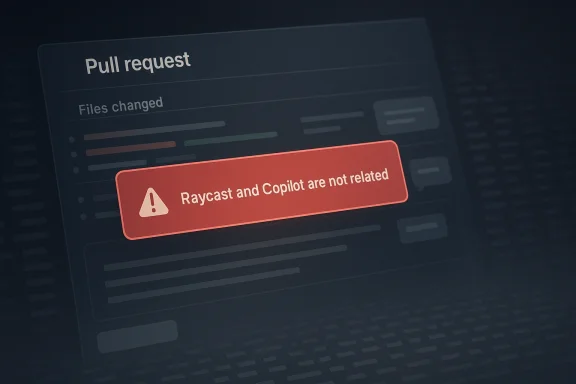
Screenshot shows a “Pull request” page with a warning: “Raycast and Copilot are not related.”Background​

The incident landed at an especially sensitive moment for GitHub and Copilot. Over the past year, Microsoft has steadily expanded Copilot from a code-completion assistant into a broader agentic coding platform, with the ability to create pull requests, respond to review comments, and help manage work inside repositories. That growth has been accompanied by a growing expectation from users that Copilot should feel like a tool, not a channel for marketing or a surface for unwanted product promotion.
What made this episode different was the placement. According to reporting on the incident, a developer named Zach Manson noticed that after a teammate asked Copilot to correct a typo in a pull request, the assistant not only made the requested change but also inserted a note referencing Raycast and Copilot itself. The wording was framed like a helpful tip, but in practice it read like an endorsement buried inside a pull request description, which is exactly the sort of context where developers expect precision, not persuasion.
The timing also matters because GitHub had just spent weeks publicizing new ways to invoke Copilot in pull requests. On March 24, GitHub announced that users could mention @copilot in any pull request to ask the coding agent to make changes, while also noting that Copilot had previously opened new pull requests on top of existing ones under certain workflows. On March 5, GitHub said users could even pick a model for Copilot in pull request comments. In other words, the platform had been actively broadening Copilot’s footprint inside the review process right before the backlash erupted.
That broader footprint is important because it changes the trust model. A simple IDE autocomplete suggestion is one thing; a comment or footer inside a pull request is quite another. Once an AI assistant is allowed to speak in review threads, even a small misfire can look like platform policy rather than a one-off error, and that is exactly how this controversy spread so quickly.

Why the timing mattered​

  • GitHub had recently expanded Copilot coding agent workflows inside pull requests.
  • The message appeared in a place where developers assume authorship and intent.
  • The wording looked promotional, even if GitHub says it was meant as a product tip.
  • The controversy arrived while Microsoft and GitHub are pushing harder on AI adoption.

Overview​

The central dispute is straightforward but consequential: did Microsoft intentionally inject advertisements into GitHub pull requests, or did a feature meant to provide tips leak into the wrong context? Microsoft’s public position is the latter. According to the company, GitHub has no plans to integrate advertising into pull requests, and the Raycast message was not part of a marketing campaign but the result of a logic error that caused product tips to appear where they should not have appeared.
Raycast, for its part, has also denied any co-marketing arrangement with Microsoft. That matters because the message explicitly named the third-party app, making it easy for observers to assume some sort of sponsored integration or commercial placement had been arranged behind the scenes. In reality, the most likely explanation is far less glamorous and far more awkward: a misrouted feature intended to educate users about Copilot capabilities ended up looking like a paid plug.
The scale amplified the outrage. Multiple reports say the same text appeared in more than 11,000 pull requests, and the pattern suggested a systemic issue rather than a single malformed comment. Once developers began searching for the exact phrase, they found it widely replicated, which turned a one-off complaint into a platform-wide trust issue. A bug that quietly repeats itself at scale is never just a bug; it becomes a statement about how carefully the system is governed.
This is also not the first time Copilot has raised concerns about exposure, context, and unintended behavior. GitHub and Microsoft have spent the last two years defending Copilot’s data handling, output quality, and product boundaries, including earlier controversies about repository exposure and AI behavior inside code collaboration tools. The new controversy fits a broader pattern in which the limits of AI product design become visible only after a feature has already been deployed at scale.

The core trust problem​

When developers review a pull request, they are evaluating code, intent, and change history. A line that looks like a human-authored note from the contributor carries a very different weight from a vendor-generated prompt or tip. The error therefore wasn’t just that the text was present; it was that it blurred the boundary between assistant output and developer speech.

How the Incident Spread​

The original report by Zach Manson seems to have acted as the spark. His description resonated because it captured two modern fears at once: that AI assistants can behave unpredictably, and that big platforms may quietly use assistant interfaces to promote their own ecosystems. Once he described the behavior as “horrific,” the framing stuck, and it was quickly echoed by other developers who had seen similar notes in their own repositories.
The broader spread appears to have been identified by searching for the exact promotional string and finding it in thousands of pull requests. That detail matters because it suggests the text was not handcrafted for one user or one project; it was generated from a reusable template or rule path. In that sense, the issue looks less like a marketing team experiment and more like a product logic mistake that was unintentionally allowed to scale.
What made the backlash especially intense is that the note was not visually separated from the work in a way that clearly signaled “this came from the tool.” Developers have long tolerated AI suggestions that are obviously machine-made, but they tend to react badly when AI output is inserted into collaborative records as if it were organic. That distinction is critical for code review culture, where provenance is as important as correctness.
There is also a reputational asymmetry at play. If an independent startup inserts a clumsy tip into a workflow, users may roll their eyes and move on. If Microsoft does it inside GitHub, the same action is interpreted as platform power being used to nudge developers toward a preferred ecosystem. The same text therefore carries a much larger meaning when it comes from the owner of the platform.

What users objected to most​

  • The message appeared inside pull request content.
  • It was easy to misread as human-authored.
  • It referenced a third-party product by name.
  • It seemed to promote Microsoft’s own Copilot ecosystem.
  • It was replicated at scale across many repositories.

Microsoft’s Response​

Microsoft’s response was to deny intent and emphasize malfunction. The company said the issue was not an ad campaign and that GitHub does not intend to place advertising into pull requests. Instead, the behavior came from a program logic error that caused a feature intended for specific contexts to appear as a footer in the wrong place. GitHub has already updated the feature so the messages should no longer appear in pull request comments.
That distinction may sound narrow, but it is the entire battle. If the message had been a deliberate placement, the story would have been about monetization and platform ethics. If it was a bug, the story becomes one of engineering oversight and weak guardrails. Either way, the outcome is the same for users: a promotional note landed where it should not have been. The only difference is whether the company is accused of malice or incompetence.
GitHub’s own messaging around Copilot has recently leaned heavily on flexibility and user control. Its March 24 changelog post stressed that users can ask Copilot to make changes in existing pull requests, while earlier March updates emphasized model selection and faster agent startup times. That makes the current backlash especially embarrassing, because the problem did not arise from a hidden feature but from a visible feature whose handling of context appears to have been mishandled.
It also helps explain why the company moved quickly to disable the behavior. For a product positioned as a trusted development assistant, a sustained perception that it is slipping promotional copy into repository discussions is toxic. It is not enough to say “it was only a bug” if the bug itself produces ad-shaped output in a developer workspace.

The company’s likely calculation​

Microsoft likely recognized that arguing semantics would only prolong the firestorm. By framing the issue as a logic bug and disabling the behavior, the company could contain the immediate reputational damage while preserving the broader Copilot narrative. That approach may be pragmatic, but it does not erase the trust cost created by the incident.

Raycast’s Role​

Raycast became the lightning rod because its name appeared in the inserted text. That was enough for some observers to assume an integration partnership or hidden commercial relationship between Microsoft and Raycast. But Raycast has denied any co-marketing deal, and the most credible reporting points to the text being generated by Copilot logic rather than a Raycast campaign.
Still, the company is not entirely incidental to the story. Raycast does offer extensions related to GitHub Copilot, and its ecosystem is explicitly tied to productivity workflows on macOS and Windows. That means the platform exists in the same conceptual neighborhood as the feature being discussed, which may have made the inserted message feel plausible enough to evade immediate suspicion. Plausible text is often more dangerous than obviously fake text because it blends too easily into real product guidance.
The incident also highlights how fragile third-party associations can be in AI workflows. A product tip that references another app may look harmless inside a lab demo, but once it appears in the middle of a collaborator’s pull request, it can be interpreted as a recommendation from the repository owner or even from the platform itself. That is especially true when the text is presented with an emoji and the conversational tone typical of AI-generated output.
For Raycast, the safest possible posture is exactly the one it appears to have taken: deny the existence of a paid relationship, avoid escalating the dispute, and let Microsoft own the operational explanation. Even when a company is merely named in a bug, the optics can still be damaging if the public concludes the naming was intentional.

Why Raycast got pulled into the drama​

  • The inserted note named Raycast directly.
  • Raycast has real Copilot-related integrations.
  • The wording looked promotional rather than neutral.
  • Users often assume named partners imply a deal.
  • The association widened the controversy beyond GitHub alone.

The Developer Backlash​

The anger from developers was not just about one bad note. It was about the possibility that a platform they use for source control and collaboration could become a hidden advertising surface. That is a profound cultural offense in software teams, where trust in tooling is built on the assumption that infrastructure is neutral unless explicitly stated otherwise.
There is also a strong emotional component here. Developers already live with enough noise: AI-generated suggestions that miss context, chat systems that overpromise, and product updates that arrive without clear opt-in boundaries. Seeing a pull request description quietly rewritten to include a plug for a tool was enough to make many users feel that the platform had crossed from assistance into manipulation. That explains why the reaction was so heated, and why the word advertising spread faster than the word bug.
The concern is not theoretical. Once an AI system can modify pull request text, it can potentially alter the tone, framing, and context of developer communication. That raises questions about authorship, consent, and auditability. In highly regulated or security-sensitive environments, even a minor unauthorized wording change can create compliance headaches or confuse reviewers about what actually happened.
What makes the backlash especially important is that it came from users who are generally not hostile to AI. Many developers now accept Copilot as a useful part of their workflow, but that acceptance depends on clear boundaries. The reaction to this incident suggests those boundaries remain fragile, and that users are willing to tolerate AI help only if the tool stays visibly subordinate to the human author.

Trust, consent, and authorship​

A pull request is not a billboard. It is a record of changes, review, discussion, and accountability. If a platform inserts extra text into that record without obvious consent, it risks corrupting the social contract that makes collaborative development work.

What the Bug Says About Copilot’s Evolution​

This episode is revealing because it shows how far Copilot has moved beyond autocomplete. GitHub now positions Copilot as an agentic assistant that can start tasks, open pull requests, respond to comments, and collaborate across issues and chats. The more autonomous the assistant becomes, the more opportunities there are for context leakage and output that escapes its intended lane.
That evolution makes product boundaries harder to maintain. A feature that is safe when used only on Copilot-originated pull requests may become inappropriate when applied to any pull request mentioning Copilot. GitHub’s own changelog language helps explain the problem: it says the behavior was originally intended for a narrower set of circumstances, then broadened to include human-created PRs as well. Once that boundary shifted, the risk profile changed too.
The incident also exposes a common weakness in AI product design: the assumption that helpful content is always welcome. Product tips may be useful in onboarding screens or documentation sidebars, but they become intrusive when inserted into a live collaboration record. That is particularly true in code review, where every extra line competes with the actual technical discussion and may be mistaken for part of the change set.
This is why some developers interpreted the note not as a mistake but as a warning about the future. If a coding agent can subtly promote itself or adjacent tools today, what happens when AI systems become more deeply embedded across issue trackers, pull requests, chats, and release notes? The broader the agent surface, the more a small logic flaw can resemble platform policy.

The product lesson​

  • Autonomy increases the risk of unintended context.
  • Expansion without strict guardrails invites user distrust.
  • Tips are not neutral when they appear in workflow records.
  • Agents need sharper boundaries than chatbots.
  • Human authorship must remain obvious in collaborative tools.

Enterprise and Consumer Impact​

For enterprise teams, the consequences are likely to be more serious than the immediate embarrassment. Companies using Copilot in regulated industries, audited environments, or internal compliance workflows may now ask whether the assistant can be trusted to preserve strict message boundaries. Even if Microsoft fixed the bug quickly, procurement and security teams will want to know how often AI-generated “help” can leak into sensitive records.
Consumers and smaller teams are likely to react differently. Individual developers may shrug, disable certain features, or simply become more skeptical of Copilot-generated text. But the broader effect could still be meaningful: once a tool is perceived as prone to promotional overreach, users start to scrutinize every extra line it adds. That skepticism can erode adoption even when the underlying code-generation quality remains strong.
The enterprise angle matters because Microsoft has spent heavily positioning Copilot as a serious productivity platform, not a novelty. Any incident that makes the assistant look like a marketing vehicle undercuts that message immediately. This is especially awkward because GitHub has been marketing Copilot as something that can support serious engineering work, including pull request creation and review assistance.
There is also a governance dimension. Enterprises do not only care whether a tool works; they care whether it can be explained to auditors, security leaders, and legal teams. A feature that silently adds tool recommendations into pull requests is hard to justify in environments where every artifact needs a clear provenance trail. The more regulated the industry, the less room there is for “it was just a bug” as an end-user explanation.

Different reactions by audience​

  • Enterprises will focus on control, auditability, and policy.
  • Consumers will focus on annoyance, trust, and feature settings.
  • Dev teams will focus on whether Copilot can be safely used in review workflows.
  • Open-source maintainers may be especially sensitive to unsolicited text in PRs.
  • Security-conscious organizations may reassess AI permissions.

GitHub’s Changing Product Strategy​

The timing of the Raycast incident is telling because GitHub has been moving aggressively to make Copilot central to the development experience. In late March, GitHub announced faster startup for Copilot coding agent, broader support for @copilot inside pull requests, and additional workflow integrations with Slack and Jira. The company is clearly betting that the future of GitHub is not just hosting code, but orchestrating work through AI.
That strategy creates a larger surface area for mistakes. As Copilot becomes more embedded in the workflow, it must also become more disciplined about where it speaks, what it says, and how it signals its own presence. The current incident suggests that GitHub’s systems may still be catching up to the scale of that ambition. A feature set that spans issues, pull requests, comments, chats, and external apps is simply harder to police than a narrow coding assistant.
There is a competitive angle too. Microsoft wants Copilot to be the default AI layer across developer work, and GitHub remains its most valuable platform for that mission. But if users start viewing Copilot-generated text as a source of unwanted inserts or subtle self-promotion, competitors will use that discomfort to argue for simpler, more transparent AI tooling. In AI products, trust is often the moat, and this incident chips at that moat.
Still, it would be a mistake to overstate the long-term damage. GitHub’s ecosystem remains deeply embedded in software development, and Copilot still offers obvious productivity gains when it works as intended. The more likely outcome is not a mass migration away from GitHub, but a sharper demand for explicit settings, clearer labels, and better control over assistant-generated content.

Platform strategy vs platform trust​

GitHub’s challenge is no longer just feature velocity. It is the harder task of proving that accelerated AI workflows can remain predictable, auditable, and non-promotional even as they become more powerful.

Strengths and Opportunities​

The good news for GitHub is that this appears to have been contained quickly, and the company has a chance to turn a credibility problem into a governance improvement story. If it uses the incident to tighten review surfaces, improve labeling, and communicate more clearly about assistant behavior, it can still preserve momentum on Copilot adoption. The broader market for developer AI remains huge, and GitHub still has the advantage of distribution, brand recognition, and workflow depth.
  • GitHub can use the incident to improve feature gating.
  • Better UI labeling could make assistant output unmistakable.
  • Stronger opt-in controls would reassure enterprise buyers.
  • Clearer separation between tips and comments could reduce confusion.
  • The episode may push Microsoft toward more transparent AI governance.
  • GitHub can reinforce that Copilot is a helper, not a marketer.
  • Developers may appreciate faster fixes and candid explanations.

Why the upside still exists​

If GitHub responds well, it can show that the platform is capable of self-correction. In a market where AI trust is still being defined, that kind of responsiveness matters almost as much as raw capability. A visible commitment to user control could become a competitive advantage rather than merely a damage-control tactic.

Risks and Concerns​

The bigger danger is that users stop believing the line between “helpful suggestion” and “product promotion” is reliably enforced. Even if this specific issue is fixed, one poorly labeled message can leave a long tail of skepticism, especially among teams that already view AI assistants as noisy or overconfident. The reputational damage may be subtle, but in platform products subtle damage compounds quickly.
  • Users may become more suspicious of any AI-generated text in PRs.
  • Enterprises may tighten review policies around Copilot usage.
  • Developers may disable agent features to avoid unexpected inserts.
  • Microsoft risks reinforcing the idea that it treats GitHub as a funnel.
  • The bug raises questions about testing and release validation.
  • Third-party partners may hesitate to appear in Copilot-related surfaces.
  • Future assistant features may face heavier scrutiny before launch.

The reputational downside​

The hardest part of incidents like this is not the cleanup; it is the lingering memory. Developers are quick to remember when a tool makes them feel like a marketing target, and much slower to forget it. If GitHub wants Copilot to be a trusted collaborator, it must prove that every text surface is governed by stricter rules than this one clearly was.

Looking Ahead​

The immediate question is whether this remains a one-day controversy or becomes a symbol of a deeper concern about AI in developer tools. GitHub says the behavior has been disabled, and that will likely stop the technical problem from spreading further. But the public conversation now shifts to how Copilot is tested, how its surfaces are labeled, and how often these “tips” can appear without feeling like covert promotion.
More broadly, this incident may force Microsoft and GitHub to be more explicit about what Copilot is and is not allowed to do inside collaboration artifacts. That matters because the company is pushing the product into more places, from Slack to Jira to pull requests, and every new integration expands the risk of crossing from assistance into intrusion. The future of developer AI will not be judged only by model quality; it will also be judged by restraint.

What to watch next​

  • Whether GitHub publishes a fuller technical postmortem.
  • Whether Copilot gains more visible labeling in PR workflows.
  • Whether enterprises revise internal policies for AI-assisted review.
  • Whether Microsoft clarifies how product tips are generated and gated.
  • Whether other Copilot surfaces receive similar scrutiny.
The broader lesson is simple but uncomfortable: in developer tooling, trust is part of the product. GitHub can fix a bug faster than it can repair a perception problem, and this incident has already reminded users that AI assistants must earn their place inside the engineering workflow every single time they speak.

Source: Notebookcheck More than 11,000 GitHub projects affected: Copilot posted ads for Raycast
 

Back
Top