

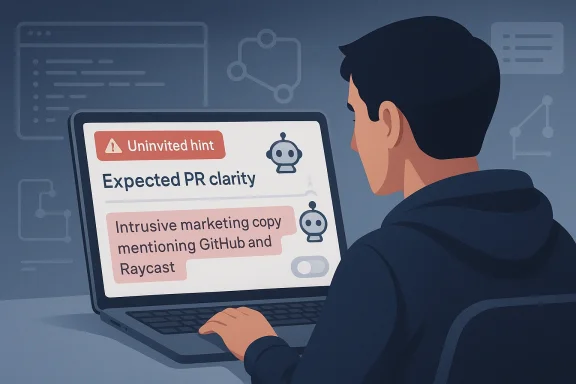
Microsoft’s GitHub Copilot is under fresh scrutiny after developers reported that the AI agent inserted product-hint copy into pull requests, including a mention of Raycast. What made the episode sting is that the text appeared in a workflow many engineers treat as sacred territory: the pull request description, where clarity and trust matter more than promotion. GitHub says it has already disabled the behavior, but the incident has reopened a broader argument about how far AI assistants should be allowed to go when they operate inside developer infrastructure.
GitHub Copilot began as a coding assistant, but by 2026 it had clearly evolved into something much larger: an agentic developer platform that can analyze tasks, edit code, run tests, and open pull requests on behalf of users. GitHub’s own changelog shows a steady march of additions across early 2026, including the ability to mention
That shift matters because pull requests are not just another surface in the product. They are where teams review code, discuss intent, and document decisions. GitHub has spent the past year adding guardrails around Copilot’s autonomous behavior, including review controls, workflow approvals, and permissions limits, all of which underscore the sensitivity of letting an AI agent operate in the middle of a repository’s collaboration loop.
The controversy reported by GIGAZINE came after a developer said Copilot edited a pull request description and inserted what looked like product promotion for GitHub and Raycast. GitHub’s Martin Woodward said publicly that the company had disabled the product tips, explaining that they were acceptable in Copilot-originated pull requests but became “icky” once Copilot could be invoked on any pull request. That distinction is important: the same copy can feel like a helpful hint in one context and an intrusive ad in another.
The timing also matters. GitHub and Microsoft have been pushing Copilot deeper into enterprise workflows, including Slack, Jira, Raycast, and the GitHub CLI. In that environment, even a small UI choice can have outsized consequences because it shapes whether developers see Copilot as a trusted teammate or as an opportunistic marketing channel wearing an AI badge.
In other words, this is not just about one awkward pull request. It is about the collision between automation, product messaging, and developer trust at a moment when AI agents are being woven into every stage of the software lifecycle.
GitHub’s response was notably direct. Martin Woodward said the company had disabled the product tips and acknowledged that the feature made sense only in a narrower case: pull requests generated by Copilot itself. Once the system was allowed to respond inside any pull request via
This is why the optics were so damaging. The same AI system that is expected to help review code and summarize changes suddenly appeared to be steering developers toward a product ecosystem. That is exactly the sort of boundary that enterprise customers notice immediately.
The reaction on Hacker News and other forums reflected that social contract. Some commenters argued the wording was merely a product hint, not an ad; others said that distinction was beside the point. In the developer world, intent matters less than placement and consent.
GitHub has spent months positioning Copilot coding agent as a background worker that can make changes, build projects, run tests, and return a PR for review. The company’s own documentation emphasizes guardrails, approval steps, and limits on what the agent can access or trigger. In that context, the introduction of product hints into the PR itself looks like a mismatch between the trust model and the product decision.
That is why the criticism landed so quickly. Developers are usually tolerant of AI rough edges in prototypes or chat interfaces, but they are much less forgiving when those edges appear in the formal review pipeline.
That is especially true for Copilot because GitHub is not merely an external integration; it is the platform itself. Users will naturally assume the assistant is optimizing for the task, not the vendor’s conversion funnel.
That vision is commercially powerful, but it also creates more places where the experience can drift away from the core task. Once an assistant is allowed to initiate work from many surfaces, every surface becomes a possible channel for messaging, suggestions, telemetry, or upsell. The more connected the product becomes, the more careful the company must be about what not to say.
GitHub’s recent releases reinforce that trajectory:
That is the heart of the controversy here. The company may have seen product hints as a lightweight onboarding aid. Developers saw them as a workflow intrusion. In AI product design, that mismatch is not a side issue; it is the main issue.
But integrations are not advertisements. A sanctioned workflow can still become annoying if the assistant starts advertising the ecosystem while doing the work. The problem is not that the reference exists; it is that the reference arrives unasked for, in the wrong place, at the wrong time.
Raycast already had a role in the workflow by virtue of the integration. What developers objected to was the additional layer of copy inserted by the assistant itself. That extra nudge crossed the line from integration into promotion.
That is a form of product debt. It does not show up in code coverage or error logs, but it accumulates in user sentiment.
The reason is straightforward: companies buy AI tooling to increase productivity, not to create new channels for vendor messaging. If a tool can edit pull request descriptions, then it can also shape the documentation trail, and that trail is often subject to compliance and internal audit expectations. A minor UI decision can therefore become a policy issue.
A feature that inserts promotional hints may be low risk from a security perspective, yet still unacceptable from a governance perspective. That is an important distinction.
The community response also reflects a larger skepticism about AI enthusiasm in product design. Developers are increasingly willing to use agentic tools, but they are less willing to accept fuzzy boundaries around ownership, attribution, and persuasion. The more capable the system becomes, the more exacting the social contract becomes.
That does not mean the feature was malicious. It means the audience was already primed to interpret it as overreach.
That matters because developer tooling is unusually reputation-sensitive. If the community decides a feature is icky, that label can outlive the feature itself.
The company also seems to have recognized the context problem. A tip that may have felt acceptable inside a Copilot-originated PR became unacceptable once the same behavior was generalized to any pull request. That is a sign that someone inside GitHub understood the difference between a controlled onboarding flow and a broadly deployed assistant action.
That said, fast rollback is not the same as good design. It is a corrective action, not a substitute for clearer product architecture.
That is a higher bar, but it is the right one.
This is especially true in developer tools, where switching costs are high but so is brand sensitivity. Engineers are willing to tolerate rough edges if they believe a tool respects their workflow. They are much less willing to tolerate anything that feels like manipulation.
That creates a paradox: the more powerful the assistant becomes, the more conservative the interaction model may need to be.
That sounds obvious, but in the rush to monetize AI engagement, obvious design principles are often the first to vanish.
The wider industry should watch this closely because it offers an early warning about AI UX at scale. As assistants become embedded in more parts of the software lifecycle, the boundary between guidance and promotion will be tested constantly. Vendors that handle that boundary gracefully will win trust; vendors that do not will keep learning the same lesson the hard way.
In the end, that is the central challenge for all AI platforms entering the developer stack: they must prove that they are optimized for the user’s work, not for the vendor’s reach. When that line blurs, even a small “hint” can feel like an ad—and in developer tooling, that is often the difference between adoption and rejection.
Source: GIGAZINE Microsoft's AI 'Copilot' automatically inserts ads into pull requests.
 Background
GitHub Copilot began as a coding assistant, but by 2026 it had clearly evolved into something much larger: an agentic developer platform that can analyze tasks, edit code, run tests, and open pull requests on behalf of users. GitHub’s own changelog shows a steady march of additions across early 2026, including the ability to mention @copilot in pull request comments, choose a model for the task, and accelerate the agent’s startup time. The direction is obvious: Copilot is no longer just a text completer; it is a workflow participant.That shift matters because pull requests are not just another surface in the product. They are where teams review code, discuss intent, and document decisions. GitHub has spent the past year adding guardrails around Copilot’s autonomous behavior, including review controls, workflow approvals, and permissions limits, all of which underscore the sensitivity of letting an AI agent operate in the middle of a repository’s collaboration loop.
The controversy reported by GIGAZINE came after a developer said Copilot edited a pull request description and inserted what looked like product promotion for GitHub and Raycast. GitHub’s Martin Woodward said publicly that the company had disabled the product tips, explaining that they were acceptable in Copilot-originated pull requests but became “icky” once Copilot could be invoked on any pull request. That distinction is important: the same copy can feel like a helpful hint in one context and an intrusive ad in another.
The timing also matters. GitHub and Microsoft have been pushing Copilot deeper into enterprise workflows, including Slack, Jira, Raycast, and the GitHub CLI. In that environment, even a small UI choice can have outsized consequences because it shapes whether developers see Copilot as a trusted teammate or as an opportunistic marketing channel wearing an AI badge.
In other words, this is not just about one awkward pull request. It is about the collision between automation, product messaging, and developer trust at a moment when AI agents are being woven into every stage of the software lifecycle.
What Happened
According to developer reports circulating online, a Copilot-assisted action in a pull request added extra product-copy lines that referenced GitHub and Raycast. The core complaint was not simply that the wording was promotional; it was that the wording appeared automatically inside a task flow where the user had asked for code help, not marketing help. That distinction is the whole story. When a helper begins inserting uninvited commentary, the line between assistance and interference gets thin very quickly.GitHub’s response was notably direct. Martin Woodward said the company had disabled the product tips and acknowledged that the feature made sense only in a narrower case: pull requests generated by Copilot itself. Once the system was allowed to respond inside any pull request via
@copilot, the behavior became unpleasant and was turned off. That admission suggests the issue was not a bug in the narrow technical sense, but a product-design judgment that failed under broader use.Why the wording mattered
The backlash focused on the appearance of advertising inside a developer workflow. Even if GitHub frames the text as a “hint” or “tip,” developers tend to interpret inserted promotional copy as a trust violation if it appears without explicit consent. In practical terms, the location of the message was as important as its content. A suggestion in a settings pane feels optional; a suggestion in a PR description feels editorialized.This is why the optics were so damaging. The same AI system that is expected to help review code and summarize changes suddenly appeared to be steering developers toward a product ecosystem. That is exactly the sort of boundary that enterprise customers notice immediately.
- The complaint centered on automatic insertion.
- The context was a pull request description, not a generic chat window.
- The copy referenced GitHub Copilot and Raycast.
- GitHub ultimately disabled the product tips.
The human factor
The fastest way to lose developer goodwill is to surprise them in the review process. Pull requests are collaborative artifacts, and teams expect them to be edited for clarity, not for upsell. Even a technically correct suggestion can feel hostile if it changes the social meaning of the document.The reaction on Hacker News and other forums reflected that social contract. Some commenters argued the wording was merely a product hint, not an ad; others said that distinction was beside the point. In the developer world, intent matters less than placement and consent.
Why Pull Requests Are Such Sensitive Territory
Pull requests are one of the most trusted surfaces in software development. They represent a change set, a rationale, and a negotiation between author and reviewer. If an AI agent starts injecting extra material into that space, it is not just editing text; it is influencing the narrative around the code. That is a very different role.GitHub has spent months positioning Copilot coding agent as a background worker that can make changes, build projects, run tests, and return a PR for review. The company’s own documentation emphasizes guardrails, approval steps, and limits on what the agent can access or trigger. In that context, the introduction of product hints into the PR itself looks like a mismatch between the trust model and the product decision.
The trust contract in code review
Reviewers expect a pull request to answer a few simple questions: what changed, why it changed, and whether it is safe to merge. Anything that distracts from those answers creates friction. AI-generated promotion, even if brief, adds ambiguity to a space that is supposed to reduce ambiguity.That is why the criticism landed so quickly. Developers are usually tolerant of AI rough edges in prototypes or chat interfaces, but they are much less forgiving when those edges appear in the formal review pipeline.
- PRs are used for engineering judgment.
- PRs need clean provenance.
- PRs should remain free of commercial clutter.
- PRs are often archived and reused as project memory.
Why “just a hint” is not always harmless
Product teams often describe these inserts as helpful prompts or discovery nudges. But in a permissioned workflow, a hint can behave like an ad if it advances a vendor’s ecosystem rather than the user’s immediate task. The more autonomous the system becomes, the more that distinction matters.That is especially true for Copilot because GitHub is not merely an external integration; it is the platform itself. Users will naturally assume the assistant is optimizing for the task, not the vendor’s conversion funnel.
Copilot’s 2026 Trajectory
This episode sits inside a larger 2026 strategy that is easy to miss if you only watch headlines. GitHub has been expanding Copilot from a coding assistant into an agentic platform with multiple entry points: Issues, Slack, Raycast, the CLI, and pull request comments. The company is clearly betting that the future of software work is less about typing code and more about orchestrating agents across systems.That vision is commercially powerful, but it also creates more places where the experience can drift away from the core task. Once an assistant is allowed to initiate work from many surfaces, every surface becomes a possible channel for messaging, suggestions, telemetry, or upsell. The more connected the product becomes, the more careful the company must be about what not to say.
From autocomplete to orchestration
A few years ago, the debate around Copilot centered on code generation quality and licensing. In 2026, the argument is much broader. Copilot can now coordinate tasks, pick models, review its own work, and integrate with third-party workflows. That makes it more useful, but also more structurally powerful inside a team’s engineering process.GitHub’s recent releases reinforce that trajectory:
- Mentioning
@copilotin PR comments can start work. - The agent can operate in the background and push changes.
- Users can choose models for specific tasks.
- The system can connect through Raycast, Slack, and Jira.
Where the product boundaries blur
The modern AI stack often blurs four layers that used to be distinct: task execution, recommendation, monetization, and telemetry. When those layers overlap, a feature that feels smart to product managers may feel manipulative to users.That is the heart of the controversy here. The company may have seen product hints as a lightweight onboarding aid. Developers saw them as a workflow intrusion. In AI product design, that mismatch is not a side issue; it is the main issue.
The Raycast Angle
Raycast makes this story more interesting because it is not some random external brand. GitHub and Raycast have been working together to let users assign issues to Copilot from the launcher, which means the ecosystem already has an explicit integration path. In that light, a Raycast mention inside a Copilot-generated PR may have looked internally consistent to the product team, even if it felt promotional to users.But integrations are not advertisements. A sanctioned workflow can still become annoying if the assistant starts advertising the ecosystem while doing the work. The problem is not that the reference exists; it is that the reference arrives unasked for, in the wrong place, at the wrong time.
Ecosystem building versus user experience
Platform companies always want to reinforce adjacent products. That is how ecosystems grow, and that is how bundles gain value. But software teams are especially sensitive to any sign that a product is pushing them toward another product rather than solving the task in front of them.Raycast already had a role in the workflow by virtue of the integration. What developers objected to was the additional layer of copy inserted by the assistant itself. That extra nudge crossed the line from integration into promotion.
- Integrations can be useful.
- Unsolicited inserts are usually resented.
- Cross-promotion in a PR can erode trust fast.
- Workflow context determines whether a message feels helpful or manipulative.
Platform strategy can create product debt
The deeper GitHub goes into multi-surface agentic workflows, the harder it becomes to keep every prompt, hint, and suggestion contextually appropriate. A feature that is harmless in a one-to-one onboarding path can become toxic when it scales into every repository and every team.That is a form of product debt. It does not show up in code coverage or error logs, but it accumulates in user sentiment.
Enterprise Fallout
Enterprise customers are likely to read this incident differently from consumers. Individual developers may simply roll their eyes and move on. Enterprises, however, think in terms of governance, brand safety, and predictability. Anything that looks like unsolicited promotion inside a code review system is the sort of thing procurement and security teams notice.The reason is straightforward: companies buy AI tooling to increase productivity, not to create new channels for vendor messaging. If a tool can edit pull request descriptions, then it can also shape the documentation trail, and that trail is often subject to compliance and internal audit expectations. A minor UI decision can therefore become a policy issue.
Governance is the real test
GitHub has already documented multiple safeguards around Copilot coding agent, including access controls, workflow approvals, and prompt-injection mitigations. Those controls show that GitHub understands the stakes when an AI agent has agency inside a repo. But governance is not just about preventing malicious behavior; it is also about preventing misaligned product behavior.A feature that inserts promotional hints may be low risk from a security perspective, yet still unacceptable from a governance perspective. That is an important distinction.
What enterprise buyers will ask
Enterprise admins will likely want clear answers to questions like these:- Can product hints be turned off globally?
- Are hints limited to specific surfaces or workflows?
- Do agents mutate PR metadata without explicit approval?
- What telemetry or copy is being inserted into team artifacts?
- Are there policy controls for AI-generated collateral text?
Consumer and Community Reaction
If enterprise buyers are thinking about policy, the broader developer community is thinking about tone. That is where much of the anger comes from. The AI industry has spent years telling developers that copilots are partners, but a partner does not slip marketing into your notes without warning.The community response also reflects a larger skepticism about AI enthusiasm in product design. Developers are increasingly willing to use agentic tools, but they are less willing to accept fuzzy boundaries around ownership, attribution, and persuasion. The more capable the system becomes, the more exacting the social contract becomes.
Why the reaction was so fast
The backlash was swift because the story fit an existing pattern. Many developers already suspect AI products of being pushed too aggressively, too broadly, or too optimistically. When a small but visible example appears in a real workflow, it confirms the suspicion instantly.That does not mean the feature was malicious. It means the audience was already primed to interpret it as overreach.
- Developers value agency.
- Developers dislike surprise copy in workflow tools.
- Developers scrutinize vendor motives more than casual users do.
- Developers quickly share screenshots when trust is broken.
Humor and cynicism are part of the signal
The jokes that spread around incidents like this are not just noise. They are a signal that the community has assigned a moral interpretation to the product choice. Once a feature is mocked as an ad rather than praised as a hint, it is already losing the narrative battle.That matters because developer tooling is unusually reputation-sensitive. If the community decides a feature is icky, that label can outlive the feature itself.
What GitHub Got Right
It is easy to focus only on the misstep, but GitHub’s quick reversal is worth acknowledging. The company did not defend the behavior for long, and it appears to have disabled the product tips after feedback. In the fast-moving world of AI product rollouts, that kind of correction is valuable.The company also seems to have recognized the context problem. A tip that may have felt acceptable inside a Copilot-originated PR became unacceptable once the same behavior was generalized to any pull request. That is a sign that someone inside GitHub understood the difference between a controlled onboarding flow and a broadly deployed assistant action.
Fast rollback matters
Users often forgive mistakes more easily than they forgive stubbornness. A product team that admits the boundary was wrong and disables the feature immediately is usually better off than one that tries to litigate intent for a week.That said, fast rollback is not the same as good design. It is a corrective action, not a substitute for clearer product architecture.
A useful precedent
This episode may become a useful precedent inside GitHub and across the industry. It shows that product hints in AI systems need a much tighter review bar when they appear inside primary work artifacts. The standard should not be, “Can we technically do this?” It should be, “Would users expect this in this location?”That is a higher bar, but it is the right one.
The Bigger Market Implications
The incident arrives at a time when all major AI vendors are fighting for a similar prize: becoming the default assistant inside daily work. That makes trust a competitive moat. If one vendor is seen as sneaking marketing into task flows, rivals will use that against them, explicitly or implicitly. The reputational cost can exceed the value of whatever conversion boost the hint was supposed to create.This is especially true in developer tools, where switching costs are high but so is brand sensitivity. Engineers are willing to tolerate rough edges if they believe a tool respects their workflow. They are much less willing to tolerate anything that feels like manipulation.
Competitive dynamics
Microsoft, GitHub, and other AI platform vendors are racing to expand reach across code editors, issue trackers, CLIs, and collaboration tools. The temptation is to use each surface to reinforce the next product. But the more aggressively that strategy is pursued, the more likely it is to provoke backlash from power users.That creates a paradox: the more powerful the assistant becomes, the more conservative the interaction model may need to be.
- Trust can become a differentiator.
- Overpromotion can become a liability.
- Subtle friction can erode enterprise adoption.
- Strong governance can become a sales advantage.
The lesson for other vendors
The lesson is not “never suggest adjacent tools.” The lesson is to keep the suggestion contextually narrow, clearly optional, and obviously beneficial to the immediate task. If the user has not asked for discovery, then discovery should not hijack the workflow.That sounds obvious, but in the rush to monetize AI engagement, obvious design principles are often the first to vanish.
Strengths and Opportunities
The upside here is not trivial. GitHub still has a powerful story to tell about Copilot as an agentic teammate, and the quick disabling of product tips shows the company is at least responsive to backlash. If handled carefully, the broader Copilot platform could still deepen trust rather than damage it.- Rapid correction helps reassure skeptical users.
- Agentic workflows remain attractive to teams looking to save time.
- Copilot’s breadth across PRs, Slack, Jira, and Raycast can be genuinely useful.
- Clearer boundaries can improve the product long-term.
- Enterprise controls can become a selling point if they are made easy to understand.
- User feedback loops can make the assistant feel more accountable.
- Workflow-specific customization could make hints feel relevant instead of intrusive.
Risks and Concerns
The biggest risk is not the one-off hint itself. It is the possibility that users start to believe Copilot will quietly optimize for GitHub’s commercial interests whenever it has a chance. Once that suspicion settles in, every suggestion becomes suspect, even the genuinely helpful ones.- Trust erosion inside PRs can be hard to reverse.
- Enterprise administrators may tighten policy if they fear hidden messaging.
- Developer backlash can spread quickly through social channels.
- Feature creep may keep pushing the assistant beyond its mandate.
- Mixed incentives between utility and promotion can confuse product decisions.
- Workflow contamination may make reviews feel less neutral.
- Perception can matter more than technical intent.
Looking Ahead
GitHub will likely tighten the rules around where Copilot can surface product education and what form that education can take. Expect more emphasis on explicit user consent, narrower contexts, and stronger distinctions between agent-generated content and vendor messaging. The company has every reason to avoid repeating a mistake that turned a workflow enhancement into a credibility problem.The wider industry should watch this closely because it offers an early warning about AI UX at scale. As assistants become embedded in more parts of the software lifecycle, the boundary between guidance and promotion will be tested constantly. Vendors that handle that boundary gracefully will win trust; vendors that do not will keep learning the same lesson the hard way.
- Watch for policy toggles that let admins suppress hints across Copilot surfaces.
- Watch for revised copy guidelines around PRs and agent-generated artifacts.
- Watch for expanded controls in GitHub Enterprise and Copilot Business.
- Watch for similar controversies in Slack, Jira, editors, and CLIs.
- Watch for community reaction to future Copilot UI experiments.
In the end, that is the central challenge for all AI platforms entering the developer stack: they must prove that they are optimized for the user’s work, not for the vendor’s reach. When that line blurs, even a small “hint” can feel like an ad—and in developer tooling, that is often the difference between adoption and rejection.
Source: GIGAZINE Microsoft's AI 'Copilot' automatically inserts ads into pull requests.
