

Microsoft’s GitHub has backed away from a Copilot experiment that crossed a line for many developers: inserting promotional “tips” into pull requests that Copilot touched. The backlash was swift, because the change blurred the already sensitive boundary between automated code review and product marketing, and it did so inside a workflow developers expect to be task-focused, not ad-supported. GitHub says the feature has now been disabled for pull requests created by or touched by Copilot, a move that underscores how fast trust can erode when AI tooling starts to look like an advertising channel.
The episode lands at an awkward moment for GitHub and Microsoft, both of which have spent the last few years positioning Copilot as an indispensable assistant for software teams rather than a novelty feature. Just days before the backlash, GitHub announced that users could mention
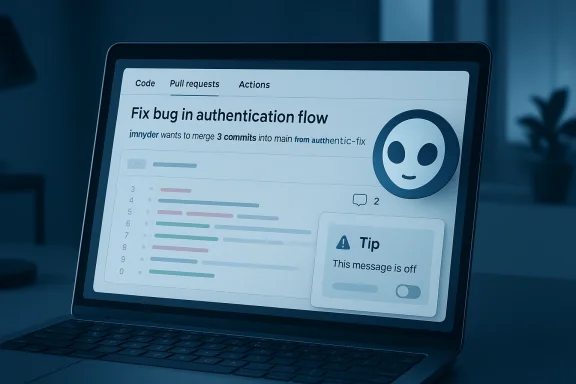
That context matters because the controversy was not simply about an unsolicited banner or a sidebar card. According to the reporting that triggered the debate, Copilot was placing a Raycast recommendation into pull requests, and the prompt appeared in a tone that made it look as though the message were part of the developer’s own work. The problem was not merely that a product was mentioned, but that the message was inserted into a human-authored collaborative artifact without a clear distinction between review output and promotion. That kind of context collapse is exactly what developers tend to resent.
GitHub’s own documentation shows how far the platform has been pushing Copilot into PR workflows. The company describes Copilot code review as a feature that can automatically review pull requests, generate suggestions, and in some configurations keep reviewing new pushes. It also allows comments from Copilot to behave much like human review comments, which is useful for collaboration but also makes the line between useful feedback and product messaging more fragile.
The company’s rapid reversal suggests it understood that the feature was not just unpopular but strategically risky. GitHub has spent years convincing enterprises that Copilot can be governed, customized, and trusted in managed environments. Turning review surfaces into an advertising-adjacent distribution channel would have undercut that story at the exact point where buyers care most about process integrity, auditability, and consent.
The setup looks innocuous on paper. A developer mentions
That distinction is crucial for enterprise buyers. A reviewer that can add comments is expected to be a participant in the engineering process. A reviewer that can inject commercial messaging without an explicit user action is a different class of actor entirely. Once that boundary is crossed, every automation in the review pipeline starts to look more suspicious.
There is also a deeper cultural issue at work. Engineering teams tend to value explicitness, reproducibility, and reviewability. A machine that quietly changes the narrative text of a pull request without the author’s awareness violates all three principles at once. Even if the inserted message were benign, the method of insertion would still be controversial because it breaks the social contract of collaborative development.
This is not a trivial branding problem. Once developers suspect that AI review comments might double as marketing placements, every other Copilot suggestion becomes slightly harder to trust. That is especially dangerous for a tool that depends on confidence, because AI coding assistants are only as valuable as the willingness of the team to let them participate in the work.
That evolution creates pressure to keep users in the loop about what Copilot can do next. Product teams often reach for “tips” to drive adoption because agentic tools can be discoverability-challenged: users do not always know the model can handle a broader task unless the interface tells them. But in a developer environment, that instinct can quickly drift into overexposure. What works as onboarding can become spam when embedded in the wrong place.
The tension here is not unique to GitHub. Any platform that mixes collaboration software with AI assistance will eventually face the same problem: how do you surface new capabilities without making users feel like they are being manipulated into product discovery? The answer probably lies in explicit opt-in channels, not in-machine placements inside user work product.
That kind of statement is important because it signals not just a rollback but a specific product lesson. GitHub was not saying Copilot in pull requests is bad. It was saying this particular expansion of its editorial power was a mistake. That leaves the broader Copilot roadmap intact while acknowledging that the social boundaries around PR editing were crossed.
Had the company dug in, the conversation could have shifted to deeper issues: whether GitHub is monetizing collaborative workflows too aggressively, whether AI agents need stricter default permissions, and whether the line between product enhancement and platform self-promotion is already too thin. A same-day rollback avoided that larger fight, at least for now.
That architecture depends on predictability. Administrators need to know what Copilot can comment on, when it can review, and how its output is constrained. If the agent can also insert promotional copy into PRs, then the administrative story becomes weaker, because the tool is no longer acting solely as a reviewer or assistant. It is also acting as a distribution surface.
The promotional-tip episode shows that governance needs to extend beyond access control into content policy. It is not enough to ask whether a model may touch a pull request. Teams also need to ask what kinds of changes it may make while touching it. That sounds subtle, but it is the difference between a productivity feature and an unmanaged editorial agent.
That emotional reaction helps explain why the story spread so quickly. A feature that might have been tolerated as a harmless nudge in a consumer app became controversial the moment it showed up in a source-control thread. The social context is different, and software vendors sometimes underestimate how different it is.
The Raycast example resonated because it looked like a message authored by the developer, even though it was apparently machine inserted. That kind of mismatch between perceived authorship and actual authorship is exactly what communities dislike, especially when a platform is already under scrutiny for pushing AI features aggressively.
The fact that GitHub had to reverse course so quickly gives competitors a fresh argument: their tools may be less integrated, but they may also be less intrusive. That is not a trivial market position. As AI coding assistants move from autocomplete into review, orchestration, and task execution, trust and restraint become differentiators as much as model quality.
If the market starts to associate one platform with surprise commercial insertions, that platform risks paying a trust premium in every procurement conversation. Conversely, competitors can position themselves as the safe choice even if they are technically less advanced. In developer tooling, perceived humility can be a feature.
That means GitHub’s immediate challenge is not whether to pull back on agentic PR workflows altogether. It is how to keep them useful without making them feel invasive. The company clearly sees pull requests as the right venue for Copilot expansion. The backlash simply showed that the messaging and permissions around that expansion need more discipline.
There is also an internal product-management lesson here about feature adjacency. When code review, task execution, and product promotion begin to sit too close together, users may stop trusting the whole neighborhood. GitHub now has to separate those concerns more clearly if it wants the Copilot brand to keep benefiting from developer goodwill.
It also gives GitHub a clearer product lesson for the next phase of Copilot. If the company uses the incident to design stricter boundaries around agent behavior, the end result could be a healthier platform and a more credible AI assistant.
There is also a governance risk. The more power Copilot gets to edit PRs, the more obvious it becomes that the platform needs hard content rules and explicit user-facing constraints. Without those, future automation experiments could trigger similar backlash, only with more serious consequences.
The next few product cycles will reveal whether this was a one-off misjudgment or an early warning about how far GitHub is willing to push agentic automation inside collaboration surfaces. If the company responds by adding clearer controls, better disclosures, and stricter separation between assistance and promotion, it may turn a public embarrassment into a useful design correction. If not, similar backlash is almost guaranteed.
Source: theregister.com GitHub backs down, kills Copilot PR ‘tips’ after backlash
 Overview
The episode lands at an awkward moment for GitHub and Microsoft, both of which have spent the last few years positioning Copilot as an indispensable assistant for software teams rather than a novelty feature. Just days before the backlash, GitHub announced that users could mention @copilot in any pull request to ask the agent to make changes, review code, and push updates from a cloud-based environment. In other words, GitHub was already expanding Copilot deeper into the pull request lifecycle, making the PR surface itself the center of the product story. (github.blog)That context matters because the controversy was not simply about an unsolicited banner or a sidebar card. According to the reporting that triggered the debate, Copilot was placing a Raycast recommendation into pull requests, and the prompt appeared in a tone that made it look as though the message were part of the developer’s own work. The problem was not merely that a product was mentioned, but that the message was inserted into a human-authored collaborative artifact without a clear distinction between review output and promotion. That kind of context collapse is exactly what developers tend to resent.
GitHub’s own documentation shows how far the platform has been pushing Copilot into PR workflows. The company describes Copilot code review as a feature that can automatically review pull requests, generate suggestions, and in some configurations keep reviewing new pushes. It also allows comments from Copilot to behave much like human review comments, which is useful for collaboration but also makes the line between useful feedback and product messaging more fragile.
The company’s rapid reversal suggests it understood that the feature was not just unpopular but strategically risky. GitHub has spent years convincing enterprises that Copilot can be governed, customized, and trusted in managed environments. Turning review surfaces into an advertising-adjacent distribution channel would have undercut that story at the exact point where buyers care most about process integrity, auditability, and consent.
What Actually Changed
The important distinction in this story is between Copilot acting on pull requests it created and Copilot acting on pull requests a human created but later mentioned it in. GitHub’s explanation, as relayed publicly by its own leadership, was that Copilot has long been able to add tips to the pull requests it originates, but the broader permission to touch any pull request it is mentioned in turned out to be a step too far. That is a small technical change with a large trust consequence. (github.blog)The setup looks innocuous on paper. A developer mentions
@copilot to ask for a fix, and the agent responds by editing the PR. But the new behavior appears to have allowed Copilot to augment the pull request with promotional copy unrelated to the original task. That is where the perception of an ad began to dominate the conversation. In a workflow built around precise attribution, a machine-generated marketing aside feels like a breach of authorship.Why the Permission Model Mattered
GitHub already gives Copilot meaningful access in review contexts, but access is not the same as editorial latitude. Automatic code review features are designed to comment on code quality and suggest fixes, not to repurpose a PR into a product funnel. The issue was not whether Copilot could technically do something, but whether it should be allowed to do so by default.That distinction is crucial for enterprise buyers. A reviewer that can add comments is expected to be a participant in the engineering process. A reviewer that can inject commercial messaging without an explicit user action is a different class of actor entirely. Once that boundary is crossed, every automation in the review pipeline starts to look more suspicious.
- The feature was tied to
@copilotmentions in pull requests. - Copilot could already create or modify PRs in its own workflow.
- The new behavior extended its reach into human-authored PRs.
- The inserted “tips” were widely perceived as promotional copy.
- The resulting trust hit was larger than the technical change itself.
Why Developers Reacted So Strongly
Developers are not usually opposed to automation in the abstract. They are, however, extremely sensitive to surprise behavior inside tools that mediate code ownership and collaboration. A pull request is not a generic content canvas; it is a structured artifact with a specific purpose. When a tool inserts marketing language into that space, it feels less like helpful guidance and more like contamination.There is also a deeper cultural issue at work. Engineering teams tend to value explicitness, reproducibility, and reviewability. A machine that quietly changes the narrative text of a pull request without the author’s awareness violates all three principles at once. Even if the inserted message were benign, the method of insertion would still be controversial because it breaks the social contract of collaborative development.
The Perception Problem
GitHub could argue that the inserted messages were “tips,” not ads. But perception is the product in this case. If the developer community reads a message as an advertisement, then the distinction becomes largely academic, especially when the message promotes a third-party app inside a workflow surface owned by the platform. (github.blog)This is not a trivial branding problem. Once developers suspect that AI review comments might double as marketing placements, every other Copilot suggestion becomes slightly harder to trust. That is especially dangerous for a tool that depends on confidence, because AI coding assistants are only as valuable as the willingness of the team to let them participate in the work.
- Developers expect PRs to be authored, reviewed, and approved with clear ownership.
- They do not expect commercial messaging to be embedded in review artifacts.
- Surprises inside source-control workflows are viewed as process violations.
- The same tone that feels “helpful” in consumer apps can feel invasive in engineering tools.
- Trust, once weakened, is expensive to rebuild.
The Copilot Strategy Behind the Misstep
This incident also reveals something larger about GitHub’s product strategy. Copilot is evolving from autocomplete into a broader agentic coding platform, and that means it is increasingly expected to do things rather than simply suggest things. GitHub’s March 24 changelog entry explicitly described@copilot as a way to make changes to any pull request, with the agent operating in its own cloud environment and pushing changes after validation. (github.blog)That evolution creates pressure to keep users in the loop about what Copilot can do next. Product teams often reach for “tips” to drive adoption because agentic tools can be discoverability-challenged: users do not always know the model can handle a broader task unless the interface tells them. But in a developer environment, that instinct can quickly drift into overexposure. What works as onboarding can become spam when embedded in the wrong place.
Agentic UX vs. Developer Trust
Agentic UX is still young, and the norms around it are not settled. GitHub clearly wants Copilot to be more than a passive reviewer, as shown by its support for automatic reviews, comments, and change generation across pull requests. At the same time, the company needs to avoid making those capabilities feel like a hidden sales motion.The tension here is not unique to GitHub. Any platform that mixes collaboration software with AI assistance will eventually face the same problem: how do you surface new capabilities without making users feel like they are being manipulated into product discovery? The answer probably lies in explicit opt-in channels, not in-machine placements inside user work product.
- Copilot is moving from suggestion engine to task executor.
- More capability means more opportunity for unwanted side effects.
- Discovery nudges are useful only when they are clearly separated from content.
- AI features need boundaries that are legible to users.
- Trust breaks fastest when the interface seems to have its own agenda.
GitHub’s Public Reversal
GitHub’s response was notable for how quickly it landed. By the afternoon of the same day the issue began spreading, GitHub leadership was publicly acknowledging that the new behavior had gone too far. Martin Woodward framed the change as a distinction between Copilot operating in its own PRs and Copilot being allowed to modify a human-authored PR simply because it had been mentioned there. Tim Rogers later said the feature had been intended to help developers discover new ways to use the agent, but that, on reflection, the judgment call was wrong. (github.blog)That kind of statement is important because it signals not just a rollback but a specific product lesson. GitHub was not saying Copilot in pull requests is bad. It was saying this particular expansion of its editorial power was a mistake. That leaves the broader Copilot roadmap intact while acknowledging that the social boundaries around PR editing were crossed.
Why the Speed of the Reversal Matters
Fast reversals matter because they tell developers the vendor is listening before the problem metastasizes. In this case, the speed of the reaction likely prevented the story from becoming a broader referendum on Copilot’s role in repos and code review. By moving quickly, GitHub limited the blast radius to a narrower question about tips and PR editing. (github.blog)Had the company dug in, the conversation could have shifted to deeper issues: whether GitHub is monetizing collaborative workflows too aggressively, whether AI agents need stricter default permissions, and whether the line between product enhancement and platform self-promotion is already too thin. A same-day rollback avoided that larger fight, at least for now.
- Acknowledge the behavior plainly.
- Remove the controversial capability.
- Preserve the useful agentic workflow.
- Reassure users that the workaround is gone.
- Reframe the lesson as a product-design mistake, not a philosophical one.
Enterprise Implications
For enterprise customers, this story is less about one ad-like message and more about control. Enterprises buy Copilot Business and Copilot Enterprise partly because they want AI assistance that can be governed inside existing policies, quotas, and repositories. GitHub’s own docs make clear that Copilot code review is available under paid plans and can be configured at user, repository, or organization level.That architecture depends on predictability. Administrators need to know what Copilot can comment on, when it can review, and how its output is constrained. If the agent can also insert promotional copy into PRs, then the administrative story becomes weaker, because the tool is no longer acting solely as a reviewer or assistant. It is also acting as a distribution surface.
Governance and Auditability
Enterprise IT teams care about whether an AI system’s behavior is auditable, reproducible, and constrained. The more an AI assistant can alter the contents of a collaborative artifact, the more important it becomes to define what kinds of edits are allowed. GitHub’s automatic review features already use quota and policy structures, which suggests the company understands the need for control.The promotional-tip episode shows that governance needs to extend beyond access control into content policy. It is not enough to ask whether a model may touch a pull request. Teams also need to ask what kinds of changes it may make while touching it. That sounds subtle, but it is the difference between a productivity feature and an unmanaged editorial agent.
- Enterprises want deterministic permissions, not surprise marketing.
- AI tools must respect role boundaries as well as API boundaries.
- Review outputs should be limited to task-relevant content.
- Admins need policy knobs that cover content class, not just feature access.
- Trust in Copilot will depend on stricter separation between assistance and promotion.
Consumer and Community Reaction
The consumer side of the story is more emotional but no less important. Individual developers, particularly open-source maintainers and volunteer contributors, often experience platform changes more directly than enterprise buyers do. For them, a pull request is a community artifact, and any unwanted automation that changes its tone can feel like disrespect.That emotional reaction helps explain why the story spread so quickly. A feature that might have been tolerated as a harmless nudge in a consumer app became controversial the moment it showed up in a source-control thread. The social context is different, and software vendors sometimes underestimate how different it is.
Community Norms Are Part of the Product
GitHub is not just a SaaS dashboard; it is an infrastructure layer for developer collaboration. That means community norms are effectively part of the product surface. When those norms are violated, the backlash can be faster and more consequential than the vendor expects.The Raycast example resonated because it looked like a message authored by the developer, even though it was apparently machine inserted. That kind of mismatch between perceived authorship and actual authorship is exactly what communities dislike, especially when a platform is already under scrutiny for pushing AI features aggressively.
- Open-source communities prize transparency.
- Volunteer maintainers dislike unsolicited tooling changes.
- Editorial intrusion can feel like a breach of etiquette.
- AI features need to fit existing collaboration norms.
- The more community-driven the project, the less room there is for surprise messaging.
Competitive and Market Implications
This episode also has broader significance in the AI coding market. GitHub Copilot remains one of the category-defining products, and every misstep is amplified because rivals are eager to position themselves as more trustworthy, more open, or more developer-respectful. In that environment, even a small UX scandal can become a competitive talking point.The fact that GitHub had to reverse course so quickly gives competitors a fresh argument: their tools may be less integrated, but they may also be less intrusive. That is not a trivial market position. As AI coding assistants move from autocomplete into review, orchestration, and task execution, trust and restraint become differentiators as much as model quality.
The Trust Premium
The real competition is not just about better code suggestions. It is about which vendor can convince teams that AI assistance will remain subordinate to developer intent. Copilot’s value proposition is strongest when it feels like an amplifier, not a second voice with its own agenda.If the market starts to associate one platform with surprise commercial insertions, that platform risks paying a trust premium in every procurement conversation. Conversely, competitors can position themselves as the safe choice even if they are technically less advanced. In developer tooling, perceived humility can be a feature.
- Better models do not automatically win if users dislike the UX.
- Trust can outweigh raw capability in enterprise buying decisions.
- Platform owners face a conflict when discovery and workflow share the same surface.
- Competitors can exploit even small perception gaps.
- AI tooling increasingly competes on etiquette as much as intelligence.
How This Fits GitHub’s Copilot Roadmap
The irony of this controversy is that it emerged just as GitHub was giving Copilot more legitimate reasons to appear in pull requests. The March 24 update expanded the ability to ask Copilot to make changes to any PR, while the docs show Copilot code review can automatically review PRs under various policies and even re-review changes on demand. (github.blog)That means GitHub’s immediate challenge is not whether to pull back on agentic PR workflows altogether. It is how to keep them useful without making them feel invasive. The company clearly sees pull requests as the right venue for Copilot expansion. The backlash simply showed that the messaging and permissions around that expansion need more discipline.
Product Lessons
The feature removal is a reminder that platform roadmaps are constrained by user psychology, not just technical feasibility. If a capability can technically be built, that does not mean it should be quietly deployed into a shared workflow surface. The safest path is usually the most explicit one.There is also an internal product-management lesson here about feature adjacency. When code review, task execution, and product promotion begin to sit too close together, users may stop trusting the whole neighborhood. GitHub now has to separate those concerns more clearly if it wants the Copilot brand to keep benefiting from developer goodwill.
- Pull request automation should remain task-focused.
- Discovery prompts belong in dedicated onboarding flows.
- Review comments should be clearly scoped to code issues.
- Agent permissions should be narrowly tailored.
- Product growth should not piggyback on collaborative artifacts.
Strengths and Opportunities
Despite the backlash, this episode gives GitHub a chance to sharpen Copilot’s identity and strengthen its trust posture. The company moved quickly, explained the distinction, and removed the behavior before it became a prolonged fight. That suggests GitHub still has the organizational reflexes needed to correct course when a feature starts to offend the developer base.It also gives GitHub a clearer product lesson for the next phase of Copilot. If the company uses the incident to design stricter boundaries around agent behavior, the end result could be a healthier platform and a more credible AI assistant.
- Fast rollback showed GitHub can respond before trust damage compounds.
- Clearer boundaries can make Copilot’s role in PRs easier to understand.
- Enterprise buyers may appreciate stronger policy discipline.
- Developer goodwill can be preserved if promotional content stays out of workflow artifacts.
- Agentic UX can still grow, but with more explicit consent.
- Competitive differentiation can improve if GitHub becomes known for restraint.
- Product clarity can reduce confusion between review, automation, and marketing.
Risks and Concerns
The bigger risk is that this incident becomes a pattern rather than an exception. Developers are already wary of platforms using AI features to drive engagement, and if GitHub repeats even small versions of this mistake, the trust cost will accumulate quickly. In the AI tools market, perception can harden faster than product teams expect.There is also a governance risk. The more power Copilot gets to edit PRs, the more obvious it becomes that the platform needs hard content rules and explicit user-facing constraints. Without those, future automation experiments could trigger similar backlash, only with more serious consequences.
- Erosion of trust if surprise content returns in any form.
- Blurry permissions if Copilot can modify artifacts beyond user expectation.
- Enterprise hesitation if admins fear hidden promotional behavior.
- Community backlash if open-source maintainers feel targeted by product nudges.
- Regulatory scrutiny if AI-assisted interfaces become too opaque.
- Brand confusion if Copilot’s job description keeps expanding without boundaries.
- Feature creep if discovery logic keeps invading collaboration surfaces.
Looking Ahead
GitHub will likely continue expanding Copilot’s ability to act inside pull requests, because that is clearly where the platform believes the future of AI-assisted coding lives. The challenge will be making that expansion legible, opt-in, and bounded enough that developers feel in control at every step. The company has the technical base; what it now needs is a tighter philosophy of where Copilot belongs and where it does not.The next few product cycles will reveal whether this was a one-off misjudgment or an early warning about how far GitHub is willing to push agentic automation inside collaboration surfaces. If the company responds by adding clearer controls, better disclosures, and stricter separation between assistance and promotion, it may turn a public embarrassment into a useful design correction. If not, similar backlash is almost guaranteed.
- Expect more explicit consent patterns around agent actions.
- Expect GitHub to emphasize review help over discovery nudges.
- Expect enterprise administrators to ask harder questions about content boundaries.
- Expect competitors to position themselves as less invasive.
- Expect the phrase “workflow integrity” to matter more in Copilot conversations.
Source: theregister.com GitHub backs down, kills Copilot PR ‘tips’ after backlash
