

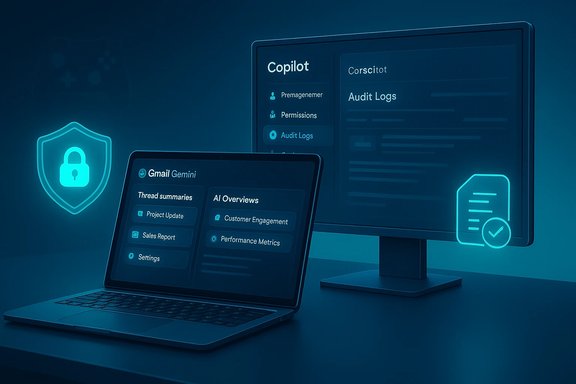
The modern inbox is quietly becoming a battleground for convenience, data, and trust — and Gmail’s newest Gemini-powered features are the latest front line in a wider AI scramble that touches Windows, Microsoft’s Copilot ambitions, developer consoles, and even the consoles you game on.
Background
Windows Weekly episode 966 framed this moment as more than product updates and release notes: it’s a snapshot of an industry shifting from “AI as novelty” to “AI as operating assumption,” and the consequences that flow from that shift. The hosts traced a broad arc — Microsoft’s renewed push to make Copilot central to Windows and Office, Patch Tuesday’s steady security cadence, fresh Insider features for accessibility and enterprise controls, and commercial moves from Google, Apple, OpenAI, and others that accelerate AI into email, search, and health. The episode’s show notes capture this blend of technical detail and cultural framing: convenience vs. control, marketing vs. reliability, and feature velocity vs. governance.This feature unpacks those developments, verifies the major technical claims against public sources, and offers a practical lens for Windows users, IT professionals, and privacy‑minded consumers. The analysis is organized into discrete sections to make it actionable: what changed, why it matters, and what to watch for next.
Overview: What happened this week
- Gmail entered what Google calls the “Gemini era,” adding thread summaries, AI Overviews that can answer natural‑language questions about your inbox, and expanded compose helpers such as Help Me Write and Proofread. Google’s own product post explains the rollout and the tiering of features.
- Microsoft’s Windows 11 Insider builds added Copilot‑powered image descriptions to Narrator and delivered new enterprise controls for Copilot, signaling both accessibility gains and administrative governance options for IT pros. These changes were reflected in recent Dev/Beta release notes and independent reporting.
- January’s Patch Tuesday addressed a large set of vulnerabilities across Microsoft products; independent analysis notes more than 100 CVEs, including several high‑risk issues that administrators need to prioritize.
- Microsoft confirmed a phased retirement of the Microsoft Lens mobile app in favor of OneDrive scanning capabilities, with Message Center updates giving concrete dates for removal and migration guidance to enterprise customers.
- Xbox’s Developer Direct event is slated for January 22 and will showcase Forza Horizon 6 gameplay and an extended look at Fable; Obsidian’s Avowed will land on PS5 on February 17 alongside a substantial anniversary update. These moves illustrate the increasingly platform‑agnostic release strategies of major game studios.
- Internally at Microsoft, leadership attention has focused sharply on Copilot’s real‑world reliability. Multiple reports — surfaced from internal communications and investigative reporting — say CEO Satya Nadella took a hands‑on role after concluding some integrations (notably Gmail/Outlook connectors) “don’t really work.” The claim has been widely reported and debated in industry press.
- The AI market is also expanding into sensitive domains: Google and Apple announced deeper cooperation around Gemini models powering Siri, while OpenAI unveiled healthcare‑focused product lines that allow medical data to be connected under enterprise/compliance frameworks. These moves push AI into regulated workloads and consumer health workflows.
Microsoft and the Copilot reckoning
What’s changed
Over the past year Microsoft pushed hard to make Copilot the organizing principle of its product strategy: embedded across Windows, Office, Edge, GitHub, and Azure. That effort involved heavy cloud and datacenter spending, partnerships with multiple model providers, and a public narrative of Copilot transforming productivity.But marketing and engineering don’t always meet in the product. According to multiple reports, Nadella escalated into a product steward role — convening technical meetings, flagging integration gaps, and calling out specific problems in internal communications. The clearest example reported: the Gmail and Outlook connectors delivering inconsistent or unreliable results in user tests and pilot deployments. Several outlets cite an internal email and related communications that framed these integrations as “not smart,” prompting direct executive involvement.
Why this matters
- Operational credibility matters for adoption. Enterprises buy productivity gains, not marketing slides. When a feature promises to “summarize threads” or “draft replies,” an error rate that inserts hallucinations or misses key attachments is a deal‑breaker for procurement teams.
- Integration is technically hard. Mailboxes are heterogeneous: different encodings, languages, inconsistent metadata, attachments of many formats, and disparate server behaviors. Building reliable LLM workflows across that surface area requires robust parsers, fallback logic, and auditable decision trails.
- Executive focus is a double‑edged sword. Nadella’s involvement can accelerate fixes and staffing, but it also concentrates pressure and signals product urgency — which can increase short‑term risk if timelines compress.
What Microsoft can do (and some cues it’s taking)
- Tighten end‑to‑end testing with enterprise corpora and real‑world archived threads. This reduces surface‑area surprises in production.
- Emphasize human‑in‑the‑loop controls for any action that involves sending, booking, or paying on behalf of users.
- Expand administrative tooling (policy gating, DLP integration, audit logs) so IT teams can enable AI features safely at scale. Microsoft’s recent Insider notes show movement in this direction, adding admin controls and uninstall options for Copilot apps on managed devices.
Gmail’s Gemini shift: convenience vs. surveillance
What Google shipped
Google’s Jan 8 announcement positions Gmail as an active assistant, not just a store of messages. The headline features include:- AI Overviews: Summaries of long threads and natural‑language Q&A against a user’s inbox.
- AI Inbox: An experimental curated view that surfaces priorities and suggested to‑dos.
- Compose helpers: Help Me Write, Suggested Replies, and Proofread.
The risks and trade‑offs
- Data centralization: email is possibly the densest, richest private dataset most consumers have — receipts, health communications, contracts, and identity cues. Giving an AI assistant the ability to index and answer questions over that corpus magnifies privacy and compliance risk.
- Paid gating: feature tiering means convenience may be monetized; enterprises must reconcile licensing, data handling, and governance routes for employees who rely on these features.
- Automation surprises: AI Overviews can speed triage, but when assistants misclassify priorities (e.g., marking an important legal email as “low priority”), the operational consequences are real.
Practical mitigation for users and admins
- Audit and document who in the organization can enable AI features and under what policy.
- Limit scope: use least‑privilege access for any assistant (e.g., a single folder instead of the entire mailbox).
- Maintain human review workflows for high‑impact actions — approvals before sending or archiving critical emails.
Windows 11, Patch Tuesday, and accessibility gains
Windows 11 Insider signals
Microsoft’s first preview builds of 2026 extend Copilot’s reach into accessibility: Narrator now uses Copilot on Copilot+ PCs to generate richer, contextual image descriptions. The capability is being broadened beyond Snapdragon‑gated devices toward Intel and AMD platforms, which signals Microsoft intends accessibility features to be more universal. The Insider blog and Windows coverage list activation shortcuts and privacy toggles so users control what images are sent to Copilot.Patch Tuesday (January 2026)
The January security update addressed a large number of CVEs across Windows and associated products — a reminder that the cadence of stability and security maintenance remains critical even as the industry chases headline AI features. Analysts flagged priority patches for elevation‑of‑privilege and remote code execution vulnerabilities that admins should triage immediately.Why IT must not deprioritize basics
No amount of AI polish will rescue a fleet compromised through an unpatched RCE. The integration of AI features increases complexity — more services, connectors, and tokens — which raises the importance of the fundamentals: timely patching, least‑privilege accounts, strong MFA, and segmented networks for sensitive workloads.AI in regulated spaces: health and payments
OpenAI’s healthcare push
OpenAI launched a suite of healthcare products — ChatGPT Health and OpenAI for Healthcare — that explicitly aim to support clinical workflows and HIPAA‑eligible deployments. Enterprise features include BAAs, audit logs, customer-managed keys, and a promise not to use patient content to train models when those protections are enabled. That said, consumer‑facing health features (like ChatGPT Health) are separate and operate under different privacy and compliance assumptions.Microsoft and commerce: Copilot as checkout
Microsoft’s Copilot is also pushing into transactional flows by enabling in‑chat checkout capabilities, allowing users to complete purchases without being redirected. That convenience converts conversational UI into a financial surface that must consider payment security, PCI compliance, and social‑engineering attack surfaces. News coverage and trade press reported Copilot’s shopping capabilities showcased at NRF and similar events.The reality check
- HIPAA and financial compliance are not feature flags; they are legal obligations. Vendors offering “privacy guarantees” must still demonstrate contractual, technical, and audit mechanisms (BAAs, SOC reports, PCI attestation) to enterprise buyers.
- For consumer users, connecting health or payment apps to AI assistants can be useful — but the risk model changes: data handled by consumer tiers may lack enterprise protections and could be retained or inspected for abuse monitoring unless explicitly segregated.
Gaming and platform shifts: Developer Direct and Avowed to PS5
Developer Direct, Forza, and Fable
Xbox’s Developer Direct on January 22 promises extended gameplay for Forza Horizon 6 and Fable, betting big on premium content reveals and momentum for 2026 titles. For fans and IT directors managing gaming labs, the event will set expectations for performance, platform parity, and cross‑platform availability.Avowed moves to PS5
Obsidian’s Avowed arriving on PS5 on February 17 (alongside a free anniversary update across platforms) is emblematic of a broader change: major publishers are selectively relaxing platform exclusivity in favor of broader distribution and long‑tail revenue. That shift affects Xbox’s historical content advantage and has implications for Game Pass economics and cross‑platform QA pipelines.Strengths, weaknesses, and what to watch
Notable strengths
- Rapid iteration and feature delivery: Google and Microsoft are shipping meaningful AI features (thread summarization, accessibility tools) that materially improve day‑to‑day tasks.
- Enterprise feature focus: Microsoft’s additions of admin controls for Copilot and OpenAI’s BAAs for health offering show the market maturing toward enterprise usability and compliance options.
- Platform convergence: cross‑platform releases and third‑party partnerships (e.g., Gemini in Siri) mean consumers get more choice and vendors get broader distribution channels.
Real weaknesses and risks
- Reliability and hallucinations: LLMs can misstate facts or misclassify messages; when assistants act autonomously (send emails, make purchases), errors have direct financial and legal consequences.
- Privacy surface expansion: allowing models to index emails, health records, or payment credentials concentrates sensitive data under vendor control. Consumer tiers that lack legal protections (BAAs) risk accidental exposure or unwanted retention.
- Governance gaps: administrative controls are improving but are not yet standard. The default experience for many consumers will remain convenience‑first, with opt‑out controls buried in settings.
- Organizational strain: the cost of running large LLM workloads and the talent chase to staff these efforts are material — which is why executive focus has tightened at companies like Microsoft.
Practical guidance for users and admins
For end users
- Secure your accounts: enable strong passwords, a third‑party password manager, and an authenticator app for MFA rather than SMS.
- Review AI feature permissions: when an assistant requests inbox or calendar access, limit scope and set human confirmation for actions that send money or forward messages.
- Maintain local control: when possible, favor local or device‑level AI options (e.g., local model runs on NPU/GPU) for highly sensitive data.
For IT teams
- Inventory AI surfaces: which apps and connectors in your environment can access mail, files, or health data?
- Enforce least privilege: grant the minimum permissions required for scheduled automations or assistants.
- Require BAAs for PHI: only use vendor offerings with signed BAAs and explicit data segregation for patient data.
- Audit and log: enable audit trails and telemetry for any agentic AI workflows so you can trace decisions.
- Test in sandboxes: pilot any automation on anonymized or synthetic data for several weeks before enterprise rollouts.
Where this goes next
AI is accelerating feature innovation across email, operating systems, and games — but the pace of innovation is colliding with a growing demand for governance. Expect the next 12 months to be defined by three dynamics:- Consolidation of features into paid tiers and enterprise bundles as vendors rationalize monetization with compliance.
- Continued executive scrutiny and reallocation of engineering resources at major vendors as product gaps become visible in real usage.
- Practical governance features becoming table stakes (audit logs, admin toggles, BAAs, and human approvals) as enterprises move from experimentation to scaling.
Conclusion
Windows Weekly 966 captured a simple truth beneath the headlines: AI is no longer optional or peripheral. It is being woven into the fabric of productivity, accessibility, and commerce. That offers real benefits — faster triage of email, richer screen‑reading descriptions, and new gameplay experiences — but it also elevates risk, from hallucinations to privacy erosion.The appropriate response for any IT leader or thoughtful user is twofold: adopt where the value is demonstrable and govern where the risk is measurable. For Gmail’s Gemini features and Microsoft’s Copilot experiments that means careful rollout, human oversight, and relentless basics: patching, authentication, and least privilege.
The tools are powerful and the convenience is tempting. The next wave of winners will be those who deliver AI that people can trust — not just admire for its cleverness.
Source: Thurrott.com Windows Weekly 966: You Can't Spell Gmail Without AI
