

Google opened pre-orders in select markets this week for its new $99.99 Google Home Speaker, a Gemini-powered smart speaker due on retail shelves June 25, 2026, with 360-degree audio, new colors, and paid Google Home Premium features. The headline is not really the fabric, the LED ring, or even the price. Google is trying to reset the smart speaker category around generative AI after years of voice assistants teaching users to keep their expectations low. The bet is that the next successful home computer will not be the loudest speaker, but the one that can understand a messy sentence without turning domestic automation into a syntax test.
The smart speaker market has been waiting for somebody to admit what everyone already knew: the first generation of voice assistants was useful, but brittle. Google Assistant, Alexa, and Siri all made timers, weather checks, music playback, and smart bulbs feel futuristic for a while. Then the future stalled somewhere between “I found this on the web” and a misunderstood command that turned on the wrong lamp.
Google’s new Home Speaker is therefore less a product launch than a mea culpa wrapped in recycled 3D-knit fabric. After years in which Nest Audio and Nest Mini hardware quietly aged on shelves, Google is returning with a device explicitly built for Gemini for Home. That phrasing matters because it moves the speaker away from the old assistant-as-command-line model and toward something closer to a domestic AI terminal.
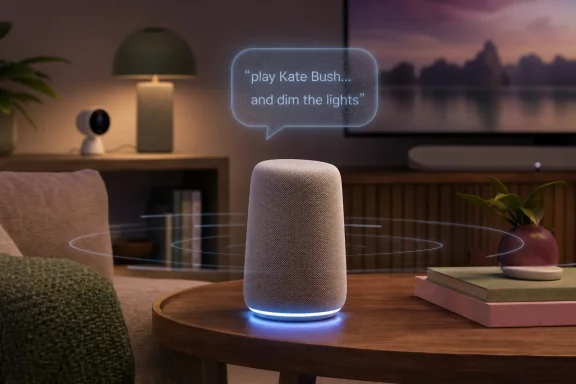
The company’s pitch is simple: users should be able to talk normally. That means asking for “the Stranger Things song by Kate Bush,” changing an instruction mid-sentence, or combining several home actions without having to memorize the precise invocation that a cloud parser expects. For a category that became synonymous with command repetition, this is not a small change.
It is also a risky one. Smart speakers live in kitchens, bedrooms, nurseries, and living rooms, not demo booths. An AI assistant that sounds more natural also invites more trust, more data, and more opportunities for failure when it misunderstands context.
The old hidden indicator lights are gone, replaced by a dynamic LED ring around the base. That may sound cosmetic, but in smart home hardware, feedback is part of trust. Users need to know when a microphone is listening, when the device is processing, and when it has moved from passive object to active agent.
The speaker is also smaller than the old Nest Audio while promising 360-degree sound. Google says two units can be paired for stereo, and the device can be linked with a Google TV Streamer for enhanced television audio. That positions it not only as a smart assistant endpoint, but as part of Google’s broader attempt to make the living room less dependent on Amazon’s Echo line and Apple’s HomePod strategy.
Still, Google’s challenge is not whether the new speaker can fill a room with sound. Plenty of cheap Bluetooth speakers already do that. The real question is whether it can fill a room with confidence.
Google Home Premium Standard is positioned around more natural Gemini Live-style interactions and smarter automation creation. The Advanced tier adds AI summaries, richer camera history features, and home-event intelligence for compatible Nest cameras and doorbells. In other words, Google is not merely selling a speaker; it is selling a front door into a monthly smart home platform.
That changes the economics of the category. The first wave of smart speakers was often subsidized hardware designed to increase ecosystem lock-in. The new wave looks more like a subscription accessory: affordable enough to enter the home, useful enough without payment, but clearly designed to become more capable when attached to a recurring plan.
For consumers, this creates a familiar modern bargain. The speaker may be cheap, but the best features are not necessarily included in the box. For administrators, privacy-minded users, and households already paying for cloud storage, cameras, streaming services, and AI tools, it adds one more line item to the pile.
Google does have an advantage here. If a household already uses Nest cameras, Google TV, Android phones, and Google One or AI subscriptions, the Home Speaker becomes another node in a larger fabric. But that advantage also makes the lock-in more visible.
Gemini for Home is meant to attack that problem directly. Google says the assistant can understand more natural wording, corrections, follow-up questions, and multi-step requests. A user should be able to ask for several actions in one sentence instead of chaining together separate commands with repeated wake words.
That is the right problem to solve. In real homes, people do not speak in neatly structured API calls. They hesitate, revise, point vaguely toward rooms, refer to songs by lyrics or movie scenes, and assume shared context. The speaker that handles that gracefully will feel less like a gadget and more like infrastructure.
But generative AI introduces a different failure mode. The old assistant often failed obviously: it said it could not help, played the wrong song, or misunderstood a device name. A generative assistant can sound confident while still being wrong. That matters when the request involves locks, cameras, routines, children’s rooms, or security notifications.
The smart home is an unforgiving test environment for AI because the consequences are physical. A hallucinated answer in a browser tab is annoying; a misunderstood home routine at midnight is personal.
Yet the feature also revives an old smart speaker anxiety: when exactly is the device listening? Google will argue, as every platform vendor does, that visual indicators, privacy controls, and processing boundaries make the experience safe. Many users will accept that trade-off because convenience usually wins in the home.
The problem is not simply whether the microphone is technically recording all the time. The problem is whether users can form an accurate mental model of what the device hears, stores, processes, and sends to the cloud. Generative AI makes that harder because the interaction feels less transactional and more conversational.
This is where the LED ring becomes more than decoration. Clear, persistent, readable status indicators matter when a device is designed to be spoken to casually. If Google wants people to treat Gemini like a natural home assistant, it has to make the boundaries of that interaction obvious.
That is exactly the kind of AI feature that sounds useful in a controlled demo. Ask what happened while you were out, search for a package delivery, summarize motion events, or catch up on activity around the front door. For busy households, this is a compelling use of AI because it turns hours of passive footage into something searchable.
It is also a sharp escalation in the sensitivity of smart home data. Camera history is not just content; it is a behavioral record of a household. It can reveal routines, visitors, children’s movements, deliveries, absences, and patterns that are far more intimate than a playlist request.
Google is not alone in this direction. The entire smart home industry is moving from device control to ambient interpretation. Cameras no longer merely record, doorbells no longer merely notify, and speakers no longer merely answer. They summarize, infer, and increasingly decide what deserves attention.
That is useful, but it deserves more scrutiny than a colorway announcement. AI in the home is not just a feature category. It is a new layer of interpretation between users and their own domestic lives.
A Windows user may have an Android phone, a Google TV streamer, Nest cameras, a Microsoft 365 subscription, a gaming PC, and an Xbox in the same home. The smart home layer cuts across operating-system loyalties. That is why Google’s renewed push matters even to people who spend their workday in Windows 11, Entra ID, PowerShell, and Edge.
The strategic gap is obvious. Microsoft has Copilot on PCs, in Microsoft 365, in Edge, and across enterprise workflows, but it has no serious consumer smart speaker presence. Cortana’s retreat left Microsoft without a voice endpoint in the home just as AI assistants are becoming more capable. Google, Amazon, and Apple are left to define what ambient consumer AI feels like.
That does not mean Microsoft needs to resurrect a Cortana cylinder for the kitchen. But it does mean the AI platform war is being fought in places where Windows is not the operating system. The PC may remain the productivity hub, but the home’s ambient interface is increasingly a speaker, display, phone, or TV box.
For IT pros, this matters because consumer expectations leak into enterprise expectations. Once users get used to conversational systems that understand messy instructions at home, they will expect the same from workplace tools. They will also bring the same privacy blind spots with them.
In the old model, more speakers meant more assistant access points. In the Gemini model, more speakers mean more ambient AI coverage. The speaker becomes a distributed interface for the home, not merely a music endpoint with a microphone attached.
This is why the Google TV Streamer pairing matters. If the speaker can become part of home theater audio while also serving as a voice assistant, it earns its place in the room even when the AI features are idle. The smartest smart home products are often the ones that still justify themselves when the cloud service is having a bad day.
Google also understands that smart speakers have to be socially acceptable objects. A device in the kitchen needs to blend in. A bedroom speaker must not look like surveillance hardware. The recycled fabric and softened color palette are not just design choices; they are camouflage for a more ambitious computing model.
That model depends on patience from users who may feel burned by the last decade of smart assistant promises. Google can launch Gemini for Home with better language understanding, but it cannot instantly restore faith that voice computing is worth using beyond timers and lights.
This is not a uniquely Google problem. AI infrastructure is expensive, and companies are moving quickly to attach usage-based or tiered economics to features that once might have shipped as static software capabilities. The smart home simply makes the tension more obvious because users already bought the cameras, speakers, bulbs, and displays.
The risk is that households begin to see their own homes as a set of locked feature gates. Want natural conversation? Pay. Want better automation help? Pay. Want AI summaries of camera history? Pay more. The device may be inexpensive, but the home operating system becomes a subscription bundle.
There is a reasonable counterargument. Cloud video history, AI search, and natural language processing all have ongoing costs. Users who want advanced capabilities should expect to pay for them. A recurring plan may also fund longer-term support and faster feature updates than the old one-and-done hardware model.
But Google has to be careful. The smart home is not a productivity SaaS suite. People are more sensitive to recurring fees when the product is sitting on a shelf in the living room, listening for commands, and controlling devices they already paid for.
But the tougher competitor is apathy. Many people already own a smart speaker and barely use it. Others unplugged theirs, muted the microphone, or relegated it to a child’s room. The market Google is re-entering is not a pristine growth category; it is a category that trained users to expect disappointment.
That makes the first few months crucial. If Gemini for Home reliably handles natural speech, the product could reawaken interest in voice as an interface. If it stumbles in ordinary kitchens and living rooms, users will not patiently debug it. They will go back to phone screens and manual switches.
The new speaker also arrives in a world where AI branding is everywhere. Consumers have heard that AI will rewrite work, search, art, phones, PCs, and home automation. The novelty has faded quickly. Google cannot simply say “Gemini” and expect the average household to care.
What it can do is solve small annoyances consistently. That is how ambient computing wins. Not through grand agentic speeches, but through fewer repeated wake words, fewer failed commands, better routines, and a home that understands “turn everything off except the kitchen” the first time.
That shift will make the category more useful and more complicated at the same time. The more context Gemini understands, the more value it can provide. The more value it provides, the more users will need to ask what data is being processed, where it is stored, how subscriptions change access, and what happens when services are discontinued or renamed.
For enthusiasts, the appeal is obvious. A speaker that understands multi-step commands, supports natural follow-ups, improves room audio, and links into cameras and TV audio is a much more interesting product than another puck-shaped timer. For skeptics, the concerns are equally obvious: cloud dependence, subscription creep, privacy ambiguity, and the long memory of Google abandoning or reworking consumer products.
The healthiest way to view the launch is neither as a revolution nor as a gimmick. It is a serious attempt to fix the interface failure that limited the first smart speaker era. Whether it succeeds depends less on Gemini’s benchmark performance than on whether it behaves sensibly when a tired person mumbles a messy command from across the room.
 Google Returns to the Room It Helped Abandon
The smart speaker market has been waiting for somebody to admit what everyone already knew: the first generation of voice assistants was useful, but brittle. Google Assistant, Alexa, and Siri all made timers, weather checks, music playback, and smart bulbs feel futuristic for a while. Then the future stalled somewhere between “I found this on the web” and a misunderstood command that turned on the wrong lamp.Google’s new Home Speaker is therefore less a product launch than a mea culpa wrapped in recycled 3D-knit fabric. After years in which Nest Audio and Nest Mini hardware quietly aged on shelves, Google is returning with a device explicitly built for Gemini for Home. That phrasing matters because it moves the speaker away from the old assistant-as-command-line model and toward something closer to a domestic AI terminal.
The company’s pitch is simple: users should be able to talk normally. That means asking for “the Stranger Things song by Kate Bush,” changing an instruction mid-sentence, or combining several home actions without having to memorize the precise invocation that a cloud parser expects. For a category that became synonymous with command repetition, this is not a small change.
It is also a risky one. Smart speakers live in kitchens, bedrooms, nurseries, and living rooms, not demo booths. An AI assistant that sounds more natural also invites more trust, more data, and more opportunities for failure when it misunderstands context.
The Color Refresh Is the Least Interesting Part
The new speaker arrives in Hazel and Porcelain broadly, with Jade and Berry offered in the United States. Those are the details that make for neat product photography, but they are not the story. The more meaningful design shift is that Google has made the speaker look less like a legacy Nest product and more like a visible participant in the room.The old hidden indicator lights are gone, replaced by a dynamic LED ring around the base. That may sound cosmetic, but in smart home hardware, feedback is part of trust. Users need to know when a microphone is listening, when the device is processing, and when it has moved from passive object to active agent.
The speaker is also smaller than the old Nest Audio while promising 360-degree sound. Google says two units can be paired for stereo, and the device can be linked with a Google TV Streamer for enhanced television audio. That positions it not only as a smart assistant endpoint, but as part of Google’s broader attempt to make the living room less dependent on Amazon’s Echo line and Apple’s HomePod strategy.
Still, Google’s challenge is not whether the new speaker can fill a room with sound. Plenty of cheap Bluetooth speakers already do that. The real question is whether it can fill a room with confidence.
Gemini Turns the Smart Speaker Into a Subscription Endpoint
The most important phrase in Google’s launch language is not “360-degree audio.” It is “Google Home Premium.” The base product costs $99.99, but the full Gemini-powered home experience is increasingly tied to recurring service tiers.Google Home Premium Standard is positioned around more natural Gemini Live-style interactions and smarter automation creation. The Advanced tier adds AI summaries, richer camera history features, and home-event intelligence for compatible Nest cameras and doorbells. In other words, Google is not merely selling a speaker; it is selling a front door into a monthly smart home platform.
That changes the economics of the category. The first wave of smart speakers was often subsidized hardware designed to increase ecosystem lock-in. The new wave looks more like a subscription accessory: affordable enough to enter the home, useful enough without payment, but clearly designed to become more capable when attached to a recurring plan.
For consumers, this creates a familiar modern bargain. The speaker may be cheap, but the best features are not necessarily included in the box. For administrators, privacy-minded users, and households already paying for cloud storage, cameras, streaming services, and AI tools, it adds one more line item to the pile.
Google does have an advantage here. If a household already uses Nest cameras, Google TV, Android phones, and Google One or AI subscriptions, the Home Speaker becomes another node in a larger fabric. But that advantage also makes the lock-in more visible.
The Old Assistant Model Broke Because People Had to Think Like Machines
The great disappointment of the smart speaker era was not that assistants lacked features. It was that they required users to phrase ordinary human needs in machine-friendly language. If you knew the right command, the experience felt magical; if you did not, it felt like arguing with an appliance.Gemini for Home is meant to attack that problem directly. Google says the assistant can understand more natural wording, corrections, follow-up questions, and multi-step requests. A user should be able to ask for several actions in one sentence instead of chaining together separate commands with repeated wake words.
That is the right problem to solve. In real homes, people do not speak in neatly structured API calls. They hesitate, revise, point vaguely toward rooms, refer to songs by lyrics or movie scenes, and assume shared context. The speaker that handles that gracefully will feel less like a gadget and more like infrastructure.
But generative AI introduces a different failure mode. The old assistant often failed obviously: it said it could not help, played the wrong song, or misunderstood a device name. A generative assistant can sound confident while still being wrong. That matters when the request involves locks, cameras, routines, children’s rooms, or security notifications.
The smart home is an unforgiving test environment for AI because the consequences are physical. A hallucinated answer in a browser tab is annoying; a misunderstood home routine at midnight is personal.
Continued Conversation Is a Convenience With a Privacy Shadow
One of the most user-friendly changes is Continued Conversation, which reduces the need to repeat “Hey Google” for follow-up requests. Anyone who has tried to cook, clean, or manage a house with voice commands understands the appeal. Hot-word fatigue is real, and it is one reason many smart speakers became glorified timers.Yet the feature also revives an old smart speaker anxiety: when exactly is the device listening? Google will argue, as every platform vendor does, that visual indicators, privacy controls, and processing boundaries make the experience safe. Many users will accept that trade-off because convenience usually wins in the home.
The problem is not simply whether the microphone is technically recording all the time. The problem is whether users can form an accurate mental model of what the device hears, stores, processes, and sends to the cloud. Generative AI makes that harder because the interaction feels less transactional and more conversational.
This is where the LED ring becomes more than decoration. Clear, persistent, readable status indicators matter when a device is designed to be spoken to casually. If Google wants people to treat Gemini like a natural home assistant, it has to make the boundaries of that interaction obvious.
The Camera Features Push Google Into More Sensitive Territory
The Home Speaker’s most consequential premium features are not about music or recipes. They are about cameras. Google Home Premium can provide tools such as camera history search and Home Briefs that summarize activity around the house.That is exactly the kind of AI feature that sounds useful in a controlled demo. Ask what happened while you were out, search for a package delivery, summarize motion events, or catch up on activity around the front door. For busy households, this is a compelling use of AI because it turns hours of passive footage into something searchable.
It is also a sharp escalation in the sensitivity of smart home data. Camera history is not just content; it is a behavioral record of a household. It can reveal routines, visitors, children’s movements, deliveries, absences, and patterns that are far more intimate than a playlist request.
Google is not alone in this direction. The entire smart home industry is moving from device control to ambient interpretation. Cameras no longer merely record, doorbells no longer merely notify, and speakers no longer merely answer. They summarize, infer, and increasingly decide what deserves attention.
That is useful, but it deserves more scrutiny than a colorway announcement. AI in the home is not just a feature category. It is a new layer of interpretation between users and their own domestic lives.
The Windows Household Is Still a Cross-Platform Household
For WindowsForum readers, the Google Home Speaker is not a Windows device in the conventional sense. It is not a PC peripheral, it does not run Windows, and it will not replace a desktop, laptop, or mini PC in any serious workflow. But the modern Windows household is rarely a Microsoft-only household.A Windows user may have an Android phone, a Google TV streamer, Nest cameras, a Microsoft 365 subscription, a gaming PC, and an Xbox in the same home. The smart home layer cuts across operating-system loyalties. That is why Google’s renewed push matters even to people who spend their workday in Windows 11, Entra ID, PowerShell, and Edge.
The strategic gap is obvious. Microsoft has Copilot on PCs, in Microsoft 365, in Edge, and across enterprise workflows, but it has no serious consumer smart speaker presence. Cortana’s retreat left Microsoft without a voice endpoint in the home just as AI assistants are becoming more capable. Google, Amazon, and Apple are left to define what ambient consumer AI feels like.
That does not mean Microsoft needs to resurrect a Cortana cylinder for the kitchen. But it does mean the AI platform war is being fought in places where Windows is not the operating system. The PC may remain the productivity hub, but the home’s ambient interface is increasingly a speaker, display, phone, or TV box.
For IT pros, this matters because consumer expectations leak into enterprise expectations. Once users get used to conversational systems that understand messy instructions at home, they will expect the same from workplace tools. They will also bring the same privacy blind spots with them.
Google Is Selling a New Interface, Not Just a New Speaker
The hardware itself is deliberately modest. At $99.99, the Google Home Speaker is priced to be bought in multiples, gifted casually, and placed in more than one room. That is the classic smart speaker playbook, but the purpose has changed.In the old model, more speakers meant more assistant access points. In the Gemini model, more speakers mean more ambient AI coverage. The speaker becomes a distributed interface for the home, not merely a music endpoint with a microphone attached.
This is why the Google TV Streamer pairing matters. If the speaker can become part of home theater audio while also serving as a voice assistant, it earns its place in the room even when the AI features are idle. The smartest smart home products are often the ones that still justify themselves when the cloud service is having a bad day.
Google also understands that smart speakers have to be socially acceptable objects. A device in the kitchen needs to blend in. A bedroom speaker must not look like surveillance hardware. The recycled fabric and softened color palette are not just design choices; they are camouflage for a more ambitious computing model.
That model depends on patience from users who may feel burned by the last decade of smart assistant promises. Google can launch Gemini for Home with better language understanding, but it cannot instantly restore faith that voice computing is worth using beyond timers and lights.
The Subscription Split May Decide Whether Gemini Feels Like Progress
The most delicate product decision Google has made is separating baseline Gemini functionality from premium Gemini features. If the free experience is too limited, the speaker risks feeling like a demo for a subscription. If the paid features are too generous, Google loses the recurring revenue story that appears to justify the platform investment.This is not a uniquely Google problem. AI infrastructure is expensive, and companies are moving quickly to attach usage-based or tiered economics to features that once might have shipped as static software capabilities. The smart home simply makes the tension more obvious because users already bought the cameras, speakers, bulbs, and displays.
The risk is that households begin to see their own homes as a set of locked feature gates. Want natural conversation? Pay. Want better automation help? Pay. Want AI summaries of camera history? Pay more. The device may be inexpensive, but the home operating system becomes a subscription bundle.
There is a reasonable counterargument. Cloud video history, AI search, and natural language processing all have ongoing costs. Users who want advanced capabilities should expect to pay for them. A recurring plan may also fund longer-term support and faster feature updates than the old one-and-done hardware model.
But Google has to be careful. The smart home is not a productivity SaaS suite. People are more sensitive to recurring fees when the product is sitting on a shelf in the living room, listening for commands, and controlling devices they already paid for.
The Real Competition Is User Apathy
Google’s direct competitors are obvious: Amazon’s Echo line and Apple’s HomePod family. Amazon has scale and a long smart home device catalog. Apple has trust, audio credibility, and deep integration with iPhone households. Google has search, Android, Nest, YouTube, and the Gemini brand.But the tougher competitor is apathy. Many people already own a smart speaker and barely use it. Others unplugged theirs, muted the microphone, or relegated it to a child’s room. The market Google is re-entering is not a pristine growth category; it is a category that trained users to expect disappointment.
That makes the first few months crucial. If Gemini for Home reliably handles natural speech, the product could reawaken interest in voice as an interface. If it stumbles in ordinary kitchens and living rooms, users will not patiently debug it. They will go back to phone screens and manual switches.
The new speaker also arrives in a world where AI branding is everywhere. Consumers have heard that AI will rewrite work, search, art, phones, PCs, and home automation. The novelty has faded quickly. Google cannot simply say “Gemini” and expect the average household to care.
What it can do is solve small annoyances consistently. That is how ambient computing wins. Not through grand agentic speeches, but through fewer repeated wake words, fewer failed commands, better routines, and a home that understands “turn everything off except the kitchen” the first time.
The Smart Home Finally Gets Its AI Reckoning
The launch of the Google Home Speaker shows how quickly the smart home is being reorganized around AI services rather than standalone devices. The speaker is not just a replacement for Nest Audio. It is the first visible piece of Google’s attempt to make Gemini the conversational layer for domestic computing.That shift will make the category more useful and more complicated at the same time. The more context Gemini understands, the more value it can provide. The more value it provides, the more users will need to ask what data is being processed, where it is stored, how subscriptions change access, and what happens when services are discontinued or renamed.
For enthusiasts, the appeal is obvious. A speaker that understands multi-step commands, supports natural follow-ups, improves room audio, and links into cameras and TV audio is a much more interesting product than another puck-shaped timer. For skeptics, the concerns are equally obvious: cloud dependence, subscription creep, privacy ambiguity, and the long memory of Google abandoning or reworking consumer products.
The healthiest way to view the launch is neither as a revolution nor as a gimmick. It is a serious attempt to fix the interface failure that limited the first smart speaker era. Whether it succeeds depends less on Gemini’s benchmark performance than on whether it behaves sensibly when a tired person mumbles a messy command from across the room.
The June 25 Speaker Launch Is Really a Test of Trust
The concrete story is straightforward, but the implications are broader than a $99.99 gadget.- Google’s new Home Speaker is available for pre-order in select markets and is scheduled to reach shelves on June 25, 2026.
- The device is built around Gemini for Home, with more natural language understanding, follow-up conversations, and support for complex multi-step commands.
- Google is using the speaker to push Google Home Premium, where the most advanced AI features, including camera-related intelligence, sit behind paid plans.
- The hardware adds 360-degree audio, stereo pairing, Google TV Streamer pairing, improved microphones, a base LED ring, and four color options with some regional differences.
- The biggest unanswered question is not whether Gemini is smarter than Google Assistant, but whether households will trust a more conversational AI inside the home.
- For Windows users and IT pros, the launch is another reminder that consumer AI interfaces are moving beyond the PC, even as their expectations will inevitably flow back into workplace computing.
References
- Primary source: Manila Bulletin
Published: 2026-06-20T04:50:10.405048
Manila Bulletin - Google Speakers just got a colorful update
After six years, Google is making a comeback in the smart speaker market with a pop of color and a lot of AI (Artificial Intelligence).Considered its first...mb.com.ph
- Independent coverage: Bandwidth Blog
Published: 2026-06-19T11:50:10.411092
- Related coverage: androidcentral.com
Google's new Home Speaker is here: Gemini built-in, upgraded sound, and a $99 price tag | Android Central
The Home Speaker is Google's first smart speaker designed around Gemini from the ground up.www.androidcentral.com - Related coverage: techradar.com
- Related coverage: whathifi.com
Google's Gemini-touting smart speaker is officially here – can it compete with Alexa and Siri? | What Hi-Fi?
Google re-enters the smart speaker race on the 25th of Junewww.whathifi.com - Related coverage: t3.com
"A fundamental transition to voice assistance" – Google's new Home Speaker brings the AI fight to Amazon and Apple | T3
It's all about giving Gemini a platform for dominance – and users a better experiencewww.t3.com
- Related coverage: blog.google
Get to know the new Google Home Speaker
Meet the Google Home Speaker for Gemini. Control smart home devices, manage routines, and get fast answers using natural language.blog.google - Official source: store.google.com
- Official source: 9to5google.com
Google Home Speaker available June 25 for $99, pre-orders today
The Google Home Speaker will finally launch and hit store shelves next week with pre-orders starting today...9to5google.com - Related coverage: phonearena.com
The all-new Google Home Speaker with Gemini is finally up for grabs, replacing two old Nest devices - PhoneArena
Both the Nest Audio and Nest Mini have been officially discontinued to make room for a new $99.99 Google Home Speaker.www.phonearena.com - Related coverage: thurrott.com
Google's Gemini-Powered Home Speaker Launches on June 25 for $99.99 - Thurrott.com
The new Gemini-powered Google Home Speaker will launch on June 25, and it’s available for pre-order today for $99.99. Google is also offering customers 6 months of Google Home Premium and 3 months of YouTube Premium.www.thurrott.com - Related coverage: bestbuy.com
- Related coverage: logicity.in
Google Home Speaker with Gemini launches June 25 for $99 | Logicity
— Read more on the Logicity blog about AI, web development, and digital growth.logicity.in - Related coverage: intomobile.com
Google Home Speaker review: The first smart speaker built for Gemini
Google's new $99.99 speaker puts Gemini at the center of your home, with natural conversation, 360-degree audio, and a handful of AI features that actually make sensewww.intomobile.com - Related coverage: techrepublic.com
Google Launches $99 Gemini-Powered Home Speaker
Google’s Gemini-powered Home Speaker brings conversational AI, 360-degree sound, smart home controls, and Premium features to homes starting June 25.www.techrepublic.com
- Related coverage: techadvisor.com
Google Home Speaker Potential Launch Date 25 June - Tech Advisor
Google's Gemini-infused next-gen smart speaker is imminent... if this Canadian product page is accuratewww.techadvisor.com - Official source: support.google.com

Learn about Gemini for Home camera features - Google Home and Nest Help
Gemini for Home camera features help you keep up with important events captured on your Nest Cameras and Doorbells. If you’re a Google Home app user who meets the eligibility requirements, you can use
support.google.com
- Related coverage: tomsguide.com
Google's new $99 smart home speaker leaks — here's how it compares to the Apple HomePod Mini and Amazon Echo Dot Max | Tom's Guide
A surprise leak on Best Buy appears to reveal the next Google Home speaker launching in late June.www.tomsguide.com - Related coverage: cincodias.elpais.com
- Related coverage: thenewamerican.com
