

Google appears to be testing a new image-generation model called Instant-Ramen through online experiments and AI community discussions, where the name has reportedly surfaced beside image-generation trials. Google has not officially announced the model, confirmed its capabilities, or said whether it will ship as a public product. The direct takeaway for WindowsForum readers is simple: treat Instant-Ramen as an early signal of where Google’s image AI work may be heading, not as something to plan deployments around yet.
For Windows users, developers, creators, and IT teams already supporting AI-assisted design, marketing, documentation, and content workflows, the practical issue is not the codename. It is whether the next generation of image models can become reliable enough for real work: fast iteration, controlled edits, consistent output, and clear governance.
While Instant-Ramen remains unannounced, do not build policy, budgets, products, or client commitments around it. Do prepare for the broader shift it represents.
For Windows workflows, the implications are immediate:
Google has not officially announced Instant-Ramen. The missing details can be grouped plainly: there are no confirmed technical specifications, benchmark results, availability details, pricing terms, product surfaces, API commitments, or launch timeline. That absence should frame every claim about the model.
The source coverage describes Instant-Ramen as a new Google image-generation model under development and discusses it as a possible successor to Nano Banana. That should be treated as interpretation, not confirmation. Until Google says more, the safest reading is that Instant-Ramen is a reported model name associated with image-generation experiments, not a public product and not a confirmed product lineage.
That still makes it worth watching. Nano Banana reportedly gained attention for fast image creation, editing capabilities, and strong prompt adherence. If Google is testing something that builds on that reputation, the interesting question is whether the company can make image generation more dependable in production-style workflows, not merely more impressive in isolated examples.
The first wave of consumer image generators was judged by spectacle: photorealistic faces, cinematic lighting, fantasy scenes, glossy social graphics, and viral prompts. The next wave is being judged by repeatability, edit stability, instruction following, speed, and whether generated assets can survive review by a brand, legal, security, or compliance team.
A model that can make one impressive image is interesting. A model that can make dozens of consistent campaign assets, preserve a product or character across revisions, follow layout instructions, and return usable edits quickly is far more useful.
Speed changes behavior. When generation takes too long, users over-plan prompts, batch requests, and tolerate fewer revisions. When a model is fast enough, the workflow becomes more natural: try, inspect, adjust, and repeat. That starts to feel less like gambling with a prompt box and more like working with creative software.
Editing matters even more. Practical creative work is rarely just “make an image from nothing.” It is more often “change this product shot,” “keep the same subject but alter the setting,” “remove this object,” “make this fit a banner format,” “create variants for different audiences,” or “preserve the visual style while changing one element.” A model with useful editing capabilities can fit into existing workflows. A model that only generates from scratch remains more limited.
Prompt adherence is the bridge between speed and editing. Creative workers can tolerate some imperfection if the system understands the brief. They are less forgiving when a model ignores layout instructions, changes the subject, inserts unreadable text, distorts a product, or “improves” an image in a way that breaks the assignment.
The Instant-Ramen rumor lands in that context. If the reported model is real and if it is related to Nano Banana, the logical expectation would be continuity in those areas: speed, editing, and prompt following. But that remains unconfirmed. Google has not said that Instant-Ramen will be faster, higher quality, more editable, or publicly available.
The enthusiast phrase circulating around the rumor — “Ramen is cooking. Time to serve soon.” — captures the excitement, but it should not be mistaken for evidence of a launch date. It does not establish whether Instant-Ramen will appear in Gemini, a developer API, Google Cloud, a creative tool, an enterprise product, or anywhere else.
That ambiguity is normal in AI development. Large AI companies often test models under temporary names, internal labels, anonymous evaluation environments, or names that never become public brands. A model can be technically real and still ship under a different name. It can be split across products, limited to selected users, folded into a broader model family, or never released in the form seen during testing.
For that reason, the codename should be treated cautiously. Instant-Ramen may be a final name, an internal codename, a temporary evaluation label, or a signal that has been overinterpreted by the community. Until Google clarifies it, the only solid public claim is that the name has reportedly surfaced in connection with image-generation experiments.
That does not make the story meaningless. Early model names now shape expectations before official launches. Developers watch model pickers. Testers compare outputs. Creators share screenshots. Product teams infer roadmaps. Vendors notice which capabilities generate attention. The rumor stage has become part of the AI market cycle.
That leaves four practical unknowns.
The first is lineage. We do not know whether Instant-Ramen is a direct successor to Nano Banana, a specialized variant, an editing-focused model, a faster tier, a research system, or a temporary test label. Calling it a successor is plausible based on the way it is being discussed, but it is not confirmed.
The second is capability. The source report says Google’s newest image model may bring faster performance, better image quality, and more powerful editing tools. Those are reasonable expectations for any next-generation image model, but none has been officially confirmed for Instant-Ramen. The clearest phrasing is this: if Instant-Ramen is intended as a Nano Banana follow-up, users would expect improvements in speed, image quality, and editing, but Google has not verified those features.
The third is availability. A model inside a consumer chatbot is very different from a model available through developer platforms. A model limited to testers is different from one offered to enterprises. For IT teams, availability determines governance: who can use the model, what data can be submitted, whether logs exist, whether outputs can be audited, and whether the tool can be restricted.
The fourth is economics and licensing. Speed and quality matter, but so do price, rate limits, commercial terms, retention rules, and usage rights. A spectacular but expensive image model may remain a premium creative tool. A fast, affordable model with clear terms can become infrastructure for marketing automation, app personalization, product mockups, internal communications, and design prototyping.
That is why Instant-Ramen should not be treated as a buying signal. It suggests Google may be preparing another move in image generation. It does not yet tell users, developers, or admins what they can deploy.
That is why prompt adherence and editing matter so much. In a business workflow, a model that produces beautiful but unpredictable results is less useful than one that reliably follows the brief. A visually impressive output can still fail if it changes the product, garbles text, breaks a brand template, distorts a face, or cannot repeat the same style across a series.
Google has obvious reasons to keep improving image generation. Its AI ecosystem touches consumer products, productivity workflows, developer tools, cloud services, advertising, Android, Chrome, and search-adjacent experiences. If an image model becomes dependable enough, Google can surface it in places where users already work rather than forcing them into a standalone creative tool.
But that remains a strategic possibility, not an Instant-Ramen fact. There is no official confirmation that this model will appear in any specific Google product. The practical story is narrower and more useful: if Google is testing a new image model, Windows teams should expect AI-generated visuals to keep moving closer to everyday work.
That is already enough to matter. Workers do not need to understand model architecture to test an image generator. They can see whether text is readable, whether an edit preserves the subject, whether the output follows the instruction, and whether the tool is fast enough to use during a real task. Image AI is one of the easiest AI categories for ordinary users to judge — and one of the easiest for them to adopt without waiting for IT.
That is especially true in Windows-heavy environments where employees move assets across browsers, Office documents, creative tools, chat apps, file shares, and cloud drives. A model may run elsewhere, but the workflow touches the Windows desktop.
The first concern is data exposure. Image editing often begins with an upload: a product photo, a customer image, a screenshot, a whiteboard, a design mockup, a confidential slide, or an internal diagram. If users submit those assets to unapproved AI tools, organizations can lose control of sensitive material before security teams know which service was used.
The second concern is provenance. AI-generated images are becoming more realistic and more editable. That helps design and marketing teams, but it complicates compliance, brand governance, incident response, and misinformation risk. If an organization cannot distinguish approved AI-generated assets from unofficial ones, it may eventually publish something it cannot explain or defend.
The third concern is licensing and reuse. The source material does not provide Instant-Ramen licensing terms because Google has not released availability information. Nobody should assume the model is safe for commercial use, redistribution, client work, product mockups, regulated communications, or public campaigns until official terms exist.
The fourth concern is operational dependency. Once employees discover a useful image model, they build habits around it. Marketing teams use it for drafts. Product teams use it for mockups. Support teams use it for help visuals. Executives use it for presentations. If the tool is unannounced, unavailable, rate-limited, renamed, or restricted, those habits can break.
Admins should not wait for Instant-Ramen specifically before building policy. The right response is to treat this rumor as another reminder that AI image generation is becoming a mainstream workplace capability. Whether Google’s next model is called Instant-Ramen or something else, the governance work is largely the same.
A model exposed only through a consumer interface has limited developer impact. A model exposed through an API can become part of applications: personalized content generation, game assets, design automation, catalog imagery, educational diagrams, document illustrations, customer-facing creative tools, and internal workflow systems.
Once a model enters software, the evaluation changes. Developers need to know latency, cost, rate limits, input formats, output formats, safety behavior, failure modes, retention rules, and edit consistency. A model that looks excellent in screenshots may still be difficult to build around if it behaves unpredictably under real application load.
The most important capability may be iterative editing. Developers do not merely need “generate image.” They need workflows that can preserve an object, alter a background, maintain a character, localize text, resize a composition, apply brand constraints, and revise an image without starting from scratch. If future Google image models improve editing, the developer question will be whether those controls are exposed in a structured enough way to support real products.
Another key issue is multimodal input. Some image tasks begin with a prompt, but many begin with mixed context: a prompt plus a reference image, a screenshot plus an instruction, a diagram plus a style guide, or multiple source images that need to be combined. The source report describes enhanced multimodal understanding as a possible improvement, but that remains unconfirmed for Instant-Ramen.
Failure behavior also matters. Model demos rarely show what happens when prompts are ambiguous, source images conflict, policy filters trigger, or generated text is wrong. Production systems need graceful failures. If a model cannot complete an edit, it should say so clearly rather than returning a plausible but incorrect visual. In visual workflows, silent failure can be worse than refusal.
Until Google releases documentation, developers should resist building plans around Instant-Ramen. But they should prepare evaluation harnesses now. The right test set is not a collection of pretty prompts. It is a set of real tasks from the organization’s own workflows, including edits, revisions, brand constraints, text-in-image requirements, accessibility needs, unacceptable outputs, and recovery paths.
The practical Windows question is how generated images move through the organization. A user may create an image in a browser, paste it into PowerPoint, store it in OneDrive or Google Drive, send it through Teams or Slack, edit it in a desktop graphics tool, compress it locally, attach it to email, and publish it through a content management system. Each step creates governance, security, and asset-management questions.
Browser controls matter. Data-loss prevention matters. Endpoint logging matters. File labeling matters. User education matters. Employees often treat image prompts as casual experimentation even when the source material is sensitive. A screenshot of an unreleased dashboard is still confidential when uploaded for “just a quick mockup.”
There is also a downstream workflow issue. Even when generation runs in the cloud, the outputs land on client machines. Designers, marketers, trainers, and support teams still need local tools to inspect, crop, annotate, composite, compress, and distribute images. The better cloud generation becomes, the more downstream asset management matters on the PC.
For IT teams, the answer is not to block every image tool reflexively. AI image generation can reduce production time for internal graphics, draft concepts, training material, support visuals, mockups, and early creative exploration. The better posture is controlled enablement: approved tools, clear data rules, review paths, and a shared understanding of what AI-generated visuals may and may not be used for.
The first layer is reported signal: references to Instant-Ramen reportedly appeared alongside image-generation experiments. That is the strongest part of the story.
The second layer is interpretation: the model is being discussed as a possible successor to Nano Banana. That may be a reasonable reading of the context, but it remains unconfirmed.
The third layer is expectation: Instant-Ramen could improve speed, image quality, editing, or multimodal understanding. That reflects the direction users would expect from a next-generation image model, but those features have not been officially confirmed.
That distinction matters because speculation can harden into assumed capability. Users start waiting for features that may not ship. Developers start planning around APIs that may not exist. Business teams start asking IT about tools that are not available. Competitors and commentators respond to an imagined product rather than a documented one.
Instant-Ramen may deserve attention. It does not yet deserve certainty.
Speed would be one obvious measure. A faster model changes how people work because it encourages iteration. But speed without control only makes wrong answers arrive faster. A strong successor would need to handle multi-step creative intent: generate, revise, preserve, localize, reformat, and refine without drifting away from the original brief.
Image quality would also need definition. Photorealism is only one kind of quality. For business use, quality can mean clean edges, accurate product geometry, consistent characters, readable text, brand-safe composition, predictable aspect ratios, and fewer strange artifacts. A model can be artistically impressive and still fail at mundane production work.
Editing may be the most consequential area to watch. Editing is where AI image models become collaborators rather than vending machines. If users can make targeted changes without regenerating the entire image, the model becomes useful for revision cycles, not just first drafts.
The unanswered question is whether Google would present such capabilities as consumer magic, developer infrastructure, enterprise tooling, or some combination of all three. A consumer launch would generate attention quickly. A developer and enterprise-ready launch would matter more over time. The strongest version would be accessible enough for ordinary users, structured enough for builders, and governable enough for organizations.
Official specifications would help users understand what the model is designed to do. Benchmark results could help compare performance, though image-generation benchmarks rarely capture everything that matters in real work. Availability information would tell developers and businesses whether the model is a curiosity or a tool. Pricing and usage terms would determine whether it fits experimentation, production, or enterprise procurement.
Google also needs clarity around identity. If Instant-Ramen is only a codename, users should not be surprised if it disappears or launches under another name. If it becomes a public model, users will need to know where it lives, what terms govern it, and how it relates to existing Google AI products.
For Windows admins, the governance test is similar. The question is not “Should we allow Instant-Ramen?” because there is no confirmed product to allow. The question is “Are we ready for better image-generation tools to appear in the services employees already use?”
That means updating acceptable-use policies, reviewing approved AI vendors, clarifying upload rules, and preparing lightweight review processes for public-facing visual content. It also means giving users practical guidance rather than vague warnings. Employees need to know what they can upload, what they cannot upload, when generated images require review, and how to label or store AI-assisted assets.
This timeline matters because it keeps the story in proportion. The model name is early. The product details are missing. The workflow implications are real but broader than one rumor.
The key is to avoid treating each new model name as a brand-new governance problem. Instant-Ramen may or may not become a public product, but the administrative challenge is already here.
For WindowsForum readers, the practical takeaway is to prepare the workflow before the model arrives. Admins should tighten AI image policies and upload rules. Developers should build realistic evaluation tests. Creators should treat unannounced tools and unclear licensing as draft-only territory. Business teams should insist on provenance and review before public use.
If Google eventually confirms Instant-Ramen, the first question should not be “How good are the sample images?” It should be “Can this fit safely and predictably into the way people actually work?”
That is where the real test will be. Not in the codename, not in the rumor cycle, and not in a handful of impressive examples, but in the daily Windows workflows where generated images become documents, slides, campaigns, support assets, prototypes, and business records.
For Windows users, developers, creators, and IT teams already supporting AI-assisted design, marketing, documentation, and content workflows, the practical issue is not the codename. It is whether the next generation of image models can become reliable enough for real work: fast iteration, controlled edits, consistent output, and clear governance.
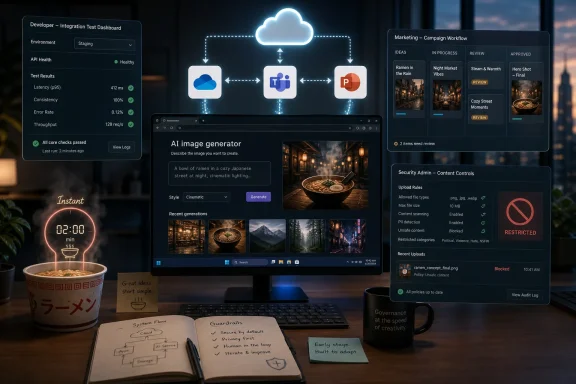 What Windows Teams Should Do Right Now
While Instant-Ramen remains unannounced, do not build policy, budgets, products, or client commitments around it. Do prepare for the broader shift it represents.- Windows admins: Review where employees are already using browser-based AI image tools, desktop creative apps, cloud drives, and productivity suites to create or edit visuals. Decide what kinds of images must not be uploaded to any unapproved AI service.
- Developers: Build evaluation tests around real workflow needs — editing, consistency, text rendering, latency, safety behavior, and failure handling — rather than waiting for a demo reel.
- Creators and business teams: Keep AI-generated images in draft status until licensing, provenance, review, and approval rules are clear for the specific tool being used.
For Windows workflows, the implications are immediate:
- AI image generation is becoming part of normal office work, not just a design-team experiment.
- Data-loss risk starts at upload, especially when users submit screenshots, product photos, customer images, unreleased visuals, or internal diagrams.
- Governance must cover the full asset lifecycle, from prompt and source image to generated file, edited version, approval, storage, and publication.
Google’s Next Image Model Is Still Unconfirmed, but the Pattern Is Familiar
The NPowerUser report puts Instant-Ramen in a category that has become familiar in generative AI: a model name appears before a product page, benchmark deck, formal launch post, or public documentation. The first hints reportedly surfaced through online testing and AI community discussions, with references to the name appearing alongside image-generation experiments. That does not prove a finished product exists, but it is often how model watchers first notice something moving through a company’s testing pipeline.Google has not officially announced Instant-Ramen. The missing details can be grouped plainly: there are no confirmed technical specifications, benchmark results, availability details, pricing terms, product surfaces, API commitments, or launch timeline. That absence should frame every claim about the model.
The source coverage describes Instant-Ramen as a new Google image-generation model under development and discusses it as a possible successor to Nano Banana. That should be treated as interpretation, not confirmation. Until Google says more, the safest reading is that Instant-Ramen is a reported model name associated with image-generation experiments, not a public product and not a confirmed product lineage.
That still makes it worth watching. Nano Banana reportedly gained attention for fast image creation, editing capabilities, and strong prompt adherence. If Google is testing something that builds on that reputation, the interesting question is whether the company can make image generation more dependable in production-style workflows, not merely more impressive in isolated examples.
The first wave of consumer image generators was judged by spectacle: photorealistic faces, cinematic lighting, fantasy scenes, glossy social graphics, and viral prompts. The next wave is being judged by repeatability, edit stability, instruction following, speed, and whether generated assets can survive review by a brand, legal, security, or compliance team.
A model that can make one impressive image is interesting. A model that can make dozens of consistent campaign assets, preserve a product or character across revisions, follow layout instructions, and return usable edits quickly is far more useful.
Nano Banana Set the Baseline: Speed, Editing, and Prompt Adherence
Nano Banana matters because it gave Google a recognizable position in AI-generated imagery. According to the source material, it gained attention for fast image creation, editing capabilities, and strong prompt adherence. Those traits may sound less flashy than raw photorealism, but they are exactly what moves an image model from novelty into daily use.Speed changes behavior. When generation takes too long, users over-plan prompts, batch requests, and tolerate fewer revisions. When a model is fast enough, the workflow becomes more natural: try, inspect, adjust, and repeat. That starts to feel less like gambling with a prompt box and more like working with creative software.
Editing matters even more. Practical creative work is rarely just “make an image from nothing.” It is more often “change this product shot,” “keep the same subject but alter the setting,” “remove this object,” “make this fit a banner format,” “create variants for different audiences,” or “preserve the visual style while changing one element.” A model with useful editing capabilities can fit into existing workflows. A model that only generates from scratch remains more limited.
Prompt adherence is the bridge between speed and editing. Creative workers can tolerate some imperfection if the system understands the brief. They are less forgiving when a model ignores layout instructions, changes the subject, inserts unreadable text, distorts a product, or “improves” an image in a way that breaks the assignment.
The Instant-Ramen rumor lands in that context. If the reported model is real and if it is related to Nano Banana, the logical expectation would be continuity in those areas: speed, editing, and prompt following. But that remains unconfirmed. Google has not said that Instant-Ramen will be faster, higher quality, more editable, or publicly available.
Instant-Ramen Is Not a Product Yet
The most responsible reading is straightforward: Instant-Ramen appears to be a model name circulating around reported testing, not an announced product. NPowerUser says the name has appeared in testing and community discussions, but Google has not confirmed the model, its capabilities, or its release path.The enthusiast phrase circulating around the rumor — “Ramen is cooking. Time to serve soon.” — captures the excitement, but it should not be mistaken for evidence of a launch date. It does not establish whether Instant-Ramen will appear in Gemini, a developer API, Google Cloud, a creative tool, an enterprise product, or anywhere else.
That ambiguity is normal in AI development. Large AI companies often test models under temporary names, internal labels, anonymous evaluation environments, or names that never become public brands. A model can be technically real and still ship under a different name. It can be split across products, limited to selected users, folded into a broader model family, or never released in the form seen during testing.
For that reason, the codename should be treated cautiously. Instant-Ramen may be a final name, an internal codename, a temporary evaluation label, or a signal that has been overinterpreted by the community. Until Google clarifies it, the only solid public claim is that the name has reportedly surfaced in connection with image-generation experiments.
That does not make the story meaningless. Early model names now shape expectations before official launches. Developers watch model pickers. Testers compare outputs. Creators share screenshots. Product teams infer roadmaps. Vendors notice which capabilities generate attention. The rumor stage has become part of the AI market cycle.
The Missing Details Are the Main Point
The absence of official detail is not a footnote; it is the central fact. Since Google has not released specifications, benchmarks, availability, pricing, API details, product placement, or a launch timeline, Instant-Ramen cannot yet be evaluated as a tool. It can only be evaluated as a reported signal.That leaves four practical unknowns.
The first is lineage. We do not know whether Instant-Ramen is a direct successor to Nano Banana, a specialized variant, an editing-focused model, a faster tier, a research system, or a temporary test label. Calling it a successor is plausible based on the way it is being discussed, but it is not confirmed.
The second is capability. The source report says Google’s newest image model may bring faster performance, better image quality, and more powerful editing tools. Those are reasonable expectations for any next-generation image model, but none has been officially confirmed for Instant-Ramen. The clearest phrasing is this: if Instant-Ramen is intended as a Nano Banana follow-up, users would expect improvements in speed, image quality, and editing, but Google has not verified those features.
The third is availability. A model inside a consumer chatbot is very different from a model available through developer platforms. A model limited to testers is different from one offered to enterprises. For IT teams, availability determines governance: who can use the model, what data can be submitted, whether logs exist, whether outputs can be audited, and whether the tool can be restricted.
The fourth is economics and licensing. Speed and quality matter, but so do price, rate limits, commercial terms, retention rules, and usage rights. A spectacular but expensive image model may remain a premium creative tool. A fast, affordable model with clear terms can become infrastructure for marketing automation, app personalization, product mockups, internal communications, and design prototyping.
That is why Instant-Ramen should not be treated as a buying signal. It suggests Google may be preparing another move in image generation. It does not yet tell users, developers, or admins what they can deploy.
| Dimension | Nano Banana | Instant-Ramen |
|---|---|---|
| Status | Known model that gained attention in image generation | Unannounced model name reportedly surfaced through testing and AI discussions |
| Reported role | Popular image-generation model | Discussed as a possible successor to Nano Banana, but not confirmed by Google |
| Known strengths | Fast image creation, editing capabilities, strong prompt adherence | No officially confirmed capabilities |
| Possible direction | Baseline for speed, editing, and prompt following | Faster performance, better image quality, and stronger editing are plausible expectations, but unconfirmed |
| Official detail available | Public reputation described in source coverage | No confirmed specifications, benchmarks, availability details, pricing, API access, or launch timeline |
Why This Matters Beyond One Codename
Instant-Ramen is surfacing in a market where image-generation tools are no longer judged only as creative toys. The broader contest is shifting toward workflow capture: which model can help people produce usable visual work repeatedly, safely, and with enough control to justify adoption inside organizations.That is why prompt adherence and editing matter so much. In a business workflow, a model that produces beautiful but unpredictable results is less useful than one that reliably follows the brief. A visually impressive output can still fail if it changes the product, garbles text, breaks a brand template, distorts a face, or cannot repeat the same style across a series.
Google has obvious reasons to keep improving image generation. Its AI ecosystem touches consumer products, productivity workflows, developer tools, cloud services, advertising, Android, Chrome, and search-adjacent experiences. If an image model becomes dependable enough, Google can surface it in places where users already work rather than forcing them into a standalone creative tool.
But that remains a strategic possibility, not an Instant-Ramen fact. There is no official confirmation that this model will appear in any specific Google product. The practical story is narrower and more useful: if Google is testing a new image model, Windows teams should expect AI-generated visuals to keep moving closer to everyday work.
That is already enough to matter. Workers do not need to understand model architecture to test an image generator. They can see whether text is readable, whether an edit preserves the subject, whether the output follows the instruction, and whether the tool is fast enough to use during a real task. Image AI is one of the easiest AI categories for ordinary users to judge — and one of the easiest for them to adopt without waiting for IT.
Better Image Models Create Better Problems
A faster, higher-quality, more editable image model sounds uncomplicatedly useful until it enters real organizations. Then the main question becomes governance.That is especially true in Windows-heavy environments where employees move assets across browsers, Office documents, creative tools, chat apps, file shares, and cloud drives. A model may run elsewhere, but the workflow touches the Windows desktop.
The first concern is data exposure. Image editing often begins with an upload: a product photo, a customer image, a screenshot, a whiteboard, a design mockup, a confidential slide, or an internal diagram. If users submit those assets to unapproved AI tools, organizations can lose control of sensitive material before security teams know which service was used.
The second concern is provenance. AI-generated images are becoming more realistic and more editable. That helps design and marketing teams, but it complicates compliance, brand governance, incident response, and misinformation risk. If an organization cannot distinguish approved AI-generated assets from unofficial ones, it may eventually publish something it cannot explain or defend.
The third concern is licensing and reuse. The source material does not provide Instant-Ramen licensing terms because Google has not released availability information. Nobody should assume the model is safe for commercial use, redistribution, client work, product mockups, regulated communications, or public campaigns until official terms exist.
The fourth concern is operational dependency. Once employees discover a useful image model, they build habits around it. Marketing teams use it for drafts. Product teams use it for mockups. Support teams use it for help visuals. Executives use it for presentations. If the tool is unannounced, unavailable, rate-limited, renamed, or restricted, those habits can break.
Admins should not wait for Instant-Ramen specifically before building policy. The right response is to treat this rumor as another reminder that AI image generation is becoming a mainstream workplace capability. Whether Google’s next model is called Instant-Ramen or something else, the governance work is largely the same.
Action Checklist for Admins
- Inventory where employees already use AI image generation and editing tools, including browser-based services, integrated assistants, and desktop creative apps.
- Define which images may not be uploaded, including customer photos, unreleased product visuals, confidential screenshots, credentials, regulated data, and internal diagrams.
- Require review for public-facing AI-generated images used in marketing, sales, documentation, recruiting, support, and executive communications.
- Track which tools are approved for commercial work and which are limited to experimentation.
- Prepare guidance for provenance, labeling, storage, and retention of AI-generated visual assets.
- Watch for official Google documentation before enabling or recommending any Instant-Ramen-related workflow.
Developers Should Watch the API Story More Than the Demo Reel
For developers, the most important Instant-Ramen question is not whether it can create an impressive image from a clever prompt. It is whether any future model becomes available through stable developer platforms with predictable behavior.A model exposed only through a consumer interface has limited developer impact. A model exposed through an API can become part of applications: personalized content generation, game assets, design automation, catalog imagery, educational diagrams, document illustrations, customer-facing creative tools, and internal workflow systems.
Once a model enters software, the evaluation changes. Developers need to know latency, cost, rate limits, input formats, output formats, safety behavior, failure modes, retention rules, and edit consistency. A model that looks excellent in screenshots may still be difficult to build around if it behaves unpredictably under real application load.
The most important capability may be iterative editing. Developers do not merely need “generate image.” They need workflows that can preserve an object, alter a background, maintain a character, localize text, resize a composition, apply brand constraints, and revise an image without starting from scratch. If future Google image models improve editing, the developer question will be whether those controls are exposed in a structured enough way to support real products.
Another key issue is multimodal input. Some image tasks begin with a prompt, but many begin with mixed context: a prompt plus a reference image, a screenshot plus an instruction, a diagram plus a style guide, or multiple source images that need to be combined. The source report describes enhanced multimodal understanding as a possible improvement, but that remains unconfirmed for Instant-Ramen.
Failure behavior also matters. Model demos rarely show what happens when prompts are ambiguous, source images conflict, policy filters trigger, or generated text is wrong. Production systems need graceful failures. If a model cannot complete an edit, it should say so clearly rather than returning a plausible but incorrect visual. In visual workflows, silent failure can be worse than refusal.
Until Google releases documentation, developers should resist building plans around Instant-Ramen. But they should prepare evaluation harnesses now. The right test set is not a collection of pretty prompts. It is a set of real tasks from the organization’s own workflows, including edits, revisions, brand constraints, text-in-image requirements, accessibility needs, unacceptable outputs, and recovery paths.
The Windows Angle Is the Everyday Workflow
Instant-Ramen is not described as a Windows feature, a Microsoft integration, or a PC-specific tool. But WindowsForum readers should care because Windows remains the daily work environment where many users encounter AI image tools.The practical Windows question is how generated images move through the organization. A user may create an image in a browser, paste it into PowerPoint, store it in OneDrive or Google Drive, send it through Teams or Slack, edit it in a desktop graphics tool, compress it locally, attach it to email, and publish it through a content management system. Each step creates governance, security, and asset-management questions.
Browser controls matter. Data-loss prevention matters. Endpoint logging matters. File labeling matters. User education matters. Employees often treat image prompts as casual experimentation even when the source material is sensitive. A screenshot of an unreleased dashboard is still confidential when uploaded for “just a quick mockup.”
There is also a downstream workflow issue. Even when generation runs in the cloud, the outputs land on client machines. Designers, marketers, trainers, and support teams still need local tools to inspect, crop, annotate, composite, compress, and distribute images. The better cloud generation becomes, the more downstream asset management matters on the PC.
For IT teams, the answer is not to block every image tool reflexively. AI image generation can reduce production time for internal graphics, draft concepts, training material, support visuals, mockups, and early creative exploration. The better posture is controlled enablement: approved tools, clear data rules, review paths, and a shared understanding of what AI-generated visuals may and may not be used for.
The Hype Cycle Is Moving Faster Than the Evidence
The Instant-Ramen story also shows how AI coverage has changed. A single model name appearing in community discussion can trigger speculation before there is a product, a benchmark, a launch post, or an official company statement. Early signals are part of the AI beat, but readers need to separate three layers that often get blended together.The first layer is reported signal: references to Instant-Ramen reportedly appeared alongside image-generation experiments. That is the strongest part of the story.
The second layer is interpretation: the model is being discussed as a possible successor to Nano Banana. That may be a reasonable reading of the context, but it remains unconfirmed.
The third layer is expectation: Instant-Ramen could improve speed, image quality, editing, or multimodal understanding. That reflects the direction users would expect from a next-generation image model, but those features have not been officially confirmed.
That distinction matters because speculation can harden into assumed capability. Users start waiting for features that may not ship. Developers start planning around APIs that may not exist. Business teams start asking IT about tools that are not available. Competitors and commentators respond to an imagined product rather than a documented one.
Instant-Ramen may deserve attention. It does not yet deserve certainty.
What Would Make Instant-Ramen a Real Successor
If Google does announce Instant-Ramen, the company will need to prove more than raw image quality. Nano Banana’s reputation gives it a possible baseline, but successor status would have to be earned through practical improvements that users can feel in real workflows.Speed would be one obvious measure. A faster model changes how people work because it encourages iteration. But speed without control only makes wrong answers arrive faster. A strong successor would need to handle multi-step creative intent: generate, revise, preserve, localize, reformat, and refine without drifting away from the original brief.
Image quality would also need definition. Photorealism is only one kind of quality. For business use, quality can mean clean edges, accurate product geometry, consistent characters, readable text, brand-safe composition, predictable aspect ratios, and fewer strange artifacts. A model can be artistically impressive and still fail at mundane production work.
Editing may be the most consequential area to watch. Editing is where AI image models become collaborators rather than vending machines. If users can make targeted changes without regenerating the entire image, the model becomes useful for revision cycles, not just first drafts.
The unanswered question is whether Google would present such capabilities as consumer magic, developer infrastructure, enterprise tooling, or some combination of all three. A consumer launch would generate attention quickly. A developer and enterprise-ready launch would matter more over time. The strongest version would be accessible enough for ordinary users, structured enough for builders, and governable enough for organizations.
The Quiet Governance Test for Google
Google’s challenge is not only to make a better image model. It is to make a model people can trust enough to use where mistakes have consequences. That means documentation, safety behavior, availability rules, licensing terms, and product integration will matter as much as sample images.Official specifications would help users understand what the model is designed to do. Benchmark results could help compare performance, though image-generation benchmarks rarely capture everything that matters in real work. Availability information would tell developers and businesses whether the model is a curiosity or a tool. Pricing and usage terms would determine whether it fits experimentation, production, or enterprise procurement.
Google also needs clarity around identity. If Instant-Ramen is only a codename, users should not be surprised if it disappears or launches under another name. If it becomes a public model, users will need to know where it lives, what terms govern it, and how it relates to existing Google AI products.
For Windows admins, the governance test is similar. The question is not “Should we allow Instant-Ramen?” because there is no confirmed product to allow. The question is “Are we ready for better image-generation tools to appear in the services employees already use?”
That means updating acceptable-use policies, reviewing approved AI vendors, clarifying upload rules, and preparing lightweight review processes for public-facing visual content. It also means giving users practical guidance rather than vague warnings. Employees need to know what they can upload, what they cannot upload, when generated images require review, and how to label or store AI-assisted assets.
Timeline: What Is Known and What Comes Next
| Stage | What It Means | Status |
|---|---|---|
| Name surfaces in testing and community discussion | Early signal that model watchers have noticed a possible new Google image-generation model | Reported |
| Connection to Nano Banana discussed | Instant-Ramen is interpreted as a possible successor or follow-up | Unconfirmed |
| Capabilities inferred | Faster performance, better image quality, stronger editing, or multimodal improvements are plausible expectations | Speculative |
| Google announcement | Product name, features, availability, pricing, and documentation would become clear | Not announced |
| Developer or enterprise access | APIs, admin controls, terms, logging, and governance details would determine business usefulness | Unknown |
| Real-world evaluation | Creators, developers, and admins test the model against actual workflows | Future step |
Admin Checklist: Preparing for the Next Image Model, Whatever It Is Called
Windows admins and IT leads do not need to wait for Google to announce Instant-Ramen before doing useful work. The same checklist will apply to most AI image-generation systems.| Area | Practical Question | Recommended Action |
|---|---|---|
| Tool discovery | Which AI image tools are employees already using? | Survey teams, review browser usage where appropriate, and identify unsanctioned workflows |
| Data protection | What images must never be uploaded? | Define restricted categories such as customer images, confidential screenshots, unreleased products, credentials, regulated data, and internal diagrams |
| Commercial use | Which tools are approved for public or client-facing work? | Maintain an approved-tool list with licensing and review requirements |
| Provenance | Can the organization identify AI-generated visuals? | Require labeling, metadata practices, or documented review for public assets |
| Review | Who approves generated images before publication? | Route marketing, support, documentation, recruiting, and executive visuals through existing review processes |
| Storage | Where should AI-generated assets live? | Store approved assets in managed repositories rather than personal downloads or unmanaged folders |
| User education | Do employees understand the risks? | Provide short, concrete guidance with examples of allowed and prohibited uploads |
| Future readiness | How will new models be evaluated? | Build a repeatable test set for quality, safety, consistency, latency, and policy fit |
Bottom Line
Instant-Ramen is worth watching, but not because the name itself changes anything today. It matters because it points toward the next phase of image AI: tools that are expected to be faster, more editable, more consistent, and more useful inside ordinary work. Those expectations are not confirmed for Instant-Ramen, and Google has not announced the model, its features, availability, pricing, or launch timing.For WindowsForum readers, the practical takeaway is to prepare the workflow before the model arrives. Admins should tighten AI image policies and upload rules. Developers should build realistic evaluation tests. Creators should treat unannounced tools and unclear licensing as draft-only territory. Business teams should insist on provenance and review before public use.
If Google eventually confirms Instant-Ramen, the first question should not be “How good are the sample images?” It should be “Can this fit safely and predictably into the way people actually work?”
That is where the real test will be. Not in the codename, not in the rumor cycle, and not in a handful of impressive examples, but in the daily Windows workflows where generated images become documents, slides, campaigns, support assets, prototypes, and business records.
References
- Primary source: nokiapoweruser.com
Published: 2026-07-08T10:50:09.937486
Google Instant-Ramen AI Image Model Leaks Online - NPowerUser
Google's new Instant-Ramen AI image model has surfaced online and could be the successor to Nano Banana. - Read in Leaks / Grapevines on NPowerUser nokiapoweruser.com
- Related coverage: techradar.com
I tried Nano Banana 2 Lite, Google's new 4-second AI image generator, and it changes how you use AI art | TechRadar
Nano Banana 2 Lite makes experimenting a lot easierwww.techradar.com - Related coverage: techcrunch.com
Google adds Nano Banana-powered image generation to Gemini's Personal Intelligence | TechCrunch
That means its AI images can be created using Gemini's understanding of your likes and interests, without those having to be explicitly noted in the prompt.techcrunch.com - Related coverage: androidcentral.com
Nano Banana 2 is now Google's default image generation model, and it's a big step up | Android Central
The new model delivers Pro-grade visuals at Flash speeds, adds near-perfect text rendering, and maintains fidelity across up to 14 objects.www.androidcentral.com - Related coverage: blog.google
Nano Banana 2: Google’s latest AI image generation model
Our latest image generation model offers advanced world knowledge, production-ready specs, subject consistency and more, all at Flash speed.blog.google - Related coverage: techspot.com
Google unveils Gemini's "nano banana" model, taking AI image generation to the next level | TechSpot
Available in the Gemini app and to developers via the Gemini API, Google AI Studio, and Vertex AI platforms, nano banana is said to address one of...www.techspot.com
- Related coverage: allthings.how
How Google’s Nano Banana image model is creeping into Chrome and Gemini
Here’s how Nano Banana and Nano Banana Pro handle image creation today in Chrome, Gemini, and other Google products.allthings.how - Related coverage: gadgets360.com
- Related coverage: linkmodel.ai
Nano Banana 2 Successor? Instant-Ramen vs GPT Image 2 | LinkModel
Instant-Ramen is rumored to be Google's Nano Banana 2 successor. Here's why the AI community is comparing it with GPT Image 2.www.linkmodel.ai - Related coverage: datawebot.com
Google Nano Banana: AI Image Generation and Editing Guide | DataWeBot | DataWeBot
Learn how Google Nano Banana (Nano Banana Pro/2) enables high-fidelity 4K image generation, conversational photo editing, and character consistency for ecommerce product visuals — and how DataWeBot's product data powers these AI-driven workflows. www.datawebot.com
- Related coverage: deepmind.google
Gemini Image – Nano Banana — Google DeepMind
State-of-the-art image generation and editing models, built on Geminideepmind.google - Related coverage: builtin.com
Nano Banana: What It Is and How the AI Image Model Works | Built In
Learn what Google’s Nano Banana is, how it works, and what it can do. Explore its features, limitations, and how it compares to other AI image generators. builtin.com
- Related coverage: replicate.com
Nano Banana | Google | Image Editing
Nano Banana (aka Gemini 2.5 Flash Image from Google), Google's latest high quality image editing model with strong prompt adherence and precise image editing instruction.replicate.com
- Related coverage: axios.com
ChatGPT's new image update takes on Google's Nano Banana
OpenAI says the new model is up to four times faster.www.axios.com
- Related coverage: elpais.com
- Related coverage: omni.se
Google släpper ny version av populärt bildverktyg
Google lanserar Nano Banana 2, en ny version av bolagets AI‑verktyg för bildgenerering. Verktyget ska skapa mer realistiska bilder snabbare än föregångaren, rapporterar Reuters.omni.se
