

Google’s Ironwood TPU arrives as a defining moment in the cloud‑AI arms race: a seventh‑generation Tensor Processing Unit built for inference at hyperscale, backed by a multibillion‑dollar capacity commitment from Anthropic and timed to accelerate Google Cloud’s push to convert AI compute into recurring revenue. The architecture’s headline specs — up to 9,216 chips per pod, 192 GB HBM per chip, and a pod‑level peak measured in exaFLOPS — are real engineering steps forward, but the practical meaning of those numbers depends on precision formats, interconnect topology, software maturity, and how enterprises choose to consume the new fabric.
Google’s TPU program began as a research effort to optimize tensor‑heavy workloads for internal models and cloud customers. Over seven generations the family evolved from sparse accelerator boards to full rack‑scale fabrics engineered for both training and inference. Ironwood (TPU v7) marks a strategic pivot: it is explicitly optimized for inference at massive context lengths while still supporting training at scale. That emphasis reflects how the economics of large generative models have shifted — inference volume and latency for real‑time agents now dominate many enterprise cost models, not just raw training throughput. Google’s timing and commercial tactics are aligned. The TPU bet is part of a broader push to make Google Cloud a top‑tier AI infrastructure provider — growing the cloud business, locking in long‑term capacity buys with AI vendors, and reducing reliance on third‑party GPUs. The Ironwood announcement was accompanied by capacity and partnership disclosures that place compute commitments and revenue growth front‑and‑center for Google’s cloud strategy.
Source: The Hans India Google Unveils Ironwood TPUs: Its Most Powerful AI Chip Yet to Rival Nvidia and Microsoft
 Background / Overview
Google’s TPU program began as a research effort to optimize tensor‑heavy workloads for internal models and cloud customers. Over seven generations the family evolved from sparse accelerator boards to full rack‑scale fabrics engineered for both training and inference. Ironwood (TPU v7) marks a strategic pivot: it is explicitly optimized for inference at massive context lengths while still supporting training at scale. That emphasis reflects how the economics of large generative models have shifted — inference volume and latency for real‑time agents now dominate many enterprise cost models, not just raw training throughput. Google’s timing and commercial tactics are aligned. The TPU bet is part of a broader push to make Google Cloud a top‑tier AI infrastructure provider — growing the cloud business, locking in long‑term capacity buys with AI vendors, and reducing reliance on third‑party GPUs. The Ironwood announcement was accompanied by capacity and partnership disclosures that place compute commitments and revenue growth front‑and‑center for Google’s cloud strategy. What Ironwood actually is: key technical facts
Core silicon and memory
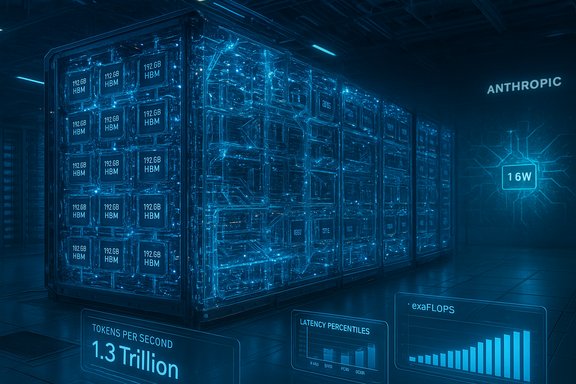
- Each Ironwood chip ships with 192 GB of High‑Bandwidth Memory (HBM) — roughly six times the HBM capacity of Google’s recent Trillium chips. This larger local memory reduces off‑chip transfers for very large models and can simplify sharding.
- Reported HBM bandwidth sits in the ~7.3–7.4 TB/s range per chip, a substantial jump that feeds wider matrix units more effectively for memory‑bound transformer workloads.
Compute peak and numeric formats
- Google public materials and vendor reporting show Ironwood delivering multi‑petaFLOP class peak throughput per chip when measured in FP8 numeric formats. Several independent analyses peg per‑chip FP8 peaks around ~4.6 petaFLOPS. These figures are meaningful for inference throughput comparisons but require careful normalization when compared to GPU claims because precision formats differ.
Interconnect, pods and scale
- Ironwood’s system design supports up to 9,216 chips in a single pod, connected by an enhanced Inter‑Chip Interconnect (ICI) and liquid cooling at pod scale. Google advertises aggregated pod performance measured in exaFLOPS for inference. The large, low‑latency fabric is central to Ironwood’s promise of simplifying very large single‑request inference and making huge context windows feasible without complex multi‑host sharding.
Power efficiency and packaging
- Google highlights improved performance per watt versus prior TPU generations; vendor materials indicate nearly 2× better per‑watt performance vs. its immediate predecessor in several metrics, though exact baseline definitions vary across presentations. Realized power draw at pod scale is nontrivial — multi‑megawatt allocations are required for full pod deployments.
Claims vs. verifiable facts — what to believe and what to treat cautiously
Google’s own post supplies a detailed spec sheet and engineering framing for Ironwood, and reputable press outlets replicated those figures. Cross‑checking shows broad agreement on the chip’s HBM capacity, ICI improvements, and the 9,216‑chip pod topology. For example, Google’s product blog provides HBM, bandwidth and ICI numbers, while independent reporting (Ars Technica, TechCrunch, The Register) corroborates pod size and memory claims. However, some headline comparisons require extra care:- “4× faster than the previous TPU generation” is true as a vendor claim in the sense that specific throughput metrics (under selected precisions and workloads) show multi‑fold gains versus certain prior chips. Independent analyses show the number depends on which prior SKU is the comparator (v5p, v6e/Trillium) and which numeric precision is used (FP8 vs BF16/FP16). Precision, compiler stack, and workload profile drive the multiplier. Treat blanket speedup claims as illustrative rather than universally applicable.
- Comparisons to supercomputers (e.g., “24× El Capitan”) fold different metrics together (FP8 vs. FP64, peak vs. sustained), so those head‑to‑head ratios can mislead if read literally. Such statements work as marketing shorthand but are not apples‑to‑apples scientific equivalence.
- Peak TFLOPS and exaFLOPS per pod numbers assume vendor‑specified numeric formats (FP8, proprietary modes) and idealized scaling across the interconnect. Real world application throughput will be lower and will depend heavily on runtime, model architecture, and data‑path I/O. Independent benchmarks will be required to translate peak numbers into per‑token latency and cost‑per‑inference for production workloads.
Anthropic, one million TPUs, and the economics of scale
The most consequential commercial outcome linked to Ironwood is the announced Anthropic arrangement: access to up to one million Google TPUs under a multiyear deal reported to be worth tens of billions of dollars and to bring over a gigawatt of AI capacity online starting in 2026. That dossier has been reported independently by major news organizations. This is not a small pilot — it is an enterprise‑scale, strategic capacity commitment that both validates Ironwood and creates a large, captive consumption anchor for Google Cloud. Why that matters:- At extreme scale, economies of scale for training and for very large‑context inference become meaningful: shorter iteration cycles, cheaper per‑token inference, and the operational capacity to support single‑pass million‑token requests that many architectures previously required sharded across dozens of hosts.
- Anthropic will still use a multi‑vendor compute posture — mixing TPUs, GPUs and other accelerators — but a dominant TPU supply provides optionality and price leverage while materially reducing Anthropic’s marginal Nvidia exposure.
- “Up to one million” is a headline contractual cap. Actual phased delivery schedules, regional availability, and the proportion of that capacity dedicated to a single model or environment will vary. Treat public‑facing totals as order‑of‑magnitude commitments rather than instantaneous, fully provisioned deployments.
- The reported “well over a gigawatt” figure reflects peak provisioning and not sustained average draw; converting that to energy‑equivalent terms (e.g., homes powered) is illustrative and sensitive to how the metric is calculated.
Where Ironwood fits in the competitive landscape
The broader market sits with three dynamics in play:- Nvidia’s entrenched software and hardware ecosystem (CUDA, cuDNN, TensorRT, NVLink) still gives GPUs a dominant role for many training and mixed‑workload cases. Porting complex, optimized model pipelines off CUDA incurs engineering costs and can temporarily reduce throughput; this ecosystem friction slows wholesale migrations.
- Hyperscalers are building alternatives — Google with Ironwood, AWS with Trainium/Inferentia/Graviton lines, and Microsoft with its Maia efforts — because reclaiming even a fraction of GPU spend can yield multi‑billion dollar savings at hyperscaler scale. Those moves create a multi‑modal datacenter world in which the right accelerator depends on workload tradeoffs.
- Vendor lock‑in vs. price‑performance tradeoffs will determine adoption outside of marquee partners. For large inference fleets where latency, per‑token cost and energy efficiency matter more than raw FP64/TOPs comparisons, Ironwood‑like architectures can win. For frontier training where software maturity, specific kernel optimizations and raw mixed‑precision memory flows still favor some GPU variants, Nvidia remains the pragmatic choice.
Business and financial signals
Google Cloud’s growth has been a central narrative alongside the Ironwood launch. Reported Q3 results placed Google Cloud revenue north of $15 billion with year‑over‑year growth around 34%, and Alphabet raised near‑term capital expenditures guidance into the $91–$93 billion range to fund data center and AI infrastructure expansion. That spending envelope is the practical fiscal backbone required to deploy multi‑megawatt TPU pods and to sustain multi‑year capacity deals. Independent financial reporting and trade press summaries corroborate the revenue and capex trajectory attributed to Google’s expanded AI investments. Implications for customers and investors:- Increased capex signals continued capacity expansion and likely prioritized inventory for TPU deployments in key regions.
- Large long‑term deals with model providers smooth utilization for Google’s TPU investments, improving the business case for continued hardware innovation.
- For enterprises, expanded TPU availability can mean better pricing options for inference pipelines if cloud providers pass along the efficiency gains.
Operational risks and engineering realities
Ironwood’s design solves important scaling problems, but deploying and relying on pod‑scale accelerators introduces a new set of operational dependencies:- Data center infrastructure: Pod‑scale liquid cooling, power delivery, and utility contracts are complex and regionally constrained. Building and operating multi‑MW pods requires long‑lead coordination with utilities and mechanical systems.
- Software and toolchain maturity: Adoption will hinge on compiler optimizations, runtime stability, and ecosystem support. Even well‑designed chips need production‑grade runtimes and tuned kernels; until those are widely available, performance will be workload‑dependent.
- Vendor and geopolitical concentration: Large, exclusive capacity commitments — or effective single‑vendor dependencies inside a cloud region — can create strategic risk. Enterprises must plan for fallbacks and cross‑cloud portability for critical workloads.
- Environmental and grid impacts: Concentrated AI deployments increase local power demand and bring sustainability scrutiny. Enterprises and providers will face pressure for carbon accounting and renewable sourcing for gigawatt‑scale compute.
Practical guidance for WindowsForum readers and enterprise IT teams
For IT leaders evaluating Ironwood‑backed services or the Anthropic offering, a disciplined procurement and testing approach will reduce downstream surprises:- Ask for topology‑aware commitments:
- Request placement guarantees for model shards (e.g., same‑pod placement for low‑latency inference).
- Require measurable tokens‑per‑second SLAs and representative latency percentiles on your workloads.
- Validate cost and performance with proof‑of‑value:
- Run production‑profile benchmarks (your model, your data) across a matrix of backends (Ironwood TPU, H100/Blackwell GPU, Trainium).
- Measure per‑token cost, tail latency (p99/p999), and energy draw for realistic concurrency.
- Include storage and I/O in the test profile — accelerators idle if datafeed rates are insufficient.
- Insist on contractual transparency:
- Ask for regional availability windows, phased delivery dates, and the terms under which capacity can be reassigned.
- Negotiate observability and telemetry requirements so you can map request routing and residency.
- Preserve portability:
- Use portable model formats (ONNX, Triton, or multi‑backend frameworks) where possible.
- Keep a multi‑cloud fall‑back plan if regulatory or availability issues require rapid relocation.
Longer‑term strategic takeaways
- Ironwood validates that hyperscalers will continue building vertically integrated stacks — custom silicon, optimized runtimes, and distribution channels — to reduce unit economics for AI services.
- Large, multi‑year deals like Anthropic’s can reshape competitive dynamics by locking major consumers into favored cloud fabrics; that increases pricing power and gives hyperscalers leverage over traditional GPU vendors in specific segments.
- The real measure of impact will be how quickly software and portability tooling reduce migration costs. Until that happens, a multi‑modal world — GPUs for some workloads, TPUs/Trainium for others — is the most likely near‑term outcome.
Conclusion
Ironwood is a major engineering step for Google: a purpose‑built inference TPU that scales to pod sizes previously reserved for the largest supercomputers and cloud clusters, backed by a headline‑grabbing Anthropic commitment that validates Google Cloud’s infrastructure strategy. The technical advances — 192 GB HBM, new ICI bandwidths, FP8 support and multi‑petaFLOP per‑chip peaks — are real and reproduced across vendor posts and independent reporting, but their practical benefits hinge on workload specifics, runtime maturity, and contractual clarity about pricing and placement. Enterprises should treat the Ironwood announcement as a genuine expansion of choice in the AI compute market: powerful, promising, and strategically significant — yet not a panacea that instantly replaces the GPU‑centric world. Rigorous testing, careful SLA negotiation, and multi‑vendor contingency planning remain the prudent path for any organization planning to anchor business‑critical AI on these new fabrics.Source: The Hans India Google Unveils Ironwood TPUs: Its Most Powerful AI Chip Yet to Rival Nvidia and Microsoft
