

Google is quietly steering advertisers away from pure search buys and toward YouTube, display and Discovery-style inventory, arguing that upper‑funnel awareness and Google’s AI‑powered ad products are the best hedge as shoppers increasingly begin product journeys inside AI assistants and conversational engines. The shift — reported in a recent industry dispatch and echoed by multiple agency executives — isn’t just a seasonal nudge for holiday budgets: it reflects a deeper product strategy from Google to make Demand Gen, Performance Max and related formats the primary path for brands that want visibility inside both traditional results and emergent AI surfaces.
The move is already reshaping agency plans for the remainder of the year and forcing marketers to reassess creative, measurement and attribution frameworks as the line between discovery and purchase blurs.
The advertising market is in the middle of a structural adjustment driven by two linked forces: (1) rapid changes in how people discover products — particularly the rise of AI‑assisted search and conversational answers — and (2) Google’s product response, which expands and repositions video, display and multiformat ad types as first‑class destinations for advertisers.
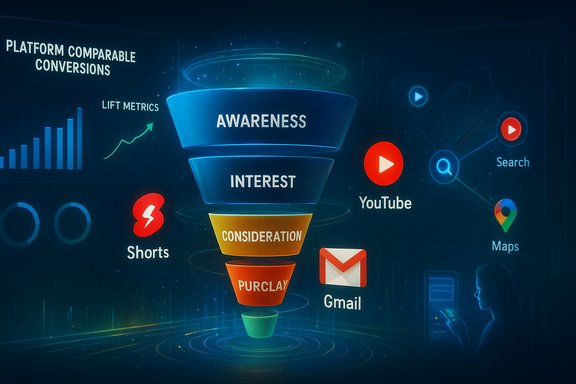
AI and assistants are changing the discovery layer. Data collected and reported this year show that a majority of consumers are encountering AI‑generated summaries on search result pages, and that many users still complement those results with traditional links — but the overall dynamic has already altered click behavior and referral patterns for publishers and advertisers. Recent public analyses find that AI summaries are now present on a large share of search sessions, and surveys show most people still rely on classic search engines for many queries even as younger cohorts experiment more with chat‑style tools. Google has answered with product changes that fold YouTube, Discover, Gmail and Display more tightly into the performance stack. The company has broadened and rebranded campaign types (notably Demand Gen) and introduced measurement features designed to make those formats comparable with social-style buying. Google’s own product communications highlight Demand Gen as an AI‑driven, visually rich format that is delivering improved conversions per dollar and a suite of tools — from platform‑comparable conversion columns to omnichannel bidding — intended to surface incremental value from awareness buys.
Key themes from agency feedback:
Source: Digiday Amid search wars, Google touts YouTube, display inventory to advertisers
The move is already reshaping agency plans for the remainder of the year and forcing marketers to reassess creative, measurement and attribution frameworks as the line between discovery and purchase blurs.
 Background / Overview
The advertising market is in the middle of a structural adjustment driven by two linked forces: (1) rapid changes in how people discover products — particularly the rise of AI‑assisted search and conversational answers — and (2) Google’s product response, which expands and repositions video, display and multiformat ad types as first‑class destinations for advertisers.AI and assistants are changing the discovery layer. Data collected and reported this year show that a majority of consumers are encountering AI‑generated summaries on search result pages, and that many users still complement those results with traditional links — but the overall dynamic has already altered click behavior and referral patterns for publishers and advertisers. Recent public analyses find that AI summaries are now present on a large share of search sessions, and surveys show most people still rely on classic search engines for many queries even as younger cohorts experiment more with chat‑style tools. Google has answered with product changes that fold YouTube, Discover, Gmail and Display more tightly into the performance stack. The company has broadened and rebranded campaign types (notably Demand Gen) and introduced measurement features designed to make those formats comparable with social-style buying. Google’s own product communications highlight Demand Gen as an AI‑driven, visually rich format that is delivering improved conversions per dollar and a suite of tools — from platform‑comparable conversion columns to omnichannel bidding — intended to surface incremental value from awareness buys.
What Google is telling advertisers — the product playbook
Demand Gen, YouTube and the push to upper funnel
Google’s strategic posture is straightforward: if discovery is moving toward immersive, conversational and visual experiences, then advertisers should invest in the places where those experiences happen. That means:- Demand Gen (the evolution of Discovery-style buys) across YouTube, Gmail and Discover feeds as the upper‑funnel reach product.
- YouTube inventory — including Shorts — as both a brand and performance engine, with shoppable and in‑stream enhancements.
- Display and Discovery placements to accumulate audiences and remarketing pools that feed search and shopping conversions later in the funnel.
Measurement and the attribution narrative
A crucial part of the pitch is measurement. Historically, marketers have relied on last‑click or search‑centric attribution to justify search spend. Google’s response is twofold:- Introduce measurement columns and conversion views that present Demand Gen performance in platform‑comparable terms so agencies can benchmark against social.
- Make it easier to run conversion‑lift tests and account‑level incrementality experiments from within Google Ads to demonstrate the funnel effect of awareness spending.
Shopper integrations and shoppable video
Beyond pure measurement, Google is extending shopping signals and retail‑focused capabilities into video and discovery placements. Recent product notes and activity from Google Marketing Live show growing emphasis on the Merchant Center as a brand and product hub, shoppable video formats, in‑ad checkout links, and local/offline offer surfaces that connect YouTube, Search and Maps. That blurs the old upper‑vs‑lower funnel boundary: a shopper can discover a product in a short-form video and convert with a few taps, all within Google’s ecosystem.Why Google is making this move (and why advertisers are listening)
1) Defensive economics: owning discovery and monetization
AI‑driven assistants and generative overviews reduce the raw number of clicks to publisher pages in some contexts. Platforms that control both the discovery surface and ad inventory have a natural advantage: they can directly monetize the summary or answer surface rather than relying on referral traffic. Google’s product changes are a prophylactic response — ensuring its own inventory (YouTube, Discover, Gmail) is the easiest place for advertisers to buy reach that will still be visible when AI answers or assistant experiences become the dominant first touch. Industry analyses and internal testing indicate platforms are actively testing ad placements inside conversational surfaces, which makes the vertical integration strategy predictable.2) Creative and measurement innovations increase the appeal of visual formats
Video and visually rich ads have become easier to produce at scale thanks to Google’s creative tools and generative creative integrations announced at industry events. For brands focused on awareness and consideration — where creative storytelling matters — YouTube and Demand Gen offer a compelling mix of scale, automation and now, more comparable metrics. Google’s own product claims about Demand Gen gains (e.g., conversions per dollar uplift from AI optimizations) are being used in sales conversations. Independent agencies and advertisers will, of course, test these claims against real client data.3) The measurement problem is real — and Google’s tooling is pragmatic
Advertisers face a measurement dilemma: AI assistants change how discovery is recorded and complicate multi‑touch attribution. Google’s push to provide platform‑comparable columns and built‑in conversion lift is an attempt to give marketers usable signals they can act on in the near term, rather than forcing an immediate rewrite of attribution frameworks. For many performance‑oriented teams, that pragmatism is attractive because it reduces the friction of running experiments and reporting to stakeholders.How agencies and advertisers are reacting — reality checks and skepticism
Agency responses are mixed. Several performance shops told industry reporters that Google has been actively recommending YouTube, display and Discovery placements. Some agency execs see opportunity — particularly for clients that need brand building ahead of the competitive holiday season — while others are more cautious about the efficacy of Google’s Discovery/display placements vs. other social platforms.Key themes from agency feedback:
- Skepticism about discovery placements: At least one performance shop continues to recommend YouTube heavily but to avoid Google’s discovery display placements, reporting lower returns relative to competitive platforms. Anecdotes like this underline that creative execution and audience targeting still matter more than the product label. (Agency perspective summarized from industry reporting.
- Concerns about platform nudges: Some agency leaders interpret Google’s product nudges as a commercial push to move budgets into formats Google can more directly monetize — especially as AI changes search behavior. That has led to pragmatic advice: test Demand Gen and platform comparable metrics with holdouts and incrementality tests rather than wholesale budget migrations.
- No widespread discounting or incentives reported: Multiple agency execs note Google hasn’t broadly used vendor discounts to coax adoption of these formats; instead, the company is leaning on product and measurement upgrades in its sales conversations.
The risks and tradeoffs for advertisers
No strategy is risk‑free. Shifting spend upstream and into platform‑native formats carries several practical and strategic risks brands must weigh.- Measurement opacity and attribution drift. Platform‑comparable columns and view‑through attribution can mask real differences in funnel behavior if not used carefully. Advertisers relying solely on platform‑reported metrics risk mis‑allocating budgets without independent incrementality tests.
- Inventory concentration and pricing pressure. If many advertisers migrate to platform‑owned surfaces, open‑web inventory may compress, driving up CPMs on premium publishers. That dynamic benefits the platforms that control both discovery and ad inventory. Independent DSPs and publishers could see margin pressure.
- Creative quality and brand distinctiveness. Flooding new formats with templated creative reduces performance. Upper‑funnel formats reward compelling, differentiated storytelling; poor creative will still underperform regardless of format. Agencies should avoid treating Demand Gen or Shorts as a plug‑and‑play replacement for thoughtful brand work.
- Regulatory and trust issues. Embedding ads in AI responses or assistant surfaces raises labeling, transparency and privacy issues. Regulators and publishers already scrutinize how platforms use content and data for model training and monetization; those risks persist and could change product economics or availability.
- Potential vendor lock‑in. Greater reliance on platform automation (Performance Max, AI Max, Demand Gen) can erode control over placements and keywords. While automation offers scale and efficiency, it also reduces line‑of‑sight on where ads show and how returns are generated. Advertisers must maintain governance and test independence.
Practical guidance: how to test Google’s upper‑funnel pitch without betting the farm
Advertisers should approach any migration toward Demand Gen / YouTube / Display with rigor. Below is a practical, sequential checklist to test and validate Google’s claims while protecting core performance metrics.- Establish baseline cohort metrics.
- Define current acquisition cohorts and their lifetime value, not just first‑touch CPA.
- Capture channel‑level benchmarks for click‑through, conversion rate, CPA and post‑purchase retention.
- Run incremental, randomized holdout tests.
- Use randomized control trials (e.g., geo holds or user holdouts) to measure the lift from Demand Gen or YouTube spend rather than relying solely on platform reporting.
- Ensure holdout windows are long enough to capture delayed conversions from upper‑funnel exposure.
- Use platform‑comparable columns — with care.
- Enable the Platform Comparable conversion columns to get a directional view against paid social. Do not use them as the only source of truth; reconcile with server‑side metrics and third‑party measurement where possible.
- Prioritize creative testing.
- Treat YouTube Shorts and Demand Gen as creative-first investments. Test multiple creative approaches and lock on the best performers before scaling.
- Maintain placement and budget guardrails.
- Use placement exclusions, audience rules and frequency caps to prevent overexposure on low‑value placements. Keep a portion of budget in control campaigns (e.g., branded search, Shopping) that deliver predictable bottom‑line performance.
- Reconcile measurement across systems.
- Use server‑side event logging as a reconciliation layer for platform-reported conversions; integrate offline sales where relevant to get omnichannel clarity.
- Monitor CPM and reach metrics for supply compression.
- If CPMs on curated open‑web inventory spike without measurable incremental performance, pause and investigate. Rising CPMs can signal shifting demand toward platform‑owned inventory.
Tactical playbook for the holiday season (compact, practical actions)
- Launch small Demand Gen pilots in early October to seed remarketing audiences for Black Friday/Cyber Week.
- Use YouTube Shorts to test 6–15 second creative variants optimized for scroll behavior; measure engagement and downstream conversion lift.
- Implement Platform Comparable columns and run conversion lift tests at the manager‑account level to measure cross‑format incrementality.
- Feed high‑quality assets into Merchant Center and enable shoppable links where appropriate to reduce friction at checkout.
- Close the loop with post-holiday retention metrics; evaluate LTV, not only immediate conversion.
What we still don’t know — and what to watch
The transition to AI‑assisted discovery is incremental and uneven across verticals. Several critical unknowns deserve attention:- How quickly will AI assistants adopt and scale monetized ad placements inside conversational answers? Early experiments exist, but full rollout cadence and ad load policies remain in flux.
- How representative are the early incrementality signals Google publishes? Platform case studies are instructive but require independent holdouts to validate for a given brand.
- Will regulators impose disclosure or licensing rules that change the economics of AI discovery surfaces? Policy actions could materially affect incentives for platforms and publishers.
- Referral traffic trends from search and AI‑driven sources.
- CPM and reach shifts for premium open‑web placements.
- The speed at which major advertisers move significant budgets into Demand Gen / YouTube Shorts and the measured ROI from independent tests.
Bottom line — a balanced verdict for marketers
Google’s current push to promote YouTube, display and Demand Gen inventory is both a product and commercial response to a changing discovery landscape. For advertisers, the move is an invitation to modernize creative, measurement and funnel thinking — but not a mandate to abandon proven, bottom‑line channels overnight.- Brands with long purchase cycles or product categories that benefit from storytelling should test and scale upper‑funnel formats aggressively, using randomized holdouts and server‑side reconciliation.
- Performance teams should preserve control budgets and insist on independent incrementality testing before shifting the majority of spend.
- Agencies and advertisers should expect more product nudges and sales conversations from Google; treat product updates as opportunities for disciplined experimentation rather than an immediate faith‑based migration.
Conclusion
Google’s messaging to advertisers is clear: as discovery patterns shift toward AI and conversational surfaces, the safest way to remain visible is to invest in the ad formats that will naturally be surfaced inside those experiences — Demand Gen, YouTube and display inventory. The company’s product updates and measurement tools make that transition easier to justify on paper, but the proof will be in independent incrementality tests and long‑term return on investment. Advertisers should treat Google’s pitch as a reason to experiment — not to surrender the controls that deliver accountable performance. The next several quarters will determine whether these upper‑funnel plays reliably translate to sustained, measurable business outcomes or whether they primarily become a convenient place to park impressions as discovery surfaces continue to evolve.Source: Digiday Amid search wars, Google touts YouTube, display inventory to advertisers
