

GPD’s high‑power Win 5 “Strix Halo” handheld is now showing signs of official Bazzite OS support — a development that could materially change the software options for owners of one of the most ambitious AMD‑APU handhelds yet — but the path between community ports, vendor blessing, and a polished, supported image remains complex and conditional.
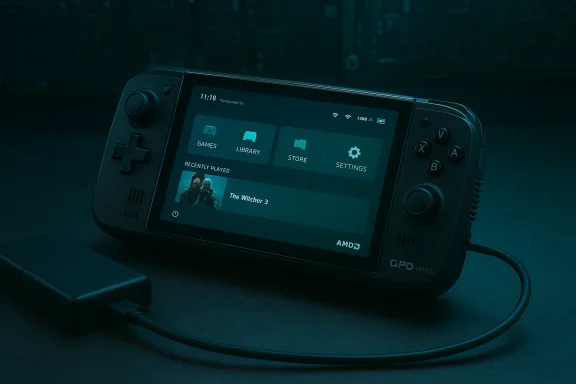
The GPD Win 5 (“Win 5”) is GPD’s flagship, Strix Halo APU‑powered handheld: a 7‑inch, 1080p, 120 Hz machine that targets near‑laptop performance by adopting AMD’s high‑end Ryzen AI Max+/“Strix Halo” class APUs. To accommodate the power and thermal demands of those APUs, GPD shipped a design that notably relies on a detachable external battery (or a very high‑wattage charger) rather than the small internal packs common to earlier handhelds. That hardware choice opens unusual software tradeoffs for handheld owners: more sustained TDP headroom, but also a form factor and thermal behavior that demands careful driver and OS tuning. ([tomshardware.com](AMD Strix Halo gaming handheld lacks an internal battery — GPD Win 5 requires an external battery or be plugged into the wall community‑driven, Fedora‑based gaming distribution that targets handheld and SteamOS‑style experiences. Built with Proton, tuned Mesa drivers, and handheld utilities (Handheld Daemon and other tools), Bazzite aims to deliver a console‑first experience and reduced OS overhead compared with a full Windows image. The community has used Bazzite to extract surprising gains on several Windows‑first handhelds, and that momentum is the technical context for any GPD/Bazzite work.
This development signals several broader things about the handheld PC market:
That said, the distinction between a community‑published, device‑targeted image and an OEM‑sanctioned factory Linux SKU matters: the former can deliver exciting capability but also requires caution, backups, and willingness to troubleshoot; the latter would represent a major consumer‑friendly milestone and reduce the risks of tinkering.
Owners and prospective buyers should watch Bazzite’s releases and GPD’s firmware notes closely, prepare recovery plans, and weigh the trade‑offs between Windows compatibility (Game Pass, anti‑cheat, vendor utilities) and the performance and UX gains a polished Linux image can offer. The Win 5’s hot‑rod hardware deserves equally careful software stewardship — and Bazzite’s growing device list suggests the community and project maintainers are ready to bring that stewardship to GPD’s Strix Halo handheld.
Source: TechPowerUp Official Bazzite OS Support Coming to GPD's Win 5 "Strix...
 Background / Overview
The GPD Win 5 (“Win 5”) is GPD’s flagship, Strix Halo APU‑powered handheld: a 7‑inch, 1080p, 120 Hz machine that targets near‑laptop performance by adopting AMD’s high‑end Ryzen AI Max+/“Strix Halo” class APUs. To accommodate the power and thermal demands of those APUs, GPD shipped a design that notably relies on a detachable external battery (or a very high‑wattage charger) rather than the small internal packs common to earlier handhelds. That hardware choice opens unusual software tradeoffs for handheld owners: more sustained TDP headroom, but also a form factor and thermal behavior that demands careful driver and OS tuning. ([tomshardware.com](AMD Strix Halo gaming handheld lacks an internal battery — GPD Win 5 requires an external battery or be plugged into the wall community‑driven, Fedora‑based gaming distribution that targets handheld and SteamOS‑style experiences. Built with Proton, tuned Mesa drivers, and handheld utilities (Handheld Daemon and other tools), Bazzite aims to deliver a console‑first experience and reduced OS overhead compared with a full Windows image. The community has used Bazzite to extract surprising gains on several Windows‑first handhelds, and that momentum is the technical context for any GPD/Bazzite work.What “official support” actually means here
“Official support” can mean different things depending on the parties involved:- Bazzite‑side official support: the Bazzite project publishes a dedicated ISO or device profile that includes kernel patches, firmware hooks, Handheld Daemon (HHD) bindings and other device‑specific configurations to make the Win 5 a first‑class target.
- GPD vendor blessing: GPD provides firmware/BIOS updates, recovery images, or driver information that permits stable Bazzite installs without aggressive workarounds — or even ships units with a vendor‑sanctioned Linux image.
- Community / third‑party port: independent contributors adapt a Bazzite build to the Win 5, but there is no formal sign‑off from either project or OEM; usability can vary and warranty/support friction may remain.
Why this matters: hardware, drivers and the OS stack
Handhelds are unusual: they compress laptop‑class silicon into tiny enclosures, making sustained performance and consistent frame‑time behavior highly sensitive to background OS activity, driver shader‑handling policies, kernel scheduler choices, and power‑management hooks. A few technical realities explain why a well‑tuned Linux image like Bazzite can be attractive on a device such as the Win 5:- Reduced OS overhead: a console‑first Linux image boots to a single, lightweight compositor and gaming shell, cutting background threads and Windows services that can create scheduling noise.
- Mesa + Proton tuning: tailored Mesa builds and Proton/Proton‑GE configurations can reduce runtime shader hitches and improve GPU utilization in some titles.
- Direct control of governors and fans: Linux tooling commoner governors and fan curve hooks that let maintainers shape a stable sustained TDP across gaming sessions.
Evidence: announcements, build notes and community testing
What anchors the claim that Bazzite support is coming to the Win 5?- Community threads and aggregated reporting have referenced Bazzite building Win 5 device support, and several community testers have already been experimenting with Bazzite on GPD hardware. These forums include detailed notes about installer behavior, BIOS quirks, and which hardware features currently work or require workarounds. Those threads form the first line of evidence that a targeted Bazzite image or device profile is being prepared and validated by users.
- Broader handheld coverage (press and hardware outlets) documents the Win 5 hardware, its Strix Halo APU options, and the unique thermal/power architecture that explains why a tuned OS profile matters. These independent hardware reports corroborate the high TDP envelope and the detachable battery design which directly affect driver and OS tuning needs.
- Reporting on Bazzite’sons (Ayaneo, AOKZOE, others) shows the project actively expanding supported platforms and publishing notes for new handhelds — a pattern consistent with adding GPD Win 5 support. However, while this indicates intent and momentum, it is distinct from a formal, vendor‑sanctioned, warranty‑safe image.
Compatibility and feature status: what’s likely to work (and not)
Based on community reports from similar projects and early Win 5 testing notes, this is a practical breakdown of likely outcomes for a Bazzite‑on‑Win‑5 install:- Likely to work well
- Core GPU and display: Mesa drivers for AMD RDNA/iGPU families are mature; expect native 1080p/120 Hz support with variable refresh behaviors once the correct kernel/mesa stack is chosen.
- TDP and frequency controls: Handheld Daemon (HHD) and Bazzite tooling usually provide usable controls for TDP and GPU frequencies out of the box for newly supported devices.
- Steam Gaming Mode and Proton: Steam’s controller‑first flow and Proton compatibility typically function as expected for many single‑player titles.
- Likely to require workarounds
- Suspend/resume and battery hot‑swap: BIOS and firmware idiosyncrasies on high‑TDP handhelds often cause wake instability; these are typically resolvable by firmware updates or kernel patches by steps.
- Advanced input features: Back‑buttons, gyros, vibration and hotkey mappings sometimes need device‑specific HHD bindings.
- Potential problem areas
- Anti‑cheat and multiplayer: Kernel‑level anti‑cheat integrations and some multiplayer middleware remain Windows‑centric; expect games protected by EAC/BE/other solutions to be problematic or Windows‑only for the foreseeable future.
- **Vendor utilities and Ry‑style or vendor‑specific windows utilities (if GPD produces any) will not be present under Linux; some device utilities may be ported community‑side but not all features will be identical.
Installation realities and risks (BIOS, Secure Boot, warranty)
Installing a third‑party OS on a modern handheld still carries friction and potential support friction. Practical considerations:- Back up your Windows recovery image before altering the system partition. Many community posts stress the importance of retaining a factory recovery option to restore warranty‑friendly configurations.
- Be prepared to manage Secure Boot / MOK enrollment. Installing Fedora‑based images often requiressabling Secure Boot for unsigned kernel modules.
- BIOS/firmware: some users on similar handhelds have had to downgrade or apply specific BIOS revisions to enable full Linux compatibility (examples exist where fan control or wake behavior were BIOS‑sensitive). Expect vendor firmware iterations to improve the experience — but these may also be Windows‑oriented by default.
- Anti‑cheat: multiplayer and competitive titles requiring kernel‑level anti‑cheat modules may be unusable under Linux, or require convoluted cloud/streaming workarounds.
- Warranty and support: installing a community image can complicate vendor support channels. If you value out‑of‑warranty repair support or straightforward RMA flows, preserve a factory image and document your steps.
Performance: expectations vs. marketing
Community experiments on high‑TDP handhelds running Bazzite or SteamOS variants have shown scene‑dependent performance uplifts: smoother frame times, improved 1% lows, and modest average FPS gains in shader‑heavy scenes. Those results are not magic — they arise from shader cache handling, compositor behavior, and kernel/driver scheduling differences. However, the uplift varies:- Mid‑TDP handheld modes (where thermal throttling would normally bite) often show the largest observed gains, because a lean OS reduces scheduling noise and allows more consistent clock maintenance.
- At extreme low power (silent modes) and at fully plugged‑in turbo settings, the differences tend to shrink or disappear.
- Real‑world numbers are highly dependent on the specific driver/kernel/Mesa/proton combo and the game scene chosen for testing.
This development signals several broader things about the handheld PC market:
- OS divergence matters more than ever: vendors that deliver a polished, handheld‑first software image (or provide easy, supported alternatives) will win customers who value console‑like consistency.
- Community OS projects are credible force multipliers: a well‑maintained community OS can increase the perceived value of hardware and push vendors to improve firmware and driver transparency.
- Anti‑cheat and ecosystem barriers remain gatekeepers: mainstream adoption of Linux images for competitive or service‑driven titles will remain blocked until anti‑cheat vendors and storefronts offer robust Linux paths.
Practical guidance for Win 5 owners today
If you own or plan to buy a GPD Win 5 and care about Bazzite/Linux:- Create a recovery USB and back up the Windows image before experimenting. This is mandatory if you want to preserve warranty and quickly restore factory behavior.
- Track Bazzite’s release notes and the project’s device list; wait for a labeled “Win 5” profile or ISO rather than adopting a generic image.
- Expect incremental improvements: early releases may require BIOS tweaks, kernel parameter fiddling, and manual Handheld Daemon configuration to enable back buttons, haptics, or microphone behavior.
- Keep dual‑boot in mind: many users run Windows for multiplayer/anti‑cheat titles and Bazzite for single‑player sessions to get the best of both worlds.
- Watch for vendor BIOS updates: GPD and s can materially change wake/sleep and thermal behavior, and these updates may be prerequisites for smooth Linux support.
Unverifiable or watch‑out claims
Some early community posts and forum threads occasionally treat early test videos or first installs as definitive proof of “complete” support. Those claims should be flagged:- If a single community video or a short test is being presented as full compatibility, treat it cautiously until multiple users and an official release note confirm parity across features.
- Hardware SKU differences (APU variant, SSD/BIOS revisions, and RAM configuration) can materially change the compatibility matrix; a working image on one Win 5 configuration may fail on another.
- Vendor‑level warranty promises about third‑party OS installs require explicit, documented OEM language; do not assume warranty neutrality.
Conclusion
The move to bring Bazzite OS support to the GPD Win 5 is an important step in the continuing maturation of handheld PC software ecosystems. For enthusiasts, a dedicated, supported Bazzite image for the Strix Halo‑powered Win 5 promises bemance, cleaner frame times in many single‑player scenarios, and a more console‑like handheld experience — provided the project and GPD finish the integration work that typically follows an initial port.That said, the distinction between a community‑published, device‑targeted image and an OEM‑sanctioned factory Linux SKU matters: the former can deliver exciting capability but also requires caution, backups, and willingness to troubleshoot; the latter would represent a major consumer‑friendly milestone and reduce the risks of tinkering.
Owners and prospective buyers should watch Bazzite’s releases and GPD’s firmware notes closely, prepare recovery plans, and weigh the trade‑offs between Windows compatibility (Game Pass, anti‑cheat, vendor utilities) and the performance and UX gains a polished Linux image can offer. The Win 5’s hot‑rod hardware deserves equally careful software stewardship — and Bazzite’s growing device list suggests the community and project maintainers are ready to bring that stewardship to GPD’s Strix Halo handheld.
Source: TechPowerUp Official Bazzite OS Support Coming to GPD's Win 5 "Strix...
