

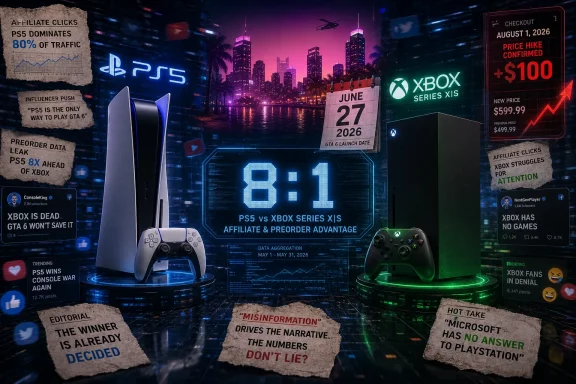
Grand Theft Auto VI preorder chatter turned into a console-war flashpoint on June 27, 2026, after Xbox disputed reports that PlayStation 5 demand was crushing Xbox Series X|S demand by an 8-to-1 margin based on IGN affiliate-link data. The argument is not really about one spreadsheet from one commerce team. It is about how quickly a narrow measurement becomes a market verdict when Xbox is already under pressure. In the week GTA 6 preorders opened, Microsoft found itself fighting not just Sony, but the perception that its hardware business has entered a defensive crouch.
The line from Xbox was blunt: the circulating claim “doesn’t represent pre-order data,” and the company says it has seen “record orders.” That is not the same as publishing a platform split, and Microsoft did not offer its own numbers to replace the viral ones. But the denial matters because it targets the category error at the center of the story: affiliate-link performance is not preorder-market performance.
That distinction can sound pedantic until it becomes the premise for headlines, influencer posts, and console-war victory laps. Affiliate systems track a publication’s outgoing commerce traffic. They do not see every retailer, every console storefront, every regional sales channel, or every digital purchase that bypasses a media site entirely.
IGN’s claim, as described in the reports circulating Friday, was narrower than some of the reposts made it sound. It was based on IGN Finds and commerce-affiliate activity, not on a full industry audit. The problem is that social media strips caveats for parts, and the number that survives is the one with the sharpest edge: 8-to-1.
That edge cuts especially deep because GTA 6 is not just another preorder. Rockstar’s next Grand Theft Auto is the sort of release that can move dormant players, late adopters, and platform fence-sitters. If any game can expose the real gravitational pull of the PS5 and Xbox Series X|S installed bases, it is this one.
A PlayStation-heavy readership will produce PlayStation-heavy clicks. A Windows- and Xbox-leaning site will probably produce more Xbox curiosity than the general gaming public. A deal-hunting audience may overrepresent physical retail links, while players who buy straight through console storefronts disappear from the dataset altogether.
This is why “our links show” is not the same as “the market shows.” It is a measurement of one funnel, not the whole river. The funnel may be real, and it may even point in the same direction as the wider market, but it cannot establish the final ratio without context.
The irony is that the weaker version of the claim is almost certainly plausible. PlayStation 5 has generally enjoyed stronger current-generation console momentum than Xbox Series X|S, and Sony’s platform is likely to produce a larger share of GTA 6 console preorders. But “PlayStation leads” and “PlayStation is crushing Xbox 8-to-1” are not the same claim.
The first is a reasonable expectation based on platform momentum. The second is a specific numerical assertion that requires stronger evidence than affiliate traffic from a single media ecosystem.
For Microsoft, that is uncomfortable timing. Xbox has spent years trying to redefine itself beyond the box, leaning on Game Pass, PC, cloud streaming, and first-party publishing across platforms. That strategy may make long-term business sense, but GTA 6 is a brutally old-fashioned hardware moment: if you want the game at launch on console, you need a PS5 or an Xbox Series X|S.
That is why preorder narratives matter even before they are complete. They tell undecided buyers where the crowd appears to be going. In multiplayer-adjacent culture, the crowd is part of the product, even when the game’s story mode is the immediate draw.
A rumor of overwhelming PlayStation demand can become self-reinforcing. If a player believes most of their friends will be on PS5, they may choose PS5. If retailers expect PS5 demand to dominate, shelf space and promotions can follow. If publishers see a lopsided platform mix, marketing leverage changes.
Xbox knows this. Its response is not merely a defense of statistical hygiene. It is an attempt to prevent a commerce-side datapoint from hardening into market truth before Microsoft, Rockstar, retailers, or platform holders release anything more comprehensive.
The reported U.S. pricing is startling in part because it rewrites the psychological map of the generation. The Xbox Series S, once Microsoft’s low-cost entry point, is moving further away from its original budget identity. The Xbox Series X with a disc drive is headed toward $800, territory that makes “just buy the console for GTA” feel less casual than it once did.
Microsoft has pointed to storage and memory component costs, reportedly saying those costs have increased by more than 2.5 times and may double again by fall 2027. That explanation is not implausible. AI infrastructure demand has distorted memory markets across the tech industry, and consoles are not immune to supply-chain economics.
But consumers do not experience macroeconomics as a bill of materials. They experience it as a checkout page. When a five-year-old console becomes dramatically more expensive just as the generation’s biggest game enters preorder, the justification may be rational while the customer reaction remains furious.
GTA 6 makes that bargain more visible. If the Series S remains the cheapest console capable of playing Rockstar’s new game at launch, then it still has a role. But if the cheapest route keeps getting more expensive, Microsoft loses some of the rhetorical advantage that justified the machine in the first place.
A $100 increase on a budget console is not just a price adjustment. It is a repositioning. The Series S becomes less of an impulse bridge from Xbox One and more of a reluctant compromise for players priced out of the Series X or PS5.
That matters because GTA 6 may be the final great migration trigger for last-generation holdouts. Many players who skipped the early PS5 and Xbox Series years could plausibly wait through cross-gen releases, remasters, live-service games, and PC backlogs. Rockstar’s launch is different: it is a cultural deadline.
If Microsoft wants Xbox One owners to stay in the Xbox ecosystem, the pitch needs to be frictionless. A looming price hike creates the opposite feeling. It tells undecided buyers that the platform is becoming costlier right when they are being asked to commit.
The console business has always been part engineering, part economics, and part theater. Players buy hardware for games, but they also buy into momentum. A platform that looks like the center of gravity can attract more attention simply by appearing inevitable.
Xbox’s problem is that its broader strategy complicates its ability to perform inevitability. Microsoft has spent recent years telling players that Xbox is an ecosystem, not merely a console. That message gives the company flexibility, especially across PC and cloud, but it also softens the emotional case for buying Xbox hardware.
Sony’s message is simpler. If you want the big console blockbusters, buy a PlayStation. That message may be incomplete, and Microsoft’s first-party publishing strength remains formidable, but simplicity wins during mass-market buying moments.
GTA 6 is exactly that kind of moment. It reaches beyond enthusiasts into the audience that buys one or two major games a year. Those players are less likely to parse platform strategy and more likely to follow the loudest signal.
This is the danger of narrative debt. Once a company has accumulated enough unresolved concerns, every new anecdote is treated as evidence of the whole. The burden of proof shifts, and denial sounds defensive even when the denial is technically correct.
Microsoft can fairly object that affiliate links are not real preorder data. It can also be true that the company has a perception problem around Xbox hardware. Those two statements are not in conflict.
The more interesting question is why Xbox is still forced to argue about hardware at all. Microsoft has tried to expand the definition of Xbox beyond consoles, yet the console remains the most visible symbol of the brand’s health. When a Rockstar-scale release approaches, the market drags Xbox back to the box.
That may be unfair, but it is not irrational. Consoles still anchor living-room gaming, digital libraries, subscriptions, accessories, and social graphs. If Xbox hardware looks weak, the rest of the ecosystem has to work harder to look durable.
But record relative to what? Record Xbox preorders for a Rockstar game? Record orders through Microsoft’s own store? Record current-generation demand during a particular preorder window? Without the denominator, the phrase reassures fans more than it informs the market.
That is not unusual. Platform holders rarely rush to publish unflattering splits or granular preorder data. They release numbers when the numbers serve the strategy. In the absence of official data, the vacuum gets filled by retailers, affiliates, analysts, leakers, and screenshots.
The result is a noisy hierarchy of evidence. First-party platform data would be strongest. Major retailer sell-through would be useful. Aggregated market-research data could help. Affiliate traffic from one publisher is interesting, but much weaker.
The public conversation, unfortunately, often reverses that hierarchy. The most shareable number wins first. The better-contextualized number, if it ever arrives, shows up after the narrative has already been minted.
That opacity can distort platform comparisons. Xbox players who buy directly through the console storefront will not show up in a media outlet’s affiliate dashboard. Neither will PS5 players who buy through Sony’s store, of course, but the balance between physical, digital, retailer, and platform-store behavior can vary by audience and region.
There is also a broader shift in what “preorder demand” means. Some players preorder early for bonuses. Some wait for reviews. Some buy digitally the night before launch. Some purchase hardware bundles. Some already know they will play the game but have no reason to commit months ahead of release.
For GTA 6, early preorder activity is less a final sales forecast than an enthusiasm snapshot. The game is too large, too mainstream, and too far from release to assume that week-one preorder ratios will perfectly map to launch-week sales.
Still, snapshots matter. They shape retailer confidence, platform messaging, and public sentiment. Xbox is right to challenge the misuse of the snapshot, but it cannot pretend the snapshot has no political value.
Some of these sources are valuable. None are magical. Each sees a different slice of behavior, and each comes with blind spots that are easy to ignore when the number flatters your preferred platform.
The GTA 6 affiliate-link dust-up is a near-perfect example. The data may accurately describe IGN’s commerce audience. It may even point toward a real PlayStation advantage. But once detached from its source and limitations, it becomes a universal claim about market demand.
That transformation is not accidental. Platforms and fandoms now operate in an attention economy where evidence-shaped content travels faster than evidence. A chart, ratio, or screenshot gives a post the costume of rigor, even when the underlying measurement is narrow.
For IT pros and Windows enthusiasts, the lesson should feel familiar. Administrators know the difference between telemetry, logs, sampling, and a full audit. They know that one dashboard can be truthful and still incomplete. Gaming discourse could use some of that discipline.
Microsoft is very good at platform abstraction. Windows, Azure, Microsoft 365, Game Pass, and Xbox all reflect a company that wants identity and services to float across devices. That approach can be powerful, especially for users who live in multiple form factors.
But consumer hardware still demands a more visceral promise. A console buyer wants to know that the box is worth buying, that the platform has momentum, and that the company will not make them feel foolish for choosing it. Abstraction does not replace confidence.
The GTA 6 moment exposes the tension. Microsoft wants Xbox to be bigger than console sales, but Rockstar’s launch makes console sales feel newly consequential. The public is not asking whether Xbox is a cloud endpoint. It is asking whether people are buying the Xbox version of the biggest game in years.
That is a narrower question than Microsoft prefers, but it is a question the company still has to answer.
The strategic problem is timing and storytelling. Announcing major hardware increases during the GTA 6 preorder window lets every critic connect the dots in the least flattering way possible. Even if the decision was driven by component contracts and global supply realities, the market sees a company raising the cost of admission before the biggest party of the generation.
That can produce a short-term rush as buyers grab remaining inventory at old prices. Windows Central’s own commentary suggested Xbox-linked deals were seeing notable click-through interest, though again that says more about its audience than the whole market. Panic buying is real, but it is not the same as brand strength.
A price hike can temporarily move units while damaging sentiment. That is the paradox Microsoft now has to manage. If Xbox sees “record orders” because players are rushing to beat an August increase, the number is commercially useful but emotionally complicated.
The risk is that Xbox becomes a platform people buy defensively, not aspirationally. They buy now because it will cost more later, not because the ecosystem feels irresistible. That is not the kind of momentum a console maker wants heading into GTA 6.
The concrete lessons are less flattering to everyone involved than a console-war meme would suggest:
For now, the story is a warning about the modern games business. Data fragments travel faster than audited reality, and companies with fragile narratives pay a higher tax on every ambiguity. Xbox can fairly say that affiliate clicks are not preorder data; it now has to prove, through pricing, availability, and player confidence, that the console bearing its name is still more than the defensive choice in the GTA 6 generation.
 Xbox Is Fighting the Story Before the Numbers Exist
The line from Xbox was blunt: the circulating claim “doesn’t represent pre-order data,” and the company says it has seen “record orders.” That is not the same as publishing a platform split, and Microsoft did not offer its own numbers to replace the viral ones. But the denial matters because it targets the category error at the center of the story: affiliate-link performance is not preorder-market performance.That distinction can sound pedantic until it becomes the premise for headlines, influencer posts, and console-war victory laps. Affiliate systems track a publication’s outgoing commerce traffic. They do not see every retailer, every console storefront, every regional sales channel, or every digital purchase that bypasses a media site entirely.
IGN’s claim, as described in the reports circulating Friday, was narrower than some of the reposts made it sound. It was based on IGN Finds and commerce-affiliate activity, not on a full industry audit. The problem is that social media strips caveats for parts, and the number that survives is the one with the sharpest edge: 8-to-1.
That edge cuts especially deep because GTA 6 is not just another preorder. Rockstar’s next Grand Theft Auto is the sort of release that can move dormant players, late adopters, and platform fence-sitters. If any game can expose the real gravitational pull of the PS5 and Xbox Series X|S installed bases, it is this one.
Affiliate Links Measure Audiences, Not Industries
Commerce data is useful. It can tell a publication what its readers click, which retailers convert, which editions generate curiosity, and which price points scare people off. But it is a dangerous proxy for the entire console market because the audience doing the clicking is already filtered before the first purchase intent is recorded.A PlayStation-heavy readership will produce PlayStation-heavy clicks. A Windows- and Xbox-leaning site will probably produce more Xbox curiosity than the general gaming public. A deal-hunting audience may overrepresent physical retail links, while players who buy straight through console storefronts disappear from the dataset altogether.
This is why “our links show” is not the same as “the market shows.” It is a measurement of one funnel, not the whole river. The funnel may be real, and it may even point in the same direction as the wider market, but it cannot establish the final ratio without context.
The irony is that the weaker version of the claim is almost certainly plausible. PlayStation 5 has generally enjoyed stronger current-generation console momentum than Xbox Series X|S, and Sony’s platform is likely to produce a larger share of GTA 6 console preorders. But “PlayStation leads” and “PlayStation is crushing Xbox 8-to-1” are not the same claim.
The first is a reasonable expectation based on platform momentum. The second is a specific numerical assertion that requires stronger evidence than affiliate traffic from a single media ecosystem.
GTA 6 Turns Every Platform Weakness Into a Public Test
Grand Theft Auto VI is scheduled for PlayStation 5 and Xbox Series X|S, with preorders opening on June 25, 2026, ahead of a planned November 19, 2026 launch. That timing turns the summer into a referendum on console readiness. Every pricing decision, bundle strategy, marketing claim, and storefront promotion now sits inside the shadow of Rockstar’s launch.For Microsoft, that is uncomfortable timing. Xbox has spent years trying to redefine itself beyond the box, leaning on Game Pass, PC, cloud streaming, and first-party publishing across platforms. That strategy may make long-term business sense, but GTA 6 is a brutally old-fashioned hardware moment: if you want the game at launch on console, you need a PS5 or an Xbox Series X|S.
That is why preorder narratives matter even before they are complete. They tell undecided buyers where the crowd appears to be going. In multiplayer-adjacent culture, the crowd is part of the product, even when the game’s story mode is the immediate draw.
A rumor of overwhelming PlayStation demand can become self-reinforcing. If a player believes most of their friends will be on PS5, they may choose PS5. If retailers expect PS5 demand to dominate, shelf space and promotions can follow. If publishers see a lopsided platform mix, marketing leverage changes.
Xbox knows this. Its response is not merely a defense of statistical hygiene. It is an attempt to prevent a commerce-side datapoint from hardening into market truth before Microsoft, Rockstar, retailers, or platform holders release anything more comprehensive.
Microsoft Picked a Brutal Week to Raise the Hardware Stakes
The preorder dispute did not land in isolation. It arrived days after Microsoft announced another steep Xbox console price increase, effective August 1, 2026, with 512GB models rising by $100 and 1TB models rising by $150 in the United States. The resulting optics were almost too convenient for Xbox’s critics: GTA 6 preorders open, then Xbox hardware gets more expensive, then a viral post suggests PlayStation demand is running away with the race.The reported U.S. pricing is startling in part because it rewrites the psychological map of the generation. The Xbox Series S, once Microsoft’s low-cost entry point, is moving further away from its original budget identity. The Xbox Series X with a disc drive is headed toward $800, territory that makes “just buy the console for GTA” feel less casual than it once did.
Microsoft has pointed to storage and memory component costs, reportedly saying those costs have increased by more than 2.5 times and may double again by fall 2027. That explanation is not implausible. AI infrastructure demand has distorted memory markets across the tech industry, and consoles are not immune to supply-chain economics.
But consumers do not experience macroeconomics as a bill of materials. They experience it as a checkout page. When a five-year-old console becomes dramatically more expensive just as the generation’s biggest game enters preorder, the justification may be rational while the customer reaction remains furious.
The Series S Was Supposed to Be the Escape Hatch
The Series S has always been Microsoft’s cleverest and most controversial current-generation console. It gave Xbox a lower-cost entry point, a compact digital machine, and a way to tell budget-conscious players that the new generation did not require a premium black monolith under the television. It also created headaches for developers and fueled arguments about whether its lower specs constrained current-generation games.GTA 6 makes that bargain more visible. If the Series S remains the cheapest console capable of playing Rockstar’s new game at launch, then it still has a role. But if the cheapest route keeps getting more expensive, Microsoft loses some of the rhetorical advantage that justified the machine in the first place.
A $100 increase on a budget console is not just a price adjustment. It is a repositioning. The Series S becomes less of an impulse bridge from Xbox One and more of a reluctant compromise for players priced out of the Series X or PS5.
That matters because GTA 6 may be the final great migration trigger for last-generation holdouts. Many players who skipped the early PS5 and Xbox Series years could plausibly wait through cross-gen releases, remasters, live-service games, and PC backlogs. Rockstar’s launch is different: it is a cultural deadline.
If Microsoft wants Xbox One owners to stay in the Xbox ecosystem, the pitch needs to be frictionless. A looming price hike creates the opposite feeling. It tells undecided buyers that the platform is becoming costlier right when they are being asked to commit.
Sony Does Not Need to Win the Argument to Benefit From It
Sony does not have to publish a triumphant preorder ratio for PlayStation to benefit from the current narrative. It only needs the default assumption to remain that GTA 6 is a PlayStation-led event. Marketing language around the game “playing best” on PS5, preorder bonuses, and platform-specific storefront visibility all reinforce that perception.The console business has always been part engineering, part economics, and part theater. Players buy hardware for games, but they also buy into momentum. A platform that looks like the center of gravity can attract more attention simply by appearing inevitable.
Xbox’s problem is that its broader strategy complicates its ability to perform inevitability. Microsoft has spent recent years telling players that Xbox is an ecosystem, not merely a console. That message gives the company flexibility, especially across PC and cloud, but it also softens the emotional case for buying Xbox hardware.
Sony’s message is simpler. If you want the big console blockbusters, buy a PlayStation. That message may be incomplete, and Microsoft’s first-party publishing strength remains formidable, but simplicity wins during mass-market buying moments.
GTA 6 is exactly that kind of moment. It reaches beyond enthusiasts into the audience that buys one or two major games a year. Those players are less likely to parse platform strategy and more likely to follow the loudest signal.
Xbox’s Real Vulnerability Is Not One Bad Ratio
The 8-to-1 figure may be shaky, but the reason it traveled so quickly is that it fit an existing story. Xbox has endured a long cycle of anxious headlines: hardware sales concerns, multiplatform release debates, Game Pass growth questions, studio uncertainty, and now repeated console price increases. A dubious datapoint becomes persuasive when it appears to confirm what people already suspect.This is the danger of narrative debt. Once a company has accumulated enough unresolved concerns, every new anecdote is treated as evidence of the whole. The burden of proof shifts, and denial sounds defensive even when the denial is technically correct.
Microsoft can fairly object that affiliate links are not real preorder data. It can also be true that the company has a perception problem around Xbox hardware. Those two statements are not in conflict.
The more interesting question is why Xbox is still forced to argue about hardware at all. Microsoft has tried to expand the definition of Xbox beyond consoles, yet the console remains the most visible symbol of the brand’s health. When a Rockstar-scale release approaches, the market drags Xbox back to the box.
That may be unfair, but it is not irrational. Consoles still anchor living-room gaming, digital libraries, subscriptions, accessories, and social graphs. If Xbox hardware looks weak, the rest of the ecosystem has to work harder to look durable.
“Record Orders” Needs a Denominator
Xbox’s statement that it has seen record orders is designed to puncture the gloom. It may be accurate. GTA 6 is likely to generate extraordinary demand across every platform where it is available, and “record” can be true even if PlayStation is ahead by a wide margin.But record relative to what? Record Xbox preorders for a Rockstar game? Record orders through Microsoft’s own store? Record current-generation demand during a particular preorder window? Without the denominator, the phrase reassures fans more than it informs the market.
That is not unusual. Platform holders rarely rush to publish unflattering splits or granular preorder data. They release numbers when the numbers serve the strategy. In the absence of official data, the vacuum gets filled by retailers, affiliates, analysts, leakers, and screenshots.
The result is a noisy hierarchy of evidence. First-party platform data would be strongest. Major retailer sell-through would be useful. Aggregated market-research data could help. Affiliate traffic from one publisher is interesting, but much weaker.
The public conversation, unfortunately, often reverses that hierarchy. The most shareable number wins first. The better-contextualized number, if it ever arrives, shows up after the narrative has already been minted.
Digital Buying Makes the Picture Even Murkier
The GTA 6 preorder story is also tangled up in the changing nature of game purchasing. Physical preorders are easier to observe through retailers and commerce links. Digital preorders through PlayStation Store and Microsoft Store are more opaque unless the platform holders disclose them.That opacity can distort platform comparisons. Xbox players who buy directly through the console storefront will not show up in a media outlet’s affiliate dashboard. Neither will PS5 players who buy through Sony’s store, of course, but the balance between physical, digital, retailer, and platform-store behavior can vary by audience and region.
There is also a broader shift in what “preorder demand” means. Some players preorder early for bonuses. Some wait for reviews. Some buy digitally the night before launch. Some purchase hardware bundles. Some already know they will play the game but have no reason to commit months ahead of release.
For GTA 6, early preorder activity is less a final sales forecast than an enthusiasm snapshot. The game is too large, too mainstream, and too far from release to assume that week-one preorder ratios will perfectly map to launch-week sales.
Still, snapshots matter. They shape retailer confidence, platform messaging, and public sentiment. Xbox is right to challenge the misuse of the snapshot, but it cannot pretend the snapshot has no political value.
The Console War Has Become a Data-Literacy Problem
The old console war was fought with exclusives, frame-rate comparisons, and sales milestones. The new one is fought with partial datasets. Circana snippets, Steam charts, achievement percentages, leaked documents, regional rankings, retailer pages, affiliate dashboards, and social-media polls all become ammunition.Some of these sources are valuable. None are magical. Each sees a different slice of behavior, and each comes with blind spots that are easy to ignore when the number flatters your preferred platform.
The GTA 6 affiliate-link dust-up is a near-perfect example. The data may accurately describe IGN’s commerce audience. It may even point toward a real PlayStation advantage. But once detached from its source and limitations, it becomes a universal claim about market demand.
That transformation is not accidental. Platforms and fandoms now operate in an attention economy where evidence-shaped content travels faster than evidence. A chart, ratio, or screenshot gives a post the costume of rigor, even when the underlying measurement is narrow.
For IT pros and Windows enthusiasts, the lesson should feel familiar. Administrators know the difference between telemetry, logs, sampling, and a full audit. They know that one dashboard can be truthful and still incomplete. Gaming discourse could use some of that discipline.
Windows Readers Should Care Because This Is Microsoft’s Consumer Edge
It is tempting for WindowsForum readers to treat console drama as a parallel universe of fandom noise. But Xbox remains one of Microsoft’s most important consumer brands, and its struggles say something about how the company handles hardware, services, ecosystems, and messaging under pressure.Microsoft is very good at platform abstraction. Windows, Azure, Microsoft 365, Game Pass, and Xbox all reflect a company that wants identity and services to float across devices. That approach can be powerful, especially for users who live in multiple form factors.
But consumer hardware still demands a more visceral promise. A console buyer wants to know that the box is worth buying, that the platform has momentum, and that the company will not make them feel foolish for choosing it. Abstraction does not replace confidence.
The GTA 6 moment exposes the tension. Microsoft wants Xbox to be bigger than console sales, but Rockstar’s launch makes console sales feel newly consequential. The public is not asking whether Xbox is a cloud endpoint. It is asking whether people are buying the Xbox version of the biggest game in years.
That is a narrower question than Microsoft prefers, but it is a question the company still has to answer.
Price Hikes Are Rational Until They Break the Story
There is a defensible business case for raising console prices if component costs have truly surged. Selling hardware at a loss is not a moral obligation, and Microsoft is not immune to memory pricing simply because it is Microsoft. If supply-chain costs are punishing enough, price increases may be unavoidable.The strategic problem is timing and storytelling. Announcing major hardware increases during the GTA 6 preorder window lets every critic connect the dots in the least flattering way possible. Even if the decision was driven by component contracts and global supply realities, the market sees a company raising the cost of admission before the biggest party of the generation.
That can produce a short-term rush as buyers grab remaining inventory at old prices. Windows Central’s own commentary suggested Xbox-linked deals were seeing notable click-through interest, though again that says more about its audience than the whole market. Panic buying is real, but it is not the same as brand strength.
A price hike can temporarily move units while damaging sentiment. That is the paradox Microsoft now has to manage. If Xbox sees “record orders” because players are rushing to beat an August increase, the number is commercially useful but emotionally complicated.
The risk is that Xbox becomes a platform people buy defensively, not aspirationally. They buy now because it will cost more later, not because the ecosystem feels irresistible. That is not the kind of momentum a console maker wants heading into GTA 6.
The GTA 6 Preorder Fight Leaves Microsoft With Fewer Places to Hide
The immediate dispute is narrow: affiliate-link data should not be treated as definitive preorder data. On that point, Xbox is right. But the broader pressure on Microsoft is real, and dismissing the viral ratio does not dismiss the market anxiety that made it believable.The concrete lessons are less flattering to everyone involved than a console-war meme would suggest:
- Affiliate-link performance can reveal a publication’s commerce behavior, but it cannot establish total platform preorder demand across retailers and digital storefronts.
- PlayStation may still lead GTA 6 preorders substantially, but the specific 8-to-1 claim needs stronger evidence than a single affiliate dataset.
- Xbox’s “record orders” response is meaningful as a rebuttal, but it remains incomplete without public numbers or a clear comparison point.
- Microsoft’s August 1, 2026 console price increases make every Xbox hardware narrative more combustible during the GTA 6 preorder cycle.
- GTA 6 is likely to function as a late-generation hardware catalyst for PS4 and Xbox One holdouts, which makes pricing and perception unusually important.
- The most honest read is that Xbox won the data-literacy argument while still facing the harder platform-momentum argument.
Rockstar’s Launch Will Decide More Than a Preorder Ratio
By November, the argument over one affiliate dataset may look quaint. GTA 6 will produce real launch behavior: console sales, digital-store rankings, retailer inventory swings, social migration, and months of post-launch engagement. That is when the market will give a clearer answer, even if the platform holders still disclose only the numbers that suit them.For now, the story is a warning about the modern games business. Data fragments travel faster than audited reality, and companies with fragile narratives pay a higher tax on every ambiguity. Xbox can fairly say that affiliate clicks are not preorder data; it now has to prove, through pricing, availability, and player confidence, that the console bearing its name is still more than the defensive choice in the GTA 6 generation.
References
- Primary source: Windows Central
Published: 2026-06-27T14:20:13.108570
"This doesn’t represent pre-order data," Xbox disputes reports of PS5 crushing GTA 6 preorder demand | Windows Central
As rumors of a massive sales gap circulate, Xbox sets the record straight on why affiliate clicks are not the same as console sales.www.windowscentral.com - Related coverage: techradar.com
PlayStation says 'GTA 6 plays best on PS5' and is giving fans a freebie if they pre-order on the PS Store | TechRadar
Rockstar Games has teamed up with Sony to offer Grand Theft Auto 6 fans a free month of GTA+ if they pre-order the game on PS5.www.techradar.com - Related coverage: techrepublic.com
Xbox Console Prices Rise Again as Microsoft Cites Memory Costs - TechRepublic
Microsoft is raising Xbox console prices worldwide on August 1 as memory and storage costs climb, with the Xbox Series X reaching $800.www.techrepublic.com
- Related coverage: techspot.com
The third Xbox price hike in 15 months raises all models by at least $100 | TechSpot
Mere days after reports of mass layoffs at Microsoft-owned game development studios, things have gone from bad to worse for Xbox. In a few weeks, the company's...www.techspot.com - Related coverage: techcrunch.com
Xbox follows Apple with price increases | TechCrunch
The company says the increases are being driven by rising memory and console storage prices, with costs more than 2.5x higher than previous levels.techcrunch.com - Related coverage: rockstarintel.com
Xbox says they've had record Pre-orders for GTA6 - RockstarINTEL
Xbox has issued a statement around GTA 6 selling better on PS5 than Xbox. Microsoft have also said they've had record preordersrockstarintel.com
- Related coverage: dotesports.com
Xbox raises prices by up to $150 amid memory cost crisis
Xbox console prices are increasing by up to $150 from August 1, 2026, as memory costs soar. The 2TB model is also being discontinued.dotesports.com - Related coverage: en.as.com
Xbox Series X|S prices rise again as Microsoft confirms major hike for August - Meristation
Xbox confirms a major price hike for Series X and Series S consoles starting August 1 due to global AI component shortages. Read the new price list.en.as.com - Related coverage: tech.yahoo.com
Xbox pushes back on claims that PS5 is dominating GTA 6 preorders, saying the numbers don’t reflect real preorder data
Xbox clarifies that affiliate links aren't sales data, refuting viral claims of PS5's 8-to-1 lead in GTA 6 preordertech.yahoo.com - Related coverage: smartprix.com
Xbox Series S And Series X Prices Are Going Up By Up To $150 From August 1, 2026 - Smartprix
Hours after Apple announced the price hike for its products (except the iPhone), Microsoft did something similar. The company confirms that Xbox console prices will rise worldwide from August 1, 2026, something I wish Apple had done, as it would have given prospective buyers some time to get the... www.smartprix.com
- Related coverage: t3.com
Grand Theft Auto VI pre-orders open for PS5 and Xbox next week, with pricing details imminent | T3
You'll be able to pre-order GTA 6 in just a few days timewww.t3.com - Related coverage: los40.com
Xbox sube sus precios de forma histórica y es la que faltaba para certificar que jugar a la consola se va a convertir en un lujo | Dispositivos | LOS40
Playstation subió. Nintendo subió. Hoy le toca a Microsoft.los40.com - Related coverage: as.com
