

Grand Theft Auto VI developers at Rockstar Games are reportedly pursuing union recognition through the Independent Workers’ Union of Great Britain ahead of the game’s November 19, 2026 launch on PlayStation 5 and Xbox Series X|S. The move turns the most commercially anticipated game release of the decade into a test of whether blockbuster economics can still coexist with precarious labor. Rockstar and parent company Take-Two are selling confidence to investors and players; some workers are trying to buy security before the credits roll.
Rockstar’s problem is not that Grand Theft Auto VI might fail. The problem is that even runaway success no longer guarantees stability for the people who make the thing being celebrated.
That is why the union push matters. It arrives not as a protest from a struggling studio, but from within the machinery of one of entertainment’s most profitable franchises. If developers believe they need collective protection before a product as enormous as GTA 6 ships, that says something brutal about the modern games business.
The timing is especially pointed. Pre-orders for Grand Theft Auto VI opened in late June 2026, with Rockstar listing a $79.99 standard edition and a November 19 release date. That date now functions as more than a launch target; it is a market signal, a publishing calendar anchor, and a deadline around which competitors, retailers, console makers, and investors are organizing their year.
For workers, though, the date may look different. A major launch is often the moment when leverage evaporates.
That pattern is not limited to contractors or temporary production roles. Full-time developers, support teams, community staff, QA workers, writers, artists, and operations workers have all been caught in the wider wave of layoffs that followed the pandemic-era expansion of the industry. The recurring lesson has been grim: being attached to a successful product does not necessarily protect a worker from being treated as a temporary cost center.
This is the context in which Rockstar employees are reportedly organizing. The argument is not merely about pay, or even about working conditions in the narrow sense. It is about whether workers can establish durable rights before the company’s need for their labor sharply declines.
Unionization changes that equation. It can force management to negotiate over redundancies, discipline, consultation processes, severance, scheduling, and workplace policy. It does not make layoffs impossible, but it can make them less arbitrary and more expensive to execute without scrutiny.
That is precisely why the fight is surfacing before launch rather than after it.
That scale cuts both ways. On one hand, Rockstar can plausibly argue that secrecy, discipline, and production control are unusually important for a release of this magnitude. On the other hand, workers and unions can argue that a company sitting on one of entertainment’s most lucrative properties has fewer excuses for instability than almost anyone else.
The reported IWGB position is straightforward: if GTA 6 is already generating enormous commercial momentum, Rockstar can afford to negotiate with the people whose work created it. That argument has force because it meets management on its own terrain. This is not a plea made in the shadow of failure; it is a demand made in the glare of expected success.
The allegation that GTA 6 pre-orders have produced billions in sales should be treated carefully unless Take-Two confirms the figure. But the broader commercial point does not depend on accepting every headline number. Rockstar’s launch is expected to be one of the defining entertainment releases of 2026, and the labor dispute now sits inside that expectation.
That makes it harder for management to frame unionization as a distraction. For workers, it is a question of who shares in the stability created by the blockbuster economy.
That distinction will matter legally, but it already matters politically. In one version of events, Rockstar acted to protect sensitive commercial material after one of the most leak-prone development cycles in gaming history. In the other, a powerful employer used confidentiality as a pretext to remove union supporters before they could build momentum.
The truth may turn on specific facts that are not public: what was said, where it was said, who had access, what policies applied, and whether enforcement was consistent. But labor disputes often become public battles long before tribunals or courts settle those details. In that arena, timing and pattern are part of the argument.
The employment tribunal development reported this summer gives the workers’ case room to proceed on claims including alleged blacklisting connected to union activity. That is not the same as a final ruling that Rockstar broke the law. It does, however, mean the dispute is not disappearing into the usual fog of corporate HR statements.
For Rockstar, that is a reputational problem arriving at the worst possible time. The company wants the conversation around GTA 6 to be about Vice City, trailers, editions, and release-day dominance. Instead, part of the conversation is now about whether the people who built the game can organize without retaliation.
That distinction matters for Rockstar. A company can decline voluntary recognition and still face a statutory recognition route if workers and a union meet the relevant thresholds. The employer’s preference is not the whole story.
This is one reason the Rockstar dispute has significance beyond one studio. The UK games industry has historically lagged behind some other sectors in formal workplace unionization, even as it has relied on highly skilled labor, intense production schedules, and global revenue streams. If a prominent studio’s workforce can push recognition into the open, others will study the mechanics.
The symbolism is already changing. ZA/UM’s UK workers unionized in 2025, marking a notable step for organized labor in British game development. In North America, union activity has advanced inside Microsoft-owned game studios through the Communications Workers of America, including teams associated with Raven Software, Blizzard, and id Software.
Rockstar is therefore not an isolated spark. It is part of a broader labor map forming across an industry that once treated unionization as culturally alien.
Microsoft’s gaming workforce has become one of the most visible examples. The company’s labor neutrality commitments and subsequent recognition of several union groups changed the risk calculation for workers elsewhere. It showed that major publishers can operate with unionized game employees, even if management would rather not make that the default.
That does not mean unionized studios are immune from layoffs. They are not. Reports of potential cuts or closures at some Microsoft-owned teams underscore the limits of collective bargaining in a consolidating industry. A union cannot make a parent company love every subsidiary, and it cannot repeal the economics of expensive development pipelines.
But it can change the process. It can give workers information, representation, and bargaining power they would not have as isolated employees waiting for a calendar invite from HR. In a volatile sector, that procedural power is not cosmetic; it is often the difference between being notified and being negotiated with.
This is the lesson Rockstar employees appear to be acting on. The goal is not to prove that GTA 6 will save every job. The goal is to prevent the launch from becoming the moment when management holds all the cards.
That is the strongest version of Rockstar’s case. If employees shared sensitive game information in a public forum, management will argue that dismissal was about protecting the product, not suppressing labor activity. In an industry where leaks can damage marketing plans, expose unfinished work, and create security risks, confidentiality rules are not inherently anti-worker.
But that argument becomes dangerous when confidentiality is stretched to cover ordinary organizing. Workers often need to discuss pay, workloads, management behavior, job security, and workplace conditions. If an employer can characterize too much of that discussion as impermissible because it touches internal operations, union rights become theoretical.
This is where tribunals and labor boards matter. They are forced to separate legitimate trade-secret protection from policies that function as gag orders. In modern digital workplaces, that line can be blurry, especially when workers organize across offices, countries, and online spaces.
Rockstar’s challenge is to defend its confidentiality rationale without appearing to criminalize the ordinary conversations that make collective action possible. The IWGB’s challenge is to show that the dismissed workers were targeted because of union activity, not because of genuine misconduct. The result will shape how other studios draft, enforce, and weaponize their own policies.
That gap is not unique to Rockstar. Every major entertainment product asks consumers to enjoy the finished work without thinking too hard about the industrial process behind it. Games make that easier because the labor is hidden inside code, art, animation, systems design, QA passes, localization, infrastructure, and live-service planning.
But labor disputes pierce that illusion. Once fired workers, union organizers, and legal proceedings enter the public conversation, the game can no longer be only a product. It becomes evidence of a production model.
That does not mean players must boycott, nor does it mean every purchase is a moral referendum. The relationship between consumer action and worker power is rarely that simple. But it does mean players should resist the lazy idea that commercial success automatically vindicates management.
A great game can come from a troubled workplace. A profitable studio can still treat workers badly. A beloved franchise can still depend on labor practices that deserve scrutiny.
Labor conflict introduces a different kind of uncertainty. It does not necessarily threaten launch day, and there is no public evidence that union organizing will delay the game. But it complicates the clean investor narrative that Rockstar is simply moving toward a record-breaking release.
Public companies dislike complications that sit outside their preferred metrics. Unit sales, bookings, recurrent consumer spending, and release calendars are comfortable topics. Alleged union busting, blacklisting claims, and tribunal proceedings are not.
The irony is that Take-Two’s own confidence strengthens the workers’ moral case. If GTA 6 is positioned as the release that will define the company’s fiscal story, workers can reasonably ask why that success should not translate into stable conditions and a formal voice. The larger the expected windfall, the less persuasive austerity becomes.
This is why the union fight has resonance even for people who never follow labor law. It asks whether the people closest to the value creation are allowed to bargain over the risks created by the same business model.
That risk is credible because the industry has repeatedly shown that success is not a shield. Studios have laid off workers after acclaimed releases, after profitable periods, after acquisitions, and after expansion plans failed to meet executive expectations. The logic is not always tied to whether a game worked; it is tied to the next forecast.
AAA development makes this worse. The staffing curve for a giant game can swell around production milestones and then become vulnerable once the launch phase ends. When a title shifts from development to live operations, the company’s labor needs change, and workers without bargaining power are exposed to management’s preferred version of efficiency.
Rockstar may have future projects, ongoing GTA Online plans, and internal needs that keep many employees busy. But that does not erase the structural fear. Workers have watched enough peers across the industry discover that “record engagement” and “difficult restructuring decision” can appear in the same corporate year.
Unionization is a rational response to that contradiction. It is not panic; it is memory.
Rockstar occupies a strange place in that mythology. It is both a prestige studio and a corporate asset, both secretive creative shop and central pillar of Take-Two’s market value. Its products are authored enough to feel culturally distinct, but industrial enough to require thousands of people across many specialties.
That scale makes old language feel inadequate. A family does not need statutory recognition. A dream factory does not usually retain lawyers for an employment tribunal. A creative tribe does not fire dozens of members and then dispute whether their organizing activity mattered.
Workers are responding by adopting the vocabulary of power rather than belonging. Recognition, bargaining, unfair treatment, blacklisting, redundancy consultation: these are not romantic words, but they are the words that govern what happens when the romance ends.
The games industry is growing up, and it is discovering that adulthood comes with labor relations.
Once GTA 6 launches, the company will have hard numbers. It will have sell-through data, engagement data, subscription conversion data, and investor expectations for the next phase. Those numbers will shape decisions about staffing, budgets, bonuses, and priorities.
Workers know this. They also know that waiting until after launch means negotiating from a weaker position. The closer a game gets to release, the more essential workers are. The farther the launch recedes, the easier it becomes for management to describe them as excess capacity.
That is why organizing ahead of release is strategically important. It attempts to lock in a collective structure while the workforce’s contribution is still impossible to deny. It says the people who built the blockbuster should not have to wait for the blockbuster to pass before asking for security.
If that logic spreads, it could alter the rhythm of labor organizing in games. Instead of union drives emerging only after crisis, more workers may organize during the high-leverage phase before launch.
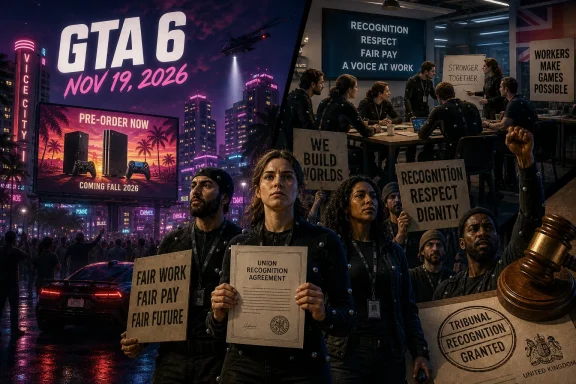 GTA 6 Turns Labor Risk Into Launch-Day Business
Rockstar’s problem is not that Grand Theft Auto VI might fail. The problem is that even runaway success no longer guarantees stability for the people who make the thing being celebrated.That is why the union push matters. It arrives not as a protest from a struggling studio, but from within the machinery of one of entertainment’s most profitable franchises. If developers believe they need collective protection before a product as enormous as GTA 6 ships, that says something brutal about the modern games business.
The timing is especially pointed. Pre-orders for Grand Theft Auto VI opened in late June 2026, with Rockstar listing a $79.99 standard edition and a November 19 release date. That date now functions as more than a launch target; it is a market signal, a publishing calendar anchor, and a deadline around which competitors, retailers, console makers, and investors are organizing their year.
For workers, though, the date may look different. A major launch is often the moment when leverage evaporates.
The Industry Built a Boom Machine and Called the Bust Normal
The games industry has spent years treating post-launch contraction as ordinary business hygiene. Hire aggressively, sprint toward certification, push marketing and QA over the line, then “right-size” once the immediate production pressure fades. The euphemisms change, but the pattern is familiar.That pattern is not limited to contractors or temporary production roles. Full-time developers, support teams, community staff, QA workers, writers, artists, and operations workers have all been caught in the wider wave of layoffs that followed the pandemic-era expansion of the industry. The recurring lesson has been grim: being attached to a successful product does not necessarily protect a worker from being treated as a temporary cost center.
This is the context in which Rockstar employees are reportedly organizing. The argument is not merely about pay, or even about working conditions in the narrow sense. It is about whether workers can establish durable rights before the company’s need for their labor sharply declines.
Unionization changes that equation. It can force management to negotiate over redundancies, discipline, consultation processes, severance, scheduling, and workplace policy. It does not make layoffs impossible, but it can make them less arbitrary and more expensive to execute without scrutiny.
That is precisely why the fight is surfacing before launch rather than after it.
Rockstar’s Commercial Gravity Makes the Labor Fight Harder to Ignore
There are many studios where a union drive would be dismissed as a niche workplace story. Rockstar is not one of them. Grand Theft Auto is not just another gaming franchise; it is a cultural platform, a recurring economic event, and one of Take-Two’s most valuable assets.That scale cuts both ways. On one hand, Rockstar can plausibly argue that secrecy, discipline, and production control are unusually important for a release of this magnitude. On the other hand, workers and unions can argue that a company sitting on one of entertainment’s most lucrative properties has fewer excuses for instability than almost anyone else.
The reported IWGB position is straightforward: if GTA 6 is already generating enormous commercial momentum, Rockstar can afford to negotiate with the people whose work created it. That argument has force because it meets management on its own terrain. This is not a plea made in the shadow of failure; it is a demand made in the glare of expected success.
The allegation that GTA 6 pre-orders have produced billions in sales should be treated carefully unless Take-Two confirms the figure. But the broader commercial point does not depend on accepting every headline number. Rockstar’s launch is expected to be one of the defining entertainment releases of 2026, and the labor dispute now sits inside that expectation.
That makes it harder for management to frame unionization as a distraction. For workers, it is a question of who shares in the stability created by the blockbuster economy.
The Firings Turned a Quiet Organizing Drive Into a Public Test Case
Rockstar’s labor dispute escalated sharply after the company fired more than 30 employees in October 2025 across UK and Canadian operations. The IWGB characterized the dismissals as union busting and said the affected workers were involved in union activity. Rockstar denied that account and said the employees were dismissed for discussing confidential information in public channels, including information related to upcoming games.That distinction will matter legally, but it already matters politically. In one version of events, Rockstar acted to protect sensitive commercial material after one of the most leak-prone development cycles in gaming history. In the other, a powerful employer used confidentiality as a pretext to remove union supporters before they could build momentum.
The truth may turn on specific facts that are not public: what was said, where it was said, who had access, what policies applied, and whether enforcement was consistent. But labor disputes often become public battles long before tribunals or courts settle those details. In that arena, timing and pattern are part of the argument.
The employment tribunal development reported this summer gives the workers’ case room to proceed on claims including alleged blacklisting connected to union activity. That is not the same as a final ruling that Rockstar broke the law. It does, however, mean the dispute is not disappearing into the usual fog of corporate HR statements.
For Rockstar, that is a reputational problem arriving at the worst possible time. The company wants the conversation around GTA 6 to be about Vice City, trailers, editions, and release-day dominance. Instead, part of the conversation is now about whether the people who built the game can organize without retaliation.
UK Labor Law Gives Workers a Path Even Without a Friendly Employer
The UK setting is important because the law gives workers rights around union membership and activity even when an employer does not voluntarily embrace a union. Workers have the right to join a trade union, and employers are restricted from treating workers unfairly because of union activity. Formal recognition is a separate question, but refusal to recognize a union voluntarily is not the end of the process.That distinction matters for Rockstar. A company can decline voluntary recognition and still face a statutory recognition route if workers and a union meet the relevant thresholds. The employer’s preference is not the whole story.
This is one reason the Rockstar dispute has significance beyond one studio. The UK games industry has historically lagged behind some other sectors in formal workplace unionization, even as it has relied on highly skilled labor, intense production schedules, and global revenue streams. If a prominent studio’s workforce can push recognition into the open, others will study the mechanics.
The symbolism is already changing. ZA/UM’s UK workers unionized in 2025, marking a notable step for organized labor in British game development. In North America, union activity has advanced inside Microsoft-owned game studios through the Communications Workers of America, including teams associated with Raven Software, Blizzard, and id Software.
Rockstar is therefore not an isolated spark. It is part of a broader labor map forming across an industry that once treated unionization as culturally alien.
Microsoft’s Game Studios Show Why Recognition Is No Longer Unthinkable
For years, the games industry’s anti-union argument relied on inevitability: unions were supposedly incompatible with creative production, rapid iteration, and studio culture. That argument has weakened as more game workers have organized without the sky falling.Microsoft’s gaming workforce has become one of the most visible examples. The company’s labor neutrality commitments and subsequent recognition of several union groups changed the risk calculation for workers elsewhere. It showed that major publishers can operate with unionized game employees, even if management would rather not make that the default.
That does not mean unionized studios are immune from layoffs. They are not. Reports of potential cuts or closures at some Microsoft-owned teams underscore the limits of collective bargaining in a consolidating industry. A union cannot make a parent company love every subsidiary, and it cannot repeal the economics of expensive development pipelines.
But it can change the process. It can give workers information, representation, and bargaining power they would not have as isolated employees waiting for a calendar invite from HR. In a volatile sector, that procedural power is not cosmetic; it is often the difference between being notified and being negotiated with.
This is the lesson Rockstar employees appear to be acting on. The goal is not to prove that GTA 6 will save every job. The goal is to prevent the launch from becoming the moment when management holds all the cards.
The Confidentiality Argument Is Stronger at Rockstar — and More Dangerous
Rockstar has a real confidentiality interest. Few entertainment products are scrutinized as intensely as Grand Theft Auto VI, and the company has already endured major leaks in the game’s development cycle. A studio making GTA 6 cannot operate like an ordinary workplace chat room with no boundaries around unreleased material.That is the strongest version of Rockstar’s case. If employees shared sensitive game information in a public forum, management will argue that dismissal was about protecting the product, not suppressing labor activity. In an industry where leaks can damage marketing plans, expose unfinished work, and create security risks, confidentiality rules are not inherently anti-worker.
But that argument becomes dangerous when confidentiality is stretched to cover ordinary organizing. Workers often need to discuss pay, workloads, management behavior, job security, and workplace conditions. If an employer can characterize too much of that discussion as impermissible because it touches internal operations, union rights become theoretical.
This is where tribunals and labor boards matter. They are forced to separate legitimate trade-secret protection from policies that function as gag orders. In modern digital workplaces, that line can be blurry, especially when workers organize across offices, countries, and online spaces.
Rockstar’s challenge is to defend its confidentiality rationale without appearing to criminalize the ordinary conversations that make collective action possible. The IWGB’s challenge is to show that the dismissed workers were targeted because of union activity, not because of genuine misconduct. The result will shape how other studios draft, enforce, and weaponize their own policies.
Players Are Being Asked to Separate the Game From the System That Made It
There is an uncomfortable gap between how players experience GTA 6 and how workers experience its production. For players, the game is spectacle: a return to Vice City, a technical showcase, a cultural event. For workers, it may also be years of crunch pressure, secrecy, internal discipline, and anxiety about what happens when the launch frenzy ends.That gap is not unique to Rockstar. Every major entertainment product asks consumers to enjoy the finished work without thinking too hard about the industrial process behind it. Games make that easier because the labor is hidden inside code, art, animation, systems design, QA passes, localization, infrastructure, and live-service planning.
But labor disputes pierce that illusion. Once fired workers, union organizers, and legal proceedings enter the public conversation, the game can no longer be only a product. It becomes evidence of a production model.
That does not mean players must boycott, nor does it mean every purchase is a moral referendum. The relationship between consumer action and worker power is rarely that simple. But it does mean players should resist the lazy idea that commercial success automatically vindicates management.
A great game can come from a troubled workplace. A profitable studio can still treat workers badly. A beloved franchise can still depend on labor practices that deserve scrutiny.
Take-Two’s Investor Story Now Has a Labor Footnote It Cannot Delete
Take-Two wants GTA 6 to communicate certainty. Pre-orders, edition pricing, marketing beats, and reaffirmed launch timing all serve that purpose. After delays, the company needs investors to believe the runway is stable.Labor conflict introduces a different kind of uncertainty. It does not necessarily threaten launch day, and there is no public evidence that union organizing will delay the game. But it complicates the clean investor narrative that Rockstar is simply moving toward a record-breaking release.
Public companies dislike complications that sit outside their preferred metrics. Unit sales, bookings, recurrent consumer spending, and release calendars are comfortable topics. Alleged union busting, blacklisting claims, and tribunal proceedings are not.
The irony is that Take-Two’s own confidence strengthens the workers’ moral case. If GTA 6 is positioned as the release that will define the company’s fiscal story, workers can reasonably ask why that success should not translate into stable conditions and a formal voice. The larger the expected windfall, the less persuasive austerity becomes.
This is why the union fight has resonance even for people who never follow labor law. It asks whether the people closest to the value creation are allowed to bargain over the risks created by the same business model.
The Post-Launch Layoff Fear Is Rational Because the Industry Keeps Proving It Rational
Skeptics may argue that fears of post-launch layoffs at Rockstar are speculative. They are right in the narrow sense: unless Rockstar announces cuts, no one should state as fact that mass layoffs are certain after GTA 6. But workers do not organize only against announced decisions; they organize against credible risk.That risk is credible because the industry has repeatedly shown that success is not a shield. Studios have laid off workers after acclaimed releases, after profitable periods, after acquisitions, and after expansion plans failed to meet executive expectations. The logic is not always tied to whether a game worked; it is tied to the next forecast.
AAA development makes this worse. The staffing curve for a giant game can swell around production milestones and then become vulnerable once the launch phase ends. When a title shifts from development to live operations, the company’s labor needs change, and workers without bargaining power are exposed to management’s preferred version of efficiency.
Rockstar may have future projects, ongoing GTA Online plans, and internal needs that keep many employees busy. But that does not erase the structural fear. Workers have watched enough peers across the industry discover that “record engagement” and “difficult restructuring decision” can appear in the same corporate year.
Unionization is a rational response to that contradiction. It is not panic; it is memory.
The Old Studio Myth Is Breaking Under Its Own Weight
Game studios have long sold themselves as families, dream factories, pirate ships, and creative tribes. That mythology was useful when workers were younger, less organized, and more willing to trade stability for proximity to famous franchises. It becomes less convincing when the industry matures into a multibillion-dollar corporate sector with public shareholders and recurring layoffs.Rockstar occupies a strange place in that mythology. It is both a prestige studio and a corporate asset, both secretive creative shop and central pillar of Take-Two’s market value. Its products are authored enough to feel culturally distinct, but industrial enough to require thousands of people across many specialties.
That scale makes old language feel inadequate. A family does not need statutory recognition. A dream factory does not usually retain lawyers for an employment tribunal. A creative tribe does not fire dozens of members and then dispute whether their organizing activity mattered.
Workers are responding by adopting the vocabulary of power rather than belonging. Recognition, bargaining, unfair treatment, blacklisting, redundancy consultation: these are not romantic words, but they are the words that govern what happens when the romance ends.
The games industry is growing up, and it is discovering that adulthood comes with labor relations.
The Real Test Is Whether Success Can Be Shared Before It Is Measured
The Rockstar union story is not only about workers protecting themselves from possible layoffs. It is about timing: whether employees can claim a voice before management converts their labor into quarterly performance.Once GTA 6 launches, the company will have hard numbers. It will have sell-through data, engagement data, subscription conversion data, and investor expectations for the next phase. Those numbers will shape decisions about staffing, budgets, bonuses, and priorities.
Workers know this. They also know that waiting until after launch means negotiating from a weaker position. The closer a game gets to release, the more essential workers are. The farther the launch recedes, the easier it becomes for management to describe them as excess capacity.
That is why organizing ahead of release is strategically important. It attempts to lock in a collective structure while the workforce’s contribution is still impossible to deny. It says the people who built the blockbuster should not have to wait for the blockbuster to pass before asking for security.
If that logic spreads, it could alter the rhythm of labor organizing in games. Instead of union drives emerging only after crisis, more workers may organize during the high-leverage phase before launch.
Vice City’s Brightest Neon Now Illuminates the Shop Floor
The concrete lessons from Rockstar’s union fight are already visible, even before the legal and recognition questions are settled. This is not a side story to GTA 6; it is part of the business reality surrounding the most watched game launch of 2026.- Grand Theft Auto VI is scheduled to launch on November 19, 2026, for PlayStation 5 and Xbox Series X|S, with pre-orders already open.
- Rockstar workers are reportedly seeking union recognition through the Independent Workers’ Union of Great Britain before the launch window closes their leverage.
- Rockstar denies union-busting allegations and says the 2025 dismissals involved breaches of confidentiality, while the union argues the workers were targeted for organizing.
- The UK legal process is now part of the story, with workers pursuing claims that include alleged blacklisting tied to union activity.
- The dispute reflects a wider games-industry shift in which workers at major studios increasingly view unions as a practical response to layoffs, crunch, and unstable production cycles.
- The commercial scale of GTA 6 makes the labor fight harder to dismiss, because expected success weakens the argument that worker security is unaffordable.
References
- Primary source: Windows Central
Published: 2026-06-30T22:20:39.741187
"Rockstar bosses can easily afford to sit around the table with the people whose hard work created these games": GTA 6 developers are looking to unionize before potential post-launch layoffs | Windows Central
As the threat of layoffs looms over the gaming industry like a dark cloud, the makers behind Grand Theft Auto are seeking to secure unionization before the game's November release.www.windowscentral.com - Related coverage: gamesradar.com
Fired GTA 6 developer accusing Rockstar Games of union busting says playing the blockbuster will "probably just bring back too much" | GamesRadar+
I definitely don't think I will buy it. I don't think I'll be able to bring myself to, personallywww.gamesradar.com - Related coverage: t3.com
GTA 6 pre-orders open now – here's where to buy Grand Theft Auto VI for PS5 or Xbox and full pricing details | T3
GTA 6 is available to order right now – here are all the details you need, including prices, stockists and editionswww.t3.com - Related coverage: techradar.com
GTA 6 isn't coming to PC on day one, so grab this PS5 at £130 off now before Prime Day comes to a close | TechRadar
The clock is tickingwww.techradar.com - Related coverage: taketwointeractivesoftwareinc.gcs-web.com
Rockstar Games Announces Pre-Orders for Grand Theft Auto VI | Take-Two Interactive Software, Inc.
Starting at Midnight Local Time on June 25, 2026 NEW YORK --(BUSINESS WIRE)--Jun. 24, 2026-- Rockstar Games ®, a publishing label of Take-Two Interactive Software, Inc. (NASDAQ: TTWO), is excited to announce that pre-orders for Grand Theft Auto VI will begin on June 25, 2026, at midnight localtaketwointeractivesoftwareinc.gcs-web.com - Related coverage: techspot.com
Rockstar says employees were fired for leaking secrets, not for trying to unionize | TechSpot
Reports emerged last week that Rockstar Games had fired between 30 and 40 staff across its UK and Canada offices on October 30.www.techspot.com
- Related coverage: investorideas.com
Take-Two Opens Grand Theft Auto VI Pre-Orders, Locking In a November Launch | InvestorIdeas
Take-Two opens GTA VI pre-orders ahead of a November 19, 2026 launch at $79.99, guiding fiscal-2027 net bookings to $8.0B-$8.2B. Analyst targets range from $280 to $368.www.investorideas.com - Related coverage: gematsu.com
- Related coverage: gaming.net
Rockstar Opens GTA 6 Pre-Orders and Locks November Launch – Gaming.net
Rockstar Games has finally put a transaction date on the industry’s most anticipated game. On June 18, 2026, the studio said pre-orders for Grand Theft Auto VI will open on June 25, 2026 across digital storefronts and select retailers — and in doing so all but guaranteed that the...www.gaming.net
- Related coverage: gamespot.com
GTA 6 Dev Says It Fired Workers For Leaking Secrets, Not For Trying To Unionize - GameSpot
Rockstar fired the workers for what it called "gross misconduct." A UK union says Rockstar is blatantly and ruthlessly trying to block a union.www.gamespot.com - Related coverage: rockstargames.com
25 июня откроются предзаказы на Grand Theft Auto VI - Rockstar Games
Предзаказы на Grand Theft Auto VI откроются 25 июня в полночь по...www.rockstargames.com
- Related coverage: uk.investing.com
Grand Theft Auto VI pre-orders open tomorrow at midnight By Investing.com
Grand Theft Auto VI pre-orders open tomorrow at midnightuk.investing.com
