

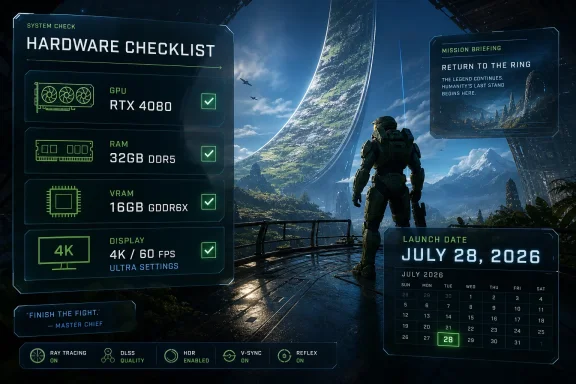
Halo Studios confirmed on June 7, 2026, that Halo: Campaign Evolved will launch July 28 on Windows PC, Xbox Series X|S, and PlayStation 5, with Premium and Collector’s Edition buyers getting early access from July 23. The bigger story for PC players is not the date, but the spec sheet: 4K/60 at Ultra asks for an RTX 4080, 32GB of RAM, and 16GB of VRAM. That is a very different class of machine from the one that once made Halo synonymous with approachable console spectacle. The remake is being sold as a homecoming, but technically it looks more like a line in the sand.
For a series built around a green-armored icon, Halo: Campaign Evolved is a surprisingly blunt statement about infrastructure. Halo Studios is not merely remastering textures or polishing a legacy campaign. It is rebuilding Combat Evolved in Unreal Engine 5 and moving away from Slipspace, the internal engine that powered Halo Infinite and carried years of expectations, delays, and post-launch baggage.
That change matters because engines are not neutral plumbing. They shape how quickly a studio can iterate, how easily it can hire, how much time engineers spend solving toolchain problems instead of shipping content, and how often PC users get to discover that a graphics menu is really a compatibility test. By choosing Unreal Engine 5, Halo Studios is buying into a modern production ecosystem that many developers already know, while also inheriting the performance questions that have followed UE5 across the PC landscape.
The official pitch is familiar: modern visuals, updated cinematics, improved controls, expanded weapons, new enemies, and three new missions under the Operation: Meteorite banner. The deeper pitch is more consequential. Microsoft is using one of its most recognizable properties to signal that the old Xbox-first, bespoke-engine model is giving way to a broader, more standardized, more multiplatform future.
That future now includes PlayStation 5, which would have sounded absurd for a mainline Halo campaign during most of the franchise’s history. In 2026, it sounds almost inevitable. Microsoft has spent the past few years repositioning Xbox less as a box under the television and more as a publishing, subscription, cloud, and PC ecosystem. Halo arriving on PS5 is not a footnote; it is the clearest possible reminder that the platform war era has given way to an audience-maximization era.
The Medium tier jumps to 1440p/60 with a Ryzen 7 5700X or Core i5-12600K, an RTX 3070 or Radeon RX 7600 XT, 16GB of RAM, and 8GB of VRAM. High, labeled as the recommended tier, moves to 4K/60 with a Ryzen 7 7700 or Core i7-12700K, an RTX 3080 Ti or Radeon RX 9070, 32GB of RAM, and 12GB of VRAM. Ultra then asks for a Ryzen 9 7900X or Core i9-13900K, an RTX 4080, 32GB of RAM, and 16GB of VRAM.
That last tier is the one that will dominate forum threads, benchmark videos, and pre-order hesitation. An RTX 4080 remains a serious GPU, not a casual recommendation. Pairing it with 32GB of RAM and 16GB of VRAM for 4K/60 at Ultra suggests Halo Studios expects the top preset to be a high-end showcase rather than a default setting for ordinary players.
The frustrating ambiguity is that the published table, at least as circulated, does not cleanly explain which upscaling technologies are assumed, whether ray tracing is enabled at each tier, or how “Ultra” differs from “High” in practice. In 2026, those details matter enormously. A 4K/60 target with native rendering, high-resolution textures, lumen-style global illumination, heavy ray tracing, and no frame generation is a different proposition from a 4K output image reconstructed from a lower internal resolution.
PC gamers have become accustomed to spec sheets that function more like marketing artifacts than engineering disclosures. The numbers are useful, but incomplete. A serious PC requirements table now needs to say what preset, what ray tracing state, what upscaler mode, what frame generation assumption, what CPU scene load, and what percentile frame-rate target the studio used. Without those details, “RTX 4080 for Ultra” is both a warning and a tease.
But UE5 has also become shorthand for a particular anxiety among PC players: gorgeous demos followed by shader compilation stutter, uneven CPU scaling, VRAM pressure, and demanding lighting systems. The engine can produce astonishing results, but it does not magically optimize a project. It gives developers powerful tools, and then it demands discipline in how those tools are used.
That is why the Halo remake’s PC requirements should be read less as a scandal and more as a diagnostic. If Halo Studios is leaning into high-end UE5 features for lighting, materials, asset density, and cinematic presentation, the hardware ask starts to make sense. The original Combat Evolved sold scale through art direction, skyboxes, clean silhouettes, and brilliant combat pacing. A 2026 remake is expected to sell that same awe through physically richer spaces, higher object density, modern animation, and expensive rendering techniques.
The danger is that the remake could lose the elegance that made the original work. Halo: Combat Evolved did not feel large because every surface was dense with detail. It felt large because its spaces were legible, its encounters were readable, and its pacing knew when to breathe. A remake that treats every corridor as a tech demo risks confusing fidelity with atmosphere.
Still, abandoning Slipspace was probably inevitable. Halo Infinite was not undone only by its engine, but the engine became the public symbol of a production model that appeared too slow for modern live-service expectations and too bespoke for a studio trying to reinvent itself. Unreal Engine 5 gives Halo Studios a chance to stop fighting its tools in public. Now the studio has to prove it can use a common toolchain without producing a common-looking shooter.
That is a natural fit for a remake built around mood. The original Halo moved players from sterile ship corridors to alien megastructure vistas, swampy horror, Forerunner interiors, and battlefield chaos. Better lighting can do real work there. Shadows, reflections, indirect lighting, and material response can make an old level feel newly physical without changing its basic geography.
But ray tracing is also where PC requirements can become slippery. If Ultra assumes ray tracing, the RTX 4080 recommendation becomes less surprising. If Ultra does not assume ray tracing, the number looks more aggressive. If consoles are using a carefully tuned mix of dynamic resolution, selective effects, and reconstruction while PC Ultra simply opens every valve, then the PC spec table may be describing a prestige mode rather than the experience most players should target.
For Windows users, the practical question is not whether ray tracing exists. It is whether the game exposes enough toggles to make performance manageable. Halo has historically depended on responsiveness: the rhythm of strafing, grenade placement, plasma fire, and shield recharge. A prettier ringworld is not worth much if the frame pacing collapses in large fights.
This is where Halo Studios must be more transparent than many publishers have been. PC players do not need every rendering technique explained in a white paper, but they do need to know what “Ultra” buys and what it costs. If ray tracing is optional, say so clearly. If VRAM spikes are expected with high-resolution textures, say so clearly. If shader precompilation exists, say so before launch day.
For WindowsForum readers, that matters because RAM is often the least glamorous upgrade and one of the most misunderstood. A system with a powerful GPU and 16GB of memory can still feel constrained if the game, Windows, background apps, browser tabs, capture software, RGB utilities, and launchers are all competing for headroom. The result is not always a clean “out of memory” error. It can be hitching, longer loads, asset streaming pauses, or inconsistent frame times.
The storage requirement also deserves attention. The game asks for an SSD with 100GB available across tiers. That figure is no longer shocking, but it reinforces that modern remakes are often as large as new releases. High-resolution assets, multiple language packs, cinematics, and patch staging all chew through space. On smaller NVMe drives, 100GB is not a line item; it is a household budgeting problem.
Resizable BAR being recommended for Windows 10 22H2 and Windows 11 is another small but telling detail. It suggests Halo Studios expects modern platform features to matter, even if they are not mandatory. For many users, that means checking motherboard firmware settings, GPU driver support, and BIOS updates rather than simply comparing CPU and GPU model numbers.
This is the new PC gaming reality: the operating system, firmware, storage, memory configuration, GPU driver, and platform features all form part of the effective spec. A PC requirements table looks simple only until it becomes a troubleshooting checklist.
On PS5, Campaign Evolved will be measured against Sony’s own first-party action showcases, third-party UE5 releases, and the expectations of players who may know Master Chief more as a gaming icon than as a formative memory. That audience will not automatically grade on a Halo curve. The remake must stand as a modern campaign shooter, not merely as a restored museum piece.
For Microsoft, that is both risk and opportunity. The opportunity is obvious: a legendary franchise can finally reach a console audience that never owned the hardware where it began. The risk is that Halo’s mythology is strongest among players who already know why the name matters. A remake has to teach that lesson without assuming reverence.
The absence of competitive multiplayer is part of that calculation. Cutting competitive multiplayer narrows the product, but it also avoids forcing the remake to compete with Halo Infinite, other live-service shooters, and the impossible memory of LAN-party Halo. Campaign co-op, crossplay, and cross-progression are the safer bet. They make Campaign Evolved a shared nostalgia machine and an onboarding product rather than a new esport battleground.
That choice may disappoint players who define Halo through Blood Gulch and pistol duels. But from a platform strategy perspective, it is coherent. Microsoft does not need another fragmented Halo multiplayer population. It needs a clean, polished, cross-platform campaign that can introduce or reintroduce the brand without the baggage of live-service balance, ranking systems, and seasonal churn.
That is a delicate line. Change too little, and the project looks like a lavish re-skin of a campaign players can already revisit. Change too much, and the studio risks tampering with one of the cleanest combat loops in shooter history. Combat Evolved worked because its sandbox was limited enough to be readable and flexible enough to surprise. Every addition has to earn its place inside that design grammar.
The new Operation: Meteorite missions are the most obvious test. Adding Master Chief and Sgt. Johnson content gives Halo Studios room to expand character dynamics and campaign variety, but it also creates a tonal challenge. New missions inserted around a beloved classic can feel either revelatory or fan-fictional, depending on writing, pacing, and restraint.
The expanded weapon roster raises similar questions. Nine additional weapons from across the series may sound like an easy win, but Combat Evolved was built around a smaller arsenal with distinct tactical roles. Adding later-series tools could enrich replayability or flatten encounter identity. The more Halo Studios changes the sandbox, the more it must rebalance the campaign’s old geometry and enemy behaviors.
The studio’s challenge is not to make Combat Evolved bigger. It is to make the remake feel as inevitable to new players as the original felt in 2001. That requires more than fidelity. It requires taste.
The good news is that the minimum and medium tiers suggest Halo Studios is not abandoning mainstream systems entirely. An RTX 2060 Super or RX 6600 for 1080p/60 keeps the door open for a broad audience, while the RTX 3070/RX 7600 XT tier for 1440p/60 lands in a familiar enthusiast zone. The bad news is that 8GB of VRAM at Medium may leave little margin if users push textures, ray tracing, or resolution scaling beyond the intended preset.
The High tier is probably where many serious PC players will aim. An RTX 3080 Ti or Radeon RX 9070, 32GB of RAM, and 12GB of VRAM for 4K/60 sounds like the real recommended experience, even if Ultra is the prestige target. The gap between High and Ultra may determine how reasonable the RTX 4080 requirement feels once benchmarks arrive.
There is also an unspoken Windows 10 question. The spec sheet supports Windows 10 22H2 64-bit and Windows 11, but the long-term center of gravity is clearly Windows 11. Driver optimization, scheduler behavior, security features, DirectStorage-adjacent expectations, and platform testing all increasingly favor the newer OS. Windows 10 users may be supported, but support is not the same as being the lead test case.
This is especially relevant because July 2026 lands well after Windows 10’s mainstream consumer support story has become more complicated for many users. Enthusiasts still running Windows 10 for compatibility or preference should not assume every new AAA release will treat their configuration as the priority. Halo may run there, but the industry is moving elsewhere.
That is why precompiled shaders, sensible first-run setup, driver readiness, and clean traversal streaming will be more important than the Ultra preset’s marketing value. Players forgive a demanding graphics mode if the game scales cleanly. They are less forgiving when a high-end rig produces uneven motion despite average frame rates that look good in a benchmark chart.
Halo Studios also needs to handle CPU behavior carefully. The CPU requirements climb quickly, topping out at Ryzen 9 7900X and Core i9-13900K for Ultra. That could reflect heavy simulation, ray tracing overhead, engine threading, or simply conservative guidance. Whatever the reason, it raises the stakes for users with older but still capable CPUs paired with modern GPUs.
The most interesting performance question may be how the remake behaves at 1440p. That is the resolution where many PC enthusiasts actually play, and where a game can often look excellent without the brutal cost of native 4K. If Campaign Evolved runs well at 1440p on cards in the RTX 3070-to-4070 class and AMD equivalents, the RTX 4080 Ultra requirement will feel like an optional ceiling. If it struggles there, the narrative will harden quickly.
A polished PC port can turn an aggressive spec sheet into a badge of ambition. A rough port can turn the same table into evidence of excess. Halo Studios has given itself little room for ambiguity.
The rebrand from 343 Industries to Halo Studios was meant to signal renewal. Moving to Unreal Engine 5 reinforces that message. Launching on PS5 makes the message impossible to ignore. This is not the old stewardship model with a new logo. Microsoft is trying to make Halo portable across engines, storefronts, devices, and audiences.
That portability comes with trade-offs. The more Halo becomes a universal Microsoft franchise, the less it can function as a simple argument for buying an Xbox console. The value shifts to Game Pass, cross-save, Play Anywhere, ecosystem convenience, and brand reach. In other words, Halo is no longer just a system seller. It is content infrastructure.
For longtime Xbox fans, that can feel like loss. For Microsoft, it is probably realism. The console market is mature, development costs are high, and first-party games need larger addressable audiences. If the price of keeping Halo big is putting it on PlayStation and building it in Unreal, Microsoft appears ready to pay it.
The open question is whether Halo’s identity survives that transition intact. A franchise can become more accessible and less distinctive at the same time. The remake’s job is to prove those outcomes are not inevitable.
That does not mean the game is only for elite rigs. The lower tiers suggest an effort to support a meaningful range of PCs, and the console versions will inevitably operate within fixed hardware envelopes. But the marketing center of gravity is clear. Halo Studios wants this remake to look expensive, current, and technically competitive.
For sysadmins and IT pros who also happen to be PC gamers, the lesson is familiar: hardware baselines are shifting again. The comfortable midrange of a few years ago is becoming the minimum or medium tier. VRAM capacity matters more. 32GB of system memory is increasingly normal for high-end gaming. SSD space is not optional. Firmware features such as ReBAR are part of the conversation.
The Halo brand makes that shift feel sharper because Halo was once the game that showed what a closed console could do. Now its remake is helping show what a high-end Windows gaming PC is expected to carry.
 Halo Comes Home by Leaving Its Old House Behind
For a series built around a green-armored icon, Halo: Campaign Evolved is a surprisingly blunt statement about infrastructure. Halo Studios is not merely remastering textures or polishing a legacy campaign. It is rebuilding Combat Evolved in Unreal Engine 5 and moving away from Slipspace, the internal engine that powered Halo Infinite and carried years of expectations, delays, and post-launch baggage.That change matters because engines are not neutral plumbing. They shape how quickly a studio can iterate, how easily it can hire, how much time engineers spend solving toolchain problems instead of shipping content, and how often PC users get to discover that a graphics menu is really a compatibility test. By choosing Unreal Engine 5, Halo Studios is buying into a modern production ecosystem that many developers already know, while also inheriting the performance questions that have followed UE5 across the PC landscape.
The official pitch is familiar: modern visuals, updated cinematics, improved controls, expanded weapons, new enemies, and three new missions under the Operation: Meteorite banner. The deeper pitch is more consequential. Microsoft is using one of its most recognizable properties to signal that the old Xbox-first, bespoke-engine model is giving way to a broader, more standardized, more multiplatform future.
That future now includes PlayStation 5, which would have sounded absurd for a mainline Halo campaign during most of the franchise’s history. In 2026, it sounds almost inevitable. Microsoft has spent the past few years repositioning Xbox less as a box under the television and more as a publishing, subscription, cloud, and PC ecosystem. Halo arriving on PS5 is not a footnote; it is the clearest possible reminder that the platform war era has given way to an audience-maximization era.
The RTX 4080 Requirement Is the Real Announcement
The spec table is where nostalgia meets silicon. The Low tier targets 1080p at 60 frames per second with a Ryzen 5 3600 or Core i7-10700K, an RTX 2060 Super, Radeon RX 6600, or Intel Arc A580, 16GB of RAM, and 8GB of VRAM. That is not absurd by 2026 standards, but it does establish a floor that leaves older midrange cards and many budget systems behind.The Medium tier jumps to 1440p/60 with a Ryzen 7 5700X or Core i5-12600K, an RTX 3070 or Radeon RX 7600 XT, 16GB of RAM, and 8GB of VRAM. High, labeled as the recommended tier, moves to 4K/60 with a Ryzen 7 7700 or Core i7-12700K, an RTX 3080 Ti or Radeon RX 9070, 32GB of RAM, and 12GB of VRAM. Ultra then asks for a Ryzen 9 7900X or Core i9-13900K, an RTX 4080, 32GB of RAM, and 16GB of VRAM.
That last tier is the one that will dominate forum threads, benchmark videos, and pre-order hesitation. An RTX 4080 remains a serious GPU, not a casual recommendation. Pairing it with 32GB of RAM and 16GB of VRAM for 4K/60 at Ultra suggests Halo Studios expects the top preset to be a high-end showcase rather than a default setting for ordinary players.
The frustrating ambiguity is that the published table, at least as circulated, does not cleanly explain which upscaling technologies are assumed, whether ray tracing is enabled at each tier, or how “Ultra” differs from “High” in practice. In 2026, those details matter enormously. A 4K/60 target with native rendering, high-resolution textures, lumen-style global illumination, heavy ray tracing, and no frame generation is a different proposition from a 4K output image reconstructed from a lower internal resolution.
PC gamers have become accustomed to spec sheets that function more like marketing artifacts than engineering disclosures. The numbers are useful, but incomplete. A serious PC requirements table now needs to say what preset, what ray tracing state, what upscaler mode, what frame generation assumption, what CPU scene load, and what percentile frame-rate target the studio used. Without those details, “RTX 4080 for Ultra” is both a warning and a tease.
Unreal Engine 5 Gives Halo a Modern Toolchain and a Familiar Burden
The move from Slipspace to Unreal Engine 5 is easy to defend strategically. Halo Studios gets access to an engine with a large developer talent pool, mature content pipelines, extensive middleware support, and technology designed for current-generation hardware. For a franchise that needs to ship across Xbox, PC, and PlayStation simultaneously, those advantages are not cosmetic.But UE5 has also become shorthand for a particular anxiety among PC players: gorgeous demos followed by shader compilation stutter, uneven CPU scaling, VRAM pressure, and demanding lighting systems. The engine can produce astonishing results, but it does not magically optimize a project. It gives developers powerful tools, and then it demands discipline in how those tools are used.
That is why the Halo remake’s PC requirements should be read less as a scandal and more as a diagnostic. If Halo Studios is leaning into high-end UE5 features for lighting, materials, asset density, and cinematic presentation, the hardware ask starts to make sense. The original Combat Evolved sold scale through art direction, skyboxes, clean silhouettes, and brilliant combat pacing. A 2026 remake is expected to sell that same awe through physically richer spaces, higher object density, modern animation, and expensive rendering techniques.
The danger is that the remake could lose the elegance that made the original work. Halo: Combat Evolved did not feel large because every surface was dense with detail. It felt large because its spaces were legible, its encounters were readable, and its pacing knew when to breathe. A remake that treats every corridor as a tech demo risks confusing fidelity with atmosphere.
Still, abandoning Slipspace was probably inevitable. Halo Infinite was not undone only by its engine, but the engine became the public symbol of a production model that appeared too slow for modern live-service expectations and too bespoke for a studio trying to reinvent itself. Unreal Engine 5 gives Halo Studios a chance to stop fighting its tools in public. Now the studio has to prove it can use a common toolchain without producing a common-looking shooter.
Ray Tracing Moves From Multiplayer Curiosity to Campaign Expectation
The Xbox store listing’s mention of ray tracing is a small line with large implications. Halo Infinite eventually added ray-traced sun shadows, but that feature was tied to multiplayer rather than the campaign that most players associate with Halo’s visual identity. Campaign Evolved appears positioned to make ray tracing part of the single-player spectacle from day one.That is a natural fit for a remake built around mood. The original Halo moved players from sterile ship corridors to alien megastructure vistas, swampy horror, Forerunner interiors, and battlefield chaos. Better lighting can do real work there. Shadows, reflections, indirect lighting, and material response can make an old level feel newly physical without changing its basic geography.
But ray tracing is also where PC requirements can become slippery. If Ultra assumes ray tracing, the RTX 4080 recommendation becomes less surprising. If Ultra does not assume ray tracing, the number looks more aggressive. If consoles are using a carefully tuned mix of dynamic resolution, selective effects, and reconstruction while PC Ultra simply opens every valve, then the PC spec table may be describing a prestige mode rather than the experience most players should target.
For Windows users, the practical question is not whether ray tracing exists. It is whether the game exposes enough toggles to make performance manageable. Halo has historically depended on responsiveness: the rhythm of strafing, grenade placement, plasma fire, and shield recharge. A prettier ringworld is not worth much if the frame pacing collapses in large fights.
This is where Halo Studios must be more transparent than many publishers have been. PC players do not need every rendering technique explained in a white paper, but they do need to know what “Ultra” buys and what it costs. If ray tracing is optional, say so clearly. If VRAM spikes are expected with high-resolution textures, say so clearly. If shader precompilation exists, say so before launch day.
The 32GB RAM Line Is the Quiet Platform Shift
The GPU requirement will get the headlines, but the 32GB RAM recommendation may be the more important signal for PC gaming in 2026. Low and Medium sit at 16GB, while High and Ultra move to 32GB. That maps neatly onto a broader transition: 16GB is still viable, but it is no longer the comfortable enthusiast baseline for big-budget games at high resolutions.For WindowsForum readers, that matters because RAM is often the least glamorous upgrade and one of the most misunderstood. A system with a powerful GPU and 16GB of memory can still feel constrained if the game, Windows, background apps, browser tabs, capture software, RGB utilities, and launchers are all competing for headroom. The result is not always a clean “out of memory” error. It can be hitching, longer loads, asset streaming pauses, or inconsistent frame times.
The storage requirement also deserves attention. The game asks for an SSD with 100GB available across tiers. That figure is no longer shocking, but it reinforces that modern remakes are often as large as new releases. High-resolution assets, multiple language packs, cinematics, and patch staging all chew through space. On smaller NVMe drives, 100GB is not a line item; it is a household budgeting problem.
Resizable BAR being recommended for Windows 10 22H2 and Windows 11 is another small but telling detail. It suggests Halo Studios expects modern platform features to matter, even if they are not mandatory. For many users, that means checking motherboard firmware settings, GPU driver support, and BIOS updates rather than simply comparing CPU and GPU model numbers.
This is the new PC gaming reality: the operating system, firmware, storage, memory configuration, GPU driver, and platform features all form part of the effective spec. A PC requirements table looks simple only until it becomes a troubleshooting checklist.
PlayStation 5 Changes the Meaning of a Halo Launch
The PS5 version is not just a business story. It changes how Halo: Campaign Evolved will be judged. For decades, Halo carried the weight of being an Xbox identity product. Its technical compromises, design choices, and release timing were interpreted through that lens. Once Halo ships day-and-date on PlayStation, the comparison set changes overnight.On PS5, Campaign Evolved will be measured against Sony’s own first-party action showcases, third-party UE5 releases, and the expectations of players who may know Master Chief more as a gaming icon than as a formative memory. That audience will not automatically grade on a Halo curve. The remake must stand as a modern campaign shooter, not merely as a restored museum piece.
For Microsoft, that is both risk and opportunity. The opportunity is obvious: a legendary franchise can finally reach a console audience that never owned the hardware where it began. The risk is that Halo’s mythology is strongest among players who already know why the name matters. A remake has to teach that lesson without assuming reverence.
The absence of competitive multiplayer is part of that calculation. Cutting competitive multiplayer narrows the product, but it also avoids forcing the remake to compete with Halo Infinite, other live-service shooters, and the impossible memory of LAN-party Halo. Campaign co-op, crossplay, and cross-progression are the safer bet. They make Campaign Evolved a shared nostalgia machine and an onboarding product rather than a new esport battleground.
That choice may disappoint players who define Halo through Blood Gulch and pistol duels. But from a platform strategy perspective, it is coherent. Microsoft does not need another fragmented Halo multiplayer population. It needs a clean, polished, cross-platform campaign that can introduce or reintroduce the brand without the baggage of live-service balance, ranking systems, and seasonal churn.
The Remake Has to Justify More Than Its Textures
The original Combat Evolved already received an Anniversary treatment in 2011, which complicates the sales pitch for another remake. A simple visual refresh would not be enough. Halo Studios is therefore adding three new missions, more weapons, expanded vehicle interactions, updated cinematics, and modernized controls. The remake is being positioned as faithful, but not frozen.That is a delicate line. Change too little, and the project looks like a lavish re-skin of a campaign players can already revisit. Change too much, and the studio risks tampering with one of the cleanest combat loops in shooter history. Combat Evolved worked because its sandbox was limited enough to be readable and flexible enough to surprise. Every addition has to earn its place inside that design grammar.
The new Operation: Meteorite missions are the most obvious test. Adding Master Chief and Sgt. Johnson content gives Halo Studios room to expand character dynamics and campaign variety, but it also creates a tonal challenge. New missions inserted around a beloved classic can feel either revelatory or fan-fictional, depending on writing, pacing, and restraint.
The expanded weapon roster raises similar questions. Nine additional weapons from across the series may sound like an easy win, but Combat Evolved was built around a smaller arsenal with distinct tactical roles. Adding later-series tools could enrich replayability or flatten encounter identity. The more Halo Studios changes the sandbox, the more it must rebalance the campaign’s old geometry and enemy behaviors.
The studio’s challenge is not to make Combat Evolved bigger. It is to make the remake feel as inevitable to new players as the original felt in 2001. That requires more than fidelity. It requires taste.
Windows Players Should Prepare for a Launch-Day Reality Check
For PC users, the safest assumption is that Halo: Campaign Evolved will be demanding, patch-sensitive, and heavily dependent on drivers at launch. That is not a prediction of disaster. It is simply how large cross-platform PC releases behave now, especially when Unreal Engine 5, ray tracing, high-resolution assets, and multiple storefronts are involved.The good news is that the minimum and medium tiers suggest Halo Studios is not abandoning mainstream systems entirely. An RTX 2060 Super or RX 6600 for 1080p/60 keeps the door open for a broad audience, while the RTX 3070/RX 7600 XT tier for 1440p/60 lands in a familiar enthusiast zone. The bad news is that 8GB of VRAM at Medium may leave little margin if users push textures, ray tracing, or resolution scaling beyond the intended preset.
The High tier is probably where many serious PC players will aim. An RTX 3080 Ti or Radeon RX 9070, 32GB of RAM, and 12GB of VRAM for 4K/60 sounds like the real recommended experience, even if Ultra is the prestige target. The gap between High and Ultra may determine how reasonable the RTX 4080 requirement feels once benchmarks arrive.
There is also an unspoken Windows 10 question. The spec sheet supports Windows 10 22H2 64-bit and Windows 11, but the long-term center of gravity is clearly Windows 11. Driver optimization, scheduler behavior, security features, DirectStorage-adjacent expectations, and platform testing all increasingly favor the newer OS. Windows 10 users may be supported, but support is not the same as being the lead test case.
This is especially relevant because July 2026 lands well after Windows 10’s mainstream consumer support story has become more complicated for many users. Enthusiasts still running Windows 10 for compatibility or preference should not assume every new AAA release will treat their configuration as the priority. Halo may run there, but the industry is moving elsewhere.
The Real PC Test Is Frame Pacing, Not Screenshot Quality
A Halo campaign can survive lower texture quality. It cannot survive bad frame pacing. The series’ combat depends on timing, spatial awareness, and instant readability. If the remake hitches when the Flood arrive, stalls when traversal crosses streaming boundaries, or stutters during shader compilation, the technical foundation will matter more than any rebuilt skybox.That is why precompiled shaders, sensible first-run setup, driver readiness, and clean traversal streaming will be more important than the Ultra preset’s marketing value. Players forgive a demanding graphics mode if the game scales cleanly. They are less forgiving when a high-end rig produces uneven motion despite average frame rates that look good in a benchmark chart.
Halo Studios also needs to handle CPU behavior carefully. The CPU requirements climb quickly, topping out at Ryzen 9 7900X and Core i9-13900K for Ultra. That could reflect heavy simulation, ray tracing overhead, engine threading, or simply conservative guidance. Whatever the reason, it raises the stakes for users with older but still capable CPUs paired with modern GPUs.
The most interesting performance question may be how the remake behaves at 1440p. That is the resolution where many PC enthusiasts actually play, and where a game can often look excellent without the brutal cost of native 4K. If Campaign Evolved runs well at 1440p on cards in the RTX 3070-to-4070 class and AMD equivalents, the RTX 4080 Ultra requirement will feel like an optional ceiling. If it struggles there, the narrative will harden quickly.
A polished PC port can turn an aggressive spec sheet into a badge of ambition. A rough port can turn the same table into evidence of excess. Halo Studios has given itself little room for ambiguity.
Microsoft Is Selling a Memory and a Migration
There is a business logic behind every technical decision here. Campaign Evolved is a remake, a cross-platform expansion, a Game Pass asset, a Steam product, a PlayStation debut, and a statement of post-343 identity all at once. That is a lot of pressure for a campaign that began life as a 2001 Xbox launch title.The rebrand from 343 Industries to Halo Studios was meant to signal renewal. Moving to Unreal Engine 5 reinforces that message. Launching on PS5 makes the message impossible to ignore. This is not the old stewardship model with a new logo. Microsoft is trying to make Halo portable across engines, storefronts, devices, and audiences.
That portability comes with trade-offs. The more Halo becomes a universal Microsoft franchise, the less it can function as a simple argument for buying an Xbox console. The value shifts to Game Pass, cross-save, Play Anywhere, ecosystem convenience, and brand reach. In other words, Halo is no longer just a system seller. It is content infrastructure.
For longtime Xbox fans, that can feel like loss. For Microsoft, it is probably realism. The console market is mature, development costs are high, and first-party games need larger addressable audiences. If the price of keeping Halo big is putting it on PlayStation and building it in Unreal, Microsoft appears ready to pay it.
The open question is whether Halo’s identity survives that transition intact. A franchise can become more accessible and less distinctive at the same time. The remake’s job is to prove those outcomes are not inevitable.
The Ringworld Now Belongs to the High-End PC Era
The most concrete read of the announcement is also the simplest: Halo: Campaign Evolved is not being built as a lightweight nostalgia product. It is being built as a modern AAA release with a modern AAA appetite. That appetite includes high CPU targets, 32GB RAM at upper presets, a 100GB SSD footprint, ray tracing, and an Ultra tier that treats the RTX 4080 as the price of admission.That does not mean the game is only for elite rigs. The lower tiers suggest an effort to support a meaningful range of PCs, and the console versions will inevitably operate within fixed hardware envelopes. But the marketing center of gravity is clear. Halo Studios wants this remake to look expensive, current, and technically competitive.
For sysadmins and IT pros who also happen to be PC gamers, the lesson is familiar: hardware baselines are shifting again. The comfortable midrange of a few years ago is becoming the minimum or medium tier. VRAM capacity matters more. 32GB of system memory is increasingly normal for high-end gaming. SSD space is not optional. Firmware features such as ReBAR are part of the conversation.
The Halo brand makes that shift feel sharper because Halo was once the game that showed what a closed console could do. Now its remake is helping show what a high-end Windows gaming PC is expected to carry.
The Spec Sheet Says What the Trailer Cannot
The announcement trailer can sell mood, memory, and spectacle. The PC requirements sell consequences. For anyone planning to play on Windows, the practical picture is already emerging.- Halo: Campaign Evolved launches July 28, 2026, with paid early access beginning July 23 for Premium and Collector’s Edition buyers.
- The remake is built in Unreal Engine 5, marking Halo’s most visible break from the Slipspace era.
- The Ultra 4K/60 target asks for an RTX 4080, 32GB of RAM, and 16GB of VRAM, making it a high-end preset rather than a mainstream expectation.
- The High 4K/60 tier, with an RTX 3080 Ti or Radeon RX 9070 and 32GB of RAM, may be the more realistic enthusiast target.
- The game supports Windows 10 22H2 and Windows 11, but modern platform features such as ReBAR are recommended.
- The lack of competitive multiplayer makes this a campaign-first remake built around co-op, crossplay, and franchise onboarding rather than a full replacement for existing Halo multiplayer.
References
- Primary source: Wccftech
Published: 2026-06-08T13:00:07.475778
Halo: Campaign Evolved Demands RTX 4080 and 32GB RAM for 4K@60 at Ultra Preset, as UE5 Remake Drops Slipspace Engine
Halo: Campaign Evolved, which dropped the Slipspace engine for Unreal Engine 5, requires an RTX 4080 and 32GB RAM for 4K@60 on Ultra.wccftech.com
- Related coverage: gamesradar.com
Don't tell Xbox, but Halo: Campaign Evolved screenshots have leaked through the Microsoft Store and revealed space combat | GamesRadar+
For the first time since Halo Reachwww.gamesradar.com - Related coverage: news.xbox.com
Halo: Campaign Evolved Launches July 28, Pre-Orders Available Now - XBOX Wire
Halo: Campaign Evolved launches July 28, 2026, with early access beginning July 23. Find out more, and pre-order today.news.xbox.com - Related coverage: halowaypoint.com
Pre-Order Bonuses and Editions | Halo: Campaign Evolved | Halo - Official Site (en)
<p>Following our exciting new mission reveal at the XBOX Showcase, the time has come to officially unveil all the pre-order bonuses and exciting content available with physical and digital editions of Halo: Campaign Evolved. Halo: Campaign Evolved launches on XBOX Series X|S, PlayStation...www.halowaypoint.com
- Related coverage: gamespot.com
New Prologue Missions For Halo: Campaign Evolved Revealed, Releasing In July - GameSpot
The remake of the Xbox classic's single-player campaign launches this summerwww.gamespot.com - Related coverage: beebom.com
Halo Campaign Evolved Pre-Order Guide: Editions, Bonuses, and More
Halo Campaign Evolved pre-orders are live, so check this guide to learn compare all editions, prices, bonuses and how to get the game.beebom.com
- Related coverage: store.steampowered.com
Precomprar Halo: Campaign Evolved en Steam
Reserva Halo: Campaign Evolved y obtén el pack Foundry Armory, con aspectos legendarios para la icónica armadura Mark V Mjolnir del Jefe Maestro.store.steampowered.com
- Related coverage: purexbox.com
- Related coverage: news.instant-gaming.com
The Premium Edition of Halo: Campaign Evolved lets you start playing on July 23 - IG News
Halo: Campaign Evolved was at the 2026 XBOX Games Showcase, and we learned that it will be released on July 28, 2026. In addition to the standard edition…news.instant-gaming.com - Related coverage: gamenguide.com
'Halo: Campaign Evolved' Preorders Now Open Ahead of Official Release for PS5, Xbox, and PC
Pre-orders for “Halo: Campaign Evolved” are now live on PS5, Xbox Series X|S, and PC ahead of its Jul. 28, 2026, release, with bonuses and special editions.www.gamenguide.com - Related coverage: halo.fr
Halo : Campaign Evolved - Éditions spéciales et bonus de précommande
Le Xbox Games Showcase a été l'occasion pour Microsoft et les Halo Studios de dévoiler les éditions de Halo : Campaign Evolved et ses bonus de précommande.www.halo.fr - Related coverage: windowscentral.com
Oop, Xbox's Halo: Campaign Evolved release date may have just leaked thanks to a retailer's mistake — it might have a Deluxe Edition with Early Access, too | Windows Central
According to new leaks, Xbox's Halo: Campaign Evolved may launch in late July.www.windowscentral.com - Related coverage: as.com
- Related coverage: space.com
Halo: Campaign Evolved: Release date, platforms, & everything else we know about the Halo remake | Space
Master Chief is returning in 2026 with a ground-up remake of the original Halo that's promising new content on top of a totally remade presentation.www.space.com
