

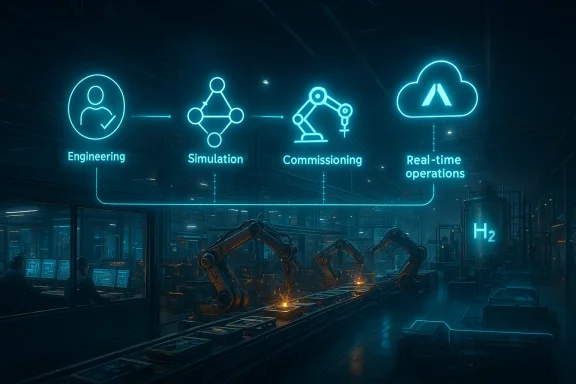
Hannover Messe 2026 has become the clearest signal yet that industrial AI is moving beyond dashboards, pilots, and isolated copilots toward something much more ambitious: a governed, traceable, agentic manufacturing model that links engineering intent with real-world execution. Schneider Electric and Microsoft are using the show to demonstrate how EcoStruxure Automation Expert and Azure AI can work together to connect design, simulation, commissioning, and operations in one workflow. If the companies’ claims hold up in broader deployment, the result could reshape how manufacturers build, validate, and scale automation across cloud, edge, and hybrid environments.
The collaboration is significant not because it introduces the idea of industrial AI, but because it reframes where the value actually sits. For years, manufacturers have talked about digital transformation in terms of IoT sensors, predictive maintenance, digital twins, or low-code automation. Schneider Electric and Microsoft are now pitching something more integrated: software-defined operations where AI agents help create, validate, and deploy automation logic and then keep that logic aligned with changing plant conditions over time.
That matters because manufacturing has never been short on data. The hard problem has always been coordination: engineering teams, operations teams, compliance teams, and systems integrators often work in different tools, with different assumptions, and at different speeds. Schneider Electric says its platform can standardize reusable logic, preserve traceability through the lifecycle, and reduce the handoff friction that traditionally stretches production changes into weeks. Microsoft, meanwhile, is positioning Azure as the intelligence and orchestration layer that can help turn that plant data into action.
The language around agentic manufacturing is also telling. This is no longer just about giving engineers a smarter assistant. It is about specialized AI agents coordinated by an orchestrator, with the system itself helping make routine design decisions, validate logic before deployment, and pass reusable automation packages from one stage to the next. In other words, the companies are trying to close the gap between the idea of a process and the process running in the real world.
Schneider Electric’s own Hannover Messe messaging in 2025 had already pointed in this direction. At that point, it was emphasizing open, software-defined automation and a generative AI assistant created with Microsoft to help engineers produce validated code more quickly. The 2026 announcement suggests that this partnership has moved from feature-level assistance toward a broader operating model. That evolution is important because the market has been flooded with copilots that help people write text or summarize information, but far fewer systems that can reliably influence industrial execution.
EcoStruxure Automation Expert sits at the center of Schneider Electric’s answer. The company describes it as an open, software-defined automation platform that can run consistently across on-premises, edge, and hybrid environments. That portability matters because manufacturers increasingly operate mixed estates: legacy equipment on one line, newer edge-connected systems on another, and cloud analytics in a separate layer. Schneider’s pitch is that logic written once can be simulated, validated, and deployed anywhere without rewriting for every target environment.
Microsoft’s role is equally strategic. At Hannover Messe 2026, the company is using the theme “Industrial Intelligence Unlocked” to frame a broader industrial AI stack that includes Work IQ, Fabric IQ, and Foundry IQ. That stack is designed to understand people, production data, and institutional knowledge, then help manufacturers connect those layers through AI. In that context, Schneider Electric is not just a partner; it is one of the clearest proof points for Microsoft’s thesis that agentic AI can drive tangible industrial workflows rather than abstract productivity gains.
The partnership also builds on a year of escalating industrial AI ambition. In 2025, Schneider Electric was already showcasing its automation platform alongside Microsoft-powered generative tools. The difference in 2026 is scale and confidence. The language has moved from helping engineers generate code faster to orchestrating design intent, validating it earlier, and deploying it across sites with traceability built in. That is a much stronger claim, and it reflects a broader market trend toward AI systems that do work, rather than merely suggest it.
The deeper story is the platform architecture. Schneider Electric says EcoStruxure Automation Expert provides the execution backbone, while Microsoft supplies the cloud and AI services that orchestrate, analyze, and optimize industrial processes. The combined model is designed to let teams create reusable logic, run simulations before deployment, and maintain traceability from concept to plant floor. That is the kind of end-to-end integration manufacturers have asked for for years, even if very few vendors have been able to deliver it cleanly.
The other important point is simulation. In manufacturing, simulation is not a luxury feature. It is the difference between a change that is safe to deploy and a change that creates downtime, scrap, or safety risk. If AI agents can help validate logic early and preserve traceability throughout the lifecycle, they do more than save time; they reduce the odds of expensive mistakes.
There is a strategic logic behind this. Microsoft has spent years building Azure into a platform that can host analytics, apps, and AI services at scale. But the industrial market is not won by infrastructure alone. It is won by referenceable workflows, visible ROI, and credible operational partners. Schneider Electric gives Microsoft all three: a recognized industrial brand, a real automation footprint, and a compelling narrative about traceable agentic manufacturing.
Microsoft’s language about Work IQ, Fabric IQ, and Foundry IQ reinforces that ambition. The company wants to present a coherent intelligence layer spanning human collaboration, real-time operations, and institutional memory. Schneider Electric’s manufacturing workflow becomes a concrete example of how that layer might look when it touches machines, not just knowledge workers.
The choice of green hydrogen is also revealing. Hydrogen production is energy intensive, operationally complex, and economically sensitive, which makes it a strong stress test for any automation platform. If a software-defined, AI-assisted approach can sustain long autonomous runs there, it suggests the model may be viable in other high-complexity industrial settings as well. Still, one successful deployment is not the same as broad reproducibility.
It does not, however, prove universal applicability. Industrial environments vary wildly in process design, regulatory burden, and tolerance for automation autonomy. The H2E Power case is impressive precisely because it is difficult, but that also means the results depend on a highly specific operational context. Buyers should treat the example as a reference architecture, not a guarantee.
This is more than a productivity boost. In industrial settings, engineering labor is expensive not only because engineers are scarce, but because every late change compounds downstream costs. Faster configuration, faster validation, and faster documentation mean better responsiveness to market changes, equipment adjustments, and production variations. That is particularly valuable in plants with frequent product changeovers or highly customized workflows.
At the same time, the engineering profession will need to adapt. If AI helps produce validated logic and documentation, engineers may spend less time on repetitive configuration and more time on architecture, risk review, and exception handling. That is a good shift, but it also raises the bar for governance. When the system is making more decisions earlier, the human review process has to become sharper, not looser.
The operations case is equally compelling. If design intent and operational execution are connected, then changes can be validated earlier, deployed more consistently, and tracked more reliably. That could reduce downtime, improve first-pass yield, and make quality management more predictable, especially in regulated industries where audit trails and safety validation matter.
Microsoft’s broader industrial narrative reinforces this point. By emphasizing trusted intelligence grounded in governed workflows, the company is acknowledging a hard truth: enterprise AI will only stick if it respects operational boundaries. That is why the Schneider partnership matters so much; it gives the abstract idea of governed agentic AI a concrete industrial form.
That broader narrative matters because manufacturers are tired of hearing that AI will someday transform everything. They want evidence that it can shorten cycles, improve yield, reduce downtime, and survive the realities of plant operations. By tying Schneider’s platform to a live hydrogen example and measurable engineering time savings, Microsoft and Schneider are doing more than marketing; they are trying to establish a category.
The other thing to watch is whether competitors respond with similar end-to-end claims. If the industry starts converging on AI agents that connect engineering, simulation, and execution, the battleground will shift from “Who has AI?” to “Whose AI is safest, most governable, and easiest to operationalize?” That would be a much more mature competition, and a much more valuable one for customers.
Source: Technology Record Hannover Messe 2026: Schneider Electric unveils agentic manufacturing capabilities powered by Microsoft Azure AI
 Overview
The collaboration is significant not because it introduces the idea of industrial AI, but because it reframes where the value actually sits. For years, manufacturers have talked about digital transformation in terms of IoT sensors, predictive maintenance, digital twins, or low-code automation. Schneider Electric and Microsoft are now pitching something more integrated: software-defined operations where AI agents help create, validate, and deploy automation logic and then keep that logic aligned with changing plant conditions over time.That matters because manufacturing has never been short on data. The hard problem has always been coordination: engineering teams, operations teams, compliance teams, and systems integrators often work in different tools, with different assumptions, and at different speeds. Schneider Electric says its platform can standardize reusable logic, preserve traceability through the lifecycle, and reduce the handoff friction that traditionally stretches production changes into weeks. Microsoft, meanwhile, is positioning Azure as the intelligence and orchestration layer that can help turn that plant data into action.
The language around agentic manufacturing is also telling. This is no longer just about giving engineers a smarter assistant. It is about specialized AI agents coordinated by an orchestrator, with the system itself helping make routine design decisions, validate logic before deployment, and pass reusable automation packages from one stage to the next. In other words, the companies are trying to close the gap between the idea of a process and the process running in the real world.
Schneider Electric’s own Hannover Messe messaging in 2025 had already pointed in this direction. At that point, it was emphasizing open, software-defined automation and a generative AI assistant created with Microsoft to help engineers produce validated code more quickly. The 2026 announcement suggests that this partnership has moved from feature-level assistance toward a broader operating model. That evolution is important because the market has been flooded with copilots that help people write text or summarize information, but far fewer systems that can reliably influence industrial execution.
Background
Manufacturing software has historically evolved in layers. First came hard-wired control systems and vendor-specific PLC environments. Then came SCADA, MES, ERP, and a long line of point solutions designed to manage separate slices of the industrial stack. The industry’s latest challenge is not connecting data in theory; it is creating a single operational fabric that can travel across plants, geographies, and hardware generations without forcing every site into a costly retooling cycle.EcoStruxure Automation Expert sits at the center of Schneider Electric’s answer. The company describes it as an open, software-defined automation platform that can run consistently across on-premises, edge, and hybrid environments. That portability matters because manufacturers increasingly operate mixed estates: legacy equipment on one line, newer edge-connected systems on another, and cloud analytics in a separate layer. Schneider’s pitch is that logic written once can be simulated, validated, and deployed anywhere without rewriting for every target environment.
Microsoft’s role is equally strategic. At Hannover Messe 2026, the company is using the theme “Industrial Intelligence Unlocked” to frame a broader industrial AI stack that includes Work IQ, Fabric IQ, and Foundry IQ. That stack is designed to understand people, production data, and institutional knowledge, then help manufacturers connect those layers through AI. In that context, Schneider Electric is not just a partner; it is one of the clearest proof points for Microsoft’s thesis that agentic AI can drive tangible industrial workflows rather than abstract productivity gains.
The partnership also builds on a year of escalating industrial AI ambition. In 2025, Schneider Electric was already showcasing its automation platform alongside Microsoft-powered generative tools. The difference in 2026 is scale and confidence. The language has moved from helping engineers generate code faster to orchestrating design intent, validating it earlier, and deploying it across sites with traceability built in. That is a much stronger claim, and it reflects a broader market trend toward AI systems that do work, rather than merely suggest it.
Why Hannover Messe Matters
Hannover Messe is not just another trade show. It is one of the places where industrial technology vendors test whether their strategy sounds visionary, practical, and safe enough for the people who actually run factories. A headline demo can generate interest, but the industrial audience is notoriously skeptical of hype. The fact that Schneider Electric and Microsoft are using Hannover to show a single workflow from design to operations suggests they believe the market is ready for a more operationally grounded AI story.From Copilot to Orchestrator
A conventional copilot helps a human produce something faster. An orchestrator coordinates multiple agents, systems, and checkpoints so that work moves with less friction. That distinction is crucial in manufacturing, where mistakes can affect uptime, safety, quality, and compliance. Schneider and Microsoft are effectively arguing that industrial AI has to become procedural, not just conversational.What Schneider Electric Is Actually Showing
The headline claim is that Schneider Electric’s Industrial Copilot, powered by Azure AI, can cut engineering time by up to 50% and shrink production changes from weeks to hours. That is a dramatic promise, but it is also one that targets a real pain point: control configuration, documentation, and change management consume enormous engineering bandwidth. If the system consistently reduces that overhead, the value is immediate and easy to measure.The deeper story is the platform architecture. Schneider Electric says EcoStruxure Automation Expert provides the execution backbone, while Microsoft supplies the cloud and AI services that orchestrate, analyze, and optimize industrial processes. The combined model is designed to let teams create reusable logic, run simulations before deployment, and maintain traceability from concept to plant floor. That is the kind of end-to-end integration manufacturers have asked for for years, even if very few vendors have been able to deliver it cleanly.
A Software-Defined Control Stack
Schneider’s software-defined approach matters because it attacks one of industrial automation’s oldest frictions: vendor lock-in. When code, logic, and runtime behavior are too tightly coupled to specific hardware, every change becomes a mini migration project. By saying automation logic can be written once and run anywhere, Schneider is making a direct case for portability, interoperability, and lower lifecycle cost.The other important point is simulation. In manufacturing, simulation is not a luxury feature. It is the difference between a change that is safe to deploy and a change that creates downtime, scrap, or safety risk. If AI agents can help validate logic early and preserve traceability throughout the lifecycle, they do more than save time; they reduce the odds of expensive mistakes.
- Reusable logic can reduce repetitive engineering work.
- Simulation-first validation lowers deployment risk.
- Traceability helps regulated industries defend decisions.
- Cross-site portability makes scaling more realistic.
- Cloud and edge consistency matters for mixed industrial estates.
Why “Runs Anywhere” Is a Big Deal
The “run it anywhere” message is more than a technical slogan. Manufacturers rarely have the luxury of replacing entire plants just to adopt new software. They need systems that can coexist with legacy assets while gradually modernizing the control layer. That is why Schneider’s hybrid story is so important: it promises continuity for operations teams and modernization for digital teams at the same time.Why Microsoft Wants This Story
Microsoft’s industrial push at Hannover Messe 2026 is centered on a simple proposition: AI will matter most where it can connect people, production data, and institutional knowledge into one governed workflow. The company’s blog frames this as “Industrial Intelligence Unlocked,” and it presents Schneider Electric as one of the clearest examples of how that idea works in practice.There is a strategic logic behind this. Microsoft has spent years building Azure into a platform that can host analytics, apps, and AI services at scale. But the industrial market is not won by infrastructure alone. It is won by referenceable workflows, visible ROI, and credible operational partners. Schneider Electric gives Microsoft all three: a recognized industrial brand, a real automation footprint, and a compelling narrative about traceable agentic manufacturing.
Azure as the Orchestration Layer
In the Schneider story, Azure is not just where models run. It is the layer that orchestrates, analyzes, and optimizes industrial processes. That is a more ambitious role than generic cloud hosting, because it places Microsoft closer to the decision path itself. It also aligns with Microsoft’s broader effort to make its industrial AI stack feel like an operating system for connected work rather than a collection of separate services.Microsoft’s language about Work IQ, Fabric IQ, and Foundry IQ reinforces that ambition. The company wants to present a coherent intelligence layer spanning human collaboration, real-time operations, and institutional memory. Schneider Electric’s manufacturing workflow becomes a concrete example of how that layer might look when it touches machines, not just knowledge workers.
- Azure gains a stronger industrial reference case.
- Schneider gets a cloud-scale AI and orchestration partner.
- Both companies can tell a more complete lifecycle story.
- The partnership supports Microsoft’s broader agentic AI narrative.
- Industrial customers get a familiar vendor stack with lower integration friction.
The Competitive Implication
This matters because Microsoft is competing not just with other cloud vendors, but with industrial software specialists, automation incumbents, and analytics players that are all trying to own the next layer of manufacturing intelligence. A partnership like this helps Microsoft argue that it is not merely offering AI models; it is helping define the industrial operating model itself. That is a much more defensible position in a market where vendors are increasingly judged on outcomes, not features.The H2E Power Example
The clearest proof point in the announcement is the H2E Power deployment in India. Schneider Electric says the system has maintained more than 6,000 hours of stable autonomous operation in a demanding green hydrogen environment and helped reduce the levelized cost of hydrogen by up to 10%, which the company estimates as roughly €500,000 a year for a typical 10 MW plant. Those are serious claims, and they give the story the kind of industrial credibility that general-purpose AI announcements often lack.The choice of green hydrogen is also revealing. Hydrogen production is energy intensive, operationally complex, and economically sensitive, which makes it a strong stress test for any automation platform. If a software-defined, AI-assisted approach can sustain long autonomous runs there, it suggests the model may be viable in other high-complexity industrial settings as well. Still, one successful deployment is not the same as broad reproducibility.
What the Example Actually Proves
At a minimum, the example shows that the joint Schneider-Microsoft approach is not limited to lab demos. It has reached a real industrial environment with meaningful uptime and economic impact. That makes it easier for buyers to imagine similar gains in adjacent sectors such as chemicals, food processing, water treatment, and advanced discrete manufacturing.It does not, however, prove universal applicability. Industrial environments vary wildly in process design, regulatory burden, and tolerance for automation autonomy. The H2E Power case is impressive precisely because it is difficult, but that also means the results depend on a highly specific operational context. Buyers should treat the example as a reference architecture, not a guarantee.
- 6,000+ hours of autonomous operation is a meaningful reliability marker.
- Hydrogen production is a harsh test for automation software.
- Cost reduction is most persuasive when tied to real plant economics.
- The example supports Schneider’s safety and traceability claims.
- Scalability across other industries still needs independent validation.
Why This Resonates with Industrial Buyers
Industrial buyers care about uptime, compliance, and repeatability more than abstract AI novelty. H2E Power speaks their language because it translates AI into operational continuity and cost reduction. That makes the partnership much easier to sell than a generic “AI transformation” pitch, especially in sectors where engineers still remember the pain of failed digital initiatives.What Changes for Engineering Teams
For engineers, the practical promise is time recovery. Schneider Electric says its Azure AI-powered industrial copilot is already saving up to 50% of time on control configuration and documentation tasks, while changes that once took weeks can now be completed in hours. If that is accurate at scale, the effect on project throughput could be profound.This is more than a productivity boost. In industrial settings, engineering labor is expensive not only because engineers are scarce, but because every late change compounds downstream costs. Faster configuration, faster validation, and faster documentation mean better responsiveness to market changes, equipment adjustments, and production variations. That is particularly valuable in plants with frequent product changeovers or highly customized workflows.
From Bottlenecks to Repeatable Packages
The interesting phrase in the Microsoft framing is “reusable automation packages.” That points to a future where the knowledge embedded in a successful deployment can be packaged, reviewed, and reused elsewhere. In practice, that would reduce the amount of tribal knowledge trapped inside individual engineering teams and make plant modernization less dependent on heroic custom work.At the same time, the engineering profession will need to adapt. If AI helps produce validated logic and documentation, engineers may spend less time on repetitive configuration and more time on architecture, risk review, and exception handling. That is a good shift, but it also raises the bar for governance. When the system is making more decisions earlier, the human review process has to become sharper, not looser.
- Faster engineering cycles can shorten commissioning windows.
- Documentation automation reduces administrative drag.
- Reusable packages improve cross-site consistency.
- Engineers can focus more on exceptions and safety.
- Governance must become more rigorous as automation expands.
Enterprise and Operations Implications
For enterprise buyers, the appeal is not just speed. It is the prospect of standardization across heterogeneous sites and hardware. Schneider Electric says the platform can scale interoperable operations across diverse sites and maintain lifecycle traceability, which is exactly what global manufacturers need when they cannot afford bespoke software stacks at every plant.The operations case is equally compelling. If design intent and operational execution are connected, then changes can be validated earlier, deployed more consistently, and tracked more reliably. That could reduce downtime, improve first-pass yield, and make quality management more predictable, especially in regulated industries where audit trails and safety validation matter.
The Real Enterprise Benefit
The real enterprise benefit is not that AI replaces engineers or operators. It is that AI becomes a disciplined coordination layer across work that has traditionally been fragmented. That means fewer handoff losses, fewer translation errors between departments, and fewer opportunities for configuration drift as plants scale. In manufacturing, those are not small improvements; they are the difference between a clever demo and a durable operating model.Microsoft’s broader industrial narrative reinforces this point. By emphasizing trusted intelligence grounded in governed workflows, the company is acknowledging a hard truth: enterprise AI will only stick if it respects operational boundaries. That is why the Schneider partnership matters so much; it gives the abstract idea of governed agentic AI a concrete industrial form.
Consumer Spillover Is Limited
Unlike consumer AI launches, this one is unlikely to show up directly on a home PC or in a mass-market app. But there is still indirect consumer impact. Better manufacturing efficiency can improve product availability, reduce waste, and, in some sectors, lower costs over time. The downstream effects may be subtle, but they are real.How This Fits the Broader Hannover Messe Narrative
Microsoft is clearly using Hannover Messe 2026 as a showcase for industrial AI maturity, not just product announcements. Its blog highlights ABB, Krones, TK Elevator, Schneider Electric, and other partners to argue that the next era of manufacturing will be shaped by AI operating inside trusted, industry-specific workflows. Schneider Electric’s announcement fits neatly into that pattern because it shows AI not as an add-on, but as part of the industrial execution model itself.That broader narrative matters because manufacturers are tired of hearing that AI will someday transform everything. They want evidence that it can shorten cycles, improve yield, reduce downtime, and survive the realities of plant operations. By tying Schneider’s platform to a live hydrogen example and measurable engineering time savings, Microsoft and Schneider are doing more than marketing; they are trying to establish a category.
The Industry 5.0 Undercurrent
The language around sustainability, resilience, and human-centered automation echoes the broader Industry 5.0 conversation. This is not about autonomous factories with no people. It is about systems that augment engineering judgment, make operational knowledge more reusable, and keep humans in control of critical decisions. That framing is likely to resonate with customers who want AI without surrendering oversight.- Multiple partners at Hannover Messe reinforce Microsoft’s industrial credibility.
- Schneider Electric gives the narrative a control-and-automation anchor.
- Hydrogen and production line use cases make the story tangible.
- The message is increasingly about trusted AI, not raw AI power.
- Industry 5.0 language helps bridge productivity and sustainability goals.
Why Rivals Should Pay Attention
Competitors should notice that this is not a single-product battle. It is a platform story, an ecosystem story, and a workflow story. Vendors that only offer isolated copilots or standalone analytics tools may find it harder to compete against integrated stacks that connect simulation, deployment, and real-time operations in one narrative.Strengths and Opportunities
Schneider Electric and Microsoft have several obvious advantages here, and they go beyond the marketing value of a big trade show launch. The most important is that they are speaking to a genuine industrial pain point: the cost and complexity of moving from engineering intent to operational reality. By combining software-defined automation with Azure AI, they are offering a plausible path to faster engineering, better traceability, and more scalable plant operations.- Clear ROI narrative tied to engineering time savings.
- Strong industrial credibility from Schneider Electric’s automation footprint.
- Cloud-scale AI orchestration through Azure and Microsoft’s industrial stack.
- Lifecycle traceability that matters in regulated sectors.
- Hybrid deployment flexibility across on-premises, edge, and cloud.
- Reusable automation logic that could improve cross-site standardization.
- A real-world hydrogen case study that strengthens the story.
Risks and Concerns
The biggest risk is that the story runs ahead of the evidence. Industrial AI is full of impressive demos, but plant operators care about repeatability, safety, and maintainability over long periods, not just early wins. A 50% engineering time reduction is meaningful, but buyers will want to know how that holds up across different plants, teams, and regulatory environments.- Pilot-to-production gaps could limit real-world adoption.
- Vendor lock-in concerns may persist even in open-standards messaging.
- Safety and compliance exposure rises as AI becomes more operationally active.
- Integration complexity may still require heavy services work.
- Data quality issues can undermine agentic workflows.
- ROI may vary sharply by plant type and maturity level.
- “Agentic” hype could outpace customer readiness.
Looking Ahead
The next phase will be about validation, not introduction. The market already understands the promise of industrial AI; what it needs now is evidence that agentic workflows can survive scale, edge cases, and the messy realities of multi-site operations. If Schneider Electric can keep producing measurable results and Microsoft can keep embedding those results inside a coherent industrial AI stack, the partnership may become a reference model for the sector.The other thing to watch is whether competitors respond with similar end-to-end claims. If the industry starts converging on AI agents that connect engineering, simulation, and execution, the battleground will shift from “Who has AI?” to “Whose AI is safest, most governable, and easiest to operationalize?” That would be a much more mature competition, and a much more valuable one for customers.
- Broader customer references beyond H2E Power.
- Deeper integration into regulated manufacturing workflows.
- Evidence of repeatable time and cost savings at scale.
- Rival announcements from other automation and cloud vendors.
- Expansion from engineering copilots to full operational orchestration.
Source: Technology Record Hannover Messe 2026: Schneider Electric unveils agentic manufacturing capabilities powered by Microsoft Azure AI
