

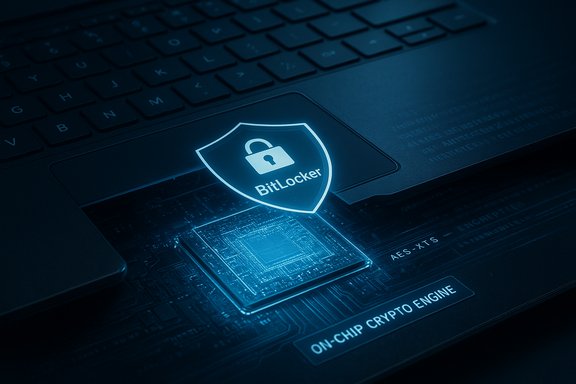
Microsoft’s plan to push BitLocker encryption into dedicated silicon on new Windows 11 PCs marks one of the most consequential changes to client-side disk encryption in years: encryption work will be offloaded from general-purpose CPU cores to on-chip crypto engines, and disk encryption keys will be wrapped and never exposed in system memory — a security and performance shift Microsoft says will begin appearing on qualifying hardware in 2026.
Microsoft has progressively moved Windows’ security model deeper into hardware for several release cycles. Device encryption became broadly enabled by default during the Windows 11 24H2 era, and features like Secure Boot, TPM, virtualization‑based protections and secure enclaves have become part of the baseline security posture for many new PCs. The new hardware‑accelerated BitLocker announcement extends that trajectory by changing where encryption work and key protection happen on the stack. Historically, BitLocker has been implemented largely in software with optional CPU instruction acceleration such as AES‑NI. The platform used the TPM as a root of trust to protect keys at rest, but the actual cryptographic operations and plaintext keys could, during operation, exist in system memory or be processed on general‑purpose CPU cores. That model exposes an attack surface that modern secure elements and hardware enclaves were built to reduce.
Microsoft’s public messaging frames two complementary changes: (1) crypto offload — moving AES and sector encryption to a hardware crypto engine on the SoC or CPU; and (2) silicon‑level key wrapping — keeping the Data Encryption Key (DEK) sealed inside a hardware boundary so the OS never observes raw key material. Microsoft says qualifying new devices will ship with this capability starting in 2026.
Independent historical tests have shown software BitLocker can impose noticeable performance impacts in certain scenarios — some SSDs and workloads saw tens‑of‑percent slowdowns in earlier benchmarks — but the magnitude varies by controller, firmware, CPU generation, and encryption mode. Hardware offload can erase most of that overhead when properly implemented, yet real‑world gains will depend on the following variables:
Source: Club386 Microsoft counts on hardware acceleration to transform BitLocker encryption | Club386
 Background
Microsoft has progressively moved Windows’ security model deeper into hardware for several release cycles. Device encryption became broadly enabled by default during the Windows 11 24H2 era, and features like Secure Boot, TPM, virtualization‑based protections and secure enclaves have become part of the baseline security posture for many new PCs. The new hardware‑accelerated BitLocker announcement extends that trajectory by changing where encryption work and key protection happen on the stack. Historically, BitLocker has been implemented largely in software with optional CPU instruction acceleration such as AES‑NI. The platform used the TPM as a root of trust to protect keys at rest, but the actual cryptographic operations and plaintext keys could, during operation, exist in system memory or be processed on general‑purpose CPU cores. That model exposes an attack surface that modern secure elements and hardware enclaves were built to reduce.Microsoft’s public messaging frames two complementary changes: (1) crypto offload — moving AES and sector encryption to a hardware crypto engine on the SoC or CPU; and (2) silicon‑level key wrapping — keeping the Data Encryption Key (DEK) sealed inside a hardware boundary so the OS never observes raw key material. Microsoft says qualifying new devices will ship with this capability starting in 2026.
What Microsoft announced — the headline features
- Hardware crypto offload: Bulk encryption/decryption for disk I/O will be executed by dedicated on‑chip engines instead of the host CPU cores, reducing CPU cycles spent on cryptography and lowering power consumption.
- Silicon‑level key protection: Encryption keys will be generated, wrapped, and stored inside a protected hardware domain — described as being at the “silicon level” — with the OS issuing cryptographic commands rather than handling plaintext keys.
- Performance and usability: Microsoft positions this mode as “faster, lower‑impact encryption by default” on qualifying new hardware, letting always‑on full‑disk encryption have less measurable effect on SSD throughput and system responsiveness.
Technical deep dive: how this actually differs from today
Software BitLocker (today)
- BitLocker’s encryption primitives and sector processing are invoked by Windows’ storage stack; AES‑NI and other CPU instructions accelerate certain math, but the OS still performs the orchestration and transient key material can be handled in system RAM. This has measurable CPU and I/O overhead on some workloads.
- The TPM historically provides attestation and storage of secrets (or sealed blobs), but it is not necessarily the execution environment that performs bulk encryption on every IO. Rather, it’s the root of trust and a sealed store for key material or key derivation roots.
Hardware‑accelerated BitLocker (the new model)
- Modern SoCs increasingly include dedicated crypto engines or security subsystems that accept high‑level commands: encrypt these bytes, decrypt these bytes. Those engines perform AES/XTS or equivalent transforms and hold key material within a protected boundary. Microsoft’s plan uses those engines as the execution target for disk encryption.
- Keys are wrapped/attested and only used inside the hardware boundary. The OS issues commands and receives ciphertext/plaintext buffers, but never reads the unwrapped DEK. This limits memory‑scraping, debugging and many kernel‑level exploitation vectors that rely on accessing plaintext keys in RAM.
- The design is analogous to existing patterns — self‑encrypting drives (SED), cloud HSMs, or secure enclaves — but differs in that the crypto engine becomes an integrated part of the client device’s root‑of‑trust and boot attest chain, rather than an optional peripheral.
Performance expectations and measured reality
Microsoft’s promise is straightforward: offload the compute-heavy parts and free CPU resources for applications, while reducing power draw. In theory, hardware crypto engines implemented with DMA‑friendly paths and tight SSD/controller integration should reduce latency and remove the SSD throughput penalties some users have measured with software BitLocker.Independent historical tests have shown software BitLocker can impose noticeable performance impacts in certain scenarios — some SSDs and workloads saw tens‑of‑percent slowdowns in earlier benchmarks — but the magnitude varies by controller, firmware, CPU generation, and encryption mode. Hardware offload can erase most of that overhead when properly implemented, yet real‑world gains will depend on the following variables:
- Quality and integration of the SoC/crypto engine and its driver.
- Firmware/UEFI cooperation and NVMe/driver path optimizations.
- SSD controller behavior and whether storage controllers still implement any additional crypto paths (OPAL/SED interactions).
- Workload patterns (sequential large transfers vs random small I/O).
Key protection, recovery, and operational implications
The idea that keys will never be exposed outside a hardware domain raises important operational questions for enterprises and technicians:- Recovery and escrow: When DEKs are tied to silicon, how will recovery keys be escrowed and restored if a motherboard or SoC fails? Microsoft’s messaging implies cloud escrow and existing recovery workflows will continue, but the exact attestation and migration flows (for example moving a drive to another machine) are not yet published. That gap matters for imaging, hardware refresh cycles, and disaster recovery planning.
- Drive mobility: Traditional BitLocker volumes can be moved and unlocked on another machine when keys are known or when recovery keys are available. Hardware‑wrapped keys may restrict this mobility unless explicit vendor workflows exist to unwrap/transfer keys through attestation. That constraint can be a security benefit — it prevents easy cloning — but imposes administrative overhead if not accompanied by clear recovery tooling.
- Forensics and incident response: Incident‑response teams used to extracting memory images or debugging kernel drivers may find fewer avenues for key recovery on affected hardware. That improves security but complicates legitimate forensic work; organizations must update playbooks and ensure backup keys are centrally escrowed and tested.
- Firmware and vendor trust: Key wrapping moves part of the trust model to OEMs and silicon vendors. Firmware bugs or supply‑chain compromises in the secure domain could become single points of failure; therefore firmware signing, attestation certificates and vendor security practices take on outsized importance. This also means timely firmware updates and vendor transparency are critical.
Post‑Quantum Cryptography: Microsoft’s parallel push
Microsoft is also moving aggressively to integrate Post‑Quantum Cryptography (PQC) into Windows’ cryptographic stacks. PQC primitives such as ML‑KEM (key encapsulation) and ML‑DSA (signatures) have been introduced in SymCrypt and made available to Windows Insiders; Microsoft announced PQC APIs as generally available in Windows Server 2025 and Windows 11 in November 2025. Why this matters in the BitLocker context:- Harvester risk: Organizations face a “harvest now, decrypt later” threat in which adversaries collect encrypted data today and decrypt it once large quantum computers exist. Microsoft’s PQC APIs let customers experiment with hybrid or pure‑PQC schemes so they can start migrating critical flows and certificates.
- Algorithm and ciphertext size tradeoffs: PQC algorithms generally produce larger keys and ciphertexts and sometimes impose CPU or bandwidth costs. That will affect designs for disk‑level envelopes, key exchange, and certificate infrastructure, and further motivates efficient hardware acceleration for PQC math where possible.
Strengths of Microsoft’s approach
- Security by default at the silicon level: Keeping keys inside hardware domains vastly reduces risk from memory theft, speculative‑execution side channels, and many root‑level attacks that rely on exposing plaintext key material. This is a high‑impact improvement in the threat model for disk encryption.
- Performance and power benefits: Offloading crypto to specialized hardware can reduce CPU utilization and battery drain on laptops, while improving I/O latency for encryption‑heavy workloads when integrated properly.
- Consistency with platform hardening trends: The change aligns BitLocker with other Microsoft moves — default device encryption, TPM/Pluton enhancements, and virtualization‑based containment — creating a more consistent trust architecture across Windows devices.
- PQC readiness: Building PQC into Windows’ crypto APIs and libraries now gives enterprises breathing room to plan migration, test interoperability, and exercise crypto‑agility before quantum threats become practical.
Risks, gaps, and open questions
- Unclear hardware compatibility matrix: Microsoft’s announcement points to a 2026 hardware roll‑out but does not list supported SoC/CPU SKUs or OEM device lists. IT and procurement teams can’t yet map which devices will ship with the necessary silicon and firmware support. Treat calendar claims and compatibility as provisional until vendors publish specifics.
- Recovery semantics and manageability: Details about recovery key escrow, cross‑device migration, and enterprise‑scale key management for silicon‑wrapped keys are not fully documented publicly. These are critical details for large deployments and disaster recovery planning.
- Vendor and firmware risk: Moving trust into firmware increases dependence on OEM security practices. Firmware vulnerabilities or supply‑chain compromises could have systemic consequences if secure enclaves are compromised. Organizations must demand transparency and patching promises from vendors.
- Transition complexity for mixed fleets: Enterprises with heterogeneous hardware will face policy complexity: some devices will support hardware BitLocker, others will remain on software BitLocker. Managing a coherent policy, performance expectations, and recovery across such fleets will require careful MDM and documentation updates.
- Unverifiable calendar specifics: Several secondary reports cite “spring 2026” or “starting in 2026” for hardware availability. While Microsoft’s Ignite materials and Windows press coverage indicate 2026 as the target period, no single Microsoft product page enumerating devices, driver models and the official feature name was available at the time of the briefing; treat specific GA dates as conditional until Microsoft and OEMs publish formal hardware/firmware rollout documentation.
Guidance for IT administrators and power users
- Inventory: Identify devices that are likely to ship on the 2026 hardware cadence (Copilot+, modern OEM SKUs) and ask vendors directly whether they expose a hardware crypto engine and secure enclave for disk encryption.
- Test: Build a lab with representative hardware to validate performance, recovery workflows, and imaging processes. Emulate drive swap and motherboard failure scenarios to test key recovery and business‑continuity procedures.
- Update processes: Revise imaging and provisioning documentation to account for hardware‑wrapped keys; ensure recovery keys are centrally escrowed, tested and accessible to authorized teams.
- Vendor SLAs: Require firmware update SLAs, signed firmware attestations, and a clear security incident notification process from OEMs and silicon vendors.
- Start PQC experiments: Leverage Microsoft’s PQC APIs and SymCrypt preview builds to begin hybrid PQC testing for TLS, certificates and identity infrastructure. Plan for increased key/ciphertext sizes and test performance implications.
- Staged adoption: Use a phased pilot approach — pilot a small user group on hardware BitLocker, validate manageability and recovery, then widen deployment. Avoid fleet‑wide policy flips without vendor validation.
Conclusion
Hardware‑accelerated BitLocker — offloading cryptography to on‑chip engines and wrapping keys at the silicon level — is a logical and technically powerful evolution of Windows’ disk‑encryption story. It promises meaningful improvements in security posture and performance, and it dovetails with Microsoft’s broader push toward hardware‑rooted trust and post‑quantum readiness. At the same time, the change raises essential operational questions around recovery, device mobility, firmware trust and vendor responsibilities that are not fully resolved in public materials. Organizations preparing to adopt these features should begin inventorying, testing and updating policies now — demand vendor documentation, plan staged deployments, and exercise recovery workflows before relying on hardware‑wrapped keys in production. The next 12–24 months will determine how smooth and secure this transition becomes across OEMs, silicon vendors and the enterprise Windows ecosystem.Source: Club386 Microsoft counts on hardware acceleration to transform BitLocker encryption | Club386
