

Microsoft’s push to harden online gaming with hardware-rooted checks — TPM 2.0, UEFI Secure Boot, Virtualization‑based Security (VBS) and remote attestation — has suddenly turned an arcane firmware feature set into something every PC gamer needs to understand, and in practice it could mean your machine will perform cryptographic checks with cloud services when publishers or anti‑cheat systems request verification of your boot state.
The videogame industry’s anti‑cheat arms race has escalated past user‑mode heuristics and into the boot chain. Modern cheat toolkits increasingly target low‑level firmware and kernel subsystems, allowing malicious code to persist across reboots and evade conventional detection. To blunt that trend, Microsoft has been promoting a layered, hardware‑anchored model for “trusted” game clients that relies on the Trusted Platform Module (TPM 2.0), UEFI Secure Boot, hypervisor isolation (VBS/HVCI), and cloud‑based remote attestation. Microsoft frames this as a cooperative model — one that gives developers cryptographically verifiable evidence that a PC booted into a known, untampered state. Major publishers have already adopted or piloted elements of this model. Activision’s RICOCHET anti‑cheat and EA’s Javelin require TPM 2.0 and Secure Boot in some title phases, and several publishers plan to verify those platform signals through server‑side attestation flows that involve Microsoft or Azure services. That is the practical root of the “ping to the cloud” headline that many outlets have used: when a remote verifier requests a TPM quote to validate a measured boot, the client — or the game’s backend — will necessarily interact with an attestation service.
Remote attestation is, by design, a cryptographic request/response sequence: a verifier (usually a cloud service or game server) asks the TPM for a signed “quote” of measurement registers, then compares the measurements to an expected baseline. That interaction requires network communication when performed by a remote verifier. Publishers like Activision plan to use such flows to validate TPM/Secure Boot state during matchmaking or account verification, and Microsoft’s platform guidance leaves remote attestation available to partners. That is the factual basis for headlines saying your PC could “ping” a cloud service. Important caveats and clarifications:
Microsoft’s platform‑level anti‑cheat shift is a major inflection point for PC gaming security: technically sensible and potentially powerful, but only as trustworthy as the policies and engineering practices that accompany it. The ability to cryptographically prove a clean boot state gives developers a real advantage in the fight against cheating — but it also raises practical, privacy and governance questions that require clear, public answers before the feature becomes a permanent part of the multiplayer experience.
Source: TechSpot Microsoft's new gaming anti-cheat could ping your PC to the cloud every time you boot
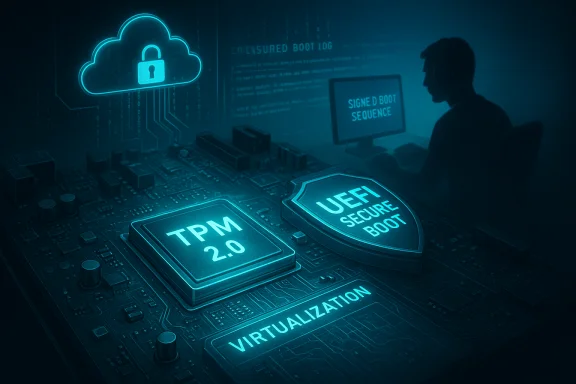 Background / Overview
The videogame industry’s anti‑cheat arms race has escalated past user‑mode heuristics and into the boot chain. Modern cheat toolkits increasingly target low‑level firmware and kernel subsystems, allowing malicious code to persist across reboots and evade conventional detection. To blunt that trend, Microsoft has been promoting a layered, hardware‑anchored model for “trusted” game clients that relies on the Trusted Platform Module (TPM 2.0), UEFI Secure Boot, hypervisor isolation (VBS/HVCI), and cloud‑based remote attestation. Microsoft frames this as a cooperative model — one that gives developers cryptographically verifiable evidence that a PC booted into a known, untampered state. Major publishers have already adopted or piloted elements of this model. Activision’s RICOCHET anti‑cheat and EA’s Javelin require TPM 2.0 and Secure Boot in some title phases, and several publishers plan to verify those platform signals through server‑side attestation flows that involve Microsoft or Azure services. That is the practical root of the “ping to the cloud” headline that many outlets have used: when a remote verifier requests a TPM quote to validate a measured boot, the client — or the game’s backend — will necessarily interact with an attestation service. What Microsoft and publishers are proposing (the technical facts)
The building blocks
- TPM 2.0 — a hardware or firmware module (dTPM, fTPM, Intel PTT) that securely stores keys and logs measured‑boot values. TPM anchors cryptographic attestations about how a machine booted.
- UEFI Secure Boot — firmware enforcement that permits only signed early‑boot components to run, blocking unsigned bootkits and many persistent cheat vectors.
- Virtualization‑based Security (VBS) / HVCI — hypervisor isolation for security services, reducing the risk of kernel tampering during runtime.
- Remote attestation — a cryptographic protocol that lets a cloud verifier validate a device’s measured boot values (as recorded in the TPM) against an expected baseline. This is the mechanism publishers are beginning to use to prove that Secure Boot and TPM protections were present and effective when the system started.
Verified, concrete publisher requirements
Activision’s official guidance clearly states that for Call of Duty: Black Ops 7 (beta and launch) the game will require TPM 2.0 and Secure Boot on PC, and it specifies supported OS and CPU baselines (Windows 10 22H2 or Windows 11; Intel 8th‑gen or newer with PTT; AMD Ryzen 2000+ with fTPM). Activision also confirms it will use an Azure‑backed remote verification flow to validate those settings. Microsoft’s Xbox Wire post frames the same architecture as a platform‑level foundation for fair play and explicitly lists TPM 2.0, Secure Boot, VBS and remote attestation as the key protections developers should rely on. Microsoft’s guidance urges players to keep firmware and Windows up to date and to enable these features so anti‑cheat teams have higher‑integrity signals to act on.Does “pinging the cloud every time you boot” describe reality?
Short answer: not exactly, and the distinction matters.Remote attestation is, by design, a cryptographic request/response sequence: a verifier (usually a cloud service or game server) asks the TPM for a signed “quote” of measurement registers, then compares the measurements to an expected baseline. That interaction requires network communication when performed by a remote verifier. Publishers like Activision plan to use such flows to validate TPM/Secure Boot state during matchmaking or account verification, and Microsoft’s platform guidance leaves remote attestation available to partners. That is the factual basis for headlines saying your PC could “ping” a cloud service. Important caveats and clarifications:
- Remote attestation is not inherently a continuous telemetry stream. It is a discrete cryptographic exchange that can be invoked on demand — typically at game launch, matchmaking, enrollment, or when a publisher’s back end requests a recheck. The frequency and timing are implementation choices publishers and anti‑cheat vendors make, not an automatic global behavior forced by Windows itself. Treat claims of a boot‑every‑boot ping as a simplification unless you see a publisher‑level policy that specifies otherwise.
- What is sent in an attestation exchange are measured‑boot values and cryptographic evidence — not arbitrary files or personal documents. However, the exact signals collected, the retention policy, and who can query attestation results are operational questions publishers must disclose. Many of those governance details remain under-specified in public messaging today. That opacity drives justified privacy concerns.
What this achieves — strengths and practical benefits
- Raises the technical bar for cheat authors. Hardware‑anchored attestations force cheats to circumvent firmware, TPM protections or code signing — a far higher engineering effort than user‑mode hacks. This increases the cost and lowers the scale of many attackers.
- Stronger forensic signals. Measured‑boot logs and TPM‑protected attestations give anti‑cheat teams cryptographic evidence, improving detection fidelity and reducing false positives from heuristic heuristics.
- Reduces some invasive client scanning. With a reliable attestation signal, vendors can rely less on heavy‑handed telemetry or file system heuristics to decide whether a client is trustworthy. That can, in theory, be less intrusive for players while improving fairness.
- Aligns PC practices with console security. Xbox consoles have long used hardware‑anchored security. Applying proven patterns on Windows can make multiplayer ecosystems more resilient when implemented carefully.
The trade‑offs and risks every player and admin must weigh
1) Privacy and data‑governance ambiguity
Remote attestation involves device state signals. Publishers must clearly declare:- exactly which TPM measurements or flags are requested,
- whether attestation results are linked to account identities,
- retention periods and access controls,
- whether attestations are reused for unrelated purposes (DRM, device gating).
Absent explicit policies, users and regulators will rightly press for transparency. Flagging vendor telemetry claims is important: numbers like “X cheaters blocked” are vendor claims until independently corroborated.
2) Exclusion and fragmentation
Not all systems can meet TPM 2.0 / Secure Boot requirements — older desktops, many Linux installs, some Steam Deck/handheld setups, and certain multi‑boot configurations may be excluded or have significant friction. Requiring these features without robust fallbacks or grace periods risks fragmenting player communities. Publishers have used phased rollouts to mitigate shock, but exclusion remains a practical consequence.3) Support burden and data‑loss hazards
Enabling Secure Boot and switching boot modes (Legacy/MBR → UEFI/GPT) can trigger BitLocker recovery prompts and conversion failures if done without backups. Many players will need step‑by‑step vendor or publisher guides to avoid data loss. Microsoft and publishers must provide clear recovery flows and guidance.4) Kernel anti‑cheat surface and stability
Kernel‑level anti‑cheat drivers and any early‑boot components run with high privilege. Bugs or misconfigurations can produce system instability or security vulnerabilities. Historically, poorly written kernel drivers — from any vendor — have led to crashes and privilege‑escalation bugs. Strong engineering, audits and bug bounties are non‑negotiable mitigations.5) Potential for mission creep
Attestation could be repurposed for DRM, platform gating or discriminatory policies unless bounded by policy and oversight. Publishers and Microsoft must explicitly limit attestation to anti‑cheat purposes (or publish clear use cases and opt‑outs) to prevent scope creep.Practical checklist — what players should do now
If you want to be ready for titles that enforce attestation and boot‑level requirements (for example, Call of Duty: Black Ops 7), follow this sequence carefully and back up before attempting firmware or disk operations. This checklist synthesizes Microsoft/publisher guidance and community best practice.- Back up everything — full image preferred. Export BitLocker recovery keys and copy them to a secure location.
- Verify platform state:
- Run Windows + R → tpm.msc and check “Specification Version = 2.0.”
- Run msinfo32 and confirm BIOS Mode = UEFI and Secure Boot State = On.
- If your disk uses MBR and your firmware is Legacy, use Microsoft’s MBR2GPT tool only after validating the disk layout and backing up. Do not attempt conversions without a tested backup and vendor guidance.
- Suspend BitLocker protection before changing firmware; re‑enable only after verifying the system boots correctly. Failure to suspend BitLocker is the most common cause of unexpected recovery screens.
- Check manufacturer support for BIOS/UEFI updates — many AMD platforms required firmware fixes during early rollouts of attestation features. If in doubt, contact your OEM.
- Test the game in non‑blocking mode (publishers often phase in enforcement). If a title provides a one‑time TPM enrollment or registration flow, follow the official steps carefully.
For developers and platform teams — implementation & governance checklist
- Publish precise, machine‑readable policies describing what attestation checks are performed, what measurements are sent, and retention/access controls.
- Use phased enforcement modes (warning → limited matchmaking → full block) to allow the community to adapt and to gather telemetry on false positives and compatibility breakage.
- Fund OEM firmware updates and provide vendor‑specific guidance for common motherboard/chipset families.
- Harden and audit kernel‑level components; enlist third‑party security reviews and bug bounty programs.
- Provide Rapid Recovery support flows and easy, well‑documented BitLocker recovery instructions so players don’t lose access to data during configuration changes.
Community and competitive fairness concerns
An overlay or assistant that captures screen content or performs in‑game analysis (for example, AI Copilot features inside Game Bar) raises a separate but related set of questions about tournament rules and fairness. Tournament organizers and anti‑cheat vendors must define whether in‑overlay AI assistance is permitted in competitive contexts. Until clear whitelisting or per‑title controls appear, conservative players and tournament admins should default to disabling assistant overlays in ranked play.Cross‑checking claims and independent corroboration
- Activision’s official support pages state TPM 2.0 and Secure Boot requirements for Black Ops 7 and confirm an Azure‑backed attestation flow for validation. That is a primary, authoritative publisher source.
- Microsoft’s Xbox Wire post publicly documents the platform features (TPM 2.0, Secure Boot, VBS, remote attestation) and promotes them as the basis for fair play across Windows and Xbox. That aligns with publisher messaging and establishes Microsoft’s intent and capabilities.
- Independent press coverage (PC Gamer, The Verge, Windows Central, TechRadar and others) corroborates the adoption trend and highlights community concerns about privacy, compatibility and performance. Use these outlets for broader context around industry reaction and hands‑on testing.
Final analysis — a measured verdict
Microsoft’s and several publishers’ move to platform‑anchored anti‑cheat is technically defensible and will materially increase the difficulty of producing reliable, persistent cheats. For the majority of modern Windows 11 PCs the changes will be low friction and will likely improve the day‑to‑day fairness of multiplayer experiences. However, implementation quality, user communication, and governance will determine whether this evolution strengthens communities or fractures them. Poor documentation or opaque telemetry practices will erode trust; heavy‑handed enforcement without recovery flows and vendor guidance will produce support incidents and possible data‑loss scenarios for inexperienced users. The most immediate risks are:- user exclusion (older hardware, Linux/SteamOS users, handheld owners),
- BitLocker and partitioning mishaps during firmware changes,
- privacy concerns where attestation flows and retention policies are not transparent,
- and stability issues if kernel‑mode anti‑cheat drivers are not rigorously audited.
What to do next (concise steps for readers)
- Back up your PC and export BitLocker keys before making firmware or partition changes.
- Check TPM and Secure Boot now (tpm.msc and msinfo32) and update firmware at the vendor site if needed.
- Follow publisher guidance for enrollment prompts or one‑time TPM registration flows when a game asks you to register your TPM/attestation.
- Demand transparency: insist publishers disclose exactly what attestation checks do, when they run, and how attestation evidence is kept and used.
Microsoft’s platform‑level anti‑cheat shift is a major inflection point for PC gaming security: technically sensible and potentially powerful, but only as trustworthy as the policies and engineering practices that accompany it. The ability to cryptographically prove a clean boot state gives developers a real advantage in the fight against cheating — but it also raises practical, privacy and governance questions that require clear, public answers before the feature becomes a permanent part of the multiplayer experience.
Source: TechSpot Microsoft's new gaming anti-cheat could ping your PC to the cloud every time you boot
