

HCLSoftware’s new collaboration with Microsoft aims to package the vendor’s Xperience‑Data‑Operations (XDO) blueprint as Azure‑hosted, marketplace‑transactable solutions—an effort designed to fast‑track AI‑powered digital transformation by unifying customer experience, data intelligence, and operational automation under a single, governed architecture.
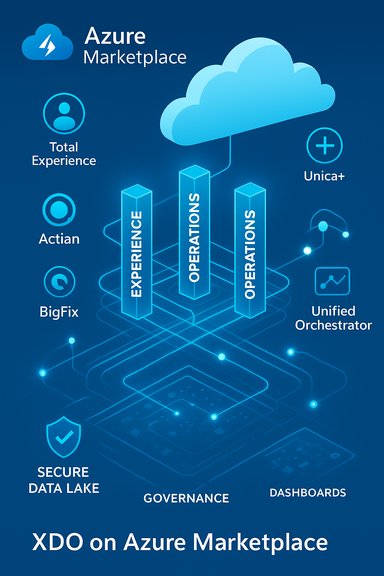
Enterprises today face three simultaneous pressures: rapidly rising customer expectations, sprawling legacy estates that still run critical services, and an urgent need to operationalize generative AI without creating new governance and reliability headaches. HCLSoftware’s XDO framework responds to those pressures by claiming to combine three domains—Experience (X), Data (D), and Operations (O)—into a single blueprint so businesses can design intelligent journeys, feed them with governed data, and run them reliably with automated operations. The vendor says this blueprint will be delivered on Microsoft Azure and integrated with Azure’s AI, data and security services, with the HCL portfolio made available via the Microsoft Marketplace for easier procurement and consumption. At a technical level, HCL maps established products to the XDO domains: HCL Total Experience and HCL Unica+ for customer experience/marketing orchestration; HCL Actian for the data layer; and HCL BigFix, HCL Workload Automation and HCL Universal Orchestrator for operational automation and resilience. These components will be hosted on Azure and exposed as Marketplace listings to unlock Azure billing, standardized procurement terms, and potential Microsoft co‑sell motions.
Microsoft’s role is presented as both platform and operational AI fabric: Azure Data services, Azure AI Foundry (the model/catalog/agent runtime), and Azure security/identity controls will serve as the runtime, governance and model‑management layer for any generative‑AI or agentic features HCL ships as part of XDO. Azure AI Foundry provides model/agent catalogs, lifecycle management, observability and policy enforcement—which are precisely the primitives enterprises need to move agentic AI from prototype to production.
For enterprises planning to adopt XDO on Azure, the most pragmatic path is a disciplined, metrics‑driven pilot that establishes data readiness, operational guardrails, and financial controls—then scale responsibly once the outcome metrics and governance frameworks prove repeatable. The HCL + Microsoft move sets a strong technical and commercial baseline for AI‑first transformation; it will succeed in proportion to how honestly organizations account for the operational and governance work that sits between a good pilot and a durable, productionized AI capability.
Source: varindia.com HCLSoftware, Microsoft partner to drive AI-powered
 Background / Overview
Enterprises today face three simultaneous pressures: rapidly rising customer expectations, sprawling legacy estates that still run critical services, and an urgent need to operationalize generative AI without creating new governance and reliability headaches. HCLSoftware’s XDO framework responds to those pressures by claiming to combine three domains—Experience (X), Data (D), and Operations (O)—into a single blueprint so businesses can design intelligent journeys, feed them with governed data, and run them reliably with automated operations. The vendor says this blueprint will be delivered on Microsoft Azure and integrated with Azure’s AI, data and security services, with the HCL portfolio made available via the Microsoft Marketplace for easier procurement and consumption. At a technical level, HCL maps established products to the XDO domains: HCL Total Experience and HCL Unica+ for customer experience/marketing orchestration; HCL Actian for the data layer; and HCL BigFix, HCL Workload Automation and HCL Universal Orchestrator for operational automation and resilience. These components will be hosted on Azure and exposed as Marketplace listings to unlock Azure billing, standardized procurement terms, and potential Microsoft co‑sell motions.Microsoft’s role is presented as both platform and operational AI fabric: Azure Data services, Azure AI Foundry (the model/catalog/agent runtime), and Azure security/identity controls will serve as the runtime, governance and model‑management layer for any generative‑AI or agentic features HCL ships as part of XDO. Azure AI Foundry provides model/agent catalogs, lifecycle management, observability and policy enforcement—which are precisely the primitives enterprises need to move agentic AI from prototype to production.
What the announcement actually says (verified claims)
The core commercial commitments
- HCLSoftware will deliver its XDO blueprint on Microsoft Azure and make the underlying products available through the Microsoft Marketplace.
- The XDO stack includes HCL Total Experience, HCL Unica+, HCL Actian, HCL BigFix, HCL AppScan on Cloud, HCL Universal Orchestrator, and HCL Workload Automation (product mapping supplied by HCL).
- The collaboration will leverage Azure Data, Azure AI Foundry, and Azure security capabilities for model hosting, governance and production controls.
Early go‑to‑market signals
- HCLSoftware reported that within weeks of the ISV collaboration being formalized it had closed three large enterprise deals via the Microsoft Marketplace, an example of early marketplace traction reported in multiple outlets. This claim is notable because it signals demand—but public buyer details were not disclosed and the contracts were not visible in public procurement records at time of reporting, so treat the announcement as positive GTM momentum rather than proof of broad commercial scale.
Why XDO on Azure matters: strategic and technical context
Marketplace-first ISV economics
Microsoft’s commercial marketplace is more than a listing: it is an integrated procurement, billing and co‑sell channel. Publishing enterprise software as transactable Marketplace offers can shorten procurement cycles, enable Azure billing consolidation, and—if the ISV meets Microsoft’s program criteria—open the door to Microsoft field engagement and co‑sell incentives. For HCL, packaging XDO components on Marketplace is a pragmatic route to remove contractual and billing friction for Azure‑centric customers and to plug into Microsoft’s partner motions.Azure AI Foundry as the operational layer for agentic AI
One of the most consequential technical alignments in the announcement is the use of Azure AI Foundry as the operational backbone for models and agents. Foundry is purpose‑built for model lifecycle management, agent orchestration, observability and enterprise controls (identity, network isolation, content safety). Those functions address three common blockers for enterprise AI: model governance, production observability, and secure tool execution for agents. Azure AI Foundry’s catalog approach—offering a curated set of foundation, task and industry models, plus tooling for RAG (retrieval‑augmented generation)—maps directly to XDO’s requirement to connect customer experiences with governed data and reliable operations.Practical integration points
- Data fabric: XDO will rely on a combination of HCL’s data offerings (Actian) and Azure Data services (Databricks, Synapse/Fabric, Azure Data Factory patterns) to build an enterprise data layer for analytics and RAG usage. This hybrid approach gives customers a choice between HCL‑managed data plumbing and Azure native services for storage, transformation and indexing.
- Agent toolchain: Agents in Foundry can be connected to enterprise knowledge stores (SharePoint, Azure AI Search) and to action tools (Azure Functions, Logic Apps) for secure orchestration—useful when automations must access sensitive systems or trigger downstream processes.
- Security and compliance: Hosting on Azure brings identity and access controls via Microsoft Entra (Azure AD), Azure network and policy controls, and Microsoft’s compliance attestations—prerequisites for regulated industries.
Notable strengths of the collaboration
- Clear product-to-problem mapping. HCL’s portfolio already addresses CX, data, and operations concerns; mapping those to an XDO blueprint reduces ambiguity for customers evaluating an end‑to‑end solution rather than a point product.
- Operational AI primitives via Foundry. Rather than shipping LLMs in isolation, the partnership leverages Foundry’s lifecycle, agent and governance features—this materially lowers the barrier for taking agentic AI into production at scale.
- Marketplace procurement and co‑sell potential. Packaging XDO components as Marketplace offers enables simplified procurement and opens Microsoft’s commercial field for co‑selling if the partnership meets program requirements; in practice this can accelerate pilot to production timelines.
- Speed to hybrid adoption. Enterprises that already run on Azure can trial or buy HCL solutions without heavy integration overhead, while organizations that prefer hybrid models retain flexibility because Azure supports bring‑your‑own storage and controlled network topologies.
Real risks, gaps and unanswered questions
While the strategic logic is strong, the combined solution exposes several pragmatic and governance risks that CIOs must weigh.1) Marketplace wins ≠ long‑term adoption
Closing deals through the Marketplace is a meaningful sales progress signal, but Marketplace purchase events often begin as pilots or limited subscriptions. There was no public buyer disclosure for the three deals HCL cited, leaving the broader scale and renewal economics unverified. Treat early Marketplace wins as promising GTM signals, not definitive proof of durable market traction.2) Integration complexity with legacy estates
HCL markets XDO as a way to “retrofit AI into legacy systems,” but connecting high‑quality signals to LLMs requires careful data engineering, de‑duplication, metadata, and semantic indexing. These are non‑trivial tasks: RAG requires curated retrieval indices and ongoing maintenance, and many enterprises underestimate the data‑ops effort required. Expect substantial upfront data work before AI features deliver reliable outcomes.3) Model governance and auditability costs
Foundry supplies governance primitives, but running model‑driven agents at scale requires continuous evaluation budgets, human‑in‑the‑loop review processes, and legal/compliance sign‑offs—especially in regulated sectors. Those costs are often underbudgeted and require new operational roles (ML Ops, AI Risk Officers).4) Vendor lock‑in and portability tradeoffs
Packaging HCL’s stack as Azure‑hosted Marketplace offers accelerates procurement but increases coupling to Azure services (Foundry, Azure Data, Entra). Customers must evaluate the TCO and vendor lock‑in effects—particularly if they want cloud portability or to maintain a multi‑cloud posture. If portability matters, plan an abstraction layer for data and workloads.5) Hidden operational and FinOps costs
Production‑grade agentic systems lock in continuous compute, retrieval and observability costs. Running Foundry agents that call multiple tools, perform vector searches and maintain state can rapidly increase spend if not governed by FinOps controls and quotas. Clear cost models and metering are essential before scaling beyond pilot use.Practical guidance for IT leaders (how to evaluate and adopt XDO on Azure)
Short checklist (quick validation)
- Confirm whether your core workloads and identity exist in Azure or if you will migrate them.
- Map the specific use cases (e.g., campaign orchestration, incident automation, doc‑assistant) to HCL products and identify the data sources each use case needs.
- Budget for data engineering, MLOps and ongoing model evaluation—not just license or Marketplace purchase price.
- Insist on portability and escape hatches: exportable data, model artifacts, and documented runbooks for recovery or reprovisioning.
Recommended phased adoption plan
- Discovery & Use‑Case Prioritization. Rank 2–3 high‑value use cases (one CX, one automation, one analytics) and formalize success metrics (KPIs) and compliance criteria.
- Proof of Value (4–8 weeks). Deploy a minimally invasive pilot using HCL Unica+ or Total Experience plus a RAG path into a controlled dataset. Use Azure AI Foundry’s catalog models and instrument evaluation metrics from day 1.
- Operationalize (3–6 months). Harden the pipeline: production vector index, reuseable prompts, test harnesses, observability dashboards, and role‑based access.
- Scale & Govern. Add FinOps, continuous evaluation, incident runbooks, and automated safety filters. Consider an internal AI Risk Board for high‑impact automations.
- Sustain & Optimize. Regularly evaluate both model performance and cost, iterate on retraining/fine‑tuning strategies and on data‑ops to reduce drift.
Technical controls to insist on
- Identity and access via Microsoft Entra with least‑privilege roles for agents and tools.
- Fine‑grained observability for agent threads, tool calls, and model decisions using application telemetry.
- Content safety and prompt‑injection mitigations provided by Foundry content filters and enterprise policies.
- Data residency and encryption options for regulated workloads (bring‑your‑own storage, managed networks).
Technical deep dive: how XDO could look in production
Experience (X)
HCL Total Experience and HCL Unica+ provide content personalization and campaign orchestration. When combined with a RAG pipeline and conversational front ends, marketers can deliver contextual, near‑real‑time experiences across channels. That requires:- Customer profile unification and event streaming into a low‑latency index.
- Semantic embeddings stored in a vector index for RAG retrieval.
- Prompt templates and guardrails to ensure consistent brand tone.
Data (D)
HCL Actian plus Azure Data services form the data fabric: ingestion (Data Factory, Databricks), transformation (Spark/SQL in Synapse or Fabric), and semantic indexing (Azure AI Search, vector stores via Foundry). Data governance layers manage lineage, PII masking and compliance.Operations (O)
BigFix, Workload Automation and Universal Orchestrator provide the runbook and endpoint controls for production operations. Agents deployed through Foundry can orchestrate workflows, trigger automations and call operational tools—but must always be constrained by identity and policy to avoid runaway automation. Observability and incident playbooks become the final line of defense.Commercial and procurement considerations
- Marketplace advantages: faster purchase, Azure‑billing consolidation, potential co‑sell with Microsoft sellers.
- Negotiation levers: seek clear SLAs for model availability if Foundry‑hosted models are part of critical paths, and request data portability and export clauses in the commercial terms.
- Proof‑of‑value billing: structure early engagements as time‑boxed pilots with clear success metrics and staged commitments to reduce risk.
- Third‑party validation: require independent security and compliance attestations for agentic features that will access regulated data.
What to watch next (market signals and verification)
- Contract disclosures: look for named customer case studies and contract sizes that validate the “three deals” claim beyond vendor PR. Multiple outlets have reported the early Marketplace wins, but vendor‑level claims require public confirmations (e.g., case studies or customer stories) to verify scale.
- Foundry adoption patterns: monitor Azure AI Foundry documentation and case studies to see how enterprises are instrumenting multi‑agent systems in production; Foundry’s role in operational AI is central to XDO’s promise.
- Pricing and FinOps transparency: watch for concrete pricing examples from HCL or Microsoft showing the end‑to‑end cost of running an XDO scenario (compute, model calls, storage, observability).
Conclusion
HCLSoftware’s decision to package the XDO blueprint on Azure and transact via the Microsoft Marketplace is a strategically sensible move: it accelerates procurement, aligns with Microsoft’s partner incentives, and leverages Azure AI Foundry’s production‑grade agent and model controls to mitigate many of the operational risks enterprises face today. The product mapping between HCL’s existing suite and XDO is coherent, and making those components available on Azure lowers friction for customers already embedded in the Microsoft ecosystem. That said, the hard work—data engineering, MLOps, cost governance and model auditing—remains with customers. Early Marketplace wins are encouraging but not definitive proof of large‑scale adoption; organizations should treat this partnership as an enabling platform and continue to insist on clear cost models, portability options, and rigorous governance before scaling agentic AI across mission‑critical processes.For enterprises planning to adopt XDO on Azure, the most pragmatic path is a disciplined, metrics‑driven pilot that establishes data readiness, operational guardrails, and financial controls—then scale responsibly once the outcome metrics and governance frameworks prove repeatable. The HCL + Microsoft move sets a strong technical and commercial baseline for AI‑first transformation; it will succeed in proportion to how honestly organizations account for the operational and governance work that sits between a good pilot and a durable, productionized AI capability.
Source: varindia.com HCLSoftware, Microsoft partner to drive AI-powered
