

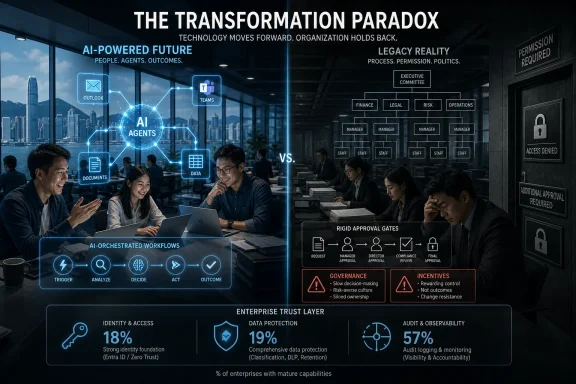
Microsoft’s 2026 Work Trend Index says Hong Kong workers are adopting AI faster than their employers are redesigning work, with 18 percent of local AI users classified as Frontier Professionals and only 19 percent reporting clearly aligned leadership on AI. That is not a story about laggards resisting the future. It is a story about employees improvising their way into a new operating model while management still treats AI as a productivity feature. The result is Microsoft’s neatest phrase in the report and the messiest reality inside companies: a Transformation Paradox.
The paradox matters because it cuts against the most comforting version of the AI-at-work narrative. For the past two years, executives have been told that the hard part was adoption: buy the tools, train the staff, watch productivity rise. Hong Kong’s numbers suggest the harder part begins after adoption, when workers discover that the job has changed but the org chart, incentives, approvals, governance, and management habits have not.
Microsoft’s Hong Kong data lands with a sharper edge than the global average because the city appears to have a relatively advanced user base and a relatively underprepared management layer. The headline figure is flattering: 18 percent of Hong Kong AI users fall into Microsoft’s “Frontier Professionals” category, compared with 16 percent globally. These are the workers who do not merely ask a chatbot to polish an email; they use agents for multi-step workflows, build multi-agent systems, and treat AI as part of how work gets decomposed and executed.
That sounds like the sort of statistic every regional technology leader would want in a keynote. Hong Kong has spent years positioning itself as a finance, logistics, professional services, and innovation hub, and an above-average share of advanced AI users fits the city’s self-image. The problem is that talent readiness is only one side of the equation. Microsoft’s survey says just 19 percent of Hong Kong AI users believe leadership is clearly and consistently aligned on AI, below the global figure of 26 percent.
That gap turns a good-news adoption story into an operating-model warning. Employees can learn prompts faster than a company can rewrite performance metrics. They can automate recurring work faster than legal, compliance, HR, and line managers can agree on what should be automated. They can build a workflow with an agent faster than a company can decide who is accountable when that workflow produces a bad recommendation, sends the wrong file, or optimizes for the wrong business outcome.
This is where the Hong Kong findings feel less like a regional curiosity and more like a preview of the next enterprise IT fight. AI adoption has escaped the pilot phase in many organizations, but organizational design has not. The same employee who is told to “innovate with AI” is still measured against quarterly targets, legacy service levels, billable-hour expectations, approval chains, and managers who may or may not understand what good AI-assisted work looks like.
That is a big statement because it moves the argument away from the user and toward the institution. The first wave of enterprise AI discourse put enormous pressure on individuals: learn the tools, become AI fluent, do not fall behind. Microsoft’s Hong Kong data shows that 75 percent of local AI users fear falling behind if they do not adapt quickly. That is a remarkable level of workplace anxiety, and it helps explain why employees are experimenting even when their companies have not provided a stable framework.
Yet fear is a poor substitute for strategy. If workers believe that adapting is urgent but also believe that redesigning work is risky, they will use AI in the least institutionally disruptive ways. They will summarize documents, draft emails, generate slides, clean up notes, and prepare analysis around the edges of existing processes. They will get faster at the work they already do, but the company will not necessarily become better at deciding what work should exist in the first place.
That is the ceiling Microsoft is trying to name. AI can raise individual output before it changes the business. It can make a consultant draft faster without changing the engagement model, make a claims handler triage faster without changing the escalation process, or make a sales team generate more account research without changing what leadership considers a qualified opportunity. Productivity rises locally while complexity remains globally intact.
This is not irrational. Most organizations reward predictable delivery more reliably than reinvention. The Hong Kong data says only 10 percent of local AI users feel rewarded for reinventing work with AI when results are not immediate. That means nine out of ten workers are operating in a system where experimentation may be rhetorically encouraged but practically unrewarded, or worse, quietly penalized when it slows visible output.
The consequence is a kind of hidden tax on AI transformation. Workers experiment after hours, between meetings, or inside personal productivity loops that do not threaten official processes. Teams develop private workarounds. Managers see output improve but may not see the underlying workflow change. IT departments then inherit a governance problem because the most meaningful experimentation has happened outside formal design.
For WindowsForum readers who live in the practical world of deployments, compliance reviews, identity permissions, endpoint management, and support queues, this should sound familiar. Enterprises rarely fail at technology adoption because the button is hard to find. They fail because ownership is ambiguous, incentives are misaligned, and the support model arrives after users have already invented their own.
That is a plausible answer, but it is not a neutral one. Microsoft is turning the management problem identified in the Work Trend Index into a product surface inside Microsoft 365. The company is effectively saying that the way out of scattered AI usage is a more capable, orchestrated, enterprise-managed AI layer that can operate across calendars, documents, workflows, and business systems. It is the familiar Microsoft move: absorb chaos into the platform.
The multi-model element is significant. Microsoft has spent years commercially intertwined with OpenAI, but Copilot Cowork reflects a broader industry shift toward choosing models by task rather than treating one frontier model as the universal engine. A system that plans, drafts, critiques, retrieves, summarizes, and executes may benefit from different models at different stages. The enterprise buyer, however, does not just need a better model mix; it needs to understand where data goes, how decisions are logged, when humans approve actions, and how failures are unwound.
That is where the product story meets the hard administrative story. A Copilot that writes a paragraph is one class of risk. A Copilot that initiates a multi-step workflow, updates records, coordinates across tools, and continues work in the background is another. The more useful the agent becomes, the more it resembles a junior employee with credentials, context, and the ability to make a mess at machine speed.
But labels can also flatter organizations into complacency. Having a higher-than-average share of Frontier Professionals does not mean a company is a Frontier Firm. Hong Kong’s data makes that distinction painfully clear. Workers can be ready before systems are ready, and when that happens, the advanced users often become the shock absorbers for organizational indecision.
These workers are asked to produce more, teach others, experiment with new tools, translate vague executive ambition into usable workflows, and absorb the risk of doing things differently. If management does not set standards, create time for experimentation, or reward reinvention, the Frontier Professional becomes less a symbol of transformation than a high-performing employee with an unpaid second job.
Microsoft’s own figures hint at this managerial dependency. Frontier Professionals are more likely to say their managers set quality standards for AI work and create space for experimentation. That is not incidental. Advanced AI use scales when managers know how to judge the work, not just when employees know how to generate it.
This is a subtle but profound change. In the old productivity-software world, competence meant knowing the application: formulas in Excel, styles in Word, rules in Outlook, permissions in SharePoint, macros for the brave and the reckless. In the AI-agent world, competence means knowing the work well enough to detect plausible nonsense, missing context, hidden assumptions, and outputs that are technically polished but operationally wrong.
That favors experienced workers in ways the early AI hype often missed. Domain judgment becomes more valuable when generation is cheap. A junior worker may be able to produce a strategy memo, customer response, or market summary quickly, but an experienced worker is more likely to know which facts are missing, which claims are overconfident, and which recommendation would trigger a compliance or customer-relations problem.
For IT and security teams, quality control also has a systems meaning. It is not enough for an employee to review an answer. Organizations need logs, permissions, retention policies, data-loss controls, model governance, and a way to determine whether an agent acted within its intended scope. Human oversight is not a vibe; it is an architecture.
That makes the “safer to focus on current goals” statistic feel less like conservatism and more like survival. When deadlines are tight and accountability is personal, redesigning the workflow is a luxury unless leadership explicitly protects the time. Employees may privately understand that a process is obsolete, but if the current process is the one that gets rewarded, audited, and defended in a crisis, it will survive.
The same pattern appears in many mature organizations outside Hong Kong. The work most in need of redesign is often the work least able to pause for redesign. A team drowning in approvals, handoffs, reporting, and meetings may be the perfect candidate for agentic automation. It is also the team least likely to have spare capacity to map processes, test alternatives, document controls, and retrain staff.
That is why Microsoft’s emphasis on organizational factors is more than consultant-speak. AI transformation requires slack, and many companies have spent years optimizing slack out of the system. If every employee is already at capacity, the instruction to reinvent work becomes another task piled onto the old work.
This matters because agentic AI is not just another interface. A chatbot that answers a question can be treated as an information source. An agent that assembles a report, compares contracts, drafts messages, updates a system, and schedules follow-up actions becomes part of the workflow itself. If that workflow is undocumented, the organization may not know where accountability sits.
Microsoft would argue that Copilot Cowork and the broader Microsoft 365 ecosystem are designed to bring this activity into managed enterprise boundaries. There is truth in that argument. Centralized identity, permissions, audit trails, compliance policies, and integration with existing Microsoft tools are real advantages over a scatter of consumer AI accounts and browser extensions.
But managed does not automatically mean understood. An organization can deploy an enterprise-grade AI tool and still fail to define which processes should change, who approves autonomous or semi-autonomous actions, what quality thresholds apply, and what happens when an agent’s work crosses departmental lines. Governance is not something a platform can supply by default; it has to be expressed as decisions.
That does not make the findings wrong. Vendor research is often most valuable when it reveals the problem a company is building products to solve. Here, Microsoft is telling customers that AI’s next phase is not individual prompting but organizational redesign around agents, human agency, and managed execution. The company is also telling customers that if they do not build the operating model, their employees will build fragments of it themselves.
The caution is that the product roadmap and the organizational prescription should not be confused. Copilot Cowork may help orchestrate work, but it cannot decide whether a company should reduce approvals, change job roles, alter performance reviews, restructure teams, or accept slower short-term output in exchange for long-term redesign. Those are leadership decisions, and Hong Kong’s numbers suggest leadership alignment is precisely where the gap is most visible.
There is a risk that companies respond to the Transformation Paradox by buying more capable tools while avoiding the uncomfortable human work. That would repeat a classic enterprise-software mistake. A workflow platform does not fix a broken workflow simply by digitizing it, and an AI agent does not fix a confused operating model simply by moving faster through it.
Identity becomes the first control point. Agents need permissions, and permissions in many organizations already reflect years of exceptions, inherited groups, stale access, and business-unit compromises. An AI system that can reason across a user’s accessible files makes over-permissioning more visible and more dangerous. The agent does not create the access problem, but it can exploit the full blast radius of access that should have been cleaned up years ago.
Data governance becomes the second control point. If workers are asking AI to analyze contracts, customer information, board materials, source code, financial models, or HR documents, classification and retention policies matter. The old habit of storing sensitive material in loosely governed folders becomes harder to tolerate when an assistant can retrieve, summarize, and recombine it in seconds.
Support becomes the third control point. Help desks will not just answer “How do I install this?” or “Why does Copilot not see my file?” They will field questions about why an agent produced a certain result, why it could not access a system, why a workflow stopped, why a cost estimate changed, or why a manager’s approval is required. The support model for AI is less like supporting Office and more like supporting a junior analyst embedded in every department.
If employees use AI to draft more reports, create more meeting summaries, generate more analysis, and respond to more messages, output rises but work may not improve. The inbox gets faster. The slide deck gets shinier. The meeting recap arrives instantly. But the organization may still be trapped in the same decision loops, status rituals, and approval structures that made work feel overloaded in the first place.
The real productivity prize comes when AI makes some work unnecessary. That means fewer status meetings because agents maintain shared context. Fewer manual reports because systems generate trusted summaries. Fewer handoffs because an agent can coordinate across tools. Fewer low-value drafts because teams agree that not every idea deserves a polished document.
This is the uncomfortable side of AI transformation. It requires leaders to delete work, not just accelerate it. It requires managers to ask whether a process exists for control, habit, compliance, or theater. It requires employees to trust that using AI to eliminate a task will not simply result in another task filling the vacuum.
That is why the Transformation Paradox is a useful frame. AI adoption creates pressure for redesign, but the pressure of existing work prevents redesign from happening. Workers feel the need to adapt quickly, yet they also see that their safest path is to meet current goals. Leaders want transformation, but only a minority of employees see consistent alignment. Companies praise reinvention, but few reward it before immediate results appear.
This is not a Hong Kong-only problem. It is likely to be most visible in places and sectors where knowledge work is dense, deadlines are unforgiving, and employees are already technically capable. Hong Kong simply gives Microsoft a clean case study: the users are moving, the tools are advancing, and the institution is struggling to metabolize the change.
That middle period is where the most important choices will be made. Companies that treat AI as an optional personal productivity booster will get uneven gains and rising frustration. Companies that treat it as a managed redesign of work will move slower at first, but they have a better chance of capturing durable value.
For administrators, this means the AI conversation should be pulled into existing governance disciplines rather than left as a novelty project. Identity hygiene, least privilege, data classification, endpoint security, audit logging, procurement controls, training, incident response, and change management are not boring prerequisites. They are the foundation that determines whether agentic work is safe enough to scale.
Microsoft’s Hong Kong findings also suggest that managers need as much training as end users. A manager who cannot define acceptable AI-assisted work will either ban useful experimentation or wave through risky output. A manager who can set standards, create time for testing, and reward thoughtful redesign becomes the difference between isolated prompting and actual transformation.
The paradox matters because it cuts against the most comforting version of the AI-at-work narrative. For the past two years, executives have been told that the hard part was adoption: buy the tools, train the staff, watch productivity rise. Hong Kong’s numbers suggest the harder part begins after adoption, when workers discover that the job has changed but the org chart, incentives, approvals, governance, and management habits have not.
 Hong Kong Is Not Waiting for the Org Chart to Catch Up
Microsoft’s Hong Kong data lands with a sharper edge than the global average because the city appears to have a relatively advanced user base and a relatively underprepared management layer. The headline figure is flattering: 18 percent of Hong Kong AI users fall into Microsoft’s “Frontier Professionals” category, compared with 16 percent globally. These are the workers who do not merely ask a chatbot to polish an email; they use agents for multi-step workflows, build multi-agent systems, and treat AI as part of how work gets decomposed and executed.That sounds like the sort of statistic every regional technology leader would want in a keynote. Hong Kong has spent years positioning itself as a finance, logistics, professional services, and innovation hub, and an above-average share of advanced AI users fits the city’s self-image. The problem is that talent readiness is only one side of the equation. Microsoft’s survey says just 19 percent of Hong Kong AI users believe leadership is clearly and consistently aligned on AI, below the global figure of 26 percent.
That gap turns a good-news adoption story into an operating-model warning. Employees can learn prompts faster than a company can rewrite performance metrics. They can automate recurring work faster than legal, compliance, HR, and line managers can agree on what should be automated. They can build a workflow with an agent faster than a company can decide who is accountable when that workflow produces a bad recommendation, sends the wrong file, or optimizes for the wrong business outcome.
This is where the Hong Kong findings feel less like a regional curiosity and more like a preview of the next enterprise IT fight. AI adoption has escaped the pilot phase in many organizations, but organizational design has not. The same employee who is told to “innovate with AI” is still measured against quarterly targets, legacy service levels, billable-hour expectations, approval chains, and managers who may or may not understand what good AI-assisted work looks like.
Microsoft’s Real Claim Is About Management, Not Models
Microsoft naturally frames the report around Copilot, agents, and the frontier of work. That is the company’s commercial interest, and nobody should pretend otherwise. But the most important claim in the Hong Kong release is not that workers are using AI more, or even that advanced users are producing better work. It is that organizational factors such as culture, manager support, and talent practices drive twice as much AI impact as individual factors alone.That is a big statement because it moves the argument away from the user and toward the institution. The first wave of enterprise AI discourse put enormous pressure on individuals: learn the tools, become AI fluent, do not fall behind. Microsoft’s Hong Kong data shows that 75 percent of local AI users fear falling behind if they do not adapt quickly. That is a remarkable level of workplace anxiety, and it helps explain why employees are experimenting even when their companies have not provided a stable framework.
Yet fear is a poor substitute for strategy. If workers believe that adapting is urgent but also believe that redesigning work is risky, they will use AI in the least institutionally disruptive ways. They will summarize documents, draft emails, generate slides, clean up notes, and prepare analysis around the edges of existing processes. They will get faster at the work they already do, but the company will not necessarily become better at deciding what work should exist in the first place.
That is the ceiling Microsoft is trying to name. AI can raise individual output before it changes the business. It can make a consultant draft faster without changing the engagement model, make a claims handler triage faster without changing the escalation process, or make a sales team generate more account research without changing what leadership considers a qualified opportunity. Productivity rises locally while complexity remains globally intact.
The Safest Choice Is Becoming the Most Expensive One
One of the most revealing figures in the Hong Kong release is not the adoption rate but the hesitation rate. Microsoft says 57 percent of Hong Kong AI users feel it is safer to focus on current goals than to redesign work with AI, compared with 45 percent globally. That is the Transformation Paradox in one sentence: employees know the future is arriving, but the safest career move is to behave as if the present still owns the scoreboard.This is not irrational. Most organizations reward predictable delivery more reliably than reinvention. The Hong Kong data says only 10 percent of local AI users feel rewarded for reinventing work with AI when results are not immediate. That means nine out of ten workers are operating in a system where experimentation may be rhetorically encouraged but practically unrewarded, or worse, quietly penalized when it slows visible output.
The consequence is a kind of hidden tax on AI transformation. Workers experiment after hours, between meetings, or inside personal productivity loops that do not threaten official processes. Teams develop private workarounds. Managers see output improve but may not see the underlying workflow change. IT departments then inherit a governance problem because the most meaningful experimentation has happened outside formal design.
For WindowsForum readers who live in the practical world of deployments, compliance reviews, identity permissions, endpoint management, and support queues, this should sound familiar. Enterprises rarely fail at technology adoption because the button is hard to find. They fail because ownership is ambiguous, incentives are misaligned, and the support model arrives after users have already invented their own.
Copilot Cowork Is Microsoft’s Answer to a Problem Microsoft Helped Create
Microsoft’s answer is Copilot Cowork, now being pushed as a way to move from conversational AI into end-to-end, multi-step workflows. The pitch is straightforward: if workers are already using AI to reason, draft, analyze, and coordinate, then the next step is to let AI systems act across applications, connect multiple models, and carry out longer-running work with more structure. In Microsoft’s preferred framing, Copilot Cowork helps close the gap between AI adoption and how work is designed.That is a plausible answer, but it is not a neutral one. Microsoft is turning the management problem identified in the Work Trend Index into a product surface inside Microsoft 365. The company is effectively saying that the way out of scattered AI usage is a more capable, orchestrated, enterprise-managed AI layer that can operate across calendars, documents, workflows, and business systems. It is the familiar Microsoft move: absorb chaos into the platform.
The multi-model element is significant. Microsoft has spent years commercially intertwined with OpenAI, but Copilot Cowork reflects a broader industry shift toward choosing models by task rather than treating one frontier model as the universal engine. A system that plans, drafts, critiques, retrieves, summarizes, and executes may benefit from different models at different stages. The enterprise buyer, however, does not just need a better model mix; it needs to understand where data goes, how decisions are logged, when humans approve actions, and how failures are unwound.
That is where the product story meets the hard administrative story. A Copilot that writes a paragraph is one class of risk. A Copilot that initiates a multi-step workflow, updates records, coordinates across tools, and continues work in the background is another. The more useful the agent becomes, the more it resembles a junior employee with credentials, context, and the ability to make a mess at machine speed.
The Frontier Professional Is a Worker, Not a Magic Wand
Microsoft’s “Frontier Professional” label is useful because it captures something real about advanced AI work. The most capable users are not simply more enthusiastic. They tend to have a different mental model: AI output is a draft, a collaborator, a reasoning surface, or an execution layer, not an oracle. They know where to delegate, where to inspect, where to iterate, and where to keep human judgment firmly in the loop.But labels can also flatter organizations into complacency. Having a higher-than-average share of Frontier Professionals does not mean a company is a Frontier Firm. Hong Kong’s data makes that distinction painfully clear. Workers can be ready before systems are ready, and when that happens, the advanced users often become the shock absorbers for organizational indecision.
These workers are asked to produce more, teach others, experiment with new tools, translate vague executive ambition into usable workflows, and absorb the risk of doing things differently. If management does not set standards, create time for experimentation, or reward reinvention, the Frontier Professional becomes less a symbol of transformation than a high-performing employee with an unpaid second job.
Microsoft’s own figures hint at this managerial dependency. Frontier Professionals are more likely to say their managers set quality standards for AI work and create space for experimentation. That is not incidental. Advanced AI use scales when managers know how to judge the work, not just when employees know how to generate it.
Quality Control Is Becoming the New Office Literacy
The Hong Kong findings say AI users rank quality control of AI output and critical thinking as the most important skills as AI becomes embedded in work. That is exactly the right instinct. The more AI moves from drafting into action, the more workplace literacy shifts from “Can you use the tool?” to “Can you verify the tool’s work in context?”This is a subtle but profound change. In the old productivity-software world, competence meant knowing the application: formulas in Excel, styles in Word, rules in Outlook, permissions in SharePoint, macros for the brave and the reckless. In the AI-agent world, competence means knowing the work well enough to detect plausible nonsense, missing context, hidden assumptions, and outputs that are technically polished but operationally wrong.
That favors experienced workers in ways the early AI hype often missed. Domain judgment becomes more valuable when generation is cheap. A junior worker may be able to produce a strategy memo, customer response, or market summary quickly, but an experienced worker is more likely to know which facts are missing, which claims are overconfident, and which recommendation would trigger a compliance or customer-relations problem.
For IT and security teams, quality control also has a systems meaning. It is not enough for an employee to review an answer. Organizations need logs, permissions, retention policies, data-loss controls, model governance, and a way to determine whether an agent acted within its intended scope. Human oversight is not a vibe; it is an architecture.
The Pressure Is Highest Where Work Is Already Dense
Hong Kong’s AI adoption gap is especially interesting because the city’s work culture is already marked by speed, density, and cross-border complexity. Finance, trade, legal services, consulting, shipping, insurance, and professional services all produce exactly the kind of document-heavy, decision-rich work that generative AI appears well suited to accelerate. These are environments where a useful agent can save hours, but also where a subtle error can become expensive quickly.That makes the “safer to focus on current goals” statistic feel less like conservatism and more like survival. When deadlines are tight and accountability is personal, redesigning the workflow is a luxury unless leadership explicitly protects the time. Employees may privately understand that a process is obsolete, but if the current process is the one that gets rewarded, audited, and defended in a crisis, it will survive.
The same pattern appears in many mature organizations outside Hong Kong. The work most in need of redesign is often the work least able to pause for redesign. A team drowning in approvals, handoffs, reporting, and meetings may be the perfect candidate for agentic automation. It is also the team least likely to have spare capacity to map processes, test alternatives, document controls, and retrain staff.
That is why Microsoft’s emphasis on organizational factors is more than consultant-speak. AI transformation requires slack, and many companies have spent years optimizing slack out of the system. If every employee is already at capacity, the instruction to reinvent work becomes another task piled onto the old work.
The Agent Era Turns Shadow IT Into Shadow Process
Enterprise IT has a familiar term for user-led tool adoption that outruns governance: shadow IT. AI agents introduce a more complicated variant, which might be called shadow process. The danger is not merely that employees use an unsanctioned app. It is that they quietly alter how work moves through the organization without the process owner, compliance function, or IT department fully understanding the change.This matters because agentic AI is not just another interface. A chatbot that answers a question can be treated as an information source. An agent that assembles a report, compares contracts, drafts messages, updates a system, and schedules follow-up actions becomes part of the workflow itself. If that workflow is undocumented, the organization may not know where accountability sits.
Microsoft would argue that Copilot Cowork and the broader Microsoft 365 ecosystem are designed to bring this activity into managed enterprise boundaries. There is truth in that argument. Centralized identity, permissions, audit trails, compliance policies, and integration with existing Microsoft tools are real advantages over a scatter of consumer AI accounts and browser extensions.
But managed does not automatically mean understood. An organization can deploy an enterprise-grade AI tool and still fail to define which processes should change, who approves autonomous or semi-autonomous actions, what quality thresholds apply, and what happens when an agent’s work crosses departmental lines. Governance is not something a platform can supply by default; it has to be expressed as decisions.
Microsoft’s Survey Also Sells Microsoft’s Roadmap
Any reading of the Work Trend Index should keep one eye on methodology and another on motive. Microsoft’s research draws on surveys and Copilot usage analysis, and it provides useful directional evidence about how AI is entering knowledge work. It also advances a commercial narrative in which the answer to workplace fragmentation is deeper adoption of Microsoft’s AI stack.That does not make the findings wrong. Vendor research is often most valuable when it reveals the problem a company is building products to solve. Here, Microsoft is telling customers that AI’s next phase is not individual prompting but organizational redesign around agents, human agency, and managed execution. The company is also telling customers that if they do not build the operating model, their employees will build fragments of it themselves.
The caution is that the product roadmap and the organizational prescription should not be confused. Copilot Cowork may help orchestrate work, but it cannot decide whether a company should reduce approvals, change job roles, alter performance reviews, restructure teams, or accept slower short-term output in exchange for long-term redesign. Those are leadership decisions, and Hong Kong’s numbers suggest leadership alignment is precisely where the gap is most visible.
There is a risk that companies respond to the Transformation Paradox by buying more capable tools while avoiding the uncomfortable human work. That would repeat a classic enterprise-software mistake. A workflow platform does not fix a broken workflow simply by digitizing it, and an AI agent does not fix a confused operating model simply by moving faster through it.
Windows Shops Will Feel This First in Identity, Data, and Support
For Windows-heavy organizations, the AI adoption gap will show up in familiar places. Microsoft 365 Copilot, Copilot Cowork, Teams, Outlook, SharePoint, OneDrive, Entra ID, Purview, Intune, and Defender are not abstract product names; they are where enterprise work already lives. If agentic AI becomes another layer across those systems, the practical burden will fall on administrators long before the board sees a clean transformation dashboard.Identity becomes the first control point. Agents need permissions, and permissions in many organizations already reflect years of exceptions, inherited groups, stale access, and business-unit compromises. An AI system that can reason across a user’s accessible files makes over-permissioning more visible and more dangerous. The agent does not create the access problem, but it can exploit the full blast radius of access that should have been cleaned up years ago.
Data governance becomes the second control point. If workers are asking AI to analyze contracts, customer information, board materials, source code, financial models, or HR documents, classification and retention policies matter. The old habit of storing sensitive material in loosely governed folders becomes harder to tolerate when an assistant can retrieve, summarize, and recombine it in seconds.
Support becomes the third control point. Help desks will not just answer “How do I install this?” or “Why does Copilot not see my file?” They will field questions about why an agent produced a certain result, why it could not access a system, why a workflow stopped, why a cost estimate changed, or why a manager’s approval is required. The support model for AI is less like supporting Office and more like supporting a junior analyst embedded in every department.
The Real Productivity Prize Is Saying No to Old Work
The most optimistic reading of Microsoft’s report is that AI will let people do higher-value work by delegating routine execution. The more sober reading is that organizations will use AI to produce more of the same work unless they deliberately remove old obligations. Both outcomes are possible, and the difference is managerial courage.If employees use AI to draft more reports, create more meeting summaries, generate more analysis, and respond to more messages, output rises but work may not improve. The inbox gets faster. The slide deck gets shinier. The meeting recap arrives instantly. But the organization may still be trapped in the same decision loops, status rituals, and approval structures that made work feel overloaded in the first place.
The real productivity prize comes when AI makes some work unnecessary. That means fewer status meetings because agents maintain shared context. Fewer manual reports because systems generate trusted summaries. Fewer handoffs because an agent can coordinate across tools. Fewer low-value drafts because teams agree that not every idea deserves a polished document.
This is the uncomfortable side of AI transformation. It requires leaders to delete work, not just accelerate it. It requires managers to ask whether a process exists for control, habit, compliance, or theater. It requires employees to trust that using AI to eliminate a task will not simply result in another task filling the vacuum.
Hong Kong’s Numbers Make the Global Lesson Harder to Ignore
The Hong Kong release is packed with percentages, but its deeper significance is the contrast between employee readiness and organizational reluctance. A higher share of advanced users should be an advantage. In practice, it becomes a stress test. The more capable employees become, the more obvious the institutional lag appears.That is why the Transformation Paradox is a useful frame. AI adoption creates pressure for redesign, but the pressure of existing work prevents redesign from happening. Workers feel the need to adapt quickly, yet they also see that their safest path is to meet current goals. Leaders want transformation, but only a minority of employees see consistent alignment. Companies praise reinvention, but few reward it before immediate results appear.
This is not a Hong Kong-only problem. It is likely to be most visible in places and sectors where knowledge work is dense, deadlines are unforgiving, and employees are already technically capable. Hong Kong simply gives Microsoft a clean case study: the users are moving, the tools are advancing, and the institution is struggling to metabolize the change.
The Microsoft 365 Admin’s Version of the Future Has Already Arrived
Near-term reality will be less cinematic than the AI keynote circuit suggests. Most organizations will not wake up one morning as Frontier Firms. They will pass through an awkward middle period in which some employees use agents fluently, others use AI as autocomplete, managers vary wildly in quality standards, and IT tries to impose order on a landscape changing faster than policy cycles.That middle period is where the most important choices will be made. Companies that treat AI as an optional personal productivity booster will get uneven gains and rising frustration. Companies that treat it as a managed redesign of work will move slower at first, but they have a better chance of capturing durable value.
For administrators, this means the AI conversation should be pulled into existing governance disciplines rather than left as a novelty project. Identity hygiene, least privilege, data classification, endpoint security, audit logging, procurement controls, training, incident response, and change management are not boring prerequisites. They are the foundation that determines whether agentic work is safe enough to scale.
Microsoft’s Hong Kong findings also suggest that managers need as much training as end users. A manager who cannot define acceptable AI-assisted work will either ban useful experimentation or wave through risky output. A manager who can set standards, create time for testing, and reward thoughtful redesign becomes the difference between isolated prompting and actual transformation.
The Hong Kong Warning Hidden Inside Microsoft’s Optimism
Microsoft’s report gives executives plenty of optimistic language, but the practical message is sharper than the marketing. Hong Kong’s workers are not waiting for permission to use AI, and the most advanced among them are already moving toward agents and multi-step workflows. The bottleneck is no longer imagination. It is organizational permission, clarity, and accountability.- Hong Kong has a higher share of advanced AI users than the global average, but its workers report weaker leadership alignment on AI than the worldwide benchmark.
- The strongest gains will not come from individual prompting alone, because culture, manager support, and talent practices appear to matter more than personal enthusiasm.
- Employees are under pressure to adapt quickly, yet many still see current goals as safer than redesigning work with AI.
- Copilot Cowork represents Microsoft’s attempt to turn scattered AI use into managed, multi-step execution across enterprise workflows.
- The next wave of AI governance will be about process, permissions, auditability, and incentives, not just model choice or prompt training.
- Companies that do not reward reinvention will get quiet workarounds instead of durable transformation.
References
- Primary source: riaugreen.com
Published: 2026-06-22T05:12:11.870983
Hong Kong's AI Adoption Outpaces Organizational Change, Microsoft Work Trend Index 2026 Finds - Berita Riau Terkini
Berita Riau Terkini<br> riaugreen.com
- Related coverage: techradar.com
Microsoft makes Copilot Cowork open to everyone, and wants to help you tackle even the trickiest work tasks | TechRadar
Copilot Cowork gets an upgrade as it opens to all userswww.techradar.com - Related coverage: axios.com
Microsoft explores DeepSeek for Copilot Cowork
Microsoft will also shift to usage-based pricing for the enterprise agent.www.axios.com
- Official source: news.microsoft.com
- Official source: blogs.microsoft.com
Introducing the First Frontier Suite built on Intelligence + Trust - The Official Microsoft Blog
Today Microsoft is announcing: Wave 3 of Microsoft 365 Copilot Expanded model diversity with Claude and next-gen OpenAI models available today General availability of Agent 365 on May 1 for $15 per user General availability of the new Microsoft 365 E7: The Frontier Suite on May 1 for $99 per...blogs.microsoft.com - Official source: microsoft.com
Work Trend Index: Microsoft’s latest research on the ways we work.
The Work Trend Index provides data-driven insights to help people and organizations thrive amid ongoing change and disruption.www.microsoft.com

- Related coverage: computerworld.com
Microsoft launches Copilot Cowork with usage-based pricing – Computerworld
Copilot Cowork customers can choose from Anthropic and OpenAI models to run the AI agent, while Microsoft reportedly plans to offer an open source model from DeepSeek to lower costs. www.computerworld.com
- Related coverage: windowscentral.com
This is Microsoft's new "Copilot Cowork": An experiment with Anthropic's Claude AI models that plans and delegates your work | Windows Central
Microsoft ships Copilot Cowork to its Frontier program.www.windowscentral.com - Related coverage: tomshardware.com
Microsoft is reportedly testing Copilot+ AI features with discrete GPUs instead of NPUs — a feature available on Windows App SDK with a Windows Insider Experimental Channel build and Developer Mode turned on | Tom's Hardware
Is this the beginning of the end for Copilot+ PCs?www.tomshardware.com - Related coverage: assets-c4akfrf5b4d3f4b7.z01.azurefd.net
Microsoft 2026 Work Trend Index Annual Report
Agents, human agency, and the opportunity for every organizationassets-c4akfrf5b4d3f4b7.z01.azurefd.net
