

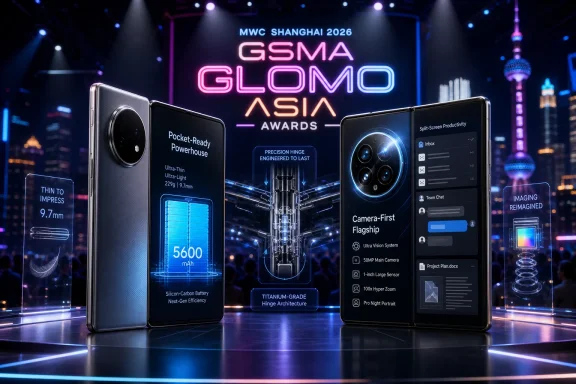
At MWC Shanghai 2026, held June 24–26 in Shanghai, Honor’s Magic V6 won GLOMO Asia awards for Best Smartphone and Disruptive Device Innovation, while vivo’s newly launched X Fold6 won Best In Show — Product. The result is not just another trophy round for Chinese Android brands. It is a marker that the foldable phone has moved from exotic engineering demo to the industry’s most aggressive flagship battlefield. The devices getting rewarded are not cautious revisions; they are attempts to make Samsung’s once-dominant Fold formula look conservative.
For years, the book-style foldable was sold with an asterisk. It was expensive, fragile-looking, thick in the pocket, compromised on cameras, and too often burdened with software that treated the inner display as a novelty rather than a reason to own the device. Buyers were asked to pay laptop money for a phone that still had to explain itself.
The Honor Magic V6 and vivo X Fold6 are arriving in a different climate. Their awards at the first GLOMO Asia event matter because they reward foldables not as curiosities, but as mainstream flagship contenders. “Best Smartphone” going to a foldable is the industry saying the form factor no longer needs a separate children’s table.
That does not mean foldables have become mass-market devices overnight. Pricing, repairability, carrier support, and long-term durability still sit between these products and ordinary buyers. But the old criticism — that folding phones were mostly thinner tablets with worse phone fundamentals — is becoming harder to sustain.
Honor and vivo are attacking that criticism from different directions. Honor is making the foldable feel less like a compromise in the hand, while vivo is pushing the camera and battery story so aggressively that the inner display almost becomes the bonus rather than the headline.
That matters because Asia is not merely another regional phone market. It is where several of the most technically ambitious Android hardware bets are now being made first. China in particular has become the proving ground for ultra-thin foldables, silicon-carbon batteries, large camera sensors, high-speed charging, and software skins designed around multitasking.
MWC Barcelona still sets much of the global narrative, especially for European media, carrier announcements, and cross-border ecosystem deals. But MWC Shanghai increasingly reflects the hardware velocity that Western buyers only see later, if they see it at all. A foldable can win plaudits in Shanghai months before it has a meaningful retail presence in the United States.
That gap is central to understanding the significance of these awards. They celebrate products that may not immediately reshape the U.S. market, but they do shape the competitive pressure facing Samsung, Google, Apple, and Microsoft-adjacent device ecosystems. The future of premium mobile hardware is being negotiated in places where American buyers often cannot walk into a store and buy the most interesting phones.
Battery chemistry is not as glamorous as a hinge demo, but it may be the thing that makes foldables viable for more people. The classic foldable dilemma is brutally simple: two displays, a hinge, more surface area, less internal space, and users who expect the same stamina as a slab flagship. Older foldables often solved that equation by accepting mediocre endurance or by becoming chunky.
Silicon-carbon batteries give manufacturers a way to increase capacity without simply making the device thicker. Honor has leaned into that advantage over multiple generations, and the Magic V6 continues the argument. The point is not merely that the battery is bigger; it is that a foldable can stop feeling like it is rationing power to justify its design.
The other half is thickness. Foldables are judged as much by the closed state as the open one, because the closed state is how they live in a pocket, bag, car mount, or payment terminal queue. A foldable that feels like two phones taped together loses before the inner screen even opens.
Honor’s broader achievement is psychological. It is trying to make the buyer forget the device is a foldable until the moment the larger screen is useful. That is the real prize in foldable design: not spectacle, but disappearance.
That is a major shift. For a long time, the best camera phones and the best foldables lived in different product categories. A user who wanted a periscope lens, large sensor, and top-tier image processing often had to choose a slab flagship. A user who wanted a folding inner screen accepted a camera system that was good enough, not best available.
Vivo has been one of the companies most willing to challenge that split. Its X-series slab phones have leaned heavily on imaging partnerships, computational photography, and ambitious sensor choices. Bringing that philosophy into a book-style foldable changes the category’s center of gravity.
The camera-first foldable also reveals something about where premium phones are headed. The inner display is no longer enough as a differentiator. A 2026 foldable has to win as a phone, a camera, a travel device, a productivity screen, and a status object all at once. If it fails in one of those roles, the price tag becomes harder to defend.
But incumbency has a cost. Once a category matures, the company that defined it can start to look cautious. Chinese foldables have repeatedly pushed thinner bodies, larger batteries, faster charging, and more adventurous camera systems while Samsung has prioritized polish, ecosystem familiarity, water resistance, software maturity, and global distribution.
Those are not trivial advantages. Enterprise buyers, U.S. carriers, and cautious consumers care about repair networks, update commitments, trade-in programs, and predictable support. A phone that wins a show award in Shanghai does not automatically displace a Galaxy Fold in a corporate procurement spreadsheet.
Still, the hardware comparison is getting uncomfortable. If competitors can offer thinner bodies, larger batteries, and stronger cameras while Samsung keeps iterating around the same basic constraints, the Fold risks becoming the conservative choice in a category it once made exciting. That is a strange position for a product line that was originally marketed as the future.
For WindowsForum readers, the Samsung question has another layer. Foldables are not just phones; they are pocket-sized endpoints in a world where Microsoft 365, Teams, Outlook, OneDrive, Remote Desktop, cloud PCs, and browser-based admin consoles define a lot of mobile productivity. Samsung has long benefited from Android enterprise credibility and DeX-adjacent workflows. But if the best hardware experiences increasingly come from brands with weaker U.S. enterprise channels, IT departments face a familiar split between what enthusiasts want and what organizations can support.
That makes the GLOMO Asia outcome feel almost like a dispatch from a parallel smartphone market. The devices pushing the category forward are real, reviewed, handled, and sold somewhere — but not necessarily where many WindowsForum readers can sensibly purchase them. Enthusiasts can import. IT departments usually cannot.
This is where Apple’s rumored foldable ambitions loom over the entire discussion, even absent a product on shelves. Apple does not need to be first to change a category; it needs to make the category safe, legible, and profitable for its customer base. If Apple eventually ships a foldable iPhone, it will not validate Honor or vivo specifically, but it will validate the premise they have been refining in public.
Until then, Samsung and Google benefit from availability as much as innovation. The Pixel Fold line gives Google a software-led interpretation of the form factor. Motorola experiments around foldable identity in different ways. Samsung remains the default answer for a buyer who wants a supported, carrier-friendly book-style foldable in the United States.
But defaults can become vulnerable. The more Chinese brands prove that thinner, longer-lasting, better-camera foldables are possible, the harder it becomes for Western-market leaders to excuse incrementalism.
Honor’s MagicOS and vivo’s OriginOS are both heavily customized Android experiences. They can deliver clever foldable features, but global users often judge them against Samsung’s One UI, Google’s Pixel software, or Apple’s iOS consistency. The question is not whether Honor or vivo can build impressive software features. The question is whether those features remain coherent, updated, localized, and trusted over a device’s usable life.
For productivity users, this matters more than benchmark scores. A foldable is attractive because it can handle email beside a document, a browser beside a chat, a remote session beside notes, or a spreadsheet with enough room to breathe. If app scaling is inconsistent or background behavior is too aggressive, the magic collapses into fiddling.
Microsoft’s Android apps are a good test case. Outlook, Teams, OneNote, Word, Excel, Edge, OneDrive, and Remote Desktop all benefit from more screen area. But they also expose the limits of multitasking ergonomics. A foldable that cannot keep a Teams call stable while referencing a document is not a productivity breakthrough; it is an expensive frustration.
The best foldable software will not be the one with the most tricks. It will be the one that makes the larger canvas feel boringly reliable. That is harder than building a thinner hinge.
Foldables remain mechanically complicated. Hinges collect anxiety even when they are well engineered. Inner displays still use softer materials than conventional glass slabs. Dust resistance, water resistance, crease visibility, repair cost, and long-term panel behavior remain part of the ownership equation.
The Magic V6 and X Fold6 may be excellent devices, but they still inherit the category’s burden of proof. Reviewers can test build quality over weeks or months. Buyers discover the three-year story. IT departments care about the four-year and five-year story, especially when premium devices are expected to last longer in service.
Repairability is another unresolved issue. A broken slab phone screen is annoying and expensive. A broken foldable inner display can be financially punishing. Insurance and care plans soften the blow, but they also reinforce the perception that foldables are still luxury electronics rather than durable everyday tools.
That is why the next phase of foldable competition cannot be only about thinness. At some point, vendors will need to compete on repair economics, parts availability, update transparency, and battery health. A foldable that costs nearly as much as a laptop should not be treated as disposable jewelry.
That regional split distorts perception. A U.S. buyer may think Samsung is moving at a reasonable pace because the local shelf says so. A buyer watching Chinese launches sees a much more intense contest, where battery capacity, display brightness, charging speed, sensor size, and foldable dimensions leapfrog rapidly.
Neither view is complete. Chinese-market phones can be spectacular on hardware and weaker on global services, distribution, or enterprise trust. U.S.-market phones can be more conservative on specifications while offering better support, warranty clarity, carrier integration, and software familiarity.
The danger for Western incumbents is that hardware gaps eventually become too large to explain away. Consumers may tolerate a smaller battery if software is better. They may tolerate slower charging if support is stronger. But if rival devices are thinner, lighter, longer-lasting, and better at photography for multiple generations, the story starts to turn.
The smartphone market has seen this pattern before. Features once dismissed as spec-sheet excess often become table stakes. High-refresh displays, fast charging, periscope zoom, computational night modes, and larger batteries all followed that path. Foldable hardware may be doing the same.
Foldables give manufacturers a way to make the flagship feel new again. They also provide a justification for higher prices at a time when consumers are holding phones longer. The industry needs a premium story, and the foldable supplies one.
That does not mean everyone needs a folding phone. Many people do not. But premium markets are not built only around need. They are built around aspiration, productivity myths, creator workflows, and the feeling that the device can do something visibly different from last year’s model.
Honor and vivo understand this. The Magic V6 appears designed to reduce the penalties of choosing a foldable. The X Fold6 appears designed to increase the rewards. One says, “This is no longer inconvenient.” The other says, “This is now the most capable phone we make.”
That two-pronged attack is why Samsung should pay attention. The foldable market is no longer about proving that hinges work. It is about proving that the best phone in the lineup should fold.
That does not make AI irrelevant. Foldables may become some of the better canvases for on-device and cloud-assisted AI features. A larger display makes it easier to compare generated text, edit images, summarize documents, or run split-screen workflows where an assistant sits beside the source material. A foldable can make AI feel less like a pop-up and more like a workspace.
But the phone still has to last all day, survive being opened thousands of times, take excellent photos, and fit in a pocket. AI cannot compensate for a thick chassis or weak battery. It can only enhance a device whose fundamentals are already strong.
This is a useful corrective to the marketing haze. The smartphone industry may be desperate to convince buyers that AI is the next upgrade cycle, but the foldable race suggests another force is still alive: physical engineering that users can feel immediately. Thinness, weight, hinge stiffness, crease visibility, heat, battery life, and camera bump geometry are not abstract. They are daily experience.
A good foldable is a better Outlook machine than a slab phone. It is a better OneNote capture device, a better Teams companion, a better remote desktop viewer, and a better emergency admin console. It will not replace a ThinkPad, Surface, or desktop workstation, but it can reduce the number of times a professional has to open one.
This matters for sysadmins and IT pros who live between endpoints. The modern workday is full of quick interventions: approving a sign-in, checking a dashboard, responding to an outage thread, editing a document, joining a call, or reviewing a pull request. A foldable does not make those tasks pleasant in every case, but it makes more of them possible without switching devices.
The catch is manageability. The best foldable for an enthusiast may not be the best foldable for an organization. Device management, patch reliability, Android Enterprise support, biometric behavior, app compatibility, and regional firmware policies all matter. A spectacular imported foldable can be a poor corporate endpoint.
That is why the GLOMO Asia winners should be read as directional rather than prescriptive. They show where mobile hardware is going. They do not automatically tell an IT department what to buy on Monday morning.
There are several concrete implications worth carrying forward:
 Foldables Have Stopped Asking for Forgiveness
For years, the book-style foldable was sold with an asterisk. It was expensive, fragile-looking, thick in the pocket, compromised on cameras, and too often burdened with software that treated the inner display as a novelty rather than a reason to own the device. Buyers were asked to pay laptop money for a phone that still had to explain itself.The Honor Magic V6 and vivo X Fold6 are arriving in a different climate. Their awards at the first GLOMO Asia event matter because they reward foldables not as curiosities, but as mainstream flagship contenders. “Best Smartphone” going to a foldable is the industry saying the form factor no longer needs a separate children’s table.
That does not mean foldables have become mass-market devices overnight. Pricing, repairability, carrier support, and long-term durability still sit between these products and ordinary buyers. But the old criticism — that folding phones were mostly thinner tablets with worse phone fundamentals — is becoming harder to sustain.
Honor and vivo are attacking that criticism from different directions. Honor is making the foldable feel less like a compromise in the hand, while vivo is pushing the camera and battery story so aggressively that the inner display almost becomes the bonus rather than the headline.
GLOMO Asia Gives the Regional Race a Global Stage
The GLOMO Asia awards are new in name, but not in lineage. They replace and evolve the Asia Mobile Awards, which had been tied to the region’s mobile industry for years. The rebrand folds Asia’s show-floor recognition into the GSMA’s better-known GLOMO framework, giving Shanghai a clearer link to the awards spectacle that already surrounds MWC Barcelona.That matters because Asia is not merely another regional phone market. It is where several of the most technically ambitious Android hardware bets are now being made first. China in particular has become the proving ground for ultra-thin foldables, silicon-carbon batteries, large camera sensors, high-speed charging, and software skins designed around multitasking.
MWC Barcelona still sets much of the global narrative, especially for European media, carrier announcements, and cross-border ecosystem deals. But MWC Shanghai increasingly reflects the hardware velocity that Western buyers only see later, if they see it at all. A foldable can win plaudits in Shanghai months before it has a meaningful retail presence in the United States.
That gap is central to understanding the significance of these awards. They celebrate products that may not immediately reshape the U.S. market, but they do shape the competitive pressure facing Samsung, Google, Apple, and Microsoft-adjacent device ecosystems. The future of premium mobile hardware is being negotiated in places where American buyers often cannot walk into a store and buy the most interesting phones.
Honor’s Double Win Is Really a Battery and Industrial Design Win
The Magic V6 winning both Best Smartphone and Disruptive Device Innovation is not just a general compliment. The disruptive part appears tied to Honor’s continued bet on silicon-carbon battery technology and aggressive foldable packaging. That combination is increasingly the axis around which the next foldable generation turns.Battery chemistry is not as glamorous as a hinge demo, but it may be the thing that makes foldables viable for more people. The classic foldable dilemma is brutally simple: two displays, a hinge, more surface area, less internal space, and users who expect the same stamina as a slab flagship. Older foldables often solved that equation by accepting mediocre endurance or by becoming chunky.
Silicon-carbon batteries give manufacturers a way to increase capacity without simply making the device thicker. Honor has leaned into that advantage over multiple generations, and the Magic V6 continues the argument. The point is not merely that the battery is bigger; it is that a foldable can stop feeling like it is rationing power to justify its design.
The other half is thickness. Foldables are judged as much by the closed state as the open one, because the closed state is how they live in a pocket, bag, car mount, or payment terminal queue. A foldable that feels like two phones taped together loses before the inner screen even opens.
Honor’s broader achievement is psychological. It is trying to make the buyer forget the device is a foldable until the moment the larger screen is useful. That is the real prize in foldable design: not spectacle, but disappearance.
Vivo Wins by Treating the Foldable as a Camera Flagship
The vivo X Fold6 winning Best In Show — Product on the same day it became official is a different kind of flex. Vivo’s pitch is less about minimalist invisibility and more about refusing to let the foldable category mean second-tier imaging. If the reported and announced specifications hold up in reviews, the X Fold6 is another sign that Chinese manufacturers are done treating camera hardware as the thing foldable buyers must sacrifice.That is a major shift. For a long time, the best camera phones and the best foldables lived in different product categories. A user who wanted a periscope lens, large sensor, and top-tier image processing often had to choose a slab flagship. A user who wanted a folding inner screen accepted a camera system that was good enough, not best available.
Vivo has been one of the companies most willing to challenge that split. Its X-series slab phones have leaned heavily on imaging partnerships, computational photography, and ambitious sensor choices. Bringing that philosophy into a book-style foldable changes the category’s center of gravity.
The camera-first foldable also reveals something about where premium phones are headed. The inner display is no longer enough as a differentiator. A 2026 foldable has to win as a phone, a camera, a travel device, a productivity screen, and a status object all at once. If it fails in one of those roles, the price tag becomes harder to defend.
Samsung’s Fold Problem Is No Longer Just Hardware
The obvious comparison is Samsung, because Samsung made the modern book-style foldable market legible outside China. The Galaxy Z Fold line normalized the hinge, the tablet-like inner screen, and the idea that a phone could be both a pocket computer and a small productivity slate. Samsung deserves credit for taking the early bruises.But incumbency has a cost. Once a category matures, the company that defined it can start to look cautious. Chinese foldables have repeatedly pushed thinner bodies, larger batteries, faster charging, and more adventurous camera systems while Samsung has prioritized polish, ecosystem familiarity, water resistance, software maturity, and global distribution.
Those are not trivial advantages. Enterprise buyers, U.S. carriers, and cautious consumers care about repair networks, update commitments, trade-in programs, and predictable support. A phone that wins a show award in Shanghai does not automatically displace a Galaxy Fold in a corporate procurement spreadsheet.
Still, the hardware comparison is getting uncomfortable. If competitors can offer thinner bodies, larger batteries, and stronger cameras while Samsung keeps iterating around the same basic constraints, the Fold risks becoming the conservative choice in a category it once made exciting. That is a strange position for a product line that was originally marketed as the future.
For WindowsForum readers, the Samsung question has another layer. Foldables are not just phones; they are pocket-sized endpoints in a world where Microsoft 365, Teams, Outlook, OneDrive, Remote Desktop, cloud PCs, and browser-based admin consoles define a lot of mobile productivity. Samsung has long benefited from Android enterprise credibility and DeX-adjacent workflows. But if the best hardware experiences increasingly come from brands with weaker U.S. enterprise channels, IT departments face a familiar split between what enthusiasts want and what organizations can support.
The U.S. Market Is Watching a Race It Can Barely Join
The awkward truth is that many of the most interesting foldables remain difficult or impossible to buy through normal U.S. channels. Honor does not have the same mainstream American presence as Samsung, Apple, Motorola, or Google. Vivo’s flagship foldables have often been China-first or China-only products. Even when import options exist, they bring questions about bands, warranties, software localization, Android Auto behavior, push notifications, and update cadence.That makes the GLOMO Asia outcome feel almost like a dispatch from a parallel smartphone market. The devices pushing the category forward are real, reviewed, handled, and sold somewhere — but not necessarily where many WindowsForum readers can sensibly purchase them. Enthusiasts can import. IT departments usually cannot.
This is where Apple’s rumored foldable ambitions loom over the entire discussion, even absent a product on shelves. Apple does not need to be first to change a category; it needs to make the category safe, legible, and profitable for its customer base. If Apple eventually ships a foldable iPhone, it will not validate Honor or vivo specifically, but it will validate the premise they have been refining in public.
Until then, Samsung and Google benefit from availability as much as innovation. The Pixel Fold line gives Google a software-led interpretation of the form factor. Motorola experiments around foldable identity in different ways. Samsung remains the default answer for a buyer who wants a supported, carrier-friendly book-style foldable in the United States.
But defaults can become vulnerable. The more Chinese brands prove that thinner, longer-lasting, better-camera foldables are possible, the harder it becomes for Western-market leaders to excuse incrementalism.
The Software Burden Is Getting Heavier
Hardware awards are useful, but foldables live or die in software. A large inner display is only valuable if apps behave intelligently, multitasking feels natural, and the operating system understands posture, continuity, and windowing. This is where Android has improved, but not evenly.Honor’s MagicOS and vivo’s OriginOS are both heavily customized Android experiences. They can deliver clever foldable features, but global users often judge them against Samsung’s One UI, Google’s Pixel software, or Apple’s iOS consistency. The question is not whether Honor or vivo can build impressive software features. The question is whether those features remain coherent, updated, localized, and trusted over a device’s usable life.
For productivity users, this matters more than benchmark scores. A foldable is attractive because it can handle email beside a document, a browser beside a chat, a remote session beside notes, or a spreadsheet with enough room to breathe. If app scaling is inconsistent or background behavior is too aggressive, the magic collapses into fiddling.
Microsoft’s Android apps are a good test case. Outlook, Teams, OneNote, Word, Excel, Edge, OneDrive, and Remote Desktop all benefit from more screen area. But they also expose the limits of multitasking ergonomics. A foldable that cannot keep a Teams call stable while referencing a document is not a productivity breakthrough; it is an expensive frustration.
The best foldable software will not be the one with the most tricks. It will be the one that makes the larger canvas feel boringly reliable. That is harder than building a thinner hinge.
Awards Do Not Solve Durability, Repair, or Trust
The industry loves awards because they compress complexity into a headline. Best Smartphone. Disruptive Innovation. Best In Show. These labels are useful shorthand, but they do not answer the questions that decide whether a device survives beyond launch enthusiasm.Foldables remain mechanically complicated. Hinges collect anxiety even when they are well engineered. Inner displays still use softer materials than conventional glass slabs. Dust resistance, water resistance, crease visibility, repair cost, and long-term panel behavior remain part of the ownership equation.
The Magic V6 and X Fold6 may be excellent devices, but they still inherit the category’s burden of proof. Reviewers can test build quality over weeks or months. Buyers discover the three-year story. IT departments care about the four-year and five-year story, especially when premium devices are expected to last longer in service.
Repairability is another unresolved issue. A broken slab phone screen is annoying and expensive. A broken foldable inner display can be financially punishing. Insurance and care plans soften the blow, but they also reinforce the perception that foldables are still luxury electronics rather than durable everyday tools.
That is why the next phase of foldable competition cannot be only about thinness. At some point, vendors will need to compete on repair economics, parts availability, update transparency, and battery health. A foldable that costs nearly as much as a laptop should not be treated as disposable jewelry.
The Android Flagship Is Becoming a Regional Story
One of the more interesting implications of the Shanghai awards is that the Android flagship market is fragmenting by region. In the United States, the premium Android conversation is still dominated by Samsung and Google, with Motorola playing selectively and OnePlus occupying an enthusiast niche. In China and parts of Asia, the fight is broader, faster, and often more technically adventurous.That regional split distorts perception. A U.S. buyer may think Samsung is moving at a reasonable pace because the local shelf says so. A buyer watching Chinese launches sees a much more intense contest, where battery capacity, display brightness, charging speed, sensor size, and foldable dimensions leapfrog rapidly.
Neither view is complete. Chinese-market phones can be spectacular on hardware and weaker on global services, distribution, or enterprise trust. U.S.-market phones can be more conservative on specifications while offering better support, warranty clarity, carrier integration, and software familiarity.
The danger for Western incumbents is that hardware gaps eventually become too large to explain away. Consumers may tolerate a smaller battery if software is better. They may tolerate slower charging if support is stronger. But if rival devices are thinner, lighter, longer-lasting, and better at photography for multiple generations, the story starts to turn.
The smartphone market has seen this pattern before. Features once dismissed as spec-sheet excess often become table stakes. High-refresh displays, fast charging, periscope zoom, computational night modes, and larger batteries all followed that path. Foldable hardware may be doing the same.
The Real Competition Is for the Post-Slab Premium Buyer
The slab phone is not dead. It remains cheaper to build, easier to protect, easier to repair, and good enough for most users. But the premium slab has a problem: it is increasingly difficult to make exciting. Faster chips, brighter screens, better cameras, and AI features can move units, but the rectangle is mature.Foldables give manufacturers a way to make the flagship feel new again. They also provide a justification for higher prices at a time when consumers are holding phones longer. The industry needs a premium story, and the foldable supplies one.
That does not mean everyone needs a folding phone. Many people do not. But premium markets are not built only around need. They are built around aspiration, productivity myths, creator workflows, and the feeling that the device can do something visibly different from last year’s model.
Honor and vivo understand this. The Magic V6 appears designed to reduce the penalties of choosing a foldable. The X Fold6 appears designed to increase the rewards. One says, “This is no longer inconvenient.” The other says, “This is now the most capable phone we make.”
That two-pronged attack is why Samsung should pay attention. The foldable market is no longer about proving that hinges work. It is about proving that the best phone in the lineup should fold.
AI Is Present, but Hardware Still Carries the Story
It is impossible to discuss 2026 mobile devices without acknowledging AI, but the GLOMO Asia phone awards are a useful reminder that hardware still matters. Vendors can wrap every launch in generative summaries, image editing, live translation, and assistant workflows. Yet the devices being rewarded here are winning because of bodies, batteries, displays, cameras, and engineering density.That does not make AI irrelevant. Foldables may become some of the better canvases for on-device and cloud-assisted AI features. A larger display makes it easier to compare generated text, edit images, summarize documents, or run split-screen workflows where an assistant sits beside the source material. A foldable can make AI feel less like a pop-up and more like a workspace.
But the phone still has to last all day, survive being opened thousands of times, take excellent photos, and fit in a pocket. AI cannot compensate for a thick chassis or weak battery. It can only enhance a device whose fundamentals are already strong.
This is a useful corrective to the marketing haze. The smartphone industry may be desperate to convince buyers that AI is the next upgrade cycle, but the foldable race suggests another force is still alive: physical engineering that users can feel immediately. Thinness, weight, hinge stiffness, crease visibility, heat, battery life, and camera bump geometry are not abstract. They are daily experience.
The Windows Crowd Should Care More Than It Thinks
Windows enthusiasts sometimes treat phone news as adjacent rather than central. Microsoft no longer builds Windows phones, and the company’s mobile strategy is mostly apps, cloud services, identity, and device management. But foldables are highly relevant to the Windows ecosystem because they are becoming the most plausible pocket productivity devices.A good foldable is a better Outlook machine than a slab phone. It is a better OneNote capture device, a better Teams companion, a better remote desktop viewer, and a better emergency admin console. It will not replace a ThinkPad, Surface, or desktop workstation, but it can reduce the number of times a professional has to open one.
This matters for sysadmins and IT pros who live between endpoints. The modern workday is full of quick interventions: approving a sign-in, checking a dashboard, responding to an outage thread, editing a document, joining a call, or reviewing a pull request. A foldable does not make those tasks pleasant in every case, but it makes more of them possible without switching devices.
The catch is manageability. The best foldable for an enthusiast may not be the best foldable for an organization. Device management, patch reliability, Android Enterprise support, biometric behavior, app compatibility, and regional firmware policies all matter. A spectacular imported foldable can be a poor corporate endpoint.
That is why the GLOMO Asia winners should be read as directional rather than prescriptive. They show where mobile hardware is going. They do not automatically tell an IT department what to buy on Monday morning.
The Shanghai Signal Samsung, Google, and Apple Cannot Ignore
The practical readout from MWC Shanghai is narrower than the award headlines but more important. Honor and vivo are proving that foldables can compete for top-tier recognition on overall smartphone quality, not merely novelty. The gap between the most ambitious Chinese foldables and the globally available models is now one of the defining tensions in mobile hardware.There are several concrete implications worth carrying forward:
- Honor’s Magic V6 winning Best Smartphone suggests the foldable category is now credible enough to compete directly against slab flagships for top industry honors.
- The Disruptive Device Innovation award points to battery chemistry and packaging as the next major foldable battleground, not just hinge design.
- Vivo’s X Fold6 winning Best In Show — Product reinforces that camera quality is becoming central to premium foldables rather than an acceptable compromise.
- Samsung’s biggest advantage remains global availability, software maturity, and support infrastructure, but those strengths are being tested by faster-moving hardware rivals.
- U.S. buyers and enterprise IT teams may see the future of foldables before they can responsibly purchase it through normal channels.
- The next winning foldable will need to prove itself over years of updates, repairs, and daily wear, not just during launch-week awards.
References
- Primary source: gsmarena.com
Published: 2026-06-27T03:30:19.488939
- Related coverage: huawei.com
- Related coverage: techradar.com
'An incredibly impressive piece of engineering' — TechRadar's MWC Awards 2026 presents our 12 winners, from cutting-edge phones and tablets, to Wi-Fi and smart security | TechRadar
Elite products to pay attention to from the Barcelona showwww.techradar.com - Related coverage: mwcshanghai.com
GLOMO Awards Asia | MWC Shanghai
Asia’s most prestigious awards in mobile and digital innovation. www.mwcshanghai.com
- Related coverage: techadvisor.com
Tech Advisor’s Best of MWC 2026 Awards - Tech Advisor
We've searched high and low for the best products at the world's biggest mobile-focused tech showwww.techadvisor.com - Related coverage: notebookcheck.net
Magic V6: Honor beats Apple, Google, Oppo and Samsung in revealing first next-gen foldable - Notebookcheck News
Honor has now fully revealed its new foldable smartphone. Arriving before the Galaxy Z Fold8, Oppo Find N6 or the Apple iPhone Fold, among others, the Honor Magic V6 is thinner, more powerful and has a bigger battery than the Magic V5. Honor has included other upgrades too, albeit with a camera... www.notebookcheck.net

- Related coverage: mwcbarcelona.com
2026 GLOMO Awards winners crowned at MWC26 Barcelona | MWC Barcelona
Where innovators, creators & leaders gather to shape the future. Join us next year in Barcelona, 1 - 4 March 2027 www.mwcbarcelona.com
- Related coverage: gizguide.com
MWC 2026: HONOR wins over 70 media awards for Robotics, Magic V6, MagicPad 4, and MagicBook Pro 14
HONOR wins over 70 media awards at MWC 2026.www.gizguide.com
- Related coverage: sammobile.com
The Galaxy S26 Ultra wins MWC's prestigious Best in Show award - SamMobile
Samsung's Galaxy S26 Ultra won 'Best in Show' at MWC 2026, impressing judges with its blend of advanced hardware and intuitive One UI 8.5. - SamMobilewww.sammobile.com - Related coverage: gizchina.com
HONOR Wins GLOMO Award at MWC 2026 for Silicon-Carbon Battery Innovation in Magic V6
HONOR wins the GLOMO Award at MWC 2026 for its silicon-carbon battery innovation in the Magic V6, while collecting over 70 media awards across its AI device lineup.www.gizchina.com - Related coverage: androidcentral.com
Honor Magic V6 review: It can't get much better than this | Android Central
The year-over-year improvements from Honor are staggering, making this a truly top-tier foldable flagship.www.androidcentral.com - Related coverage: t3.com
Honor announces Magic V6, its thinnest foldable yet, and some nice extras at MWC | T3
The most battery in a foldablewww.t3.com - Related coverage: tomsguide.com
Honor Magic V6 hands-on: A good omen | Tom's Guide
Honor's new foldable phone shows just how far behind the others are.www.tomsguide.com - Related coverage: digitalcameraworld.com
Honor just made a foldable phone that I think people will actually want (and Samsung should be worried) | Digital Camera World
Honor's new Magic V6 has a 24-hour battery, a camera system borrowed from its flagship phone, and a body barely thicker than an iPhonewww.digitalcameraworld.com - Related coverage: omdia.tech.informa.com
HONOR expands overseas in 2025: Scale, portfolio, and regional dynamics
PDF documentomdia.tech.informa.com
- Related coverage: honor.com
- Related coverage: littlebigreddot.com
honor magic v6 singapores first foldable with ip68 ip69 dual water resistance launches 4 june
PDF documentlittlebigreddot.com
- Related coverage: gizmochina.com
Vivo X Fold 6 arrives with Dimensity 9500, 7,000mAh battery, 200MP triple cameras - Gizmochina
Vivo X Fold 6 debuts with Dimensity 9500, 7,000mAh battery, Zeiss-backed cameras, dual LTPO AMOLED displays, 40W wireless charging and premium foldable design. www.gizmochina.com
- Related coverage: news.samsung.com
Samsung Galaxy S26 Ultra thắng giải ‘Best in Show’ tại Global Mobile Awards – Hội nghị Di động Thế giới (MWC) 2026 – Samsung Newsroom Việt Nam
Kênh thông tin chính thức của Công ty Điện tử Samsung nhằm cung cấp những thông tin mới nhất liên quan đến sản phẩm, con người và hoạt động kinh doanh của công ty.news.samsung.com
- Related coverage: androidauthority.com
Best of CES 2026: Android Authority's top products from the show!
Here are the Android Authority Best of CES 2026 Award winners.www.androidauthority.com - Related coverage: mobilemasr.com
GLOMO Awards 2026: Galaxy S26 Ultra Best in Show at MWC, iPhone 17 Pro Best Phone — Full List of Winners
The GSMA announced the winners of the GLOMO Awards 2026 at MWC Barcelona — the Galaxy S26 Ultra won Best in Show thanks to its world-first privacy screen, the iPhone 17 Pro Series took home the title of Best Phone, while Honor, Infinix, and Garmin received special awards. Full details.mobilemasr.com - Related coverage: samsung.com
Samsung Galaxy S26 Ultra Awarded ‘Best in Show’ at the Global Mobile Awards at Mobile World Congress 2026 | Samsung GR
Η Samsung Electronics Co., Ltd. ανακοίνωσε ότι το Galaxy S26 Ultra απέσπασε το βραβείο “Best in Show” στα Global Mobile Awards (GLOMO Awards), στο πλαίσιο του Mobile World Congress (MWC) 2026, που πραγματοποιήθηκε στη Βαρκελώνη της Ισπανίας. Η Global System for Mobile Communications Association...www.samsung.com - Related coverage: apaceffie.com
- Related coverage: trbusiness.com
