

Artificial intelligence tools can help quilters in the United States and elsewhere plan projects by turning plain-language ideas, fabric photos, color preferences, size constraints, and skill levels into draft layouts, cutting estimates, shopping lists, and visual previews before anyone cuts into cloth. The quiet surprise is not that AI has reached quilting; it is that quilting exposes what AI is actually good for. The craft is mathematical, visual, iterative, and stubbornly physical. That makes it a better test case than another chatbot demo.
Quilting looks analog because the final object is analog. It is cloth, thread, batting, hand pressure, machine tension, and the small judgment calls that happen at a cutting mat. But long before AI entered the conversation, quilters were already doing computation.
Every quilt is a grid problem wrapped in a color problem. A maker has to decide finished size, block size, seam allowance, border width, backing yardage, binding length, shrinkage, grain direction, and how much risk to tolerate when a favorite print is almost—but not quite—enough. The romance of quilting sits beside arithmetic that can punish a half-inch mistake for weeks.
That is why software has had a place in quilting for decades. Programs such as Electric Quilt, browser-based layout tools, pixel-quilt generators, and fabric calculators did not replace quilters; they gave quilters a way to preview decisions that used to require graph paper, colored pencils, and a good deal of patience. AI is not the first digitization of the craft. It is the next interface layer.
The Killeen Daily Herald’s framing of AI as a planning assistant for quilting lands because it treats the technology less like a magic artist and more like a shop helper. That is the version of AI most likely to survive the hype cycle: not a machine that “makes” the quilt, but a machine that reduces the number of avoidable mistakes before the human work begins.
That matters because the blank page is one of the most expensive places in craft. A bad first decision can lead to wasted fabric, abandoned projects, or the dreaded halfway realization that the design does not scale. AI lowers the cost of early experimentation.
In that sense, prompting is not a betrayal of traditional design. It is a faster form of sketching. The quilter is still choosing, rejecting, adjusting, and interpreting. The machine is generating possibilities at a speed that makes comparison easier.
The danger comes when the preview is mistaken for the pattern. A pretty AI image may show impossible seams, warped blocks, nonsensical quilting paths, or fabric behavior that cannot exist outside a screen. Quilting is not merely visual composition. It is construction.
That distinction separates useful craft AI from disposable AI slop. A planning assistant earns trust when it respects seam allowances, repeatable units, fabric width, block geometry, and the difference between a render and a sewable object. If it cannot do that, it is not a pattern tool. It is a mood-board generator.
For many hobbyists, the hardest part of a quilt is not sewing a straight seam. It is selecting a pattern that matches the fabric stash, calculating yardage with confidence, and visualizing whether a beloved print will become a focal point or disappear into visual noise. AI-assisted planning tools are emerging around exactly those anxieties.
Some tools invite users to upload fabric photos and generate pattern suggestions around them. Others recolor an existing pattern, create shopping lists, or produce a PDF with cutting instructions. A few advertise plain-English generation: describe the quilt you want, then edit the result in a grid.
That is a familiar software story. The successful products are not the ones that promise to eliminate expertise. They are the ones that make expertise easier to apply. A spreadsheet did not eliminate accountants; it changed the pace and scope of accounting. AI quilt planning, at its best, does something similar for hobbyist design.
For Windows users in particular, this is a continuation of an old desktop habit. Craft rooms have long contained PCs running design software, label makers, scanners, embroidery utilities, printer drivers, and pattern PDFs. The AI layer may live in the browser or the cloud, but the workflow still runs through the same everyday computing stack: files, images, printers, tablets, and backups.
That collision is healthy. It forces AI vendors to confront constraints that general-purpose image models often ignore. A quilt pattern is not merely an image of a quilt; it is a set of instructions for making one.
If a tool says a design requires two yards when it really requires three, the error is not academic. If it creates a block with tiny pieces beyond the user’s skill level, it has failed as a planning assistant. If it ignores directional prints, fabric repeats, or the difference between finished and unfinished block sizes, it may create more work than it saves.
This is where experienced quilters retain the advantage. They know when a design has too many bias edges, when a border may wave, when a high-contrast fabric will dominate, and when a “simple” pattern hides tedious repetition. AI can offer suggestions, but craft judgment remains embodied knowledge.
The same is true across technology. AI is most useful when paired with someone who can evaluate its output. In quilting, that evaluator may be a guild member, a teacher, a longarm quilter, or a hobbyist who has ruined enough fabric to be skeptical. The future belongs less to autonomous design than to assisted decision-making.
Generative AI complicates those norms. If a tool produces a design “in the style of” a living quilt artist, is that inspiration, imitation, or extraction? If a platform has trained on pattern images scraped from the web, should the resulting tool be treated as a legitimate assistant or as a laundering machine for unlicensed labor?
These questions are not theoretical. Online craft communities have already become more suspicious of suspiciously perfect quilt images, fake product listings, and patterns that appear to show beautiful finished objects no one has actually sewn. The problem is not only copyright. It is trust.
A real quilt carries evidence. There are process photos, close-ups, imperfect seams, fabric texture, quilting lines that obey the object, and human choices visible in the making. AI-generated marketing images often lack that chain of custody. They sell desire without proof.
For WindowsForum readers, the lesson is broader than quilting. AI output increasingly needs provenance. Whether the artifact is a PowerShell script, a résumé, a logo, or a quilt pattern, users need to know what was generated, what was verified, and what remains speculative. The interface should not make fiction look more finished than fact.
That diffusion is exactly how personal computing became normal. The PC did not win only because businesses needed spreadsheets. It won because families used it for schoolwork, taxes, newsletters, recipes, photos, games, and hobbies. AI is following a similar path into ordinary life through small, specific tasks.
Quilting planning is one of those tasks. It is not glamorous. It will not dominate an earnings call. But it is the kind of use case that teaches people what AI can and cannot do.
A quilter who asks a chatbot for fabric-yardage help will quickly learn the difference between confidence and accuracy. A user who uploads fabric swatches to a design tool will see the appeal of rapid visualization. Someone who receives an impossible pattern will learn why verification matters. These are better AI literacy lessons than most corporate training videos.
That is why Microsoft, Google, OpenAI, Adobe, and smaller app makers all care about creative workflows. Creativity is where people tolerate experimentation. If the tool saves time or unlocks a new idea, they come back. If it lies too smoothly, they remember.
A quilter planning with AI may use a Windows laptop to organize reference images, a browser to access an AI design tool, OneDrive or local folders to store PDFs, a printer to output templates, and perhaps photo-editing software to crop fabric swatches. The AI feature is only one link in the chain. If the rest of the workflow is clumsy, the magic evaporates.
That is where platform companies still have work to do. AI assistance needs file awareness, privacy controls, export reliability, printer sanity, and offline fallbacks. It needs to produce standard formats rather than trap users inside proprietary previews. A quilt pattern that cannot be printed cleanly or saved permanently is not a plan; it is a rental.
There is also a security dimension. Uploading photos of fabric may seem harmless, but AI craft platforms can still collect account data, images, payment details, location signals, and behavioral analytics. Hobby software does not get a privacy exemption because the subject is cozy.
The more AI moves into niche creative communities, the more users need the boring protections IT professionals already understand: strong passwords, clear data policies, reputable vendors, exportable work, and skepticism toward too-good-to-be-true ads. The quilt room is not outside the digital economy. It is one more endpoint.
Independent designers may use AI to explore layouts, generate colorways, draft descriptions, or build mockups. Fabric shops may use it to show customers how a collection could look in multiple patterns. Teachers may use it to adapt class projects for different skill levels. Guilds may use it to brainstorm charity quilt layouts from donated fabric.
That productivity gain cuts both ways. Good designers can move faster. So can scammers.
A marketplace flooded with AI-generated pattern images and untested instructions would be bad for everyone except the platforms taking transaction fees. Quilting requires reliability. If buyers cannot tell whether a pattern has been test-sewn, edited, and checked, the market becomes noisier and less trustworthy.
The likely response will be a new premium on proof. Designers who show process photos, tester versions, construction notes, and real finished quilts will stand out. “AI-assisted” may become acceptable in some contexts, but “tested” will matter more.
This mirrors software development. AI can draft code, but serious teams still need tests, review, documentation, and maintenance. A quilt pattern is code for fabric. If the code has never been run, buyers should treat it accordingly.
Taste is the ability to know which generated option is worth pursuing. Verification is the discipline to check measurements, yardage, and construction order. Finishing skill is the lived craft of cutting, piecing, pressing, quilting, binding, and correcting mistakes.
Those skills are not made obsolete by a planning assistant. They become more visible because AI can generate many plausible wrong answers. The better the preview looks, the more important it is to ask whether it can actually be made.
This is the paradox of AI in craft. It may lower the barrier to entry while raising the premium on expertise. Beginners get help starting. Experts become the people who can separate useful output from nonsense.
That is not a bad future. Many crafts survive because tools make them less intimidating without erasing their depth. Rotary cutters, acrylic rulers, computerized sewing machines, digital longarms, and downloadable patterns all changed quilting. None ended the craft.
One helper might scan a fabric stash and group prints by contrast. Another might warn that a chosen block size creates awkward cutting dimensions. Another might generate three alternate layouts for donated fabric. Another might convert a hand sketch into a clean grid. Another might check whether the backing and binding estimates are plausible.
That is not the fantasy version of AI. It is better.
The fantasy version produces a dazzling render and leaves the user to discover the hidden problems. The useful version asks clarifying questions, explains assumptions, flags uncertainty, and exports editable plans. It behaves less like a genius and more like a careful assistant.
This is where small, specialized tools may outperform general-purpose chatbots. A chatbot can talk about quilting. A dedicated quilting planner can encode quilting rules. The difference between those two things is the difference between advice and infrastructure.
For IT pros, the same pattern applies everywhere. AI value increases when the model is constrained by domain knowledge, connected to reliable data, and forced to produce outputs that can be checked. The quilting world may be homespun, but the architecture lesson is enterprise-grade.
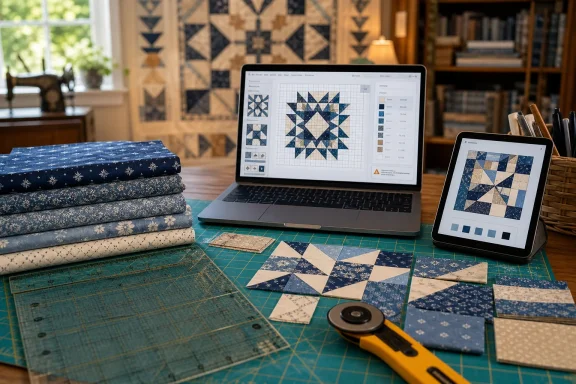 The Quilt Room Was Always a Computing Problem
Quilting looks analog because the final object is analog. It is cloth, thread, batting, hand pressure, machine tension, and the small judgment calls that happen at a cutting mat. But long before AI entered the conversation, quilters were already doing computation.Every quilt is a grid problem wrapped in a color problem. A maker has to decide finished size, block size, seam allowance, border width, backing yardage, binding length, shrinkage, grain direction, and how much risk to tolerate when a favorite print is almost—but not quite—enough. The romance of quilting sits beside arithmetic that can punish a half-inch mistake for weeks.
That is why software has had a place in quilting for decades. Programs such as Electric Quilt, browser-based layout tools, pixel-quilt generators, and fabric calculators did not replace quilters; they gave quilters a way to preview decisions that used to require graph paper, colored pencils, and a good deal of patience. AI is not the first digitization of the craft. It is the next interface layer.
The Killeen Daily Herald’s framing of AI as a planning assistant for quilting lands because it treats the technology less like a magic artist and more like a shop helper. That is the version of AI most likely to survive the hype cycle: not a machine that “makes” the quilt, but a machine that reduces the number of avoidable mistakes before the human work begins.
Prompting Is the New Graph Paper
The most useful AI quilting tools are not simply image generators. They are translators between intention and plan. A quilter can describe “a queen-size modern log cabin quilt in blues and creams using beginner-friendly blocks,” and a system can produce a rough layout, suggest block counts, estimate fabric, or offer alternative palettes.That matters because the blank page is one of the most expensive places in craft. A bad first decision can lead to wasted fabric, abandoned projects, or the dreaded halfway realization that the design does not scale. AI lowers the cost of early experimentation.
In that sense, prompting is not a betrayal of traditional design. It is a faster form of sketching. The quilter is still choosing, rejecting, adjusting, and interpreting. The machine is generating possibilities at a speed that makes comparison easier.
The danger comes when the preview is mistaken for the pattern. A pretty AI image may show impossible seams, warped blocks, nonsensical quilting paths, or fabric behavior that cannot exist outside a screen. Quilting is not merely visual composition. It is construction.
That distinction separates useful craft AI from disposable AI slop. A planning assistant earns trust when it respects seam allowances, repeatable units, fabric width, block geometry, and the difference between a render and a sewable object. If it cannot do that, it is not a pattern tool. It is a mood-board generator.
The Best AI Use Case Is Not Creativity, but Friction Removal
The cultural argument around AI often gets stuck on whether machines can be creative. Quilting suggests a more practical question: can the machine remove enough friction to leave more energy for the maker’s creativity?For many hobbyists, the hardest part of a quilt is not sewing a straight seam. It is selecting a pattern that matches the fabric stash, calculating yardage with confidence, and visualizing whether a beloved print will become a focal point or disappear into visual noise. AI-assisted planning tools are emerging around exactly those anxieties.
Some tools invite users to upload fabric photos and generate pattern suggestions around them. Others recolor an existing pattern, create shopping lists, or produce a PDF with cutting instructions. A few advertise plain-English generation: describe the quilt you want, then edit the result in a grid.
That is a familiar software story. The successful products are not the ones that promise to eliminate expertise. They are the ones that make expertise easier to apply. A spreadsheet did not eliminate accountants; it changed the pace and scope of accounting. AI quilt planning, at its best, does something similar for hobbyist design.
For Windows users in particular, this is a continuation of an old desktop habit. Craft rooms have long contained PCs running design software, label makers, scanners, embroidery utilities, printer drivers, and pattern PDFs. The AI layer may live in the browser or the cloud, but the workflow still runs through the same everyday computing stack: files, images, printers, tablets, and backups.
The Physical World Still Gets the Final Vote
The reason quilting is such a useful AI test case is that the output cannot hide behind pixels. A bad AI-generated blog post can still look fluent. A bad AI-generated quilt plan will eventually collide with fabric that frays, stretches, shifts, and runs out.That collision is healthy. It forces AI vendors to confront constraints that general-purpose image models often ignore. A quilt pattern is not merely an image of a quilt; it is a set of instructions for making one.
If a tool says a design requires two yards when it really requires three, the error is not academic. If it creates a block with tiny pieces beyond the user’s skill level, it has failed as a planning assistant. If it ignores directional prints, fabric repeats, or the difference between finished and unfinished block sizes, it may create more work than it saves.
This is where experienced quilters retain the advantage. They know when a design has too many bias edges, when a border may wave, when a high-contrast fabric will dominate, and when a “simple” pattern hides tedious repetition. AI can offer suggestions, but craft judgment remains embodied knowledge.
The same is true across technology. AI is most useful when paired with someone who can evaluate its output. In quilting, that evaluator may be a guild member, a teacher, a longarm quilter, or a hobbyist who has ruined enough fabric to be skeptical. The future belongs less to autonomous design than to assisted decision-making.
The Copyright Problem Is Sewn Into the Hype
AI’s arrival in quilting also brings the baggage already visible in illustration, photography, music, and writing. Quilting has a strong pattern economy. Designers sell PDFs, books, templates, classes, rulers, and fabric collections. The community depends on attribution, licensing, and norms around not copying someone else’s work without permission.Generative AI complicates those norms. If a tool produces a design “in the style of” a living quilt artist, is that inspiration, imitation, or extraction? If a platform has trained on pattern images scraped from the web, should the resulting tool be treated as a legitimate assistant or as a laundering machine for unlicensed labor?
These questions are not theoretical. Online craft communities have already become more suspicious of suspiciously perfect quilt images, fake product listings, and patterns that appear to show beautiful finished objects no one has actually sewn. The problem is not only copyright. It is trust.
A real quilt carries evidence. There are process photos, close-ups, imperfect seams, fabric texture, quilting lines that obey the object, and human choices visible in the making. AI-generated marketing images often lack that chain of custody. They sell desire without proof.
For WindowsForum readers, the lesson is broader than quilting. AI output increasingly needs provenance. Whether the artifact is a PowerShell script, a résumé, a logo, or a quilt pattern, users need to know what was generated, what was verified, and what remains speculative. The interface should not make fiction look more finished than fact.
Local Craft Meets the Cloud Economy
There is something revealing about a local newspaper story on AI and quilting. It shows how thoroughly generative AI has escaped the confines of Silicon Valley product launches. The technology is no longer just a boardroom topic, a developer tool, or an academic debate. It is showing up in fabric stores, guild newsletters, hobby blogs, classrooms, and kitchen-table projects.That diffusion is exactly how personal computing became normal. The PC did not win only because businesses needed spreadsheets. It won because families used it for schoolwork, taxes, newsletters, recipes, photos, games, and hobbies. AI is following a similar path into ordinary life through small, specific tasks.
Quilting planning is one of those tasks. It is not glamorous. It will not dominate an earnings call. But it is the kind of use case that teaches people what AI can and cannot do.
A quilter who asks a chatbot for fabric-yardage help will quickly learn the difference between confidence and accuracy. A user who uploads fabric swatches to a design tool will see the appeal of rapid visualization. Someone who receives an impossible pattern will learn why verification matters. These are better AI literacy lessons than most corporate training videos.
That is why Microsoft, Google, OpenAI, Adobe, and smaller app makers all care about creative workflows. Creativity is where people tolerate experimentation. If the tool saves time or unlocks a new idea, they come back. If it lies too smoothly, they remember.
The Windows Angle Is the Workflow, Not the Buzzword
For Windows enthusiasts, the quilting example may sound far from the usual diet of updates, drivers, security patches, and Copilot integration. But it is very much a Windows story because most practical AI adoption happens inside workflows rather than press releases.A quilter planning with AI may use a Windows laptop to organize reference images, a browser to access an AI design tool, OneDrive or local folders to store PDFs, a printer to output templates, and perhaps photo-editing software to crop fabric swatches. The AI feature is only one link in the chain. If the rest of the workflow is clumsy, the magic evaporates.
That is where platform companies still have work to do. AI assistance needs file awareness, privacy controls, export reliability, printer sanity, and offline fallbacks. It needs to produce standard formats rather than trap users inside proprietary previews. A quilt pattern that cannot be printed cleanly or saved permanently is not a plan; it is a rental.
There is also a security dimension. Uploading photos of fabric may seem harmless, but AI craft platforms can still collect account data, images, payment details, location signals, and behavioral analytics. Hobby software does not get a privacy exemption because the subject is cozy.
The more AI moves into niche creative communities, the more users need the boring protections IT professionals already understand: strong passwords, clear data policies, reputable vendors, exportable work, and skepticism toward too-good-to-be-true ads. The quilt room is not outside the digital economy. It is one more endpoint.
AI Will Change Pattern Design Before It Changes Sewing
The near-term disruption is not that robots will sew quilts for hobbyists. The near-term disruption is that pattern design, testing, visualization, and marketing will speed up.Independent designers may use AI to explore layouts, generate colorways, draft descriptions, or build mockups. Fabric shops may use it to show customers how a collection could look in multiple patterns. Teachers may use it to adapt class projects for different skill levels. Guilds may use it to brainstorm charity quilt layouts from donated fabric.
That productivity gain cuts both ways. Good designers can move faster. So can scammers.
A marketplace flooded with AI-generated pattern images and untested instructions would be bad for everyone except the platforms taking transaction fees. Quilting requires reliability. If buyers cannot tell whether a pattern has been test-sewn, edited, and checked, the market becomes noisier and less trustworthy.
The likely response will be a new premium on proof. Designers who show process photos, tester versions, construction notes, and real finished quilts will stand out. “AI-assisted” may become acceptable in some contexts, but “tested” will matter more.
This mirrors software development. AI can draft code, but serious teams still need tests, review, documentation, and maintenance. A quilt pattern is code for fabric. If the code has never been run, buyers should treat it accordingly.
The Human Skill Moves Up the Stack
When a tool automates part of a craft, the human role does not disappear. It shifts. In quilting, AI may reduce some planning friction, but it increases the value of taste, verification, and finishing skill.Taste is the ability to know which generated option is worth pursuing. Verification is the discipline to check measurements, yardage, and construction order. Finishing skill is the lived craft of cutting, piecing, pressing, quilting, binding, and correcting mistakes.
Those skills are not made obsolete by a planning assistant. They become more visible because AI can generate many plausible wrong answers. The better the preview looks, the more important it is to ask whether it can actually be made.
This is the paradox of AI in craft. It may lower the barrier to entry while raising the premium on expertise. Beginners get help starting. Experts become the people who can separate useful output from nonsense.
That is not a bad future. Many crafts survive because tools make them less intimidating without erasing their depth. Rotary cutters, acrylic rulers, computerized sewing machines, digital longarms, and downloadable patterns all changed quilting. None ended the craft.
The Useful Future Looks Less Like Magic and More Like Measurement
The most credible future for AI quilting is not an all-knowing design oracle. It is a set of modest, connected helpers that understand enough craft logic to be useful.One helper might scan a fabric stash and group prints by contrast. Another might warn that a chosen block size creates awkward cutting dimensions. Another might generate three alternate layouts for donated fabric. Another might convert a hand sketch into a clean grid. Another might check whether the backing and binding estimates are plausible.
That is not the fantasy version of AI. It is better.
The fantasy version produces a dazzling render and leaves the user to discover the hidden problems. The useful version asks clarifying questions, explains assumptions, flags uncertainty, and exports editable plans. It behaves less like a genius and more like a careful assistant.
This is where small, specialized tools may outperform general-purpose chatbots. A chatbot can talk about quilting. A dedicated quilting planner can encode quilting rules. The difference between those two things is the difference between advice and infrastructure.
For IT pros, the same pattern applies everywhere. AI value increases when the model is constrained by domain knowledge, connected to reliable data, and forced to produce outputs that can be checked. The quilting world may be homespun, but the architecture lesson is enterprise-grade.
The Pattern Is Clearer Than the Patchwork
The practical lesson from AI-assisted quilting is narrower and more useful than the hype suggests. Treat AI as a planning accelerator, not an authority.- AI can help quilters brainstorm layouts, colorways, and pattern options before they commit fabric to the cutting table.
- AI-generated quilt images should not be trusted as sewable patterns unless the tool provides measurements, construction logic, and verifiable cutting instructions.
- Human review remains essential because fabric behavior, seam allowances, scale, and skill level can defeat a visually attractive design.
- Pattern sellers and AI craft platforms will need clearer proof that designs are original, licensed, tested, and actually makeable.
- Windows users should treat AI quilting tools like any other cloud software by checking privacy practices, saving local copies, and preserving exportable files.
- The strongest AI craft tools will be the ones that admit uncertainty and make revision easier rather than pretending the first answer is finished.
References
- Primary source: The Killeen Daily Herald
Published: Sat, 27 Jun 2026 20:00:00 GMT
AI technology can assist with planning of quilting projects
As technology continues to influence creative industries, the quilting community is discovering new ways to incorporate artificial intelligence (AI) into a centuries old craft.kdhnews.com - Official source: apps.apple.com
Killeen Daily Herald App - App Store
Download Killeen Daily Herald by Frank Mayborn Enterprises, INC on the App Store. See screenshots, ratings and reviews, user tips, and more apps like Killeen… apps.apple.com
- Official source: play.google.com
- Related coverage: kwtx.com
Killeen planning commission denies permit for proposed data center
A proposed high-tech data center in south Killeen hit a roadblock as the city’s Planning and Zoning Commission denied a permit request for the nearly three-acre vacant property on South Fort Hood Street.www.kwtx.com
- Related coverage: bloximages.newyork1.vip.townnews.com
- Related coverage: budgetpixel.com
Quilting Pattern Generator for Custom Quilt Designs | BudgetPixel AI
Use an AI quilting pattern generator to turn photos, sketches, and fabric ideas into clear quilt-ready layouts, fast. Upload one and try it now.budgetpixel.com
