

On June 30, 2026, Microsoft published a customer story describing how Animal Protection Denmark is using Microsoft Fabric, Power BI, Dynamics 365, Power Apps, Business Central, Customer Insights, Contact Center, and Copilot Studio to unify data across shelters, supporters, finances, outreach, and emergency response. The headline is easy to file under “nonprofit digital transformation,” but the more interesting story is about what happens when a mission-driven organization outgrows heroic spreadsheet labor. Animal welfare may sound far removed from the usual WindowsForum diet of endpoint management, cloud platforms, and Microsoft licensing, yet this case lands squarely in the modern Microsoft stack. It shows Microsoft’s preferred enterprise argument in miniature: data first, applications second, AI last — and only if the foundation is clean enough to trust.
Animal Protection Denmark has been around for more than 150 years, which is long enough to predate not only cloud computing but most of the assumptions that make cloud computing feel inevitable. The organization runs shelters, educates the public, operates an animal emergency response service, and advocates for animal welfare policy locally and internationally. Its work is tactile and emotionally immediate: injured animals, frightened pets, foster placements, medical notes, field calls, donations, petitions, volunteers, and families hoping to adopt.
That is precisely why the software matters. A shelter is not merely a place with cages, kennels, and feeding schedules; it is an operations center with limited capacity and a constantly shifting set of living cases. If one team tracks medical history in one system, supporter history in another, animal movement in a third, and fundraising segments in a fourth, the organization’s ability to act quickly depends on human memory and manual reconciliation.
Microsoft’s customer story says Animal Protection Denmark’s funding has increased 150 percent over the last decade, while membership has grown 15 percent. Growth of that kind is a gift only until it becomes an administrative hazard. More supporters create more potential advocates, donors, volunteers, adopters, and callers, but they also generate more records, more exceptions, and more opportunities for contradictory numbers to quietly undermine decisions.
The organization’s answer was to make Microsoft Fabric its unified data foundation and connect it to the broader Microsoft ecosystem. Power BI provides dashboards, Dynamics 365 tracks both human supporters and animals, Business Central handles accounting, Customer Insights supports segmented outreach, Power Apps removes manual workflow steps, and Copilot Studio is being tested for future AI-assisted interactions. The result is less a single product deployment than a bet on Microsoft’s integrated cloud thesis.
Animal Protection Denmark staff reportedly spent hours each month checking and reconciling data before the Fabric implementation. That kind of work is often treated as administrative overhead, but in practice it is where operational confidence either accumulates or dies. If a board meeting, a media request, a shelter budget, and a foster-placement campaign all depend on slightly different numbers, the organization is not simply inefficient; it is narrating its own mission with a stutter.
The point of Fabric in this story is not that it makes a dashboard prettier. It is that the same question should return the same answer, regardless of whether the person asking it works in marketing, animal care, finance, outreach, or management. That sounds basic, but it is one of the hardest things for mature organizations to achieve because every department tends to build its own truth under pressure.
The detail that the organization had to define something as simple as the age range of kittens is more revealing than the product list. Data quality is not a switch. It is a series of decisions about language, categories, ownership, and accountability. Before AI can summarize, predict, or automate anything useful, someone has to decide what the words mean.
That is why this case makes Fabric look less like a fashionable data layer and more like plumbing. Plumbing is not glamorous until it fails. When it works, everyone argues about strategy instead of arguing about whether the numbers are real.
That repurposing says something important about modern CRM platforms. They are no longer merely sales tools; they are structured case-management systems with relationship intelligence bolted on. For a shelter, the relationship is not just between organization and donor, or staff and adopter. It is between an animal, its medical history, its handlers, potential families, previous contacts, capacity constraints, and future outcomes.
The software’s job is to prevent care from depending on who happens to be in the building. If a staff member is out sick or leaves the organization, the record persists. For animals with traumatic histories, Microsoft’s story emphasizes that consistency is part of treatment, not just administration. That is where a database becomes a welfare tool.
There is also a human side to the same record system. Shelter staff can see whether a person has donated, signed petitions, called the rescue line, or adopted before. In ordinary commercial language, that is a 360-degree customer view. In nonprofit practice, it becomes a way to recommend an animal that fits a household, avoid repeating questions, and turn a one-time interaction into a longer relationship with the mission.
That dual use — animals and humans in the same relationship universe — is exactly the kind of scenario Microsoft wants Dynamics 365 to own. Salesforce has long framed CRM as a platform rather than a sales database. Microsoft’s answer is increasingly that CRM, ERP, analytics, low-code apps, and AI assistance all become more valuable when they sit close to the productivity and identity stack many organizations already use.
The customer story notes that previous dashboards could freeze or take minutes to change views when working with years of data. That is the kind of performance complaint that often gets dismissed until people stop using the tool. A slow dashboard does not merely waste time; it teaches users not to ask follow-up questions.
When Power BI runs against a more coherent Fabric foundation, the promise is that staff can compare, filter, and act without waiting for the system to catch up. In an enterprise sales meeting, that means better revenue analysis. In a shelter, it may mean moving animals among sites, preparing for seasonal kitten surges, or matching foster capacity to incoming need.
This is where Microsoft’s ecosystem approach has practical force. Business Central accounting data can feed dashboards. Animal and supporter data can live in Dynamics. Power Apps can patch workflow gaps. Customer Insights can segment communications. Fabric can hold the shared analytical layer. The pieces are individually familiar, but the story depends on the connective tissue.
For IT pros, the lesson is not that every nonprofit should standardize on Microsoft. It is that fragmented systems impose hidden labor costs long before anyone calls them technical debt. By the time staff are manually reconciling numbers for board meetings or media requests, the organization is already paying interest.
Defining kitten age ranges is not a technical triumph. It is governance. So is deciding where financial records live, which team owns contact segmentation, how animal medical notes are entered, and who has authority to change shared definitions. In small organizations, these decisions are often implicit. In growing organizations, implicit rules break.
That distinction matters because Microsoft is increasingly selling Fabric as the staging ground for AI. Copilot, chatbots, and predictive models all need trusted data to avoid producing polished nonsense. A model that answers quickly from inconsistent records is worse than a human who answers slowly after checking. The former can scale confusion.
Animal Protection Denmark’s reported plans for Copilot Studio and Dynamics 365 Contact Center therefore depend on whether the data layer remains disciplined. AI chatbots for membership generation are one thing. Extending similar tooling to an animal rescue line is another. The closer automation moves to urgent, emotionally charged, or safety-related interactions, the more important it becomes that escalation paths, human review, and data accuracy are not afterthoughts.
This is the sober reading of Microsoft’s customer story. The company wants readers to see AI readiness. IT departments should see data governance debt being paid down before automation arrives.
This is where nonprofit technology starts to resemble commercial marketing. Segmentation, personalization, campaign history, and conversion tracking are familiar tools in retail and subscription businesses. In advocacy, those same tools can turn diffuse goodwill into targeted action.
There is nothing inherently cynical about that. If someone has already signaled interest in a topic, a more relevant follow-up can be less annoying and more useful. The ethical line is not personalization itself; it is whether the organization remains transparent, respectful, and careful with supporter data.
For Microsoft, this part of the story is strategically important because it shows Dynamics 365 Customer Insights as more than a marketing add-on. It becomes part of a loop: supporters interact with campaigns, those interactions enrich records, records inform outreach, outreach funds operations, and operations generate data that shapes future campaigns. The mission and the CRM become intertwined.
That interdependence is powerful, but it also raises the governance stakes. A nonprofit’s supporter database can include donations, petitions, rescue-line calls, adoption history, and interests. Those are not just marketing attributes. They are signals of values, behavior, household context, and sometimes distress. The better the system becomes, the more carefully it must be managed.
The credible part is that the organization is not starting with the chatbot. It is starting with Fabric, Dynamics records, Power BI visibility, and workflow cleanup. In other words, the AI layer comes after the operational layer has become more coherent. That sequencing is the difference between a plausible deployment and a demo.
For WindowsForum readers who administer Microsoft environments, this should sound familiar. Copilot-branded projects often expose the state of the tenant beneath them. Identity, permissions, labels, SharePoint sprawl, Teams hygiene, data classification, retention, and business application records all matter more once a conversational interface can retrieve and summarize information at speed.
The same principle applies here. A chatbot handling membership inquiries can be useful if it has access to accurate campaign, supporter, and membership data. A bot assisting with emergency animal calls must be designed with much tighter guardrails, because mistakes can have real-world consequences. The more urgent the workflow, the less acceptable it is to treat AI as a replacement for process design.
Microsoft’s advantage is that many pieces are already in its stack. Its risk is that customers may conflate integration with readiness. A connected Microsoft environment can make AI easier to deploy, but it does not absolve anyone from deciding what the AI should never do.
This is not just dashboarding. It is applied prediction, geography, timing, and intervention. The value comes from turning accumulated incident data into a warning that reaches a person before harm occurs. For an animal welfare group, that is a meaningful shift from response to prevention.
It also illustrates why unified data projects can become more ambitious over time. A shelter might begin by wanting cleaner reports. Once the data is structured and accessible, teams start asking harder questions: Where are the risks? When do they occur? Which interventions change outcomes? What can be automated without losing human judgment?
That is the strategic promise of Fabric in a nutshell. A lakehouse or analytics platform is not valuable because executives enjoy architecture diagrams. It is valuable when yesterday’s records can shape tomorrow morning’s decisions.
Still, the collision-alert idea also depends on partnerships, data quality, user trust, and careful communication. A warning that fires too often becomes noise. A warning that misses obvious hotspots loses credibility. The challenge is not only to discover patterns but to deliver them in a way people will actually heed.
But that distinction is too simple. If staff waste hours reconciling data, if animals are moved inefficiently because capacity is unclear, if outreach is generic because supporter history is fragmented, or if emergency calls cannot be prioritized well, the mission pays the price. Administrative technology is not separate from frontline impact when the front line depends on information.
This is particularly true for nonprofits that grow. Small teams can survive on personal knowledge and improvised systems. Larger organizations need repeatable processes, auditability, permission controls, shared records, and reporting that can survive staff turnover. The painful middle stage is when the organization is too large for improvisation but not yet disciplined enough for platform thinking.
Microsoft’s nonprofit pitch lands in that middle stage. The company can offer familiar productivity tools, identity, security, CRM, ERP, analytics, low-code development, and AI under one broad umbrella. That is attractive to organizations that do not want to stitch together a dozen vendors and then maintain the integration fabric themselves.
The tradeoff is lock-in. Once Dynamics records, Business Central accounting, Power BI dashboards, Fabric models, Power Apps workflows, and Copilot Studio experiences become part of daily operations, leaving the ecosystem is not a procurement decision. It is organizational surgery.
The same organizations running Windows endpoints are often standardizing identity in Entra ID, collaboration in Microsoft 365, device management in Intune, reporting in Power BI, business workflows in Power Platform, and line-of-business records in Dynamics. Fabric is Microsoft’s attempt to keep the data layer from becoming someone else’s strategic beachhead. Copilot is the user-facing pressure that makes all the underlying mess impossible to ignore.
That matters for sysadmins because business units rarely ask for “a governed semantic model.” They ask why the dashboard is slow, why two reports disagree, why a volunteer cannot access a form, why a staff member sees the wrong record, why the chatbot gave a weak answer, or why a campaign segment missed half its target audience. The architecture becomes visible through complaints.
Animal Protection Denmark’s deployment is therefore a reminder that Microsoft environments are not administered product by product anymore. The meaningful unit is the workflow. An adoption workflow might touch Dynamics, Power Apps, Power BI, Fabric, Outlook, Teams, SharePoint, and endpoint access policies before anyone describes it as “IT.”
For Windows admins and Microsoft 365 specialists, that means the job keeps moving up the stack. The endpoint still matters, but the larger challenge is guaranteeing that identity, data, security, compliance, and business applications line up well enough that frontline staff can trust what they see.
Boring reliability is what lets an organization become more ambitious. If marketing can trust kitten foster-placement numbers, it can respond to media faster. If shelter staff can trust capacity dashboards, they can move animals more intelligently. If finance data is available for reporting, leadership can connect spending to operational need. If supporter records are complete, outreach can be personal without becoming chaotic.
This is the part of digital transformation that rarely photographs well. There is no cinematic moment where a dashboard saves a puppy. There is instead a series of small reductions in friction that accumulate into more time, better decisions, and fewer preventable mistakes.
Microsoft’s marketing naturally frames the story as a validation of its platform. That is fair enough; customer stories are not investigative audits. But the practical lesson is broader than Microsoft. Any organization that wants AI-assisted operations needs to know what it knows, where it knows it, who maintains it, and whether the same query returns the same answer tomorrow.
That is true whether the workload is animal welfare, municipal services, healthcare scheduling, university advancement, or enterprise support. The tools differ. The failure modes rhyme.
Animal Protection Denmark gives Microsoft a cleaner argument because AI is not the only point. The story begins with growth, data inconsistency, and operational drag. It moves through Fabric, Dynamics, Power BI, Business Central, Power Apps, and Customer Insights. Only then does it arrive at Copilot Studio and Contact Center.
That order matters. It suggests that the real AI sale is not a chatbot subscription but an ecosystem alignment project. Microsoft wants organizations to believe that if they consolidate data and workflows into its cloud, AI capabilities will become a natural next layer rather than a separate moonshot.
For customers, the right response is cautious optimism. Integrated platforms can reduce friction, but they can also concentrate risk. Better data can improve service, but it can also enable over-personalization or over-automation. AI can triage routine interactions, but only if humans remain accountable for edge cases and high-stakes decisions.
Animal Protection Denmark’s mission gives the technology story emotional clarity. Hurt animals, crowded shelters, concerned callers, and committed supporters make the stakes easy to understand. But the underlying enterprise pattern is the same one many organizations now face: the next stage of automation depends less on buying AI than on cleaning up the mess AI would otherwise amplify.
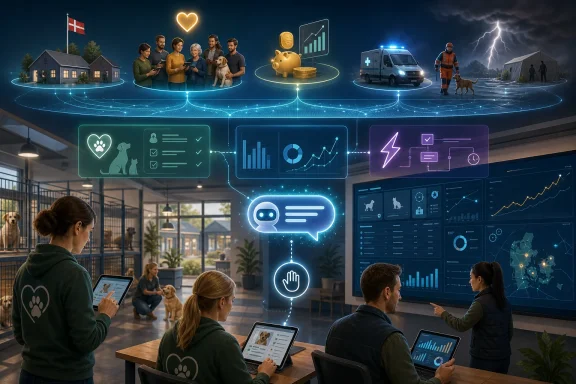 The Shelter Story Is Really a Data Story
Animal Protection Denmark has been around for more than 150 years, which is long enough to predate not only cloud computing but most of the assumptions that make cloud computing feel inevitable. The organization runs shelters, educates the public, operates an animal emergency response service, and advocates for animal welfare policy locally and internationally. Its work is tactile and emotionally immediate: injured animals, frightened pets, foster placements, medical notes, field calls, donations, petitions, volunteers, and families hoping to adopt.That is precisely why the software matters. A shelter is not merely a place with cages, kennels, and feeding schedules; it is an operations center with limited capacity and a constantly shifting set of living cases. If one team tracks medical history in one system, supporter history in another, animal movement in a third, and fundraising segments in a fourth, the organization’s ability to act quickly depends on human memory and manual reconciliation.
Microsoft’s customer story says Animal Protection Denmark’s funding has increased 150 percent over the last decade, while membership has grown 15 percent. Growth of that kind is a gift only until it becomes an administrative hazard. More supporters create more potential advocates, donors, volunteers, adopters, and callers, but they also generate more records, more exceptions, and more opportunities for contradictory numbers to quietly undermine decisions.
The organization’s answer was to make Microsoft Fabric its unified data foundation and connect it to the broader Microsoft ecosystem. Power BI provides dashboards, Dynamics 365 tracks both human supporters and animals, Business Central handles accounting, Customer Insights supports segmented outreach, Power Apps removes manual workflow steps, and Copilot Studio is being tested for future AI-assisted interactions. The result is less a single product deployment than a bet on Microsoft’s integrated cloud thesis.
Microsoft Fabric Gets Its Most Convincing Pitch Outside the Boardroom
Microsoft Fabric can sound abstract in enterprise marketing because the product sits at the intersection of data engineering, warehousing, analytics, governance, and business intelligence. It is a platform sold to solve the old problem of too many systems producing too many partial truths. That problem is easy to describe in a bank or a retailer, but it becomes unusually legible in an animal welfare nonprofit.Animal Protection Denmark staff reportedly spent hours each month checking and reconciling data before the Fabric implementation. That kind of work is often treated as administrative overhead, but in practice it is where operational confidence either accumulates or dies. If a board meeting, a media request, a shelter budget, and a foster-placement campaign all depend on slightly different numbers, the organization is not simply inefficient; it is narrating its own mission with a stutter.
The point of Fabric in this story is not that it makes a dashboard prettier. It is that the same question should return the same answer, regardless of whether the person asking it works in marketing, animal care, finance, outreach, or management. That sounds basic, but it is one of the hardest things for mature organizations to achieve because every department tends to build its own truth under pressure.
The detail that the organization had to define something as simple as the age range of kittens is more revealing than the product list. Data quality is not a switch. It is a series of decisions about language, categories, ownership, and accountability. Before AI can summarize, predict, or automate anything useful, someone has to decide what the words mean.
That is why this case makes Fabric look less like a fashionable data layer and more like plumbing. Plumbing is not glamorous until it fails. When it works, everyone argues about strategy instead of arguing about whether the numbers are real.
Dynamics 365 Turns the CRM Into a Care Record
The most interesting twist in the Animal Protection Denmark deployment is the use of Dynamics 365 Sales to manage records for animals as well as people. In the conventional enterprise world, Dynamics is a customer relationship management platform. In this setting, the “customer” concept stretches into something more morally complicated: an animal with behavior notes, feeding instructions, vaccination history, medical procedures, and a need for continuity.That repurposing says something important about modern CRM platforms. They are no longer merely sales tools; they are structured case-management systems with relationship intelligence bolted on. For a shelter, the relationship is not just between organization and donor, or staff and adopter. It is between an animal, its medical history, its handlers, potential families, previous contacts, capacity constraints, and future outcomes.
The software’s job is to prevent care from depending on who happens to be in the building. If a staff member is out sick or leaves the organization, the record persists. For animals with traumatic histories, Microsoft’s story emphasizes that consistency is part of treatment, not just administration. That is where a database becomes a welfare tool.
There is also a human side to the same record system. Shelter staff can see whether a person has donated, signed petitions, called the rescue line, or adopted before. In ordinary commercial language, that is a 360-degree customer view. In nonprofit practice, it becomes a way to recommend an animal that fits a household, avoid repeating questions, and turn a one-time interaction into a longer relationship with the mission.
That dual use — animals and humans in the same relationship universe — is exactly the kind of scenario Microsoft wants Dynamics 365 to own. Salesforce has long framed CRM as a platform rather than a sales database. Microsoft’s answer is increasingly that CRM, ERP, analytics, low-code apps, and AI assistance all become more valuable when they sit close to the productivity and identity stack many organizations already use.
Dashboards Matter Most When the Kennels Are Full
Power BI’s role in the story is familiar but still consequential: dashboards now give Animal Protection Denmark real-time visibility into capacity across its properties. That matters because adoption work is not only about finding loving homes. It is also about moving animals through a constrained system before crowding reduces welfare, increases cost, or forces worse tradeoffs.The customer story notes that previous dashboards could freeze or take minutes to change views when working with years of data. That is the kind of performance complaint that often gets dismissed until people stop using the tool. A slow dashboard does not merely waste time; it teaches users not to ask follow-up questions.
When Power BI runs against a more coherent Fabric foundation, the promise is that staff can compare, filter, and act without waiting for the system to catch up. In an enterprise sales meeting, that means better revenue analysis. In a shelter, it may mean moving animals among sites, preparing for seasonal kitten surges, or matching foster capacity to incoming need.
This is where Microsoft’s ecosystem approach has practical force. Business Central accounting data can feed dashboards. Animal and supporter data can live in Dynamics. Power Apps can patch workflow gaps. Customer Insights can segment communications. Fabric can hold the shared analytical layer. The pieces are individually familiar, but the story depends on the connective tissue.
For IT pros, the lesson is not that every nonprofit should standardize on Microsoft. It is that fragmented systems impose hidden labor costs long before anyone calls them technical debt. By the time staff are manually reconciling numbers for board meetings or media requests, the organization is already paying interest.
The “Single Source of Truth” Is a Governance Argument, Not a Slogan
Every vendor loves the phrase single source of truth, and most IT veterans have learned to distrust it. The phrase too often means “we bought another platform” rather than “we changed the habits, ownership, definitions, and incentives that made the old data unreliable.” Animal Protection Denmark’s example is useful because Microsoft’s own account acknowledges the unglamorous cleanup work behind the scenes.Defining kitten age ranges is not a technical triumph. It is governance. So is deciding where financial records live, which team owns contact segmentation, how animal medical notes are entered, and who has authority to change shared definitions. In small organizations, these decisions are often implicit. In growing organizations, implicit rules break.
That distinction matters because Microsoft is increasingly selling Fabric as the staging ground for AI. Copilot, chatbots, and predictive models all need trusted data to avoid producing polished nonsense. A model that answers quickly from inconsistent records is worse than a human who answers slowly after checking. The former can scale confusion.
Animal Protection Denmark’s reported plans for Copilot Studio and Dynamics 365 Contact Center therefore depend on whether the data layer remains disciplined. AI chatbots for membership generation are one thing. Extending similar tooling to an animal rescue line is another. The closer automation moves to urgent, emotionally charged, or safety-related interactions, the more important it becomes that escalation paths, human review, and data accuracy are not afterthoughts.
This is the sober reading of Microsoft’s customer story. The company wants readers to see AI readiness. IT departments should see data governance debt being paid down before automation arrives.
Customer Insights Makes Advocacy More Personal — and More Measurable
Animal Protection Denmark is also using Dynamics 365 Customer Insights to personalize communication with supporters. In Microsoft’s example, someone who signed a petition against the use of wild animals in circuses might later receive a donation request connected to an elephant retirement sanctuary. Another campaign invites dog-interested supporters to complete online lessons for an unofficial “dog driver’s license,” a public education effort rather than an actual license to operate anything with paws on the pedals.This is where nonprofit technology starts to resemble commercial marketing. Segmentation, personalization, campaign history, and conversion tracking are familiar tools in retail and subscription businesses. In advocacy, those same tools can turn diffuse goodwill into targeted action.
There is nothing inherently cynical about that. If someone has already signaled interest in a topic, a more relevant follow-up can be less annoying and more useful. The ethical line is not personalization itself; it is whether the organization remains transparent, respectful, and careful with supporter data.
For Microsoft, this part of the story is strategically important because it shows Dynamics 365 Customer Insights as more than a marketing add-on. It becomes part of a loop: supporters interact with campaigns, those interactions enrich records, records inform outreach, outreach funds operations, and operations generate data that shapes future campaigns. The mission and the CRM become intertwined.
That interdependence is powerful, but it also raises the governance stakes. A nonprofit’s supporter database can include donations, petitions, rescue-line calls, adoption history, and interests. Those are not just marketing attributes. They are signals of values, behavior, household context, and sometimes distress. The better the system becomes, the more carefully it must be managed.
AI Is the Destination, but Not the Starting Point
The Microsoft story closes by pointing toward Copilot Studio, chatbots, and Dynamics 365 Contact Center. Animal Protection Denmark is reportedly testing AI-assisted tools for membership generation and intends to expand the approach to its rescue line so injured or at-risk animals can get help faster. That is the kind of claim every technology vendor wants to make in 2026: AI will save time, improve service, and let human staff focus where they matter most.The credible part is that the organization is not starting with the chatbot. It is starting with Fabric, Dynamics records, Power BI visibility, and workflow cleanup. In other words, the AI layer comes after the operational layer has become more coherent. That sequencing is the difference between a plausible deployment and a demo.
For WindowsForum readers who administer Microsoft environments, this should sound familiar. Copilot-branded projects often expose the state of the tenant beneath them. Identity, permissions, labels, SharePoint sprawl, Teams hygiene, data classification, retention, and business application records all matter more once a conversational interface can retrieve and summarize information at speed.
The same principle applies here. A chatbot handling membership inquiries can be useful if it has access to accurate campaign, supporter, and membership data. A bot assisting with emergency animal calls must be designed with much tighter guardrails, because mistakes can have real-world consequences. The more urgent the workflow, the less acceptable it is to treat AI as a replacement for process design.
Microsoft’s advantage is that many pieces are already in its stack. Its risk is that customers may conflate integration with readiness. A connected Microsoft environment can make AI easier to deploy, but it does not absolve anyone from deciding what the AI should never do.
Wildlife Collisions Show the Platform Escaping the Office
One of the most intriguing parts of the case is Animal Protection Denmark’s use of years of collision data to identify places and times where animals are more likely to be hit by cars. The organization is reportedly working with a popular technology company to alert drivers when they approach high-risk areas. That moves the Microsoft stack from internal operations into public safety behavior.This is not just dashboarding. It is applied prediction, geography, timing, and intervention. The value comes from turning accumulated incident data into a warning that reaches a person before harm occurs. For an animal welfare group, that is a meaningful shift from response to prevention.
It also illustrates why unified data projects can become more ambitious over time. A shelter might begin by wanting cleaner reports. Once the data is structured and accessible, teams start asking harder questions: Where are the risks? When do they occur? Which interventions change outcomes? What can be automated without losing human judgment?
That is the strategic promise of Fabric in a nutshell. A lakehouse or analytics platform is not valuable because executives enjoy architecture diagrams. It is valuable when yesterday’s records can shape tomorrow morning’s decisions.
Still, the collision-alert idea also depends on partnerships, data quality, user trust, and careful communication. A warning that fires too often becomes noise. A warning that misses obvious hotspots loses credibility. The challenge is not only to discover patterns but to deliver them in a way people will actually heed.
Nonprofits Are Becoming Enterprise IT Shops by Necessity
The Animal Protection Denmark story fits a broader pattern: organizations that do emotionally grounded, public-interest work increasingly need enterprise-grade systems. That can feel counterintuitive. Donors often prefer the idea that money goes directly to the visible mission, not to CRM licenses, analytics platforms, or workflow automation.But that distinction is too simple. If staff waste hours reconciling data, if animals are moved inefficiently because capacity is unclear, if outreach is generic because supporter history is fragmented, or if emergency calls cannot be prioritized well, the mission pays the price. Administrative technology is not separate from frontline impact when the front line depends on information.
This is particularly true for nonprofits that grow. Small teams can survive on personal knowledge and improvised systems. Larger organizations need repeatable processes, auditability, permission controls, shared records, and reporting that can survive staff turnover. The painful middle stage is when the organization is too large for improvisation but not yet disciplined enough for platform thinking.
Microsoft’s nonprofit pitch lands in that middle stage. The company can offer familiar productivity tools, identity, security, CRM, ERP, analytics, low-code development, and AI under one broad umbrella. That is attractive to organizations that do not want to stitch together a dozen vendors and then maintain the integration fabric themselves.
The tradeoff is lock-in. Once Dynamics records, Business Central accounting, Power BI dashboards, Fabric models, Power Apps workflows, and Copilot Studio experiences become part of daily operations, leaving the ecosystem is not a procurement decision. It is organizational surgery.
The Windows Angle Is the Microsoft Stack Behind the Mission
At first glance, this is not a Windows story. There is no new Start menu, no servicing stack update, no kernel panic, no Group Policy regression, and no surprise from Redmond hiding in the system tray. But WindowsForum’s audience understands that the modern Windows estate is increasingly just one surface of Microsoft’s larger cloud control plane.The same organizations running Windows endpoints are often standardizing identity in Entra ID, collaboration in Microsoft 365, device management in Intune, reporting in Power BI, business workflows in Power Platform, and line-of-business records in Dynamics. Fabric is Microsoft’s attempt to keep the data layer from becoming someone else’s strategic beachhead. Copilot is the user-facing pressure that makes all the underlying mess impossible to ignore.
That matters for sysadmins because business units rarely ask for “a governed semantic model.” They ask why the dashboard is slow, why two reports disagree, why a volunteer cannot access a form, why a staff member sees the wrong record, why the chatbot gave a weak answer, or why a campaign segment missed half its target audience. The architecture becomes visible through complaints.
Animal Protection Denmark’s deployment is therefore a reminder that Microsoft environments are not administered product by product anymore. The meaningful unit is the workflow. An adoption workflow might touch Dynamics, Power Apps, Power BI, Fabric, Outlook, Teams, SharePoint, and endpoint access policies before anyone describes it as “IT.”
For Windows admins and Microsoft 365 specialists, that means the job keeps moving up the stack. The endpoint still matters, but the larger challenge is guaranteeing that identity, data, security, compliance, and business applications line up well enough that frontline staff can trust what they see.
The Real Win Is Boring, Which Is Why It Matters
The most persuasive outcome in Microsoft’s story is not the future chatbot or even the wildlife collision model. It is the claim that staff can now pull data with confidence and that dashboards no longer freeze under years of history. Those are boring improvements in the best sense of the word.Boring reliability is what lets an organization become more ambitious. If marketing can trust kitten foster-placement numbers, it can respond to media faster. If shelter staff can trust capacity dashboards, they can move animals more intelligently. If finance data is available for reporting, leadership can connect spending to operational need. If supporter records are complete, outreach can be personal without becoming chaotic.
This is the part of digital transformation that rarely photographs well. There is no cinematic moment where a dashboard saves a puppy. There is instead a series of small reductions in friction that accumulate into more time, better decisions, and fewer preventable mistakes.
Microsoft’s marketing naturally frames the story as a validation of its platform. That is fair enough; customer stories are not investigative audits. But the practical lesson is broader than Microsoft. Any organization that wants AI-assisted operations needs to know what it knows, where it knows it, who maintains it, and whether the same query returns the same answer tomorrow.
That is true whether the workload is animal welfare, municipal services, healthcare scheduling, university advancement, or enterprise support. The tools differ. The failure modes rhyme.
The Danish Shelter Case Leaves Microsoft With a Cleaner AI Argument
Microsoft has spent the past few years attaching Copilot to nearly every part of its portfolio. The danger of that strategy is fatigue. When every product pitch ends with an AI assistant, customers start hearing less about outcomes and more about branding.Animal Protection Denmark gives Microsoft a cleaner argument because AI is not the only point. The story begins with growth, data inconsistency, and operational drag. It moves through Fabric, Dynamics, Power BI, Business Central, Power Apps, and Customer Insights. Only then does it arrive at Copilot Studio and Contact Center.
That order matters. It suggests that the real AI sale is not a chatbot subscription but an ecosystem alignment project. Microsoft wants organizations to believe that if they consolidate data and workflows into its cloud, AI capabilities will become a natural next layer rather than a separate moonshot.
For customers, the right response is cautious optimism. Integrated platforms can reduce friction, but they can also concentrate risk. Better data can improve service, but it can also enable over-personalization or over-automation. AI can triage routine interactions, but only if humans remain accountable for edge cases and high-stakes decisions.
Animal Protection Denmark’s mission gives the technology story emotional clarity. Hurt animals, crowded shelters, concerned callers, and committed supporters make the stakes easy to understand. But the underlying enterprise pattern is the same one many organizations now face: the next stage of automation depends less on buying AI than on cleaning up the mess AI would otherwise amplify.
The Lesson From the Kennel Is Not Just for Kennels
This deployment is worth watching because it compresses a decade of Microsoft strategy into one unusually concrete nonprofit case. The products are familiar, but the combination is the story: Fabric for shared data, Dynamics for records, Power BI for visibility, Business Central for finance, Power Apps for workflow, Customer Insights for outreach, and Copilot Studio for the next wave of assisted interaction.- Animal Protection Denmark’s growth made fragmented data a practical obstacle, not merely an IT inconvenience.
- Microsoft Fabric’s most important role is creating a common foundation that lets different teams get the same answer from the same organizational reality.
- Dynamics 365 becomes more interesting when it is treated as a flexible relationship and case-management system rather than a conventional sales database.
- Power BI’s value depends on performance and trust, because slow or contradictory dashboards quietly train users to work around official systems.
- The organization’s AI plans look more credible because they follow data cleanup and workflow consolidation instead of preceding them.
- The case also shows the lock-in bargain clearly: Microsoft’s integrated stack can reduce complexity, but it can become deeply embedded in the organization’s operating model.
References
- Primary source: Microsoft
Published: 2026-06-30T14:10:09.622782
Animal Protection Denmark grows its reach to save more animals with Microsoft Fabric and Dynamics 365 | Microsoft Customer Stories
Animal Protection Denmark built a unified data foundation in Microsoft Fabric to power its growth, outreach, and future AI opportunities.www.microsoft.com
