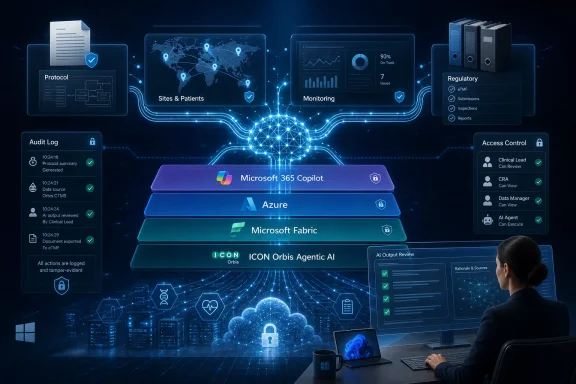
ICON plc announced on June 22, 2026, in Dublin that it has selected Microsoft as a preferred technology partner for a three-year digital innovation and AI investment plan spanning Microsoft 365 Copilot, Fabric, Azure data services, and clinical-trial AI infrastructure. The deal matters less as another Copilot rollout than as a signal that AI is moving from laboratory experiment to operating system for contract research. ICON is not buying a chatbot; it is trying to rewire how trials are designed, staffed, monitored, and adjusted. For Microsoft, the win shows how Azure and Microsoft 365 are becoming the default enterprise substrate for regulated AI.
Clinical research has always been a paperwork business disguised as a science business. Every protocol amendment, site feasibility review, adverse event workflow, patient-recruitment campaign, and monitoring report creates another layer of data that must be reconciled, audited, and trusted. The modern contract research organization lives or dies by how quickly it can turn those fragments into operational decisions without breaking the regulatory chain of custody.
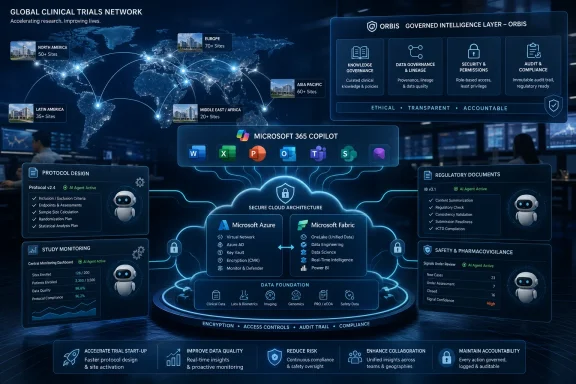
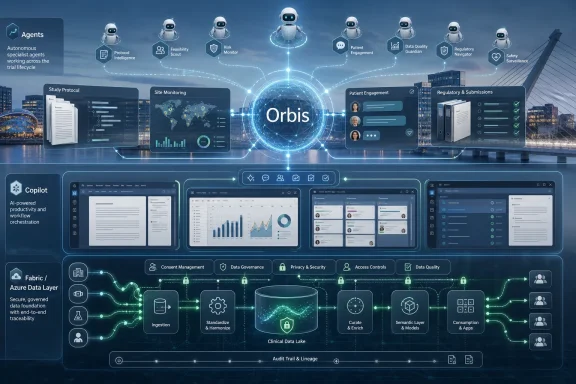
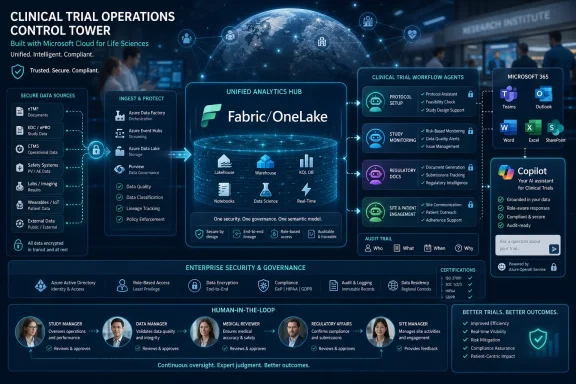
That is the context for ICON’s Microsoft selection. The company says the partnership will support Orbis, its AI platform for clinical trials, by connecting clinical, operational, and enterprise data through Microsoft Fabric and Azure data services. In plain English, ICON wants a shared data layer that can feed AI systems with fresher information than the static reports and disconnected databases that still define much of clinical operations.
This is where the announcement becomes interesting for IT pros. The first generation of enterprise AI deployments was often about giving employees a Copilot license and hoping productivity would materialize. ICON’s plan is more ambitious and more difficult: it is about creating an intelligence layer on top of regulated business data, then using that layer to power domain-specific agents inside clinical workflows.
That makes the Microsoft component strategic. Azure is not just where the models run; it becomes the governed environment where data pipelines, identity controls, audit trails, and AI services meet. In a sector where a bad recommendation can delay a trial, compromise compliance, or misallocate patient recruitment resources, the plumbing is the product.
That is exactly the kind of enterprise AI story Microsoft has been trying to tell. Consumer AI is loud, model benchmarks are volatile, and the OpenAI relationship continues to attract Wall Street drama. But Microsoft’s durable advantage is the unglamorous one: it already sits inside corporate identity, email, documents, spreadsheets, endpoint management, compliance tooling, and cloud infrastructure.
For a CRO with roughly 40,000 employees spread across dozens of countries, Microsoft 365 Copilot is not merely a productivity add-on. It is a way to push AI into the daily work surface of clinical project managers, data teams, site-support staff, finance users, and executives without asking every business unit to adopt a new standalone interface. That familiarity lowers the adoption barrier, even if it does not eliminate the hard work of governance and workflow redesign.
Microsoft’s win is also a reminder that regulated industries rarely adopt AI the way Silicon Valley demos it. They do not start with a blank prompt box and a promise of magic. They start with identity, permissions, data residency, retention policies, model governance, legal review, and a painful inventory of which systems actually contain the truth.
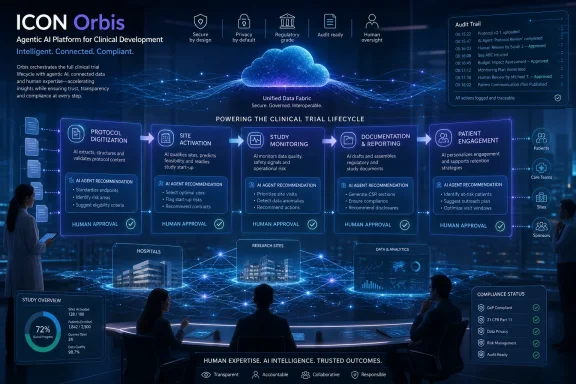
ICON has already been talking about AI in trial startup, document management, resource forecasting, metrics reporting, site identification, protocol design, and patient engagement. The Microsoft partnership gives that strategy a more coherent enterprise architecture. If Orbis can draw on a better data foundation, its agents and analytics should become less dependent on brittle integrations and manual exports.
That distinction matters because many corporate AI efforts fail at the boundary between demo and production. A prototype can summarize a protocol or draft a monitoring memo with a carefully prepared dataset. A production clinical system has to operate across messy sponsor requirements, regional regulations, legacy platforms, changing site capacity, incomplete data, and the uncomfortable fact that no two trials are quite alike.
The promise of Orbis, as framed by ICON, is that AI can help across study design, operational execution, patient and site engagement, and decision-making. The risk is that such breadth becomes a slogan unless the underlying data model is strong. Microsoft Fabric and Azure data services are therefore not background details; they are the enabling layer that determines whether the AI can reason from live operational reality or merely decorate yesterday’s reporting.
The CRO business is particularly exposed to workflow inefficiency. A large trial may involve sponsors, investigators, hospitals, labs, regulators, data-management teams, safety teams, vendors, and patients moving through a schedule that can span years. Every delay compounds, and every manual reconciliation point becomes a place where cost and risk accumulate.
That is why AI in clinical research is unlikely to be a single killer app. The value is more likely to come from dozens of narrower improvements: better site feasibility, faster document review, automated data-quality checks, smarter forecasting, more targeted recruitment, and earlier detection of operational drift. ICON’s announcement points in that direction by emphasizing domain-specific agents rather than a generic enterprise assistant.
For WindowsForum readers, the parallel with IT operations is obvious. The best automation does not replace the need for experts; it reduces the toil that prevents experts from spending time on judgment. In clinical trials, the equivalent is freeing experienced staff from manual data gathering so they can focus on whether the trial is actually working.
ICON has previously emphasized responsible AI governance, including oversight of ethical, legal, and privacy standards. That is not corporate decoration in this sector. Trial data can include sensitive health information, commercially confidential sponsor material, investigator data, and operational details that must be handled across jurisdictions.
Microsoft’s appeal here is not only model access. It is the enterprise controls around the model: Entra ID, Purview, Defender, Azure governance, Microsoft 365 compliance capabilities, and the broader security apparatus that many large organizations already use. The harder question is whether those controls are configured tightly enough when AI tools begin traversing data that was previously isolated by application boundaries.
This is where CIOs and CISOs should read the ICON announcement with both interest and caution. AI value increases when systems can see more context. AI risk also increases when systems can see more context. The next phase of enterprise AI will be defined by how well organizations reconcile those two truths.
That matters because AI agents are only as useful as the data they can access, interpret, and update. In many enterprises, the data problem is not that information does not exist. It is that information exists in too many places, under too many schemas, with too many owners, and with too little confidence about which version should drive a decision.
Clinical research intensifies that problem. Trial master files, electronic data capture systems, site portals, safety databases, recruitment systems, finance systems, HR systems, and sponsor-specific tools all produce signals. A CRO that can integrate those signals into a governed analytical layer has a real operational advantage.
If Microsoft can make Fabric credible in this kind of environment, it strengthens the company’s pitch well beyond healthcare. Every regulated industry has the same fundamental problem: AI ambition constrained by fragmented data and compliance anxiety. ICON gives Microsoft a showcase for selling the idea that its cloud stack can make enterprise AI operational rather than ornamental.
Employees need to know when Copilot is appropriate, when it is not, and how to handle generated content that touches regulated work. Managers need to avoid measuring success by license activation alone. Legal and compliance teams need to decide how AI-assisted drafts, summaries, and recommendations fit into documentation standards.
The hardest part is behavioral. Workers who are already overloaded may welcome summarization, drafting, meeting recap, and document-search features. But if AI tools are unreliable, poorly trained, or forced into workflows where they create more review burden than they remove, adoption will stall.
ICON’s advantage is that it can pair a horizontal Copilot rollout with more specialized AI investments in Orbis. The horizontal tools can improve daily knowledge work, while the domain-specific agents address clinical operations. The danger is treating those efforts as the same thing. They are not. One is enterprise productivity; the other is regulated process transformation.
Clinical development is an attractive target for platform vendors because the pain points are obvious and expensive. Trials take too long, recruitment is difficult, site burden is high, and protocol complexity keeps rising. Even modest improvements can be meaningful when applied across large portfolios of studies.
But this is also a field where vendor marketing can outrun reality. AI will not magically solve patient recruitment, site activation, or data quality. It can help identify bottlenecks, automate repetitive work, and surface better recommendations, but only if the surrounding process changes with it.
That is why ICON’s three-year framing is important. It implicitly acknowledges that this is not a quarterly feature launch. Scaling AI across clinical development requires platform work, process redesign, training, governance, validation, and enough patience to learn where the technology genuinely improves outcomes.
Microsoft 365 Copilot lives where Windows-heavy organizations spend their day: Outlook, Teams, Word, Excel, PowerPoint, SharePoint, and the Microsoft Graph. Azure provides the infrastructure. Entra governs identity. Endpoint and security tooling shape the access model. For admins, the AI era is not arriving as a separate platform; it is being layered onto the existing Microsoft estate.
That should change how IT teams think about AI readiness. The relevant question is not merely whether the organization has bought Copilot licenses. It is whether its permissions model is sane, whether SharePoint sprawl has been cleaned up, whether sensitive data is labeled, whether retention policies are coherent, and whether users understand the boundaries of AI-assisted work.
ICON’s deployment will be watched less for whether employees can draft faster emails and more for whether Microsoft’s stack can support AI at the scale and sensitivity of global clinical development. If it works, it reinforces Microsoft’s claim that the enterprise AI battleground is not the chatbot window. It is the governed data estate behind it.
ICON’s challenge is to prove that this is more than narrative. The market will eventually ask whether AI reduces trial startup times, improves margins, accelerates recruitment, lowers rework, or produces measurable quality improvements. Those outcomes are harder to demonstrate than announcing a partnership with Microsoft.
There is also the question of dependency. Standardizing around Microsoft can simplify architecture and governance, but it can also concentrate platform risk. If core AI workflows become tightly coupled to Azure services, Fabric, Microsoft 365 Copilot, and Microsoft’s AI roadmap, ICON gains integration at the price of strategic exposure to one vendor’s ecosystem.
That trade-off is not inherently bad. Most enterprises already make similar bets on Microsoft, AWS, Google, Oracle, Salesforce, SAP, or ServiceNow. The difference is that AI increases the cost of switching because it embeds platform assumptions into workflows, data models, agent behavior, and employee habits.
That promise depends on data hygiene. If permissions are too broad, agents may expose information users should not see. If data lineage is unclear, agents may cite stale or incorrect operational signals. If workflows are poorly defined, agents may automate confusion.
This is why enterprise AI is forcing organizations to revisit boring IT fundamentals. Access control, metadata, retention, data classification, logging, integration architecture, and change management suddenly become AI-enablement work. The firms that treated those disciplines as back-office chores will discover that their AI ambitions are constrained by years of accumulated entropy.
ICON’s clinical setting makes the stakes unusually visible, but the lesson generalizes. Agents are not magic colleagues. They are software systems whose usefulness is bounded by the quality of the systems they touch.
 Clinical Trials Are Becoming a Data-Center Problem
Clinical research has always been a paperwork business disguised as a science business. Every protocol amendment, site feasibility review, adverse event workflow, patient-recruitment campaign, and monitoring report creates another layer of data that must be reconciled, audited, and trusted. The modern contract research organization lives or dies by how quickly it can turn those fragments into operational decisions without breaking the regulatory chain of custody.That is the context for ICON’s Microsoft selection. The company says the partnership will support Orbis, its AI platform for clinical trials, by connecting clinical, operational, and enterprise data through Microsoft Fabric and Azure data services. In plain English, ICON wants a shared data layer that can feed AI systems with fresher information than the static reports and disconnected databases that still define much of clinical operations.
This is where the announcement becomes interesting for IT pros. The first generation of enterprise AI deployments was often about giving employees a Copilot license and hoping productivity would materialize. ICON’s plan is more ambitious and more difficult: it is about creating an intelligence layer on top of regulated business data, then using that layer to power domain-specific agents inside clinical workflows.
That makes the Microsoft component strategic. Azure is not just where the models run; it becomes the governed environment where data pipelines, identity controls, audit trails, and AI services meet. In a sector where a bad recommendation can delay a trial, compromise compliance, or misallocate patient recruitment resources, the plumbing is the product.
Microsoft Wins When AI Becomes Boring Infrastructure
The most important phrase in ICON’s announcement is not “AI.” It is “preferred technology partner.” That wording suggests a platform decision rather than a one-off procurement. ICON is standardizing enough of its AI and productivity stack around Microsoft that the partnership becomes part of the company’s three-year operating plan.That is exactly the kind of enterprise AI story Microsoft has been trying to tell. Consumer AI is loud, model benchmarks are volatile, and the OpenAI relationship continues to attract Wall Street drama. But Microsoft’s durable advantage is the unglamorous one: it already sits inside corporate identity, email, documents, spreadsheets, endpoint management, compliance tooling, and cloud infrastructure.
For a CRO with roughly 40,000 employees spread across dozens of countries, Microsoft 365 Copilot is not merely a productivity add-on. It is a way to push AI into the daily work surface of clinical project managers, data teams, site-support staff, finance users, and executives without asking every business unit to adopt a new standalone interface. That familiarity lowers the adoption barrier, even if it does not eliminate the hard work of governance and workflow redesign.
Microsoft’s win is also a reminder that regulated industries rarely adopt AI the way Silicon Valley demos it. They do not start with a blank prompt box and a promise of magic. They start with identity, permissions, data residency, retention policies, model governance, legal review, and a painful inventory of which systems actually contain the truth.
Orbis Is the Real Bet, Copilot Is the Wedge
Copilot will get the attention because it is the visible part of the deployment. ICON says it will roll out Microsoft 365 Copilot across the organization, which is a large internal commitment by any measure. But the deeper strategic bet is Orbis, the AI platform ICON wants to scale across the clinical-trial lifecycle.ICON has already been talking about AI in trial startup, document management, resource forecasting, metrics reporting, site identification, protocol design, and patient engagement. The Microsoft partnership gives that strategy a more coherent enterprise architecture. If Orbis can draw on a better data foundation, its agents and analytics should become less dependent on brittle integrations and manual exports.
That distinction matters because many corporate AI efforts fail at the boundary between demo and production. A prototype can summarize a protocol or draft a monitoring memo with a carefully prepared dataset. A production clinical system has to operate across messy sponsor requirements, regional regulations, legacy platforms, changing site capacity, incomplete data, and the uncomfortable fact that no two trials are quite alike.
The promise of Orbis, as framed by ICON, is that AI can help across study design, operational execution, patient and site engagement, and decision-making. The risk is that such breadth becomes a slogan unless the underlying data model is strong. Microsoft Fabric and Azure data services are therefore not background details; they are the enabling layer that determines whether the AI can reason from live operational reality or merely decorate yesterday’s reporting.
The CRO Market Is Under Pressure to Automate
ICON’s move lands in a clinical-research market where sponsors want faster trials, cleaner data, broader patient access, and lower cost. Those demands are not new, but they have become more acute as complex therapies, decentralized trial models, and tighter biotech funding cycles increase pressure on CRO margins. AI is attractive because it promises to remove friction from the many handoffs that make trials slow.The CRO business is particularly exposed to workflow inefficiency. A large trial may involve sponsors, investigators, hospitals, labs, regulators, data-management teams, safety teams, vendors, and patients moving through a schedule that can span years. Every delay compounds, and every manual reconciliation point becomes a place where cost and risk accumulate.
That is why AI in clinical research is unlikely to be a single killer app. The value is more likely to come from dozens of narrower improvements: better site feasibility, faster document review, automated data-quality checks, smarter forecasting, more targeted recruitment, and earlier detection of operational drift. ICON’s announcement points in that direction by emphasizing domain-specific agents rather than a generic enterprise assistant.
For WindowsForum readers, the parallel with IT operations is obvious. The best automation does not replace the need for experts; it reduces the toil that prevents experts from spending time on judgment. In clinical trials, the equivalent is freeing experienced staff from manual data gathering so they can focus on whether the trial is actually working.
Regulated AI Is a Governance Test Before It Is a Productivity Test
The clinical-trial setting makes this partnership more consequential than a routine AI licensing deal. AI systems touching trial operations must be explainable enough to support audit, constrained enough to avoid unauthorized data exposure, and reliable enough that humans can understand when to trust them. The governance burden is not a footnote; it is the central implementation challenge.ICON has previously emphasized responsible AI governance, including oversight of ethical, legal, and privacy standards. That is not corporate decoration in this sector. Trial data can include sensitive health information, commercially confidential sponsor material, investigator data, and operational details that must be handled across jurisdictions.
Microsoft’s appeal here is not only model access. It is the enterprise controls around the model: Entra ID, Purview, Defender, Azure governance, Microsoft 365 compliance capabilities, and the broader security apparatus that many large organizations already use. The harder question is whether those controls are configured tightly enough when AI tools begin traversing data that was previously isolated by application boundaries.
This is where CIOs and CISOs should read the ICON announcement with both interest and caution. AI value increases when systems can see more context. AI risk also increases when systems can see more context. The next phase of enterprise AI will be defined by how well organizations reconcile those two truths.
Fabric Gets Its Healthcare Proof Point
Microsoft Fabric is easy to underestimate because it sounds like yet another data-platform brand in a market already crowded with data warehouses, lakehouses, integration services, and analytics suites. But in a partnership like this, Fabric is the connective tissue. ICON says it will use Fabric and Azure data services to build a data layer across clinical, operational, and enterprise data.That matters because AI agents are only as useful as the data they can access, interpret, and update. In many enterprises, the data problem is not that information does not exist. It is that information exists in too many places, under too many schemas, with too many owners, and with too little confidence about which version should drive a decision.
Clinical research intensifies that problem. Trial master files, electronic data capture systems, site portals, safety databases, recruitment systems, finance systems, HR systems, and sponsor-specific tools all produce signals. A CRO that can integrate those signals into a governed analytical layer has a real operational advantage.
If Microsoft can make Fabric credible in this kind of environment, it strengthens the company’s pitch well beyond healthcare. Every regulated industry has the same fundamental problem: AI ambition constrained by fragmented data and compliance anxiety. ICON gives Microsoft a showcase for selling the idea that its cloud stack can make enterprise AI operational rather than ornamental.
The Employee Rollout May Be the Hardest Part
Deploying Microsoft 365 Copilot to every employee sounds straightforward compared with building a clinical-trial AI platform. It may not be. Large-scale productivity AI introduces cultural, legal, and managerial questions that do not disappear because the tool lives inside familiar Microsoft apps.Employees need to know when Copilot is appropriate, when it is not, and how to handle generated content that touches regulated work. Managers need to avoid measuring success by license activation alone. Legal and compliance teams need to decide how AI-assisted drafts, summaries, and recommendations fit into documentation standards.
The hardest part is behavioral. Workers who are already overloaded may welcome summarization, drafting, meeting recap, and document-search features. But if AI tools are unreliable, poorly trained, or forced into workflows where they create more review burden than they remove, adoption will stall.
ICON’s advantage is that it can pair a horizontal Copilot rollout with more specialized AI investments in Orbis. The horizontal tools can improve daily knowledge work, while the domain-specific agents address clinical operations. The danger is treating those efforts as the same thing. They are not. One is enterprise productivity; the other is regulated process transformation.
Microsoft’s Healthcare AI Strategy Is Expanding Beyond the Hospital
Microsoft’s healthcare AI story is often associated with clinicians, electronic health records, ambient documentation, and tools such as Dragon Copilot. ICON pushes the story into a different but adjacent arena: the industrial process of developing medicines. That is a useful expansion for Microsoft because life sciences workflows are rich in data, compliance requirements, and repeatable knowledge work.Clinical development is an attractive target for platform vendors because the pain points are obvious and expensive. Trials take too long, recruitment is difficult, site burden is high, and protocol complexity keeps rising. Even modest improvements can be meaningful when applied across large portfolios of studies.
But this is also a field where vendor marketing can outrun reality. AI will not magically solve patient recruitment, site activation, or data quality. It can help identify bottlenecks, automate repetitive work, and surface better recommendations, but only if the surrounding process changes with it.
That is why ICON’s three-year framing is important. It implicitly acknowledges that this is not a quarterly feature launch. Scaling AI across clinical development requires platform work, process redesign, training, governance, validation, and enough patience to learn where the technology genuinely improves outcomes.
The Windows Angle Is the Enterprise Surface Area
This is not a Windows desktop story in the narrow sense. There is no new Start menu, no driver drama, no Patch Tuesday twist. But it is very much a Windows ecosystem story because Microsoft’s AI strategy reaches the enterprise through the work surfaces IT already manages.Microsoft 365 Copilot lives where Windows-heavy organizations spend their day: Outlook, Teams, Word, Excel, PowerPoint, SharePoint, and the Microsoft Graph. Azure provides the infrastructure. Entra governs identity. Endpoint and security tooling shape the access model. For admins, the AI era is not arriving as a separate platform; it is being layered onto the existing Microsoft estate.
That should change how IT teams think about AI readiness. The relevant question is not merely whether the organization has bought Copilot licenses. It is whether its permissions model is sane, whether SharePoint sprawl has been cleaned up, whether sensitive data is labeled, whether retention policies are coherent, and whether users understand the boundaries of AI-assisted work.
ICON’s deployment will be watched less for whether employees can draft faster emails and more for whether Microsoft’s stack can support AI at the scale and sensitivity of global clinical development. If it works, it reinforces Microsoft’s claim that the enterprise AI battleground is not the chatbot window. It is the governed data estate behind it.
The Market Context Is Messier Than the Press Release
Investing.com’s report also placed the announcement inside ICON’s broader financial story, noting recent earnings pressure, analyst target revisions, and market scrutiny. That context matters because AI partnerships are now routinely used to signal strategic renewal. For public companies, “AI investment plan” can function as both operational roadmap and investor narrative.ICON’s challenge is to prove that this is more than narrative. The market will eventually ask whether AI reduces trial startup times, improves margins, accelerates recruitment, lowers rework, or produces measurable quality improvements. Those outcomes are harder to demonstrate than announcing a partnership with Microsoft.
There is also the question of dependency. Standardizing around Microsoft can simplify architecture and governance, but it can also concentrate platform risk. If core AI workflows become tightly coupled to Azure services, Fabric, Microsoft 365 Copilot, and Microsoft’s AI roadmap, ICON gains integration at the price of strategic exposure to one vendor’s ecosystem.
That trade-off is not inherently bad. Most enterprises already make similar bets on Microsoft, AWS, Google, Oracle, Salesforce, SAP, or ServiceNow. The difference is that AI increases the cost of switching because it embeds platform assumptions into workflows, data models, agent behavior, and employee habits.
The Agent Era Will Punish Weak Data Hygiene
The announcement’s reference to domain-specific agents is easy to glide past, but it may be the most revealing part. Agents promise to do more than answer questions; they can take actions, orchestrate workflows, and recommend next steps. In clinical trials, that could mean helping with site selection, surfacing missing documents, flagging recruitment risks, or preparing operational summaries.That promise depends on data hygiene. If permissions are too broad, agents may expose information users should not see. If data lineage is unclear, agents may cite stale or incorrect operational signals. If workflows are poorly defined, agents may automate confusion.
This is why enterprise AI is forcing organizations to revisit boring IT fundamentals. Access control, metadata, retention, data classification, logging, integration architecture, and change management suddenly become AI-enablement work. The firms that treated those disciplines as back-office chores will discover that their AI ambitions are constrained by years of accumulated entropy.
ICON’s clinical setting makes the stakes unusually visible, but the lesson generalizes. Agents are not magic colleagues. They are software systems whose usefulness is bounded by the quality of the systems they touch.
ICON’s Microsoft Bet Draws the New Enterprise AI Map
The most concrete reading of this deal is that ICON is consolidating its AI ambitions around Microsoft’s cloud, data, and productivity stack while trying to make Orbis the intelligent layer for clinical development. That gives IT leaders a useful template for what serious enterprise AI projects now look like.- ICON’s agreement with Microsoft is a three-year platform bet, not a narrow Copilot licensing story.
- Microsoft 365 Copilot will be deployed enterprise-wide, but the more strategic work is the scaling of ICON’s Orbis clinical-trial AI platform.
- Microsoft Fabric and Azure data services are central because clinical AI depends on governed access to operational, clinical, and enterprise data.
- Domain-specific agents are the likely battleground, since regulated industries need AI that understands workflow context rather than generic chatbot behavior.
- The biggest risks are governance, data quality, platform dependency, and the gap between AI demonstration value and measurable operational outcomes.
- For Microsoft customers, the deal reinforces that AI readiness begins with identity, permissions, compliance, and data architecture.
References
- Primary source: Investing.com Canada
Published: 2026-06-22T11:08:15.367161
ICON selects Microsoft as AI technology partner By Investing.com
ICON selects Microsoft as AI technology partnerca.investing.com - Official source: news.microsoft.com
- Related coverage: nasdaq.com
Frequency Holdings (OTC FRQN) Announces Verified in Microsoft AI Cloud Partner Program | Nasdaq
--Frequency Holdings Inc. announced today that its subsidiary ReachOut Digital Intelligence has been verified in the Microsoft AI Cloud Partner Program, positioning the Company to expand consulting and operational services around enterprise AI deployments built on the Microsoft Cloud. ReachOut...www.nasdaq.com - Related coverage: iconics.com
ICONICS Wins 2022 Microsoft IoT Partner of the Year Award | ICONICS Software Solutions
Automation software solutions that visualize, historize, analyze, and mobilize real-time information for any application on any device.iconics.com - Related coverage: investors.ttec.com
TTEC Digital achieves 2025-2026 Microsoft AI Business Solutions Inner Circle award | TTEC Holdings, Inc.
TTEC Digital is honored by Microsoft for achieving outstanding sales achievement and innovation AUSTIN, Texas , Sept. 25, 2025 /PRNewswire/ -- TTEC Holdings Inc. (NASDAQ: TTEC ), a leading global customer experience (CX) technology and services innovator for AI-enabled CX, today announced that TTECinvestors.ttec.com
- Official source: blogs.microsoft.com
From vision to reality: Microsoft's partners embrace AI to deliver customer value - The Official Microsoft Blog
Artificial intelligence is a defining technology of our time. Over the past year we’ve begun to see how it can unlock profound possibilities for individuals, organizations and society — and it’s clear that we have only scratched the surface. For Microsoft and our partners across industries, AI...blogs.microsoft.com

- Related coverage: icertis.com
Icertis Expands Strategic Partnership with Microsoft to Advance AI-Native Contract Intelligence | Icertis
New Multi-Year Agreement Deepens Joint Innovation to Enable Contracts with Agentic Automation www.icertis.com
- Related coverage: ttec.com
TTEC Digital named a launch partner for Microsoft Digital Contact Center Platform
DENVER, July 19, 2022 /PRNewswire/ -- TTEC Holdings, Inc. (NASDAQ:TTEC), one of the largest global customer experience (CX) technology and services innovators for end-to-end digital CX solutions, has been selected as a launch partner for Microsoft's Digital Contact Center Platform.www.ttec.com - Related coverage: globenewswire.com
WSP and Microsoft partner to drive digital transformation
WSP is designated as a Microsoft preferred partner for engineering and science consultancyMicrosoft is designated as a preferred digital and AI...www.globenewswire.com - Related coverage: newsroom.ibm.com
IBM Introduces New Microsoft Copilot Capabilities to Fuel AI-Powered Business Transformation
PDF documentnewsroom.ibm.com
- Related coverage: 2wtech.com
</rdf:Alt> </dc:title> <dc:description> <rdf:Alt> <rdf:li xml:lang="x-default"/> </rdf:Alt> </dc:description> <dc:creator> <rdf:Seq> <rdf:li>Sue Bre
</rdf:Alt> </dc:description> <dc:creator> <rdf:Seq> <rdf:li>Sue Bresee2wtech.com
- Related coverage: investor.iconplc.com

ICON and Advarra Introduce New ‘Research-Ready,’ Connected Site Network Model | ICON plc
Partnership will integrate ICON’s clinical trial technology with Advarra’s purpose-built system for research sites, embedded across a broad, deeply established global network. Partnership will reduce administrative friction, accelerate study startup, and increase clinical trial participation.
investor.iconplc.com
- Related coverage: iconplc.gcs-web.com

ICON Portfolio of AI Tools Drives Clinical Trial Efficiencies | ICON plc
Enterprise Ireland grant awarded to ICON to further enhance artificial intelligence capabilities DUBLIN --(BUSINESS WIRE)--Jan. 30, 2025-- ICON plc , (NASDAQ: ICLR) a world-leading clinical research organisation powered by healthcare intelligence, today announced the expansion of its portfolio of
iconplc.gcs-web.com
- Related coverage: iconplc.com
ICON releases latest version of its Digital Platform | ICON plc
ICON plc today announced the latest release of its Digital Platform.www.iconplc.com
- Related coverage: businesswire.com
- Official source: microsoft.com
Unify. Simplify. Scale: Microsoft Dragon Copilot meets the moment at HIMSS 2026 | The Microsoft Cloud Blog
See how Microsoft Dragon Copilot unifies clinical intelligence, workflows, and partner AI to reduce burden and scale care. Learn more. www.microsoft.com