

Background
Fonterra’s scale explains why AI has become so strategically important. The co-operative processes around 22 billion litres of milk solids each season, which means even modest changes in waste, downtime or manual effort can have major financial and operational consequences. Microsoft says Fonterra has been on a cloud journey for six years, first moving core operations to Azure before layering in AI in support of broader priorities.
That sequence is significant. Many organizations start with isolated pilots and hope value appears later, but Fonterra appears to have done the opposite: modernize infrastructure first, then attach AI to concrete business problems. That approach usually produces better governance, cleaner data flows and fewer fragile demos that impress in a meeting but collapse in production.
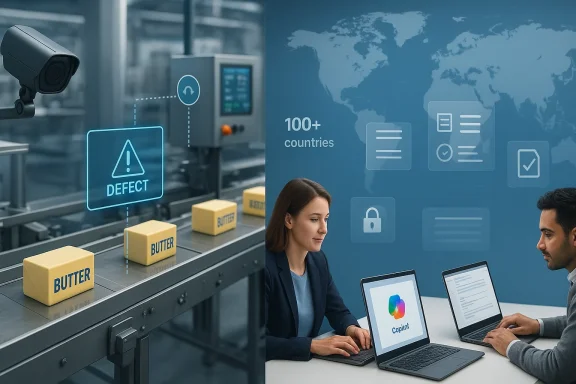
The result is a deployment model that looks less like a gadget rollout and more like industrial transformation. In manufacturing, AI is being used to inspect butter packaging and trigger pauses when faults appear. In the office, employees are using Copilot tools, GitHub Copilot and Fonterra’s own Co-op GPT to automate routine knowledge work and improve decision-making.
That mix matters because it shows the technology is being applied across both physical operations and knowledge work. The manufacturing use cases reduce disruption and improve consistency; the workplace use cases reduce friction, improve speed and let staff spend more time on judgement and collaboration. Together, they suggest a co-operative that is trying to turn AI into an operating capability rather than a novelty.
The broader context also includes Microsoft’s own shift toward more agentic, enterprise-wide AI. Across the industry, 2025 and early 2026 have been marked by a move away from experimentation and toward more durable use cases built around workflow, governance and measurable business impact. Fonterra’s story fits neatly into that trend, and that is part of why it stands out.
Why Fonterra’s AI Story Matters
Fonterra is not an obvious consumer-facing AI poster child, and that is exactly why the story is instructive. The co-operative is dealing with industrial complexity, supply chain pressure, compliance demands and a highly distributed workforce, which makes it a more realistic test of enterprise AI than a polished demo environment. If AI can work here, it is more likely to work in similarly messy organizations.
The company also has a structural advantage: it already had a modern cloud foundation before scaling AI. That reduces the likelihood that models and agents are being bolted onto legacy systems in ways that create more risk than value. It also helps explain why Microsoft frames Fonterra’s AI use as an extension of cloud transformation rather than a detached experiment.
The practical significance
The practical takeaway is that AI is being used to reduce operational noise. In a business like Fonterra, one false packaging run, one delayed maintenance event or one incomplete investment submission can create cascading costs. AI is being positioned as a way to intercept those issues earlier, standardize the response and preserve human attention for higher-value work.
That is a very different value proposition from “AI will replace workers.” Here, the message is closer to: AI can remove repetitive friction so teams can focus on quality, judgement and coordination. That framing is more credible, and more likely to stick in an industrial setting where reliability still beats hype.
- Scale amplifies small gains
- Cloud maturity enables AI adoption
- Manufacturing and office workflows both benefit
- Governance is treated as a feature, not an afterthought
- Measured rollout reduces organizational resistance
The article also hints at something broader: AI can help organizations work differently, not just faster. That distinction matters because speed alone does not guarantee better decisions. The real prize is process redesign, where AI changes how questions are asked, how work is routed and how decisions are prepared.
AI on the Factory Floor
The strongest part of the story is the manufacturing layer, because industrial AI is where credibility is won or lost. At Fonterra’s Clandeboye site in South Canterbury, AI is being used to monitor butter packaging across multiple stages of production and pause the line when faults are detected. That is a concrete, measurable intervention, not a vague promise about future efficiency.
The article also says teams have shifted from spreadsheet-based scheduling to AI-driven scheduling. That matters because scheduling is where many factories quietly lose time and money through bottlenecks, handoffs and human guesswork. If AI can improve throughput while preserving quality, the payoff is not only operational but strategic.
Predictive maintenance and plant uptime
The broader plant network adds another layer of value. Microsoft says real-time IoT data from machinery across more than 100 plants flows into the Microsoft cloud, enabling predictive maintenance that can reduce costly downtime and disruption. This is where cloud, sensors and AI converge into one of the most persuasive industrial use cases available today.
Predictive maintenance is especially important in food manufacturing because downtime is not just an equipment issue. It can affect product freshness, delivery timetables, labour deployment and customer commitments, all of which are harder to recover once the line stops. The business case is therefore broader than a maintenance budget line item.
- Fewer unplanned stoppages
- Better line consistency
- Improved maintenance planning
- Less waste from interrupted production
- Faster response to anomalies
The technology also creates a feedback loop. As more plants feed machine data into the cloud, models can become better at recognizing patterns and anticipating faults. That said, the quality of the predictions will only ever be as good as the quality of the data and the discipline of the processes behind them.
AI in Everyday Knowledge Work
If the factory floor shows AI’s physical value, the office story shows its organizational value. Microsoft says Fonterra was one of New Zealand’s earliest adopters of Microsoft 365 Copilot through the Early Adopter Programme and identified hundreds of use cases across the business. By February 2026, 35 per cent of its global workforce was actively using AI tools.
That is a meaningful adoption rate, especially because the figure includes not just Copilot Chat but Copilot Studio agents, GitHub Copilot and Fonterra’s own Co-op GPT. Microsoft says those tools generated nearly one million interactions in a single month, which suggests the usage is not superficial. People are apparently returning to the tools repeatedly, which is usually the first signal that value is sticking.
What employees are actually doing
The use cases described are not exotic. Staff are summarising meetings, capturing actions, accelerating policy drafting and asking AI to help them question assumptions and biases. That is the kind of work AI can do well because it sits in the gap between raw information and decision-ready output.
This matters because corporate productivity gains often come from boring, repeated tasks. A few minutes saved on every meeting summary, policy draft or internal query can free up substantial time over the course of a year. At scale, those savings become less about speed and more about reclaiming attention.
- Meeting summaries become faster to produce
- Action capture is more consistent
- Policy drafts start from a stronger baseline
- Teams spend less time on repetitive admin
- Employees can focus more on judgement and collaboration
There is also a cultural effect. Microsoft says AI is helping teams challenge existing ways of thinking and doing, which is a subtle but important point. In mature organizations, inertia can be as costly as inefficiency, and tools that provoke better questions can be more valuable than tools that simply draft better text.
The Rise of Production Agents
One of the most interesting details is that Fonterra’s IT Delivery team, working with EY, has built three production agents using Microsoft Copilot Studio. That moves the story beyond individual productivity and into workflow orchestration, which is where enterprise AI starts to become structurally important.
The three agents each solve a different kind of governance problem. The Idea Submission Coach helps employees strengthen investment proposals before they reach reviewers. The Architecture Assessment Agent helps the IT team evaluate technical architecture against governance and technical requirements. The Technical Accounting Assessment Agent improves consistency in financial assessment and helps ensure outputs are audit-ready.
Why these agents matter
These are not flashy customer-facing bots. They are process agents, and that is precisely why they are valuable. They standardize how work enters the system, reduce the number of incomplete submissions and make downstream reviews easier and faster.
In many enterprises, the hidden cost of decision-making is not the decision itself but the number of times the same issue must be revisited because the initial submission was incomplete. If an agent can improve the quality of first-pass inputs, the organization saves time at multiple stages. That is a quiet but powerful form of automation.
- Better-quality submissions
- Less manual triage
- More consistent governance checks
- Improved audit readiness
- Faster investment decisions
There is also an important trust dimension here. By emphasizing auditability and governance, Fonterra is signaling that enterprise AI must be explainable enough to survive internal scrutiny. That is not a minor detail; it is what separates durable enterprise adoption from short-lived excitement.
Microsoft’s Role and the Cloud Foundation
Microsoft’s framing is careful and revealing. Brendan Bain, Director Enterprise Commercial at Microsoft New Zealand, says Fonterra has been practical from the beginning and focused on real business needs rather than experimentation for its own sake. That is the kind of language vendors use when a customer is proving out an enterprise pattern they want others to follow.
The cloud foundation matters because AI at scale requires more than a model. It needs data pipelines, identity, governance, access control, integration, observability and a secure place to run. Azure is the connective tissue in the Fonterra story, linking plant data, office workflows and custom agents into one operating fabric.
Why the platform matters
This also helps explain why Microsoft is emphasizing the journey from Azure to AI. The narrative is not “we sold them AI.” It is “they modernized the core, and now AI can sit on top of it.” That is a much stronger story for enterprise customers who worry that AI projects will become isolated islands with no long-term value.
The article also hints at a broader Microsoft pattern in 2026: more emphasis on agentic workflows, governance and “frontier” style enterprise deployment. That lines up with Microsoft’s other recent messaging about Copilot, agents and durable business value. Fonterra looks like one proof point in that wider push.
- Azure provides the data and application backbone
- Copilot adds knowledge-work acceleration
- Copilot Studio supports custom workflow agents
- GitHub Copilot extends the model to developers
- Governance is increasingly part of the product story
That last point is essential. The more AI becomes embedded in business operations, the more customers need confidence that permissions, logging, auditing and oversight are part of the system. Microsoft’s ecosystem is increasingly trying to answer that question, and Fonterra is showing how those layers can work together in practice.
Sustainability and Competitive Positioning
Fonterra’s AI program is being presented not just as a productivity play but as part of a broader sustainability and resilience agenda. Microsoft says its commitment to renewable-powered New Zealand datacentres aligns with Fonterra’s environmental ambitions, reinforcing the idea that productivity and sustainability can advance together. That is a strategically useful message in an era when companies are expected to justify digital spending on more than just efficiency.
The sustainability argument is especially relevant for a dairy business with a large industrial footprint. Better scheduling, predictive maintenance and fewer faults can all reduce waste, lower energy waste and improve resource efficiency. In other words, AI can help the co-operative produce more value per unit of operational effort.
Competitive implications
Competitively, this raises the bar for peers in food and agriculture. Rivals watching Fonterra may conclude that digital maturity is no longer optional, especially when a large co-operative can use AI to improve both plant efficiency and office productivity at the same time. That is a powerful benchmark for the rest of the sector.
It is also a signal to other New Zealand firms. Microsoft and Fonterra both frame the work as raising the bar for NZ Inc, which suggests a national productivity narrative as much as a company-specific one. In a small economy, one large-scale success story can have outsized influence on how other organizations think about transformation.
- Operational efficiency can support emissions goals
- Digital and sustainability priorities are increasingly linked
- Industry peers face higher expectations
- National productivity becomes part of the narrative
- Cloud choices now carry strategic and environmental weight
The market implication is straightforward: companies that combine cloud modernization, AI workflow design and responsible governance may pull ahead faster than those that treat AI as a standalone tool. Fonterra is showing what that integrated model can look like.
Enterprise vs Consumer Impact
This is very much an enterprise story, but it still says something about the wider direction of AI adoption. Consumer AI tends to be measured in novelty, convenience and fun. Enterprise AI, by contrast, is measured in consistency, auditability, uptime and decision quality. Fonterra sits firmly in the latter camp.
For employees, the impact is practical and immediate. AI helps them capture meeting actions, draft documents, reduce repetitive work and ask better questions. For executives and managers, the benefit is more strategic: faster proposal handling, more consistent assessments and stronger governance. Those are different layers of value, and Fonterra appears to be pursuing both at once.
Consumer lessons from an enterprise rollout
Even consumers can learn from this model, though indirectly. The biggest lesson is that AI becomes more useful when it is attached to real workflows rather than treated as a standalone chatbot. That applies to personal productivity as much as it does to industrial operations. Integration beats novelty when the goal is lasting value.
Another lesson is that trust matters. Employees are more likely to use AI when they see it embedded in approved systems with clear boundaries and useful outputs. That same principle is likely to shape consumer trust over time, especially as AI becomes woven into more everyday software.
- Enterprise AI is about operational control
- Consumer AI is often about convenience
- Both depend on trust
- Workflow integration creates stickiness
- Governance improves adoption
Fonterra’s example also reminds us that the most successful AI deployments may be the least visible. The best systems often disappear into the workflow, where they become part of how work gets done rather than a separate tool users need to remember to open. That is where the category is heading.
Strengths and Opportunities
Fonterra’s AI strategy has several obvious strengths. It is grounded in real operations, backed by a mature cloud platform and tied to measurable business outcomes. The opportunity now is to extend that pattern carefully without losing the discipline that made the early deployments credible.
- Strong cloud foundation on Azure
- Clear manufacturing use cases with direct ROI potential
- High adoption across the workforce
- Practical governance-oriented agent design
- Alignment between productivity and sustainability
- Room to expand into more business units
- Potential to standardize better decision-making across the co-operative
The biggest opportunity is probably not a single dramatic breakthrough. It is the accumulation of many small gains across plants, offices and support functions. Over time, that kind of compound improvement can reshape how a large co-operative competes.
Risks and Concerns
The same breadth that makes Fonterra’s AI program compelling also creates risk. More AI use means more dependency on data quality, model reliability, user training and governance. If any one of those areas slips, the benefits can erode quickly.
- Overreliance on automated recommendations
- Data quality issues affecting plant or office workflows
- Governance drift as more agents are deployed
- Inconsistent adoption between business units
- Security and access-control complexity
- Potential bias in AI-assisted decision workflows
- Change-management fatigue among employees
There is also a cultural risk. If AI is rolled out too quickly or framed too aggressively, employees may treat it as an imposed productivity mandate rather than a useful assistive layer. Adoption at scale is not the same as genuine trust, and the difference will matter more as the tools become embedded in critical processes.
Looking Ahead
The article makes clear that this is still an early stage. Fonterra and Microsoft have already mapped an AI acceleration programme that could extend into foodservice, finance, people and culture, and corporate affairs. That suggests the current deployments are just the first phase of a broader operating redesign.
The real question is how far the company can go without losing the practical discipline that defines the current effort. If it keeps AI close to workflow pain points, keeps governance visible and keeps linking productivity to sustainability, it may become one of the stronger enterprise AI case studies in the region.
What to watch next:
- Expansion of AI agents into more finance and compliance workflows
- Broader use of predictive maintenance across plant networks
- New Copilot-driven productivity metrics beyond simple adoption counts
- Further integration between Co-op GPT and Microsoft tools
- Evidence that AI improves decision speed without hurting governance
The broader lesson is that enterprise AI is maturing. The winners are increasingly the organizations that use AI to improve how work moves through the business, not those that chase the most attention-grabbing demo. Fonterra’s approach suggests that practical, governed AI may become one of the clearest markers of operational maturity in the years ahead.