

Microsoft CEO Satya Nadella said in a “Possible Podcast” episode posted Friday that companies should manage AI agents with identities, permissions, sandboxes, policies, and audits, framing them less as chatbots and more as non-human workers inside enterprise systems. The remark sounds tidy, almost obvious, until you follow it into the Windows and Microsoft 365 estate where most corporate work actually happens. Nadella is not merely describing a management preference; he is sketching the next control plane for enterprise computing. If AI agents are going to act on behalf of users, then identity is no longer an IT plumbing concern — it is the battleground.
The first phase of the generative AI boom was sold as a productivity story. Copilot would summarize meetings, draft emails, query documents, and remove friction from office work. The demos were frictionless because the risk was mostly abstract: an assistant answered questions, a user remained in charge, and the computer did not appear to be doing much without permission.
Agentic AI changes that bargain. An agent is not just a text box with better manners. It can take instructions, traverse systems, call tools, update records, produce code, and trigger workflows. In other words, it starts to look less like software you use and more like software that works.
That is why Nadella’s “treat them like employees” line matters. Employees have accounts, job scopes, managers, onboarding, offboarding, monitoring, and consequences when they touch the wrong thing. Agents, if deployed casually, have prompts, API keys, inherited access, and a tendency to disappear into the background until something breaks.
Microsoft’s commercial opportunity is obvious. The company already owns the identity layer through Entra, the productivity layer through Microsoft 365, the endpoint and security stack through Defender, and the compliance machinery through Purview. If agents are the next workforce, Microsoft wants to sell the HR system, the badge reader, the surveillance camera, and the audit archive.
But the metaphor breaks down almost immediately. A human employee has intent, training, memory, social context, fear of consequences, and some rough understanding of when an action is sensitive. An AI agent has instructions, model behavior, tool permissions, and whatever constraints its platform successfully enforces. That distinction is not philosophical; it is operational.
A junior analyst who sees a confidential spreadsheet may know not to paste it into a vendor portal. An agent may only know that a workflow asked it to compare numbers and produce a response. A developer who is unsure about deleting a production resource might ask a colleague. An agent may confidently call the available tool because the tool is available.
That is why identity alone is not enough. A badge does not make a system safe. It only makes the system legible. Once an agent has an identity, administrators can begin to apply policy, but the hard work is deciding which actions should be possible in the first place.
The old Copilot model placed the human in a conversational loop. The agent model creates a coordination problem. If each agent requires a stream of prompts, clarifications, approvals, and reviews, then the user becomes a manager of digital interns. The promised productivity gain turns into a queue of supervision tasks.
This is where Microsoft’s language around observability becomes important. Administrators do not just need to know that an agent exists. They need to know what it did, which data it touched, which tool calls it made, which user or business process authorized it, and whether its behavior changed over time. Without that, agent adoption becomes a shadow IT problem with a friendlier UI.
The industry has seen this movie before. Macros, service accounts, OAuth app grants, browser extensions, and low-code workflows all began as productivity accelerators. Each created a new place for business logic to hide. Agents raise the stakes because they add reasoning-like behavior and natural language instructions to the automation layer.
This is classic Microsoft platform strategy. A new computing pattern appears chaotic; Microsoft absorbs it into admin surfaces that enterprises already pay for; the chaos becomes a licensing and governance story. For customers already living in Microsoft 365, that may be genuinely attractive. The alternative is stitching together agent inventories across custom apps, SaaS tools, developer platforms, and department-level experiments.
The pitch is not just convenience. It is that agents must become first-class objects in the enterprise. A first-class object can be discovered, assigned, constrained, reviewed, and retired. A hidden script with a borrowed credential cannot.
Still, the phrase “first-class identity” should make security teams alert rather than relaxed. Every new identity type becomes another object to misconfigure. Every new admin role becomes another privilege boundary to understand. Every new lifecycle workflow becomes another place where defaults matter more than marketing language.
If an agent acts with a user’s permissions, it may see everything the user can see, including things the user forgot they could access. If it acts through an application identity, it may inherit broad API rights granted years earlier for a project nobody remembers. If it is embedded in a workflow tool, it may become one more automation step with the ability to move data between systems at machine speed.
This is not a theoretical WindowsForum audience problem. Microsoft 365 tenants are often full of stale groups, overshared SharePoint sites, orphaned Teams, aging service principals, and “temporary” exceptions that became permanent. Copilot already forced many organizations to confront oversharing because it made existing access easier to query. Agents go further by making that access easier to act upon.
The uncomfortable lesson is that agent security begins before the agent exists. If your identity hygiene, data labels, group memberships, and app permissions are already messy, agents will not create the mess. They will operationalize it.
A sandboxed agent can experiment, draft, test, and propose without immediately altering production systems. That matters for coding agents, but it also matters for finance, HR, legal, customer support, and operations. The agent that can summarize invoices is one thing. The agent that can approve payments is another. The agent that can approve payments after reading a spoofed instruction buried in an email is a board-level incident waiting to happen.
Enterprise IT has spent decades separating development, test, and production environments because humans make mistakes. It would be strange to abandon that discipline for systems whose behavior is harder to predict. Yet the pressure to wire agents directly into business processes will be intense, especially when vendors demonstrate “end-to-end automation” in polished conference videos.
A serious agent program should assume that some agents will be tricked, some instructions will be ambiguous, and some access decisions will be wrong. Sandboxing is not pessimism. It is engineering.
This is where Purview becomes more than a compliance brand name. If agent prompts, responses, generated files, and tool actions can be classified, retained, searched, and reviewed, then organizations have a fighting chance of treating agent activity as part of normal governance. If they cannot, agents become an evidentiary black hole.
That matters for regulated industries, but it also matters for ordinary businesses. A sales agent that sends incorrect pricing, a support agent that exposes account details, or a coding agent that introduces a vulnerable dependency can create disputes long before regulators arrive. Without audit trails, the organization is left arguing from memory and screenshots.
The larger cultural shift is that AI outputs can no longer be treated as ephemeral chat. Once an agent acts inside enterprise systems, its actions need records. That may feel bureaucratic compared with the consumer AI experience, but enterprise computing is mostly bureaucracy made executable.
A service account usually has a defined workload, even if badly documented. A scheduled task usually runs a known script. A managed identity usually belongs to a cloud resource. An agent may be assembled by a business user, grounded in corporate data, connected to tools, modified through natural language, and repurposed as needs change. Its boundary can be fuzzier.
That fuzziness is why the “agent as employee” metaphor may be more helpful than “agent as app.” Apps are usually shipped, versioned, and reviewed. Employees are onboarded into roles and then do many things within a policy envelope. Agents will often behave more like the latter, except without judgment and with much faster execution.
The administrator’s job, then, is to resist the temptation to treat agent governance as a side panel in the AI settings page. It belongs in identity governance, data governance, endpoint security, incident response, records management, and change control. If that sounds heavy, it is because the technology is being invited into heavy places.
Agent 365 can reduce chaos, but it will not eliminate vendor lock-in. The more agent governance moves through Entra, Purview, Defender, and Microsoft 365 admin surfaces, the more Microsoft becomes the default broker for agent legitimacy. For many enterprises, that is acceptable because Microsoft is already the default broker for identity and productivity. For others, it creates a new dependency at exactly the layer where neutrality matters.
There is also a licensing question hovering over the whole discussion. Microsoft’s security and compliance stack is powerful, but its most useful controls often live in higher-tier subscriptions, add-ons, or preview programs before becoming broadly available. If safe agent deployment requires premium governance, then agentic AI may widen the gap between well-funded enterprises and smaller organizations improvising with partial controls.
The Windows ecosystem has always mixed deep integration with administrative sprawl. Agent governance could become another example: powerful when fully deployed, confusing when half-adopted, and risky when business units move faster than central IT.
That mismatch matters. If agents become common in Microsoft 365, the help desk will field questions that are not easily categorized. Why did the agent send that message? Why did it have access to that file? Why did it stop working after a Conditional Access change? Why did it produce different output this week? Why is a former employee still listed as the sponsor for a business-critical agent?
Administrators will also have to decide who is allowed to create agents in the first place. If only IT can create them, adoption slows and business users complain. If everyone can create them, the tenant fills with unmanaged automation. If departments can create them under guardrails, the guardrails must be real rather than decorative.
The pragmatic answer is probably a tiered model. Low-risk agents can draft, summarize, and retrieve. Medium-risk agents can prepare changes that require approval. High-risk agents that modify systems, move money, change access, or communicate externally need stricter lifecycle management and monitoring. That sounds obvious, but obvious controls are often the first casualties of executive urgency.
Traditional software security tries to separate data from instructions. Agentic systems blur that separation because language is both the user interface and the payload. An email, document, web page, support ticket, or Teams message can contain text that the agent interprets as relevant context. Some of that text may be malicious.
Identity helps because it narrows what the agent can do when manipulated. Sandboxes help because they contain the blast radius. Audits help because they reveal what happened afterward. But the architectural lesson is sharper: agents should not receive powerful tools merely because the human they assist is powerful.
Least privilege has always been easy to endorse and hard to implement. Agents make it unavoidable. A human executive may need broad visibility across the company. An agent drafting a trip summary for that executive does not need the same reach.
This discipline will likely borrow from identity governance, privileged access management, software asset management, and records retention. It will also demand new roles. Someone will need to sponsor agents. Someone will approve their data sources. Someone will review their outputs. Someone will decide whether an agent is still aligned with the business process it was built to serve.
That sounds like bureaucracy because it is. But the alternative is worse: a company full of invisible workers that never sleep, rarely complain, and quietly accumulate permissions. Shadow IT was already difficult when it involved SaaS subscriptions and spreadsheets. Shadow agents could be far more consequential.
The companies that do this well will not be the ones with the most agents. They will be the ones that can explain what their agents are, why they exist, what they can touch, and how they are stopped.
Nadella’s comment lands because it translates the AI agent debate from futuristic abstraction into the oldest problem in IT: who gets access to what, under whose authority, and with what evidence afterward. Microsoft is positioning Entra, Purview, Defender, and Agent 365 as the answer, and for many Windows-centric organizations that answer will be hard to ignore. But the deeper lesson is vendor-independent. If agents are becoming workers, then deploying them without identity, containment, and audit is not innovation; it is hiring without badges, managers, or logs — and hoping the building is still intact in the morning.
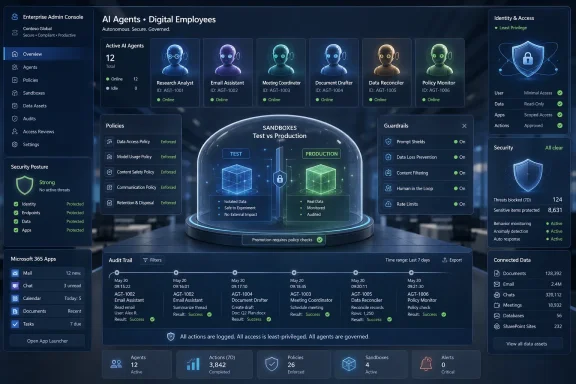 Microsoft’s Agent Pitch Has Shifted From Magic to Management
The first phase of the generative AI boom was sold as a productivity story. Copilot would summarize meetings, draft emails, query documents, and remove friction from office work. The demos were frictionless because the risk was mostly abstract: an assistant answered questions, a user remained in charge, and the computer did not appear to be doing much without permission.Agentic AI changes that bargain. An agent is not just a text box with better manners. It can take instructions, traverse systems, call tools, update records, produce code, and trigger workflows. In other words, it starts to look less like software you use and more like software that works.
That is why Nadella’s “treat them like employees” line matters. Employees have accounts, job scopes, managers, onboarding, offboarding, monitoring, and consequences when they touch the wrong thing. Agents, if deployed casually, have prompts, API keys, inherited access, and a tendency to disappear into the background until something breaks.
Microsoft’s commercial opportunity is obvious. The company already owns the identity layer through Entra, the productivity layer through Microsoft 365, the endpoint and security stack through Defender, and the compliance machinery through Purview. If agents are the next workforce, Microsoft wants to sell the HR system, the badge reader, the surveillance camera, and the audit archive.
The Employee Analogy Is Useful Because It Is Incomplete
Treating agents like employees is a strong metaphor because it forces administrators to ask the right questions. Who owns this agent? What can it access? What can it change? How long should it exist? What happens when the project ends, the sponsor leaves, or the agent begins behaving in unexpected ways?But the metaphor breaks down almost immediately. A human employee has intent, training, memory, social context, fear of consequences, and some rough understanding of when an action is sensitive. An AI agent has instructions, model behavior, tool permissions, and whatever constraints its platform successfully enforces. That distinction is not philosophical; it is operational.
A junior analyst who sees a confidential spreadsheet may know not to paste it into a vendor portal. An agent may only know that a workflow asked it to compare numbers and produce a response. A developer who is unsure about deleting a production resource might ask a colleague. An agent may confidently call the available tool because the tool is available.
That is why identity alone is not enough. A badge does not make a system safe. It only makes the system legible. Once an agent has an identity, administrators can begin to apply policy, but the hard work is deciding which actions should be possible in the first place.
The Chat Window Was Never Built to Manage a Workforce
Nadella’s admission that he may run 100 coding agents at once is more revealing than the headline quote. It points to a problem every serious AI adopter will recognize: the chat interface collapses at scale. It is fine for asking one assistant to draft a memo. It is a poor command center for supervising dozens or hundreds of semi-autonomous workers.The old Copilot model placed the human in a conversational loop. The agent model creates a coordination problem. If each agent requires a stream of prompts, clarifications, approvals, and reviews, then the user becomes a manager of digital interns. The promised productivity gain turns into a queue of supervision tasks.
This is where Microsoft’s language around observability becomes important. Administrators do not just need to know that an agent exists. They need to know what it did, which data it touched, which tool calls it made, which user or business process authorized it, and whether its behavior changed over time. Without that, agent adoption becomes a shadow IT problem with a friendlier UI.
The industry has seen this movie before. Macros, service accounts, OAuth app grants, browser extensions, and low-code workflows all began as productivity accelerators. Each created a new place for business logic to hide. Agents raise the stakes because they add reasoning-like behavior and natural language instructions to the automation layer.
Agent 365 Is Microsoft’s Attempt to Turn Chaos Into an Admin Surface
Microsoft’s answer is Agent 365, a governance framework that pulls agent oversight into familiar enterprise products. Entra provides identity and access control. Purview handles data classification, compliance, and audit concerns. Defender watches for suspicious activity and security risk. The Microsoft 365 admin center becomes the place where organizations can inventory and manage agents.This is classic Microsoft platform strategy. A new computing pattern appears chaotic; Microsoft absorbs it into admin surfaces that enterprises already pay for; the chaos becomes a licensing and governance story. For customers already living in Microsoft 365, that may be genuinely attractive. The alternative is stitching together agent inventories across custom apps, SaaS tools, developer platforms, and department-level experiments.
The pitch is not just convenience. It is that agents must become first-class objects in the enterprise. A first-class object can be discovered, assigned, constrained, reviewed, and retired. A hidden script with a borrowed credential cannot.
Still, the phrase “first-class identity” should make security teams alert rather than relaxed. Every new identity type becomes another object to misconfigure. Every new admin role becomes another privilege boundary to understand. Every new lifecycle workflow becomes another place where defaults matter more than marketing language.
The Real Risk Is Not That Agents Think — It Is That They Inherit
Most enterprise AI risk is discussed as if the model itself is the dangerous part. Hallucination, prompt injection, data leakage, and malicious outputs are real concerns. But in corporate environments, the most immediate danger may be simpler: agents can inherit access from people, apps, and workflows that were never designed for autonomous delegation.If an agent acts with a user’s permissions, it may see everything the user can see, including things the user forgot they could access. If it acts through an application identity, it may inherit broad API rights granted years earlier for a project nobody remembers. If it is embedded in a workflow tool, it may become one more automation step with the ability to move data between systems at machine speed.
This is not a theoretical WindowsForum audience problem. Microsoft 365 tenants are often full of stale groups, overshared SharePoint sites, orphaned Teams, aging service principals, and “temporary” exceptions that became permanent. Copilot already forced many organizations to confront oversharing because it made existing access easier to query. Agents go further by making that access easier to act upon.
The uncomfortable lesson is that agent security begins before the agent exists. If your identity hygiene, data labels, group memberships, and app permissions are already messy, agents will not create the mess. They will operationalize it.
Sandboxes Are the Admission That Trust Is Not Enough
Nadella’s mention of sandboxes deserves more attention than it will probably get. Identity answers the “who” question. Permissions answer the “what can it touch” question. Sandboxes answer a more important one: how much damage can it do when the first two controls fail?A sandboxed agent can experiment, draft, test, and propose without immediately altering production systems. That matters for coding agents, but it also matters for finance, HR, legal, customer support, and operations. The agent that can summarize invoices is one thing. The agent that can approve payments is another. The agent that can approve payments after reading a spoofed instruction buried in an email is a board-level incident waiting to happen.
Enterprise IT has spent decades separating development, test, and production environments because humans make mistakes. It would be strange to abandon that discipline for systems whose behavior is harder to predict. Yet the pressure to wire agents directly into business processes will be intense, especially when vendors demonstrate “end-to-end automation” in polished conference videos.
A serious agent program should assume that some agents will be tricked, some instructions will be ambiguous, and some access decisions will be wrong. Sandboxing is not pessimism. It is engineering.
Audits Turn AI From Vibes Into Evidence
The audit piece is where Microsoft’s enterprise instincts are strongest. Business users may care about whether an agent saved them time. Administrators and regulators care about whether the organization can reconstruct what happened. Who initiated the action? Which data was used? Which output was produced? Was a human approval required? Was the action consistent with policy?This is where Purview becomes more than a compliance brand name. If agent prompts, responses, generated files, and tool actions can be classified, retained, searched, and reviewed, then organizations have a fighting chance of treating agent activity as part of normal governance. If they cannot, agents become an evidentiary black hole.
That matters for regulated industries, but it also matters for ordinary businesses. A sales agent that sends incorrect pricing, a support agent that exposes account details, or a coding agent that introduces a vulnerable dependency can create disputes long before regulators arrive. Without audit trails, the organization is left arguing from memory and screenshots.
The larger cultural shift is that AI outputs can no longer be treated as ephemeral chat. Once an agent acts inside enterprise systems, its actions need records. That may feel bureaucratic compared with the consumer AI experience, but enterprise computing is mostly bureaucracy made executable.
Windows Admins Have Seen Non-Human Identities Before
For sysadmins, none of this is entirely new. Windows environments have long depended on service accounts, scheduled tasks, app registrations, managed identities, device objects, and automation accounts. Non-human actors are already everywhere. The difference is that AI agents make non-human action easier to create, easier to delegate, and harder to reason about.A service account usually has a defined workload, even if badly documented. A scheduled task usually runs a known script. A managed identity usually belongs to a cloud resource. An agent may be assembled by a business user, grounded in corporate data, connected to tools, modified through natural language, and repurposed as needs change. Its boundary can be fuzzier.
That fuzziness is why the “agent as employee” metaphor may be more helpful than “agent as app.” Apps are usually shipped, versioned, and reviewed. Employees are onboarded into roles and then do many things within a policy envelope. Agents will often behave more like the latter, except without judgment and with much faster execution.
The administrator’s job, then, is to resist the temptation to treat agent governance as a side panel in the AI settings page. It belongs in identity governance, data governance, endpoint security, incident response, records management, and change control. If that sounds heavy, it is because the technology is being invited into heavy places.
Microsoft’s Incentive Is Also Microsoft’s Blind Spot
Microsoft is right that identity, permissions, policies, sandboxes, observability, and audits are necessary. It is also the company with the strongest incentive to make agent deployment feel safe enough to accelerate. That tension should shape how customers hear the pitch.Agent 365 can reduce chaos, but it will not eliminate vendor lock-in. The more agent governance moves through Entra, Purview, Defender, and Microsoft 365 admin surfaces, the more Microsoft becomes the default broker for agent legitimacy. For many enterprises, that is acceptable because Microsoft is already the default broker for identity and productivity. For others, it creates a new dependency at exactly the layer where neutrality matters.
There is also a licensing question hovering over the whole discussion. Microsoft’s security and compliance stack is powerful, but its most useful controls often live in higher-tier subscriptions, add-ons, or preview programs before becoming broadly available. If safe agent deployment requires premium governance, then agentic AI may widen the gap between well-funded enterprises and smaller organizations improvising with partial controls.
The Windows ecosystem has always mixed deep integration with administrative sprawl. Agent governance could become another example: powerful when fully deployed, confusing when half-adopted, and risky when business units move faster than central IT.
The Boardroom Wants Agents; The Help Desk Will Get the Tickets
The people most excited about agents are not always the people who will support them. Executives hear a story about leverage: one employee coordinating dozens of digital workers, teams automating backlogs, departments operating with new speed. IT hears a story about inventory, access reviews, incident response, data loss prevention, and user confusion.That mismatch matters. If agents become common in Microsoft 365, the help desk will field questions that are not easily categorized. Why did the agent send that message? Why did it have access to that file? Why did it stop working after a Conditional Access change? Why did it produce different output this week? Why is a former employee still listed as the sponsor for a business-critical agent?
Administrators will also have to decide who is allowed to create agents in the first place. If only IT can create them, adoption slows and business users complain. If everyone can create them, the tenant fills with unmanaged automation. If departments can create them under guardrails, the guardrails must be real rather than decorative.
The pragmatic answer is probably a tiered model. Low-risk agents can draft, summarize, and retrieve. Medium-risk agents can prepare changes that require approval. High-risk agents that modify systems, move money, change access, or communicate externally need stricter lifecycle management and monitoring. That sounds obvious, but obvious controls are often the first casualties of executive urgency.
The Security Model Must Assume Prompt Injection Is an Access Problem
Prompt injection is often described as a strange AI vulnerability, as if it belongs in a separate category from ordinary security. In practice, it is an access-control problem wearing a language mask. If an agent can read untrusted content and then use tools, the untrusted content may influence the tool use. The system has crossed a boundary.Traditional software security tries to separate data from instructions. Agentic systems blur that separation because language is both the user interface and the payload. An email, document, web page, support ticket, or Teams message can contain text that the agent interprets as relevant context. Some of that text may be malicious.
Identity helps because it narrows what the agent can do when manipulated. Sandboxes help because they contain the blast radius. Audits help because they reveal what happened afterward. But the architectural lesson is sharper: agents should not receive powerful tools merely because the human they assist is powerful.
Least privilege has always been easy to endorse and hard to implement. Agents make it unavoidable. A human executive may need broad visibility across the company. An agent drafting a trip summary for that executive does not need the same reach.
Agent Management Will Become a New Administrative Discipline
The enterprise will need a new operational vocabulary. Agent inventory will sit beside device inventory. Agent access reviews will sit beside user access reviews. Agent retirement will become part of project closure. Agent incident response will require logs that explain not only which API was called, but what instruction chain led to it.This discipline will likely borrow from identity governance, privileged access management, software asset management, and records retention. It will also demand new roles. Someone will need to sponsor agents. Someone will approve their data sources. Someone will review their outputs. Someone will decide whether an agent is still aligned with the business process it was built to serve.
That sounds like bureaucracy because it is. But the alternative is worse: a company full of invisible workers that never sleep, rarely complain, and quietly accumulate permissions. Shadow IT was already difficult when it involved SaaS subscriptions and spreadsheets. Shadow agents could be far more consequential.
The companies that do this well will not be the ones with the most agents. They will be the ones that can explain what their agents are, why they exist, what they can touch, and how they are stopped.
Nadella’s Employee Metaphor Leaves IT With a Very Real Checklist
The practical message for Windows and Microsoft 365 administrators is not to panic, and not to wait. Nadella’s framing is a signal that Microsoft expects agent identity and governance to become normal enterprise infrastructure, not an experimental feature bolted onto Copilot. The organizations that prepare now will have fewer surprises when agents move from demos into production workflows.- Every AI agent that can access company data should have a distinct identity rather than hiding behind a shared account, broad app permission, or human user token.
- Agent permissions should be scoped to the task, reviewed on a schedule, and removed when the business owner or project no longer justifies them.
- Agents that create, modify, delete, approve, or transmit business data should run inside controlled environments with clear human approval points.
- Agent prompts, responses, tool calls, and generated artifacts should be treated as records when they affect business decisions or regulated data.
- Existing Microsoft 365 oversharing, stale groups, and excessive app grants should be cleaned up before agents make those weaknesses easier to exploit.
- Security teams should test agent behavior against untrusted documents, emails, and web content rather than assuming natural language instructions are benign.
Nadella’s comment lands because it translates the AI agent debate from futuristic abstraction into the oldest problem in IT: who gets access to what, under whose authority, and with what evidence afterward. Microsoft is positioning Entra, Purview, Defender, and Agent 365 as the answer, and for many Windows-centric organizations that answer will be hard to ignore. But the deeper lesson is vendor-independent. If agents are becoming workers, then deploying them without identity, containment, and audit is not innovation; it is hiring without badges, managers, or logs — and hoping the building is still intact in the morning.
References
- Primary source: aol.com
Published: 2026-06-11T06:30:15.624106
Satya Nadella says AI agents should be treated like employees with identities, permissions, and audits - AOL
Microsoft CEO Satya Nadella says companies should manage AI agents like employees, giving them identities and permissions.www.aol.com - Related coverage: windowscentral.com
Satya Nadella says AI agents deserve real "identities" — after another Microsoft CEO said the tech would take white-collar jobs | Windows Central
Despite AI's big threat to job security, Microsoft's CEO says AI agents should be treated more like human employees.www.windowscentral.com - Related coverage: livemint.com
Satya Nadella says AI agents will need identities, security and governance like employees | Mint
In a conversation with Reid Hoffman, Satya Nadella discussed the importance of AI agents in the workforce. He said these agents would require identities, security and governance structures. www.livemint.com
- Official source: learn.microsoft.com
Microsoft Entra Agents | Microsoft Learn
Learn about Microsoft Entra agents, AI-powered automation tools that enhance identity and access management operations.learn.microsoft.com - Related coverage: techradar.com
Microsoft reveals Agent 365 - the new and (hopefully) easy way to get a handle on all these new AI agents at work | TechRadar
Say hello to Agent 365www.techradar.com - Related coverage: digit.in
Microsoft CEO Satya Nadella says AI agents need identities, permissions and policies like employees
Satya Nadella says AI agents need identities, permissions and policies just like employees. The comments come just a few days after Microsoft Build 2026. www.digit.in
- Related coverage: app.dealroom.co
Microsoft's Nadella: AI agents need identities, permissions and audits like employees | Dealroom.co
Microsoft CEO Satya Nadella says AI agents should be managed like human employees, with specific identities, permissions and audit capabilities. Speaking on the "Possible Podcast", Nadella explained that companies need to establish policies and sandboxes to govern their AI agents...app.dealroom.co
