

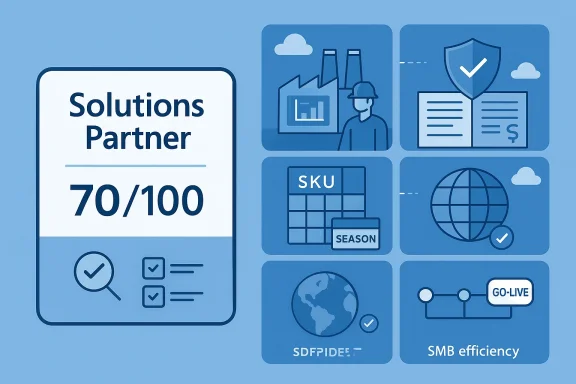
Microsoft Dynamics 365 partner selection has become a far more disciplined exercise than it was in the old Gold-and-Silver era. Microsoft now frames credibility through Solutions Partner for Business Applications status, which requires at least 70 points out of 100 across performance, skilling, and customer success metrics, and that change matters because it gives buyers a tougher baseline for judging real capability. Microsoft’s own partner directory also emphasizes that the right firm should help with assessment, implementation, training, and ongoing optimization—not just a one-time deployment.
That shift helps explain why the strongest Dynamics 365 firms are no longer competing on branding alone. They are competing on vertical specialization, proof of delivery, and the ability to keep pace with Microsoft’s cloud update cadence, which now touches everything from Finance and Supply Chain to Copilot-enabled workflows. In the current market, the best partner is the one that can make Dynamics 365 operationally safer, faster to deploy, and easier to govern over time.
The partner ecosystem around Dynamics 365 has changed meaningfully over the last several years, and buyers should understand that history before comparing firms. Microsoft replaced the familiar Gold and Silver competencies with Solutions Partner designations to better reflect demonstrable performance, customer success, and technical skilling, rather than legacy badge-collecting. That means a partner’s logo is only the starting point; the real question is whether the firm can repeatedly turn platform capability into business outcomes.
Microsoft has also pushed partners to do more than implement software. The company’s own guidance for Dynamics 365 says partners should help customers evaluate solutions, tailor existing capabilities, and stay on track with ongoing support and optimization. In other words, the modern partner relationship is closer to a managed transformation program than a classic ERP install. That is especially important now that cloud ERP and CRM systems evolve continuously, not every few years.
The article this feature is based on leans heavily on awards, case studies, and customer evidence, which is exactly the right instinct. Microsoft Partner of the Year recognition, Inner Circle status, and documented case studies can all reveal patterns that marketing pages often hide. But buyers should still remember that awards are signals, not guarantees, and a partner’s fit depends on geography, industry, team continuity, and change-management depth as much as reputation.
For Dynamics 365 specifically, the market has divided into several clear archetypes. Some partners excel in manufacturing and supply chain, where plant-floor complexity and forecasting accuracy are paramount. Others dominate finance, retail, or SMB deployments, where compliance, speed, and standardization shape the project. That segmentation is useful because it lets buyers compare firms against the actual problem they need to solve, not against an abstract “best consultant” label.
Microsoft’s own messaging reinforces that reality. The company’s Dynamics 365 pages now highlight partner-assisted assessment, implementation services, industry services, and even FastTrack onboarding. That tells you something important: Microsoft expects buyers to need specialist help, and it expects the best partners to augment the product with process design, governance, and training.
Microsoft’s current qualification logic underscores this point. The 70-point threshold is not a vanity score; it is a structured way to force balance across customer adds, certifications, usage growth, and deployments. That design makes it harder for a partner to coast on one strong marketing story while underperforming in the day-to-day work that actually matters to customers.
The most practical interpretation is simple. Use the badge to filter out weak candidates, then use industry fit and delivery style to choose among the finalists. Not every qualified partner is the right partner, and that distinction is where many Dynamics projects either save money or bleed it.
For manufacturers, the value proposition is not merely “ERP implementation.” It is the ability to model demand, scheduling, plant processes, inventory, and shop-floor reality in a way that is usable by operations teams. A partner that understands the pressure of downtime, line balance, and production constraints can often eliminate more friction in the first 90 days than a more generalist firm can remove in a year.
This is where industry specialization beats broad claims. A partner that spends most of its time in manufacturing can bring prebuilt templates, common failure patterns, and a language that resonates with plant managers and CFOs alike. That practical fluency is often what turns a technically correct implementation into an adopted one.
It is also worth asking how the firm ties Dynamics 365 to adjacent Microsoft tools such as Power Platform or analytics. The strongest manufacturing programs increasingly depend on low-code extensions and live operational reporting, not static ERP screens. That makes the partner’s data and automation competence almost as important as its project methodology.
The strength of Avanade is not just headcount. It is the combination of consulting breadth, change-management muscle, and broad cloud capability across Dynamics 365, Azure, and Microsoft’s newer AI features. For companies trying to unify multiple business units and geographies, that breadth can matter more than a narrower vertical niche.
The company also benefits from Microsoft proximity. Avanade has repeatedly been cited in Microsoft materials around early access to innovation and co-development patterns, which can be valuable when a company wants to move quickly on AI-enabled workflows, Copilot, or broader cloud integration. That said, early access is only valuable if the customer is ready to absorb it. Innovation without organizational readiness can create more noise than value.
That is not a flaw so much as a segmentation issue. Buyers should think carefully about whether they are buying a transformation partner or a deployment partner. Those are related but not identical services, and confusing the two is a common source of overruns.
This matters because many Dynamics 365 Finance projects fail not on technical grounds but on accounting complexity. Revenue recognition, multi-entity consolidation, tax treatment, audit readiness, and reporting controls all shape how the software should be implemented. A partner that begins with finance logic rather than module configuration can avoid serious downstream pain.
Microsoft’s own Dynamics 365 Finance messaging reinforces the importance of trusted planning, cash management, and business performance management. Those are not side features; they are the core of why finance leaders buy the product. That means implementation partners need to know more than deployment checklists—they need to understand financial operating models.
That trust is crucial because finance stakeholders are usually the most skeptical users in the room. They know the cost of a bad implementation, and they are the ones who live with broken reconciliations if the partner gets things wrong. A strong finance partner lowers both technical and political risk.
Retail, apparel, and consumer goods businesses live and die by speed. They need demand sensing, inventory visibility, merchandising discipline, and supply-chain coordination across factories, warehouses, and stores. A specialist partner can pre-wire much of that logic into Dynamics 365 so the business spends less time inventing process and more time executing it.
This is where the company’s market positioning is most convincing. A partner with deep experience in consumer brands can understand planning cycles, product lifecycle pressure, and the operational tug-of-war between e-commerce and physical retail. That’s not just software know-how; it is commercial empathy.
At the same time, retail buyers should still probe carefully. A partner that has deep sector expertise may still vary by geography, team, or support model, and retail timelines can get very compressed during peak season. Asking about post-launch support, seasonal readiness, and inventory testing should be mandatory, not optional.
SMBs rarely need the most elaborate consulting architecture. They usually need disciplined implementation, practical templates, and a support model that does not force them to build a large internal admin team too early. Velosio’s packaging reflects that reality, especially for firms moving from older accounting or ERP tools into Business Central.
Velosio’s appeal also comes from continuity. Ongoing managed services can help firms maintain security, updates, and minor process changes without constant hiring. In practice, that can be the difference between a successful cloud adoption and a stalled one that never quite gets stable.
In that sense, Velosio’s value is structural rather than flashy. It helps organizations move from legacy systems to a cloud ERP posture with less operational trauma. For many SMBs, that alone is a major competitive advantage.
A buyer also needs to distinguish between a partner that is great at assessment and one that is great at implementation. Some firms excel at discovery workshops and business case design, while others are stronger in build, test, and cutover. The best all-around partner can do both, but many businesses should be honest about which capability they need most.
A second useful filter is post-go-live support. A partner that disappears after cutover creates hidden cost later, even if the initial bid looks attractive. The best firms treat go-live as the beginning of optimization, not the end of responsibility.
Microsoft’s own ecosystem also creates a rich set of opportunities for these partners. Dynamics 365, Power Platform, Azure, and Copilot are increasingly interconnected, so a partner that can extend beyond core ERP or CRM can deliver much more value over time. The result is a wider runway for automation, analytics, and change management.
Another concern is overbuying scale. Large enterprises may truly need a global partner like Avanade, but smaller firms can easily pay for capabilities they do not need. On the flip side, an SMB choosing a boutique specialist may discover too late that the firm lacks the bandwidth for multi-country complexity or deep change-management support. Fit matters more than fame.
We should also expect more emphasis on continuous service. As Microsoft’s update rhythm continues and customers adopt more agents, low-code extensions, and cross-cloud workflows, the partner role will become more ongoing and less finite. The winning partners will be the ones that remain useful after launch, not the ones that only shine in the proposal stage.
Source: northpennnow.com Best Microsoft Dynamics Partners Compared: Top Implementation Specialists | NorthPennNow
That shift helps explain why the strongest Dynamics 365 firms are no longer competing on branding alone. They are competing on vertical specialization, proof of delivery, and the ability to keep pace with Microsoft’s cloud update cadence, which now touches everything from Finance and Supply Chain to Copilot-enabled workflows. In the current market, the best partner is the one that can make Dynamics 365 operationally safer, faster to deploy, and easier to govern over time.
 Background
The partner ecosystem around Dynamics 365 has changed meaningfully over the last several years, and buyers should understand that history before comparing firms. Microsoft replaced the familiar Gold and Silver competencies with Solutions Partner designations to better reflect demonstrable performance, customer success, and technical skilling, rather than legacy badge-collecting. That means a partner’s logo is only the starting point; the real question is whether the firm can repeatedly turn platform capability into business outcomes.Microsoft has also pushed partners to do more than implement software. The company’s own guidance for Dynamics 365 says partners should help customers evaluate solutions, tailor existing capabilities, and stay on track with ongoing support and optimization. In other words, the modern partner relationship is closer to a managed transformation program than a classic ERP install. That is especially important now that cloud ERP and CRM systems evolve continuously, not every few years.
The article this feature is based on leans heavily on awards, case studies, and customer evidence, which is exactly the right instinct. Microsoft Partner of the Year recognition, Inner Circle status, and documented case studies can all reveal patterns that marketing pages often hide. But buyers should still remember that awards are signals, not guarantees, and a partner’s fit depends on geography, industry, team continuity, and change-management depth as much as reputation.
For Dynamics 365 specifically, the market has divided into several clear archetypes. Some partners excel in manufacturing and supply chain, where plant-floor complexity and forecasting accuracy are paramount. Others dominate finance, retail, or SMB deployments, where compliance, speed, and standardization shape the project. That segmentation is useful because it lets buyers compare firms against the actual problem they need to solve, not against an abstract “best consultant” label.
Microsoft’s own messaging reinforces that reality. The company’s Dynamics 365 pages now highlight partner-assisted assessment, implementation services, industry services, and even FastTrack onboarding. That tells you something important: Microsoft expects buyers to need specialist help, and it expects the best partners to augment the product with process design, governance, and training.
Why the Partner Tier Matters
The most important thing a buyer can do is stop treating implementation firms as interchangeable. A strong Dynamics 365 partner shapes the rollout architecture, the data model, the change plan, and the long-term support pattern. That is why the partner tier matters so much: the right team reduces deployment risk, while the wrong one can turn a modern cloud platform into a slow, expensive argument about scope.Microsoft’s current qualification logic underscores this point. The 70-point threshold is not a vanity score; it is a structured way to force balance across customer adds, certifications, usage growth, and deployments. That design makes it harder for a partner to coast on one strong marketing story while underperforming in the day-to-day work that actually matters to customers.
What the badge does — and does not — tell you
A Solutions Partner badge can tell you that Microsoft sees credible evidence of recent performance. It cannot tell you whether the same consultants will still be on your project six months from now, or whether your internal team will get enough enablement to sustain the system after launch. That is why partner selection should combine badge verification with reference calls and staffing review.The most practical interpretation is simple. Use the badge to filter out weak candidates, then use industry fit and delivery style to choose among the finalists. Not every qualified partner is the right partner, and that distinction is where many Dynamics projects either save money or bleed it.
- Use Microsoft status as a baseline, not a final verdict.
- Check whether the firm has live references in your industry.
- Confirm who will actually staff the project.
- Ask how the partner handles Microsoft’s monthly and biannual update cadence.
- Look for clear handoff and hyper-care procedures.
- Probe whether the team supports optimization after go-live.
The Manufacturing Specialist: MCA Connect
MCA Connect is the clearest example of a partner that has built a defensible niche rather than chasing generic enterprise services. Microsoft listed MCA Connect among its 2024 Americas Partner of the Year winners for Business Applications, and earlier Microsoft award coverage also placed it among notable Dynamics 365 Supply Chain finalists and winners. That award trail matters because it aligns neatly with the company’s manufacturing-first story.For manufacturers, the value proposition is not merely “ERP implementation.” It is the ability to model demand, scheduling, plant processes, inventory, and shop-floor reality in a way that is usable by operations teams. A partner that understands the pressure of downtime, line balance, and production constraints can often eliminate more friction in the first 90 days than a more generalist firm can remove in a year.
Why industry depth matters
The reason MCA Connect stands out is that manufacturing ERP is unforgiving. If the process design is weak, the system will expose every bad assumption in procurement, planning, and scheduling. If the design is strong, the same system can improve throughput, reduce rework, and make forecasting much more reliable. That is a very different game from a standard CRM rollout.This is where industry specialization beats broad claims. A partner that spends most of its time in manufacturing can bring prebuilt templates, common failure patterns, and a language that resonates with plant managers and CFOs alike. That practical fluency is often what turns a technically correct implementation into an adopted one.
- Manufacturing partners must understand operations, not just software.
- Production planning failures show up quickly in daily performance.
- The best specialists reduce redesign time by bringing repeatable patterns.
- Industry knowledge also improves user adoption after go-live.
- Strong fit matters more than a broad but shallow enterprise résumé.
What buyers should ask MCA-type partners
Buyers in discrete or process manufacturing should ask how the partner handles master data, scheduling logic, and supply chain exceptions. They should also ask how the team will handle post-go-live tuning, because plant environments rarely stay static long enough for a one-and-done deployment. A good manufacturing partner should be able to explain how it reduces disruption, not just how it configures modules.It is also worth asking how the firm ties Dynamics 365 to adjacent Microsoft tools such as Power Platform or analytics. The strongest manufacturing programs increasingly depend on low-code extensions and live operational reporting, not static ERP screens. That makes the partner’s data and automation competence almost as important as its project methodology.
The Global Scale Play: Avanade
Avanade occupies the opposite end of the spectrum from a boutique specialist. Microsoft describes Avanade as a long-time strategic ally, and the company’s own materials emphasize its repeated recognition with Microsoft partner awards and its deep Microsoft-centric delivery model. That is exactly the sort of scale and institutional alignment that large multinational enterprises often need.The strength of Avanade is not just headcount. It is the combination of consulting breadth, change-management muscle, and broad cloud capability across Dynamics 365, Azure, and Microsoft’s newer AI features. For companies trying to unify multiple business units and geographies, that breadth can matter more than a narrower vertical niche.
Enterprise complexity demands enterprise governance
Avanade tends to make the most sense when a program spans multiple countries, dozens of legal entities, or a wide mix of business processes. In those scenarios, success depends as much on governance, rollout discipline, and user adoption as it does on configuration. A firm with global delivery capability can reduce fragmentation and give the executive team a single operating rhythm.The company also benefits from Microsoft proximity. Avanade has repeatedly been cited in Microsoft materials around early access to innovation and co-development patterns, which can be valuable when a company wants to move quickly on AI-enabled workflows, Copilot, or broader cloud integration. That said, early access is only valuable if the customer is ready to absorb it. Innovation without organizational readiness can create more noise than value.
- Best suited for complex, multinational programs.
- Strong choice when governance and change management are critical.
- Useful for customers blending ERP, CRM, analytics, and AI.
- Less attractive for small regional implementations.
- Premium scale can be overkill for simpler needs.
The tradeoff behind the brand
The obvious concern is cost and fit. Global firms often bring strong methods but can feel heavy if the project is modest in scope. For a mid-sized company with a straightforward Business Central or Sales deployment, Avanade’s scale may be more than the business truly needs.That is not a flaw so much as a segmentation issue. Buyers should think carefully about whether they are buying a transformation partner or a deployment partner. Those are related but not identical services, and confusing the two is a common source of overruns.
The Finance and Compliance Play: RSM
RSM has a compelling profile for organizations where compliance, controls, and finance transformation are inseparable. Microsoft’s own partner materials and case studies show RSM aligned with the Microsoft cloud and AI stack, and Microsoft has highlighted RSM as a finalist in partner awards related to business transformation and AI innovation. That combination suggests a firm that understands how finance systems now sit at the center of broader digital change.This matters because many Dynamics 365 Finance projects fail not on technical grounds but on accounting complexity. Revenue recognition, multi-entity consolidation, tax treatment, audit readiness, and reporting controls all shape how the software should be implemented. A partner that begins with finance logic rather than module configuration can avoid serious downstream pain.
Why finance specialists win credibility
RSM’s value is that it starts from the language of controllership and compliance. That is especially useful for regulated sectors like healthcare, professional services, and nonprofits, where the ERP must support business agility without weakening the control environment. A generalist partner can install the software; a finance-first partner can make it auditable and sustainable.Microsoft’s own Dynamics 365 Finance messaging reinforces the importance of trusted planning, cash management, and business performance management. Those are not side features; they are the core of why finance leaders buy the product. That means implementation partners need to know more than deployment checklists—they need to understand financial operating models.
- Finance-first partners help reduce accounting rework.
- Compliance planning should begin in discovery, not post-config.
- Good partners align processes with audit and reporting requirements.
- Regulated industries benefit from control-aware blueprints.
- Ongoing optimization is as important as initial go-live.
The hidden value in fixed-fee discipline
One of the most important things a finance-oriented partner can offer is predictability. Fixed-fee sprints, clear sign-off gates, and explicit deliverables matter because finance teams dislike open-ended scope any more than they dislike broken controls. When a partner can articulate the route from chart of accounts to monthly close, the project becomes easier for the CFO to trust.That trust is crucial because finance stakeholders are usually the most skeptical users in the room. They know the cost of a bad implementation, and they are the ones who live with broken reconciliations if the partner gets things wrong. A strong finance partner lowers both technical and political risk.
The Retail and Apparel Specialist: Sunrise Technologies
Sunrise Technologies is one of the clearest examples of a partner that has made a sector bet and kept it for decades. Microsoft has highlighted Sunrise’s history as a partner since 2003 and its long-standing ERP focus in retail and apparel, while Sunrise’s own marketplace materials emphasize a large number of global Dynamics deployments and a retail-oriented solution set. That combination makes it especially relevant for consumer brands with complex SKU and seasonality demands.Retail, apparel, and consumer goods businesses live and die by speed. They need demand sensing, inventory visibility, merchandising discipline, and supply-chain coordination across factories, warehouses, and stores. A specialist partner can pre-wire much of that logic into Dynamics 365 so the business spends less time inventing process and more time executing it.
Why retail specialization is hard to fake
In apparel, the data model itself is often the project. Size, color, style, season, channel, and markdown logic create combinatorial complexity that generic consultants often underestimate. Sunrise’s prebuilt retail and supply chain accelerators matter because they shorten the path from concept to usable system, and they reduce the amount of custom code that will later need maintenance.This is where the company’s market positioning is most convincing. A partner with deep experience in consumer brands can understand planning cycles, product lifecycle pressure, and the operational tug-of-war between e-commerce and physical retail. That’s not just software know-how; it is commercial empathy.
- Strong fit for apparel, footwear, and consumer brands.
- Useful when SKU complexity is high.
- Helpful for retailers balancing stores, digital, and wholesale.
- Accelerators can shorten implementation time.
- Clean core design improves upgrade resilience.
Balancing speed with maintainability
One of the best things about Sunrise’s model is its emphasis on keeping the core solution clean and extending through Microsoft-native tools. That matters because retail businesses do not want a fragile implementation that breaks every time Microsoft updates the cloud. They want a system that can evolve with the business and survive frequent releases with minimal drama.At the same time, retail buyers should still probe carefully. A partner that has deep sector expertise may still vary by geography, team, or support model, and retail timelines can get very compressed during peak season. Asking about post-launch support, seasonal readiness, and inventory testing should be mandatory, not optional.
The SMB Efficiency Play: Velosio
Velosio is the kind of partner that resonates with small and midsize organizations that want a modern Microsoft stack without enterprise sprawl. Microsoft has highlighted Velosio in Dynamics-related customer stories, and the firm’s own marketplace offerings emphasize Business Central and change-management support. That makes it a particularly interesting choice for firms that value speed, standardization, and long-term support.SMBs rarely need the most elaborate consulting architecture. They usually need disciplined implementation, practical templates, and a support model that does not force them to build a large internal admin team too early. Velosio’s packaging reflects that reality, especially for firms moving from older accounting or ERP tools into Business Central.
Why SMBs buy differently
For many SMBs, the danger is not under-customization; it is overcomplication. A partner that uses a fixed-scope or rapid-start model can help the business get value quickly without turning the project into a never-ending design workshop. That speed is valuable because SMBs often have fewer internal project resources and less tolerance for implementation drift.Velosio’s appeal also comes from continuity. Ongoing managed services can help firms maintain security, updates, and minor process changes without constant hiring. In practice, that can be the difference between a successful cloud adoption and a stalled one that never quite gets stable.
- Good fit for Business Central-first projects.
- Attractive to distributors and growing SMBs.
- Rapid deployment can lower time-to-value.
- Managed services reduce staffing pressure.
- Template-driven work keeps projects manageable.
The right kind of simplicity
The smartest SMB implementations are not the cheapest; they are the most disciplined. A partner that can simplify the initial rollout while leaving room for future growth helps the customer avoid rebuilds later. That is especially important when a company expects to grow into more complex finance, inventory, or service needs over time.In that sense, Velosio’s value is structural rather than flashy. It helps organizations move from legacy systems to a cloud ERP posture with less operational trauma. For many SMBs, that alone is a major competitive advantage.
How to Compare These Partners
The ranking framework behind the original piece is sensible because it balances Microsoft status, recent awards, customer evidence, industry fit, and support quality. That is exactly the mix buyers should use when comparing Dynamics 365 partners in 2026. No single criterion is enough on its own, and the most dangerous mistake is choosing a partner because its marketing page feels polished.A buyer also needs to distinguish between a partner that is great at assessment and one that is great at implementation. Some firms excel at discovery workshops and business case design, while others are stronger in build, test, and cutover. The best all-around partner can do both, but many businesses should be honest about which capability they need most.
Practical comparison criteria
The most reliable way to compare firms is to make the conversation concrete. Ask for timelines, staffing, assumptions, and references that match your project scale. You should also ask whether the partner has experience with Dynamics 365 update management, because cloud releases can break a fragile project if regression testing is weak.A second useful filter is post-go-live support. A partner that disappears after cutover creates hidden cost later, even if the initial bid looks attractive. The best firms treat go-live as the beginning of optimization, not the end of responsibility.
- Match the partner’s industry specialization to your actual business model.
- Verify current Microsoft status and recent award history.
- Ask for references with similar size, geography, and complexity.
- Review the staffing plan, not just the sales pitch.
- Confirm support for testing, training, and post-launch optimization.
Strengths and Opportunities
The strongest theme across the five partners is that specialization is finally being rewarded. Whether the need is manufacturing precision, enterprise governance, compliance, retail speed, or SMB simplicity, the market is rewarding firms that solve a narrow problem exceptionally well. That is good news for buyers, because it means there are now clearer paths to fit than there were in the one-size-fits-all consulting era.Microsoft’s own ecosystem also creates a rich set of opportunities for these partners. Dynamics 365, Power Platform, Azure, and Copilot are increasingly interconnected, so a partner that can extend beyond core ERP or CRM can deliver much more value over time. The result is a wider runway for automation, analytics, and change management.
- Industry depth reduces redesign and accelerates adoption.
- Microsoft credentials help buyers filter out weak candidates.
- Fixed-scope methods improve budget predictability.
- Managed services support long-term system health.
- AI and Copilot readiness creates room for future ROI.
- Clean-core extensions improve upgrade resilience.
- Global delivery helps multinationals standardize execution.
Risks and Concerns
The biggest risk in the Dynamics partner market is assuming that a strong brand automatically means strong delivery. Awards and badges are useful signals, but they do not replace due diligence on the specific consultants who will staff the project. A buyer can still end up with a great name and a weak project team if it does not inspect the actual delivery bench.Another concern is overbuying scale. Large enterprises may truly need a global partner like Avanade, but smaller firms can easily pay for capabilities they do not need. On the flip side, an SMB choosing a boutique specialist may discover too late that the firm lacks the bandwidth for multi-country complexity or deep change-management support. Fit matters more than fame.
- Badge inflation can hide weak implementation discipline.
- Overly broad scope often leads to delays and change orders.
- Poor post-go-live support creates long-term ownership pain.
- Insufficient industry knowledge increases rework.
- Staff turnover can erase continuity and project memory.
- Overcustomization makes upgrades harder and more expensive.
- Weak testing can turn cloud updates into business disruption.
Looking Ahead
The next wave of Dynamics 365 partner competition will be shaped by AI, automation, and industry accelerators rather than classic ERP configuration alone. Microsoft is increasingly packaging Dynamics 365 around Copilot-assisted workflows, forecasting, and connected data, which means partners will need to prove they can operationalize intelligence rather than simply install modules. That will likely widen the gap between elite specialists and average implementers.We should also expect more emphasis on continuous service. As Microsoft’s update rhythm continues and customers adopt more agents, low-code extensions, and cross-cloud workflows, the partner role will become more ongoing and less finite. The winning partners will be the ones that remain useful after launch, not the ones that only shine in the proposal stage.
What buyers should watch next
- Continued growth in Copilot and AI-based partner accelerators.
- More proof that partners can support clean-core architectures.
- Stronger demand for firms that manage update readiness and regression testing.
- Further specialization by industry, especially manufacturing, retail, and finance.
- Increased buyer scrutiny of staffing continuity and post-go-live support.
Source: northpennnow.com Best Microsoft Dynamics Partners Compared: Top Implementation Specialists | NorthPennNow
