

HP used CES 2026 to recast the “future of work” around a singular, measurable premise: professional fulfillment is not a soft HR metric but a strategic lever that technology—when designed and deployed properly—can convert into productivity, resilience, and long‑term growth.
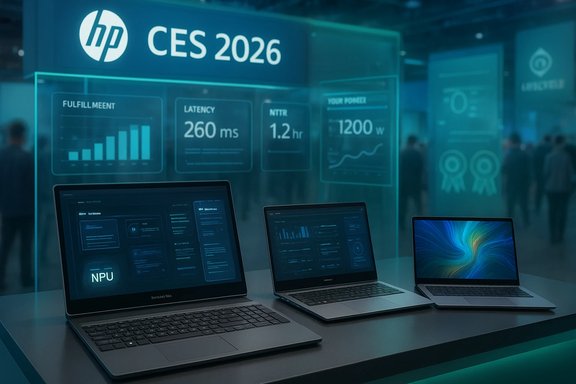
HP arrived at CES with a coherent strategic narrative: push meaningful AI into the places people work, make the endpoint the primary execution layer for Copilot‑era experiences, and wrap that capability with fleet management, security, and lifecycle tooling that enterprises actually buy. The company framed this thesis with a trio of tactical moves—novel device form factors, scale‑ready notebook refreshes with high‑performance NPUs, and workflow integrations that bring AI into traditionally manual touchpoints such as printers and device repair cycles.
This was not a scattershot product release. HP argued that only about one in five knowledge workers report a healthy relationship with work, and that access to the right tools and visible employer investment in technology materially improves that ratio—claims used to justify a “fulfillment‑led growth” approach that ties device procurement to retention, engagement, and measurable workflow improvements. That framing shifts device buying from a cost‑containment problem into an outcome‑driven procurement conversation.
Why this matters: the EliteBoard reframes the desktop as a movable, centrally managed asset that can deliver local inference for Copilot experiences without routing every request to the cloud. For IT, the promise is attractive—plug a single cable into a monitor and you’ve provisioned a managed Copilot+ endpoint. For users, the keyboard form factor reduces carry weight and solves logistics for flexible workspaces. But the category raises immediate technical questions about sustained thermals, surface temperatures, and real‑world ergonomics that must be validated in independent testing.
Operational note: enterprises must validate where inference takes place for each workflow—on‑device vs cloud mediation—how telemetry is logged, and whether DLP and retention policies are enforced consistently. Printer endpoints are often overlooked in governance frameworks; introducing AI there must be accompanied by careful auditing and red‑team privacy reviews.
That said, turning the thesis into measurable ROI requires disciplined measurement: time‑saved studies, error rates on generative summaries, human‑in‑the‑loop checks for high‑risk content, and a clear chain of custody and audit for any AI‑generated artifacts.
For IT leaders, the opportunity is real but far from turnkey: insist on SKU‑level transparency, independent benchmarks for sustained workloads, and careful governance for Copilot integrations. Pilot deliberately, measure the human outcomes HP highlights (fulfillment, time saved, reduced friction), and ensure the security and privacy guardrails are in place before broader rollouts. If those boxes are ticked, HP’s fulfillment‑led, Copilot‑powered endpoint strategy could meaningfully change how organizations think about the PC on the desk—and about technology as a genuine lever for worker fulfillment and business performance.
Source: The Chronicle PH HP bets on fulfillment-led growth, unveils AI-driven of work at CES 2026
 Background / Overview
HP arrived at CES with a coherent strategic narrative: push meaningful AI into the places people work, make the endpoint the primary execution layer for Copilot‑era experiences, and wrap that capability with fleet management, security, and lifecycle tooling that enterprises actually buy. The company framed this thesis with a trio of tactical moves—novel device form factors, scale‑ready notebook refreshes with high‑performance NPUs, and workflow integrations that bring AI into traditionally manual touchpoints such as printers and device repair cycles.This was not a scattershot product release. HP argued that only about one in five knowledge workers report a healthy relationship with work, and that access to the right tools and visible employer investment in technology materially improves that ratio—claims used to justify a “fulfillment‑led growth” approach that ties device procurement to retention, engagement, and measurable workflow improvements. That framing shifts device buying from a cost‑containment problem into an outcome‑driven procurement conversation.
What HP announced at CES 2026 — the headlines
- EliteBoard G1a — a full Windows Copilot+ PC integrated inside a keyboard chassis (HP’s “keyputer”), presented as a CES Innovation Award honoree and targeted at hybrid/hot‑desking scenarios.
- EliteBook X G2 Series — next‑generation business laptops across Intel, AMD, and Qualcomm platforms, positioned for AI‑intensive workflows.
- OmniBook family refresh — consumer and prosumer devices including the OmniBook Ultra 14 and OmniStudioX, touting OLED panels, Snapdragon X2 Elite options, and aggressive battery claims for selected SKUs.
- HP for Microsoft 365 Copilot (Workpath app) — Copilot features pushed to HP Workpath‑enabled multifunction printers for on‑device summarization, translation and intelligent storage to OneDrive/SharePoint. Availability slated for Spring 2026.
- Workforce Experience Platform (WXP) updates — firmware/BIOS‑level remote repair and unified device analytics designed to lower MTTR for distributed fleets.
- HyperX consolidation and gaming hardware — OMEN and HyperX unified under HyperX; flagship gaming laptop HyperX OMEN MAX 16 claimed as the most powerful gaming laptop with fully internal cooling and high Total Platform Power (TPP) figures in select SKUs.
- HP Digital Passport — a device lifecycle and sustainability dashboard to centralize feature, repairability, and support information.
- Future of Work Accelerator return — HP confirmed a 2026 iteration of the program (opening to nonprofit and for‑profit applicants) to support AI and future‑of‑work solutions, continuing its investment in skills and access programs.
Deep dive: devices and form factors
EliteBoard G1a — the keyboard that is a PC
The most visually provocative product HP displayed was the EliteBoard G1a, which literally places a full Windows PC—CPU, RAM, storage, wireless, I/O and an on‑device NPU—inside a full‑size keyboard. HP positions the EliteBoard for hot‑desking, branch offices, and environments where quick, secure redeployment matters more than raw laptop mobility. The design emphasizes serviceability: removable panels for RAM, storage and wireless modules and a detachable battery option for a subset of SKUs. Ship window and headline specs were announced with a March shipping estimate at CES.Why this matters: the EliteBoard reframes the desktop as a movable, centrally managed asset that can deliver local inference for Copilot experiences without routing every request to the cloud. For IT, the promise is attractive—plug a single cable into a monitor and you’ve provisioned a managed Copilot+ endpoint. For users, the keyboard form factor reduces carry weight and solves logistics for flexible workspaces. But the category raises immediate technical questions about sustained thermals, surface temperatures, and real‑world ergonomics that must be validated in independent testing.
EliteBook X G2 Series — multi‑architecture Copilot+ laptops
The EliteBook X G2 line extends HP’s enterprise pitch across several silicon families: Intel Core Ultra, AMD Ryzen AI (HX PRO), and Qualcomm Snapdragon X2 Elite. HP emphasized configurations with very high NPU throughput—up to 85 TOPS in some Qualcomm Snapdragon X2 Elite SKUs—positioning these devices for concurrent local AI workloads such as transcription, live summarization and image processing. Shipping was described as beginning in February and rolling into spring for various SKUs.OmniBook refresh — consumer AI PCs and battery claims
The OmniBook family was redeployed as HP’s consumer/prosumer line, with the OmniBook Ultra 14 and OmniBook 3 16 receiving attention for display quality and battery life. HP made aggressive claims—examples include up to 45 hours of local video playback in tightly controlled OmniBook 3 16 configurations. These figures depend heavily on configuration, software, and playback test methodologies; HP’s marketing tests are useful baselines but not a substitute for mixed‑use, real‑world battery testing.Extending AI beyond the screen: printers, peripherals and lifecycle tooling
HP for Microsoft 365 Copilot — AI at the printer
A standout platform move was embedding Microsoft 365 Copilot functionality into HP Workpath‑enabled multifunction printers via an HP Workpath app. The app brings three headline features to the printer panel: automatic summarization of scanned documents, intelligent file naming and storage suggestions into OneDrive/SharePoint, and on‑device translation at the point of capture. HP positioned this as a way to remove friction from paper‑to‑digital workflows and support multilingual environments. Workplace availability was stated for Spring 2026 and requires tenant Copilot licensing.Operational note: enterprises must validate where inference takes place for each workflow—on‑device vs cloud mediation—how telemetry is logged, and whether DLP and retention policies are enforced consistently. Printer endpoints are often overlooked in governance frameworks; introducing AI there must be accompanied by careful auditing and red‑team privacy reviews.
Workforce Experience Platform (WXP) updates
HP expanded the Workforce Experience Platform with a firmware/BIOS‑level recovery capability designed to repair non‑booting devices remotely and reduce mean‑time‑to‑repair (MTTR) for distributed fleets. Firmware‑level tooling is compelling because it promises continuity for remote and hybrid estates, but it also concentrates privileged recovery paths. IT teams must demand audited role‑based controls, SIEM integration, and reproducible testing with encrypted drives (BitLocker/TPM) before allowing broad operational use.HP Digital Passport and sustainability tracking
The HP Digital Passport aims to centralize device feature sets, repairability status, and the support journey for customers—an onboarding/ESG asset that supports procurement-level decisions. HP framed this as a procurement aid to measure repairability, recycled material content, and lifecycle milestones; the value proposition hinges on trustworthy, machine‑readable lifecycle data tied to warranty and repair channels.Gaming consolidation and peripherals
HP consolidated OMEN and HyperX under the HyperX master brand and promoted high‑power gaming machines such as the HyperX OMEN MAX 16, which HP described as its most powerful gaming laptop with fully internal cooling and up to 300 W Total Platform Power (TPP) in select configurations. These moves streamline branding and make it easier for fans to find premium gaming SKUs, but the real technical questions—sustained TPP, thermals, noise and surface temperatures—require third‑party stress testing.Strategic analysis — strengths, practical benefits, and risks
Strengths and clear positives
- Holistic platform narrative. HP’s announcements connect endpoint hardware, firmware-level manageability (WXP), and workflow endpoints (printers) into a single procurement story—an attractively coherent pitch for IT buyers looking to accelerate Copilot adoption.
- On‑device AI emphasis. Local NPUs promise lower latency, better data locality and reduced cloud cost for common enterprise tasks like transcription, summarization and image processing. That architecture also maps well to regulated verticals that limit cloud transit.
- Serviceability and lifecycle focus. Repairable components and tools such as Digital Passport and WXP recovery suggest real opportunities to lower TCO through easier repairs and faster MTTR—if they operate as described.
- Practical workflow innovations. Pushing Copilot to the scanner/printer is a high‑leverage change: the point where paper becomes digital is an obvious place to save time and remove clerical burden.
Risks, caveats and open questions
- Numeric claims are conditional. HP’s headline figures—50+ TOPS for the EliteBoard, up to 85 TOPS for certain EliteBook/OmniBook SKUs, 45‑hour battery claims, and 300 W TPP for gaming—depend on SKU choices, specific NPU silicon variants and vendor test methodologies. These should be treated as marketing maxima until independent, workload‑relevant benchmarks confirm sustained performance.
- Thermals and sustained performance. New form factors (keyboard PC, ultra‑thin notebooks) and very high‑power gaming SKUs raise legitimate concerns about throttling, fan noise, and surface temperatures under sustained loads. Independent thermal profiling is essential.
- Governance and privacy for Copilot integrations. Embedding Copilot into printers and endpoints introduces new telemetry, retention and inference locality questions. Enterprises must map data flows, audit logs and DLP integration before production rollouts.
- License and TCO complexity. Microsoft 365 Copilot entitlements, Workpath Premium bundles and device upgrades compound total cost; organizations must model licensing and measure actual productivity gains before fleet replacement decisions.
- Firmware‑level privileges. WXP recovery offers real operational benefits, but it also creates a high‑value privileged path; role‑based access, SIEM visibility and independent auditing are non‑negotiable preconditions.
Practical guidance for IT buyers — a 30–90 day pilot plan
- Define pilot cohorts: select representative users (knowledge workers, hybrid workers, creators, branch staff) and two device cohorts — one for EliteBoard G1a and one for EliteBook X G2 Snapdragon variants.
- Acquire SKU‑level transparency: demand exact processor and NPU SKUs (e.g., Snapdragon X2E‑90 vs X2E‑84, AMD Ryzen AI 300 model identifiers) and the corresponding software stacks needed to unlock NPU acceleration.
- Establish workload benchmarks: measure latency and throughput on your real tasks—live transcription, local LLM response times, image inference concurrency—and track sustained NPU throughput under thermal load.
- Validate battery in mixed use: run a mixed‑productivity battery suite (idle, conferencing, local inference, browser use) rather than vendor playback loops.
- Test WXP recovery with encryption: validate firmware‑level recovery with BitLocker/TPM and confirm audit trails, role‑based operations and UEM integrations.
- Red‑team printer Copilot workflows: examine where inference runs, what metadata is logged, and how files are stored to OneDrive/SharePoint under tenant configuration. Run DLP and privacy assessments.
- Model TCO & licensing: include Copilot licensing, Workpath Premium, warranty and repair economics, and the potential productivity delta in your financial model.
Procurement checklist — what to ask HP (or any OEM)
- Which exact NPU and SoC SKU is installed in the device I’m testing? Provide SKU IDs that map to independent chip spec sheets.
- Can you provide independent benchmark data (or permit third‑party testing) for sustained real‑world workloads, not just synthetic TOPS or playback loops?
- How does the WXP firmware recovery flow interact with encrypted drives, TPM/BitLocker and our UEM tooling? Are logs forwardable to our SIEM?
- For the HP for Microsoft 365 Copilot Workpath app: where do inferences run by default, what telemetry is collected, and how can defaults be hardened to meet our retention and DLP policies?
- What parts are genuinely field‑serviceable, and what is the expected depot vs on‑site repair mix for the EliteBoard and key mobile SKUs? Is Digital Passport accessible to procurement systems for lifecycle reporting?
Cross‑checks and verification notes
- TOPS and battery hours are useful comparative metrics but are not proxies for user experience. TOPS measures peak matrix ops; application performance requires end‑to‑end profiling. Treat HP’s TOPS claims as conditional and request SKU‑level documentation and independent workloads before drawing conclusions.
- HP presented ship windows and availability windows (February–March 2026 for many SKUs; Spring 2026 for Workpath printer integrations). Buyers should reconcile announced ship windows against local availability and licensing rollouts during procurement planning.
- Where public verification was limited (for example, sustained NPU throughput under sustained, concurrent inference), the correct operational posture is to assume vendor intent but require proof via pilot programs and independent benchmarks.
Wider implications: fulfillment‑led growth as an enterprise mandate
HP’s framing—invest in technology that measurably improves worker fulfillment and you will capture productivity and retention gains—is a notable pivot in vendor positioning. Device refresh cycles have long been justified by security, manageability and incremental performance gains. HP argues the next wave of justification is human‑centered outcomes: less cognitive friction, shorter capture workflows, and more time spent on value‑creating tasks rather than admin work. If procurement leaders can reliably quantify time saved (for example, through Copilot‑driven scanning and automatic summarization), the business case for higher‑end NPUs and platform bundles becomes far easier to defend.That said, turning the thesis into measurable ROI requires disciplined measurement: time‑saved studies, error rates on generative summaries, human‑in‑the‑loop checks for high‑risk content, and a clear chain of custody and audit for any AI‑generated artifacts.
Conclusion
HP’s CES 2026 slate is more than a set of incremental device updates; it’s an integrated bet that on‑device AI, paired with fleet manageability and workflow integrations, will redefine the endpoint as an active node in enterprise AI workflows. The EliteBoard G1a is the boldest, most attention‑grabbing proof point—an explicit attempt to reimagine the desktop for hot‑desking and distributed teams—while the EliteBook X G2 and OmniBook family push high‑TOPS NPUs into mainstream enterprise and consumer tiers. Printer‑side Copilot, firmware recovery in WXP, and lifecycle tooling such as Digital Passport round out a platform play aimed at deliverable operational value.For IT leaders, the opportunity is real but far from turnkey: insist on SKU‑level transparency, independent benchmarks for sustained workloads, and careful governance for Copilot integrations. Pilot deliberately, measure the human outcomes HP highlights (fulfillment, time saved, reduced friction), and ensure the security and privacy guardrails are in place before broader rollouts. If those boxes are ticked, HP’s fulfillment‑led, Copilot‑powered endpoint strategy could meaningfully change how organizations think about the PC on the desk—and about technology as a genuine lever for worker fulfillment and business performance.
Source: The Chronicle PH HP bets on fulfillment-led growth, unveils AI-driven of work at CES 2026
