

HP announced at Computex in Taipei on June 1, 2026, that it will ship new Windows PCs and workstations built around NVIDIA’s RTX Spark platform, including OmniBook laptops, compact desktops, and GB300-powered ZGX systems aimed at developers, creators, gamers, and enterprise AI teams. The announcement is less a routine product refresh than a declaration that the Windows PC is being repositioned as an AI development endpoint. HP is betting that local agents, hybrid AI workflows, and preconfigured developer stacks will matter as much as battery life and screen size in the next buying cycle. For Windows users and IT departments, the interesting question is not whether the AI PC label survives another marketing season, but whether this new hardware class finally gives the phrase something concrete to mean.
The first wave of AI PCs was sold largely as a promise of better videoconferencing, smarter search, and lightweight inference running on a neural processing unit. HP’s Computex pitch is pointedly different. These machines are not merely meant to use AI features in Windows; they are meant to help developers build, test, and run agentic software locally before scaling it elsewhere.
That shift matters because it changes the buyer. A Copilot+ laptop might be aimed at a knowledge worker who wants better battery life and a few AI-assisted shell features. An RTX Spark notebook or compact desktop is aimed at the person who needs CUDA, local model execution, fast iteration, and enough unified memory to avoid sending every experiment to a cloud instance.
HP’s language is heavy with the industry’s current favorite word: agentic. Strip away the gloss and the premise is straightforward. If the next generation of applications uses autonomous agents that can inspect files, call tools, manipulate windows, and coordinate tasks across apps, developers will need local systems that can run those agents safely and quickly during development.
That is why HP’s announcement reads like a portfolio move rather than a single hero product launch. The company is previewing RTX Spark laptops, promising a compact RTX Spark desktop, extending Windows support to a GB300-based deskside system, and packaging developer-ready AMD workstations. The company is trying to occupy every rung between a thin Windows laptop and a rackable AI system.
For years, NVIDIA’s role in PCs has been obvious but bounded. It owned the discrete GPU conversation for gaming, content creation, workstation visualization, and GPU compute. The CPU, operating system, and platform identity belonged mostly to Intel, AMD, Microsoft, and more recently Qualcomm in the Windows on Arm lane.
RTX Spark blurs those lines. It is not just a graphics option inside an otherwise conventional laptop. It is a full platform pitch: Arm CPU cores, NVIDIA GPU acceleration, unified memory, local AI inference, and a Windows environment meant to keep developers inside the PC instead of forcing them into remote servers for every serious workload.
That creates opportunity and risk in equal measure. NVIDIA brings a software ecosystem that AI developers already understand, and CUDA remains one of the most powerful forms of platform lock-in in modern computing. But Windows on Arm has a long institutional memory, and enterprise IT departments do not forget compatibility pain just because a keynote says the problem is solved.
HP’s decision to attach OmniBook branding to RTX Spark is therefore notable. The OmniBook Ultra 16 and OmniBook X 14 are not obscure dev kits hidden behind a workstation badge. They are mainstream-facing premium laptops, and HP says the OmniBook X 14 configuration will be the world’s thinnest RTX Spark system. That is a consumer-industrial-design claim attached to a developer-platform thesis.
That is a subtle but important change. Traditional premium laptop marketing revolves around familiar tradeoffs: thinness versus thermals, battery life versus performance, screen quality versus price. AI developer hardware adds another axis: how much useful model work can be done on the device before the user has to rent time elsewhere.
The answer will depend on more than TOPS numbers or a stage demo. Developers will care about memory ceilings, framework compatibility, container support, driver maturity, Windows subsystem behavior, and whether their tools feel native or merely tolerated. If a machine can run a local coding agent, a small language model, an image pipeline, and a modern IDE without collapsing into fan noise and paging, the pitch becomes real.
The gaming angle is also not incidental. NVIDIA’s RTX brand carries enormous weight with PC buyers who may not think of themselves as AI developers. By attaching RTX Spark to gaming and creator workflows as well as agent development, HP and NVIDIA are trying to avoid the narrow fate of past developer-first hardware: admired by specialists, ignored by everyone else.
Still, there is a danger in overloading the category. A system that is marketed simultaneously to gamers, creators, enterprise developers, and AI hobbyists can end up satisfying none of them perfectly. HP’s eventual pricing and configuration choices will reveal whether these are practical premium PCs or prestige machines built to prove a platform point.
That matters because the AI PC conversation has too often been forced through the laptop lens. Portability is valuable, but many developers and creators do their heaviest work at a desk, connected to multiple monitors, fast storage, and wired networking. A compact RTX Spark desktop could function as a local AI node: personal, quiet, accessible, and powerful enough to reduce cloud dependence for everyday experimentation.
This is where Windows has a genuine opening. Developers who live in Windows today often juggle WSL, Docker, remote Linux hosts, cloud notebooks, and GPU workstations. If HP can ship a compact device with the right NVIDIA stack, predictable drivers, and a sane Windows development environment, it could become the missing middle between a laptop and a data-center GPU.
That does not mean it replaces cloud AI. The largest models, multi-user training jobs, and production-scale deployments will still live elsewhere. But the gap between “toy local demo” and “expensive remote instance” is exactly where a strong desktop AI platform can earn its keep.
The most convincing version of the AI PC may not be the one that writes your email on an airplane. It may be the box under a monitor that lets a developer prototype a local agent, test it against Windows apps, and then decide what belongs on-device, what belongs on-prem, and what belongs in the cloud.
The intended customer is not the home enthusiast deciding between an OmniBook and a gaming desktop. HP is speaking to enterprise teams building frontier agents, regulated AI workflows, and always-on systems that need to connect to Windows applications and business processes. In other words, it is trying to keep Windows relevant where AI development starts to look like infrastructure.
This is a smart defensive move. If enterprise AI work happens entirely in Linux clusters, cloud notebooks, and managed model platforms, Windows risks becoming a front-end operating system for work that is actually built elsewhere. By pushing GB300-class systems toward Windows workflows, HP is aligning with Microsoft’s broader effort to make Windows a serious host for local and hybrid AI development.
There is also a practical IT argument here. Many enterprises have Windows-heavy application estates, identity systems, endpoint management processes, and security tooling. If AI agents are expected to interact with Office files, line-of-business apps, browser sessions, and internal workflows, testing those agents close to the Windows environment is not a luxury.
The hard part will be operational discipline. A deskside AI supercomputer attached to Windows workflows sounds powerful, but it also sounds like a governance headache if access control, model provenance, data boundaries, and monitoring are treated as afterthoughts. HP’s enterprise credibility will depend less on the raw hardware than on how cleanly these machines fit into managed environments.
This matters because local AI is often sold as inherently safer than cloud AI. The argument has some merit: keeping sensitive data on a local device can reduce exposure to third-party services and network transit. But locality alone is not security. A powerful local model with tool access, file access, and application control can become a new class of privileged software.
The ZGX Nano pitch acknowledges that reality. In classified or remote environments, the problem is not merely whether the model runs locally. The problem is whether the entire system can be trusted under strict physical, network, and administrative constraints. Removing radios and limiting external interfaces may sound old-fashioned, but in high-assurance computing, old-fashioned controls often survive because they work.
For WindowsForum readers, the takeaway is that the AI PC conversation is splitting into two tracks. One track is about convenience: faster local assistants, creative tools, and responsive agents. The other is about containment: how to give AI enough access to be useful without giving it enough reach to become dangerous.
HP is clearly trying to speak to both. That is sensible, but it also underscores how immature the category remains. The industry has not yet settled on what a secure local agent platform looks like, especially when agents are expected to interact with ordinary desktop software built long before this threat model existed.
This is the AI PC as productivity appliance rather than AI development platform. The Thunderbolt Share angle is especially telling. HP is not just selling compute; it is selling workflow fluidity between two PCs, one keyboard and mouse, fast file transfer, and a cleaner desk setup than a bulky tower provides.
That may sound mundane next to RTX Spark, but mundane is where PCs actually win or lose. A mini desktop that handles multiple displays, fast peripheral connections, and AI-accelerated local tasks could be far more valuable to many users than a speculative agent demo. The best AI hardware will still need to be a good PC when the AI feature is not in use.
Intel’s role here is also important. HP is not abandoning the traditional x86 Windows ecosystem while embracing NVIDIA’s Arm-based push. Instead, it is segmenting the portfolio: Intel Core Ultra for mainstream compact productivity, AMD Ryzen AI PRO for workstation-class development, NVIDIA RTX Spark for local AI and creator acceleration, and GB300 for enterprise-scale agent infrastructure.
That segmentation is rational, but it complicates the buying story. The industry spent years telling users to pick by brand, CPU tier, and GPU tier. Now buyers are being asked to understand NPUs, unified memory, local inference, agent frameworks, model sizes, and whether their workflow needs CUDA, ROCm, or neither.
That is a smart move because developers care about time-to-first-result. Hardware specs matter, but the first hour with a machine often determines whether it becomes a daily tool or a shelf ornament. If HP can ship a workstation with usable frameworks, starter models, command-line workflows, and documentation that does not assume a weekend of driver archaeology, it will have solved a real pain point.
AMD’s inclusion also keeps HP from appearing locked into a single AI worldview. NVIDIA’s software ecosystem is dominant, but many enterprises and developers want alternatives for cost, openness, supply chain, or architectural reasons. ROCm has had a more uneven developer reputation than CUDA, but packaging and validation can do a lot to reduce friction.
The broader message is that HP sees developer readiness as a product feature. That is a welcome change. PC vendors have long sold performance as a number printed on a spec sheet, then left developers to discover whether the drivers, libraries, firmware, and management tools cooperate. In the AI era, the software stack is not an accessory. It is the product.
That timing matters because AI PC announcements have a habit of arriving before the software that justifies them. The industry can ship silicon faster than it can reshape user behavior, developer tooling, and enterprise governance. A machine can be capable of running local agents long before the average organization is ready to approve agents that manipulate files and applications autonomously.
There is also the compatibility question. NVIDIA and Microsoft are making bold claims about RTX Spark and Windows, but Windows on Arm remains a platform where the last few percent of edge cases can matter disproportionately. A developer machine that runs almost everything is impressive; an enterprise client fleet that fails on one VPN client, kernel driver, security agent, or line-of-business plug-in is a deployment problem.
HP’s advantage is that it does not have to make one machine solve everything. Its portfolio approach lets the company route different customers to different architectures. The downside is that the portfolio itself becomes a map IT departments must learn to read.
That is why the most important details may not be the keynote-friendly ones. Buyers will need to know support lifecycles, firmware update policies, manageability, repairability, Linux support, Windows image support, security baselines, and whether preconfigured AI environments can be rebuilt reproducibly rather than treated as magic factory images.
That alignment is powerful because each party needs the others. Microsoft needs silicon that makes local AI feel materially different from yesterday’s PC. NVIDIA needs Windows volume and OEM reach if it wants RTX Spark to be more than a developer curiosity. HP needs a reason for customers to refresh premium PCs in a market where ordinary productivity workloads have not required radical upgrades for years.
But the alignment also creates a delicate dependency chain. If Windows agent features are underwhelming, HP’s hardware looks early. If RTX Spark systems are expensive and scarce, Microsoft’s Windows AI story looks aspirational. If enterprise controls lag behind the demos, IT departments will slow-roll adoption no matter how impressive the silicon looks.
This is where WindowsForum’s audience should stay skeptical but interested. The history of the PC is full of platform reinventions that sounded inevitable until they met drivers, budgets, procurement cycles, and user habits. It is also full of moments when a new hardware-software combination quietly changed what developers expected a normal machine to do.
RTX Spark could be one of those moments, but only if the systems feel less like a science project and more like a better workstation. HP’s job is to make that transition boring in the best possible sense: open the box, enroll the device, run the tools, build the thing.
The mention of OpenClaw-based starter kits and Hermes support points toward a world where PC vendors are no longer shipping inert hardware and walking away. They are trying to ship a development posture: a suggested way to build local agents, test them, and connect them to hybrid AI infrastructure. That is a major shift in the OEM role.
It also raises accountability questions. If HP ships a developer stack, it inherits some responsibility for keeping that stack current, secure, and compatible. AI tooling changes quickly. Frameworks evolve, models are replaced, vulnerabilities appear, and best practices move. A stale factory image can become technical debt almost immediately.
Enterprise customers will ask the harder version of that question. Can these systems be rebuilt from documented components? Can the AI stack be patched through normal management channels? Can models be inventoried? Can local agents be restricted by policy? Can telemetry be controlled? The answers will matter more than whether the demo agent can summarize a folder.
For enthusiasts, the same issue appears in a different form. A truly useful AI PC should not lock users into a fragile vendor demo. It should expose enough of the stack for experimentation, replacement, and repair. The enthusiasts who made the PC ecosystem vibrant will not be satisfied with a black box wearing a developer badge.
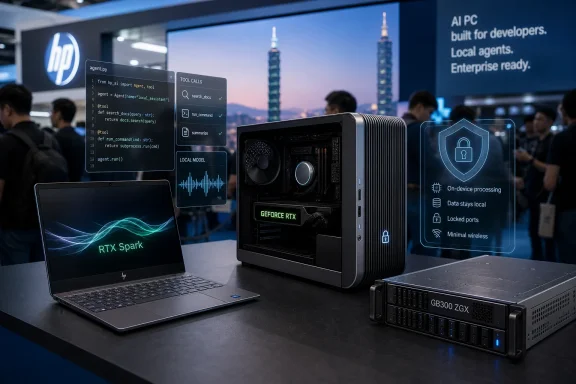 HP Turns the AI PC From Consumption Device Into Build Machine
The first wave of AI PCs was sold largely as a promise of better videoconferencing, smarter search, and lightweight inference running on a neural processing unit. HP’s Computex pitch is pointedly different. These machines are not merely meant to use AI features in Windows; they are meant to help developers build, test, and run agentic software locally before scaling it elsewhere.That shift matters because it changes the buyer. A Copilot+ laptop might be aimed at a knowledge worker who wants better battery life and a few AI-assisted shell features. An RTX Spark notebook or compact desktop is aimed at the person who needs CUDA, local model execution, fast iteration, and enough unified memory to avoid sending every experiment to a cloud instance.
HP’s language is heavy with the industry’s current favorite word: agentic. Strip away the gloss and the premise is straightforward. If the next generation of applications uses autonomous agents that can inspect files, call tools, manipulate windows, and coordinate tasks across apps, developers will need local systems that can run those agents safely and quickly during development.
That is why HP’s announcement reads like a portfolio move rather than a single hero product launch. The company is previewing RTX Spark laptops, promising a compact RTX Spark desktop, extending Windows support to a GB300-based deskside system, and packaging developer-ready AMD workstations. The company is trying to occupy every rung between a thin Windows laptop and a rackable AI system.
RTX Spark Gives Windows a New Silicon Story
RTX Spark is the gravitational center of the announcement. NVIDIA is pitching the platform as a Windows PC superchip that combines a Grace CPU, Blackwell-class RTX graphics, unified memory, and the CUDA software stack in systems thin enough for laptops and small enough for compact desktops. That puts NVIDIA in a place it has long influenced but rarely occupied directly: the heart of the Windows client platform.For years, NVIDIA’s role in PCs has been obvious but bounded. It owned the discrete GPU conversation for gaming, content creation, workstation visualization, and GPU compute. The CPU, operating system, and platform identity belonged mostly to Intel, AMD, Microsoft, and more recently Qualcomm in the Windows on Arm lane.
RTX Spark blurs those lines. It is not just a graphics option inside an otherwise conventional laptop. It is a full platform pitch: Arm CPU cores, NVIDIA GPU acceleration, unified memory, local AI inference, and a Windows environment meant to keep developers inside the PC instead of forcing them into remote servers for every serious workload.
That creates opportunity and risk in equal measure. NVIDIA brings a software ecosystem that AI developers already understand, and CUDA remains one of the most powerful forms of platform lock-in in modern computing. But Windows on Arm has a long institutional memory, and enterprise IT departments do not forget compatibility pain just because a keynote says the problem is solved.
HP’s decision to attach OmniBook branding to RTX Spark is therefore notable. The OmniBook Ultra 16 and OmniBook X 14 are not obscure dev kits hidden behind a workstation badge. They are mainstream-facing premium laptops, and HP says the OmniBook X 14 configuration will be the world’s thinnest RTX Spark system. That is a consumer-industrial-design claim attached to a developer-platform thesis.
The OmniBook Bet Is About Normalizing Local AI
The HP OmniBook Ultra 16 and OmniBook X 14 powered by RTX Spark are expected later this year, with pricing and detailed configurations still under wraps. On paper, they are pitched at creators, gamers, AI developers, and anyone else who wants NVIDIA’s full-stack AI platform in a mobile Windows machine. In practice, HP is testing whether the market can absorb a premium laptop whose defining spec is not just CPU class or GPU tier, but local AI capacity.That is a subtle but important change. Traditional premium laptop marketing revolves around familiar tradeoffs: thinness versus thermals, battery life versus performance, screen quality versus price. AI developer hardware adds another axis: how much useful model work can be done on the device before the user has to rent time elsewhere.
The answer will depend on more than TOPS numbers or a stage demo. Developers will care about memory ceilings, framework compatibility, container support, driver maturity, Windows subsystem behavior, and whether their tools feel native or merely tolerated. If a machine can run a local coding agent, a small language model, an image pipeline, and a modern IDE without collapsing into fan noise and paging, the pitch becomes real.
The gaming angle is also not incidental. NVIDIA’s RTX brand carries enormous weight with PC buyers who may not think of themselves as AI developers. By attaching RTX Spark to gaming and creator workflows as well as agent development, HP and NVIDIA are trying to avoid the narrow fate of past developer-first hardware: admired by specialists, ignored by everyone else.
Still, there is a danger in overloading the category. A system that is marketed simultaneously to gamers, creators, enterprise developers, and AI hobbyists can end up satisfying none of them perfectly. HP’s eventual pricing and configuration choices will reveal whether these are practical premium PCs or prestige machines built to prove a platform point.
The Compact Desktop Is the More Honest AI PC
The laptop gets the glamour, but HP’s planned compact RTX Spark desktop may be the more coherent product. Local AI workloads often benefit from sustained power, stable thermals, large memory pools, and predictable desk-bound usage. A small desktop does not have to pretend that all-day battery life and workstation-class inference are equally easy priorities.That matters because the AI PC conversation has too often been forced through the laptop lens. Portability is valuable, but many developers and creators do their heaviest work at a desk, connected to multiple monitors, fast storage, and wired networking. A compact RTX Spark desktop could function as a local AI node: personal, quiet, accessible, and powerful enough to reduce cloud dependence for everyday experimentation.
This is where Windows has a genuine opening. Developers who live in Windows today often juggle WSL, Docker, remote Linux hosts, cloud notebooks, and GPU workstations. If HP can ship a compact device with the right NVIDIA stack, predictable drivers, and a sane Windows development environment, it could become the missing middle between a laptop and a data-center GPU.
That does not mean it replaces cloud AI. The largest models, multi-user training jobs, and production-scale deployments will still live elsewhere. But the gap between “toy local demo” and “expensive remote instance” is exactly where a strong desktop AI platform can earn its keep.
The most convincing version of the AI PC may not be the one that writes your email on an airplane. It may be the box under a monitor that lets a developer prototype a local agent, test it against Windows apps, and then decide what belongs on-device, what belongs on-prem, and what belongs in the cloud.
GB300 Brings the Workstation Back Into the Windows Story
HP’s ZGX Fury GB300 announcement sits at the opposite end of the spectrum. The company says its deskside and rackable high-performance systems powered by NVIDIA’s GB300 Grace Blackwell Ultra Desktop Superchip will gain Windows support later this year. That is a striking phrase: Windows support for a class of machine that sounds more like an AI appliance than a conventional PC.The intended customer is not the home enthusiast deciding between an OmniBook and a gaming desktop. HP is speaking to enterprise teams building frontier agents, regulated AI workflows, and always-on systems that need to connect to Windows applications and business processes. In other words, it is trying to keep Windows relevant where AI development starts to look like infrastructure.
This is a smart defensive move. If enterprise AI work happens entirely in Linux clusters, cloud notebooks, and managed model platforms, Windows risks becoming a front-end operating system for work that is actually built elsewhere. By pushing GB300-class systems toward Windows workflows, HP is aligning with Microsoft’s broader effort to make Windows a serious host for local and hybrid AI development.
There is also a practical IT argument here. Many enterprises have Windows-heavy application estates, identity systems, endpoint management processes, and security tooling. If AI agents are expected to interact with Office files, line-of-business apps, browser sessions, and internal workflows, testing those agents close to the Windows environment is not a luxury.
The hard part will be operational discipline. A deskside AI supercomputer attached to Windows workflows sounds powerful, but it also sounds like a governance headache if access control, model provenance, data boundaries, and monitoring are treated as afterthoughts. HP’s enterprise credibility will depend less on the raw hardware than on how cleanly these machines fit into managed environments.
ZGX Nano Shows That Air Gaps Still Matter
The ZGX Nano configuration is the least flashy part of HP’s announcement and one of the most revealing. HP describes it as a system for regulated, classified, and remote environments, with hardware and software integration designed to reduce attack surfaces by physically restricting wireless access and external interfaces. That is not the language of consumer AI magic; it is the language of security teams that do not want a clever agent to become a clever exfiltration path.This matters because local AI is often sold as inherently safer than cloud AI. The argument has some merit: keeping sensitive data on a local device can reduce exposure to third-party services and network transit. But locality alone is not security. A powerful local model with tool access, file access, and application control can become a new class of privileged software.
The ZGX Nano pitch acknowledges that reality. In classified or remote environments, the problem is not merely whether the model runs locally. The problem is whether the entire system can be trusted under strict physical, network, and administrative constraints. Removing radios and limiting external interfaces may sound old-fashioned, but in high-assurance computing, old-fashioned controls often survive because they work.
For WindowsForum readers, the takeaway is that the AI PC conversation is splitting into two tracks. One track is about convenience: faster local assistants, creative tools, and responsive agents. The other is about containment: how to give AI enough access to be useful without giving it enough reach to become dangerous.
HP is clearly trying to speak to both. That is sensible, but it also underscores how immature the category remains. The industry has not yet settled on what a secure local agent platform looks like, especially when agents are expected to interact with ordinary desktop software built long before this threat model existed.
OmniDesk Mini Makes the Desk Setup Part of the AI Pitch
The new HP OmniDesk Mini Desktop PC is more conventional than the RTX Spark and GB300 announcements, but it may be easier for ordinary buyers to understand. HP says the system is powered by Intel Core Ultra Series 3 processors, includes built-in AI capabilities, supports Thunderbolt Share, offers two Thunderbolt 4 connections, and can drive up to four 4K displays. Availability is expected in August 2026, with pricing coming later.This is the AI PC as productivity appliance rather than AI development platform. The Thunderbolt Share angle is especially telling. HP is not just selling compute; it is selling workflow fluidity between two PCs, one keyboard and mouse, fast file transfer, and a cleaner desk setup than a bulky tower provides.
That may sound mundane next to RTX Spark, but mundane is where PCs actually win or lose. A mini desktop that handles multiple displays, fast peripheral connections, and AI-accelerated local tasks could be far more valuable to many users than a speculative agent demo. The best AI hardware will still need to be a good PC when the AI feature is not in use.
Intel’s role here is also important. HP is not abandoning the traditional x86 Windows ecosystem while embracing NVIDIA’s Arm-based push. Instead, it is segmenting the portfolio: Intel Core Ultra for mainstream compact productivity, AMD Ryzen AI PRO for workstation-class development, NVIDIA RTX Spark for local AI and creator acceleration, and GB300 for enterprise-scale agent infrastructure.
That segmentation is rational, but it complicates the buying story. The industry spent years telling users to pick by brand, CPU tier, and GPU tier. Now buyers are being asked to understand NPUs, unified memory, local inference, agent frameworks, model sizes, and whether their workflow needs CUDA, ROCm, or neither.
AMD Gets a Developer Lane Instead of a Footnote
HP’s Z2 Mini G1a update deserves attention because it prevents the announcement from becoming an all-NVIDIA narrative. HP says it is bringing AMD Ryzen AI PRO 400 series processors to the Z2 Mini G1a and integrating AMD’s Ryzen AI Halo developer software stack, including the Ryzen AI Developer Center, ROCm, preinstalled AI frameworks, models, and guided playbooks. The promise is simple: an off-the-shelf workstation that lets developers start building AI workloads without assembling the stack by hand.That is a smart move because developers care about time-to-first-result. Hardware specs matter, but the first hour with a machine often determines whether it becomes a daily tool or a shelf ornament. If HP can ship a workstation with usable frameworks, starter models, command-line workflows, and documentation that does not assume a weekend of driver archaeology, it will have solved a real pain point.
AMD’s inclusion also keeps HP from appearing locked into a single AI worldview. NVIDIA’s software ecosystem is dominant, but many enterprises and developers want alternatives for cost, openness, supply chain, or architectural reasons. ROCm has had a more uneven developer reputation than CUDA, but packaging and validation can do a lot to reduce friction.
The broader message is that HP sees developer readiness as a product feature. That is a welcome change. PC vendors have long sold performance as a number printed on a spec sheet, then left developers to discover whether the drivers, libraries, firmware, and management tools cooperate. In the AI era, the software stack is not an accessory. It is the product.
The Marketing Is Ahead of the Proof
There is a lot to like in HP’s announcement, but the claims are still mostly claims. The RTX Spark laptops are coming later this year. Pricing is not available. Detailed configurations are not yet public. The compact RTX Spark desktop is planned, not shipping. Windows support for the GB300-powered ZGX Fury is promised for later in the year. The OmniDesk Mini has an August 2026 target, but its value will depend heavily on configuration and price.That timing matters because AI PC announcements have a habit of arriving before the software that justifies them. The industry can ship silicon faster than it can reshape user behavior, developer tooling, and enterprise governance. A machine can be capable of running local agents long before the average organization is ready to approve agents that manipulate files and applications autonomously.
There is also the compatibility question. NVIDIA and Microsoft are making bold claims about RTX Spark and Windows, but Windows on Arm remains a platform where the last few percent of edge cases can matter disproportionately. A developer machine that runs almost everything is impressive; an enterprise client fleet that fails on one VPN client, kernel driver, security agent, or line-of-business plug-in is a deployment problem.
HP’s advantage is that it does not have to make one machine solve everything. Its portfolio approach lets the company route different customers to different architectures. The downside is that the portfolio itself becomes a map IT departments must learn to read.
That is why the most important details may not be the keynote-friendly ones. Buyers will need to know support lifecycles, firmware update policies, manageability, repairability, Linux support, Windows image support, security baselines, and whether preconfigured AI environments can be rebuilt reproducibly rather than treated as magic factory images.
Microsoft’s Stake Is Bigger Than HP’s Product Line
HP’s announcement lands in a broader Windows moment. Microsoft wants Windows to be seen not merely as the place where office work happens, but as the operating system where personal agents run, developers build them, and enterprises govern them. NVIDIA wants to bring its AI platform deeper into the PC, not just the data center. HP wants to turn that strategic collision into hardware customers can buy.That alignment is powerful because each party needs the others. Microsoft needs silicon that makes local AI feel materially different from yesterday’s PC. NVIDIA needs Windows volume and OEM reach if it wants RTX Spark to be more than a developer curiosity. HP needs a reason for customers to refresh premium PCs in a market where ordinary productivity workloads have not required radical upgrades for years.
But the alignment also creates a delicate dependency chain. If Windows agent features are underwhelming, HP’s hardware looks early. If RTX Spark systems are expensive and scarce, Microsoft’s Windows AI story looks aspirational. If enterprise controls lag behind the demos, IT departments will slow-roll adoption no matter how impressive the silicon looks.
This is where WindowsForum’s audience should stay skeptical but interested. The history of the PC is full of platform reinventions that sounded inevitable until they met drivers, budgets, procurement cycles, and user habits. It is also full of moments when a new hardware-software combination quietly changed what developers expected a normal machine to do.
RTX Spark could be one of those moments, but only if the systems feel less like a science project and more like a better workstation. HP’s job is to make that transition boring in the best possible sense: open the box, enroll the device, run the tools, build the thing.
The Real Test Will Happen After the Unboxing
HP’s Computex announcement is strongest when it focuses on reducing friction. Preconfigured environments, open-source toolchains, command-line workflows, starter kits, and support for agent frameworks are not glamorous in the way a thin laptop render is glamorous. They are, however, exactly the kind of details that determine whether developers adopt a platform.The mention of OpenClaw-based starter kits and Hermes support points toward a world where PC vendors are no longer shipping inert hardware and walking away. They are trying to ship a development posture: a suggested way to build local agents, test them, and connect them to hybrid AI infrastructure. That is a major shift in the OEM role.
It also raises accountability questions. If HP ships a developer stack, it inherits some responsibility for keeping that stack current, secure, and compatible. AI tooling changes quickly. Frameworks evolve, models are replaced, vulnerabilities appear, and best practices move. A stale factory image can become technical debt almost immediately.
Enterprise customers will ask the harder version of that question. Can these systems be rebuilt from documented components? Can the AI stack be patched through normal management channels? Can models be inventoried? Can local agents be restricted by policy? Can telemetry be controlled? The answers will matter more than whether the demo agent can summarize a folder.
For enthusiasts, the same issue appears in a different form. A truly useful AI PC should not lock users into a fragile vendor demo. It should expose enough of the stack for experimentation, replacement, and repair. The enthusiasts who made the PC ecosystem vibrant will not be satisfied with a black box wearing a developer badge.
The HP Announcement Worth Remembering After Computex
HP’s new lineup is not a single product story; it is a signpost for where the Windows ecosystem thinks the next fight will happen. The PC is being recast as a local AI workstation, a secure agent host, and a hybrid endpoint that decides what work should happen on-device and what should move to larger infrastructure.- HP plans to bring NVIDIA RTX Spark to the OmniBook Ultra 16 and OmniBook X 14 later in 2026, with pricing and final specifications still to come.
- HP is also planning a compact RTX Spark desktop, which may be the more practical form factor for sustained local AI development.
- The ZGX Fury GB300 is aimed at enterprise AI teams that want deskside or rackable systems tied more directly into Windows workflows.
- The ZGX Nano shows that regulated environments will demand physical and architectural controls, not just promises that local AI is safer.
- The OmniDesk Mini gives HP a more mainstream compact desktop story, with Intel Core Ultra Series 3 processors, Thunderbolt Share, and support for up to four 4K displays.
- The AMD-powered Z2 Mini G1a matters because prevalidated developer stacks may become as important as raw silicon in AI workstation buying decisions.
References
- Primary source: HP
Published: 2026-06-05T20:10:20.595579
HP Debuts PCs Built for the Next Wave of Windows PC Experiences Powered by NVIDIA RTX Spark™ | HP® Official Site
Today, HP Inc. (NYSE: HPQ) announced its latest devices and solutions, designed to enable developers of all types to create new experiences using AI.www.hp.com
- Related coverage: tomshardware.com
Computex 2026 Day Zero Wrap-Up: Nvidia launches RTX Spark Superchip assault on laptop and desktop markets, Intel readies Xeon 6+ | Tom's Hardware
Computex 2026 is off to a strong startwww.tomshardware.com - Related coverage: axios.com
Microsoft debuts Nvidia-powered Microsoft Surface Ultra laptop
Microsoft is trying again to redefine the PC for the AI era.www.axios.com
- Related coverage: windowscentral.com
Microsoft is making a Surface mini PC for AI developers: Meet the Surface RTX Spark Dev Box, featuring 128GB RAM and one petaflop of AI compute power | Windows Central
Coming later this year, Microsoft is shipping its first Surface branded mini PC, aimed solely at AI developers looking to adopt NVIDIA's new RTX Spark platform.www.windowscentral.com - Related coverage: investor.nvidia.com
NVIDIA Corporation - NVIDIA and Microsoft Reinvent Windows PCs for the Age of Personal AI
RTX Spark — a 1-Petaflop Superchip, the Full CUDA and RTX Ecosystem, and Windows-Native Agents — a New Beginning for Personal Computers News Summary: NVIDIA RTX Spark powers the world’s first Windows PCs purpose-built for personal agents, featuring 1 petaflop of AI performance, industry-leading...investor.nvidia.com - Official source: blogs.windows.com
Introducing a powerful new chapter for Windows PCs, accelerated by NVIDIA RTX Spark
Today at NVIDIA GTC, Microsoft and NVIDIA announced the world’s most powerful and efficient thin-and-light Windows PCs ever. Accelerated by NVIDIA RTX Sparkblogs.windows.com
- Related coverage: techcrunch.com
Nvidia chases $200B CPU market with AI agent PCs from Microsoft, Dell, and HP | TechCrunch
If Nvidia has cracked a way to bring AI agents easily, safely, and usefully to the masses, it could — and should — be big.techcrunch.com - Related coverage: gadgets360.com
HP OmniBook Ultra 16 (2026), OmniBook X 14 (2026) Unveiled With Nvidia's RTX Spark 'Superchip' | Technology News
HP has announced that its next-generation HP OmniBook Ultra 16 (2026) and OmniBook X 14 (2026) will be powered by the new Nvidia RTX Spark superchip.www.gadgets360.com - Related coverage: thesiliconreview.com
NVIDIA RTX Spark Brings 1 Petaflop AI Acceleration to Windows PCs
NVIDIA AI launched RTX Spark, a 1 petaflop AI superchip for Windows PCs, Microsoft optimizing Windows local AI agents The Silicon Review reports fall 2026 rollout thesiliconreview.com
- Related coverage: techtimes.com
Nvidia RTX Spark Superchip: Windows PC Chip With Full CUDA Stack Targets Dell, Microsoft This Fall
Nvidia RTX Spark Superchip launched at Computex 2026 as Nvidia’s first Windows PC processor, co-developed with Microsoft, pairing a Blackwell GPU with 6,144 CUDA cores and 128 GB unified memory in awww.techtimes.com - Related coverage: blogs.nvidia.com
Faster Local AI Agents on RTX PCs and DGX Spark | NVIDIA Blog
Announced at GTC Taipei at COMPUTEX, NVIDIA OpenShell brings secure agents to Windows with 2x inference performance on llama.cpp — plus, Adobe rebuilds its apps with performance and memory enhancements, and Blender adds NVIDIA DLSS 4.5 Ray Reconstruction for NVIDIA RTX Spark.blogs.nvidia.com - Related coverage: elpais.com
Nvidia anuncia la reinvención del ordenador personal con un chip de IA con el que reta a Intel y AMD | Economía | EL PAÍS
El gigante crea un procesador diseñado junto a Microsoft. Fabricantes como Dell, HP y Asus se unen al proyectoelpais.com - Related coverage: qualcomm.com
- Related coverage: signal65.com
- Related coverage: nvidia.com
NVIDIA AI Enterprise—DGX Spark | NVIDIA
NVIDIA AI Enterprise—DGX Spark brings all the enterprise-class benefits to the world’s smallest AI supercomputer: a suite of software designed to optimize AI development and deployment, access to support specialists to ensure issues are expeditiously resolved, Production Branch (PB) and...www.nvidia.com
