

In a vivid example of automation run amok, an HR team’s test of an offboarding automation tool accidentally dispatched a blunt “You’re fired” style termination notice to the entire company — including the CEO — triggering minutes of panic across Slack, an all‑hands scramble by IT, and a viral Reddit post that turned the incident into an internet spectacle on November 9–10, 2025. This feature unpacks what we know, verifies claims where possible, explains the technical and governance failures that made the mishap likely, and outlines practical, high‑impact steps HR, IT and security teams should apply immediately to prevent a repeat. The reporting to date leaves several details — notably the employer’s identity — undisclosed; where facts are not public or corroborated we flag the uncertainty so teams can separate verifiable lessons from anecdote.
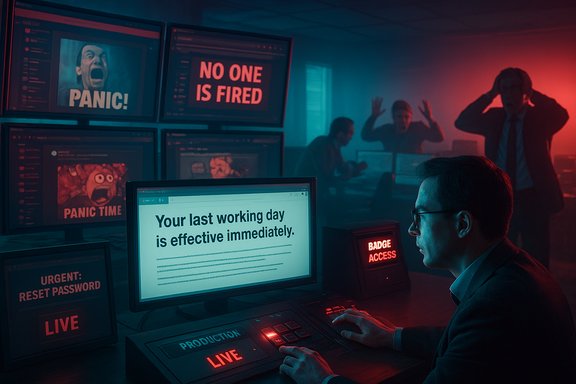
The incident began when an employee posted an account of the event to Reddit’s r/Wellthatsucks on November 9, 2025, describing a test of a new offboarding automation tool that unintentionally ran in “live” mode and sent a mass termination email to roughly 300 recipients. The message reportedly opened with the line “Your last working day is effective immediately.” Within minutes Slack “went nuclear,” managers asked whether they should “start packing,” and IT had to publish an urgent all‑caps reassurance: “NO ONE IS FIRED. PLEASE DO NOT TURN IN YOUR BADGES.” The Reddit post quickly amassed tens of thousands of upvotes and was picked up by mainstream outlets. Multiple mainstream outlets reprinted the account and the Reddit screenshots; the coverage is consistent about the core facts (test → live → mass “termination” email → panic → IT correction), but none of the published reports has identified the company involved. That remains an important unknown, and it means reporting is limited to the available first‑person account and the media amplification that followed.
Automation will continue to shape people operations; the value proposition remains compelling. The imperative for leaders is to pair automation with responsibility: stronger access controls, explicit human sign‑offs, rehearsed communications, and the humility to accept that when the output touches someone’s livelihood, a machine should never be the final arbiter.
(Reporting in this piece relies on the Reddit account report and contemporaneous coverage by mainstream outlets; the employer has not been publicly identified in the available coverage and some operational details remain unverified.
Source: Storyboard18 HR blunder sends “You’re Fired” email to entire company including CEO
 Overview
The incident began when an employee posted an account of the event to Reddit’s r/Wellthatsucks on November 9, 2025, describing a test of a new offboarding automation tool that unintentionally ran in “live” mode and sent a mass termination email to roughly 300 recipients. The message reportedly opened with the line “Your last working day is effective immediately.” Within minutes Slack “went nuclear,” managers asked whether they should “start packing,” and IT had to publish an urgent all‑caps reassurance: “NO ONE IS FIRED. PLEASE DO NOT TURN IN YOUR BADGES.” The Reddit post quickly amassed tens of thousands of upvotes and was picked up by mainstream outlets. Multiple mainstream outlets reprinted the account and the Reddit screenshots; the coverage is consistent about the core facts (test → live → mass “termination” email → panic → IT correction), but none of the published reports has identified the company involved. That remains an important unknown, and it means reporting is limited to the available first‑person account and the media amplification that followed. Background: Why HR teams automate offboarding (and what they typically automate)
HR and IT teams have increasingly automated routine elements of onboarding and offboarding to reduce manual errors, accelerate access changes, and ensure compliance. Commonly automated tasks include:- revoking access (directory and application accounts),
- disabling physical access badges,
- scheduling final payroll and benefits actions,
- sending standard exit documentation (NDAs, equipment return forms),
- initiating equipment recovery workflows.
What happened (reconstructed timeline)
- HR prepared a test of a new offboarding automation tool designed to send templated “exit” emails and trigger downstream IT/physical‑security processes.
- During testing, the system was left in live mode rather than test mode, causing the termination template to be sent to the target distribution list — which, according to the Reddit poster, included approximately 300 people and leadership.
- Recipients reacted on internal channels; Slack rapidly filled with alarm, jokes, and at least one manager asking whether they should “start packing.”
- IT intervened with an emergency all‑staff message stating no one had actually been terminated and urging employees not to return badges.
- The original Reddit post and screenshots spread widely, driving mainstream coverage and a wave of commentary about automation, testing practices and layoff signals.
Why this was avoidable: technical and process failures
This incident is emblematic of a common failure pattern when automation is introduced without layered controls. Several specific failures are likely:- Testing in production (or insufficiently isolated UAT) — Test data and templates were apparently present in the production environment and able to reach live mail lists. Proper separation of test and production environments would have prevented a live mail send.
- Inadequate gating and approvals — No last‑mile confirmation, approval or enforced human sign‑off prevented a single operator action from sending a high‑impact notice to a large group.
- Excessive permissions on automation tooling — If the tool could send to broad distribution lists without multi‑party confirmation, it effectively removed basic checks that should sit between intent and mass effect.
- No fail‑safe throttling or sandbox send — Enterprise mail systems and orchestration platforms can throttle or require moderated sends for large lists; those controls appear to have been lacking or disabled.
- Poor communication playbook — The immediate reaction required IT to issue an all‑caps denial; a rehearsed, fast‑acting communications protocol would have allowed a quicker, calmer response.
Cultural and legal implications
Even when a message is a mistake, the psychological and legal impacts can be material.- Employee trust and engagement — Receiving a termination notice (even erroneously) is traumatic. The incident likely eroded trust and will require deliberate remediation from leadership to repair morale.
- Potential legal exposure — In some jurisdictions a written termination notice can trigger contractual or statutory obligations (severance, notice periods) if accompanied by follow‑through actions. Organizations must confirm the email did not initiate payroll or benefits changes; if it did, legal and payroll teams will need to act fast. Public coverage so far doesn’t report payroll or account changes, but the risk profile demands a careful internal audit.
- Reputational risk — Viral posts and mainstream coverage can affect employer brand, recruiting, and customer confidence; the story’s rapid spread underscores how quickly an internal operational error becomes external PR exposure.
Automation in HR — benefits, blindspots and regulation
Automation in HR delivers real benefits — faster processes, fewer clerical mistakes, and consistent application of policies — but the risks are well documented. Independent guidance on HR automation and AI emphasizes:- classify offboarding and termination flows as high‑risk,
- require human sign‑off for decisions that affect employment status,
- run privacy and data‑protection impact assessments before production,
- validate vendor claims about safeguards and where model inference runs,
- maintain observability and immutable runbooks for each automation.
Three immediate actions every company should take now
If your organization uses or is evaluating HR automation, implement the following emergency steps within 24–72 hours:- Verify scope of the error
- Confirm whether only an email template was dispatched or whether any downstream systems (Active Directory, badge management, payroll) executed actions. Preserve logs and audit trails.
- Lock down mass‑send capabilities and enforce multi‑party gating
- Require at least two approvals for any automation that targets large groups or modifies employment status. Temporarily restrict who can send messages to enterprise‑wide lists.
- Issue a clear, calm internal communication and host live Q&A
- Leadership should acknowledge the mistake quickly, provide a factual timeline, and open a forum (town hall or AMA) to address concerns. Rapid, transparent communication reduces rumor and demonstrates control.
Technical controls and design patterns to prevent mass‑termination mistakes
Treating termination automation as a safety‑critical system requires engineering discipline. Recommended controls include:- Environment separation — Distinct UAT/staging and production environments with separate data sets and no access to production mail lists for testing.
- Role‑based access control (RBAC) — Limit who can trigger production runs. Assign “test” and “execute” roles distinctly.
- Two‑person (or three‑way) authorization — Require explicit secondary approval before any workflow that will notify or change the status of more than N users (for example, N = 5).
- Moderated distribution lists — For very large lists, require moderated sends that queue for review by designated approvers.
- Rate limiting and send delays — Implement a configurable delay (for example, 10–30 minutes) for high‑impact send actions so operators can cancel erroneous sends.
- Dry‑run and red‑team testing — Regularly run dry‑runs with synthetic test accounts and simulate failure modes to verify fail‑safe behaviors.
- Audit logging and immutable runbooks — Capture who initiated the action, what parameters were used, and the approvals granted. Store logs in immutable storage for post‑event review.
- Human‑in‑the‑loop workflows — For any action that materially affects employment, automation should prepare draft documents and suggested actions, but not execute without explicit human confirmation.
HR and legal playbook for responding to a mistaken termination email
When an erroneous termination communication occurs, HR and legal teams must move in lockstep. A recommended playbook:- Immediate verification — Confirm technical scope (email only vs. account/badge/payroll changes). Escalate to IT and payroll.
- Containment communication — Issue a single, clear corrective message and pin it to internal channels; avoid numerous follow‑ups that sow confusion. Use neutral language (e.g., “administrative error” rather than sarcastic or flippant phrasing).
- Support resources — Make Employee Assistance Programs (EAPs), HR hotlines and managers available to address distress. Acknowledge the emotional harm plainly.
- Audit and forensics — Collect logs, configuration snapshots, and approval records to determine root cause. Preserve evidence for legal review.
- Remediation and discipline — If the issue was negligence or violation of policy, apply proportionate remediation and update procedures accordingly. Protect any whistleblowers or employees who responsibly raised concerns during the event.
- Public statement (if required) — If the incident leaks externally, prepare a factual press statement that outlines corrective steps and commits to improvements without disclosing personnel details.
Why automation still belongs in HR — with conditions
The story’s punchline (and the internet’s amusement) masks an important reality: automation, when governed properly, reduces routine errors and gives HR capacity to focus on higher‑value human work. The critical qualification is this: automation must be designed with guardrails that reflect the human stakes involved. Practical guardrails are:- High‑risk classification for any automation touching employment status.
- Mandatory human approvals for final decisions.
- Vendor and procurement diligence — require evidence of tenant isolation, data residency and the ability to sandbox actions.
- Periodic audits and fairness testing for systems that generate recommendations about people.
Tactical checklist for IT, HR and security leaders (quick reference)
- Disable production mass‑send capabilities except under documented change windows.
- Enforce RBAC and multi‑approval for termination workflows.
- Create a “red phone” IT/HR/communications channel for rapid, authenticated incident correction.
- Add automated throttles and a 15‑minute grace period for high‑impact sends.
- Catalog who can email enterprise‑wide lists and implement moderated lists for corporate announcements.
- Run a scenario table‑top exercise covering “erroneous termination notice” and other HR mishaps; update playbooks after the exercise.
Broader lessons for leaders: trust, transparency and tech humility
There’s an easy joke in this story — and countless commenters on Reddit supplied punchlines — but the deeper corporate lesson is about trust architecture. Companies that automate high‑stakes human decisions without layered governance essentially outsource trust to a script. Leaders must own the social contract that binds employees to employers: systems may be efficient, but fairness and respect are not automatable.- Transparency matters. When automation is deployed change‑management must include workers, unions (where present), and legal counsel.
- Measure non‑technical risk. Track morale indicators, HR ticket volumes and leadership accessibility after incidents. Metrics that capture trust erosion matter as much as uptime.
- Adopt conservative defaults. When in doubt, design automation to prepare drafts and work items — not to execute irrevocable actions.
Conclusion
The viral HR “You’re fired” email is an avoidable cautionary tale: a basic testing and governance lapse transformed an internal trial into a company‑wide scare and a public joke. The core fix is simple in principle — isolate tests, require approvals, and treat employment changes as high‑risk operations — but requires sustained discipline across HR, IT, legal and security to implement and enforce.Automation will continue to shape people operations; the value proposition remains compelling. The imperative for leaders is to pair automation with responsibility: stronger access controls, explicit human sign‑offs, rehearsed communications, and the humility to accept that when the output touches someone’s livelihood, a machine should never be the final arbiter.
(Reporting in this piece relies on the Reddit account report and contemporaneous coverage by mainstream outlets; the employer has not been publicly identified in the available coverage and some operational details remain unverified.
Source: Storyboard18 HR blunder sends “You’re Fired” email to entire company including CEO
