Hyland has partnered with Microsoft to make Hyland Content Innovation Cloud available on Microsoft Azure and through Microsoft Marketplace, expanding deployment options for enterprise customers that need governed content services across regions, regulated industries, and cloud environments as AI projects move into production. The announcement is not simply another cloud availability note. It is a signal that the next phase of enterprise AI will be fought less over chatbots and more over the messy, permissioned, unstructured content that businesses have spent decades accumulating. For Microsoft, it is another move to make Azure the default operating layer for regulated AI adoption; for Hyland, it is a bid to remain central as content management becomes AI infrastructure.

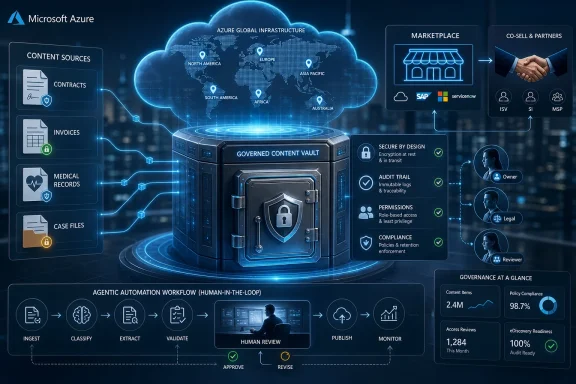
Azure cloud compliance graphic showing secured content vault, AI workflow automation, and regional governance.Hyland Moves Its Content Stack Closer to Azure’s Center of Gravity​

Hyland’s deal with Microsoft lands at a moment when “AI readiness” has become the new migration pitch. Enterprises are no longer asking only whether a workload can run in the cloud. They are asking whether their data, documents, workflows, and compliance controls can be made useful to AI systems without blowing up governance models in the process.
That is where Hyland wants Content Innovation Cloud to sit. The company’s core argument is that enterprise AI cannot operate responsibly on a diet of disconnected PDFs, scanned forms, case files, customer records, archived correspondence, and SharePoint sprawl. The value is in the content, but so is the risk.
By bringing the platform to Azure, Hyland is not merely adding another hosting venue. It is placing its content services inside the same commercial, infrastructure, and AI orbit many large organizations already use for Microsoft 365, Entra identity, Purview governance, Azure AI services, and line-of-business modernization. That matters because enterprise architecture decisions increasingly hinge on reducing the number of trust boundaries an organization has to defend.
The partnership also gives Hyland a stronger answer to a persistent buyer objection: where exactly will the data live, who controls it, and how does that square with local regulation? Azure’s regional footprint gives Hyland a broader map to point to when customers in healthcare, insurance, finance, education, and government ask for data residency options. Those conversations are no longer edge cases; they are the center of enterprise software procurement.

The AI Story Is Really a Content Governance Story​

The most revealing part of the announcement is not the phrase “agentic automation,” though it appears with the inevitability of the current market cycle. The revealing part is Hyland’s emphasis on governed content as the foundation for production AI. That is a more sober claim, and a more important one.
The industry has spent the past two years selling AI as a model problem. Choose the right model, tune the right prompt, connect the right copilots, and productivity will follow. But inside large organizations, the bottleneck is often far less glamorous: the AI system cannot see the right documents, cannot distinguish final from obsolete versions, cannot respect entitlements reliably, or cannot explain why it produced a recommendation based on a particular record.
Enterprise content management was once treated as a filing-cabinet discipline: capture, classify, retain, retrieve, archive. In the AI era, those old verbs become operational controls. A system that cannot determine whether a contract is current should not be drafting customer commitments. A claims assistant that cannot respect policyholder privacy should not be summarizing medical attachments. A government workflow bot that cannot preserve records rules is not a productivity tool; it is an audit finding waiting to happen.
Hyland’s opportunity is to reposition content management from back-office hygiene to AI enablement. That is a compelling repositioning, but it is not automatic. Customers will judge the Azure partnership by whether it makes governed content easier to use in actual workflows, not by whether it adds another logo slide to an AI deck.

Microsoft’s Marketplace Strategy Turns Procurement Into Platform Gravity​

The Microsoft Marketplace component may sound like a sales-channel detail, but it is strategically important. Enterprise software buying has become as much about procurement mechanics as product capability. If a customer can retire an internal purchasing process by buying through an existing Microsoft agreement, the path from evaluation to deployment can shorten dramatically.
That is the premise behind marketplace-led cloud selling. Microsoft wants its marketplace to function as a trusted catalog for cloud solutions, AI applications, and agent-oriented software. Vendors want access to customers who already have Azure commitments and procurement relationships. Customers want fewer supplier onboarding cycles, fewer contract exceptions, and a clearer way to apply cloud spend to business initiatives.
For Hyland, being available through Microsoft Marketplace can make the platform easier to buy for Azure-centric enterprises. That does not guarantee adoption, but it removes friction from the part of the process where many enterprise deals stall. The technical buyer may care about architecture; the business sponsor may care about AI outcomes; the procurement team cares about contract path, spend alignment, and risk review.
Microsoft’s co-sell machinery also matters. A formal go-to-market arrangement means Hyland is not just placing a product in a digital catalog and hoping customers find it. The companies are aligning around enterprise use cases where content governance, workflow automation, and AI deployment intersect. In practical terms, that gives Microsoft field teams another story to tell when customers ask how to operationalize AI beyond Microsoft 365 Copilot experiments.

Regulated Industries Are the Real Prize​

The announcement explicitly points toward sectors where content is both valuable and constrained: healthcare, insurance, financial services, education, and government. That focus is not incidental. These are the industries where AI demand is high, but the margin for governance failure is low.
Healthcare organizations sit on enormous volumes of clinical, administrative, billing, and imaging-related content. Insurers run on claims files, correspondence, policy documents, evidence packets, and regulatory records. Banks and public agencies face retention rules, jurisdictional restrictions, audit obligations, and strict access controls. In these environments, a generic AI assistant bolted onto a document store is not enough.
The harder problem is making AI context-aware without making it reckless. The system needs to know which documents matter, which versions are authoritative, which users are allowed to see which fragments, and how long records must be retained. Those are content services problems before they are AI problems.
Azure gives Hyland a stronger infrastructure story for those buyers. Microsoft’s cloud already has deep enterprise penetration and a compliance vocabulary familiar to regulated customers. Hyland brings domain-specific content management and workflow experience. The partnership is designed to make those two stories sound like one architecture rather than two vendors shaking hands in a press release.

Multicloud Remains the Escape Hatch Enterprises Still Demand​

Hyland is careful to frame the Microsoft deal as part of a broader multicloud strategy rather than an exclusive pivot. That nuance matters. Large enterprises may standardize heavily on Azure, but they rarely live in a single-cloud fantasy world. Acquisitions, legacy systems, regional constraints, risk management policies, and departmental purchasing all produce hybrid and multicloud realities.
The Azure expansion gives customers more choice, but it also tests Hyland’s ability to preserve portability. If Content Innovation Cloud becomes meaningfully better on Azure than elsewhere, some customers will welcome the optimization while others will worry about lock-in. If it remains too abstracted from Azure’s native services, Microsoft-centric customers may wonder whether the partnership changes enough.
That tension is unavoidable. Deep integration creates value, but it also creates dependency. Enterprise buyers know this, and many now evaluate cloud partnerships by asking what happens if business, regulatory, or cost pressures force a change later. Hyland’s public emphasis on supporting customers “wherever they are” is therefore not just marketing language; it is a defensive necessity.
For Microsoft, the calculation is simpler. Every serious software platform that moves closer to Azure helps reinforce Azure as the place where enterprise AI projects become operational. The company does not need every partner to be exclusive. It needs the default path of least resistance to run through its cloud.

Agentic Automation Needs Boring Infrastructure More Than Bigger Promises​

The phrase agentic automation is doing a lot of work in enterprise software right now. Vendors use it to describe AI-driven systems that can perform tasks, route work, trigger processes, and make decisions across applications with less human prompting. The concept is powerful, but the implementation depends on infrastructure that is decidedly unglamorous.
An agent that drafts a response, opens a case, retrieves a supporting document, updates a workflow, and notifies a user must operate inside a web of permissions and business rules. It must know when it has enough information and when it should escalate. It must leave a trace. It must not invent a record, ignore a retention rule, or surface confidential content to the wrong person.
That is why content governance is not a sidecar to agentic AI. It is one of the control planes. If enterprises are going to let AI systems act rather than merely answer, those systems need reliable access to the documents and metadata that define the business process. They also need the constraints that prevent action from becoming exposure.
Hyland’s pitch is that its platform can turn governed content into actionable intelligence. The phrase is polished, but the underlying need is real. Production AI will not be measured by demo quality; it will be measured by whether it can survive compliance review, user adoption, security scrutiny, and operational exceptions.

The WindowsForum Angle Is the Microsoft Cloud Flywheel​

For WindowsForum readers, the news matters less because Hyland itself is a household name and more because it reflects Microsoft’s broader enterprise strategy. Azure is increasingly the gravitational center for Microsoft’s partner ecosystem, while Microsoft Marketplace is becoming the commercial front door for third-party cloud and AI software. That is a familiar pattern: Microsoft wins not only by building the platform, but by making the platform the easiest place to buy, deploy, govern, and justify adjacent software.
This has practical consequences for sysadmins and IT decision-makers. A Hyland-on-Azure deployment may reduce some integration friction in Microsoft-heavy environments, particularly where identity, security review, cloud procurement, and data residency policies already revolve around Microsoft tooling. It may also shift more content workloads into the same administrative orbit as other Azure services, changing how teams think about monitoring, access control, cost allocation, and incident response.
But convenience should not be mistaken for simplicity. Content platforms are sticky, deeply embedded systems. They touch records schedules, business processes, departmental habits, custom integrations, and compliance workflows. Moving or expanding them into Azure may be strategically attractive, but it still requires careful architecture and governance.
The most successful deployments will likely be those that treat the partnership as an opportunity to clean up content strategy, not merely rehost it. AI tends to expose organizational disorder. If the underlying document estate is duplicative, poorly classified, and inconsistently permissioned, putting it near Azure AI services does not magically make it trustworthy.

The Deal Makes Sense Because Both Sides Need the Same Missing Piece​

Hyland needs scale, cloud relevance, and a stronger AI-era narrative. Microsoft needs partners that make Azure more useful for industry-specific, content-heavy workflows. The overlap is obvious: enterprises want AI, but they need it grounded in the information that actually runs the business.
The partnership also reflects a maturing AI market. In 2023 and 2024, many enterprise AI conversations were exploratory: pilots, proofs of concept, internal chatbots, and productivity experiments. By 2026, the pressure has shifted toward operational use, where executives expect measurable workflow impact and risk teams expect enforceable controls.
That shift favors vendors with credible governance stories. It also favors cloud platforms that can offer infrastructure, AI services, security tooling, commercial channels, and partner ecosystems as a bundle. Microsoft has been building precisely that bundle. Hyland is now trying to make sure its content layer is part of it.
The open question is execution. Partnerships are easy to announce and difficult to operationalize. Customers will want to see how deployment works across regions, how marketplace purchasing maps to existing agreements, how deeply Hyland integrates with Microsoft identity and AI services, and how the combined stack handles real-world governance edge cases.

The Practical Reading for Azure-Centric IT Teams​

This announcement should not send every Hyland customer rushing to redraw architecture diagrams overnight. It should, however, prompt a more serious conversation about where enterprise content platforms sit in AI roadmaps. If AI strategy is being led entirely by application teams or data science groups, the organization may be overlooking the content layer that determines whether AI can safely act on business knowledge.
For Azure-centric shops, the immediate appeal is alignment. A content platform available through Azure and Microsoft Marketplace can fit more naturally into existing cloud governance and procurement models. That may be especially valuable for organizations already standardizing identity, security posture management, and compliance reporting around Microsoft tools.
For non-Azure or mixed-cloud organizations, the calculus is more nuanced. Hyland’s multicloud framing suggests customers should not read the deal as a forced migration signal. But over time, the richest integrations and most aggressive co-sell incentives may cluster where Microsoft sees strategic value. That is how platform ecosystems usually behave.
The best response is neither enthusiasm nor suspicion. It is due diligence. IT leaders should ask which workloads benefit from Azure deployment, which data residency requirements become easier to satisfy, which integrations improve, which costs shift, and which operational responsibilities remain unchanged.

Azure Gets Another Content On-Ramp, and Buyers Get Homework​

The Hyland-Microsoft partnership is best understood as a content-governance play dressed in cloud expansion clothing. It gives Hyland more Azure reach, gives Microsoft another regulated-industry partner story, and gives customers another route to bring enterprise documents closer to AI-enabled workflows.
  • Hyland Content Innovation Cloud is being made available on Microsoft Azure, expanding deployment options for customers with regional and data residency requirements.
  • The companies are pairing the technical partnership with joint go-to-market and co-sell activity aimed at enterprise AI and workflow use cases.
  • Microsoft Marketplace availability may simplify procurement for organizations that already buy cloud software through Microsoft agreements.
  • The strongest fit is likely in regulated industries where unstructured content, compliance, and workflow automation are tightly connected.
  • The partnership expands Hyland’s cloud options without being presented as an exclusive move away from multicloud deployment.
  • The real test will be whether customers can use governed content in production AI systems without weakening security, compliance, or operational control.
The larger lesson is that enterprise AI is becoming less about spectacle and more about plumbing. Hyland and Microsoft are betting that the companies ready to move beyond pilots will need governed content, regional deployment flexibility, marketplace procurement, and AI infrastructure to work as one system. If that bet is right, the winners in the next phase of cloud AI will not be the vendors with the loudest demos, but the ones that make old business content safe enough, accessible enough, and useful enough for machines to act on it.

References​

  1. Primary source: ChannelLife UK
    Published: Mon, 01 Jun 2026 13:06:00 GMT
  2. Official source: learn.microsoft.com
  3. Official source: blogs.microsoft.com
  4. Related coverage: hyland.com
  5. Related coverage: prnewswire.com
  6. Official source: azure-int.microsoft.com
  1. Official source: marketplace.microsoft.com
  2. Official source: techcommunity.microsoft.com
  3. Official source: partner.microsoft.com
 

Hyland announced on June 1, 2026, that it is partnering with Microsoft to bring the Hyland Content Innovation Cloud to Microsoft Azure, expand availability through Microsoft Marketplace, and create a joint go-to-market motion for enterprise content and AI deployments. The move is not merely another cloud listing in a crowded marketplace. It is a bet that the next phase of enterprise AI will be won less by model choice than by control over the documents, records, workflows, and permissions that decide whether those models can be trusted in production. For WindowsForum readers, the interesting part is not the branding around “agentic” work; it is how deeply the Microsoft cloud is becoming the default procurement, deployment, and governance layer for enterprise software that used to sit closer to the line-of-business stack.

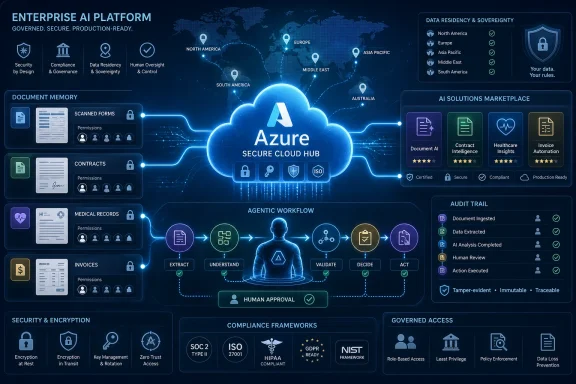
Enterprise AI platform dashboard showing Azure secure cloud hub, document workflows, governance, and audit trail.Microsoft’s AI Platform Needs Governed Content, Not Just Bigger Models​

The enterprise AI story has spent two years talking as if the bottleneck were raw intelligence. Bigger models, longer context windows, better copilots, and faster inference have dominated the conversation. But inside large organizations, the problem is often more mundane and more stubborn: the business knows where the answers are, but those answers live in unstructured content spread across document stores, records systems, case files, emails, scanned forms, images, legacy ECM repositories, and workflow platforms.
Hyland’s pitch to Microsoft’s Azure base lands squarely in that gap. The company is not claiming to be the model provider of record. It is arguing that AI systems need a governed content foundation before they can safely automate work that touches regulated data, customer files, clinical records, claims, student records, public-sector documents, or financial workflows.
That is a less glamorous position than building the AI assistant everyone sees on screen, but it may be the more durable one. Enterprises can experiment with a chatbot in a sandbox using a sanitized knowledge base. They cannot let an agent approve a claim, route a medical record, summarize a legal packet, or trigger a government workflow unless the underlying content is current, permission-aware, auditable, and stored in the right jurisdiction.
This is where the Microsoft angle matters. Azure is not simply compute capacity in this deal; it is the cloud substrate many enterprises already use for identity, security policy, compliance tooling, procurement, data residency planning, and AI infrastructure. By bringing the Content Innovation Cloud onto Azure, Hyland is trying to meet customers where their architects, finance teams, and compliance officers already have leverage.

Hyland Is Selling the Boring Part of AI Because the Boring Part Is Where Production Breaks​

The announcement’s language leans hard into “agentic automation,” “actionable intelligence,” and production-scale AI. That vocabulary is now unavoidable in enterprise software, and some skepticism is healthy. But beneath the marketing layer is a real operational problem: most organizations do not fail at AI because they cannot call an API; they fail because they cannot reliably connect AI to the business context that makes an answer useful.
Content management has always been the unglamorous infrastructure of enterprise work. It stores the intake forms, invoices, claims packets, medical images, correspondence, approval chains, retention rules, and audit trails that keep companies and agencies functioning. In the AI era, those systems become even more important because they hold the raw material that agents are expected to reason over.
That changes the value of old ECM assets. A scanned document repository that once looked like a compliance burden may become part of the context layer for a workflow agent. A records policy that once existed to satisfy auditors may become a control boundary for what AI can retrieve, summarize, or act upon. A metadata model that once looked like administrative overhead may become the difference between a useful answer and a hallucinated one.
Hyland’s advantage, if it can execute, is that it already speaks the language of document-heavy industries. Healthcare, insurance, financial services, education, and government are not waiting for AI because they lack enthusiasm. They are moving cautiously because errors are expensive, privacy rules are real, and data sovereignty cannot be waved away with a demo.

Azure Turns a Content Platform Into a Regional Deployment Argument​

The strongest part of the Microsoft partnership is not that Hyland will run on another hyperscaler. It is that Azure gives Hyland a bigger regional and compliance story at exactly the moment customers are demanding more precise control over where data lives and how it is processed.
Data residency used to be a procurement checkbox. In the AI era, it becomes a design constraint. If an organization uses AI to process business content, it must understand not only where the stored files reside, but also where indexing, enrichment, model calls, embeddings, workflow actions, logs, and derived outputs are created and retained.
That is especially important outside the United States, but it is not only an international issue. Public-sector agencies, healthcare systems, insurers, banks, and universities increasingly want deployment patterns that match local law, contractual commitments, and internal risk policy. The ability to say “we can deploy this content platform in Azure regions that align with your geography and governance model” is therefore more than a technical feature. It is a sales accelerator.
For Microsoft, this reinforces Azure’s role as the enterprise landing zone for regulated AI workloads. The company has spent years positioning Azure as the place where customers can combine cloud infrastructure, identity, security, compliance, and AI services. Hyland gives Microsoft another industry-specific content layer to attach to that proposition.
For Hyland, Azure access lowers a familiar enterprise barrier. A CIO or chief data officer may not want to introduce another isolated cloud relationship just to modernize content services. But if the deployment can ride on an existing Azure architecture, existing security practices, and existing Microsoft commercial commitments, the internal argument becomes easier.

Marketplace Is the Procurement Story Hiding in Plain Sight​

The Microsoft Marketplace piece deserves more attention than it usually gets. Enterprise software partnerships often lead with technology integration and bury procurement in the final paragraph. In practice, procurement can be the difference between a promising platform and a stalled pilot.
Making Hyland products available through Microsoft Marketplace gives customers a route to buy using commercial machinery they may already have in place. That can matter for organizations with Azure consumption commitments, standardized vendor review processes, or cloud procurement governance that strongly favors marketplace transactions over bespoke contracting.
This is one reason cloud marketplaces have become strategic assets for the hyperscalers. They are not just app stores. They are procurement channels, partner ecosystems, and consumption engines. If a customer can apply existing cloud spend commitments to a third-party solution, the sales conversation changes from “approve a new vendor and a new budget line” to “allocate existing cloud commitment toward a workload we already need.”
That is good for Microsoft because it makes Azure stickier. It is good for Hyland because it reduces friction. It is good for customers only if the marketplace route does not obscure the hard questions: data architecture, long-term cost, contractual lock-in, regional availability, support boundaries, and whether the product’s Azure deployment has feature parity with other cloud options.
The procurement shortcut is useful, but it is not a substitute for architecture review. IT teams should treat marketplace availability as a way to simplify buying, not as proof that a deployment is automatically aligned with internal policy.

The Multicloud Message Is a Necessary Hedge​

Hyland is careful to frame the Microsoft deal as an expansion of cloud choice rather than a single-cloud conversion. That caveat matters. Many of Hyland’s customers are large, slow-moving, and heterogeneous by design. They may run Microsoft 365, Azure, AWS workloads, legacy on-premises systems, private cloud infrastructure, and industry-specific applications that are not moving anywhere quickly.
A clean “all-in on Azure” story would be attractive to Microsoft but less credible to customers who already live in fragmented environments. Content platforms often sit across departmental and historical boundaries. One part of the organization may be modernizing aggressively while another still depends on legacy repositories or regulated archives that cannot be moved without a multi-year program.
The multicloud language is therefore not just diplomatic. It reflects how enterprise content actually behaves. Documents and records accumulate over decades. They are embedded in workflows, retention schedules, integrations, and user habits. Even when the strategic direction is cloud-first, the operational reality is hybrid for a long time.
That is why Hyland’s Azure move should be read as additive rather than exclusive. The company gains a stronger Microsoft path without abandoning customers who need other deployment models. Microsoft gains a partner whose customers may be easier to pull toward Azure-adjacent modernization without forcing a disruptive migration on day one.

The Windows Angle Is Identity, Governance, and the Microsoft Gravity Well​

For WindowsForum readers, the immediate connection is not the Windows desktop. It is the Microsoft enterprise stack that surrounds it: Entra ID, Microsoft 365, SharePoint, Teams, Purview, Defender, Azure, Power Platform, and the broader set of services that now define many Windows-centric organizations.
The more enterprise software lands on Azure and sells through Microsoft Marketplace, the more Microsoft becomes the control plane for organizational technology decisions. That has real advantages. Identity integration can become cleaner. Security policy can become more consistent. Procurement can become faster. Admins can standardize monitoring, access, and compliance processes around a smaller number of platforms.
But there is also a gravitational cost. Once content platforms, AI tools, workflow engines, and procurement commitments converge around Azure, switching paths becomes harder. The decision to deploy one content platform through Microsoft’s ecosystem may be perfectly rational. The cumulative effect of dozens of similar decisions is a deeper dependency on Microsoft’s commercial and technical roadmap.
That is not inherently bad. Microsoft has earned enterprise trust in many areas, and Azure’s global footprint is a serious asset. But IT leaders should name the trade-off plainly. Azure alignment can reduce operational complexity while increasing strategic dependency.
This is especially relevant for organizations that want to keep AI governance portable. If an enterprise’s document intelligence, content services, identity policy, marketplace billing, and agent workflows all become tightly coupled to one hyperscaler, it may gain speed but lose negotiating flexibility. The question is not whether Azure is capable. The question is how much optionality the organization wants to preserve.

“Agentic Automation” Is the New Wrapper Around Old Workflow Ambitions​

The term “agentic” is now doing a lot of work in enterprise announcements. It implies that AI systems will not merely answer questions but take actions, coordinate tasks, and drive workflows with some degree of autonomy. In Hyland’s framing, the governed content layer is what lets those agents operate with confidence.
That is a sensible thesis, but it should be handled carefully. Many of the workflows now being rebranded as agentic automation have existed for years in less fashionable form: document capture, classification, routing, extraction, exception handling, approval chains, case management, and robotic process automation. AI can improve these workflows, but it does not repeal the need for process design.
The risk is that organizations hear “agent” and imagine a general-purpose digital employee. The more realistic near-term value is narrower and more useful. An agent might classify incoming documents, summarize a case file, detect missing information, recommend a next action, or draft a response for human review. Those are meaningful improvements, especially at scale, but they still require controls.
Hyland’s content governance pitch is relevant precisely because agentic systems are dangerous when detached from policy. A workflow agent that cannot distinguish between draft and approved content is a liability. An AI assistant that retrieves records a user should not see is a security incident waiting to happen. A summarization system that ignores retention or jurisdictional rules can create compliance exposure even if its language sounds plausible.
The practical question for customers is not whether Hyland and Microsoft can say “agentic” convincingly. It is whether the resulting platform can enforce permissions, preserve auditability, expose data lineage, support human review, and operate within the regions and regulations that govern the customer’s business.

The Deal Shows How Microsoft Wins Without Owning Every Layer​

Microsoft does not need to build every vertical application or content platform to benefit from the AI infrastructure boom. It needs partners to make Azure the natural place where those applications run, transact, and integrate. Hyland’s announcement is a textbook example of that strategy.
By bringing a regulated-content specialist into the Azure ecosystem, Microsoft expands the set of enterprise workloads that can be tied to its cloud and AI platform. The value is not limited to compute consumption. Marketplace transactions, co-sell motions, identity integration, security alignment, and AI service adjacency all reinforce Azure’s position in the account.
This is why the joint go-to-market language matters. A co-sell arrangement can put Hyland into conversations where Microsoft account teams are already discussing AI modernization, cloud migration, data governance, or industry transformation. That gives Hyland reach it would be expensive to build alone and gives Microsoft a more complete answer when customers ask how to operationalize AI against regulated content.
The result is an ecosystem flywheel. Microsoft attracts partners because enterprises already buy Azure. Partners attract customers because Microsoft can simplify procurement and deployment. Customers deepen Azure consumption because more of their business applications become available there. The technical partnership is only one part of the loop; the commercial machinery may be just as important.

Customers Should Ask Hard Questions Before the AI Gloss Takes Over​

The announcement is directionally important, but it does not answer every implementation question. That is normal for a partnership launch, especially one tied to a broader platform and marketplace motion. Still, IT teams should avoid treating strategic alignment as a substitute for due diligence.
The first question is availability. Customers should confirm which Hyland products and services are available on Azure, in which regions, under what deployment model, and with what feature parity compared with other Hyland cloud offerings. “Available through Azure” can mean several different things depending on architecture, hosting, integration, support, and commercial packaging.
The second question is data flow. In AI-enabled content systems, the storage location is only one piece of the puzzle. Teams should map how content is indexed, processed, embedded, summarized, logged, retained, and exposed to workflow agents. They should also understand whether Microsoft AI services, Hyland services, or third-party components are involved at each stage.
The third question is governance. If the platform is meant to support regulated industries, customers need evidence around access control, audit trails, encryption, retention, eDiscovery, data residency, disaster recovery, and administrative separation of duties. The best AI demo in the world will not survive a compliance review if the control model is vague.
The fourth question is operational fit. Many Hyland customers have complex existing deployments. Migration strategy, coexistence with on-premises repositories, integration with Microsoft 365 and SharePoint, identity federation, backup strategy, and admin tooling will decide whether the Azure option accelerates modernization or simply adds another cloud layer to manage.

The Real Contest Is Over the Enterprise Content Memory​

Every major enterprise software company now wants to become the interface through which employees interact with business knowledge. Microsoft has Copilot across Microsoft 365 and Windows-adjacent workflows. Salesforce wants business context through CRM. ServiceNow wants it through work management. OpenAI, Google, AWS, Oracle, SAP, and a long list of vertical vendors are all chasing their own version of the same prize.
Hyland’s angle is that the enterprise memory is not just chat history, email, or CRM fields. It is the body of governed content that records what the organization has done and what it is allowed to do next. That is a powerful position if customers accept it.
Content is messy, but it is also sticky. Once a platform becomes responsible for the records that drive clinical, financial, legal, educational, or public-sector decisions, it becomes difficult to displace. If AI makes those records more valuable by turning them into operational intelligence, the content platform’s strategic importance rises.
This is why the partnership is bigger than a deployment announcement. It reflects a broader market shift from AI as a standalone application to AI as an embedded capability inside governed systems of work. The companies that control those systems will shape what enterprise AI can actually do.

The Useful Reading for IT Teams Is Hidden Beneath the Partnership Language​

Hyland’s Azure expansion is a meaningful signal for organizations that already depend on Microsoft’s cloud, but it should be read as a starting point rather than a finished answer.
  • Hyland is bringing the Content Innovation Cloud to Microsoft Azure as part of a partnership announced on June 1, 2026.
  • The arrangement includes Microsoft Marketplace availability and a joint go-to-market motion intended to make enterprise procurement and sales alignment easier.
  • The strongest customer argument is not generic AI acceleration, but governed access to unstructured content in regulated industries.
  • Azure gives Hyland a broader regional deployment and data residency story, especially for customers with sovereignty and compliance constraints.
  • The deal expands Hyland’s cloud options rather than replacing its multicloud positioning.
  • IT leaders should validate architecture, data flows, regional availability, governance controls, and commercial terms before treating marketplace availability as deployment readiness.
The larger lesson is that enterprise AI is becoming less about who can produce the flashiest assistant and more about who can safely connect automation to the content that runs the business. Hyland’s Microsoft partnership gives Azure another piece of that production puzzle, and it gives Hyland a stronger route into organizations already committed to Microsoft’s cloud. If the next wave of AI adoption is judged by workflows that survive audits, cross borders legally, and make decisions from trusted records, then the quiet infrastructure of content management may matter more than the loudest model launch.

References​

  1. Primary source: ChannelLife Australia
    Published: Mon, 01 Jun 2026 13:06:00 GMT
  2. Related coverage: hyland.com
  3. Related coverage: prnewswire.com
  4. Official source: blogs.microsoft.com
  5. Official source: azure-int.microsoft.com
  6. Official source: marketplace.microsoft.com
 

Hyland announced on June 1, 2026, that it is partnering with Microsoft to bring the Hyland Content Innovation Cloud to Microsoft Azure, making its enterprise content platform available through Azure regions, Microsoft Marketplace, and Microsoft’s co-sell motion. The announcement is not simply another cloud availability note dressed up with AI language. It is a signal that the next enterprise AI contest is moving away from model demos and toward the duller, harder machinery of governed content, procurement channels, data residency, and workflow control. For WindowsForum readers, the interesting part is not that Hyland has found another hyperscaler route; it is that Microsoft’s cloud ecosystem keeps absorbing the systems of record that enterprises need before Copilot-style automation can become operational reality.

Microsoft Azure cloud governance diagram with secure content vault, audit trail, and workflow pipeline.Microsoft’s AI Ambition Needs Somebody Else’s Filing Cabinets​

The last two years of enterprise AI have been sold as a model story. Bigger models, cheaper tokens, richer copilots, smarter agents: the industry’s marketing departments have trained customers to look upward, toward the foundation model layer, as if that is where the entire transformation will be decided. But inside most large organizations, the blockage is usually lower down and far less glamorous.
The documents are scattered. The permissions are uneven. The metadata is unreliable. The workflows exist partly in content management systems, partly in email, partly in line-of-business applications, and partly in the institutional memory of employees who know which spreadsheet actually matters.
That is where Hyland’s Microsoft deal earns its relevance. Hyland is not trying to compete with Azure as a cloud platform or with Microsoft as an AI infrastructure vendor. It is positioning its Content Innovation Cloud as a governed content layer that can make enterprise information usable by automated systems without pretending that decades of records management, case files, forms, images, contracts, and departmental repositories can simply be thrown into a vector database and blessed as digital transformation.
Microsoft, for its part, benefits from having more of that messy enterprise substrate adjacent to Azure. The company already has the operating system footprint, the productivity suite, the identity layer, the developer platform, and a widening set of AI services. What it does not automatically have is clean, permission-aware, industry-specific access to every customer’s high-value content estate. Partnerships like this are how Microsoft widens the aperture without building or buying every vertical content platform itself.
The result is an alliance that sounds predictable on the surface and strategic underneath. Hyland gets Azure reach, marketplace access, and Microsoft sales gravity. Microsoft gets another reason for regulated enterprises to treat Azure as the place where their content, AI, and workflow plans converge.

The Cloud Region Is Now a Product Feature​

The old enterprise software pitch was about functionality. The cloud pitch added elasticity, managed operations, and subscription economics. The AI pitch now adds a new requirement: where the data lives, where it is processed, and whether the organization can prove that both choices satisfy internal and external rules.
That makes Azure availability more than a hosting detail. Hyland is explicitly framing the Microsoft partnership around regional reach, data residency options, and the ability to support customers across cloud environments. That language matters because the customers most likely to care about Hyland’s platform are not startups free to chase the cheapest GPU region. They are hospitals, insurers, banks, public agencies, universities, and large enterprises whose records are entangled with statutes, retention schedules, audit trails, and sovereignty expectations.
For those buyers, “cloud” has never meant “anywhere.” It means a set of acceptable places, controls, and contractual assurances. A platform that can run in more Azure geographies gives procurement and compliance teams more room to say yes, especially when the alternative is a custom exception process or a stalled AI pilot that cannot cross the line into production.
The practical significance is easy to underestimate. An AI proof of concept can run on sanitized data in a friendly region and produce a convincing demo. A production deployment has to ingest real documents, honor real permissions, survive audits, and fit a disaster recovery plan. It has to answer whether patient records, loan files, claims correspondence, student documents, or government case material can be stored and processed in a specific jurisdiction.
Hyland’s bet is that customers will not separate those questions from AI adoption. In that reading, Azure is not merely compute capacity. It is a compliance and operations envelope that makes the content layer easier to buy.

Marketplace Is the Quiet Weapon in the Deal​

The Microsoft Marketplace angle may turn out to be as important as the technical integration. Enterprise software buyers do not only choose products; they choose purchasing paths. If a vendor can be bought through an existing Microsoft commercial agreement, the friction drops, the budget conversation changes, and the sales cycle can shorten.
That is especially true when customers have committed cloud spend with Microsoft. Marketplace procurement can let organizations apply existing cloud commitments to third-party software purchases, which gives a Hyland deal a different internal shape than a standalone vendor contract. For a CIO, procurement officer, or enterprise architect trying to consolidate cloud spending, that matters.
It also aligns Hyland with Microsoft’s partner machinery. Co-sell is not just a press-release phrase. It means Microsoft account teams can have a reason to bring Hyland into conversations where the customer’s AI ambition is blocked by content sprawl, document-heavy workflows, or governance requirements. For Hyland, that is access to a sales channel few independent enterprise software companies can reproduce on their own.
For Microsoft, marketplace expansion has a cumulative effect. The more serious industry software that becomes purchasable and deployable through Microsoft’s commercial ecosystem, the more Azure looks less like an infrastructure choice and more like the default enterprise procurement rail. That is a powerful form of lock-in because it is procedural rather than purely technical.
This is where administrators should pay attention. A marketplace purchase may be easier to approve, but it also tightens the relationship between cloud commitments, identity decisions, security controls, and vendor governance. The convenience is real. So is the need for disciplined tenant management, permissions review, cost allocation, and lifecycle oversight.

Hyland Is Selling Governance as the Missing AI Layer​

Hyland’s public language around the deal leans hard into “agentic” work. That term is already at risk of becoming another enterprise AI buzzword, stretched to cover everything from scripted automation to semi-autonomous assistants. But underneath the branding is a real architectural point: agents are only useful in business workflows if they can act on trusted context.
That context is usually buried in unstructured content. Contracts, invoices, claims packets, medical documents, transcripts, HR forms, engineering files, case notes, scanned records, and emails often contain the facts that determine what a business process should do next. Traditional systems of record hold structured data, but the reasoning trail often lives in documents.
Hyland’s Content Innovation Cloud is pitched as a way to connect, govern, enrich, and automate around that content. The company has been expanding the platform with content federation, intelligent document processing, workflow automation, and AI-oriented context services. The Microsoft partnership gives that strategy a larger cloud stage.
The key phrase from Hyland’s side is “governed content.” It is doing a lot of work. In enterprise AI, governance is not a decorative compliance layer added after a system starts producing output. It is the difference between an assistant that can summarize a brochure and an automation system that can move a claim, a permit, a loan, or a patient record through a process without violating policy.
That is why document management vendors suddenly sound more strategically relevant than they did during the first wave of generative AI hype. The industry spent 2023 and 2024 asking what models could generate. The harder 2026 question is what systems can safely do with the information an organization already owns.

Regulated Industries Are the Real Test Case​

The partnership’s stated targets include healthcare, insurance, financial services, education, and government. That is not accidental. These sectors have large volumes of content, strict rules about handling it, and workflow bottlenecks that AI vendors love to cite in demos.
They are also the sectors least likely to accept vague answers about training data, residency, access control, retention, or auditability. A hospital cannot treat clinical documentation as generic enterprise text. An insurer cannot let an automated workflow mishandle claims evidence. A public agency cannot make sensitive records globally fluid just because a cloud service is technically capable of moving them.
This is where Azure’s regional footprint and Microsoft’s enterprise compliance posture become part of Hyland’s value proposition. The content platform still has to prove itself on implementation details, but Azure gives it a recognizable operating environment for customers already standardized on Microsoft identity, security, management, and procurement tools.
For Windows-heavy organizations, the fit is obvious. Microsoft Entra ID, Microsoft 365, SharePoint, Teams, Purview, Defender, and Azure services are already embedded in many enterprise estates. A content platform that can sit more naturally in that orbit has a better chance of becoming part of production architecture rather than another isolated AI experiment.
Still, there is a caution buried in the promise. Regulated industries do not need more disconnected AI pilots. They need fewer systems that create new governance blind spots. The success of this partnership will depend less on whether Hyland and Microsoft can describe agent-driven workflows and more on whether customers can map those workflows to existing controls without inventing a parallel compliance universe.

Multicloud Survives, But Azure Gains the Center of Gravity​

Hyland is careful to frame the Microsoft agreement as an expansion of cloud options, not an exclusive turn toward Azure. That distinction is important. Enterprise software vendors know that the biggest customers rarely want a single-cloud ultimatum, especially when geography, acquisitions, legacy deployments, and regulatory constraints create mixed environments.
But “multicloud” often means different things depending on who is speaking. To a CIO, it can mean avoiding concentration risk. To an application vendor, it can mean supporting enough deployment models to keep sales conversations alive. To a hyperscaler, it can mean allowing the customer to bring other systems into its orbit while keeping the strategic control plane close.
In this case, Azure clearly gains weight. Hyland’s software being available through Azure, connected to Microsoft’s marketplace and co-sell channels, gives Microsoft a stronger hand in accounts where content governance and AI deployment are becoming linked. Even if Hyland continues to support broader cloud strategies, the Microsoft route now has commercial and operational advantages that customers will notice.
That does not make the partnership hostile to multicloud. In fact, it may make multicloud more practical for some organizations by giving them a governed content platform with wider deployment choice. But it does make Azure harder to ignore when AI plans intersect with enterprise content.
The question for IT leaders is whether this centralization simplifies architecture or quietly narrows future choices. Azure-native convenience can be a gift when teams are under pressure to deliver. It can also become a long-term dependency if content workflows, AI services, identity assumptions, and procurement incentives all converge in one vendor’s ecosystem.

The Windows Angle Is Bigger Than Windows​

At first glance, this is a cloud software story rather than a Windows story. But for WindowsForum’s audience, the connection is not hard to find. Microsoft’s enterprise strategy increasingly treats Windows, Microsoft 365, Azure, Entra, Defender, Purview, Power Platform, and Copilot as pieces of a single operating environment for work.
The desktop is no longer the boundary of Microsoft’s influence. It is one endpoint in a broader system where identity, policy, content, security telemetry, and automation travel across cloud services. When a vendor like Hyland moves closer to Azure, it strengthens that system because more enterprise content can participate in Microsoft-centered workflows.
That matters for administrators who live with the consequences. A user may experience AI as a button in a productivity app, but IT has to answer where the underlying documents came from, whether the user had rights to them, whether the retention label followed, whether the action was logged, and whether the result can be explained later. Those are not model questions. They are platform questions.
Hyland’s role is to bring business content management and workflow automation into that discussion. Microsoft’s role is to provide the cloud, identity, AI, marketplace, and sales structure around it. Together, they are making the case that enterprise AI becomes real only when it is attached to managed content and operational process.
This is also why Windows administrators should resist treating AI strategy as someone else’s problem. The same directory groups, conditional access policies, endpoint controls, information protection labels, and audit expectations that shaped the Microsoft stack before generative AI will shape it afterward. The tooling changes, but the governance burden does not disappear.

Agentic Automation Is a Sales Pitch Until It Meets Change Control​

The phrase “agentic automation” is everywhere now because it promises a step beyond dashboards and chatbots. Instead of asking a model a question, the enterprise wants systems that can take action: classify a document, route an exception, assemble a case file, trigger a workflow, escalate a risk, or prepare a decision for human review.
That is a compelling vision. It is also exactly where enterprise IT tends to become conservative, and for good reason. Automation that reads content is useful; automation that acts on content can create liability if the rules, permissions, and failure modes are not well understood.
Hyland and Microsoft are pitching the partnership as a way to move AI from pilots into day-to-day workflows. The phrase is right, but the operational path is steep. Production AI in content-heavy environments requires testing, policy mapping, integration with existing records systems, monitoring, exception handling, and user training. It also requires sober decisions about where humans remain in the loop.
That last point is often softened in vendor language. “Agentic” suggests autonomy, but most regulated enterprises will begin with constrained automation rather than open-ended agents. The more sensitive the workflow, the more likely the first deployments will be assistive, supervised, and narrowly scoped.
This is not a failure of the technology. It is how durable enterprise systems are introduced. The organizations that benefit most will be the ones that treat agents not as magic employees but as software components that need permissions, logs, rollback paths, and accountability.

The Content Wars Are Becoming the AI Wars​

There is a broader market pattern here. The first AI infrastructure wave rewarded companies with models, GPUs, cloud capacity, and developer platforms. The next wave will reward companies that control the business context those models need. That context lives in content systems, collaboration platforms, data warehouses, CRM systems, ERP platforms, ticketing queues, and vertical applications.
Microsoft already has a formidable position in collaboration and productivity content through Microsoft 365. But the enterprise content universe is larger and stranger than SharePoint and OneDrive. Hyland’s installed base and product portfolio reach into specialized document and process environments that Microsoft cannot simply assume are native to its stack.
By bringing Hyland’s Content Innovation Cloud to Azure, Microsoft is effectively expanding the set of enterprise content that can be made AI-adjacent without demanding an immediate rip-and-replace migration. Hyland’s federation-oriented messaging is important here. Customers do not want to move every repository before they can start extracting value from content.
That is also why the partnership speaks to unstructured data so directly. AI vendors often describe unstructured data as an untapped gold mine, but unstructured content is not valuable merely because it exists. It becomes valuable when it is connected to permissions, business meaning, process state, and governance rules.
The winners in this market will not be the vendors that can ingest the most files in a demo. They will be the vendors that can preserve the enterprise meaning of those files while making them useful to automation. Hyland is arguing that this is its home turf. Microsoft is giving that argument a larger cloud venue.

Procurement May Decide the Pace More Than Technology​

One of the less glamorous truths of enterprise IT is that technology is often ready before the organization is ready to buy it. Marketplace availability is designed to attack that problem. It gives vendors a way to meet customers inside purchasing structures they already use, and it gives customers a way to consolidate spend through familiar agreements.
For Hyland, Microsoft Marketplace can reduce the overhead of selling into large accounts, particularly those already deep into Azure commitments. For customers, it may simplify legal review, billing, and budget application. For Microsoft, it increases the amount of third-party software gravity flowing through its commercial platform.
This creates a feedback loop. If a customer can buy Hyland through Microsoft, deploy it on Azure, integrate it with Microsoft identity and AI services, and justify it as part of an enterprise AI modernization effort, the deal becomes easier to package. That ease does not guarantee success, but it can accelerate adoption.
The danger is that procurement simplicity can obscure architectural complexity. Buying through Marketplace does not automatically solve data classification, tenant design, identity boundaries, integration debt, or records retention. It just makes the purchase easier. The work still lands on enterprise architects, security teams, records managers, and application owners.
That is why this announcement should be read as an opportunity, not a shortcut. The commercial route may be smoother. The implementation still deserves the same skepticism IT pros apply to any platform that touches sensitive business content.

The AI Readiness Problem Finally Gets a Business Owner​

A recurring problem in enterprise AI is that everyone agrees the organization needs better data, but no one owns the ugly middle layer between raw information and usable intelligence. Data teams own warehouses and lakes. Security teams own controls. Legal owns risk. Business units own process. IT owns platforms. Records teams own retention. The AI team, if it exists, owns the demo.
Content management vendors are trying to step into that gap. Hyland’s message is that AI readiness depends on making enterprise content governed, connected, enriched, and actionable. That is a more grounded claim than the idea that a general-purpose assistant can simply hover over the organization and understand it.
The Microsoft partnership strengthens that claim because it places the content readiness layer inside a cloud ecosystem that many enterprises already trust. If Hyland can connect content repositories, apply governance, enrich context, and enable workflow automation on Azure, it becomes easier for customers to assign ownership to a platform rather than a loose committee.
But ownership will still be contested. Business units will want speed. Compliance teams will want proof. Security teams will want containment. Users will want convenience. Vendors will want expansion. The hard part is not getting everyone to agree that AI-ready content is good; it is getting them to agree on the operating model.
That is the hidden enterprise work behind the announcement. Bringing Hyland to Azure may solve some deployment and procurement constraints. It does not automatically solve organizational fragmentation. In many companies, that will remain the hardest migration.

The Real Win Is Less AI Theater and More Boring Control​

The industry’s AI narrative has been inflated by demos that make hard problems look like interface problems. Ask a question, get an answer. Upload a document, receive a summary. Tell an agent what you want, watch it go. Enterprise reality is not so clean.
Hyland and Microsoft are selling a more plausible version of the future, even if they are using the same fashionable vocabulary as everyone else. The premise is that automation at scale requires governed content, regional deployment options, procurement alignment, and integration with everyday workflows. That is less cinematic than a chatbot, but it is much closer to how enterprises actually change.
The value for customers will depend on execution. If the partnership produces a clean Azure deployment path, meaningful marketplace availability, strong identity and governance integration, and practical patterns for regulated industries, it could help organizations move AI projects out of the lab. If it becomes mostly co-branded positioning, customers will still be left stitching together content, permissions, and workflows themselves.
Microsoft has every incentive to make the former happen. Azure’s competition with AWS and Google Cloud is no longer just about infrastructure services. It is about becoming the place where enterprise AI becomes operational. That requires partners with domain-specific systems and content expertise.
Hyland has every incentive as well. Enterprise content management is being redefined by AI, and legacy document storage is not a growth story by itself. By leaning into governed content, agentic workflows, and Azure reach, Hyland is trying to make itself part of the AI operating layer rather than a repository vendor defending old territory.

The Azure Deal Gives Hyland’s AI Story a Distribution Engine​

Hyland’s announcement arrives alongside a broader push around its Content Innovation Cloud, including agentic automation, enterprise context, and content federation messaging. That timing is important. The Microsoft partnership is not a standalone infrastructure decision; it is part of a campaign to recast enterprise content management as the foundation for AI-native work.
The challenge is that many customers have heard similar transformation language before. ECM vendors have spent years promising modernization, workflow efficiency, and unified content. What is different now is the pressure from executives to show AI progress and the realization that AI progress stalls when content is inaccessible or ungoverned.
Azure gives Hyland a distribution engine for that argument. Microsoft’s enterprise account presence, marketplace channel, and cloud commitments can put Hyland into more AI strategy conversations than it could reach alone. That is particularly valuable when the buyer is not only a records manager or departmental application owner, but a CIO, chief data officer, security leader, or AI transformation office.
Still, Hyland will need to translate the broad promise into concrete deployment patterns. Customers will want to know which repositories can be federated, how permissions are preserved, how content is enriched, how agents are constrained, how audit trails work, and how costs scale. The more Hyland and Microsoft can answer those questions with reference architectures rather than slogans, the stronger the partnership becomes.
For IT pros, the right posture is neither cynicism nor credulity. This is a logical move by both companies. It is also a reminder that enterprise AI is becoming a platform integration problem, and platform integration is where hidden costs, governance gaps, and long-term dependencies usually appear.

The Practical Reading for Microsoft-Centric IT Shops​

For organizations already committed to Microsoft’s stack, the Hyland partnership should be viewed as another sign that Azure is becoming the default landing zone for serious enterprise AI adjuncts. It does not mean every Hyland customer should move immediately, and it does not mean Azure is the only viable cloud for content-heavy AI. It does mean the path of least resistance may increasingly run through Microsoft’s commercial and technical ecosystem.
That has practical implications for architecture planning. Content platforms can no longer be evaluated only as repositories or workflow tools. They need to be assessed as AI context providers, governance enforcement points, and automation substrates. The questions admins ask during procurement should evolve accordingly.
The most important shift is mental. If AI systems are going to act on enterprise content, then content management becomes security infrastructure. It becomes identity infrastructure. It becomes compliance infrastructure. It becomes part of the operational fabric that determines whether AI can be trusted outside a sandbox.
That is the unglamorous but necessary reading of the Hyland-Microsoft deal. The future being sold is agent-driven work. The future that has to be built is permission-aware, region-conscious, auditable workflow automation.

The Deal’s Meaning Is Written in the Deployment Details​

The Hyland-Microsoft partnership is best understood through the concrete changes it could bring to customers rather than the broad language of transformation. The strategic direction is clear, but the operational value will be measured in implementation specifics.
  • Hyland’s Content Innovation Cloud is being brought to Microsoft Azure to expand deployment choice, geographic reach, and data residency options for enterprise customers.
  • Microsoft Marketplace availability could make Hyland easier to buy for organizations that already use Microsoft commercial agreements and cloud commitments.
  • The co-sell arrangement gives Hyland access to Microsoft’s enterprise sales motion while giving Microsoft another content governance partner for Azure-based AI adoption.
  • The most relevant customers are likely to be regulated or document-heavy organizations where AI cannot move into production without strong controls over content, permissions, and location.
  • The partnership reinforces a larger market shift in which enterprise AI depends less on model novelty and more on governed access to business context.
  • IT teams should treat the deal as a platform integration opportunity that still requires careful planning around identity, compliance, auditability, cost, and long-term cloud dependency.
The announcement’s real importance is that it makes a blunt admission the AI industry often avoids: enterprises cannot automate what they cannot govern. Hyland is bringing its content platform closer to Azure because the next phase of AI adoption will be fought in the places where business information already lives, not just in model benchmarks or keynote demos. Microsoft gets a stronger bridge into regulated content workflows, Hyland gets the distribution and cloud reach of a hyperscaler, and customers get a potentially cleaner path from AI experiments to controlled production systems. The winners will be the organizations that use that path deliberately, because the future of agentic work will belong less to the flashiest assistant than to the platforms that can prove what the assistant is allowed to know, where it learned it, and what it is permitted to do next.

References​

  1. Primary source: IT Brief UK
    Published: Mon, 01 Jun 2026 13:06:00 GMT
  2. Related coverage: hyland.com
  3. Related coverage: prnewswire.com
  4. Official source: partner.microsoft.com
  5. Related coverage: microland.com
 

Hyland announced on June 1, 2026, that it is expanding its Microsoft partnership by bringing the Hyland Content Innovation Cloud to Microsoft Azure, pairing enterprise content management with Azure infrastructure, Microsoft Marketplace availability, and a joint go-to-market motion. The announcement is less about another cloud deployment option than about where the next enterprise AI battleground is moving: from models and chatbots to the governed content those systems need to act reliably. For Microsoft, Hyland adds another specialized workload to Azure’s AI orbit. For customers, it raises a familiar question with sharper stakes: whether putting business content closer to AI makes operations smarter, or simply makes lock-in more sophisticated.

Cybersecurity concept with a glowing server, cloud protection, and verified data icons in a futuristic network.The AI Race Has Reached the Filing Cabinet​

Enterprise AI has spent the past two years promising to reason over the workplace, but much of the workplace still lives in documents, case files, scanned records, claims folders, invoices, contracts, medical forms, and compliance archives. That is the unglamorous layer Hyland knows well. It is also the layer that determines whether an AI assistant can do anything more useful than summarize a meeting or draft a polite email.
The Hyland-Microsoft announcement is built around a simple premise: unstructured content should become AI-ready data. That phrase deserves some skepticism, because vendors now apply it to almost any repository that can be indexed, embedded, searched, or routed through a model. But the underlying problem is real. Most organizations do not lack content; they lack content that AI systems can safely interpret, contextualize, govern, and use inside business processes.
That is why this partnership matters more than a routine marketplace listing. Hyland is not merely saying its software will run on Azure. It is positioning its Content Innovation Cloud as a bridge between enterprise content repositories and the new generation of agentic workflows Microsoft is aggressively courting across Azure, Copilot, Fabric, and its developer platforms.
Microsoft’s role is equally clear. Azure wants to be the substrate not just for model inference and app hosting, but for the workflows, identity controls, data pipelines, governance policies, and partner applications that make AI plausible in regulated businesses. Hyland brings a customer base and a content-management vocabulary that Microsoft does not need to invent from scratch.

Hyland Is Selling Governance as the Missing AI Ingredient​

The old enterprise content management pitch was about capture, storage, workflow, records, and compliance. The new pitch keeps those nouns but changes the verb. Content is no longer merely managed; it is activated.
That shift is all over Hyland’s language. The company describes its platform as a way to connect content with agentic execution, automation, analytics, and decision-making. Its customers, especially in sectors such as healthcare, financial services, government, insurance, and higher education, often sit on decades of information that is highly valuable and highly constrained. AI can read it only if the organization can answer the dull but decisive questions: who can access it, where it resides, how long it is retained, what policy applies, and whether the source is authoritative.
This is where Hyland’s message becomes more credible than generic AI boosterism. A model that can generate fluent prose is not the same thing as a business system that can approve a claim, route a patient record, prepare a legal packet, or flag a missing document without creating a compliance incident. The hard work is not the demo. The hard work is permissioning, provenance, lifecycle management, exception handling, auditability, and integration with existing systems that nobody wants to break.
By moving Content Innovation Cloud deeper into Azure, Hyland is trying to package that hard work for customers already standardizing on Microsoft’s cloud and AI stack. The claim is that content can become usable by AI agents without surrendering the governance controls that made ECM software necessary in the first place. That is the product story. The implementation story will be messier.

Microsoft Marketplace Is the Quiet Power Move​

The Microsoft Marketplace angle may sound administrative, but procurement is often where enterprise AI plans go to die. A platform can be technically interesting and still stall for months if purchasing, vendor review, security assessment, contracting, and cloud budget allocation all move through separate channels. Marketplace availability gives Microsoft and Hyland a cleaner commercial path into accounts that already have Azure commitments.
That matters because enterprise AI is increasingly sold through consumption channels rather than old-style standalone software deals. If a customer can buy Hyland offerings through familiar Microsoft procurement routes, the partnership becomes easier for Microsoft sellers to position and easier for CIOs to justify within existing cloud spend. The joint co-sell motion reinforces that this is not just a technology integration; it is a sales alignment.
For Microsoft, this is a familiar and effective pattern. Azure becomes more attractive when specialized partners treat it as their preferred enterprise AI landing zone. Partners get reach, credibility, and access to Microsoft field sellers. Customers get simplified procurement, but they also move another workload into Microsoft’s commercial gravity.
That gravity has consequences. Once content platforms, AI services, identity, workflow automation, analytics, and developer tooling are all bound together through Azure, extracting a single piece becomes harder. That does not make the strategy nefarious; it makes it effective. The enterprise cloud business has always been about making the platform more useful and, inevitably, more difficult to leave.

Agentic AI Needs Better Raw Material Than Chat Logs​

The most important word in the announcement is not “Azure.” It is “agentic.”
Agentic AI is the current enterprise software obsession: systems that do not merely answer prompts but take steps, call tools, coordinate with other agents, and push work through a process. Microsoft has been leaning hard into this vocabulary, and the timing of Hyland’s announcement, around its CommunityLIVE 2026 event and amid Microsoft’s broader agentic AI push, is not accidental. Every software company now needs to explain what its platform does when AI stops being a side panel and starts becoming an operator.
The uncomfortable truth is that many agentic AI demos assume a world cleaner than the one IT departments actually run. Real organizations have duplicate records, legacy imaging systems, regional retention rules, conflicting metadata, PDF scans with dubious OCR, forgotten SharePoint sites, departmental repositories, and business processes that depend on exceptions. An agent operating in that environment is only as useful as the content layer beneath it.
Hyland’s bet is that the content layer can become a governed workbench for agents. Instead of asking a model to rummage through a poorly labeled document swamp, an enterprise can expose curated, permission-aware, policy-bound content to automated workflows. In theory, that reduces hallucination risk, improves traceability, and makes AI actions more defensible.
In practice, it will depend on whether customers invest in the content hygiene they have deferred for years. AI does not magically fix bad information architecture. It often reveals it.

The Partnership Gives Both Companies Something They Need​

Hyland needs Azure because enterprise software buyers increasingly want cloud-native, AI-ready, regionally available platforms with a major hyperscaler behind them. Even when customers are not fully ready to modernize, the board-level pressure to explain an AI strategy is intense. A strong Microsoft alignment gives Hyland a cleaner answer: bring your governed content estate into an Azure-backed platform and connect it to the AI ecosystem your organization is probably already evaluating.
Microsoft needs partners like Hyland because AI adoption in large organizations is not a single-platform story. Microsoft can provide Copilot, Azure AI services, identity, security tooling, data platforms, and developer frameworks, but it cannot replace every specialized business system that contains valuable enterprise knowledge. The company’s AI ambitions depend on partner ecosystems that can make Azure relevant inside vertical and domain-specific workflows.
That is why content management is suddenly strategic again. For years, ECM sounded like a mature category: necessary, sticky, and often unexciting. AI has changed the packaging. The systems that once stored business records are now being recast as knowledge substrates for automation.
There is a genuine opportunity here. If Hyland can make governed enterprise content more accessible to Azure AI services and Microsoft-adjacent workflows, customers may be able to automate document-heavy processes that have resisted previous waves of digital transformation. But there is also a danger that the phrase “agentic enterprise” becomes a new wrapper around old integration projects, with AI sprinkled over the same operational debt.

The Channel Story Is Bigger Than the Product Story​

Redmond Channel Partner’s framing is significant because this announcement is not aimed only at developers or platform architects. It is aimed at the Microsoft channel.
The channel has been searching for repeatable AI offerings that go beyond Copilot licensing and prompt-writing workshops. Content modernization, governance, migration, compliance mapping, workflow redesign, and Azure deployment all create services opportunities. Hyland’s move gives Microsoft partners another enterprise AI story to carry into accounts where “we need AI” has become an executive mandate but “we know what data it should use” has not yet become an operational plan.
For systems integrators and managed service providers, the value is obvious. They can package assessments around content readiness, build migration plans, connect repositories, configure security models, and design AI-assisted workflows. They can also help customers decide which processes are worth automating and which ones are too brittle or high-risk for early agentic deployments.
The risk is that the channel over-sells readiness. Enterprise AI projects fail not because the demo was weak, but because the organization underestimated the policy, process, and data cleanup required. If partners treat Hyland-on-Azure as a shortcut to agentic automation rather than a platform for disciplined modernization, customers will end up with expensive pilots and little production impact.
The best channel plays will be specific. Claims intake, loan document review, patient record routing, contract lifecycle support, public records processing, compliance evidence gathering, and employee case management are plausible targets because they are content-heavy and process-bound. “Make all our documents intelligent” is not a project. It is a slogan.

Azure Becomes the Place Where Content, Identity, and AI Collide​

One reason Microsoft is so well positioned in enterprise AI is that it already owns or influences several control planes that matter: identity through Entra, productivity through Microsoft 365, cloud infrastructure through Azure, security through Defender and Purview-adjacent governance tooling, and developer workflows through GitHub and Visual Studio. Adding content platforms into that mix strengthens the argument that Azure is where business context should live.
For WindowsForum readers, the relevance is not confined to cloud architects. Microsoft’s enterprise AI strategy increasingly blurs the boundaries between desktop productivity, cloud services, line-of-business apps, and backend automation. A document handled in a familiar Windows environment may be governed in an enterprise content platform, indexed through cloud services, surfaced through Copilot-like experiences, and acted on by an agent running against Azure infrastructure.
That end-to-end story is compelling, but it also concentrates operational dependency. If Azure identity, Azure-hosted content services, Microsoft Marketplace procurement, and Microsoft AI tooling all become part of the same workflow, outages, policy changes, licensing shifts, and security incidents can ripple across more of the business. Enterprise IT will need architecture discipline, not just vendor enthusiasm.
The other practical issue is data residency. Hyland explicitly points to regional support and cloud-environment flexibility, which is essential for regulated customers. AI adoption often slows when organizations cannot prove where content lives, where it is processed, and whether model-related services move data across boundaries. Azure’s global footprint helps, but residency is not merely a data-center selection box. It is a contract, configuration, audit, and governance problem.

The Hard Part Is Turning “Unstructured” Into Trustworthy​

Unstructured content is a seductive phrase because it makes the problem sound like a technical format issue. In reality, unstructured content is often politically, legally, and operationally tangled. A scanned contract may be easy to OCR and hard to interpret. A patient record may be accessible to one role but not another. A human resources file may be relevant to a case but subject to strict retention and privacy constraints.
AI systems need more than text extraction. They need context about document type, version, authority, sensitivity, lineage, and relationship to a business process. Without that context, automation becomes risky. An agent that retrieves the wrong version of a policy or acts on an incomplete record may produce a confident error at enterprise scale.
Hyland’s traditional strengths could help here, provided the platform keeps governance close to automation. The danger in many AI architectures is that content is copied, chunked, indexed, embedded, and scattered into new stores faster than governance teams can understand the implications. The more layers between the system of record and the AI action, the harder it becomes to answer who knew what, when, and why.
This is why content platforms are trying to reassert themselves. If they can become the governed source layer for AI, they avoid being bypassed by ad hoc retrieval systems and departmental experiments. If they cannot, customers will stitch together their own pipelines, often with uneven controls and unclear ownership.

The Buzzwords Are Annoying Because the Problem Is Real​

“Content-powered agentic enterprise” sounds like something assembled by a committee that was paid by the syllable. That does not mean the concept is empty. Enterprise software has always advanced by attaching fashionable labels to stubborn old problems, and the current label happens to be agentic AI.
The test is whether the partnership produces measurable improvements in work that organizations already care about. Can a claims processor handle more cases with fewer manual document checks? Can a hospital route records faster without increasing privacy risk? Can a bank assemble audit evidence more reliably? Can a government agency respond to records requests with better traceability and fewer delays?
If the answer is yes, the branding will not matter much. If the answer is no, the market will eventually file agentic content automation beside blockchain document workflows and other once-urgent enterprise transformations that produced more slide decks than savings.
The skepticism should be sharp but not lazy. Many IT pros have good reason to be tired of AI marketing. They also know that document-heavy workflows remain a major source of cost, delay, and error. A credible platform that connects governed content to automation could be valuable precisely because the work is boring.

Enterprise Buyers Should Ask Where the Control Plane Lives​

The central architectural question for customers is not whether Hyland and Microsoft can produce an impressive integrated story. They can. The question is where control resides when content, AI, workflow, identity, and procurement are braided together.
If Hyland’s platform remains the authoritative governance layer while Azure supplies scalable infrastructure and AI services, customers may get a balanced architecture. If content governance becomes subordinate to downstream AI tooling, the organization risks creating a fast-moving automation layer that is harder to audit than the systems it replaces. The difference will show up in implementation details: permissions, logging, retention, model access, human review, exception management, and rollback.
Security teams should also treat agentic AI as a new operational actor, not simply a smarter search interface. An agent that can retrieve content, call tools, update records, and trigger workflows needs identity, scope, monitoring, and termination controls. It should not inherit broad user permissions without careful design. It should not be allowed to turn a document repository into an action engine without guardrails.
This is where Microsoft’s broader security ecosystem could help, but only if customers configure it deliberately. Governance is not a vendor feature you admire in a press release. It is a set of boring decisions someone must own.

Hyland’s Azure Bet Marks a New Phase for ECM​

The move also says something about the future of enterprise content management as a category. ECM vendors can no longer survive by being passive repositories. The market is pushing them toward intelligence, automation, orchestration, and cloud-native delivery. Hyland’s Content Innovation Cloud branding is part of that repositioning.
That shift creates pressure on existing Hyland customers. Some will see the Azure partnership as a practical modernization path. Others will worry about migration complexity, cost, and the fate of legacy deployments. Hyland’s challenge is to make the new platform feel like an evolution rather than a forced march.
The most convincing path will be incremental. Customers should be able to identify a high-value process, connect the relevant content, preserve governance, add AI-assisted classification or summarization, introduce limited workflow automation, and expand only after results are proven. The least convincing path will be a giant transformation program justified by abstract agentic ambition.
Microsoft will likely prefer the former in public and benefit from the latter in consumption. That tension is built into cloud economics. Customers need to remember that AI success is not measured in tokens, storage, or marketplace transactions. It is measured in cycle time, error reduction, compliance confidence, and business outcomes that survive contact with production.

The Real Test Will Be the First Boring Workflow That Actually Improves​

The practical reading of the Hyland-Microsoft announcement is not that every enterprise content problem has suddenly found its AI answer. It is that a major ECM vendor and the dominant enterprise cloud platform are aligning around the same thesis: AI agents need governed business content if they are going to do useful work outside demos.
  • Hyland announced the Azure partnership on June 1, 2026, alongside Microsoft Marketplace availability and a joint go-to-market motion.
  • The strategic value lies in turning managed enterprise content into AI-ready material for automation, analytics, and agentic workflows.
  • Microsoft gains a specialized content-management partner that strengthens Azure’s enterprise AI ecosystem.
  • Customers gain a potentially cleaner procurement and deployment path, but they also deepen their dependence on Microsoft’s cloud and commercial platform.
  • The biggest implementation risks are not model quality alone, but permissions, data residency, records governance, auditability, and content hygiene.
  • The best early use cases will be narrow, document-heavy workflows where success can be measured without pretending the whole enterprise has become agentic overnight.
Hyland and Microsoft are not announcing the end state of enterprise AI; they are announcing another piece of the plumbing required to make it useful. The companies are betting that the next wave of automation will not be won by the flashiest chatbot, but by the platform that can safely connect business content to action. That is a sensible bet, and a revealing one: after all the noise about artificial intelligence, the future of enterprise AI may depend on whether organizations can finally get their documents, records, and workflows in order.

References​

  1. Primary source: Redmond Channel Partner
    Published: Wed, 03 Jun 2026 00:26:16 GMT
  2. Related coverage: tomsguide.com
  3. Related coverage: techradar.com
  4. Related coverage: hyland.com
  5. Related coverage: prnewswire.com
  6. Related coverage: techtarget.com
  1. Related coverage: kmworld.com
  2. Related coverage: pressreleasehub.pa.media
  3. Related coverage: digitalbusiness-magazin.de
 

Hyland announced on June 1, 2026, that it is partnering with Microsoft to bring Hyland Content Innovation Cloud to Microsoft Azure, sell Hyland solutions through Microsoft Marketplace, and pursue a joint go-to-market motion aimed at regulated enterprises using AI with governed content. The announcement is not just another cloud availability note dressed up in agentic AI language. It is a signal that the next phase of enterprise AI will be fought less over models and more over where corporate content lives, who governs it, and how easily vendors can plug that content into Microsoft’s commercial machine. For WindowsForum readers, the story matters because the Microsoft enterprise stack is becoming the place where document systems, compliance regimes, workflow automation, and AI agents are being asked to converge.

Cloud security and access control network with server lock icons, shields, and connected user approval flows.Microsoft’s Agentic Pitch Now Needs Someone Else’s Filing Cabinets​

For the last two years, Microsoft has tried to make “AI at work” synonymous with Copilot, Azure AI, Microsoft 365, Fabric, and an ever-expanding vocabulary of agents. The company’s strategic logic is obvious: if business users already live in Windows, Office, Teams, SharePoint, Entra, and Azure, Microsoft has a plausible claim to become the default control plane for enterprise AI.
But there is a persistent problem in that pitch. Most of the content that matters inside large organizations does not sit neatly in a single Microsoft graph, and much of it was never designed to be consumed by a large language model. Claims documents, medical records, student files, government case packets, loan folders, scanned PDFs, contracts, emails, and decades-old document repositories are messy, permissioned, regulated, and politically sensitive.
That is where Hyland enters the frame. Hyland is best known in enterprise content management circles for systems such as OnBase and for its long role in document-heavy industries where workflow is less about chat and more about moving governed records through legally constrained processes. Its Content Innovation Cloud is being positioned as the layer that turns governed content into AI-ready operational fuel.
The partnership with Microsoft therefore has a very specific subtext. Microsoft can provide the cloud, AI services, identity infrastructure, marketplace, and sales channel. Hyland can provide the content governance story Microsoft needs when a CIO asks why an AI agent should be allowed anywhere near a repository full of patient charts, insurance files, or public-sector records.
That division of labor is not accidental. It is increasingly the enterprise AI bargain: hyperscalers supply the platform gravity, while domain vendors supply the data, semantics, workflow knowledge, and regulatory muscle.

The Real Product Is Trust, Not Another Agent​

The phrase agentic enterprise is already well on its way to becoming one of 2026’s most overworked technology slogans. Vendors use it to describe everything from workflow bots to model-driven automation systems that can plan, act, and call tools across business processes. The problem is that in regulated enterprises, autonomy is not the first thing buyers want from AI. Control is.
Hyland and Microsoft are leaning directly into that tension. Their announcement emphasizes governed content, data residency, geographic reach, compliance, and production-scale deployments. That is the language of enterprises that have moved past the demo stage and discovered that a clever AI assistant is only useful if it knows which documents it may read, which workflows it may trigger, and which audit trail will survive a regulator’s inspection.
This is why content management is having an unexpected second life in the AI cycle. ECM used to be the dull but necessary plumbing of enterprise IT: retention schedules, metadata, access controls, records management, imaging, and workflow routing. In the agentic AI era, those same dull capabilities become the difference between a pilot that impresses executives and a deployment that legal, compliance, and security teams will actually approve.
An AI agent that summarizes an insurance claim is only as good as its access to the authoritative claim file. An agent that helps process a patient referral must understand privacy boundaries, clinical context, document provenance, and downstream workflow obligations. An agent that assists a government case worker has to operate under rules that cannot be waived simply because the interface now has a chat box.
That is the commercial insight behind Hyland’s move to Azure. The company is not merely saying its platform can run on Microsoft’s cloud. It is arguing that governed content is the missing substrate for enterprise agents, and that Azure is a preferred place to industrialize that substrate.

Marketplace Availability Turns AI Ambition Into a Procurement Strategy​

One of the less flashy but more consequential parts of the announcement is Hyland’s planned availability through Microsoft Marketplace. That detail matters because enterprise AI adoption is not slowed only by technical immaturity. It is slowed by procurement, budget ownership, vendor risk review, cloud commitment structures, and the internal politics of buying yet another platform.
Microsoft Marketplace gives Hyland a route into customers that already have Azure consumption agreements and cloud purchasing motions. For Microsoft, the arrangement encourages more workloads and spend to flow through Azure. For Hyland, it reduces friction in accounts where Microsoft is already a strategic vendor and where procurement teams may prefer buying through existing cloud commitments rather than opening a separate purchasing process.
That may sound like back-office trivia, but it is central to how enterprise software actually spreads. The best technology does not always win; the technology that fits the budget vehicle, security review, identity model, and executive sponsorship often does. Marketplace availability can turn a speculative AI project into something easier to justify against an existing Microsoft commercial relationship.
The joint go-to-market and co-sell language also deserves attention. Microsoft’s partner ecosystem is a force multiplier, but it is not charity. A formal co-sell motion means Hyland wants Microsoft’s field organization aligned around use cases where content-heavy workflows and Azure AI can be sold together. In practical terms, that usually means target-account planning, shared pipeline development, and an attempt to make the combined story feel less like a partner add-on and more like part of the Microsoft enterprise roadmap.
For CIOs, this changes the conversation. A Hyland-on-Azure pitch can be framed not as a standalone ECM modernization project, but as part of a broader AI, cloud, security, and workflow transformation program. That framing is exactly what vendors need when budgets are consolidating around fewer strategic platforms.

Regulated Industries Are the Prize Because They Have the Hardest Content Problem​

Hyland and Microsoft are explicitly pointing at healthcare, insurance, financial services, education, and government. That is not just vertical marketing boilerplate. Those sectors are where the gap between AI promise and AI deployability is widest.
In healthcare, unstructured content is everywhere: referrals, scans, faxes, lab documents, clinical notes, consent forms, payer correspondence, and administrative records. In insurance, claims processing depends on document packages that vary by line of business, jurisdiction, customer, and event. In government, case files and public records workflows sit inside statutory obligations that cannot be ignored. In finance, records, identity, auditability, and retention requirements are not optional extras.
These are also sectors where Microsoft already has deep enterprise penetration. Windows endpoints, Microsoft 365, Teams, Entra ID, Azure, Defender, Purview, and Power Platform are familiar fixtures in many of these environments. Hyland does not need Microsoft to explain the value of the cloud to those customers. It needs Microsoft to help make Hyland’s content layer feel native to their strategic infrastructure decisions.
The harder question is whether agentic AI is the right organizing principle for these industries yet. There is a meaningful difference between automating document classification, extracting metadata, recommending next steps, and allowing agents to execute workflows across systems. The first set of capabilities is already familiar from intelligent document processing and workflow automation. The second raises more difficult questions about oversight, liability, reversibility, and exception handling.
That is why the phrase “production-scale AI” is doing so much work in this announcement. It acknowledges that many enterprises are stuck in pilot purgatory, where AI tools perform well in controlled demos but stumble when exposed to real-world document variation, permissions complexity, and process exceptions. Hyland’s bet is that content governance can bridge that gap.
Microsoft’s bet is broader. If every serious enterprise AI deployment needs a governed data and content foundation, Azure benefits from being the place where those foundations are modernized, connected, and monetized.

Azure Gets Another Reason to Be the Enterprise AI Default​

Microsoft’s AI strategy is not only about building models or selling Copilot seats. It is about making Azure the default execution environment for enterprise AI workloads, especially those that touch identity, governance, security, and business data. Hyland’s move supports that strategy by pulling a mature ECM vendor further into Azure’s orbit.
This matters because enterprise AI is becoming less of a single-product category and more of a stack. There is infrastructure for compute, services for model orchestration, identity for access, governance for compliance, data platforms for grounding, workflow tools for execution, security tools for monitoring, and marketplaces for procurement. Microsoft wants as much of that stack as possible to resolve back to Azure and Microsoft 365.
Hyland brings a kind of content specialization that Microsoft cannot simply wish into existence. SharePoint and Microsoft 365 contain enormous volumes of enterprise content, but many organizations also rely on specialized repositories, line-of-business document systems, imaging workflows, and records platforms that sit outside the Microsoft-native world. The more Microsoft can make those systems cooperate with Azure AI and marketplace purchasing, the more credible its “AI platform for the enterprise” story becomes.
For Windows administrators and Microsoft-focused IT teams, the practical impact may appear gradually. More AI-enabled content workflows may authenticate through Entra ID, connect into Teams or Microsoft 365 experiences, use Azure services under the hood, and appear in procurement as Azure-adjacent solutions. The old boundary between “the Microsoft stack” and “third-party enterprise apps” keeps getting blurrier.
That blur can be useful. It can simplify identity, security review, procurement, monitoring, and integration. It can also increase dependency on Microsoft’s commercial ecosystem, especially when organizations use cloud commitments as the gravitational center of software purchasing.

Hyland’s Multicloud Language Keeps the Door Open​

The Azure announcement comes alongside Hyland’s broader cloud positioning, including attention to other cloud environments and regional deployment needs. That matters because regulated enterprises often do not want a single-cloud sermon. They want options shaped by geography, sovereignty, existing contracts, latency, disaster recovery, and internal risk policy.
Hyland’s message is therefore carefully balanced. Azure becomes a major destination for Content Innovation Cloud, but Hyland does not present itself as abandoning multicloud flexibility. That is sensible. Many Hyland customers operate in industries where data residency is not just a preference; it is a board-level or legal requirement. A credible AI content platform must be able to meet customers where their records can legally and operationally live.
This is also where the Microsoft partnership has to prove itself beyond press-release language. Data residency is not solved by saying “Azure has global regions.” Enterprises will still ask where data is stored, where inference happens, how logs are retained, whether customer content is used for model training, what encryption controls exist, how access is audited, and how cross-border support is handled.
Those questions will not be answered by the phrase agentic enterprise. They will be answered in contracts, architecture diagrams, compliance documentation, admin controls, and incident response plans. Hyland and Microsoft have chosen the right nouns — governance, residency, compliance, control — but customers will judge them by implementation detail.
The multicloud posture also protects Hyland commercially. If the company becomes too closely identified with one hyperscaler, it risks narrowing its addressable market. If it stays too abstract, it risks losing the go-to-market force that comes from deep cloud partnerships. The Azure collaboration is Hyland trying to thread that needle.

The Agentic Enterprise Still Has a Windows Problem​

For all the emphasis on cloud platforms, enterprise work still lands on endpoints. Windows PCs remain the front door for many business processes, from claims adjusters reviewing documents to hospital administrators managing records to public-sector employees processing case files. If agentic workflows are going to matter, they have to fit into the daily reality of desktops, browsers, Office documents, Teams chats, scanned files, and legacy applications.
That is where the Microsoft angle becomes more interesting for this audience. Azure may host the services, but Windows and Microsoft 365 shape the user experience. The success of content-powered AI will depend on whether it reduces context switching or merely adds another pane of glass to an already crowded desktop.
A well-executed Hyland-Microsoft integration could make document-heavy work feel less fragmented. A user might search, classify, summarize, route, and act on governed content without manually jumping among repositories, file shares, email attachments, and workflow queues. An admin might enforce access through familiar identity and policy controls. A compliance officer might get better auditability than in an improvised AI pilot built from disconnected tools.
A poorly executed version would look familiar to anyone who has lived through enterprise software consolidation. There would be overlapping admin portals, unclear data boundaries, half-finished connectors, inconsistent permissions, and AI features that work best in demos using idealized documents. The difference between those outcomes will determine whether “agentic enterprise” becomes a productivity story or another layer of abstraction.
The endpoint question also intersects with security. Agents that can act on enterprise content create new risks around prompt injection, excessive permissions, data leakage, mistaken automation, and compromised identities. In document-heavy workflows, the wrong action can have legal, financial, or clinical consequences. Windows administrators and security teams will need to think of AI agents less like chatbots and more like privileged automation clients.

Governance Is the New Integration Layer​

For years, enterprise integration was mostly discussed in terms of APIs, connectors, middleware, and data synchronization. In the agentic AI era, governance becomes the integration layer that matters most. An AI system does not merely need to connect to content; it needs to understand what that content is, who may use it, how reliable it is, and what actions it can justify.
Hyland’s pitch is built around that idea. Content becomes “AI-ready” not because it has been dumped into a vector database, but because it carries structure, permissions, metadata, lineage, and policy. That is the difference between a search experiment and a business process.
This is also where older ECM disciplines regain strategic relevance. Records management, retention, document classification, workflow state, audit logs, and role-based access controls used to be treated as compliance necessities. Now they become the scaffolding for AI systems that must behave predictably in real organizations.
Microsoft has its own governance assets, including identity, security, compliance, and data tools across the Microsoft cloud. But Hyland’s value proposition is that governance must reach into specialized content lifecycles that Microsoft does not fully own. The partnership is strongest if it lets those governance models reinforce each other rather than compete.
That will require clarity. Customers will need to know which policies are enforced in Hyland, which are enforced in Microsoft services, how conflicts are resolved, and how audit evidence is produced. Agentic AI does not eliminate the need for boring administrative truth tables. It makes them more important.

The Co-Sell Machine May Matter More Than the Code​

Technology partnerships often get judged by integration depth, but this one should also be judged by sales execution. Hyland and Microsoft are launching a formal joint go-to-market and co-sell motion, which is a sign that both companies see revenue opportunity in packaging content governance and Azure AI together.
That is especially important because enterprise content management is not typically bought on impulse. ECM touches records policy, business process ownership, departmental budgets, migration planning, and long-term operational risk. Modernizing it for AI may involve technical architecture, but it also involves organizational negotiation.
Microsoft’s field presence can help elevate that discussion. If Azure account teams can bring Hyland into conversations about AI readiness, document workflow modernization, and regulated industry transformation, Hyland gains access to executive-level buying centers that might otherwise see ECM as a back-office system. Microsoft gains a partner that can make Azure AI more credible in content-heavy use cases.
The danger is that co-sell incentives can flatten nuance. Customers may hear a polished story about agentic transformation before they have completed the hard work of content hygiene, permissions cleanup, repository rationalization, and workflow redesign. AI does not magically repair a decade of inconsistent metadata or departmental sprawl.
That is why IT leaders should treat the announcement as an opening, not a shortcut. The partnership may reduce procurement and integration friction, but it does not remove the need for architecture discipline. If anything, it raises the stakes, because agentic workflows amplify whatever assumptions are embedded in the content foundation.

The Cloud Migration Subplot Has Not Gone Away​

Beneath the AI vocabulary sits an older enterprise software story: cloud migration. Hyland has a large installed base with customers that have used ECM platforms for many years, often in complex and customized environments. Moving those customers toward cloud-native content services is strategically important regardless of the AI cycle.
The Microsoft partnership gives that migration story a more urgent rationale. Instead of telling customers to modernize because cloud is more scalable, Hyland can tell them cloud modernization is the path to AI-enabled, governed automation. That is a more compelling boardroom message in 2026.
But cloud migration in ECM is rarely simple. Content repositories can be enormous, retention rules can be intricate, integrations can be brittle, and business processes can be deeply embedded in departmental habits. The move to Azure may help with infrastructure and regional reach, but customers will still have to plan migrations carefully.
This is where Hyland’s credibility will be tested. The company must show that Content Innovation Cloud can serve both new AI ambitions and the practical realities of existing ECM estates. Enterprises do not want to choose between preserving operational continuity and chasing AI transformation. They want a path that lets them modernize without breaking the processes that keep the organization running.
Microsoft, meanwhile, benefits from every such modernization landing on Azure. The more content workflows move into cloud environments aligned with Azure AI and Microsoft Marketplace, the more Microsoft’s platform becomes embedded in operational decision-making.

The Risk Is That “Agentic” Becomes a Mask for Automation Debt​

The industry’s current enthusiasm for agents can obscure an uncomfortable truth: many organizations still have not solved basic automation problems. Workflows remain fragmented. Data quality remains uneven. Permissions are overbroad. Business processes rely on exceptions that live in employees’ heads. Documents arrive in inconsistent formats from customers, partners, agencies, and legacy systems.
Adding agents to that environment can help, but it can also create a new class of automation debt. If agents are layered on top of poorly governed content, they may produce confident but unreliable outputs. If they are given too much authority, they may act faster than oversight mechanisms can catch. If they are constrained too tightly, they may become expensive suggestion engines rather than operational tools.
Hyland’s governed-content framing is an attempt to avoid that trap. The company is essentially arguing that agents need an enterprise content operating model before they can safely execute real work. That is a more sober and defensible claim than the idea that AI agents will simply roam across corporate systems and make everything efficient.
Still, buyers should be alert to where the marketing outruns the product. Terms like Enterprise Agent Mesh, context engine, AI-ready content, and agentic automation sound powerful, but the meaningful questions are concrete. What systems are supported? What workflows can be executed today? How are permissions enforced? What happens when an agent is wrong? How does a human override or review an action? What evidence remains afterward?
The answers will vary by deployment. The announcement sets a strategic direction, not a universal guarantee.

The Practical Reading for Microsoft-Centric IT Shops​

For organizations already standardized on Microsoft, the Hyland partnership is another sign that Azure is becoming the default arena for serious enterprise AI integration. That does not mean every Hyland customer should rush into a new architecture. It does mean Microsoft-aligned IT teams should expect more vendors to frame their AI roadmaps around Azure availability, Marketplace procurement, Entra integration, and Copilot-adjacent workflows.
The first practical step is inventory. IT teams need to know where critical content lives, who owns it, which repositories are authoritative, and which workflows would actually benefit from AI assistance. Without that map, agentic automation becomes an expensive guessing exercise.
The second step is governance cleanup. Before AI agents can act on content, organizations need to revisit access controls, retention policies, metadata quality, classification schemes, audit requirements, and exception handling. This is not glamorous work, but it is the work that makes AI deployments survive contact with production.
The third step is procurement strategy. If Hyland solutions become available through Microsoft Marketplace, customers should understand how purchases map to existing Azure commitments, security review processes, and vendor management policies. Marketplace convenience is useful, but it should not substitute for architectural review.
Finally, IT leaders should demand proof in their own workflows. A generic demo of document summarization is not enough. The test is whether AI can improve a real claims process, records request, referral workflow, enrollment packet, loan file, or case management queue while preserving governance and auditability.

The Azure-Hyland Deal Narrows the Next AI Checklist​

The Hyland-Microsoft partnership is not a consumer AI story, and it is not a Windows feature update. Its importance lies in the way it reveals where enterprise AI is headed: toward governed content, cloud marketplaces, regulated workflows, and vendor ecosystems that can turn AI from a pilot into a purchasing motion.
  • Hyland announced the Microsoft partnership on June 1, 2026, with the goal of bringing Content Innovation Cloud to Azure and aligning the companies around joint enterprise sales.
  • The most important technical claim is that governed content can become AI-ready data for agents and workflows, especially in document-heavy regulated industries.
  • Microsoft Marketplace availability could reduce procurement friction for customers that already buy through Azure commitments and Microsoft commercial channels.
  • The partnership strengthens Microsoft’s position as the enterprise AI platform layer while giving Hyland more reach into Azure-centered accounts.
  • The hardest work for customers will still be content governance, permissions cleanup, workflow mapping, and audit design before agents are allowed to affect production processes.
  • The announcement should be read as a cloud-and-governance strategy as much as an AI product story.
The smarter way to read this partnership is not as proof that the agentic enterprise has arrived, but as evidence that vendors now understand what has been missing: trusted content, enforceable governance, and a commercial path into real enterprise deployments. Microsoft can make Azure the arena, and Hyland can bring the filing cabinets, workflows, and compliance vocabulary, but customers will decide whether the combination produces accountable automation or just more AI theater. The next phase of enterprise AI will not be won by the loudest agent demo; it will be won by the systems that can act on the right content, under the right rules, in the places where real work already happens.

References​

  1. Primary source: KMWorld
    Published: Tue, 02 Jun 2026 14:15:31 GMT
  2. Related coverage: tomsguide.com
  3. Related coverage: hyland.com
  4. Related coverage: prnewswire.com
  5. Related coverage: techtarget.com
  6. Related coverage: pressreleasehub.pa.media
 

Back
Top