

IBM’s move to bake sovereignty into a software foundation, Apache’s modernization of an in‑memory data platform, and a burst of practical, security‑focused AI tooling dominated this week’s real‑time analytics headlines — developments that matter to Windows‑centric enterprises building low‑latency data pipelines, AI inference stacks, and secure agentic integrations.
The opening weeks of 2026 show a clear pattern: vendors are shifting from proof‑of‑concept AI features to operational platforms that promise governance, control, and production readiness. That means announcements now emphasize three themes that matter for real‑time analytics teams and Windows operations professionals alike:
For Windows‑centric enterprises, the takeaway is straightforward: invest in operational controls, expand external‑surface visibility to include MCP and agentic interfaces, and validate performance and governance under realistic production scenarios. Vendors are shipping the building blocks; the next phase is disciplined integration, verification, and governance so real‑time analytics and AI deliver value without introducing systemic risk.
Source: RT Insights Real-time Analytics News for the Week Ending January 17 - RTInsights
 Background
The opening weeks of 2026 show a clear pattern: vendors are shifting from proof‑of‑concept AI features to operational platforms that promise governance, control, and production readiness. That means announcements now emphasize three themes that matter for real‑time analytics teams and Windows operations professionals alike:- Sovereignty and control over identities, keys, telemetry, and runtime governance for AI workloads.
- Modernized foundations for low‑latency state and cache layers used by real‑time applications, driven by enterprise Java and updated security stacks.
- Operational tooling for agentic AI and GPUs — exposure management for new AI integration layers, unified compute control planes for GPU capacity, and vendor integrations for agentic commerce and shopping surfaces.
IBM Sovereign Core: sovereignty as a built‑in property
What IBM announced
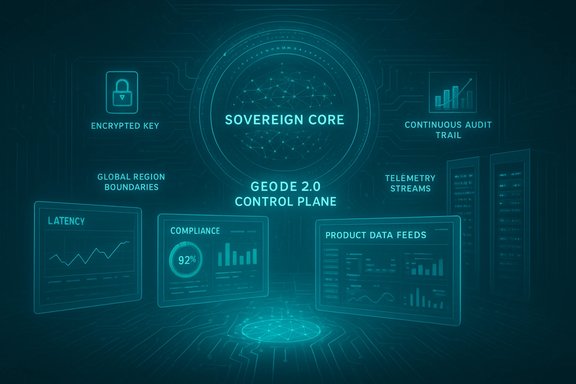
IBM unveiled IBM Sovereign Core, a software foundation that treats sovereignty — operational authority, data residency, and auditability — as an inherent system property rather than an after‑market policy layer. The product is positioned to support on‑prem, in‑region clouds, and local service provider operations, with a tech preview scheduled for February and general availability targeted mid‑2026. Key claims include customer‑operated control planes, in‑boundary identity and key custody, continuous compliance telemetry, and governed local AI inference.Strengths
- Operational authority: By delivering a control plane that customers operate directly, IBM reduces reliance on cross‑border vendor control planes — an important advantage for governments and regulated enterprises that must prove operational independence.
- Run‑time governance for AI: Embedding governance at inference time addresses a major regulatory blind spot: models and agents that act continuously and therefore need continuous traceability and audit trails. This aligns with emerging regulatory expectations in the EU and elsewhere.
- Interoperability: Built on Red Hat open‑source foundations, Sovereign Core is intended to integrate with common enterprise stacks rather than force a closed ecosystem, easing migration and hybrid scenarios.
Risks and open questions
- Operational complexity: Moving the control plane to the customer shifts operational burden to in‑region teams or local service providers. Organizations without mature SRE, security, and compliance operations may find this costly and error‑prone.
- Proving claims in practice: IBM’s claims about continuous compliance and in‑boundary key custody are promising, but buyers should demand concrete, verifiable evidence (attestation, audit logs, integration with HSMs, and third‑party audits) before relying on Sovereign Core for regulated workloads.
- Vendor lock‑in paradox: The product promises independence, yet adoption will create new operational dependencies. Evaluate migration pathways and replaceability to avoid long‑term lock‑in.
Practical guidance for Windows admins
- Verify whether your regulatory posture truly requires a customer‑operated control plane — sometimes cloud provider contractual and technical guarantees suffice.
- Pilot Sovereign Core in a contained environment to validate telemetry, audit exports, and HSM integration before production rollout.
- Require SIEM/APM integrations and clearly defined playbooks for incident response, especially for AI agent behaviors.
Apache Geode 2.0: modernizing the in‑memory tier
What’s new
Apache Software Foundation released Apache Geode 2.0, a major modernization of the in‑memory distributed data management platform. The release moves the runtime to Java 17, migrates to Jakarta EE 10, updates build tooling to Gradle 7, upgrades Spring Framework integrations, and strengthens security posture by fixing numerous vulnerabilities. The aim is compatibility with modern servlet containers and cloud‑native deployment patterns.Why this matters for real‑time analytics
Geode is often used as a low‑latency, strongly consistent cached layer or a globally distributed state store for high‑throughput applications. Upgrading to modern Java and Spring ecosystems reduces friction for teams that run JVM‑based analytics services and provides longer security maintenance windows — important for regulated production systems.Strengths
- Enterprise readiness: Security fixes and modern framework support lower operational risk and ease integration with Spring Boot‑based microservices common in enterprise stacks.
- Tooling and management: Modernized CLI and management tooling simplify day‑to‑day operations and automation.
Risks and operational considerations
- Migration effort: The move to Jakarta EE and newer dependency sets may require code and configuration changes for existing apps; plan compatibility testing and staged rollouts.
- State management complexity: If you’re using Geode for critical stateful streaming features, validate failover, snapshot, and recovery behavior under real load before upgrade.
Real‑time analytics news in brief: practical implications
This week produced several focused product releases and strategic partnerships relevant to anyone building real‑time analytics or AI inference platforms.Cast AI — OMNI Compute (unified compute control plane)
Cast AI introduced OMNI Compute, a control plane that discovers compute (including GPUs) across clouds and regions and presents them as native capacity to existing Kubernetes clusters. It promises to extend clusters transparently to remote GPUs without code changes and help avoid cloud lock‑in. This is significant for inference pipelines that need burst GPU capacity but want to preserve deployment portability and compliance controls.- Strength: Easier access to scarce GPU capacity and centralized policy controls.
- Caution: Network latency and data locality matter for inference; test end‑to‑end performance and ensure encryption and data‑in‑transit protections are enforced.
Commvault — Cloud Unified Data Vault (S3 protection)
Commvault Cloud Unified Data Vault brings Commvault‑managed, S3‑compatible endpoints with agentless immutability, encryption, and air‑gapped protection — a practical approach for protecting S3‑backed backups and AI datasets without modifying applications. Useful for teams that store model training data or snapshot backups in S3 and require immutability and regulatory retention.- Benefit: Agentless protection reduces friction for developers.
- Risk: Operational model shifts control to a managed endpoint — validate access controls, restore processes, and recovery SLAs.
CyCognito — MCP Server Exposure Management
CyCognito announced MCP Server Exposure Management to discover externally reachable Model Context Protocol (MCP) servers and bring them into external attack surface workflows. With MCP emerging as the integration fabric for agentic AI, visibility into exposed MCP servers is critical to avoid blind spots in perimeter and API security.- Strength: Adds a new dimension to external‑attack surface management for AI integration layers.
- Caution: Detection is the first step — teams must pair discovery with governance: inventory, least‑privilege policies, token rotation, and robust OAuth/jwt validations.
Google — Universal Commerce Protocol (UCP) for agentic shopping
Google launched the Universal Commerce Protocol (UCP), an open standard for agentic commerce that connects AI agents, merchants, and payment providers across the purchase lifecycle. UCP aims to standardize agent interactions to let LLM agents perform discovery, purchase, and post‑purchase actions across platforms. Early adopters include major retailers and payments firms.- Implication: Retailers and commerce platforms must plan how product data, prices, and inventory are surfaced and authorized in agentic channels.
- Operational note: Real‑time inventory and pricing integration becomes a competitive requirement — Algolia’s collaboration with Microsoft to deliver enriched attributes into Copilot/Bing Shopping is a direct response.
Sisense — Managed LLM, MCP server and assistant
Sisense released a suite combining a Sisense Managed LLM, a Model Context Protocol server, and the Sisense Intelligence assistant to enable agentic analytics and embedable, actionable insights. The offering targets product teams and analysts who want governed AI in analytics workflows.- Opportunity: Accelerates embedding generative analytics in apps without bespoke LLM ops.
- Consideration: Confirm model provenance, data retention policies, and BYO LLM options to meet enterprise governance requirements.
Partnerships, consolidation, and market moves
Rimes — PANTA, BMLL, Ortec Finance
Rimes announced partnerships with PANTA, BMLL, and Ortec Finance to enhance index analytics, historical order‑book access, and performance/attribution workflows. For financial real‑time analytics teams, these integrations mean richer ingest and validation pipelines for models and backtests.Algolia + Microsoft — product data into AI shopping surfaces
Algolia’s collaboration with Microsoft ensures real‑time enriched product attributes (pricing, availability, features) flow into Copilot, Bing Shopping, and Edge — an important step for retailers to control product presentation in off‑site AI discovery surfaces.Amplitude acquires InfiniGrow
Amplitude acquired InfiniGrow to extend marketing analytics with AI‑driven forecasting and what‑if analysis — a nudge toward analytics platforms that not only describe past events but actively guide budget allocation and campaign optimization.Delinea acquires StrongDM
Delinea signed a definitive agreement to acquire StrongDM, combining enterprise PAM with just‑in‑time runtime authorization — explicitly positioning identity security for the agentic AI era where non‑human identities proliferate and ephemeral access is common. Expect integrated policy and audit controls optimized for developer and agent workflows.Densify → Kubex (rebrand)
Densify rebranded to Kubex to reflect its shift to Kubernetes and AI/GPU optimization, launching Kubex AI for agentic, conversational optimization of compute resources — a clear sign that infrastructure optimization players are pivoting to meet GPU and Kubernetes scale.SymphonyAI — Industrial AI apps for CPG & Food & Beverage
SymphonyAI released eight industrial AI apps built for high‑velocity CPG production, integrating with Microsoft Foundry and Azure services and using MCP to expose Live Industrial Copilots in Teams. These are vertically focused applications that drive low‑latency, domain‑specific automation.University collaboration — UTC joins Southeastern Quantum Collaborative
The University of Tennessee at Chattanooga accepted an invitation to join the Southeastern Quantum Collaborative, broadening an ecosystem that includes IBM, IonQ, Oak Ridge, and defense‑industry partners to move quantum research closer to fieldable capabilities. Quantum R&D investments increasingly intersect with secure compute and cryptography considerations relevant to long‑lived enterprise archives.Cross‑cutting analysis: what to watch and how to act
1) Governance at runtime is now a procurement requirement
The IBM Sovereign Core announcement and multiple identity/security plays (Delinea+StrongDM, CyCognito) show vendors expect customers to demand run‑time governance — traceability, attested control planes, and short‑lived identities for agentic operations. For Windows shops, that means:- Require operational evidence and attestation before approving AI platforms for production.
- Build playbooks that treat model inference and agent actions as auditable transactions with human‑review triggers.
2) Visibility into new attack surfaces is urgent
MCP servers and agentic protocols create dynamic, tool‑driven surfaces that traditional discovery tools miss. External attack surface management must be extended to detect and classify MCP endpoints, OAuth clients, and tool catalogs to mitigate supply‑chain and command‑injection risks. Use tools like CyCognito’s new capability as part of a broader risk workflow: inventory → prioritize → remediate → monitor.3) GPU and Kubernetes control planes are maturing — but test performance & governance
OMNI Compute and Kubex point to richer cross‑cloud GPU orchestration and automated optimization, but network topology and data residency still dictate where inference should run. Before adopting multi‑region GPU bursting:- Run latency and throughput experiments from representative client locations.
- Validate encryption in transit, HSM access for keys, and regulatory implications for cross‑region inference.
4) Real‑time data fabric choices still matter
Apache Geode’s modernization reminds architects that the low‑latency tier must stay current with frameworks and security updates. When selecting or upgrading stateful caches or in‑memory stores:- Align to supported JVM versions, container runtimes, and security patch schedules.
5) Commerce and retail will adopt agentic standards rapidly
UCP and related agentic commerce standards mean product feeds, inventory, and pricing must be real‑time and authoritative. If your organization sells online or operates product catalogs, prioritize:- Real‑time product attribute pipelines (inventory, price, availability).
- Control and provenance over product metadata to avoid misrepresentation across agentic channels.
Recommended checklist for Windows‑focused IT leaders
- Inventory AI surfaces: scan for MCP servers, open agent endpoints, and external agent callbacks. Deploy external attack surface tools that include MCP discovery.
- Test Sovereign claims: if evaluating IBM Sovereign Core, demand telemetry export formats, HSM integration demo, and a documented path for regulatory auditors.
- Prepare the low‑latency tier: schedule compatibility tests for Apache Geode 2.0 upgrades, validate Java 17 runtime support, and test backups/restore under production state sizes.
- Validate cross‑cloud GPU orchestration: benchmark inference across OMNI Compute or Kubex AI-managed flows with your model sizes and data locality constraints.
- Secure agentic commerce integrations: ensure product attributes and pricing channels (Algolia/Microsoft feeds, UCP endpoints) are under CI/CD controls and real‑time test harnesses.
Conclusion
This week’s announcements reflect a maturation in the market: the conversation has shifted from can we run AI‑powered features to how should we operate, govern, and secure them at production scale. IBM Sovereign Core repositions sovereignty as an operational property rather than a compliance checkbox, Apache Geode 2.0 modernizes the in‑memory tier enterprises depend on for low‑latency data access, and a wave of targeted products — from GPU control planes and S3‑native vaulting to MCP discovery and agentic commerce standards — address the practical plumbing required for trustworthy, real‑time AI.For Windows‑centric enterprises, the takeaway is straightforward: invest in operational controls, expand external‑surface visibility to include MCP and agentic interfaces, and validate performance and governance under realistic production scenarios. Vendors are shipping the building blocks; the next phase is disciplined integration, verification, and governance so real‑time analytics and AI deliver value without introducing systemic risk.
Source: RT Insights Real-time Analytics News for the Week Ending January 17 - RTInsights
