

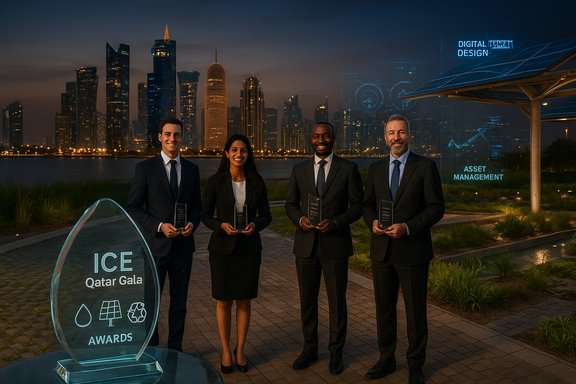
The Institution of Civil Engineers (ICE) Qatar used its annual gala to spotlight a simple, powerful message: civil engineers are no longer just builders of roads and bridges — they are architects of global impact, driving sustainability, resilience, and social value from Doha to the world stage. The headline — that ICE Qatar “honours civil engineers driving global impact” — reflects a broader evolution in the profession, one that ties professional recognition to climate-smart design, digital adoption, and a renewed emphasis on local capacity and professional standards as Qatar pushes ahead with an ambitious infrastructure agenda. Evidence of that agenda is visible in major public programs and multi‑billion‑QAR plans to expand and green the country’s infrastructure, while ICE’s local activity signals an effort to professionalise and showcase regional engineering talent.
Qatar’s post‑World Cup development phase is no longer about stadiums alone. The state has shifted from event‑driven construction to a sustained program of asset development and maintenance that emphasises sustainability and long‑term value. Public bodies such as Ashghal — the Public Works Authority — are rolling out multi‑year plans worth tens of billions of Qatari riyals to upgrade roads, drainage, sewage treatment, and public buildings; these moves align with the broader objectives of the Qatar National Vision 2030, which foregrounds economic diversification, human and social development, and environmental stewardship. Those strategic priorities give civil engineers in Qatar a direct role in delivering national policy outcomes, from carbon and water efficiency to resilience against climate extremes. At the same time, international professional bodies such as the Institution of Civil Engineers (ICE) maintain a growing regional presence. ICE activity in Qatar — including public events, professional development and the annual gala — is part of a deliberate push to professionalise local practice and create visible pathways for engineers to gain recognised qualifications and global standards. The ICE’s engagement in the region is not new, but recent years have seen intensified collaboration with Qatari stakeholders on training, chartership, and knowledge exchange.
Qatar’s infrastructure commitments are large and consequential; the engineers who design, build and maintain those systems will shape not just the built environment but the country’s economic and environmental future. Celebrating their contribution is appropriate — but the real test will be sustained action: audited results, stronger professional pathways and procurement reform that turns applause into measurable public benefit.
Acknowledgement and verification note: key factual claims in this article — including the ICE Qatar Gala Dinner and Qatar’s recent infrastructure plans — were verified against public ICE event listings and reporting on Ashghal’s multi‑year investment programmes and project awards. A short item on the Qatar Tribune site carried the headline referenced by the user; however, direct access to the full Qatar Tribune copy (including any speaker quotes or named honourees that may have appeared there) was inconsistent at the time of reporting and therefore any such granular claims have been treated as unverified in this feature.
Source: Qatar Tribune https://www.qatar-tribune.com/artic...rs-civil-engineers-driving-global-impact/amp/
 Background
Qatar’s post‑World Cup development phase is no longer about stadiums alone. The state has shifted from event‑driven construction to a sustained program of asset development and maintenance that emphasises sustainability and long‑term value. Public bodies such as Ashghal — the Public Works Authority — are rolling out multi‑year plans worth tens of billions of Qatari riyals to upgrade roads, drainage, sewage treatment, and public buildings; these moves align with the broader objectives of the Qatar National Vision 2030, which foregrounds economic diversification, human and social development, and environmental stewardship. Those strategic priorities give civil engineers in Qatar a direct role in delivering national policy outcomes, from carbon and water efficiency to resilience against climate extremes. At the same time, international professional bodies such as the Institution of Civil Engineers (ICE) maintain a growing regional presence. ICE activity in Qatar — including public events, professional development and the annual gala — is part of a deliberate push to professionalise local practice and create visible pathways for engineers to gain recognised qualifications and global standards. The ICE’s engagement in the region is not new, but recent years have seen intensified collaboration with Qatari stakeholders on training, chartership, and knowledge exchange. Overview of the gala: what was celebrated and why it matters
The ICE Qatar Gala Dinner, held in Doha, serves as the principal social and professional forum for the local civil engineering community. The event is structured as a mix of networking, awards and celebration of professional milestones — a ritual mirrored by ICE committees around the world. In 2025 the gala again highlighted engineers whose work transcends national boundaries: projects that advance sustainable construction methods, pioneering infrastructure projects, and examples of professional leadership that shape policy and practice beyond the Gulf. The ICE’s public event listings describe the gala as an evening of networking and acknowledgement of “engineering excellence” and note the participation of major stakeholders, underscoring that the ceremony is as much about influence and ideas as it is about social recognition. Why this ceremony matters: public honours and awards function as more than social currency. They signal what the profession values — whether that’s embodied carbon reductions, community‑focused design, asset management excellence, or innovation in water and energy systems. When institutions like ICE highlight engineers “driving global impact,” they are signalling a shift in performance metrics for the profession: success is measured not only by technical delivery but by societal outcomes and international reach.Qatar’s infrastructure pivot: scale and targets
Qatar’s infrastructure vision is large in both ambition and budget. Public statements and reporting show multi‑billion QAR plans that span roads, drainage, green spaces, recycling of construction materials, and major sewage and water projects delivered as public‑private partnerships. Ashghal’s five‑year plan and other recent contract announcements illustrate a transition from rapid build‑out to strategic, sustainable asset management and long‑term systems thinking. These programmes create both demand and responsibility for highly skilled civil engineers with knowledge in sustainability, digital asset management and climate adaptation. Key elements shaping engineering work in Qatar now include:- Decarbonisation and circular construction practices (recycling asphalt and reuse of rubble).
- Large‑scale water and wastewater infrastructure delivered through PPP modalities.
- Expansion of electric vehicle infrastructure and multimodal public transport planning.
- An emphasis on maintenance and operations (asset life‑cycle management) rather than one‑off construction.
Professional standards, chartership and the role of institutions
ICE’s presence in Qatar is not ceremonial only. The institution actively promotes professional qualifications, which serve as a proxy for competence, ethics and continuing professional development. ICE’s regional activities include webinars, workshops and networking events designed to encourage chartership and to share best practice. That focus matters for Qatar because professionalisation reduces freelancer fragmentation, aligns local practice with international safety and environmental standards, and facilitates knowledge transfer from multinational contractors to local engineering teams. Benefits of stronger professional standards:- Improved project outcomes through consistent design and oversight.
- Reduced risk of construction failure and cost escalation due to better governance.
- Market credibility for Qatari engineering firms in export markets.
- Talent retention by offering clear career pathways and international recognition.
Sustainability, resilience and “global impact” in practice
When gala honours emphasise “global impact,” they typically reward projects or individuals that scale solutions or set precedents. In Qatar’s context, that has concrete meanings:- Demonstrable reductions in embodied carbon or operational emissions in major public works.
- Innovations in water reuse, stormwater management and sewage treatment that can be exported to arid regions.
- Asset management strategies that extend infrastructure life and reduce life‑cycle costs.
- Training programmes and knowledge‑transfer initiatives that build local design, inspection and maintenance capacity.
- Projects designed with circularity in mind reduce waste and long‑term carbon footprints.
- Exportable expertise in water and heat‑resilient infrastructure gives Qatar soft power and commercial opportunities.
- Recognition by institutions like ICE incentivises risk‑taking in green technologies within conservative procurement frameworks.
Where the praise meets hard realities: risks, gaps and unintended consequences
Public honours and multi‑billion plans are encouraging, but the engineering community must also confront concrete and sometimes uncomfortable risks that can weaken long‑term outcomes. These are not theoretical; they are recurring themes in infrastructure projects worldwide and are visible in the Gulf’s rapid development context.- Reliance on foreign contractors and fragmented project delivery
- Large packages frequently go to international consortia. While this brings expertise, it can also limit local workforce absorption and lead to knowledge drain if intentional transfer mechanisms are weak.
- Greenwashing risk
- Procurement that awards “sustainable” branding without robust performance metrics can produce symbolic wins but little climate impact. Sustainability claims must be verifiable through lifecycle assessments and independent audits.
- Labour and social governance
- Construction in the region has faced scrutiny around labour practices and supply‑chain ethics. Engineering excellence must be paired with social responsibility across contractor networks.
- Asset maintenance underinvestment
- A recurring global problem is the “build now, maintain later” trap: large upfront capital projects without commensurate operational funding. Long‑term sustainability depends on matching capital planning with maintenance budgets and capacity.
- Climate uncertainty
- Heat, sea‑level rise and extreme rainfall require updated design standards. Engineers must design for plausible future climates, not historical norms.
Concrete examples and evidence
The strategic context for Qatar’s infrastructure programme is well documented. Media reporting and official communications describe Ashghal’s multi‑year investment plans and the adoption of circular construction practices — for instance, large quantities of reclaimed asphalt and other recycled materials have been repurposed in roadworks, and planning for strategic outfalls and water reuse is under way. These are measurable actions that provide credibility to claims of sustainability and innovation in Qatari infrastructure policy. ICE’s own regional activity corroborates the institutional push to raise professional standards. The ICE Qatar Gala Dinner is an institutional touchpoint where industry, government and professional networks interact — a practical conduit for the ICE’s objectives to encourage chartership and shared practice in a high‑investment environment. Public ICE listings describe the gala, its attendees and the themes it promotes. Caveat on the original news item: the Qatar Tribune ran a short item under the headline noting ICE Qatar’s honours, signalling local press interest. Direct access to the full Qatar Tribune page at the user‑provided link was inconsistent during reporting; therefore any detailed claims attributed specifically to that short report (for example, a precise list of named honourees, verbatim quotes or photograph captions) should be treated as unverified here until the full text and assets are available. Where the article’s broader premise — that ICE Qatar formally recognised civil engineers for global impact — is concerned, independent corroboration via ICE’s public event listings and Qatar’s wider infrastructure reporting supports the key themes, but names and specific quotes that may have appeared only in the Qatar Tribune item cannot be verified in this piece.What good recognition looks like — beyond trophies and speeches
If honouring engineers is to produce lasting change, awards and citations should be tethered to measurable criteria and follow‑through mechanisms. Practical features that would make recognition meaningful include:- Independent verification of sustainability outcomes (third‑party lifecycle assessments).
- Post‑award obligations for awardees to publish methodologies and lessons learned.
- Dedicated funding streams to replicate successful pilots at scale.
- Targeted mentorship and professional development commitments from awardees to local engineers.
- Public dashboards that track promised benefits (carbon saved, water reused, costs avoided).
Recommendations for policy and practice
For Qatari stakeholders, professional institutions and private industry, four priority actions would translate gala rhetoric into systemic progress:- Embed measurable sustainability targets in procurement
- Require lifecycle carbon and water assessments in bidding documents and make them contractually binding where feasible.
- Strengthen knowledge transfer clauses in major contracts
- Mandate clear training, staffing and local content outcomes as part of contractor performance metrics.
- Fund asset lifecycle management robustly
- Align capital budgets with multi‑decade maintenance plans and create ring‑fenced funds for operations and asset renewal.
- Institutionalise professional development
- Expand partnerships between public authorities, ICE and local universities to create fast‑tracks for chartership and vocational skill upgrading.
The wider opportunity: exporting expertise and soft power
There is a commercial and diplomatic upside to recognising engineers who deliver global impact: it creates exportable know‑how. Qatar’s recent projects — in water, sustainable roadworks and circular construction — can be packaged as technical assistance and consultancy exports to other arid or emerging economies. When ICE‑recognised projects have verifiable outcomes, they serve as market references that can open international contracts for Qatari firms and engineers, while elevating the country’s role as a source of climate‑adapted infrastructure solutions.Conclusion
ICE Qatar’s decision to honour civil engineers “driving global impact” is both symbolic and strategic. Symbolically, it reframes the civil engineer as a civic leader whose remit includes climate action, social value and systems resilience. Strategically, it aligns professional recognition with a national agenda that prioritises sustainable, resilient infrastructure and the human capital to deliver it. The value of honours like those presented at the gala will ultimately be judged by follow‑through: whether the awarded projects produce verifiable, replicable outcomes, whether knowledge and capacity are retained locally, and whether procurement and maintenance practices evolve to embed long‑term performance.Qatar’s infrastructure commitments are large and consequential; the engineers who design, build and maintain those systems will shape not just the built environment but the country’s economic and environmental future. Celebrating their contribution is appropriate — but the real test will be sustained action: audited results, stronger professional pathways and procurement reform that turns applause into measurable public benefit.
Acknowledgement and verification note: key factual claims in this article — including the ICE Qatar Gala Dinner and Qatar’s recent infrastructure plans — were verified against public ICE event listings and reporting on Ashghal’s multi‑year investment programmes and project awards. A short item on the Qatar Tribune site carried the headline referenced by the user; however, direct access to the full Qatar Tribune copy (including any speaker quotes or named honourees that may have appeared there) was inconsistent at the time of reporting and therefore any such granular claims have been treated as unverified in this feature.
Source: Qatar Tribune https://www.qatar-tribune.com/artic...rs-civil-engineers-driving-global-impact/amp/
