

On 7 May 2026, the UK Information Commissioner’s Office fined South Staffordshire Plc and South Staffordshire Water Plc £963,900 after a cyber-attack exposed personal data belonging to roughly 633,887 people, including customers, employees, and some vulnerable service users. The headline number is not the real story. The real story is that a utility provider responsible for essential services reportedly discovered a long-running compromise not because its security controls worked, but because its IT systems began to misbehave. For Windows administrators, the case reads less like an exotic ransomware drama than a familiar inventory of neglected basics.
A near-£1 million penalty is large enough to make a boardroom wince, but small enough to be misread as the cost of doing business. That would be a mistake. The ICO’s action against South Staffordshire is a regulatory judgment on a much wider pattern: critical organisations cannot treat monitoring, patching, and access control as aspirational improvements to be scheduled after the next budget cycle.
The breach began, according to the ICO’s findings, with a successful phishing email in September 2020. An employee opened a malicious attachment, giving the attacker a foothold. From there, the intrusion reportedly remained undetected for 20 months before the attacker escalated privileges and moved deeper into the environment in 2022.
That timeline matters because it collapses the comforting myth of the single bad click. Phishing may have opened the door, but it did not keep the attacker hidden for nearly two years. Long dwell time is usually a symptom of weak telemetry, incomplete asset awareness, poor segmentation, and insufficient privilege control.
South Staffordshire’s case is therefore not simply about one user being fooled. It is about an organisation whose defensive architecture, as described by the regulator, did not produce enough signal when the attacker turned a foothold into control.
Domain administrator access is the skeleton key of many enterprise Windows estates. It can allow attackers to access servers, create accounts, disable protections, move laterally, collect data, and obscure their path. In mature environments, privileged access is tightly monitored, time-limited, segmented, and treated as inherently dangerous. In weaker ones, it becomes the attacker’s passport.
The attack largely unfolded between May and July 2022, and South Staffordshire discovered the intrusion on 15 July 2022 after IT performance issues triggered an internal investigation. That is the phrase every security team should pause over. Performance degradation is not a detection strategy.
By the time sluggish systems forced the issue, the attacker had reportedly been able to access and exfiltrate a vast quantity of data. Between August and November 2022, more than 4.1 terabytes of data were published on the dark web. That data included names, addresses, email addresses, dates of birth, telephone numbers, online account credentials, bank account numbers, and sort codes. For employees, the exposure also included National Insurance numbers and HR records.
The most sensitive category may have been smaller in scale but heavier in consequence. Some customers on the Priority Services Register had information exposed from which disabilities could be inferred. A breach involving ordinary contact details is harmful enough. A breach involving vulnerability indicators for people who may depend on priority support during water outages crosses into a different ethical territory.
Legacy systems are not automatically indefensible. Industrial environments, utilities, and operational technology networks often contain old platforms because replacement is expensive, risky, or tied to specialist hardware. But unsupported systems demand compensating controls: isolation, strict firewalling, privileged access barriers, application allow-listing, enhanced monitoring, and a written risk acceptance process owned by senior management.
What regulators increasingly reject is the quiet drift of legacy risk. A server that remains online because nobody owns the migration plan is not the same as a legacy system deliberately isolated and governed. The ICO’s findings suggest that South Staffordshire’s security posture was not merely imperfect; it lacked basic visibility across most of the estate.
Only 5 percent of the IT environment was reportedly being monitored. That figure is extraordinary because it reframes the breach from a contest between attacker and defender into something closer to an unattended building. If defenders cannot see 95 percent of their environment, they are not hunting intrusions. They are hoping the intrusion becomes noisy enough to reveal itself.
For WindowsForum readers, this is where the story becomes practical. Many estates still contain a mixture of domain-joined servers, forgotten virtual machines, vendor-managed appliances, old file shares, and “temporary” systems that became permanent. Attackers do not need the network diagram to be tidy. They only need one neglected corner that still talks to something valuable.
Modern security assumes that some phishing attempts will succeed. That assumption is not defeatist; it is realistic. The job of enterprise defence is to ensure that a single compromised endpoint does not become domain compromise, mass data access, and dark web publication.
That requires layered controls. Endpoint detection should notice suspicious execution. Identity systems should flag unusual privilege escalation. Network monitoring should detect lateral movement. Data-loss controls should recognise abnormal exfiltration. Vulnerability management should reduce the number of easy next steps available to an attacker.
The ICO’s criticism appears aimed at precisely those layers. It found inadequate vulnerability management, unpatched critical systems, no regular security scans, obsolete software, and minimal monitoring coverage. In that context, the phishing email was not the catastrophe. It was the first domino in a room where too many dominoes had been left standing in a straight line.
This distinction matters because it affects accountability. If leadership frames the breach as a user-error incident, the remedy becomes awareness training and perhaps a sterner email from HR. If leadership frames it as a systemic control failure, the remedy becomes investment, governance, architecture, and measurable risk reduction.
Many enterprises have spent years modernising cloud identity while leaving on-premises AD as a sprawling trust fabric full of old groups, stale accounts, service accounts with excessive privileges, and domain admins used for routine administration. That is not just untidy. It is dangerous.
A well-run Windows environment treats privileged identity as a controlled substance. Domain admin accounts are few, monitored, separated from daily-use accounts, protected by multi-factor authentication where possible, and never used casually for desktop administration. Tiering models separate domain controllers, servers, and workstations so compromise in one layer does not automatically lead to another.
The South Staffordshire case illustrates why those principles are not academic. Once an attacker crosses into privileged identity, incident response becomes much harder. You must assume credentials are compromised, persistence may be planted, logs may be incomplete, and ordinary administrative trust may be poisoned.
That is also why dwell time is so punishing. A breach detected within hours may be contained around a workstation or user account. A breach detected after months, with admin-level access in play, becomes a reconstruction project. Investigators must determine not only what happened, but what can still be trusted.
In South Staffordshire’s case, the regulator’s focus was personal data extracted and later published. That is the part that follows people home. A rebuilt server may be restored in days or weeks; a leaked date of birth, address, bank detail, or National Insurance number cannot be patched.
The exposure of online account credentials adds another layer. Password reuse remains common, despite years of warnings. A credential leaked from a utility account can become a stepping stone into email, retail, banking-adjacent services, or other consumer platforms if users reused passwords. Even when passwords are changed, the risk persists through targeted fraud, phishing, and social engineering.
Bank account numbers and sort codes are not the same as full card details, but they are not harmless. Combined with names, addresses, dates of birth, and telephone numbers, they can support convincing scams. The danger is not always direct account takeover; it is the construction of a believable identity dossier.
For employees, HR data is particularly toxic. National Insurance numbers, payroll details, disciplinary records, absence information, and internal employment documents can expose people to fraud and embarrassment. In a breach like this, employees are not merely staff affected by an incident. They are data subjects whose employer failed to protect information collected as a condition of work.
That creates a trust bargain. Customers may provide information about disability, medical needs, age-related vulnerability, or household circumstances because the service provider needs to prioritise them in an emergency. If that information leaks, the harm is not merely privacy loss. It may expose people to targeting, stigma, or manipulation.
This is one reason security in utilities cannot be judged only by whether taps keep running. Operational continuity is vital, but data protection is also part of public trust. A water company’s customer database is not a low-value back-office asset. It contains maps of households, vulnerabilities, payment relationships, and contact channels.
The ICO’s enforcement action implicitly rejects the idea that essential-service providers can separate cyber resilience from data protection. A cyber-attack on a utility may not poison the water supply, but it can still harm the people who depend on that utility.
That is particularly important as utilities become more digitised. Customer portals, smart metering, operational analytics, outsourced support platforms, and cloud services expand the data surface. The more essential providers know about us, the more serious their obligation to defend that knowledge becomes.
This is where the South Staffordshire penalty becomes relevant beyond the water sector. The regulator is not saying that every cyber-attack is punishable simply because an attacker succeeded. It is saying that organisations handling personal data must be able to show that their security posture was proportionate to the risk.
That distinction is crucial. Security law does not demand magic. It does not require perfect prevention. It does require evidence that the organisation understood its environment, monitored it, patched known weaknesses, controlled access, and maintained reasonable defences for the data it held.
The voluntary settlement also matters. South Staffordshire admitted liability early and agreed to pay the reduced fine without appeal. That does not erase the breach, but it signals the practical value of cooperation once a regulator is involved.
For other organisations, the lesson is not that early admission makes everything fine. It is that defensibility starts long before an incident. If your patch records, asset inventories, privileged access reviews, vulnerability scans, and monitoring coverage are thin, the post-breach conversation will be brutal.
That is why asset visibility remains foundational. You cannot patch what you do not know exists. You cannot monitor what is not onboarded. You cannot segment what has never been mapped. A Windows estate with unknown servers and unmanaged endpoints is not merely inefficient; it is indefensible.
Vulnerability management is equally unforgiving. Regular internal and external scans are not paperwork exercises. They are a way to find the paths an attacker will find anyway. When critical systems remain unpatched, the organisation is effectively betting that attackers will overlook what automated tools are built to discover.
Monitoring coverage is where many organisations still underinvest. Logs are noisy, storage is expensive, tools generate false positives, and skilled analysts are hard to hire. But none of that changes the basic equation: without telemetry, incident response begins late.
The reported 5 percent monitoring figure should become a boardroom slide across sectors. It is not a marginal gap. It is the difference between a security function and a security aspiration.
A board does not need to know every Event ID in a Windows security log. It does need to know whether the organisation has an accurate asset inventory, how much of the environment is monitored, how quickly critical vulnerabilities are patched, how privileged access is controlled, and which legacy systems remain unsupported.
Those questions are not optional for operators of essential services. They belong in risk committees, audit packs, supplier reviews, and incident exercises. If executives only learn the answers after a breach, the governance system has already failed.
The case also underlines the role of cyber insurance and third-party responders. Bringing in specialists after discovery is sensible, but it is not a substitute for day-to-day resilience. Incident response firms can help rebuild trust in an environment; they cannot retroactively create the missing alerts from the previous 20 months.
This is the uncomfortable truth for many organisations: the most important security decisions are made years before the breach. They happen when a server migration is postponed, when monitoring coverage is accepted as partial, when a service account is granted broad rights, when a scanner is not deployed, and when nobody asks whether the risk owner has actually accepted the risk.
The hard part is not knowing these risks exist. The hard part is turning that knowledge into organisational action. Security teams can document findings for years while business owners defer remediation because the system is stable, the vendor is difficult, or the downtime window is politically impossible.
Regulatory penalties change that calculus. They turn “technical debt” into legal and financial exposure. They give administrators a stronger argument: this is not merely best practice, and it is not merely an IT preference. It is part of the organisation’s duty to protect personal data.
The practical response begins with ruthless clarity. Which systems are unsupported? Which assets are unmonitored? Which privileged accounts have not been reviewed? Which critical vulnerabilities are past service-level targets? Which data repositories contain sensitive personal information but lack adequate access controls?
Those questions are uncomfortable because they create evidence. But evidence is precisely what organisations need. A risk that is measured can be funded, sequenced, mitigated, or formally accepted. A risk that is whispered about in ticket comments eventually becomes a regulator’s paragraph.
The most concrete lessons are not glamorous, but they are the ones that decide whether the next incident is a contained compromise or a public enforcement action.
The South Staffordshire penalty lands at a moment when every utility, council, hospital, manufacturer, and mid-sized enterprise is being asked to digitise more while carrying decades of inherited infrastructure. That tension will not disappear. The organisations that survive it will be the ones that stop treating visibility, patching, and privilege control as hygiene slogans and start treating them as operational facts, measured continuously and funded accordingly.
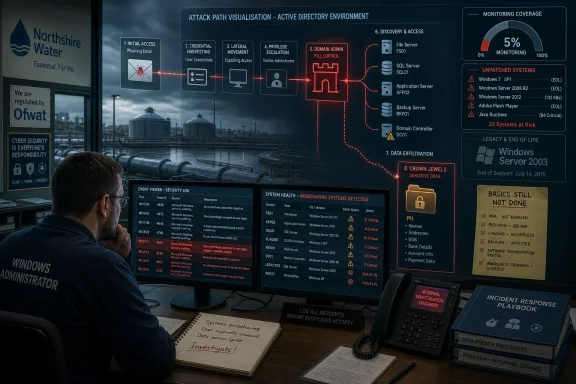 The Fine Is Smaller Than the Warning
A near-£1 million penalty is large enough to make a boardroom wince, but small enough to be misread as the cost of doing business. That would be a mistake. The ICO’s action against South Staffordshire is a regulatory judgment on a much wider pattern: critical organisations cannot treat monitoring, patching, and access control as aspirational improvements to be scheduled after the next budget cycle.The breach began, according to the ICO’s findings, with a successful phishing email in September 2020. An employee opened a malicious attachment, giving the attacker a foothold. From there, the intrusion reportedly remained undetected for 20 months before the attacker escalated privileges and moved deeper into the environment in 2022.
That timeline matters because it collapses the comforting myth of the single bad click. Phishing may have opened the door, but it did not keep the attacker hidden for nearly two years. Long dwell time is usually a symptom of weak telemetry, incomplete asset awareness, poor segmentation, and insufficient privilege control.
South Staffordshire’s case is therefore not simply about one user being fooled. It is about an organisation whose defensive architecture, as described by the regulator, did not produce enough signal when the attacker turned a foothold into control.
A Water Company Became a Case Study in Ordinary Failure
The details are depressingly familiar to anyone who has worked in corporate IT. The attacker reportedly gained domain administrator privileges in May 2022, the highest level of control in a Windows domain. Once that happens, the conversation changes. The breach is no longer about one compromised mailbox or one infected workstation; it is about the integrity of the identity layer itself.Domain administrator access is the skeleton key of many enterprise Windows estates. It can allow attackers to access servers, create accounts, disable protections, move laterally, collect data, and obscure their path. In mature environments, privileged access is tightly monitored, time-limited, segmented, and treated as inherently dangerous. In weaker ones, it becomes the attacker’s passport.
The attack largely unfolded between May and July 2022, and South Staffordshire discovered the intrusion on 15 July 2022 after IT performance issues triggered an internal investigation. That is the phrase every security team should pause over. Performance degradation is not a detection strategy.
By the time sluggish systems forced the issue, the attacker had reportedly been able to access and exfiltrate a vast quantity of data. Between August and November 2022, more than 4.1 terabytes of data were published on the dark web. That data included names, addresses, email addresses, dates of birth, telephone numbers, online account credentials, bank account numbers, and sort codes. For employees, the exposure also included National Insurance numbers and HR records.
The most sensitive category may have been smaller in scale but heavier in consequence. Some customers on the Priority Services Register had information exposed from which disabilities could be inferred. A breach involving ordinary contact details is harmful enough. A breach involving vulnerability indicators for people who may depend on priority support during water outages crosses into a different ethical territory.
The Windows Server 2003 Detail Says the Quiet Part Out Loud
The mention of obsolete, unsupported software, including Windows Server 2003, is more than a colourful detail. It is a flashing warning light for any organisation still carrying legacy Windows systems because “they still work.” Windows Server 2003 left extended support long ago. In security terms, it belongs to a different age.Legacy systems are not automatically indefensible. Industrial environments, utilities, and operational technology networks often contain old platforms because replacement is expensive, risky, or tied to specialist hardware. But unsupported systems demand compensating controls: isolation, strict firewalling, privileged access barriers, application allow-listing, enhanced monitoring, and a written risk acceptance process owned by senior management.
What regulators increasingly reject is the quiet drift of legacy risk. A server that remains online because nobody owns the migration plan is not the same as a legacy system deliberately isolated and governed. The ICO’s findings suggest that South Staffordshire’s security posture was not merely imperfect; it lacked basic visibility across most of the estate.
Only 5 percent of the IT environment was reportedly being monitored. That figure is extraordinary because it reframes the breach from a contest between attacker and defender into something closer to an unattended building. If defenders cannot see 95 percent of their environment, they are not hunting intrusions. They are hoping the intrusion becomes noisy enough to reveal itself.
For WindowsForum readers, this is where the story becomes practical. Many estates still contain a mixture of domain-joined servers, forgotten virtual machines, vendor-managed appliances, old file shares, and “temporary” systems that became permanent. Attackers do not need the network diagram to be tidy. They only need one neglected corner that still talks to something valuable.
The Phishing Email Was the Spark, Not the Fire
It is tempting for organisations to respond to cases like this with more phishing training. Training matters, and users should learn to recognise suspicious attachments, unexpected prompts, and credential-harvesting pages. But training alone is an inadequate answer to a breach that allegedly persisted for 20 months.Modern security assumes that some phishing attempts will succeed. That assumption is not defeatist; it is realistic. The job of enterprise defence is to ensure that a single compromised endpoint does not become domain compromise, mass data access, and dark web publication.
That requires layered controls. Endpoint detection should notice suspicious execution. Identity systems should flag unusual privilege escalation. Network monitoring should detect lateral movement. Data-loss controls should recognise abnormal exfiltration. Vulnerability management should reduce the number of easy next steps available to an attacker.
The ICO’s criticism appears aimed at precisely those layers. It found inadequate vulnerability management, unpatched critical systems, no regular security scans, obsolete software, and minimal monitoring coverage. In that context, the phishing email was not the catastrophe. It was the first domino in a room where too many dominoes had been left standing in a straight line.
This distinction matters because it affects accountability. If leadership frames the breach as a user-error incident, the remedy becomes awareness training and perhaps a sterner email from HR. If leadership frames it as a systemic control failure, the remedy becomes investment, governance, architecture, and measurable risk reduction.
Domain Administrator Is Where Incidents Become Existential
The escalation to domain administrator privileges should be the moment that makes every Windows admin sit up. Active Directory remains the central nervous system of countless organisations. When attackers control it, they can often control the organisation’s Windows estate.Many enterprises have spent years modernising cloud identity while leaving on-premises AD as a sprawling trust fabric full of old groups, stale accounts, service accounts with excessive privileges, and domain admins used for routine administration. That is not just untidy. It is dangerous.
A well-run Windows environment treats privileged identity as a controlled substance. Domain admin accounts are few, monitored, separated from daily-use accounts, protected by multi-factor authentication where possible, and never used casually for desktop administration. Tiering models separate domain controllers, servers, and workstations so compromise in one layer does not automatically lead to another.
The South Staffordshire case illustrates why those principles are not academic. Once an attacker crosses into privileged identity, incident response becomes much harder. You must assume credentials are compromised, persistence may be planted, logs may be incomplete, and ordinary administrative trust may be poisoned.
That is also why dwell time is so punishing. A breach detected within hours may be contained around a workstation or user account. A breach detected after months, with admin-level access in play, becomes a reconstruction project. Investigators must determine not only what happened, but what can still be trusted.
Data Exfiltration Is the Ransomware Story That Outlived Encryption
For years, ransomware was understood by the public as an availability problem: criminals encrypted systems, organisations paid to get files back, and the damage was measured in downtime. That model has not disappeared, but the more durable harm now often comes from data theft.In South Staffordshire’s case, the regulator’s focus was personal data extracted and later published. That is the part that follows people home. A rebuilt server may be restored in days or weeks; a leaked date of birth, address, bank detail, or National Insurance number cannot be patched.
The exposure of online account credentials adds another layer. Password reuse remains common, despite years of warnings. A credential leaked from a utility account can become a stepping stone into email, retail, banking-adjacent services, or other consumer platforms if users reused passwords. Even when passwords are changed, the risk persists through targeted fraud, phishing, and social engineering.
Bank account numbers and sort codes are not the same as full card details, but they are not harmless. Combined with names, addresses, dates of birth, and telephone numbers, they can support convincing scams. The danger is not always direct account takeover; it is the construction of a believable identity dossier.
For employees, HR data is particularly toxic. National Insurance numbers, payroll details, disciplinary records, absence information, and internal employment documents can expose people to fraud and embarrassment. In a breach like this, employees are not merely staff affected by an incident. They are data subjects whose employer failed to protect information collected as a condition of work.
The Priority Services Register Raises the Stakes
The exposure of information from the Priority Services Register deserves special attention because it reveals how utility data can carry hidden sensitivity. Water companies hold information not because they are social networks or advertisers, but because they deliver essential services. Some customers disclose needs so they can receive help during disruptions.That creates a trust bargain. Customers may provide information about disability, medical needs, age-related vulnerability, or household circumstances because the service provider needs to prioritise them in an emergency. If that information leaks, the harm is not merely privacy loss. It may expose people to targeting, stigma, or manipulation.
This is one reason security in utilities cannot be judged only by whether taps keep running. Operational continuity is vital, but data protection is also part of public trust. A water company’s customer database is not a low-value back-office asset. It contains maps of households, vulnerabilities, payment relationships, and contact channels.
The ICO’s enforcement action implicitly rejects the idea that essential-service providers can separate cyber resilience from data protection. A cyber-attack on a utility may not poison the water supply, but it can still harm the people who depend on that utility.
That is particularly important as utilities become more digitised. Customer portals, smart metering, operational analytics, outsourced support platforms, and cloud services expand the data surface. The more essential providers know about us, the more serious their obligation to defend that knowledge becomes.
The Regulator Is Targeting the Management System, Not Just the Incident
The ICO found infringements of the UK GDPR’s security principles, including obligations to process personal data securely and to implement appropriate technical and organisational measures. Those words can sound abstract, but in enforcement they become concrete: patching, monitoring, scanning, access control, supported software, and incident detection.This is where the South Staffordshire penalty becomes relevant beyond the water sector. The regulator is not saying that every cyber-attack is punishable simply because an attacker succeeded. It is saying that organisations handling personal data must be able to show that their security posture was proportionate to the risk.
That distinction is crucial. Security law does not demand magic. It does not require perfect prevention. It does require evidence that the organisation understood its environment, monitored it, patched known weaknesses, controlled access, and maintained reasonable defences for the data it held.
The voluntary settlement also matters. South Staffordshire admitted liability early and agreed to pay the reduced fine without appeal. That does not erase the breach, but it signals the practical value of cooperation once a regulator is involved.
For other organisations, the lesson is not that early admission makes everything fine. It is that defensibility starts long before an incident. If your patch records, asset inventories, privileged access reviews, vulnerability scans, and monitoring coverage are thin, the post-breach conversation will be brutal.
The Security Basics Are No Longer Basic Enough to Ignore
The most striking feature of the case is how little of it depends on cutting-edge attacker tradecraft. Phishing, malware persistence, lateral movement, privilege escalation, data theft, and publication on the dark web are now standard components of the criminal playbook. The differentiator is how quickly an organisation interrupts the chain.That is why asset visibility remains foundational. You cannot patch what you do not know exists. You cannot monitor what is not onboarded. You cannot segment what has never been mapped. A Windows estate with unknown servers and unmanaged endpoints is not merely inefficient; it is indefensible.
Vulnerability management is equally unforgiving. Regular internal and external scans are not paperwork exercises. They are a way to find the paths an attacker will find anyway. When critical systems remain unpatched, the organisation is effectively betting that attackers will overlook what automated tools are built to discover.
Monitoring coverage is where many organisations still underinvest. Logs are noisy, storage is expensive, tools generate false positives, and skilled analysts are hard to hire. But none of that changes the basic equation: without telemetry, incident response begins late.
The reported 5 percent monitoring figure should become a boardroom slide across sectors. It is not a marginal gap. It is the difference between a security function and a security aspiration.
Boards Cannot Outsource the Consequences
Cybersecurity is often delegated downward until it becomes a technical problem owned by teams without the authority or budget to fix structural risk. The South Staffordshire case shows why that model fails. Unsupported servers, incomplete monitoring, and weak vulnerability management are rarely the result of one administrator’s preference. They are usually the accumulated residue of funding decisions, deferred migrations, operational pressure, and weak governance.A board does not need to know every Event ID in a Windows security log. It does need to know whether the organisation has an accurate asset inventory, how much of the environment is monitored, how quickly critical vulnerabilities are patched, how privileged access is controlled, and which legacy systems remain unsupported.
Those questions are not optional for operators of essential services. They belong in risk committees, audit packs, supplier reviews, and incident exercises. If executives only learn the answers after a breach, the governance system has already failed.
The case also underlines the role of cyber insurance and third-party responders. Bringing in specialists after discovery is sensible, but it is not a substitute for day-to-day resilience. Incident response firms can help rebuild trust in an environment; they cannot retroactively create the missing alerts from the previous 20 months.
This is the uncomfortable truth for many organisations: the most important security decisions are made years before the breach. They happen when a server migration is postponed, when monitoring coverage is accepted as partial, when a service account is granted broad rights, when a scanner is not deployed, and when nobody asks whether the risk owner has actually accepted the risk.
Windows Administrators Know Where the Bodies Are Buried
For sysadmins, the South Staffordshire enforcement notice will feel less like a surprise than a public airing of familiar private anxieties. Every mature Windows admin has seen some version of the same landscape: an old server nobody wants to touch, a business-critical application tied to an unsupported OS, a domain group with too many members, a vendor account with unclear ownership, a logging tool licensed for less coverage than the estate requires.The hard part is not knowing these risks exist. The hard part is turning that knowledge into organisational action. Security teams can document findings for years while business owners defer remediation because the system is stable, the vendor is difficult, or the downtime window is politically impossible.
Regulatory penalties change that calculus. They turn “technical debt” into legal and financial exposure. They give administrators a stronger argument: this is not merely best practice, and it is not merely an IT preference. It is part of the organisation’s duty to protect personal data.
The practical response begins with ruthless clarity. Which systems are unsupported? Which assets are unmonitored? Which privileged accounts have not been reviewed? Which critical vulnerabilities are past service-level targets? Which data repositories contain sensitive personal information but lack adequate access controls?
Those questions are uncomfortable because they create evidence. But evidence is precisely what organisations need. A risk that is measured can be funded, sequenced, mitigated, or formally accepted. A risk that is whispered about in ticket comments eventually becomes a regulator’s paragraph.
The Lesson for Every Windows Estate Is Written in the Dwell Time
The South Staffordshire case should not be filed away as a water-sector oddity. It is a warning about what happens when ordinary weaknesses align. A phishing email lands. Malware runs. Monitoring misses it. Legacy systems remain exposed. Vulnerabilities persist. Privileges escalate. Data leaves. The organisation notices too late.The most concrete lessons are not glamorous, but they are the ones that decide whether the next incident is a contained compromise or a public enforcement action.
- Organisations should be able to state, with evidence, what percentage of their environment is covered by security monitoring and why any remaining systems are excluded.
- Unsupported Windows systems should be removed, isolated, or governed through explicit risk acceptance backed by compensating controls.
- Domain administrator privileges should be rare, monitored, separated from daily accounts, and reviewed as a standing executive risk.
- Vulnerability scanning should be regular, comprehensive, and tied to remediation deadlines that business owners cannot quietly ignore.
- Sensitive customer and employee data should be mapped so that breach impact is not discovered only after attackers publish it.
- Phishing resilience should be treated as one layer of defence, not as a convenient explanation for failures deeper in the estate.
The South Staffordshire penalty lands at a moment when every utility, council, hospital, manufacturer, and mid-sized enterprise is being asked to digitise more while carrying decades of inherited infrastructure. That tension will not disappear. The organisations that survive it will be the ones that stop treating visibility, patching, and privilege control as hygiene slogans and start treating them as operational facts, measured continuously and funded accordingly.
References
- Primary source: The HR Director
Published: 2026-05-24T06:05:07.762586
South Staffordshire water fined after failures in data security | theHRD
South Staffordshire Plc and its subsidiary, South Staffordshire Water Plc, have been fined £963,900 by the Information Commissioner’s Office (ICO) following a major cyber-attack that compromised the personal data of over 630,000 individuals.www.thehrdirector.com - Related coverage: ico.org.uk
- Related coverage: theregister.com
ICO fines South Staffordshire £963K over 2022 breach
Utility provider failed to detect Cl0p ransomware attack for nearly two yearswww.theregister.com - Related coverage: pacific.london
ICO Water Crisis: £1m Fine Exposes Two-Year Hidden Breach Reality | Pacific Technology Group
ICO's £963,900 fine against South Staffordshire Water reveals 20 months of undetected access, exposing systemic monitoring failures that UK mid-market firms cannot afford.www.pacific.london - Related coverage: lyrie.ai
The Two-Year Shadow: South Staffs Water Fined £1M for Undetected Cl0p Ransomware | Lyrie Research | Lyrie Research
On May 11, 2026, the UK's Information Commissioner's Office announced it had fined South Staffordshire Plc and South Staffordshire Water Plc £963,900 following a serious Cl0p ransomware attack that began in September 2024 but remained undetected until early 2026—a 16-month dwell time. lyrie.ai
- Related coverage: watermagazine.co.uk
ICO issues fine of nearly £1m against South Staffordshire Plc and South Staffordshire Water Plc following major cyber attack and data breach - Water Magazine
The ICO has fined South Staffordshire Plc and South Staffordshire Water Plc (together South Staffordshire) £963,900 following a serious cyber attack. www.watermagazine.co.uk
- Related coverage: measuredcollective.com
ICO fines South Staffordshire PLC & South Staffordshire Water £963,900 after phishing-led breach exposed 633,887 people’s data
The ICO fined South Staffordshire £963,900 after a phishing-led cyber attack exposed 633,887 people’s data. What failed, and what managers should review now.measuredcollective.com - Related coverage: mlex.com
UK’s South Staffordshire fined almost £1m for data security breach (update*) | MLex | Specialist news and analysis on legal risk and regulation
MLex Summary: UK company South Staffordshire — a water utility — has been fined more than £960,000 by the Information Commissioner’s Office, after a cyberattack exposed the personal data of more than 630,000 customers and employees. The attackers remained undetected for nearly two years...www.mlex.com - Related coverage: trowers.com
ICO fines South Staffordshire Water nearly £1 million following major cyber-attack | Trowers & Hamlins law firm
The Information Commissioner's Office ("ICO") has recently issued a monetary penalty of £963,900 against South Staffordshire Plc and South Staffordshire Water Plc ("South Staffordshire"). South Staffordshire Water Plc is a primary supplier of clean water to...www.trowers.com - Related coverage: thecybersignal.com
ICO Fines South Staffordshire Water for 20-Month Cl0p Breach
The ICO fined South Staffordshire Water nearly GBP 1 million on May 11 over a Cl0p attack that exposed 633,887 records. Hackers sat undetected for 20 months. Only 5 percent of the IT environment was monitored. www.thecybersignal.com
- Related coverage: securityintelhub.com
UK fines water supplier $1.3M for exposing data of 664k customers | Security Intel Hub
The Information Commissioner's Office has fined South Staffordshire Water Plc and parent company South Staffordshire Plc £963,900 ($1.3 million) over a cyberattack that exposed the personal data of 663,887 customers and employees. [...]securityintelhub.com - Related coverage: south-staffs-water.co.uk
- Related coverage: ofwat.gov.uk
Ofwat’s final decision to impose a financial penalty on Southern Water Services Limited
PDF documentwww.ofwat.gov.uk
