

Icon’s June 22, 2026 Microsoft partnership puts Copilot, enterprise cloud, data infrastructure, and the Orbis agentic AI platform into the operating fabric of clinical trials run by the Dublin-based CRO, leaving sponsors and sites to determine who absorbs the change-management burden. The announcement reads like a technology upgrade, but in active studies it behaves like an operating-model change. That distinction matters because clinical development contracts are built around planned services, documented monitoring approaches, and controlled systems—not surprise AI acceleration layered into work already underway.
The real question for sponsors is not whether Icon should modernize. It is whether the efficiency dividend belongs to the CRO, the sponsor, the site, or some unresolved middle ground where everyone claims the savings and no one owns the disruption.
Clinical research organizations have spent years telling sponsors that technology will make trials faster, cleaner, and less labor-intensive. That pitch is not wrong. Anyone who has watched a study team chase missing data across email threads, portals, monitoring reports, and spreadsheet trackers knows that the current model is begging for automation.
But the Icon-Microsoft deal is not a new dashboard bolted onto a single protocol. Icon says Microsoft 365 Copilot will be deployed enterprise-wide, while Microsoft cloud, data, and AI infrastructure will help scale Orbis, Icon’s governed agentic AI platform across the clinical development lifecycle. That is the language of a platform migration, not a feature release.
For WindowsForum readers, the analogy is familiar. When a company moves from a local file server and manual approvals into Microsoft 365, Teams, Purview, Power Platform, and Copilot, the licensing line is only the first cost. The real cost is identity, governance, retention, training, workflow redesign, auditability, and support. The same principle applies in clinical operations, except the workflows touch regulated research, patient safety, and sponsor contracts.
The immediate commercial tension is simple. If Orbis reduces monitoring hours, Icon will want credit for the productivity gain. If Orbis creates retraining, validation, or site-support work, sponsors will ask whether that is part of Icon’s overhead. Sites, as usual, will experience the change as unpaid labor unless someone deliberately protects them.
In a clinical trial, that distinction is not academic. An AI layer that identifies risk signals might influence which sites receive more frequent monitoring. It might change how data queries are drafted. It might alter how protocol deviations are surfaced, triaged, or escalated. It might also change how project managers allocate CRA time across sites.
From a sponsor’s headquarters, those changes may look like operational optimization. At a site, they arrive as different behavior from the CRO. A coordinator may see new query language, a different tempo of follow-up, a change in source data verification expectations, or a CRA explaining that “the system” flagged the site for additional review.
That is where change management becomes more than training. The site does not need a press release about AI-enabled clinical development. It needs to know whether the monitoring model has changed, whether the documented rationale still matches the work being performed, and whether new expectations are being imposed under an old agreement.
ICH E6(R3) strengthens the expectation that monitoring approaches be planned, risk-proportionate, and documented. That creates an uncomfortable question for any AI-driven monitoring recalibration. If a CRO’s new platform changes the practical intensity of monitoring mid-study, is that merely an internal method improvement, or is it a change to the monitoring strategy?
The answer will depend on the contract, the monitoring plan, and the degree of change. A background analytics improvement that helps a project manager prioritize work may not require a formal amendment. A system-driven change that doubles visit frequency, expands source verification, or changes query methodology starts to look like something sponsors and sites should have been told about in advance.
The regulatory language does not always map neatly onto modern AI infrastructure. Guidelines can say the sponsor should document monitoring rationale. They do not necessarily say what happens when the risk engine itself becomes a moving target, maintained inside a CRO’s enterprise platform and enhanced through a hyperscaler partnership.
For Microsoft, this is exactly the kind of vertical AI adoption it wants: a regulated industry, a data-heavy workflow, and a major services partner embedding Microsoft technology into repeatable operations. For Icon, Microsoft offers scale, governance tooling, identity integration, and a familiar enterprise stack that can make AI adoption look less experimental to sponsors.
But enterprise-grade does not automatically mean study-ready. Clinical systems live under validation expectations, audit trails, role-based access controls, privacy constraints, and sponsor-specific operating procedures. Moving more workflow intelligence into a Microsoft-enabled backbone may improve governance, but it also creates new questions about where records live, how decisions are logged, and who can explain an AI-generated operational action during an inspection.
That is not an argument against Microsoft. In many ways, Microsoft is the safer partner compared with a patchwork of smaller AI vendors. The point is that trust in the vendor does not eliminate the need for documented change control. In regulated operations, the phrase enterprise-wide deployment should make legal, quality, and clinical operations teams sit up straight.
The commercial promise is obvious. If AI can reduce manual review, automate study startup tasks, accelerate feasibility work, and triage monitoring more intelligently, CROs can defend margins while sponsors push for faster trials. In a healthier version of the market, sponsors get lower cost and shorter timelines, CROs get scalable productivity, and sites get fewer redundant requests.
The messier version is more likely in the short term. CROs may capture productivity gains internally while sponsors continue paying under existing work orders. Sponsors may demand savings without funding transition work. Sites may be asked to learn yet another operating rhythm without new compensation.
This is the familiar enterprise software trap: the business case is built on future-state efficiency, while the implementation burden lands immediately on people already operating at capacity. Clinical research sites have been living inside that trap for years.
That gap matters because clinical trial outsourcing contracts tend to distinguish between the work purchased and the vendor’s internal means of performing it. If Icon changes an internal tool used by its employees, the CRO may argue that no amendment is needed. If the change affects sponsor deliverables, site workflows, validation documentation, monitoring intensity, or training requirements, sponsors will argue that the operational scope has changed.
Neither side is obviously wrong. A CRO must be able to modernize its own systems. A sponsor must be able to control the conduct, budget, and documentation of its study. The collision occurs when an internal platform becomes operationally external.
This is where procurement language written for EDC licenses and pass-through vendor fees starts to look dated. AI platforms do not fit cleanly into “software license,” “internal overhead,” or “study-specific service.” They are all three at once.
The problem is that gain-share only works when the baseline is defined before the work changes. Sponsors need to know what the expected monitoring hours, query volumes, startup timelines, and project-management workload would have been without the AI intervention. CROs need a fair way to prove that the platform—not protocol simplicity, site mix, recruitment luck, or sponsor decisions—created the savings.
For studies contracted in 2023 or 2024, that baseline may not exist. If Orbis reduces monitoring effort by 15 percent, the sponsor may expect a discount. Icon may treat the savings as margin recapture from its own investment. If the same platform requires study-team training or documentation updates, both sides may point to the other’s budget.
That is why AI pricing cannot be treated as a finance-team afterthought. The commercial model determines whether the platform is experienced as innovation or as a dispute engine.
A sponsor can dispute an invoice. A CRO can classify work as billable or nonbillable. A site coordinator usually just absorbs the task. Training modules, system access requests, revised query formats, monitoring schedule changes, portal messages, and “quick alignment calls” all land as time taken from another protocol.
That burden is cumulative. Modern sites already juggle EDC, eConsent, ePRO, IRT, imaging portals, safety systems, document exchange platforms, payment portals, and sponsor-specific trackers. A CRO-side AI layer may not add a login in every case, but it can still add cognitive load by changing the rhythm of requests.
The cruel irony is that AI may reduce work for the CRO while increasing work for the site. If automated risk detection generates more targeted follow-up, the CRO can argue that monitoring is smarter. The site experiences more interruptions. Both things can be true.
IT administrators know the pattern. A new Microsoft capability appears in the tenant. Business leaders want it enabled. Security asks about data boundaries. Legal asks about retention. Compliance asks about auditability. Users ask why their workflow changed overnight.
Clinical operations is now facing the same model, but with trial records and patient-facing consequences attached. If Orbis is scaled through Microsoft infrastructure, sponsors should ask the same questions a competent Microsoft 365 admin would ask about Copilot: what data is in scope, what actions are logged, what permissions apply, how outputs are reviewed, and who owns incident response when automation behaves unexpectedly.
That does not make the technology suspect. It makes governance central. AI that cannot be governed is not enterprise software; it is a liability with a product roadmap.
Sponsors should ask whether any active studies will be moved onto Orbis-enabled workflows during the current contract term. They should ask whether monitoring plans, data-management plans, project-management workflows, or site-facing processes will change. They should ask whether any retraining, validation, documentation, or integration work will be charged to the study.
Those questions should be answered in writing. A slide saying “AI-enabled efficiencies” is not enough. If the platform changes how the study is operated, the sponsor needs a record of what changed, when it changed, and whether the change affects cost, quality, or regulatory documentation.
Sites should not wait for the sponsor to sort it out privately. Investigators and coordinators should ask CRAs to document the current monitoring approach and any expected changes in visit frequency, query generation, or source verification. The site does not need to litigate the CRO’s technology roadmap. It needs a baseline.
But that version depends on transparency. Sponsors must know when an AI-enabled process is changing study operations. Sites must know when monitoring expectations change. Quality teams must know how decisions are logged and reviewed. Contracts must say who pays for transition work and who receives efficiency value.
The dangerous version is not killer robots running clinical trials. It is a much more mundane failure: a platform upgrade treated as internal IT modernization even though it changes how regulated work is performed. That is how small ambiguities become invoice disputes, audit findings, site burnout, and damaged trust.
The clinical research industry is not allergic to technology. It is allergic to surprise. A CRO that wants sponsors and sites to accept agentic AI needs to make the operational blast radius visible before the rollout reaches them.
The real question for sponsors is not whether Icon should modernize. It is whether the efficiency dividend belongs to the CRO, the sponsor, the site, or some unresolved middle ground where everyone claims the savings and no one owns the disruption.
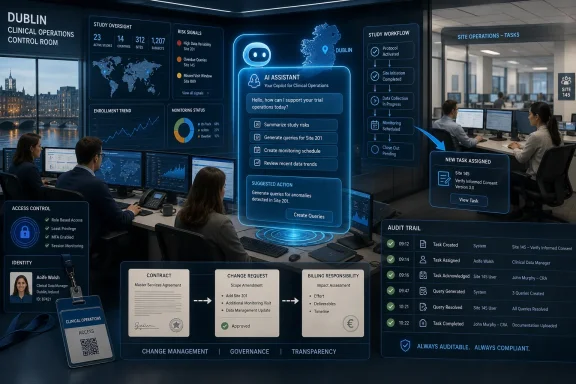 The AI Upgrade Arrives as a Contract Problem
Clinical research organizations have spent years telling sponsors that technology will make trials faster, cleaner, and less labor-intensive. That pitch is not wrong. Anyone who has watched a study team chase missing data across email threads, portals, monitoring reports, and spreadsheet trackers knows that the current model is begging for automation.But the Icon-Microsoft deal is not a new dashboard bolted onto a single protocol. Icon says Microsoft 365 Copilot will be deployed enterprise-wide, while Microsoft cloud, data, and AI infrastructure will help scale Orbis, Icon’s governed agentic AI platform across the clinical development lifecycle. That is the language of a platform migration, not a feature release.
For WindowsForum readers, the analogy is familiar. When a company moves from a local file server and manual approvals into Microsoft 365, Teams, Purview, Power Platform, and Copilot, the licensing line is only the first cost. The real cost is identity, governance, retention, training, workflow redesign, auditability, and support. The same principle applies in clinical operations, except the workflows touch regulated research, patient safety, and sponsor contracts.
The immediate commercial tension is simple. If Orbis reduces monitoring hours, Icon will want credit for the productivity gain. If Orbis creates retraining, validation, or site-support work, sponsors will ask whether that is part of Icon’s overhead. Sites, as usual, will experience the change as unpaid labor unless someone deliberately protects them.
Orbis Makes the Back Office Visible at the Site
The important word in Icon’s announcement is agentic. A conventional analytics system produces recommendations. An agentic system can act across steps in a workflow, escalating issues, generating tasks, prioritizing queues, and routing work based on data signals.In a clinical trial, that distinction is not academic. An AI layer that identifies risk signals might influence which sites receive more frequent monitoring. It might change how data queries are drafted. It might alter how protocol deviations are surfaced, triaged, or escalated. It might also change how project managers allocate CRA time across sites.
From a sponsor’s headquarters, those changes may look like operational optimization. At a site, they arrive as different behavior from the CRO. A coordinator may see new query language, a different tempo of follow-up, a change in source data verification expectations, or a CRA explaining that “the system” flagged the site for additional review.
That is where change management becomes more than training. The site does not need a press release about AI-enabled clinical development. It needs to know whether the monitoring model has changed, whether the documented rationale still matches the work being performed, and whether new expectations are being imposed under an old agreement.
Risk-Based Monitoring Was Supposed to Be Documented, Not Mystical
Clinical operations already moved away from one-size-fits-all monitoring years ago. Risk-based monitoring was meant to focus attention where it matters most: participant safety, critical data, and trial integrity. The point was not to make monitoring opaque. It was to make it more defensible.ICH E6(R3) strengthens the expectation that monitoring approaches be planned, risk-proportionate, and documented. That creates an uncomfortable question for any AI-driven monitoring recalibration. If a CRO’s new platform changes the practical intensity of monitoring mid-study, is that merely an internal method improvement, or is it a change to the monitoring strategy?
The answer will depend on the contract, the monitoring plan, and the degree of change. A background analytics improvement that helps a project manager prioritize work may not require a formal amendment. A system-driven change that doubles visit frequency, expands source verification, or changes query methodology starts to look like something sponsors and sites should have been told about in advance.
The regulatory language does not always map neatly onto modern AI infrastructure. Guidelines can say the sponsor should document monitoring rationale. They do not necessarily say what happens when the risk engine itself becomes a moving target, maintained inside a CRO’s enterprise platform and enhanced through a hyperscaler partnership.
Microsoft Is the Infrastructure Story, Not Just the Copilot Story
It is tempting to read the announcement as “Icon is rolling out Copilot.” That undersells the strategic move. Microsoft 365 Copilot is the recognizable front end, but enterprise cloud, data, and AI infrastructure are the deeper play.For Microsoft, this is exactly the kind of vertical AI adoption it wants: a regulated industry, a data-heavy workflow, and a major services partner embedding Microsoft technology into repeatable operations. For Icon, Microsoft offers scale, governance tooling, identity integration, and a familiar enterprise stack that can make AI adoption look less experimental to sponsors.
But enterprise-grade does not automatically mean study-ready. Clinical systems live under validation expectations, audit trails, role-based access controls, privacy constraints, and sponsor-specific operating procedures. Moving more workflow intelligence into a Microsoft-enabled backbone may improve governance, but it also creates new questions about where records live, how decisions are logged, and who can explain an AI-generated operational action during an inspection.
That is not an argument against Microsoft. In many ways, Microsoft is the safer partner compared with a patchwork of smaller AI vendors. The point is that trust in the vendor does not eliminate the need for documented change control. In regulated operations, the phrase enterprise-wide deployment should make legal, quality, and clinical operations teams sit up straight.
The Savings Will Be Measured Before the Burden Is
The CRO industry has a powerful incentive to frame AI as an efficiency engine. Consulting analyses have already argued that AI could disrupt large portions of CRO value pools, especially monitoring, project management, and patient recruitment. That is the backdrop against which every major CRO is now positioning its platform story.The commercial promise is obvious. If AI can reduce manual review, automate study startup tasks, accelerate feasibility work, and triage monitoring more intelligently, CROs can defend margins while sponsors push for faster trials. In a healthier version of the market, sponsors get lower cost and shorter timelines, CROs get scalable productivity, and sites get fewer redundant requests.
The messier version is more likely in the short term. CROs may capture productivity gains internally while sponsors continue paying under existing work orders. Sponsors may demand savings without funding transition work. Sites may be asked to learn yet another operating rhythm without new compensation.
This is the familiar enterprise software trap: the business case is built on future-state efficiency, while the implementation burden lands immediately on people already operating at capacity. Clinical research sites have been living inside that trap for years.
The 2024 Contract Was Not Written for the 2026 Platform
Many active Phase II and Phase III studies in 2026 were contracted before enterprise agentic AI became a standard procurement topic. Their master service agreements and work orders likely contain language for pass-through costs, technology fees, change orders, and direct expenses. They may not contain language for a CRO-wide AI platform transition that materially changes how services are delivered.That gap matters because clinical trial outsourcing contracts tend to distinguish between the work purchased and the vendor’s internal means of performing it. If Icon changes an internal tool used by its employees, the CRO may argue that no amendment is needed. If the change affects sponsor deliverables, site workflows, validation documentation, monitoring intensity, or training requirements, sponsors will argue that the operational scope has changed.
Neither side is obviously wrong. A CRO must be able to modernize its own systems. A sponsor must be able to control the conduct, budget, and documentation of its study. The collision occurs when an internal platform becomes operationally external.
This is where procurement language written for EDC licenses and pass-through vendor fees starts to look dated. AI platforms do not fit cleanly into “software license,” “internal overhead,” or “study-specific service.” They are all three at once.
Gain-Share Sounds Elegant Until Nobody Agreed on the Baseline
Some analysts have pointed toward gain-share models as a rational way to price AI-driven efficiency. If a CRO’s AI platform shortens timelines or reduces manual effort, the CRO keeps a portion of the value created. In theory, that aligns incentives better than billing hours forever.The problem is that gain-share only works when the baseline is defined before the work changes. Sponsors need to know what the expected monitoring hours, query volumes, startup timelines, and project-management workload would have been without the AI intervention. CROs need a fair way to prove that the platform—not protocol simplicity, site mix, recruitment luck, or sponsor decisions—created the savings.
For studies contracted in 2023 or 2024, that baseline may not exist. If Orbis reduces monitoring effort by 15 percent, the sponsor may expect a discount. Icon may treat the savings as margin recapture from its own investment. If the same platform requires study-team training or documentation updates, both sides may point to the other’s budget.
That is why AI pricing cannot be treated as a finance-team afterthought. The commercial model determines whether the platform is experienced as innovation or as a dispute engine.
Sites Will Pay First Unless Sponsors Intervene
Sites are the least protected party in this conversation. They are also the first place operational ambiguity becomes real.A sponsor can dispute an invoice. A CRO can classify work as billable or nonbillable. A site coordinator usually just absorbs the task. Training modules, system access requests, revised query formats, monitoring schedule changes, portal messages, and “quick alignment calls” all land as time taken from another protocol.
That burden is cumulative. Modern sites already juggle EDC, eConsent, ePRO, IRT, imaging portals, safety systems, document exchange platforms, payment portals, and sponsor-specific trackers. A CRO-side AI layer may not add a login in every case, but it can still add cognitive load by changing the rhythm of requests.
The cruel irony is that AI may reduce work for the CRO while increasing work for the site. If automated risk detection generates more targeted follow-up, the CRO can argue that monitoring is smarter. The site experiences more interruptions. Both things can be true.
The Windows Lesson Is Governance Before Rollout
There is a reason this story belongs on a Windows-focused forum as much as in a clinical research publication. Microsoft’s enterprise AI strategy is increasingly built around embedding Copilot and Azure-backed intelligence into the places work already happens. That means the hard part is no longer installing software. The hard part is governing AI-mediated workflow change.IT administrators know the pattern. A new Microsoft capability appears in the tenant. Business leaders want it enabled. Security asks about data boundaries. Legal asks about retention. Compliance asks about auditability. Users ask why their workflow changed overnight.
Clinical operations is now facing the same model, but with trial records and patient-facing consequences attached. If Orbis is scaled through Microsoft infrastructure, sponsors should ask the same questions a competent Microsoft 365 admin would ask about Copilot: what data is in scope, what actions are logged, what permissions apply, how outputs are reviewed, and who owns incident response when automation behaves unexpectedly.
That does not make the technology suspect. It makes governance central. AI that cannot be governed is not enterprise software; it is a liability with a product roadmap.
The QBR Becomes a Change-Control Meeting
The next quarterly business review between a sponsor and Icon should not be a passive update on digital innovation. It should be a structured change-control discussion.Sponsors should ask whether any active studies will be moved onto Orbis-enabled workflows during the current contract term. They should ask whether monitoring plans, data-management plans, project-management workflows, or site-facing processes will change. They should ask whether any retraining, validation, documentation, or integration work will be charged to the study.
Those questions should be answered in writing. A slide saying “AI-enabled efficiencies” is not enough. If the platform changes how the study is operated, the sponsor needs a record of what changed, when it changed, and whether the change affects cost, quality, or regulatory documentation.
Sites should not wait for the sponsor to sort it out privately. Investigators and coordinators should ask CRAs to document the current monitoring approach and any expected changes in visit frequency, query generation, or source verification. The site does not need to litigate the CRO’s technology roadmap. It needs a baseline.
The Best Version of Orbis Is Boringly Transparent
There is a good version of this story. In that version, Icon uses Microsoft infrastructure to scale a governed AI platform that reduces manual drag, catches risk earlier, improves study startup, and frees CRAs from low-value administrative work. Sponsors get cleaner execution. Sites get fewer redundant requests. Patients benefit from trials that move faster without cutting corners.But that version depends on transparency. Sponsors must know when an AI-enabled process is changing study operations. Sites must know when monitoring expectations change. Quality teams must know how decisions are logged and reviewed. Contracts must say who pays for transition work and who receives efficiency value.
The dangerous version is not killer robots running clinical trials. It is a much more mundane failure: a platform upgrade treated as internal IT modernization even though it changes how regulated work is performed. That is how small ambiguities become invoice disputes, audit findings, site burnout, and damaged trust.
The clinical research industry is not allergic to technology. It is allergic to surprise. A CRO that wants sponsors and sites to accept agentic AI needs to make the operational blast radius visible before the rollout reaches them.
The Invoice Is Only One Line in the Real Orbis Test
The practical readout from the Icon-Microsoft partnership is not whether Copilot can make clinical teams more productive. It probably can. The real test is whether Icon, sponsors, and sites can turn enterprise AI deployment into controlled operational change rather than unmanaged workflow drift.- Sponsors should review active Icon work orders for notification duties, change-order triggers, technology fees, retraining language, and platform-transition provisions.
- Study teams should confirm whether Orbis-enabled workflows will alter monitoring intensity, risk thresholds, query generation, or source data verification during the current study term.
- Sites should ask CRAs to document the current monitoring model before any AI-enabled operating changes arrive.
- Legal and procurement teams should define whether AI-generated efficiency belongs to the sponsor, the CRO, or a pre-agreed gain-share model.
- Quality teams should require clear audit trails, validation documentation, and human review pathways for AI-influenced operational decisions.
- Future CRO agreements should treat enterprise AI platforms as study-impacting infrastructure when they affect site workflows, monitoring plans, or regulated records.
References
- Primary source: The Clinical Trial Vanguard
Published: 2026-06-25T07:50:08.836369
When Your CRO’s AI Platform Upgrades, Who Pays for the Change Management?
Icon's Microsoft-Copilot partnership scales its Orbis AI platform enterprise-wide. For sites and sponsors mid-trial, the operational cost question starts now.www.clinicaltrialvanguard.com - Related coverage: bcg.com
- Related coverage: efor-group.com
ICH E6 (R3): Risk-Based Monitoring in practice | Efor
ICH E6 (R3) is transforming Risk-Based Monitoring into a proactive, digital and quality-driven approach for clinical trials.efor-group.com - Related coverage: web-assets.bcg.com
