

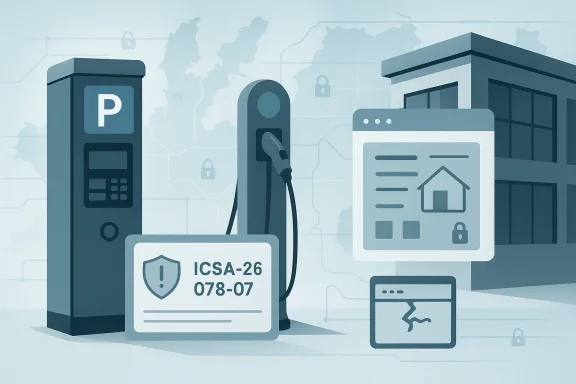
A fresh industrial-cybersecurity advisory tied to IGL-Technologies Oy and its eParking.fi platform appears to be circulating under ICSA-26-078-07, but the originating CISA page is currently unavailable behind the DHS web content outage message. Because CISA’s search surface is not returning a live advisory record for that identifier right now, the safest reading is that this is a newly posted or temporarily inaccessible ICS advisory rather than a fully archived notice. eParking.fi is the flagship service of IGL-Technologies, a Tampere-based Finnish company whose products center on parking management, electric-vehicle charging, and remote control of heating and charging posts, which makes any security issue here relevant to both building operators and EV infrastructure users.
Industrial control system advisories matter because they sit at the intersection of software security, operational technology, and real-world physical processes. Unlike ordinary consumer app bugs, flaws in parking, charging, or building-control platforms can directly affect whether equipment works, whether users can pay, whether access can be granted, and whether operators can maintain service continuity. That is why CISA continues to publish ICS advisories as a dedicated class of security guidance, separate from general-purpose vulnerability bulletins.
IGL-Technologies is not a household name in the United States, but its eParking ecosystem is deeply embedded in parking and EV-charging workflows. The company has described eParking as a long-running platform for parking and charging operations, and its public materials say the system supports payment for parking, electricity billing, and remote management of load and heating posts. In practical terms, that means a single vendor stack can touch vehicles, buildings, payment flows, and user identity management.
That kind of integration is attractive to customers because it simplifies deployment and administration. It is also exactly what makes the platform sensitive: if a vulnerability reaches authentication, configuration, or control-plane functions, the blast radius can expand quickly from a single app instance into a broader parking or charging estate. The more a service becomes a hub, the more it resembles infrastructure. That is why ICS advisories about niche vendors deserve attention well beyond their home market.
The current reporting challenge is that the CISA page itself is not loading cleanly, and the search index does not yet surface a usable advisory entry for this exact code. That makes it hard to confirm whether the issue is a new vulnerability disclosure, a vendor update, an advisory correction, or simply a transient publishing failure on the DHS side. For readers, the practical takeaway is simple: treat the platform as security-relevant and look for vendor guidance, but avoid assuming that the outage message itself is evidence of compromise.
From a security perspective, a product like eParking sits in a difficult middle ground. It is neither a simple website nor a traditional PLC or relay controller, yet it affects physical assets that people rely on daily. The attack surface is therefore mixed: web application logic, backend APIs, mobile clients, payment integrations, device provisioning, and potentially device-to-cloud control channels all matter. That combination is where small bugs can become outsized operational problems.
That is especially true for software that bridges digital systems and physical equipment. Parking and EV charging may not sound as dramatic as grid control or water treatment, but these systems are part of the built environment and increasingly sit inside larger smart-building architectures. A flaw that exposes user data, allows account takeover, or disrupts remote control can still create costly real-world outages.
A vulnerable parking platform can also become a foothold into broader property-management tooling. Many organizations link parking with access badges, EV charging, building automation, and customer support systems. If an attacker can manipulate those links, the business impact extends beyond a single app outage and into a reputational and contractual problem. In enterprise environments, the worst damage is often indirect.
That distinction matters because consumer-facing software often gets judged on usability, not resilience. Yet user reviews for eParking already suggest mixed experiences around reliability and support, which means any security event could compound an existing trust problem. Even when vulnerabilities are technical, the customer remembers the outcome: failed sessions, broken payments, or inaccessible services.
This is where IGL-Technologies’ hybrid model cuts both ways. Its broad platform can be compelling because it addresses parking, charging, and billing together, but a security issue in any one layer can tarnish the entire stack. Rivals may not need to be more feature-rich; they may simply need to be more boring, with cleaner segmentation and fewer moving parts.
The history of ICS security also helps explain why this matters. Earlier generations of control systems were isolated, proprietary, and awkward to update. Modern systems are more flexible, cloud-connected, and easier to manage, but they also inherit web-app risks like authentication failures, exposed APIs, and insecure integration boundaries. The consequence is a wider attack surface hidden behind a friendlier UI.
If the final disclosure turns out to involve authentication, exposed APIs, or remote control functions, the story will be larger than a single parking platform. It will reinforce a familiar 2026 lesson: the most important vulnerabilities are often not in dramatic infrastructure products, but in the cloud-connected operational tools that quietly run everyday life. Parking, charging, access, and billing are becoming one system, and one system means one security problem can matter everywhere.
Source: CISA IGL-Technologies eParking.fi | CISA
 Background
Industrial control system advisories matter because they sit at the intersection of software security, operational technology, and real-world physical processes. Unlike ordinary consumer app bugs, flaws in parking, charging, or building-control platforms can directly affect whether equipment works, whether users can pay, whether access can be granted, and whether operators can maintain service continuity. That is why CISA continues to publish ICS advisories as a dedicated class of security guidance, separate from general-purpose vulnerability bulletins.IGL-Technologies is not a household name in the United States, but its eParking ecosystem is deeply embedded in parking and EV-charging workflows. The company has described eParking as a long-running platform for parking and charging operations, and its public materials say the system supports payment for parking, electricity billing, and remote management of load and heating posts. In practical terms, that means a single vendor stack can touch vehicles, buildings, payment flows, and user identity management.
That kind of integration is attractive to customers because it simplifies deployment and administration. It is also exactly what makes the platform sensitive: if a vulnerability reaches authentication, configuration, or control-plane functions, the blast radius can expand quickly from a single app instance into a broader parking or charging estate. The more a service becomes a hub, the more it resembles infrastructure. That is why ICS advisories about niche vendors deserve attention well beyond their home market.
The current reporting challenge is that the CISA page itself is not loading cleanly, and the search index does not yet surface a usable advisory entry for this exact code. That makes it hard to confirm whether the issue is a new vulnerability disclosure, a vendor update, an advisory correction, or simply a transient publishing failure on the DHS side. For readers, the practical takeaway is simple: treat the platform as security-relevant and look for vendor guidance, but avoid assuming that the outage message itself is evidence of compromise.
What eParking.fi Actually Does
eParking.fi is best understood as more than a parking app. It is a service layer for parking permits, payment, EV charging, and connected heating infrastructure, which means it must speak to both end users and installed hardware. That dual role creates a classic IT/OT crossover problem: the same environment has to be usable like a consumer app while remaining trustworthy like a building system.The platform’s functional scope
Public descriptions of the service say users can manage parking, pay electricity bills tied to charging or heating, and interact with remote-controlled posts. The company also positions itself around open interfaces and roaming concepts in EV charging, which suggests it participates in a broader ecosystem rather than operating as a closed, single-purpose utility. That ecosystem integration is commercially smart, but it raises the stakes if authorization or data handling is imperfect.From a security perspective, a product like eParking sits in a difficult middle ground. It is neither a simple website nor a traditional PLC or relay controller, yet it affects physical assets that people rely on daily. The attack surface is therefore mixed: web application logic, backend APIs, mobile clients, payment integrations, device provisioning, and potentially device-to-cloud control channels all matter. That combination is where small bugs can become outsized operational problems.
Why the hybrid model matters
The hybrid model can be a strength because it lets operators centralize administration. It can also become a liability if customers assume cloud convenience equals low risk. In the real world, parking operators and housing companies often want remote management, billing automation, and self-service access, but those features only work safely when authentication and tenant separation are airtight.- Centralized control can reduce manual overhead.
- Remote billing makes operations scalable.
- Connected charging improves utilization.
- Open interfaces support ecosystem growth.
- Weak segregation can widen impact if one account is compromised.
Why CISA Advisories Matter Here
CISA’s ICS advisories are not casual blog posts; they are a formal channel for warning operators about exploitable weaknesses that may affect critical or semi-critical infrastructure. The agency’s coordinated vulnerability disclosure program exists precisely so vendors, researchers, and defenders can align on accurate, actionable guidance. When CISA issues or republishes an ICS notice, the expectation is that operators will treat it as operationally relevant, not just theoretically interesting.That is especially true for software that bridges digital systems and physical equipment. Parking and EV charging may not sound as dramatic as grid control or water treatment, but these systems are part of the built environment and increasingly sit inside larger smart-building architectures. A flaw that exposes user data, allows account takeover, or disrupts remote control can still create costly real-world outages.
Reading the advisory code
The code ICSA-26-078-07 follows CISA’s standard ICS advisory naming pattern, which strongly suggests a March 2026 advisory sequence. Even without a live page, the naming convention signals that this is supposed to be treated as a structured advisory record rather than a loose mention in an unrelated bulletin. That matters because operators often use advisory IDs to map patch campaigns, ticketing, and compliance checks.- Advisory IDs are used operationally in patch workflows.
- CISA’s ICS channel is meant for technical remediation.
- A missing page does not necessarily mean the issue is false.
- Temporary unavailability can delay mitigation tracking.
- Vendors and operators should still preserve internal records.
The publication outage itself
The DHS message about the web content platform being unavailable is significant for a different reason: it shows how public cyber information can be temporarily harder to access exactly when defenders need it most. For a short window, that can slow triage, especially for organizations that rely on the CISA page as the canonical source for affected versions and mitigations. The lesson is not dramatic, but it is important: maintain secondary channels, local copies, and vendor contacts.What We Can Infer — and What We Cannot
What can be inferred is that the advisory is likely connected to a product with real-world operational reach and that CISA considered the issue worthy of an ICS label. What cannot be confirmed from the currently available public evidence is the exact vulnerability class, affected versions, severity, or remediation steps. Without the live advisory text, anything more specific would be speculation, and speculation is exactly what defenders should avoid in incident response.Practical implications of incomplete visibility
Incomplete visibility is not uncommon with newly posted government advisories, especially when content delivery or redirection issues interfere with the page load. In those cases, the best operational posture is to treat the notice as potentially real, but to wait for the vendor or CISA to confirm details before taking disruptive action. That balancing act is dull, but it is also how mature security teams avoid self-inflicted outages.- Confirm whether the vendor has issued matching guidance.
- Check whether internal systems use the affected product family.
- Preserve logs from the time the advisory appeared.
- Avoid broad changes until the scope is validated.
- Prepare temporary compensating controls.
Enterprise Impact
For enterprise customers, eParking is not just a convenience layer; it is often part of tenant services, parking revenue, and facilities automation. If the advisory concerns authentication, session handling, API access, or remote device control, the implications can range from service degradation to payment issues or unauthorized operational changes. Enterprises also tend to have more complex identity and integration environments, which means one flaw can be amplified by many connected systems.A vulnerable parking platform can also become a foothold into broader property-management tooling. Many organizations link parking with access badges, EV charging, building automation, and customer support systems. If an attacker can manipulate those links, the business impact extends beyond a single app outage and into a reputational and contractual problem. In enterprise environments, the worst damage is often indirect.
Operational priorities for IT and facilities teams
Teams should map every location using eParking or any adjacent IGL-Technologies component. They should also identify whether the platform is hosted by the vendor, by a reseller, or on-premises, because that changes patch ownership and incident escalation paths. Those distinctions matter more than many organizations realize, especially when a product spans software and physical control points.- Inventory affected properties and installations.
- Identify whether any remote-control features are enabled.
- Check for vendor notices, hotfixes, or tenant advisories.
- Review access logs for unusual administration actions.
- Coordinate facilities, IT, and security teams before changing settings.
Consumer and Driver Impact
Consumers feel these issues differently. A parking operator may worry about service continuity and billing integrity, while a driver mostly cares whether the app works, whether payment succeeds, and whether a charging or heating point behaves normally. If an advisory relates to the mobile app, backend login, or payment workflow, users may notice the issue first as frustration rather than as a formal security event.That distinction matters because consumer-facing software often gets judged on usability, not resilience. Yet user reviews for eParking already suggest mixed experiences around reliability and support, which means any security event could compound an existing trust problem. Even when vulnerabilities are technical, the customer remembers the outcome: failed sessions, broken payments, or inaccessible services.
User trust and service continuity
For EV drivers, the practical risk is not abstract. If a charging session fails, the consequences can include delays, missed appointments, or the inability to complete a trip. If parking payment or permit enforcement is affected, the problem turns into a customer-service issue immediately, and users may not care whether the cause was a patch, an outage, or a security mitigation. They only know the service stopped behaving like a service.- App reliability is a trust anchor.
- Billing errors can create support backlogs.
- Charging failures affect mobility, not just convenience.
- Security changes may appear to users as outages.
- Clear communication reduces confusion.
Competitive and Market Implications
The Nordic and European EV-charging ecosystem is highly competitive, and that competition increasingly includes software trustworthiness. Companies do not just sell hardware or a mobile app; they sell an operational promise that charging, billing, and permit management will work consistently across many locations. If one platform is forced into prolonged remediation, competitors can use that moment to highlight resilience, customer support, and simpler architecture.This is where IGL-Technologies’ hybrid model cuts both ways. Its broad platform can be compelling because it addresses parking, charging, and billing together, but a security issue in any one layer can tarnish the entire stack. Rivals may not need to be more feature-rich; they may simply need to be more boring, with cleaner segmentation and fewer moving parts.
Ecosystem pressure
The broader market has been moving toward interoperability, open APIs, and roaming arrangements. That trend helps customers avoid lock-in, but it also means vendors compete on trust, patch discipline, and operational transparency. In that environment, a CISA-linked advisory can have a reputational effect even if the technical flaw is narrow.- Security posture is now a sales differentiator.
- Operators compare uptime as closely as pricing.
- Vendors with transparent remediation win trust faster.
- Ecosystem integration raises both opportunity and liability.
- Open interfaces need strong identity controls.
Historical Context: How We Got Here
The evolution of eParking mirrors the broader digitalization of mobility. What started as a specialized parking and heating-control service has grown into a networked system that touches EV charging, parking permissions, and remote administration. Public material indicates that IGL-Technologies has spent years building the platform around real estate and mobility use cases, which is exactly the kind of gradual expansion that creates a larger security footprint over time.The history of ICS security also helps explain why this matters. Earlier generations of control systems were isolated, proprietary, and awkward to update. Modern systems are more flexible, cloud-connected, and easier to manage, but they also inherit web-app risks like authentication failures, exposed APIs, and insecure integration boundaries. The consequence is a wider attack surface hidden behind a friendlier UI.
Why parking and charging are now security topics
Parking and charging were once operational chores. Now they are digital services with user identities, payment flows, billing records, and telemetry. That means a flaw in a parking platform is no longer just a local nuisance; it becomes part of the modern cyber-risk conversation that includes service availability, privacy, and potentially safety. The category changed before many operators noticed it had changed.Strengths and Opportunities
Even with the current advisory uncertainty, the underlying platform still has meaningful strengths. It serves a growing market, it addresses multiple operator pain points at once, and it sits in an ecosystem that is only becoming more connected. If IGL-Technologies handles the issue well, it can reinforce trust rather than lose it.- Strong fit for EV charging and parking convergence.
- Useful remote-management capabilities for operators.
- Clear alignment with smart-building and mobility trends.
- Potentially sticky customer relationships due to operational integration.
- Open-interface strategy can support partner growth.
- A well-managed response can improve credibility.
- Rapid remediation can differentiate the vendor from slower competitors.
Risks and Concerns
The biggest risks are not limited to one advisory page. They include uncertainty about scope, delays caused by the inaccessible CISA content, and the possibility that customers may not know whether they are affected. If the issue involves access control or backend services, the impact could spread across parking, charging, and billing workflows simultaneously.- Unclear affected-version scope.
- Delayed remediation because the advisory page is unavailable.
- Customer confusion over whether the issue is security-related or merely a service outage.
- Risk of overreaction if organizations patch blindly.
- Risk of underreaction if they wait too long.
- Possible reputational damage if support communication is slow.
- Compounding effects in properties that rely on many integrated services.
Looking Ahead
The next step is straightforward: wait for the advisory to become fully readable or for the vendor to publish matching technical guidance, then reconcile that with internal asset inventories. Organizations using eParking should assume this is a meaningful event until proven otherwise, but they should avoid changing production systems without a clear remediation path. That conservative posture is not exciting, yet it is the right response when a government advisory is partially inaccessible.If the final disclosure turns out to involve authentication, exposed APIs, or remote control functions, the story will be larger than a single parking platform. It will reinforce a familiar 2026 lesson: the most important vulnerabilities are often not in dramatic infrastructure products, but in the cloud-connected operational tools that quietly run everyday life. Parking, charging, access, and billing are becoming one system, and one system means one security problem can matter everywhere.
- Watch for a restored CISA advisory page.
- Watch for vendor patch or mitigation notes.
- Watch for operator advisories from affected property managers.
- Watch for evidence of whether the flaw is local, remote, or authentication-based.
- Watch for whether the issue affects mobile users, administrators, or both.
Source: CISA IGL-Technologies eParking.fi | CISA
Last edited:
