

CISA published advisory ICSA-26-148-01 on May 28, 2026, warning that MacGregor’s Voyage Data Recorder G4e is affected by multiple credential and access-control weaknesses that could let an attacker gain administrator access to the maritime device. The advisory is narrow in product scope but broad in operational meaning: a ship’s “black box” is no longer just a passive recorder when it is networked, remotely supported, and trusted after an incident. The uncomfortable lesson is that maritime safety equipment has inherited the same old security sins that enterprise IT has spent decades trying to stamp out. Default credentials, weakly protected passwords, and hard-coded secrets are not exotic vulnerabilities; they are the residue of an industry that connected operational gear faster than it modernized its assumptions.
The MacGregor VDR G4e is not a consumer gadget, a cloud service, or a Windows endpoint sitting under a desk. It is a voyage data recorder, the maritime cousin of an aircraft flight recorder, designed to collect and preserve navigational, sensor, bridge audio, and operational data so investigators can reconstruct what happened after a casualty. That mission gives the device an unusual status aboard ship: it is both mundane infrastructure and evidence system.
That dual role is what makes this advisory worth more than a routine vulnerability notice. CISA says successful exploitation could allow an attacker to gain administrator access to the device, and the listed weakness classes read like a roll call of avoidable design debt: use of default credentials, insufficiently protected credentials, weak password hashing, hard-coded credentials, and files or directories exposed to external parties. In a purely office-IT context, those would already be serious. In a safety and incident-investigation context, they carry a different kind of weight.
The usual temptation is to ask whether an attacker could “take over the ship” through a VDR. That is the wrong first question. The sharper concern is whether an attacker can compromise a trusted recorder, move through adjacent networks, hide what happened, or harvest data that helps a later operation. Safety equipment does not have to steer the rudder to matter strategically.
Voyage data recorders sit at an awkward intersection of regulation, retrofitting, shipyard economics, and long service life. They must interface with many onboard systems, survive harsh environments, and remain usable by crews and investigators who may not be cybersecurity specialists. Those requirements often produce devices that are reachable, serviceable, and durable — three virtues that become liabilities when authentication is weak.
In the maritime world, those incentives are especially powerful. A vessel may change flags, management companies, satellite providers, maintenance contractors, and operating routes while embedded systems remain onboard. Documentation is not always perfect. Crew turnover is real. A technician who needs to restore service quickly in port may prize a known password more than a clean credential lifecycle.
That is precisely why hard-coded or shared secrets are so dangerous in operational technology. A password that feels like a service convenience on day one can become a skeleton key on day 2,000. If the same credential works across units, or if hashes can be cracked cheaply, the compromise of one device can inform attacks against many others.
CISA’s phrasing does not say public exploitation is underway. In fact, the agency says it has not received reports of known public exploitation specifically targeting these vulnerabilities. That is important, but it should not become a sedative. In industrial and maritime environments, the absence of public exploitation is often a statement about visibility, not impossibility.
Attackers do not need a splashy exploit chain when vendors have accidentally left them a door key. The defensive question for operators is not whether this advisory has already become ransomware tradecraft. It is whether their own deployments assume the VDR is safely obscure, safely internal, or safely “not IT.”
The VDR’s value to an attacker is not limited to the contents of the recorder itself. A device that touches bridge systems, shipboard networks, remote support workflows, and maintenance channels can offer reconnaissance opportunities. The attacker may learn network addressing, naming conventions, connected equipment, operational routines, or vendor support patterns.
That matters because maritime cyber incidents are rarely about a single box. Ships are systems of systems. Navigation, communications, cargo handling, engine monitoring, hotel systems, corporate IT, port interfaces, and satellite links may be separated cleanly on a well-run vessel — or entangled by years of retrofits and urgent fixes on a less disciplined one.
The advisory’s “files or directories accessible to external parties” language is another red flag. Exposed directories can turn a device into a map. Even if the contents are not catastrophic on their own, they may reveal versions, configuration files, backup artifacts, password material, logs, or installer packages. In real intrusions, such scraps often become the connective tissue between initial access and meaningful compromise.
There is also a subtler integrity problem. If an incident occurs after a VDR has been compromised, investigators and insurers may face uncomfortable questions about the chain of trust. Was the recorder functioning normally? Were files altered? Were logs complete? Could an administrator-level attacker have disabled, deleted, or manipulated data? Even the need to ask those questions weakens the evidentiary value of the system.
Maritime OT often arrives at the same lesson later because its procurement cycle is different. Ships are expensive, regulated, and long-lived. Equipment is chosen for approval status, service availability, interoperability, and survivability. A product that works reliably across a fleet for a decade can accumulate security assumptions that would be unacceptable in a modern enterprise appliance.
The MacGregor advisory is therefore not just about one model. It is about the lag between connectivity and governance. Remote support, cloud-assisted monitoring, long-term recording, and data analytics all create legitimate operational value. They also erase the old comfort that shipboard systems are isolated by geography.
The sea is not an air gap when a device has remote service pathways, satellite connectivity, vendor support access, or a bridge into business networks. Nor is obscurity a control when researchers, attackers, insurers, classification societies, and port-state authorities increasingly understand that maritime systems are just specialized computers wearing rugged enclosures.
The old IT joke is that every industry eventually invents Active Directory badly. Maritime has its own version: every safety-critical subsystem eventually becomes a managed endpoint, but without the endpoint management discipline. The result is a fleet of embedded systems that may be essential, certified, and poorly integrated into modern vulnerability management.
That advice will not thrill anyone looking for a silver bullet. It is nonetheless the correct starting point because vulnerabilities involving credentials get dramatically worse when devices are exposed or reachable from broad networks. A weak password is one problem on a tightly controlled maintenance segment. It is another problem entirely when the management interface is discoverable from a corporate subnet, a satellite link, or the public internet.
For ship operators, the hard work is not reading the mitigation paragraph. It is translating it into fleet reality. Which vessels carry the affected VDR G4e? Which firmware and configuration states are present? Which accounts exist? Which credentials are unique? Which interfaces are exposed? Which remote service channels are active? Which firewall rules were added years ago and never revisited?
The answer will not always be in a neat CMDB. Maritime asset inventories are notoriously uneven because vessels are mobile, crews rotate, contractors install equipment, and shore-side IT may not control bridge electronics. This is where an advisory becomes a governance test. If an operator cannot quickly determine exposure to a named product vulnerability, the vulnerability is only one symptom of a larger operational blind spot.
Network segmentation is similarly easy to endorse and harder to prove. A diagram may show a clean boundary between operational technology and business networks, but a vessel may contain maintenance laptops, temporary cellular routers, vendor modems, shared switches, or undocumented connections that defeat the diagram. Security lives in the as-built network, not the as-imagined one.
The industry’s reaction to such research has not always been graceful. Safety-regulated sectors can be defensive because disclosure threatens reputation, certification confidence, and customer trust. But mature handling of vulnerability reports is now part of product safety. A device that cannot tolerate scrutiny is not more secure because nobody talks about it.
The MacGregor case also shows why coordinated disclosure remains valuable. CISA’s advisory gives operators a common reference point, a severity score, a list of weakness categories, and basic mitigations. That is not the same as a complete remediation playbook, but it is far better than rumor, private emails, or a proof-of-concept dropped without warning.
For vendors, the deeper obligation is to move beyond one-off fixes. Credential flaws tend to be systemic. If a product contains hard-coded accounts, weak hashes, and exposed directories, the remediation likely requires more than changing a password. It may require redesigning authentication, improving file permissions, rotating service credentials, adding logging, revisiting recovery workflows, and creating a practical upgrade path for vessels that cannot simply reboot during operations.
That is the challenge with maritime equipment: even when a fix exists, deployment is constrained by class approvals, maintenance windows, port calls, spare parts, crew workload, and risk assessments. Security engineering has to meet that environment rather than pretend ships behave like office laptops on a Tuesday patch cycle.
For a VDR, confidentiality, integrity, and availability are not abstract security properties. Confidentiality may involve bridge audio, voyage data, operational patterns, and potentially sensitive incident material. Integrity may affect the reconstruction of an accident or near miss. Availability may determine whether data exists when investigators need it.
The score also does not fully capture fleet-scale risk. A vulnerability in a niche maritime device may look smaller than a flaw in a mass-market Windows component, but the affected environments can be high-value, hard to patch, and globally distributed. A smaller population of devices can still matter if each device sits inside critical transportation infrastructure.
CISA lists the critical infrastructure sector as Transportation Systems and deployment as worldwide. That should shift the mental model from “a product bug” to “a distributed operational risk.” The devices may be scattered across fleets, flags, and management companies, but the weakness class is common enough that attackers understand how to exploit it once they find reachable targets.
There is no need to exaggerate the advisory into a cyber-doom scenario. The responsible reading is more precise: a trusted maritime recorder may be susceptible to administrative compromise through avoidable credential and exposure weaknesses, and operators should assume that reachable management interfaces are risky until proven otherwise.
Shore-side systems often handle remote monitoring, maintenance coordination, crew administration, compliance reporting, fleet analytics, file transfer, and vendor support. If a shipboard device is compromised, the attacker may seek credentials or pathways that eventually touch corporate networks. If corporate IT is compromised, the attacker may pivot toward vessels through management channels.
This is where traditional Windows administration and maritime OT security meet. Identity, segmentation, patch governance, remote access, logging, backup integrity, and least privilege are not “IT-only” concerns. They are the connective tissue of any organization that runs distributed technical assets.
A VDR may not join Active Directory, but the laptops used to service it might. The remote support portal may rely on Windows endpoints. The documentation share may contain default credential sheets. The firewall rule request may come through an IT ticket. The incident response team may be asked to determine whether recorder data can be trusted.
That is why advisories like this should be read by more than marine electronics specialists. They reveal the places where operational systems inherit enterprise dependencies without enterprise controls. The practical response is not to make shipboard OT look exactly like office IT. It is to bring the strongest IT disciplines — inventory, identity, monitoring, segmentation, and change control — into the maritime context without breaking operations.
The first operational step is discovery. Fleet operators need to identify every MacGregor VDR G4e deployment, including vessels under third-party management, recently acquired ships, laid-up vessels, and training or simulator environments. The second step is exposure mapping: determine whether management interfaces are reachable from business networks, satellite paths, Wi-Fi, service laptops, or the public internet.
The third step is credential hygiene. Default accounts should be disabled or changed where the product permits it, unique strong credentials should be used per vessel and per role, and any vendor or service accounts should be documented and time-bounded. If the device uses weak password hashing internally, compensating controls around access become even more important because a stolen hash may be easier to crack.
The fourth step is evidence preservation. If there is any suspicion that a VDR has been accessed improperly, operators should avoid casually overwriting logs or configurations before incident responders can collect them. The device’s role as a recorder means that forensic handling matters more than it would for a disposable appliance.
Finally, operators should test their assumptions. A firewall rule that supposedly blocks access should be verified. A remote support account that supposedly no longer exists should be checked. A vessel network diagram should be compared with switch configurations and actual cabling. Maritime cyber risk is full of comforting paperwork; attackers care only about the reachable path.
The VDR advisory fits into that broader regulatory and commercial pressure. A ship that cannot protect safety-relevant data, maintain trusted records, or control remote access is not merely suffering an IT problem. It is carrying operational uncertainty. Insurers, charterers, port authorities, classification societies, and investigators all have reasons to care.
This does not mean every vulnerability becomes a detention-worthy emergency. Shipping is a risk-managed business, and not every advisory requires the same response timeline. But credential flaws in safety-adjacent systems should rise above the noise because they are easy to understand, frequently exploitable, and often preventable.
The industry’s next maturity step is to stop treating cyber hygiene as a retrofit tax. Security requirements should be part of procurement, acceptance testing, service contracts, and lifecycle management. Vendors should be expected to provide unique credentials, secure update mechanisms, documented hardening guidance, vulnerability disclosure processes, and realistic support for deployed fleets.
That expectation should extend to replacement planning. If an older device cannot support basic credential management or secure remote administration, operators should account for that limitation in risk decisions. Sometimes mitigation is enough. Sometimes the honest answer is that the device belongs on a tightly isolated island until it can be replaced.
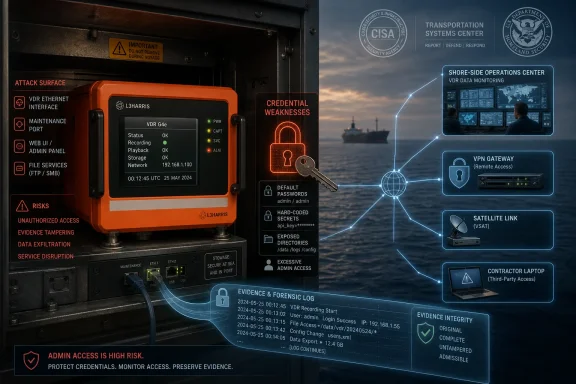 A Ship’s Black Box Has Become Part of the Attack Surface
The MacGregor VDR G4e is not a consumer gadget, a cloud service, or a Windows endpoint sitting under a desk. It is a voyage data recorder, the maritime cousin of an aircraft flight recorder, designed to collect and preserve navigational, sensor, bridge audio, and operational data so investigators can reconstruct what happened after a casualty. That mission gives the device an unusual status aboard ship: it is both mundane infrastructure and evidence system.That dual role is what makes this advisory worth more than a routine vulnerability notice. CISA says successful exploitation could allow an attacker to gain administrator access to the device, and the listed weakness classes read like a roll call of avoidable design debt: use of default credentials, insufficiently protected credentials, weak password hashing, hard-coded credentials, and files or directories exposed to external parties. In a purely office-IT context, those would already be serious. In a safety and incident-investigation context, they carry a different kind of weight.
The usual temptation is to ask whether an attacker could “take over the ship” through a VDR. That is the wrong first question. The sharper concern is whether an attacker can compromise a trusted recorder, move through adjacent networks, hide what happened, or harvest data that helps a later operation. Safety equipment does not have to steer the rudder to matter strategically.
Voyage data recorders sit at an awkward intersection of regulation, retrofitting, shipyard economics, and long service life. They must interface with many onboard systems, survive harsh environments, and remain usable by crews and investigators who may not be cybersecurity specialists. Those requirements often produce devices that are reachable, serviceable, and durable — three virtues that become liabilities when authentication is weak.
The Oldest Security Failure Still Works at Sea
The most striking feature of the CISA advisory is not novelty. It is familiarity. Default credentials and hard-coded credentials are among the oldest failures in networked technology because they make deployment easy, support predictable, and manufacturing simpler. They also age terribly once a product is installed across fleets, passed between owners, serviced by contractors, and left in place for years.In the maritime world, those incentives are especially powerful. A vessel may change flags, management companies, satellite providers, maintenance contractors, and operating routes while embedded systems remain onboard. Documentation is not always perfect. Crew turnover is real. A technician who needs to restore service quickly in port may prize a known password more than a clean credential lifecycle.
That is precisely why hard-coded or shared secrets are so dangerous in operational technology. A password that feels like a service convenience on day one can become a skeleton key on day 2,000. If the same credential works across units, or if hashes can be cracked cheaply, the compromise of one device can inform attacks against many others.
CISA’s phrasing does not say public exploitation is underway. In fact, the agency says it has not received reports of known public exploitation specifically targeting these vulnerabilities. That is important, but it should not become a sedative. In industrial and maritime environments, the absence of public exploitation is often a statement about visibility, not impossibility.
Attackers do not need a splashy exploit chain when vendors have accidentally left them a door key. The defensive question for operators is not whether this advisory has already become ransomware tradecraft. It is whether their own deployments assume the VDR is safely obscure, safely internal, or safely “not IT.”
The Risk Is Administrative Control, Not Just Data Exposure
Administrator access to a voyage data recorder is a serious outcome because the device is supposed to be a reliable witness. At minimum, admin control can expose configuration data, stored recordings, logs, credentials, and network details. Depending on implementation and integration, it may also allow changes to users, services, firmware, storage behavior, or remote access settings.The VDR’s value to an attacker is not limited to the contents of the recorder itself. A device that touches bridge systems, shipboard networks, remote support workflows, and maintenance channels can offer reconnaissance opportunities. The attacker may learn network addressing, naming conventions, connected equipment, operational routines, or vendor support patterns.
That matters because maritime cyber incidents are rarely about a single box. Ships are systems of systems. Navigation, communications, cargo handling, engine monitoring, hotel systems, corporate IT, port interfaces, and satellite links may be separated cleanly on a well-run vessel — or entangled by years of retrofits and urgent fixes on a less disciplined one.
The advisory’s “files or directories accessible to external parties” language is another red flag. Exposed directories can turn a device into a map. Even if the contents are not catastrophic on their own, they may reveal versions, configuration files, backup artifacts, password material, logs, or installer packages. In real intrusions, such scraps often become the connective tissue between initial access and meaningful compromise.
There is also a subtler integrity problem. If an incident occurs after a VDR has been compromised, investigators and insurers may face uncomfortable questions about the chain of trust. Was the recorder functioning normally? Were files altered? Were logs complete? Could an administrator-level attacker have disabled, deleted, or manipulated data? Even the need to ask those questions weakens the evidentiary value of the system.
Maritime OT Keeps Rediscovering Enterprise IT’s Bad Habits
For WindowsForum readers, the pattern will feel familiar. The enterprise world has spent decades learning that credentials are infrastructure, not paperwork. Password hashes need modern computational cost. Defaults must be changed. Administrative accounts must be unique, auditable, and revocable. Sensitive files cannot sit in reachable paths simply because “only technicians know where they are.”Maritime OT often arrives at the same lesson later because its procurement cycle is different. Ships are expensive, regulated, and long-lived. Equipment is chosen for approval status, service availability, interoperability, and survivability. A product that works reliably across a fleet for a decade can accumulate security assumptions that would be unacceptable in a modern enterprise appliance.
The MacGregor advisory is therefore not just about one model. It is about the lag between connectivity and governance. Remote support, cloud-assisted monitoring, long-term recording, and data analytics all create legitimate operational value. They also erase the old comfort that shipboard systems are isolated by geography.
The sea is not an air gap when a device has remote service pathways, satellite connectivity, vendor support access, or a bridge into business networks. Nor is obscurity a control when researchers, attackers, insurers, classification societies, and port-state authorities increasingly understand that maritime systems are just specialized computers wearing rugged enclosures.
The old IT joke is that every industry eventually invents Active Directory badly. Maritime has its own version: every safety-critical subsystem eventually becomes a managed endpoint, but without the endpoint management discipline. The result is a fleet of embedded systems that may be essential, certified, and poorly integrated into modern vulnerability management.
CISA’s Mitigation Advice Is Boring Because It Is Correct
CISA’s recommended practices are familiar: minimize network exposure, keep control-system devices off the internet, place control-system networks and remote devices behind firewalls, isolate them from business networks, and use more secure remote access methods such as VPNs when remote access is required. The agency also reminds operators that VPNs are only as secure as the connected devices and must themselves be kept current.That advice will not thrill anyone looking for a silver bullet. It is nonetheless the correct starting point because vulnerabilities involving credentials get dramatically worse when devices are exposed or reachable from broad networks. A weak password is one problem on a tightly controlled maintenance segment. It is another problem entirely when the management interface is discoverable from a corporate subnet, a satellite link, or the public internet.
For ship operators, the hard work is not reading the mitigation paragraph. It is translating it into fleet reality. Which vessels carry the affected VDR G4e? Which firmware and configuration states are present? Which accounts exist? Which credentials are unique? Which interfaces are exposed? Which remote service channels are active? Which firewall rules were added years ago and never revisited?
The answer will not always be in a neat CMDB. Maritime asset inventories are notoriously uneven because vessels are mobile, crews rotate, contractors install equipment, and shore-side IT may not control bridge electronics. This is where an advisory becomes a governance test. If an operator cannot quickly determine exposure to a named product vulnerability, the vulnerability is only one symptom of a larger operational blind spot.
Network segmentation is similarly easy to endorse and harder to prove. A diagram may show a clean boundary between operational technology and business networks, but a vessel may contain maintenance laptops, temporary cellular routers, vendor modems, shared switches, or undocumented connections that defeat the diagram. Security lives in the as-built network, not the as-imagined one.
The Researcher Credit Matters More Than It Looks
CISA credits Andrew Tierney of Pen Test Partners with reporting the vulnerabilities. That detail matters because maritime cybersecurity has benefited heavily from independent research that looks past vendor brochures and into deployed reality. Researchers have repeatedly shown that ships, ports, offshore systems, satellite terminals, and navigation-adjacent technologies contain the same classes of bugs found elsewhere, often with higher operational stakes.The industry’s reaction to such research has not always been graceful. Safety-regulated sectors can be defensive because disclosure threatens reputation, certification confidence, and customer trust. But mature handling of vulnerability reports is now part of product safety. A device that cannot tolerate scrutiny is not more secure because nobody talks about it.
The MacGregor case also shows why coordinated disclosure remains valuable. CISA’s advisory gives operators a common reference point, a severity score, a list of weakness categories, and basic mitigations. That is not the same as a complete remediation playbook, but it is far better than rumor, private emails, or a proof-of-concept dropped without warning.
For vendors, the deeper obligation is to move beyond one-off fixes. Credential flaws tend to be systemic. If a product contains hard-coded accounts, weak hashes, and exposed directories, the remediation likely requires more than changing a password. It may require redesigning authentication, improving file permissions, rotating service credentials, adding logging, revisiting recovery workflows, and creating a practical upgrade path for vessels that cannot simply reboot during operations.
That is the challenge with maritime equipment: even when a fix exists, deployment is constrained by class approvals, maintenance windows, port calls, spare parts, crew workload, and risk assessments. Security engineering has to meet that environment rather than pretend ships behave like office laptops on a Tuesday patch cycle.
Severity Scores Understate the Trust Problem
The advisory gives the issue a CVSS v3 score of 8.3, which places it in high-severity territory. That number is useful for prioritization, but it cannot capture the full trust dimension of a compromised recorder. CVSS is good at describing technical exploitability and impact categories. It is less good at measuring what happens when a system of record becomes suspect.For a VDR, confidentiality, integrity, and availability are not abstract security properties. Confidentiality may involve bridge audio, voyage data, operational patterns, and potentially sensitive incident material. Integrity may affect the reconstruction of an accident or near miss. Availability may determine whether data exists when investigators need it.
The score also does not fully capture fleet-scale risk. A vulnerability in a niche maritime device may look smaller than a flaw in a mass-market Windows component, but the affected environments can be high-value, hard to patch, and globally distributed. A smaller population of devices can still matter if each device sits inside critical transportation infrastructure.
CISA lists the critical infrastructure sector as Transportation Systems and deployment as worldwide. That should shift the mental model from “a product bug” to “a distributed operational risk.” The devices may be scattered across fleets, flags, and management companies, but the weakness class is common enough that attackers understand how to exploit it once they find reachable targets.
There is no need to exaggerate the advisory into a cyber-doom scenario. The responsible reading is more precise: a trusted maritime recorder may be susceptible to administrative compromise through avoidable credential and exposure weaknesses, and operators should assume that reachable management interfaces are risky until proven otherwise.
Windows Shops Should Care Because Ships Are Now Branch Offices With Propellers
A Windows-focused audience might reasonably ask why a maritime VDR advisory belongs on its radar. The answer is that many organizations no longer have a clean boundary between IT and operational environments. Shipping companies, port operators, energy firms, logistics providers, insurers, ship managers, and vendors all depend on Windows infrastructure somewhere in the chain.Shore-side systems often handle remote monitoring, maintenance coordination, crew administration, compliance reporting, fleet analytics, file transfer, and vendor support. If a shipboard device is compromised, the attacker may seek credentials or pathways that eventually touch corporate networks. If corporate IT is compromised, the attacker may pivot toward vessels through management channels.
This is where traditional Windows administration and maritime OT security meet. Identity, segmentation, patch governance, remote access, logging, backup integrity, and least privilege are not “IT-only” concerns. They are the connective tissue of any organization that runs distributed technical assets.
A VDR may not join Active Directory, but the laptops used to service it might. The remote support portal may rely on Windows endpoints. The documentation share may contain default credential sheets. The firewall rule request may come through an IT ticket. The incident response team may be asked to determine whether recorder data can be trusted.
That is why advisories like this should be read by more than marine electronics specialists. They reveal the places where operational systems inherit enterprise dependencies without enterprise controls. The practical response is not to make shipboard OT look exactly like office IT. It is to bring the strongest IT disciplines — inventory, identity, monitoring, segmentation, and change control — into the maritime context without breaking operations.
The Patch Is Only Part of the Repair
CISA’s public text emphasizes defensive measures, but operators should treat remediation as a layered exercise. A vendor fix, if available through normal support channels, is necessary but not sufficient. Credential weaknesses leave residue: shared passwords may have been copied, exposed files may have been downloaded, and attacker knowledge may persist after a software update.The first operational step is discovery. Fleet operators need to identify every MacGregor VDR G4e deployment, including vessels under third-party management, recently acquired ships, laid-up vessels, and training or simulator environments. The second step is exposure mapping: determine whether management interfaces are reachable from business networks, satellite paths, Wi-Fi, service laptops, or the public internet.
The third step is credential hygiene. Default accounts should be disabled or changed where the product permits it, unique strong credentials should be used per vessel and per role, and any vendor or service accounts should be documented and time-bounded. If the device uses weak password hashing internally, compensating controls around access become even more important because a stolen hash may be easier to crack.
The fourth step is evidence preservation. If there is any suspicion that a VDR has been accessed improperly, operators should avoid casually overwriting logs or configurations before incident responders can collect them. The device’s role as a recorder means that forensic handling matters more than it would for a disposable appliance.
Finally, operators should test their assumptions. A firewall rule that supposedly blocks access should be verified. A remote support account that supposedly no longer exists should be checked. A vessel network diagram should be compared with switch configurations and actual cabling. Maritime cyber risk is full of comforting paperwork; attackers care only about the reachable path.
Regulators Are Pushing the Industry Toward Cyber-Seaworthiness
The maritime sector has been moving, slowly but unmistakably, toward treating cybersecurity as part of safety management rather than a separate technical specialty. That shift is necessary because modern vessels are increasingly digital platforms. Navigation, communications, cargo systems, engine controls, environmental monitoring, and compliance reporting all depend on software and connectivity.The VDR advisory fits into that broader regulatory and commercial pressure. A ship that cannot protect safety-relevant data, maintain trusted records, or control remote access is not merely suffering an IT problem. It is carrying operational uncertainty. Insurers, charterers, port authorities, classification societies, and investigators all have reasons to care.
This does not mean every vulnerability becomes a detention-worthy emergency. Shipping is a risk-managed business, and not every advisory requires the same response timeline. But credential flaws in safety-adjacent systems should rise above the noise because they are easy to understand, frequently exploitable, and often preventable.
The industry’s next maturity step is to stop treating cyber hygiene as a retrofit tax. Security requirements should be part of procurement, acceptance testing, service contracts, and lifecycle management. Vendors should be expected to provide unique credentials, secure update mechanisms, documented hardening guidance, vulnerability disclosure processes, and realistic support for deployed fleets.
That expectation should extend to replacement planning. If an older device cannot support basic credential management or secure remote administration, operators should account for that limitation in risk decisions. Sometimes mitigation is enough. Sometimes the honest answer is that the device belongs on a tightly isolated island until it can be replaced.
The Concrete Lessons Hidden in a Maritime Advisory
The MacGregor VDR G4e advisory is small enough to miss in the daily stream of ICS notices, but it is a useful case study because the weaknesses are concrete and the asset is unusually trusted. The lesson is not that every ship is suddenly at risk. The lesson is that even systems built for safety and investigation can carry ordinary, dangerous authentication failures.- Operators should identify all MacGregor VDR G4e units in their fleets and treat unknown exposure as a finding, not a paperwork gap.
- Administrators should remove internet reachability and restrict access to the smallest practical set of maintenance hosts and networks.
- Fleet IT and OT teams should verify that default, shared, or vendor service credentials are not being reused across vessels.
- Security teams should review whether VDR management paths cross business networks, remote support systems, satellite links, or contractor laptops.
- Incident responders should treat a compromised VDR as both an endpoint and a potential evidence system, preserving logs and configuration state before making disruptive changes.
- Procurement teams should require modern credential handling, secure update practices, and vulnerability disclosure commitments from maritime equipment vendors.
References
- Primary source: CISA
Published: 2026-05-28T12:00:00+00:00
MacGregor Voyage Data Recorder (VDR) G4e | CISA
www.cisa.gov
- Related coverage: static.mackaycomm.com
- Related coverage: data.ntsb.gov
- Related coverage: ocimf.org
- Related coverage: captainsmode.com
💾 Voyage Data Recorder (VDR): Purpose, Data Logged, S-VDR Differences, IMO Rules
Know how a Voyage Data Recorder (VDR) logs ship data, aids investigations, and meets SOLAS/IMO rules for safety and compliance at sea.www.captainsmode.com - Related coverage: marineinsight.com
Voyage Data Recorder on a Ship Explained
VDR or Voyage data recorder is a type of black box for merchant ship to record the important ships operating parameters & voices in navigation bridge.www.marineinsight.com
- Related coverage: shipuniverse.com
- Related coverage: sailorinsight.com

- Related coverage: amimarine.com
Voyage Data Recorders - The Definitive Guide - AMI Marine
The definitive guide to Voyage Data Recorders: regulations, system features, installation, and how to choose the right VDR for your vessel.amimarine.com - Related coverage: marinelookout.com

