

Microsoft’s Power Apps announcement at Ignite 2025 signals a deliberate pivot from traditional low-code tooling toward an agentic, AI-first development model that promises to collapse the time between idea and production while folding governance, identity, and telemetry into the same managed platform.
Microsoft framed Ignite’s Power Apps updates as a complete reimagining of the platform: a new web-first developer surface at vibe.powerapps.com, deeper Microsoft 365 Copilot integration, a Dataverse-hosted Model Context Protocol (MCP) server for agent access, and expanded administrative telemetry and governance inside the Power Platform admin center (PPAC). These changes are advertised as enabling everyone from business makers to pro developers to collaborate with teams of agents that can define requirements, propose data models, and scaffold full‑stack applications in minutes. This isn’t an isolated marketing message. Microsoft’s technical documentation already describes Dataverse acting as an MCP server — an open integration point so LLM-powered clients and agents can list and manipulate tables, run queries, and call CRUD tools — and PPAC content shows admins how to enable and manage MCP clients in managed environments. The documentation confirms the core plumbing needed for agent-to-app interactions. Why this matters now: the industry is converging on “vibe coding” or prompt-first app generation — rapid, conversational scaffolding followed by human-in-the-loop refinement. Microsoft is leveraging deep tenant grounding (Microsoft 365 content, Graph, Dataverse) and its enterprise controls to make that pattern viable inside corporate security boundaries. Independent coverage and conference reporting observe the same trajectory: Copilot is being positioned not merely as an assistant but as a platform that authors apps, automations, and agents.
Source: Microsoft Inside the new Power Apps: The future of app development - Microsoft Power Platform Blog
 Background / Overview
Microsoft framed Ignite’s Power Apps updates as a complete reimagining of the platform: a new web-first developer surface at vibe.powerapps.com, deeper Microsoft 365 Copilot integration, a Dataverse-hosted Model Context Protocol (MCP) server for agent access, and expanded administrative telemetry and governance inside the Power Platform admin center (PPAC). These changes are advertised as enabling everyone from business makers to pro developers to collaborate with teams of agents that can define requirements, propose data models, and scaffold full‑stack applications in minutes. This isn’t an isolated marketing message. Microsoft’s technical documentation already describes Dataverse acting as an MCP server — an open integration point so LLM-powered clients and agents can list and manipulate tables, run queries, and call CRUD tools — and PPAC content shows admins how to enable and manage MCP clients in managed environments. The documentation confirms the core plumbing needed for agent-to-app interactions. Why this matters now: the industry is converging on “vibe coding” or prompt-first app generation — rapid, conversational scaffolding followed by human-in-the-loop refinement. Microsoft is leveraging deep tenant grounding (Microsoft 365 content, Graph, Dataverse) and its enterprise controls to make that pattern viable inside corporate security boundaries. Independent coverage and conference reporting observe the same trajectory: Copilot is being positioned not merely as an assistant but as a platform that authors apps, automations, and agents. What’s new — the headline features
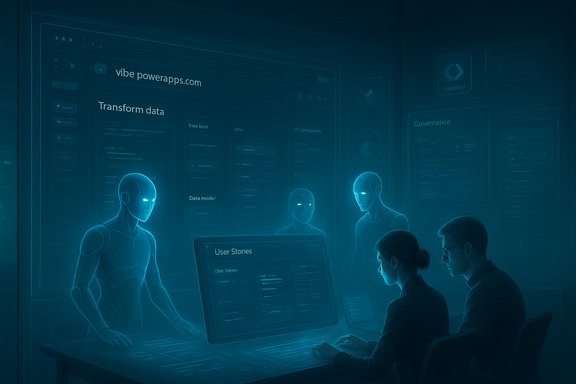
A reimagined Power Apps experience (vibe.powerapps.com)
- A new web surface described as combining “vibe coding” speed with the scale of Power Platform.
- An agent-first authoring experience: describe the app in natural language and allow a team of agents to draft user stories, propose data models, and generate full‑stack code that includes APIs, UIs, and forms — iteratively refined with the maker.
Microsoft 365 Copilot + App agents (App Builder & Workflows)
- Copilot’s App Builder and Workflows agents were already surfaced inside Microsoft 365 Copilot to create apps and automation from conversation; Microsoft’s Power Apps announcement extends and integrates these capabilities closely with Power Apps tooling and Dataverse grounding. That means users can generate an app or flow from Copilot and have it persist data into Microsoft Lists, SharePoint, or Dataverse where appropriate.
Dataverse Model Context Protocol (MCP) Server
- Dataverse can be configured as an MCP server so agent clients can call standardized “tools” (list_tables, read_query, create_record, describe_table, update_record, etc.. Admins must enable the Dataverse MCP server for managed environments and explicitly allow MCP clients via PPAC. The MCP surface is already documented and supported in Copilot Studio, Visual Studio/GitHub Copilot, and selective third‑party clients.
Agent feed and agentic collaboration
- A unified agent feed surfaces what agents are doing, supports handoffs to humans, prioritizes actions, and flags tasks needing human input — bringing human-agent work orchestration into the everyday productivity surface. Microsoft positions this as the connective tissue between Outlook, Teams, and apps so context and actions flow naturally.
Governance, telemetry, and admin UX improvements
- The Power Platform admin center adds an inventory view and usage insights so tenant admins can see apps, automations, and agents; identify top makers; detect non-approved regions; reassign orphaned resources; and run advisor-driven recommendations. Code apps can now be hosted on Power Platform while benefiting from Entra integration and 1,400+ connectors under governance controls.
How the pieces fit together: a technical map
Agents → MCP → Dataverse → Tenant data
Agents (Copilot Studio agents, App Builder, Workflows, or custom agents) interact with applications via the Dataverse MCP server. That server exposes a toolset (CRUD operations, schema description, search) so agents can read, update, and reason over business data in a tenant-aware fashion. The PPAC-managed configuration gates which MCP clients are allowed and which environments are exposed. This creates a standardized, auditable channel for agent-driven app actions.Copilot grounding and context flow
Microsoft 365 Copilot supplies agent-level models and first‑party agents (Researcher, Analyst) and can draw on Microsoft Graph and tenant content. The announced tighter integration means Copilot can ship context from documents, emails, and calendar events into app-level interactions — e.g., update a Power Apps record while reading an Outlook thread without leaving the email. Microsoft’s public notes refer to a staged preview for unified Copilot chat in model-driven apps beginning December 10, 2025.Developer workflows and hosted code apps
Developers can author code apps in their preferred environment and deploy to Power Platform to gain Entra authentication, connectors, DLP enforcement, inventory tracking, and health telemetry. Microsoft promotes a single managed platform for both low-code, AI-generated, and custom-coded apps — addressing lifecycle, governance, and scale in one control plane.Strengths: where Microsoft’s approach is convincing
- Deep enterprise grounding. Copilot + Dataverse + Graph creates stronger contextual relevance than most point solutions can deliver, because artifacts are tenant-scoped and can inherit permissions. This reduces data exfiltration risk compared with ad‑hoc external AI services.
- Governance-first architecture. The requirement to enable MCP clients in PPAC, Entra integration for hosted code apps, and inventory/usage telemetry shows Microsoft is building agentic features with admin controls rather than as unconstrained consumer tooling. That’s a critical differentiator for regulated industries.
- Speed and accessibility. App Builder and Workflows lower entry barriers for citizen developers: prototypes and team-level apps that previously lived in spreadsheets can be scaffolded conversationally and published quickly, speeding iteration and reducing developer backlog.
- Platform consolidation. Hosting low‑code, AI-generated, and code apps in one managed plane simplifies lifecycle and compliance: one audit trail, one set of connectors, one place to apply DLP. This helps organizations standardize practices rather than policing shadow IT across many tooling silos.
Risks, unknowns, and operational trade-offs
- Preview vs. production reality. Many demonstrations use sped-up, pre-release visuals; Microsoft emphasizes that the final product may differ and some elements are still in preview. The claim that agents will produce full‑stack, production‑grade apps “in minutes” is seductive but must be validated in real-world scenarios with complex data models, integrations, and non-trivial business rules. Treat early outcomes as prototypes, not production-ready replacements for engineering-led development.
- Governance complexity at scale. Although PPAC is adding inventory and usage insights, agent proliferation introduces novel governance vectors: identity-bound agents (Entra Agent IDs), unattended agent autonomy, and multi-tenant connectors. Admins will need new processes for agent lifecycle management, threat modeling for agent behaviors, and playbooks for quarantining or revoking misbehaving agents. Early reporting shows Microsoft plans Entra identities and quarantine APIs, but operationalizing those at enterprise scale will take time.
- Data exposure and billing nuances. MCP tool access and tenant grounding reduce some risk, but documentation flags billing and credits for Dataverse MCP tool usage in certain scenarios. Organizations should map potential cost exposure for agent-driven queries and instrument budgets accordingly. Full billing models for cross‑tenant agent calls and third‑party clients can be subtle.
- Developer model friction. The promise that developers can deploy any code app to Power Platform and have it inherit governance is attractive, but practical limits (runtime constraints, supported frameworks, performance SLAs, and custom runtime dependencies) will constrain which workloads are suitable to host on the managed platform without separate cloud infra. Early documentation and preview notes indicate support for hosted code apps, but specifics on limits and performance SLAs remain to be validated in production.
- Over-reliance on generated logic. Generative agents can scaffold UI, schema, and flows, but complex business logic, regulatory validations, and non-functional requirements (latency, resiliency, audit trails) still demand human engineering oversight. Relying solely on agent output without structured testing and validation creates operational risk. Independent analysis of App Builder/Workflows stresses that the initial design is optimized for rapid prototyping rather than mission-critical delivery.
Practical guidance for IT leaders and architects
- Start with a sandbox, not production. Enable Frontier or preview features in non‑production environments to understand agent outputs, data models, and MCP interactions before broader rollout.
- Map governance and agent ownership now. Define who can create, approve, and operate agents; establish naming conventions, lifecycle policies, and playbooks to quarantine agents. Use PPAC’s inventory view and usage insights as the single source of truth.
- Treat generated artifacts as first-class artifacts in ALM. Require CI/CD, automated tests, security scans, and approval gates for any app or agent that moves beyond team‑level prototypes. The platform supports deployment pipelines; adopt them.
- Monitor costs and billing. Audit MCP tool usage and Copilot credits for agent calls; simulate expected workloads to estimate chargebacks. Dataverse MCP documentation explicitly calls out billing nuances for tool usage.
- Validate data lineage and compliance. Ensure any generated app that persists data meets retention, classification, and DLP requirements; configure connector policies and environment-level controls in PPAC.
- Invest in maker enablement and guardrails. Teach teams how to craft precise prompts, review generated schemas, and embed testing in the iteration loop to improve output quality and safety. Practical success stories will come from structured, disciplined adoption rather than ad‑hoc experimentation.
Developer and partner opportunities
- Build reusable agent skills and store entries for the Agent Store to monetize or scale internal capabilities.
- Offer managed agent and app review services (testing, compliance signoffs, and hardened deployment pipelines).
- Create templates and starter agents for industry verticals where repetitive patterns can be formalized and governed.
- Integrate observability and security tooling into agent CI to provide continuous evaluation of agent behavior and regressions.
Verification notes and key references checked
- The Power Platform blog post “Inside the new Power Apps” (published November 18, 2025) contains the canonical announcement text including vibe.powerapps.com, MCP server, PPAC inventory, and the staged December 10, 2025 preview for unified Copilot chat in model-driven apps.
- Microsoft Learn documentation confirms the Dataverse MCP server concept, the tools it exposes to agents, and the administrative steps to enable MCP clients and configure MCP on managed environments. This documentation was updated in mid‑November 2025 and explicitly covers how MCP clients (Copilot Studio, VS GitHub Copilot, and others) connect.
- Independent reporting and industry coverage (conference and news outlets) align with Microsoft’s public message that Copilot is evolving into a platform for app and workflow generation, and that agentic features are being rolled out initially through preview programs. These analyses highlight both the promise and the practical constraints of prompt-first app creation.
What to watch next
- The December 10, 2025 preview window for unified Copilot chat in model-driven apps: validate features and user experience in early release tenants.
- MCP client expansion and third‑party support (Claude, GitHub Copilot, other LLM clients) and how billing and access controls evolve for non‑Microsoft clients.
- Entra Agent ID lifecycle and quarantine APIs in PPAC: how easily can security teams discover, audit, and isolate problematic agents at scale? Industry writeups indicate these controls are in evolution and will be critical for adoption in regulated sectors.
- Real‑world performance case studies showing where agentic app generation reduces time-to-value without introducing unacceptable operational burdens. Expect Microsoft and partners to publish validation stories in the months after preview.
Conclusion
Microsoft’s Ignite 2025 Power Apps push ties together generative AI, tenant grounding, and enterprise governance in a single narrative: accelerate idea-to-app velocity without surrendering control. The technical building blocks (Dataverse MCP server, PPAC inventory and policy surfaces, Copilot Studio agents, and Entra identity integration) are largely in place and documented; early previews already show the practical workflows for App Builder and Workflows inside Copilot. For IT leaders, the imperative is clear: pilot deliberately, codify governance and cost controls early, and treat agent outputs as engineering artifacts that require test, validation, and lifecycle management. For developers and partners, a new set of opportunities emerges around agent skills, hardened templates, and managed deployment services. The promise is powerful — faster, more contextual apps that live inside corporate controls — but the next 6–12 months will determine whether the vision converts from prototype magic into reliable, scalable production practices.Source: Microsoft Inside the new Power Apps: The future of app development - Microsoft Power Platform Blog
