

Microsoft’s latest guidance on agentic AI lands on a deceptively simple point: the organizations getting value from agents are not starting with agents at all. They are starting with business workflows, especially those already captured in Power Apps, CRM systems, service platforms, and other governed applications where roles, permissions, data boundaries, and accountability are already defined. That shift matters because it reframes the agent boom from a race to build clever demos into a disciplined transformation program aimed at measurable impact.
Microsoft has spent the past two years moving its AI story from assistants to copilots to agents, and now to what it calls the Frontier Firm. The term describes an organization that blends human judgment with AI-operated systems, using agents not as novelty chatbots but as participants in real work. In Microsoft’s framing, these companies are not simply buying AI licenses; they are redesigning how work flows through the enterprise.
The new Power Platform discussion, centered on a conversation with Futurum’s Mitch Ashley, reflects a maturing message from Microsoft. Early enterprise AI excitement often revolved around broad prompts, productivity gains, and experimentation. The current emphasis is more operational: pick the right workflows, embed agents inside existing applications, govern them with the same seriousness as employees and apps, and measure whether they actually improve outcomes.
That evolution follows a familiar technology adoption curve. Low-code platforms first promised to let business teams build apps without waiting for traditional development backlogs. Robotic process automation then promised to remove repetitive manual work. Generative AI added natural-language reasoning and content creation, but also introduced unpredictable behavior, cost questions, and security anxiety.
Agents sit at the intersection of all three waves. They can reason, trigger actions, call tools, interact with data, and coordinate tasks across systems. That makes them potentially powerful, but also risky if they are built outside established controls. Microsoft’s argument is that Power Platform, Power Apps, Copilot Studio, and related governance tools give customers a bridge between experimentation and production-grade AI.
The larger context is also competitive. Microsoft is positioning its business applications stack against rival agent frameworks from Salesforce, ServiceNow, Google, AWS, Oracle, OpenAI ecosystem partners, and specialized automation vendors. The company’s differentiator is not just model quality; it is the claim that enterprises can scale agents faster by building on the apps, identities, security policies, and process maps they already use.
A workflow-first approach forces a different discipline. It asks whether a process is high-value, measurable, repetitive enough to benefit from automation, and governed enough to tolerate agentic action. In practice, that makes existing business applications a natural starting point because they already represent how work is supposed to happen.
Power Apps is especially relevant here because many enterprises have spent years encoding departmental processes into low-code applications. Those apps contain forms, permissions, business logic, approvals, audit trails, and user roles. Agents layered into that environment inherit more context than a standalone bot bolted onto the side.
Microsoft’s workflow-first message is also a warning to customers chasing AI theater. A flashy proof of concept may impress a steering committee, but it rarely survives contact with compliance teams, finance owners, or frontline workers. A workflow that already matters to the business has a better chance of becoming a durable AI deployment.
This is why Microsoft keeps returning to the idea that apps encode the business. A claims app, recruiting app, field-service app, or expense app is not just a data-entry surface. It is a miniature operating model with rules, records, and assumptions that an agent can use if the platform exposes them safely.
The company’s recent Power Apps updates reinforce that direction. Copilot is being embedded directly into business apps, while app skills can be exposed outward so agents can use application capabilities as tools. The result is a two-way model: AI comes into the app to help the user, and the app’s logic flows outward into agents that operate across broader work surfaces.
The practical advantage is continuity. Companies do not have to rip out existing systems to experiment with agents. They can start with a workflow that already has users, data, ownership, and controls, then extend it with AI where the economics and risk profile make sense.
The companies breaking through are more deliberate. They identify which parts of a workflow should be handled by agents, which parts require human judgment, and how exceptions move between the two. That is the difference between automating an isolated task and improving an end-to-end business outcome.
A CRM process illustrates the point well. Agents may be useful for account research, lead triage, opportunity preparation, meeting summaries, or follow-up drafting. Humans still own the customer relationship, negotiation strategy, sensitive decisions, and accountability for outcomes.
A roadmap does not have to be bureaucratic. It does have to be explicit. Without criteria for success, ownership, security review, deployment, training, and measurement, even a promising agent can become another abandoned innovation project.
The organizations Microsoft highlights treat adoption as a shared muscle. Managers become power users, teams share prompts and examples, and learning spreads socially through events such as prompt-a-thons. This matters because agent adoption is not only about tool usage; it is about changing the rhythm of daily work.
There is also a cultural dimension. Employees may worry that agents are being introduced to replace them, monitor them, or devalue their expertise. Clear communication is essential because Microsoft’s own framing says agents should change where people spend time, not remove human leadership from the process.
The agent era raises the stakes because poor adoption can produce both underuse and misuse. A dormant agent wastes money, but a misunderstood agent can create bad records, send premature messages, or surface sensitive information in the wrong context. Training is therefore both a productivity investment and a risk control.
Agents require clear identity, permissioning, auditing, and lifecycle management. They may call connectors, read enterprise data, trigger workflows, or generate outputs that affect customers and employees. A single compromised identity or poorly configured connector can create a larger blast radius than a traditional app bug.
Power Platform’s existing governance model gives Microsoft an advantage here. Concepts such as environments, data loss prevention policies, role-based access, managed deployment, audit logs, and admin visibility already exist. The task now is to adapt those controls to agents that can initiate actions, not merely respond to clicks.
A mature center of excellence should not simply approve or reject agent projects. It should provide templates, patterns, evaluation methods, governance zones, and reusable components. Done well, it becomes an enablement function that helps business units move faster within safe boundaries.
The right metrics combine efficiency, employee experience, customer outcomes, and sustained usage. Microsoft cites its own customer service experience, saying AI-powered changes helped teams handle roughly twice the volume of customer cases with the same number of people while improving satisfaction. That is the kind of outcome leaders want because it links AI to capacity, quality, and employee focus.
Still, measurement must be handled carefully. Productivity metrics can create perverse incentives if they reward speed without quality. An agent that closes cases faster but increases reopens, escalations, or customer frustration is not a success.
This is where CFO scrutiny will intensify. As agent licensing, consumption, and infrastructure costs grow, finance teams will ask whether AI programs produce measurable returns. The organizations that define metrics early will have a major advantage over those that retrofit ROI arguments after the budget cycle begins.
Enterprise buyers also care about integration. Agents that live outside identity, compliance, records management, and admin tooling are hard to justify in regulated environments. Microsoft’s strongest enterprise argument is that agents can be built and governed through familiar Microsoft infrastructure.
This is especially relevant for companies already standardized on Microsoft 365, Entra, Purview, Defender, Dataverse, Dynamics 365, and Power Platform. The more of that estate a customer uses, the stronger Microsoft’s platform gravity becomes. Agents then become another reason to consolidate around Microsoft’s business cloud.
This is where Microsoft’s Frontier Firm concept becomes more than marketing. If agents become durable participants in work, companies will need new roles such as agent owners, AI trainers, AI security specialists, workflow designers, and ROI analysts. The software stack will matter, but the operating model will matter more.
For SMBs, agents could offer meaningful leverage if packaged well. A small service company may not need a custom AI architecture; it needs an agent that can summarize customer requests, update records, draft replies, and flag exceptions. The winning products will hide complexity without hiding controls.
Microsoft’s partner ecosystem will be important here. Many SMBs rely on managed service providers, consultants, and cloud partners to configure Microsoft 365, security, and business apps. If those partners can deliver repeatable agent templates with sensible defaults, agent adoption may spread beyond large enterprises.
That indirect consumer impact should not be underestimated. If enterprises deploy agents well, customers may experience faster service and fewer repetitive interactions. If they deploy them poorly, customers may encounter more opaque automation, robotic responses, and escalation frustration.
The strategic bet is clear. If the winning agent platform is the one that understands work context, identity, permissions, documents, meetings, business records, and operational workflows, Microsoft has a powerful installed-base advantage. It already sits inside the productivity layer for many organizations.
However, the market will not be decided by distribution alone. Customers will compare reliability, price, openness, model choice, integration depth, and governance maturity. Microsoft’s rivals will argue that their systems of record, industry clouds, or AI-native platforms provide better grounding for specific workflows.
The open question is how interoperable agent ecosystems become. If standards for tool use, context sharing, evaluation, and agent identity mature, customers may be able to mix platforms more easily. If not, the agent era could intensify enterprise software consolidation around a few dominant vendors.
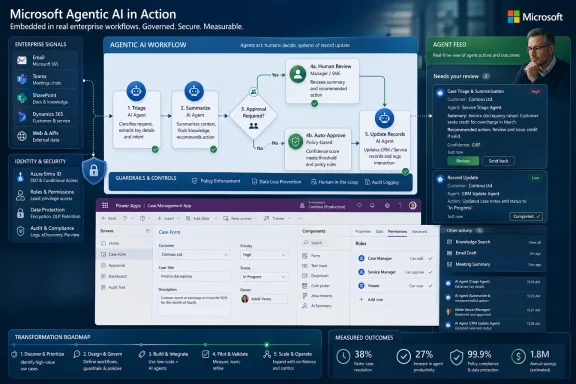
An agent feed inside Power Apps gives users a place to see, review, approve, and guide agent activity. That design acknowledges that human-in-the-loop systems are only effective when the loop is convenient. A manager or adjuster should not need to hunt through logs to understand what an agent is about to do.
The concept also supports graduated autonomy. Low-risk actions can happen quietly, while higher-impact steps require explicit approval. That is the right model for enterprise AI because not every task deserves the same level of friction.
The agent feed may become one of the more consequential design patterns in Microsoft’s stack. If it works well, it gives business users confidence without forcing them to become AI administrators. If it becomes noisy, confusing, or overloaded with approvals, it could slow adoption and create alert fatigue.
The next phase will likely be defined by proof at scale. Customers will want case studies that show not only impressive demos, but sustained improvements in service volume, cycle time, employee satisfaction, compliance posture, and total cost. They will also want clearer guidance on licensing, consumption, evaluation, and cross-platform governance.
Source: Microsoft How Frontier Firms scale agents with confidence - Microsoft Power Platform Blog
 Background
Microsoft has spent the past two years moving its AI story from assistants to copilots to agents, and now to what it calls the Frontier Firm. The term describes an organization that blends human judgment with AI-operated systems, using agents not as novelty chatbots but as participants in real work. In Microsoft’s framing, these companies are not simply buying AI licenses; they are redesigning how work flows through the enterprise.The new Power Platform discussion, centered on a conversation with Futurum’s Mitch Ashley, reflects a maturing message from Microsoft. Early enterprise AI excitement often revolved around broad prompts, productivity gains, and experimentation. The current emphasis is more operational: pick the right workflows, embed agents inside existing applications, govern them with the same seriousness as employees and apps, and measure whether they actually improve outcomes.
That evolution follows a familiar technology adoption curve. Low-code platforms first promised to let business teams build apps without waiting for traditional development backlogs. Robotic process automation then promised to remove repetitive manual work. Generative AI added natural-language reasoning and content creation, but also introduced unpredictable behavior, cost questions, and security anxiety.
Agents sit at the intersection of all three waves. They can reason, trigger actions, call tools, interact with data, and coordinate tasks across systems. That makes them potentially powerful, but also risky if they are built outside established controls. Microsoft’s argument is that Power Platform, Power Apps, Copilot Studio, and related governance tools give customers a bridge between experimentation and production-grade AI.
The larger context is also competitive. Microsoft is positioning its business applications stack against rival agent frameworks from Salesforce, ServiceNow, Google, AWS, Oracle, OpenAI ecosystem partners, and specialized automation vendors. The company’s differentiator is not just model quality; it is the claim that enterprises can scale agents faster by building on the apps, identities, security policies, and process maps they already use.
Why Microsoft Wants Customers to Start With Workflows
The app is the map
The most important line in Microsoft’s argument is that successful teams begin by asking which workflows matter most to the business. That sounds obvious, but it cuts against the way many organizations approach AI adoption. Too often, teams begin with a technology capability and then search for somewhere to use it.A workflow-first approach forces a different discipline. It asks whether a process is high-value, measurable, repetitive enough to benefit from automation, and governed enough to tolerate agentic action. In practice, that makes existing business applications a natural starting point because they already represent how work is supposed to happen.
Power Apps is especially relevant here because many enterprises have spent years encoding departmental processes into low-code applications. Those apps contain forms, permissions, business logic, approvals, audit trails, and user roles. Agents layered into that environment inherit more context than a standalone bot bolted onto the side.
- Existing applications already define who can do what
- Data access rules are easier to preserve inside governed workflows
- Business owners are clearer when an app already has accountable stakeholders
- Agent actions can be tied to familiar screens, records, and approval points
Why this matters
For WindowsForum readers, the key point is architectural. Agents are not just another UI layer; they are execution components. If they are allowed to act without grounding in real systems of record, they can create confusion faster than they create productivity.Microsoft’s workflow-first message is also a warning to customers chasing AI theater. A flashy proof of concept may impress a steering committee, but it rarely survives contact with compliance teams, finance owners, or frontline workers. A workflow that already matters to the business has a better chance of becoming a durable AI deployment.
Power Apps as the Agentic Foundation
Low-code becomes operational infrastructure
Microsoft’s Power Apps pitch has long been about empowering business users and professional developers to build applications quickly. In the agent era, that low-code estate becomes something more strategic: a foundation for agentic applications. The more processes a company has digitized in Power Apps, the more structured context it can expose to agents.This is why Microsoft keeps returning to the idea that apps encode the business. A claims app, recruiting app, field-service app, or expense app is not just a data-entry surface. It is a miniature operating model with rules, records, and assumptions that an agent can use if the platform exposes them safely.
The company’s recent Power Apps updates reinforce that direction. Copilot is being embedded directly into business apps, while app skills can be exposed outward so agents can use application capabilities as tools. The result is a two-way model: AI comes into the app to help the user, and the app’s logic flows outward into agents that operate across broader work surfaces.
- Model-driven apps can bring Copilot into structured business processes
- App skills can help agents perform data entry, summarization, exploration, and visualization
- MCP-style connections give agents a governed way to use app capabilities
- Agent feeds create a place for users to supervise activity inside the business app
The significance for enterprises
This is not merely a feature update. It is Microsoft’s attempt to turn Power Apps from a low-code app builder into a core part of the AI operations layer. If that works, Power Platform becomes less of a departmental productivity tool and more of an enterprise substrate for human-agent collaboration.The practical advantage is continuity. Companies do not have to rip out existing systems to experiment with agents. They can start with a workflow that already has users, data, ownership, and controls, then extend it with AI where the economics and risk profile make sense.
Vision Needs a Roadmap
The gap between ambition and execution
Microsoft’s post draws a sharp distinction between organizations with a strong agentic vision and those with a clear execution path. That distinction is important because enterprise AI programs can stall in two opposite ways. Some become governance-heavy and slow, while others produce exciting demos that cannot be scaled safely.The companies breaking through are more deliberate. They identify which parts of a workflow should be handled by agents, which parts require human judgment, and how exceptions move between the two. That is the difference between automating an isolated task and improving an end-to-end business outcome.
A CRM process illustrates the point well. Agents may be useful for account research, lead triage, opportunity preparation, meeting summaries, or follow-up drafting. Humans still own the customer relationship, negotiation strategy, sensitive decisions, and accountability for outcomes.
- Select a workflow tied to a measurable business goal
- Map the human decisions, system actions, and data dependencies
- Identify agent-suitable tasks such as research, triage, preparation, and summarization
- Define approval points, exception handling, and rollback procedures
- Measure sustained usage and outcome improvement before expanding
Avoiding pilot purgatory
The phrase pilot purgatory is especially apt in the agent market. Many organizations have enough internal enthusiasm to launch pilots, but not enough operating discipline to graduate them. The result is a portfolio of disconnected experiments that consume executive attention without changing the business.A roadmap does not have to be bureaucratic. It does have to be explicit. Without criteria for success, ownership, security review, deployment, training, and measurement, even a promising agent can become another abandoned innovation project.
Adoption Is a Capability, Not a Launch Event
People need to learn how to work with agents
Microsoft’s point about adoption may be the most underappreciated part of the discussion. Many leaders assume that natural-language interfaces make training unnecessary. In reality, using agents well is a new workplace skill, and employees need practice to understand what agents can do, when to trust them, and when to intervene.The organizations Microsoft highlights treat adoption as a shared muscle. Managers become power users, teams share prompts and examples, and learning spreads socially through events such as prompt-a-thons. This matters because agent adoption is not only about tool usage; it is about changing the rhythm of daily work.
There is also a cultural dimension. Employees may worry that agents are being introduced to replace them, monitor them, or devalue their expertise. Clear communication is essential because Microsoft’s own framing says agents should change where people spend time, not remove human leadership from the process.
- Managers need to model agent use in real workflows
- Teams need repeated practice, not one-time training
- Employees need examples tied to their actual roles
- Leaders need to explain how human judgment remains central
Training as change management
This is classic change management dressed in new technology. The lesson from past Windows, Office, SharePoint, Teams, and Power Platform deployments is that features do not automatically produce transformation. People adopt new work patterns when they see peers succeed and when management rewards the behavior.The agent era raises the stakes because poor adoption can produce both underuse and misuse. A dormant agent wastes money, but a misunderstood agent can create bad records, send premature messages, or surface sensitive information in the wrong context. Training is therefore both a productivity investment and a risk control.
Governance as an Accelerator
Guardrails make speed possible
Microsoft argues that governance should not be viewed as a brake. That is a smart reframing because enterprise IT teams are often accused of slowing innovation. In agentic systems, however, the absence of governance is what slows scale, because no responsible business owner wants autonomous tools spreading across departments without visibility.Agents require clear identity, permissioning, auditing, and lifecycle management. They may call connectors, read enterprise data, trigger workflows, or generate outputs that affect customers and employees. A single compromised identity or poorly configured connector can create a larger blast radius than a traditional app bug.
Power Platform’s existing governance model gives Microsoft an advantage here. Concepts such as environments, data loss prevention policies, role-based access, managed deployment, audit logs, and admin visibility already exist. The task now is to adapt those controls to agents that can initiate actions, not merely respond to clicks.
- Every production agent should have an owner
- Every agent should operate under defined permissions
- Sensitive actions should require human approval
- Telemetry should show usage, cost, errors, and business impact
- Security teams should review connectors, identities, and data movement
Centers of excellence evolve
Microsoft also points to agentic centers of excellence as a pattern among successful customers. That is a logical extension of the Power Platform Center of Excellence model many organizations already use. The difference is that agentic AI brings new questions about autonomy, intent, model behavior, and oversight.A mature center of excellence should not simply approve or reject agent projects. It should provide templates, patterns, evaluation methods, governance zones, and reusable components. Done well, it becomes an enablement function that helps business units move faster within safe boundaries.
Measuring What Actually Matters
Counting agents is not enough
One of the strongest parts of Microsoft’s message is its insistence that counting agents is a poor proxy for success. Enterprises learned a similar lesson with apps, automations, dashboards, and Teams channels. Volume can indicate activity, but it does not prove value.The right metrics combine efficiency, employee experience, customer outcomes, and sustained usage. Microsoft cites its own customer service experience, saying AI-powered changes helped teams handle roughly twice the volume of customer cases with the same number of people while improving satisfaction. That is the kind of outcome leaders want because it links AI to capacity, quality, and employee focus.
Still, measurement must be handled carefully. Productivity metrics can create perverse incentives if they reward speed without quality. An agent that closes cases faster but increases reopens, escalations, or customer frustration is not a success.
- Sustained active usage by role and workflow
- Cycle-time reduction without quality degradation
- Employee satisfaction and reduced repetitive work
- Customer satisfaction, resolution quality, and escalation rates
- Cost per completed workflow, not just cost per model call
From usage analytics to business evidence
Copilot Studio and Power Platform analytics can help teams see which agents are used and how they perform. But the deeper question is whether the workflow itself improves. That requires business metrics from CRM, service, finance, operations, or HR systems.This is where CFO scrutiny will intensify. As agent licensing, consumption, and infrastructure costs grow, finance teams will ask whether AI programs produce measurable returns. The organizations that define metrics early will have a major advantage over those that retrofit ROI arguments after the budget cycle begins.
Enterprise Impact: Productivity, Control, and New Operating Models
The enterprise case is about scale
For large organizations, Microsoft’s agent strategy is fundamentally about scaling work without scaling headcount at the same rate. That does not mean every deployment is a staff-reduction project. It means companies want to absorb more customer demand, regulatory complexity, operational workload, and internal support volume without overwhelming teams.Enterprise buyers also care about integration. Agents that live outside identity, compliance, records management, and admin tooling are hard to justify in regulated environments. Microsoft’s strongest enterprise argument is that agents can be built and governed through familiar Microsoft infrastructure.
This is especially relevant for companies already standardized on Microsoft 365, Entra, Purview, Defender, Dataverse, Dynamics 365, and Power Platform. The more of that estate a customer uses, the stronger Microsoft’s platform gravity becomes. Agents then become another reason to consolidate around Microsoft’s business cloud.
- IT can reuse familiar governance patterns
- Business teams can extend existing processes rather than rebuild them
- Security teams can apply identity and compliance controls
- Executives can tie agents to measurable workflow outcomes
A new layer of digital labor
The phrase digital labor can sound abstract, but it captures a real management shift. If agents perform recurring work, organizations need to assign ownership, monitor performance, evaluate risk, and retire agents that no longer serve a purpose. That begins to look less like software deployment and more like workforce operations.This is where Microsoft’s Frontier Firm concept becomes more than marketing. If agents become durable participants in work, companies will need new roles such as agent owners, AI trainers, AI security specialists, workflow designers, and ROI analysts. The software stack will matter, but the operating model will matter more.
Consumer and SMB Impact
Smaller organizations face a different calculation
Although Microsoft’s language often targets the enterprise, the workflow-first lesson applies to small and midsize businesses as well. SMBs also have repetitive, measurable workflows: appointment scheduling, customer follow-up, invoice processing, onboarding, support triage, and inventory updates. The difference is that smaller organizations may lack formal governance teams.For SMBs, agents could offer meaningful leverage if packaged well. A small service company may not need a custom AI architecture; it needs an agent that can summarize customer requests, update records, draft replies, and flag exceptions. The winning products will hide complexity without hiding controls.
Microsoft’s partner ecosystem will be important here. Many SMBs rely on managed service providers, consultants, and cloud partners to configure Microsoft 365, security, and business apps. If those partners can deliver repeatable agent templates with sensible defaults, agent adoption may spread beyond large enterprises.
- SMBs need packaged workflows, not blank-canvas platforms
- Managed service providers can become agent operations partners
- Simple governance defaults will matter more than elaborate frameworks
- Cost predictability will be critical for small-business confidence
The consumer angle is indirect
For everyday Windows users, this announcement does not immediately change the desktop experience. Its impact is more likely to appear through workplace apps, customer service interactions, and business processes that become partially agent-driven. A support ticket may be triaged by an agent before a person responds; a sales rep may arrive better prepared because an agent assembled the briefing.That indirect consumer impact should not be underestimated. If enterprises deploy agents well, customers may experience faster service and fewer repetitive interactions. If they deploy them poorly, customers may encounter more opaque automation, robotic responses, and escalation frustration.
Competitive Implications for the Agent Market
Microsoft is selling the control plane
The agent market is becoming crowded, and every major enterprise software vendor wants to own the orchestration layer. Salesforce has Agentforce, ServiceNow is embedding AI agents into workflow automation, Google is pushing Gemini across Workspace and Cloud, and AWS is building around Bedrock and enterprise AI services. Microsoft’s answer is to make agents inseparable from Microsoft 365, Power Platform, Dynamics, and its security stack.The strategic bet is clear. If the winning agent platform is the one that understands work context, identity, permissions, documents, meetings, business records, and operational workflows, Microsoft has a powerful installed-base advantage. It already sits inside the productivity layer for many organizations.
However, the market will not be decided by distribution alone. Customers will compare reliability, price, openness, model choice, integration depth, and governance maturity. Microsoft’s rivals will argue that their systems of record, industry clouds, or AI-native platforms provide better grounding for specific workflows.
- Salesforce will compete hard in CRM and customer engagement
- ServiceNow will emphasize enterprise workflow and IT operations
- Google will lean on Workspace, search, and Gemini integration
- AWS will court builders who want cloud-native model flexibility
- Specialized startups will target narrow workflows with faster iteration
The platform lock-in question
Microsoft’s workflow-first strategy also raises the familiar issue of lock-in. The more agents depend on Power Apps, Dataverse, Microsoft 365 signals, Entra identities, and proprietary admin tooling, the harder it may be to move them elsewhere. For some customers, that integration is a benefit; for others, it is a strategic risk.The open question is how interoperable agent ecosystems become. If standards for tool use, context sharing, evaluation, and agent identity mature, customers may be able to mix platforms more easily. If not, the agent era could intensify enterprise software consolidation around a few dominant vendors.
Human Oversight and the Agent Feed
Supervising work where work happens
Microsoft’s discussion of the agent feed is important because it addresses a practical problem: where does a human actually supervise an agent? If oversight lives in a separate admin console, frontline workers may ignore it. If approvals appear inside the business app, they become part of the workflow.An agent feed inside Power Apps gives users a place to see, review, approve, and guide agent activity. That design acknowledges that human-in-the-loop systems are only effective when the loop is convenient. A manager or adjuster should not need to hunt through logs to understand what an agent is about to do.
The concept also supports graduated autonomy. Low-risk actions can happen quietly, while higher-impact steps require explicit approval. That is the right model for enterprise AI because not every task deserves the same level of friction.
- Low-risk tasks can run in the background
- Medium-risk tasks can be summarized for review
- High-risk actions should require explicit approval
- Critical exceptions should route to accountable humans immediately
Trust through visibility
Visibility is central to trust. Users are more likely to accept agents when they can see what the agent did, why it made a recommendation, and how to correct it. Invisible automation may be efficient, but it can also feel arbitrary and unsafe.The agent feed may become one of the more consequential design patterns in Microsoft’s stack. If it works well, it gives business users confidence without forcing them to become AI administrators. If it becomes noisy, confusing, or overloaded with approvals, it could slow adoption and create alert fatigue.
Strengths and Opportunities
Microsoft’s latest guidance is strongest when it treats agents as part of an operating model rather than a standalone product category. The company is effectively telling customers that the path to value runs through governed workflows, measurable outcomes, and human adoption, not isolated demos. That message is pragmatic and likely to resonate with CIOs who have watched earlier automation programs stall.- Workflow-first deployment gives organizations a clearer path from idea to business value.
- Power Apps integration lets customers build on existing permissions, records, and process logic.
- Governance reuse reduces the need to invent an entirely new control model for agents.
- Human oversight patterns such as agent feeds can make autonomy safer and more acceptable.
- Business-value measurement helps separate durable transformation from short-lived experimentation.
- Partner-led implementation could make agent adoption more repeatable for SMBs and industry-specific scenarios.
- Frontier Firm positioning gives Microsoft a strategic narrative that links Copilot, Power Platform, Agent 365, and security into one enterprise story.
Risks and Concerns
The risks are equally real, and they deserve more than a passing mention. Agentic AI increases the number of systems that can take action, the speed at which mistakes can propagate, and the difficulty of tracing intent across workflows. Microsoft’s approach mitigates some of that risk, but it does not eliminate it.- Over-automation could push agents into workflows where human judgment should remain primary.
- Permission sprawl may occur if agent identities, connectors, and access rights are not tightly managed.
- Cost unpredictability could grow as agents call tools, models, workflows, and external services.
- Employee mistrust may undermine adoption if leaders frame agents mainly as labor replacement.
- Vendor lock-in could deepen if critical workflows become tightly coupled to one platform stack.
- Measurement distortion may reward speed while masking quality problems, escalations, or customer frustration.
- Security failures could have amplified consequences because agents can operate across multiple systems and data sources.
Looking Ahead
Microsoft’s agent strategy is moving quickly from concept to operational packaging. With Copilot increasingly embedded in Microsoft 365 and business applications, Power Apps gaining agent-facing capabilities, and Agent 365 positioned as a control plane, the company is trying to make agent deployment feel like an extension of existing enterprise IT rather than a separate AI science project. That is a sensible direction, but execution will determine whether customers see durable gains or simply a new layer of complexity.The next phase will likely be defined by proof at scale. Customers will want case studies that show not only impressive demos, but sustained improvements in service volume, cycle time, employee satisfaction, compliance posture, and total cost. They will also want clearer guidance on licensing, consumption, evaluation, and cross-platform governance.
- Watch how quickly Power Apps customers adopt agent feeds and app skills in production
- Watch whether Agent 365 becomes a true multi-platform governance layer or mainly a Microsoft-stack tool
- Watch how Microsoft partners package repeatable agent workflows for SMBs and vertical industries
- Watch whether customers measure outcomes rigorously enough to avoid another wave of pilot purgatory
- Watch employee sentiment as agents move from optional assistants to embedded participants in daily work
Source: Microsoft How Frontier Firms scale agents with confidence - Microsoft Power Platform Blog
