

This year’s Microsoft Ignite arrives not as a parade of product teasers but as a strategic ground game: an explicit invitation for startups and enterprises to assemble AI solutions that are secure, scalable, and commercially viable.
Background / Overview
Microsoft Ignite 2025 is scheduled for November 18–21 at the Moscone Center in San Francisco, with optional pre-conference activities and a robust digital track for remote attendees. The event’s public messaging, session catalog, and partner briefings make one theme unmistakable: AI is the operating model for enterprise transformation, and Ignite is Microsoft’s forum for turning that vision into operational reality.This pivot matters because enterprises are no longer asking whether to adopt generative AI; they are asking how to adopt it safely and at scale. Ignite is being framed as the place to learn the new playbook — not simply to “build or buy,” but to assemble trusted platform services, validated startup capabilities, and governed agentic AI into production systems that deliver measurable business outcomes.
What Microsoft is signaling at Ignite 2025
From narrative to mechanics: enterprise AI as assembly work
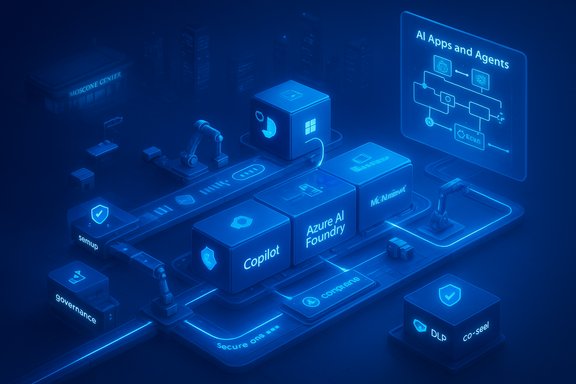
Microsoft’s public positioning for Ignite stretches beyond feature announcements. The company is emphasizing three commercial levers that matter to enterprise buyers and startup founders alike: the unified Microsoft Marketplace with an explicit AI Apps and Agents category, the partner/co-sell ecosystem, and curated startup programs like Microsoft for Startups’ Pegasus cohort designed to accelerate enterprise readiness.- The Microsoft Marketplace is now a single destination combining the previous Azure Marketplace and AppSource, with a focused AI Apps and Agents category intended to surface solutions that integrate with Copilot, Azure AI Foundry, and Microsoft 365. This is presented not only as a discovery channel but as a procurement mechanism that preserves enterprise controls and billing cohesion.
- Co-sell mechanics remain central: Microsoft’s seller network and co-sell-ready designations are the practical route to enterprise pipeline acceleration — but they require non-trivial technical validation and documentation. Multiple community guides and partner documentation underscore that co-sell readiness is prescriptive, not automatic.
- Pegasus and other curated startup tracks intend to bundle go-to-market resources, technical enablement, and enterprise introductions into a single engagement for startups that have achieved certain levels of maturity and security posture. The Pegasus Program is invite-only and emphasizes go-to-market acceleration and technical support to scale with Azure.
Why the marketplace shift matters
Microsoft’s unification of marketplaces is consequential: it reduces friction for procurement, standardizes security review gates, and creates a single catalog where AI agents and apps can be purchased and deployed in context with a customer’s existing Microsoft stack. That makes integration decisions — e.g., embedding an agent into Copilot workflows or deploying an Azure AI Foundry service — less hypothetical and more operationally decidable. Microsoft’s product pages and partner guidance now explicitly show how marketplace offers map into Copilot and Azure Foundry workflows. This structural change also reframes the economics: Microsoft is signaling a marketplace model that focuses on publishing fees and cloud consumption, rather than consumer-style commission economics, while requiring security and compliance reviews to maintain enterprise trust. Startups should view the marketplace as a channel that reduces procurement friction but increases gating: you must be enterprise-ready to play here.Microsoft for Startups and the Pegasus Program: what it offers — and what it means
What Pegasus actually does for startups
The Pegasus Program is positioned as the next-stage engagement inside Microsoft for Startups: invite-only, focused on startups that are moving toward scale and revenue. Program benefits publicized by Microsoft include go-to-market support, introductions into Microsoft’s sales channel, and technical enablement through dedicated Cloud Solutions Architect resources. Microsoft’s marketing materials highlight case studies where Pegasus alumni converted introductions into Marketplace listings and co-sell engagements. Concretely, startups in Pegasus can expect help in three areas:- Technical readiness (security, scalability, Azure optimization)
- Commercial motion (account targeting, co-marketing, seller introductions)
- Operational support (engineering review, prioritized access to Azure AI offerings)
How Pegasus fits into the enterprise assembly model
Pegasus is effectively Microsoft’s attempt to reduce buyer risk and accelerate time-to-value by certifying a subset of startups as “enterprise-ready” partners. For enterprises, this means a smaller set of vetted vendors to consider when composing an AI stack. For startups, it means that meeting Microsoft’s technical and security thresholds unlocks distribution and seller advocacy — a multiplier that can convert pilot momentum into multi-account pipeline quickly. The caveat is clear: the program is selective and operational work is required to maintain eligibility.Enterprise readiness: the checklist startups must meet
What “enterprise-ready” actually requires today
Being enterprise-ready in 2025 is a multi-dimensional bar. Based on Microsoft guidance, partner documentation, and marketplace requirements, the working checklist looks like this:- Secure architecture and compliance artifacts (DLP integration, data residency, SOC / ISO posture where relevant).
- Integration with Microsoft identity (Azure AD), observability for enterprise operations, and tested Azure hosting patterns.
- Responsible AI practices baked into the product — from model provenance to red-team testing and RAG/knowledge-base hygiene.
- Documentation and GTM collateral required for co-sell readiness (one-pager, deployment guides, customer references).
- Marketplace publishing readiness, including security/compliance review artifacts and listing metadata for the AI Apps and Agents category.
Short-term steps for founders attending Ignite
- Prioritize sessions on Azure AI Foundry, Copilot Studio, and Marketplace publishing guidance. Treat keynote sessions as strategy reconnaissance and deep dives as operational training.
- Bring two artifacts: (A) a technical integration map showing identity, data flow, and hosting; (B) a business one-pager containing the problem statement, measurable outcomes, and an initial pricing model. Use these as the basis for roundtables, Ask-the-Expert sessions, and seller introductions.
- Verify marketplace and co-sell mechanics with Microsoft staff onsite — program details change and confirmations in writing (or portal screenshots) reduce post-event friction.
The benefits: why enterprises and startups should care
For enterprises: faster time-to-value with guardrails
Enterprises gain three pragmatic benefits from this assemble-era approach:- Faster procurement and integration via a unified Microsoft Marketplace and dedicated AI categories, enabling quicker pilots to production.
- A curated partner set (Pegasus and co-sell-ready vendors) reduces vendor risk because Microsoft’s technical vetting becomes an additional signal for security and scale posture.
- Better governance surface: marketplaces and platform integration encourage observability, identity consistency (Azure AD), and commercial clarity around billing and SLAs.
For startups: distribution and validation
Startups that invest in enterprise-readiness can unlock disproportionate benefits:- The Microsoft seller network and co-sell channels can amplify outreach to enterprise accounts that would otherwise be unreachable by a small GTM team.
- Marketplace listings provide discoverability inside the customer’s procurement footprint and can reduce friction for pilot procurement and billing consolidation.
- Programs like Pegasus can accelerate product hardening (CSA support, prioritized technical resources) and provide case-study opportunities that dramatically shorten sales cycles.
Risks and trade-offs: what leaders must watch
Vendor lock and hyperscaler dependency
A strong assembly play with Microsoft-native components carries an implicit trade-off: operational and commercial dependency on a single hyperscaler. Deep integration with Azure AI Foundry, Copilot, and Marketplace will create efficiencies but also increase switching costs and exposure to future policy or pricing changes. Teams must model these dependencies explicitly and negotiate contract protections where possible.The gating paradox: marketplace trust vs. discoverability friction
Requiring security and compliance reviews is sensible for enterprise buyers — but it raises a gating paradox for early-stage innovators. Strict gates protect customers but can delay or block innovative entrants that lack enterprise certifications. Startups should treat Marketplace compliance steps as a prioritized engineering investment rather than an afterthought.Hype risk vs. product-market fit
Ignite’s focus on agentic AI and Copilot integrations creates pressure to attach “agent” or “Copilot-ready” labels to products. Enterprises will not buy labels; they will buy solutions that fix concrete problems under governance constraints and measurable ROI. Startups should prioritize solving specific compliance- or workflow-driven problems over chasing every new API or SDK.Program terms volatility
Credits, incentives, co-sell rules, and marketplace policies evolve quickly. Founders and procurement teams must treat program claims (e.g., credit amounts or co-sell benefits) as negotiable or time-boxed until verified in writing. Microsoft’s Founders Hub details show generous credit ceilings for eligible startups — up to $150,000 over time — but eligibility and exact credit allocation depend on program tiers and investor network relationships. Confirm terms directly before relying on them in a runway model.Practical playbook: turning Ignite momentum into enterprise deals
Before the event
- Export the session catalog and select sessions that map directly to your integration plan (Azure AI Foundry, Copilot Studio, Marketplace publishing).
- Prepare two artifacts: the one-page business case and the technical integration map. Have these available in PDF and digital whiteboard form for quick sharing.
- Book roundtables and Ask-the-Expert sessions where possible and identify 8–12 target accounts or solution partners to meet onsite.
During the event
- Treat keynotes as strategic reconnaissance and deep sessions as operational briefings. Capture specific product timelines and API constraints you’ll need to build against.
- Run short discovery interviews with enterprise attendees; capture pain statements verbatim and ask for next-step commitments (pilot, proof of value, procurement owner).
- Use partner booths and Marketplace staff to validate publishing steps, scoping documents, and co-sell thresholds. Get portal screens or emails confirming any essential details.
After the event
- Follow up within 72 hours referencing the conversation and the artifact you shared. Convert conversations into concrete pipeline items and prioritized product backlog changes.
- If Marketplace listing is validated, begin the publishing checklist immediately and prepare the co-sell collateral required for in-market and Azure IP co-sell eligibility.
- Use any Pegasus or Founders Hub introductions to validate deployment patterns in a pilot environment and to secure a co-sell or referral path.
A critical read: what Microsoft does well — and where it still needs to prove results
Strengths
- Integrated commerce and procurement: The unified Microsoft Marketplace simplifies discovery and procurement for enterprise buyers and aligns billing and consumption models in a way that enterprises prefer. The new AI Apps and Agents category provides an explicit runway for agentic solutions to be discoverable and integrable.
- Program-led acceleration for startups: Pegasus and Microsoft for Startups provide a clear, resource-backed path for startups to reach enterprise readiness faster — combining technical, commercial, and sales enablement in a lifecycle approach.
- Platform-first enterprise governance: Integration guidance around Azure AD, Copilot Studio, and Azure AI Foundry aligns product design with enterprise governance needs, lowering the friction for pilots to become production deployments.
Weaknesses and open questions
- Dependency risk and vendor economics: Deeply assembling around Microsoft’s stack increases switching cost and could expose buyers and partners to future policy or pricing changes that are hard to mitigate. Program terms and incentives change, and historical precedent suggests these can shift between fiscal years.
- Operational gating for innovation: The security and compliance gates that make Marketplace enterprise-friendly also raise the bar for small or early-stage innovators. Startups must balance speed of iteration with the investment required to meet enterprise controls.
- Proof at scale: Microsoft’s marketplace and partner programs offer distribution levers, but conversion to repeatable revenue at scale remains an execution challenge. Attendees should look for concrete post-event case studies demonstrating co-sell conversions and measurable ROI, not just pilot anecdotes.
Conclusion — What to expect and how to act
Microsoft Ignite 2025 is being positioned as a decisive moment in Microsoft’s enterprise AI strategy — a pivot from conceptual AI rhetoric to pragmatic adoption mechanics. The consolidated Marketplace, the explicit AI Apps and Agents category, and programs like Pegasus are all designed to shrink the distance between innovation and enterprise procurement. For startups, the path to impact is clear but not easy: focus relentlessly on enterprise-readiness, secure the technical and documentation artifacts required for co-sell and Marketplace publishing, and convert every conversation into a documented follow-up with an accountable next step. For enterprise leaders, Ignite is a chance to vet the assembly patterns you will rely on in the next 18–24 months — test integrations with Copilot and Azure AI Foundry, validate governance playbooks, and use Marketplace vetting as an additional signal when evaluating vendors.Ignite will show how the ecosystem can work when platform capability, curated partners, and enterprise discipline align. The real test after the keynotes is simple: how many pilots convert to predictable, governed production flows and measurable business outcomes. Those who prepare to assemble — not merely build or buy — will be best positioned to win in the AI era.
Source: Microsoft Microsoft Ignite 2025: Turning vision into enterprise impact - Microsoft for Startups Blog
